

Bloomberg

Wall Street Unites on 7-Bank Platform to Ease CLO, Loan Auction

(Bloomberg) — Citigroup Inc. and Bank of America Corp. have teamed up with five other banks to form Octaura Holdings, an electronic trading platform for syndicated loans and collateralized loan obligations.

Brian Bejile, a longtime trading executive with Citigroup, was tapped as chief executive officer of the independent company, according to a statement. Credit Suisse Group AG, Goldman Sachs Group Inc., JPMorgan Chase & Co., Morgan Stanley and Wells Fargo & Co. — along with Moody’s Analytics — are also founding institutions of the firm. 

“It’s one thing to have liquidity from one or two banks, it’s another thing to have liquidity from seven major institutions,” Bejile said. “We went to investors and asked them ‘What do you think about the platform we have put together?’ The response was very emphatically ‘We’re excited.’”

Octaura got its start as a joint initiative between Citigroup and Bank of America. The push — which originally had the internal code name of Project Octopus — was inspired by technology the two firms developed separately before they started working together on the initiative last year. 

The new platform will be a central place for trading desks to see data and perform analytics on assets within the structured credit and leveraged finance markets. Octaura plans to debut the venue for loans first with the one for CLOs to follow. The company ultimately hopes to expand to other credit market products.

Game of Telephone

Even though the markets for CLOs and syndicated loans have more than doubled to more than $1 trillion each in the last decade, it’s still a largely manual process to trade the products. Prices can be hard to come by and regulators have warned that investors may not fully understand the risks of investing in funds that hold such hard-to-sell assets.

Take, for instance, a CLO auction: An investor submits a bid to a salesperson at their preferred dealer by placing a phone call or starting an instant-messaging chat. That salesperson, in turn, often phones the trader who is collecting similar bids from salespeople across their firm. 

That trader ultimately submits the best bid to the salesperson representing the seller. The process can stretch on for hours, and traders and salespeople usually aren’t able to offer investors feedback on their bids midway through, Bejile said. 

“It’s like a giant game of telephone,” Bejile said. “The two or three hour auctions are now, in our product, as short as ten to fifteen minutes.”

Three years ago, Citigroup debuted an electronic bidding capability for CLOs on its Citi Velocity platform to try to solve this problem for its own clients. Almost instantly, the bank saw a 50% jump in the volume of bids it was seeing in auctions. That technology is part of what formed the basis for Octaura. 

Loan Markets

The market for loans is also largely manual, said David Trepanier, head of structured products, global credit and special situations at Bank of America. That’s why the firm created its electronic platform Instinct Loan Match in 2016, which also helped form the basis for Octaura.

“We were trying to build what each other had built: I was going to try to build out CLO electronification at Bank of America and Brian wanted to move into loan trading,” Trepanier said. “We got together and said ‘Why are we trying to replicate each other’s great work? Why wouldn’t we just combine it and allow the user to have one portal and one experience to trade loans and CLOs?’ ”

Citigroup and Bank of America ultimately tapped Genesis Global Fintech Inc. to help it develop the technology underlying Octaura’s venues. From there, the two began pitching other dealers on joining them in the initiative. 

“We came to the other dealers with an actual business plan and we had the experience of dealing with other trading venues and trading platforms and we had actual technology,” said Katya Chupryna, head of Citigroup’s spread products investment technologies group, which helped lead the work inside the bank. “That ultimately led to a very quick acceleration.”

Now, Bejile said he’s already fielding interest from other dealers looking to join Octaura’s venues.

“We hope this platform can save clients time by 60% to 70%,” said Vitaliy Kozak, Citigroup’s global co-head of secondary CLO, asset-backed securitization and collateralized debt obligation trading. “There’s a lot of excitement, both in the dealer and client communities to make this space more efficient and bring it into the 21st Century.”

More stories like this are available on bloomberg.com

©2022 Bloomberg L.P.
Global Stock Rout Prompts Call for Back-to-Basics Investing

(Bloomberg) — Traders unnerved by a selloff that hit stocks and bonds alike are looking for refuge, increasing the appeal of investments offering reliable returns such as shares that pay steady dividends.

A rout that’s seen global stocks enter a bear market and so-called risk-free Treasuries slump is forcing investors to get creative. They are looking at assets like high-dividend shares, investment-grade bonds and Chinese stocks.

Investors are hoping the assets they buy will withstand any fallout from an expected accelerated pace of interest-rate hikes by the Federal Reserve to tame inflation that’s climbing at the fastest pace in four decades. 

“We are arguing for adjusting the portfolio to get those exposures that make sense in the current environment,” said Peter Garnry, head of equity strategy at Saxo Bank A/S. “These themes are commodities, defense, logistics, cyber security and mega caps.” 


Meanwhile, BlackRock Inc.’s Karim Chedid, head of the investment strategy team and senior strategist for iShares EMEA, said they prefer stocks that can navigate persistent inflation and more difficult margins, like healthcare and tech and generally defensive sectors with consumer price inelasticity.

Here’s a list of other assets that are attracting investors’ attention:

Free-Cash Flow Stocks

The era of easy money with very low or negative real rates is clearly over, according to Ellen Hazen, chief market strategist and portfolio manager at F.L.Putnam Investment Management. “It’s clear all that stuff we learn during our CFA exams and in business schools about how you value companies and this kind of cash flow, that matters again. And what that means is you want to own companies that are generating free cash flow,” she said on Bloomberg Television on Tuesday.

Health-care, insurance, and a few technology and software stocks in the S&P index generate a lot of free cash flow, which make them look appealing for F.L.Putnam.

Dividend-Yield

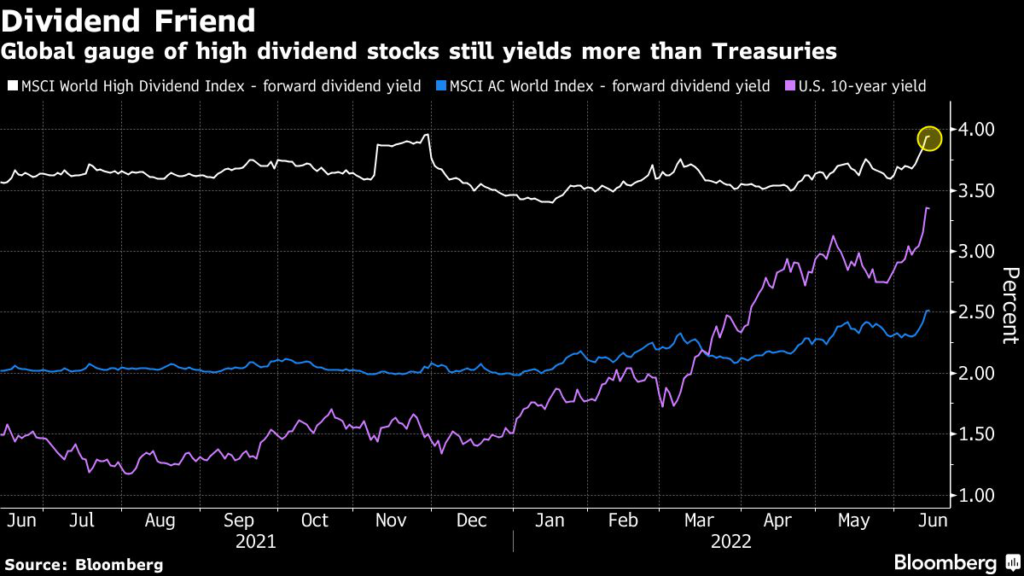
Some investors are tweaking their dividend strategies. Marija Veitmane, senior strategist at State Street Global Markets, said high-dividend yielding stocks are the best place to hide, along with commodities and large caps. 

Central banks will keep raising rates as consumers and corporates continue to have a lot of cash and access to still-cheap borrowing, she said. “This is a very negative outlook for stocks, so we would be sellers of any rally.”

Sat Duhra of Janus Henderson Investors has been adding to positions in mainland Chinese shares, including in the renewable-energy infrastructure and water sectors, on attractive valuations and as they will be paying out dividends in June and July.

The Singapore-based portfolio manager is investing in Asian companies with dividend yields of around 6-8%. It “is a decent spread over bond yields and provides some protection in a period of heightened volatility,” he said.

Pricing Power

HSBC Holdings Plc has a list of stocks that tend to do well even in a weak macroeconomic environment, said Herald van der Linde, head of APAC equity strategy. “These stocks can do that because their businesses have pricing power, or they operate in a special niche or are key players in highly concentrated markets.”

Meanwhile, now that Asian economies are reopening, JPMorgan Asset Management sees the outlook for domestic demand improving in the region. Current earnings forecasts for Asian equities seem “too conservative for 2022 and valuation is also attractive once market sentiment improves,” wrote Tai Hui, Asia chief market strategist, in a note.

Mirabaud & Cie SA is also finding opportunities in stocks with pricing power, such as Sika AG, Geberit AG and Givaudan SA, said John Plassard, a director at the firm. 

“With equity returns essentially bimodal and largely recession dependent, we focus on relative value opportunities and reassess our preferred themes and related screens,” UBS Group AG strategists including Keith Parker wrote in a note.

They are focusing on pricing power, stocks with higher and improving quality as well as shares exposed to high-income consumers.

“Some of the consumer staples companies are holding up given price elasticity for the strong brands,” said Louise Dudley, portfolio manager at Federated Hermes. Stocks with stable dividend policies are havens and there’s value in health care and energy, she said.

Fabio Caldato, a partner at Olympia Wealth Management, also “built a decent bulk of healthcare companies and we are still buyers of the sector, with a strong focus on big European pharma” like GSK Plc and Sanofi.

Wells Fargo strategists including Christopher P. Harvey said in a note they screened for long ideas, using history as a guide for a recession portfolio that includes names like Comcast Corp., Coca-Cola Co. and International Business Machines Corp.

China’s Stocks

For CEB International Investment Corp., now’s a good time to buy so-called new economy stocks in China including tech despite the regulatory risk there. “Lots of people one year ago thought this thing would be pushed like a more backward cycle for all the tech stocks,” said Banny Lam, head of research. “I am really positive about this sector, and in the second half of this year.”

Goldman Sachs Group Inc., meanwhile, remains bullish on China stocks as the government is easing overall policies, and it says the nation’s internet shares are still trading below their intrinsic value, strategists including Kinger Lau wrote in note.

Pictet Asset Management recently sold its China positions again because the zero Covid-19 policy is “too risky” and is underweight equities across the board right now in terms of geographies, said Frederic Rollin, senior investment adviser at the firm.

Investment-Grade Bonds

High-rated bonds strike a good balance between income generation and resilience against slowdown concerns, according to JPMorgan’s Tai Hui. While a short-term challenge for fixed income is risk from duration — a measure of debt price’s sensitivity to interest-rate moves, income generated from government and corporate notes offers a better cushion to offset price volatility from rising rates.

“Now is the time to start re-building fixed income exposure” as central bank tightening anchors long-term inflation expectations, said Nannette Hechler-Fayd’herbe, chief investment officer of international wealth management and global head economics and research at Credit Suisse Group AG.

“Core government bonds and high grade corporate credits are offering decent yields now and emerging market hard currency bonds (for example in USD) are outright attractive,” she said.

(Adds further comments.)

More stories like this are available on bloomberg.com

©2022 Bloomberg L.P.

Billionaire Claure Plans to Hire Dayenoff to Run Family Office

(Bloomberg) — Billionaire Marcelo Claure is in advanced talks to hire Diego Dayenoff, a former senior managing director at hedge fund Key Square Group, to oversee investments at his almost $4 billion family office Claure Group, according to people familiar with the matter.

Dayenoff, who has a background in event-driven investing with a focus on emerging markets, joined Scott Bessent’s macro fund Key Square in 2017. He most recently worked at Key Square spin-out Ghisallo Capital Management, an event-driven fund that shares offices and some resources with Bessent’s firm. He left in February. He was previously a managing director at hedge fund Fir Tree Capital Management.

Claure, 51, and Dayenoff declined to comment. They are among backers of Latin American venture capital firm 17Sigma. 

The former chief operating officer of Japanese conglomerate SoftBank Group Corp., Claure is known for helping turn around the U.S. wireless carrier Sprint Corp. and troubled co-working startup WeWork. The Bolivia-born executive left SoftBank earlier this year after clashing with founder Masayoshi Son over compensation. 

Read more: Claure Is a Huge Believer in Latin America Amid Disruptions

Claure invests through Claure Group as well as Claure Capital, an investment firm of which he is chairman and chief executive officer. Educational-technology startup Aprende Institute, led by Claure’s younger brother Martin Claure, has said Claure Group is among its backers. The billionaire has backed companies including mortgage-servicing startup Valon and software maker ID.me, and counts soccer teams Club Bolivar and Girona FC among his other holdings. 

More stories like this are available on bloomberg.com

©2022 Bloomberg L.P.

Bitcoin Turns Lower Again as Celsius Weighs on Sentiment

(Bloomberg) — Bitcoin delivered another white-knuckle ride Tuesday, briefly turning positive before resuming its slide as speculators struggled to price in the prospect of even bigger Federal Reserve interest-rate hikes to quell inflation and the consequences of the halt of withdrawals by the lending platform Celsius.

The largest digital token was down about 5% to $22,053 as of 7:24 a.m. in New York. It had dropped as low as $20,823, the least since December 2020. Ether was down as similar amount, while altcoins like Solana, Avalanche and Polkadot were mixed.

Cryptocurrencies have become emblematic of a flight from speculative assets as monetary policy is tightened around the world to fight inflation, draining liquidity from global markets. Each swoon evokes the obligatory question of whether the time is right to buy the dip because a nadir may be close at hand.

“There were some buyers waiting for an opportunity to buy on dips and that’s why Bitcoin has come off its lows,” Sathvik Vishwanath, chief executive officer of the Unocoin crypto exchange, said from Bengaluru, India. But the reprieve may be temporary as retail investors remain jittery about liquidity, he said.

Crypto lender Celsius freezing withdrawals on Monday exacerbated worries about the stress in the digital-asset sector, marking a fresh crisis just a month after the Terra stablecoin’s collapse roiled the market. News of Celsius’s decision helped push the overall crypto market capitalization below $1 trillion on Monday for the first time since January 2021. 

Some market watchers are predicting more fallout from Celsius’s troubles. 

“A run on Celsius could end up having a bigger impact on the market as a whole than the collapse of the Terra ecosystem – that hurt a lot, but was relatively isolated,” Noelle Acheson, head of market insights at Genesis Global Trading, said in a Twitter thread on Monday. “This implosion could impact many ecosystems, as Celsius has a range of assets leveraged on several platforms.”

Traders are also monitoring MicroStrategy Inc., whose big bet on Bitcoin is backfiring. The firm loaded up on the coins and may need to post additional collateral for a loan as Bitcoin tests a key price range it flagged last month. MicroStrategy owns about $2.7 billion in Bitcoin.

More than $1.1 billion was liquidated in the crypto markets on Monday — about $685 million of longs and $468 million on the short side, according to Coinglass data. That’s the most for both longs and shorts in at least the past three months, the data showed.

Crypto linked shares in Asia, such as Monex Group and SBI Holdings Inc., retreated Tuesday amid the sour overall mood.

Some strategists are looking for signs of a crypto bottom. Mark Newton of Fundstrat Global Advisors said Bitcoin is “getting closer to intermediate-term levels of support which suggest buying dips should be correct by the end of the second quarter.”

More stories like this are available on bloomberg.com

©2022 Bloomberg L.P.

Tesla, MicroStrategy, Ark ETF Need to Capitulate Before Stocks Bottom

(Bloomberg) — MicroStrategy Inc., ARK Innovation exchange-traded fund, Tesla Inc. and Twitter Inc. are what I’m watching to identify the ultimate capitulation point of this cycle.

Every time there’s a panicked few days’ trading in markets, my inbox gets filled with messages asking whether we’ve seen a capitulation point that clears the way for the next bull market in stocks. The short answer is always: No. The more nuanced answer is differentiating between a capitulation point and THE capitulation point. There will be plenty of the former on the way down. Short-term traders can use them to play the powerful bear-market rallies, but they shouldn’t give long-term investors any reason to relax.

In one way, it’s highly encouraging that everyone is still obsessed about when to “buy the dip.” It shows that the cult of equity isn’t broken in the US and Europe — there’s no fear yet that we may have seen a multi-decade peak a la Japan in 1989 or (maybe) China in 2007. On the other hand, the bear market probably won’t end until we start hearing more such gloomy prognostications.

So what am I watching for as signs of THE big US equity market capitulation? It’s for the bellwether froth trades to all blow up:

  • MicroStrategy to implode. This cycle won’t be over until those with leveraged exposure to cryptocurrencies get cleaned out
  • ARK Innovation ETF collapses. It’s the flagship for buying into narratives on the future with no consideration of valuation. I arbitrarily picked a close below $33 as key (being the four-year low traded during the pandemic panic) and that level is now near enough after Monday’s close at $36.58
  • Tesla is the godfather of meme stocks and the flagship for the idea US technology can do no wrong. A great company but where valuations became unanchored and detached from the market. I never identified a level here, but instead now I have…
  • Twitter. The Musk buyout either being terminated or renegotiated at a lower price is my latest signal to watch. It is derivative of the health of Tesla and the general enthusiasm of US tech. (I realize there’s quite a bit of Elon Musk linkage in this list — both direct and indirect — and I’m okay with that.)

Those are the markers I’m seeking to prove fear has trumped greed and speculative positions have been cleaned out, meaning it’ll be time to become a long-term US stocks bull again. 

  • NOTE: Mark Cudmore is a macro strategist and the global managing editor of Bloomberg’s Markets Live team. The observations he makes are his own and not intended as investment advice. For more markets analysis, see the MLIV blog.

More stories like this are available on bloomberg.com

©2022 Bloomberg L.P.
Five Steps to get Road Transport on Track for Net-Zero Emissions

(Bloomberg) — The latest car sales data from China shows a steady acceleration in electric-vehicle adoption. Shipments of passenger EVs more than doubled last month compared to the same period last year. Around a quarter of sales in China so far in 2022 are either fully electric or plug-in hybrids. That rate can probably hold up, leading to some 5.7 million plug-in vehicle sales this year.

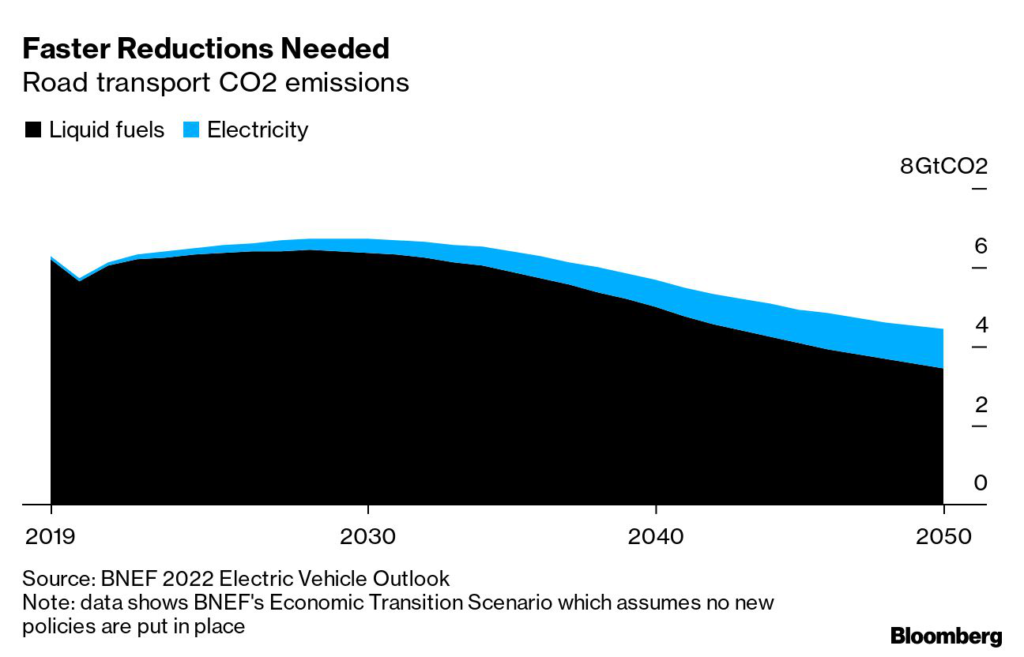
Covering topics related to EVs feels like there’s a constant drumbeat of good news like this. So far, the numbers tend to only go in one direction, and that’s up. But here’s a downer to balance things out: despite the recent faster EV adoption, road transport is still nowhere near on track to reach carbon neutrality, or “net zero,” by 2050.

BloombergNEF’s latest Electric Vehicle Outlook shows EV adoption continuing to accelerate in the years ahead, with the fleet rising from 17 million at the end of last year to 228 million by 2030 and over 700 million by 2040. Even with all that growth, CO2 emissions from road transport still come in at 4.4 gigatons in 2050 in BNEF’s Economic Transition Scenario, which assumes no new policies are implemented. That is down from 6.3 gigatons today — a remarkable achievement given rising global population and wealth — but still a long way from reaching net zero. 

So, what will it take to get road transport on track for net zero? Here are five steps:

  1. Get moving on zero-emission heavy trucks. BNEF’s outlook grades each segment of road transport on how close it is to reaching net zero by 2050. Buses and two/three wheelers, for example, are almost on track. Passenger cars and light commercial vehicles are on a positive trajectory, but still need some additional policy support, especially in emerging economies. Heavy trucks are nowhere near net zero and are set to account for a growing share of road transport emissions. Urgent action is needed to get the market for zero-emission trucks moving. The most important factor will be more stringent truck emissions policies and potentially quotas like California has introduced in its Advanced Clean Trucks regulation. A big push is also needed on megawatt-scale charging infrastructure, and potentially hydrogen refueling stations for some difficult-to-electrify long-haul routes.

  2. Close the EV adoption gap between wealthy and emerging economies. The current trajectory suggests a two-tiered global auto market is emerging and that the benefits of electrification could accrue very unevenly. New-vehicle sales in wealthy countries are set to go mostly electric in the next decade, while those in emerging economies lag far behind. Air quality in cities is already markedly worse in poorer nations, and this issue will complicate further if the EV adoption gap isn’t addressed. Cost-competitive EVs will make this much easier, but it still takes time to build adoption, and turning over the fleet is a slow process.

    BNEF’s outlook shows emerging economies accounting for 59% of global combustion-vehicle sales by 2040, up from 29% today. Governments in wealthy countries should look for ways to support EV adoption in emerging nations and help jumpstart the market, otherwise the transition will not be an equitable one.

  3. It’s time to build. There are two big areas that require substantial investment as the EV market scales: Charging infrastructure and battery supply chains. Both will need to see major development to prevent them from holding back EV adoption in the decades ahead. Governments should look to streamline permitting processes where possible, while industry participants should commit to supply-chain transparency to ensure consumers are confident in what they’re buying. 

  4. Look beyond the drivetrain. As I wrote last week, even a modest 10% reduction in distance traveled via car globally by 2050 yields major benefits and makes the journey to net zero much easier. Investments in public transport and better infrastructure to support cycling and walking can all play a role. This will help improve local air quality and drive down CO2 emissions while also reducing strain on the battery supply chain. Still, it’s important to recognize that even with those measures, the world will need a lot of EVs to achieve net zero by mid-century. The case of the Netherlands is illustrative here. The country is densely populated, wealthy, flat, temperate and invests heavily in cycling. Even there, bicycles account for only about 8% of distance traveled (though their share of trips is much higher at 25%), while cars cover 69%. Countries should continue to push for all of the changes above – including EVs – because every one of them will be needed to achieve climate targets.  

  5. Concurrent decarbonization of the power sector. EVs have lower lifetime CO2 emissions than comparable internal combustion vehicles today but realizing the full benefit will require concurrent decarbonization of the electricity system. In BNEF’s analysis, transport emissions will drop by another gigaton in 2050 if all those EVs are powered by renewables. Fortunately, the transition to a low-carbon power system is already well underway.

There you have it, five steps to close the gap. Let’s get going.

More stories like this are available on bloomberg.com

©2022 Bloomberg L.P.
Oracle’s Cloud Sales Show Momentum, Sending Shares Higher

(Bloomberg) — Oracle Corp. reported results and gave a forecast suggesting the effort to move its customers to the cloud is gaining momentum, and the acquisition of health care records provider Cerner Corp. will help accelerate the growth of the business.

Investors reacted positively, sending shares up more than 13% in pre-market trading Tuesday after a day in which the overall market plunged and Oracle’s stock hit a 16-month low.

“Couple a high growth rate in our cloud infrastructure business with the newly acquired Cerner applications business — and Oracle finds itself in position to deliver stellar revenue growth over the next several quarters,” Chief Executive Officer Safra Catz said Monday in a statement. 

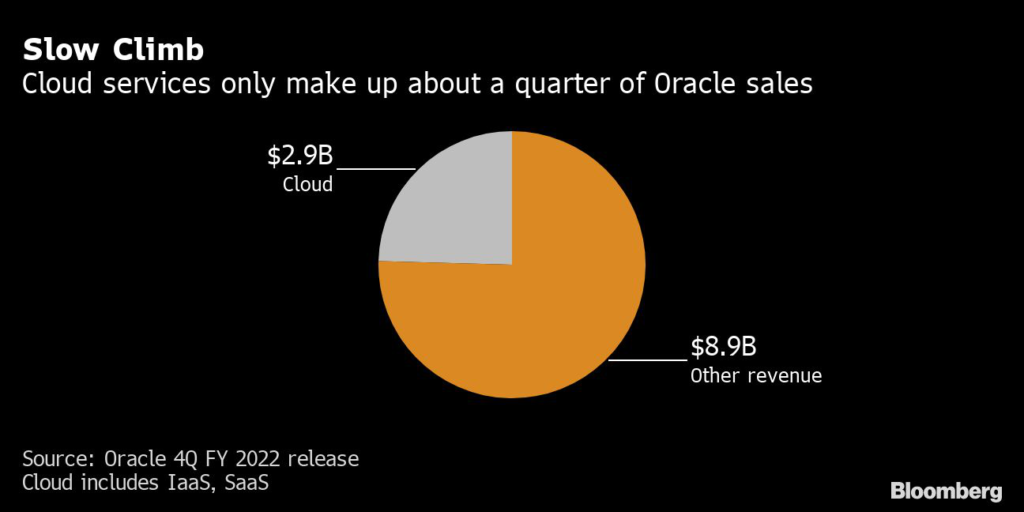
Cloud revenue — the highly watched segment that Oracle has been trying to expand — rose 19% to $2.9 billion in the fiscal fourth quarter, the Austin, Texas-based company said. Cloud sales growth had been greater than 20% since Oracle, the second-biggest software maker by revenue, began disclosing it last year.

While sales of applications for management and financial operations have fueled the company’s cloud effort thus far, Oracle “experienced a major increase in demand in our infrastructure cloud business” of 36% in the three-month period ended May 31, Catz said in the statement. 

Cloud revenue will accelerate as much as 25% in the current quarter and more than 30%, in constant currency, in the fiscal year, Catz said during a conference call after the results. That revenue may increase as much as 47% in the period ending in August including cloud sales from Cerner, she added.  

Economic headwinds like inflation and currency volatility could lead to corporate cost-cutting that may help drive cloud adoption, wrote JPMorgan’s Mark Murphy ahead of the results. The fast-growing cloud market is led by Amazon.com Inc., Microsoft Corp. and Alphabet Inc.’s Google.

“Often, customers save money” by moving to Oracle’s cloud infrastructure, Catz said during the call.

Oracle is hoping its $28.3 billion acquisition of Cerner, completed last week, will build inroads in the health care industry, which has been comparatively slow to adopt cloud technology. During the call, co-founder and Chairman Larry Ellison said health care is “clearly going to be our largest business.”

The deal will be accretive to Oracle’s earnings in fiscal year 2023, Catz said. With Cerner now part of Oracle’s business, revenue may increase as much as 19% in the current quarter, she said. Profit, excluding some items, will be $1.04 to $1.08 a share in the period.

In the fiscal fourth quarter, sales increased 5.5% to $11.8 billion, topping the average analyst estimate of $11.7 billion. The results marked Oracle’s eighth straight quarter of year-over-year revenue increases. Profit, excluding some items, was $1.54 a share, compared with the average estimate of $1.38 a share.  

With a surging US dollar, tech peers with significant overseas exposure including Salesforce Inc. and Microsoft Corp. have seen growth eaten by currency volatility. Oracle, with nearly half of its sales outside the Americas, said quarterly revenue was reduced 5% by currency fluctuations. On Monday, the US dollar hit its highest level since April 2020 as traders bet on an increasingly-rapid round of interest rate hikes from the Federal Reserve.

Oracle’s biggest positive surprise was in license spending, which reflects continuing investment from the company’s customers in uncertain times, said Anurag Rana, an analyst at Bloomberg Intelligence. “It’s a good reflection of broad-based technology spending and bodes well for the entire sector,” he said.

Cloud license and on-premise license sales gained 18% to $2.54 billion, beating the average estimate of $2.17 billion. Sales of the Fusion application for managing corporate finances rose 20% in the quarter, compared with 33% in the previous period. Sales of NetSuite enterprise planning tools, targeted to small- and mid-sized businesses, increased 27%, the same as in the previous quarter.

The shares closed at $64.05 in New York, the lowest value since February 2021, and have slipped 27% this year amid a broad rout among technology companies.

(Updated with shares.)

More stories like this are available on bloomberg.com

©2022 Bloomberg L.P.

Disney’s ‘Lightyear’ Banned From Childrens’ Viewing in Singapore

(Bloomberg) — Walt Disney Co.’s animated Pixar film ‘Lightyear’ won’t be able to be watched by kids in Singapore after the city-state’s Info-communications Media Development Authority gave it a NC16 rating because it includes a kiss between two female characters. 

The Southeast Asian nation issued the minimum 16-year-old age rating to the ‘Toy Story’ spin-off Tuesday, saying that while it is an “excellent animated film set in the US context, Singapore is a diverse society where we have multiple sensibilities and viewpoints.”

‘Lightyear’ contains depictions of a female lead character and her partner starting a family and going through different milestones of their lives, and also sharing a kiss. According to IMDA, it’s the first commercial children’s animation to feature overt homosexual depictions.

It isn’t the first time Singapore’s conservative stance on homosexuality has come to the fore. There have long been calls for the nation’s government to repeal the section of the country’s penal code that criminalizes gay sex. In April, Minister for Home Affairs and Law K. Shanmugam said the government has been consulting with diverse groups of Singaporeans to better understand their viewpoints on the law.

IMDA did ask Disney to consider releasing the film in two versions, however this suggestion was turned down, IMDA said.

“Even among members who were willing to consider a lower rating, some were uncomfortable that this would mean it can be shown unedited, to a broad-based audience on free-to-air TV,” the body added.

The United Arab Emirates has also banned ‘Lightyear’ from cinemas. The movie won’t be shown in 14 Middle Eastern and Asian countries when it releases in theaters this week, Reuters reported, citing an unidentified person familiar with the matter.

More stories like this are available on bloomberg.com

©2022 Bloomberg L.P.
Disney’s ‘Lightyear’ Banned From Children’s Viewing in Singapore

(Bloomberg) — Walt Disney Co.’s animated Pixar film ‘Lightyear’ won’t be able to be watched by kids in Singapore after the city-state’s Infocomm Media Development Authority gave it a NC16 rating because it includes a kiss between two female characters. 

The Southeast Asian nation issued the minimum 16-year-old age rating to the ‘Toy Story’ spin-off Tuesday, saying that while it is an “excellent animated film set in the US context, Singapore is a diverse society where we have multiple sensibilities and viewpoints.”

‘Lightyear’ contains depictions of a female lead character and her partner starting a family and going through different milestones of their lives, and also sharing a kiss. According to IMDA, it’s the first commercial children’s animation to feature overt homosexual depictions.

It isn’t the first time Singapore’s conservative stance on homosexuality has come to the fore. There have long been calls for the nation’s government to repeal the section of the country’s penal code that criminalizes gay sex. In April, Minister for Home Affairs and Law K. Shanmugam said the government has been consulting with diverse groups of Singaporeans to better understand their viewpoints on the law.

IMDA did ask Disney to consider releasing the film in two versions, however this suggestion was turned down, IMDA said.

“Even among members who were willing to consider a lower rating, some were uncomfortable that this would mean it can be shown unedited, to a broad-based audience on free-to-air TV,” the body added.

The United Arab Emirates has also banned ‘Lightyear’ from cinemas. The movie won’t be shown in 14 Middle Eastern and Asian countries when it releases in theaters this week, Reuters reported, citing an unidentified person familiar with the matter.

More stories like this are available on bloomberg.com

©2022 Bloomberg L.P.

MicroStrategy Risks Margin Call as Bitcoin Breaches $21,000

(Bloomberg) — MicroStrategy Inc. may need to post additional collateral for a loan as Bitcoin tests a key price range flagged by the company last month.

The software firm that invested heavily in Bitcoin said on a conference call in May that if the token’s price dropped enough, it would need to add to the digital asset originally pledged for the $205 million loan it took out in March. The initial value committed was around $820 million at the time but has since fallen to about half that.

MicroStrategy has become closely linked with Bitcoin, after it was one of the first major companies to buy the tokens for its corporate treasury. Chief Executive Officer Michael Saylor frequently touts the world’s largest cryptocurrency on social media and at conferences — including a tweet on Monday amid the selloff saying “In #Bitcoin We Trust.” 

Read more:

  • MicroStrategy Leads Crypto Stock Selloff as Bitcoin Unravels
  • MicroStrategy’s Losses From Bitcoin Bet Approach $1 Billion

A MicroStrategy spokesman didn’t immediately respond to an email sent outside regular office hours. The company’s stock fell 1.4% in premarket trading on Tuesday, following a 25% plunge the day before that drove it to the lowest level since October 2020.

“Bitcoin needs to cut in half for around $21,000 before we’d have a margin call,” Phong Le, MicroStrategy’s president, said on the call in early May. “That said, before it gets to 50%, we could contribute more Bitcoin to the collateral package, so it never gets there.”

Bitcoin has now reached that level, falling for an eighth straight day to as low as $20,824 on Tuesday before recovering to trade at $22,300 as of 11 a.m. in Longon. 

As of May 2, MicroStrategy held about 129,218 Bitcoins, with an approximate average purchase price of $30,700 each, according to a company filing.


(Updates with premarket stock drop in fourth paragraph.)

More stories like this are available on bloomberg.com

©2022 Bloomberg L.P.

Close Bitnami banner
Bitnami