Bloomberg

Suspected Iranian Hackers Targeted Ex-Israeli Officials

(Bloomberg) —

Alleged Iranian hackers targeted the email accounts of former Israeli and American government officials, according to research published by the Israeli cybersecurity firm Check Point Software Technologies Ltd.

Attackers targeted accounts by using standard hacking techniques such as email phishing and social engineering, the researchers said.

The targets included Tzipi Livni, a former minister of justice and minister of foreign affairs, in addition to a unnamed former Israeli military official and a former US ambassador to Israel, Check Point researchers said in a report published Tuesday. The researchers only specified Livni by name, and gave descriptions of the other people targeted. 

The goal was to steal personal information, scan passports and gain access to their mail accounts, said Sergey Shykevich, threat intelligence group manager at Check Point.

In one example provided by Check Point, Livni received an email from a former senior official in the Israeli Defense Forces. The emails were sent from that official’s genuine email address, suggesting the account was compromised and being used by the alleged Iranian hackers.

The attackers’ strategy was to use a compromised email account to create a rapport with the recipient, the researchers said. After a few messages, the hackers would include links to malicious documents or phishing pages. 

In the case of Livni, the hacker posing as the former military official asked her several times to open a document using her email password, at which point Livni grew suspicious. She realized the messages were fake after speaking in person to the former military official with whom she thought she’d been corresponding, according to Check Point.

“The operation implements a very targeted phishing chain that is specifically crafted for each target,” Shykevich said.

Check Point determined that the phishing campaign was linked to Iran because the attacker used a domain name that was also used in an Iranian campaign that targeted attendees of the 2020 Munich Security conference, according to Shykevich. Microsoft Corp. previously linked the campaign to Iranian hackers.

Some the phishing attacks succeeded in obtaining personal information and passport scans of its targets, Shykevich said.

The Check Point researchers attributed the attacks to a specific group of Iranian hackers dubbed Phosphorus, sometimes referred to as APT35 or Charming Kitten by computer security researchers. 

In 2019, Microsoft accused Phosphorus hackers of targeting accounts associated with a US presidential campaign.

More stories like this are available on bloomberg.com

©2022 Bloomberg L.P.

Bitcoin Slumps as Much as 10% in Deepening Crypto Sector Selloff

(Bloomberg) — Bitcoin delivered another white-knuckle ride Tuesday, dropping 10% before paring much of the slide as speculators struggled to price in the prospect of even bigger Federal Reserve interest-rate hikes to quell inflation.

The largest digital token rebounded from a $2,386 intraday drop to trade at $22,420 as of 10:51 a.m. in London, down 3.4%. Ether also trimmed losses, while altcoins like Solana, Avalanche and Polkadot traded higher. 

Cryptocurrencies have become emblematic of a flight from speculative assets as monetary policy is tightened around the world to fight inflation, draining liquidity from global markets. Each swoon evokes the obligatory question of whether the time is right to buy the dip because a nadir may be close at hand.

“There were some buyers waiting for an opportunity to buy on dips and that’s why Bitcoin has come off its lows,” Sathvik Vishwanath, chief executive officer of the Unocoin crypto exchange, said from Bengaluru, India. But the reprieve may be temporary as retail investors remain jittery about liquidity, he said.

Crypto lender Celsius freezing withdrawals on Monday exacerbated worries about the stress in the digital-asset sector, marking a fresh crisis just a month after the Terra stablecoin’s collapse roiled the market. News of Celsius’s decision helped push the overall crypto market capitalization below $1 trillion on Monday for the first time since January 2021. 

Some market watchers are predicting more fallout from Celsius’s troubles. 

“A run on Celsius could end up having a bigger impact on the market as a whole than the collapse of the Terra ecosystem – that hurt a lot, but was relatively isolated,” Noelle Acheson, head of market insights at Genesis Global Trading, said in a Twitter thread on Monday. “This implosion could impact many ecosystems, as Celsius has a range of assets leveraged on several platforms.”

Traders are also monitoring MicroStrategy Inc., whose big bet on Bitcoin is backfiring. The firm loaded up on the coins and may need to post additional collateral for a loan as Bitcoin tests a key price range it flagged last month.

More than $1.1 billion was liquidated in the crypto markets on Monday — about $685 million of longs and $468 million on the short side, according to Coinglass data. That’s the most for both longs and shorts in at least the past three months, the data showed.

Crypto linked shares in Asia, such as Monex Group and SBI Holdings Inc., retreated Tuesday amid the sour overall mood.

Some strategists are looking for signs of a crypto bottom. Mark Newton of Fundstrat Global Advisors said Bitcoin is “getting closer to intermediate-term levels of support which suggest buying dips should be correct by the end of the second quarter.”

(Updates with comment from Noelle Acheson in seventh paragraph.)

More stories like this are available on bloomberg.com

©2022 Bloomberg L.P.

China City Accused of Using Covid Health Codes to Stop Protests

(Bloomberg) — A manufacturing hub in central China is allegedly abusing its Covid control measures to prevent investors who say they have been swindled out of billions of dollars in a suspected financial scam from returning to the city to protest. 

Several people who claim to have been denied access to their money invested via online platforms said their health codes turned red when they scanned in at the main train station of Zhengzhou, the capital of Henan province, meaning they could no longer move about freely. They had carried green health codes when they left their hometowns, said the people, who declined to be identified for fear of reprisals.

Such alleged use of health-code apps to track people beyond their intended purpose has caused a firestorm, adding to concerns that the strict Covid restrictions imposed in mainland China and Hong Kong are doubling as a form of social control. In Hong Kong, groups of more than four are still banned from gathering outdoors — though restaurants allow bigger groups at the same table — and the rule is widely seen as a way of preventing political protests.

A former editor of the Communist Party’s Global Times newspaper said such health code manipulation jeopardizes the public’s support, while the Caixin news outlet warned in an editorial that any abuse of the system could pose a potential threat to society. A human rights lawyer accused the authorities of meddling with his health code to bar him from traveling, the New York Times reported earlier this year.

Phone calls to the Zhengzhou city government and the local health authority went unanswered. An employee handling city government hotline inquiries told local media that there was some error with their so-called Big Data information database and the situation had been reported to the government for rectification.

The latest development came after hundreds of protesters gathered outside the Henan office of China’s banking regulator in late May, demanding that authorities ensure the return of tens of billions of yuan invested in what could be one of the nation’s largest financial scams. Four banks in the province froze online and mobile cash withdrawal services in April, and a probe found that their common shareholder colluded with bank employees to illicitly attract public funds via online platforms. The investigation is ongoing and it’s unclear whether the funds are missing. 

China adopts a three-tiered health code color system to keep track of people who may have been infected by Covid, with red indicating the highest level of risk that bars people from entering public places or taking public transport while green grants them access. For tracking purposes, residents are required to scan venue codes for all public places they visit, which will then bring up the health code on their mobile phones for further checking. 


There were no risk areas in Zhengzhou or other cities in Henan as of late Monday, according to official data. It was unclear whether the authorities used other criteria to change the local health codes of the people Bloomberg spoke with, who had green health codes when leaving their hometowns. Zhengzhou, known locally as “iPhone city,” is home to the world’s biggest production base for iPhones.

Two of the people said they were taken to a local school once they arrived in Zhengzhou and were told by police to return to their hometowns. Others involved said they tested the health code app from outside the city by scanning Zhengzhou venue codes remotely, only to find they turned red, adding to signs they were being targeted.

The alleged abuse of health code rules prompted a public outcry on Chinese social media, with some calling it a “creative” way of using the system. 

Hu Xijin, former editor of the Global Times, posted on his Weibo that local health codes should be used for Covid prevention purposes only, without naming Zhengzhou or Henan.

“If any local government tries to prevent the movement of certain people by controlling their health codes for other purposes, it’s not only a clear violation of Covid prevention rules but also jeopardizes authority of the system and the public’s support,” Hu wrote in his Tuesday post. “It’ll do more harm than good to our social governance.”


More stories like this are available on bloomberg.com

©2022 Bloomberg L.P.

Millennials Hunting Returns Drive Risk-Hungry Investing in India

(Bloomberg) — An impatient Indian investor class, largely driven by millennials, is leaping into riskier investments from peer-to-peer lending to cryptocurrencies in the hope of boosting returns rocked by one of the worst inflation rates in Asia.

The sheer number of individuals pouring money into new and lightly controlled assets sets India apart, after the pandemic fueled the rise of retail investors globally and left many exposed to the potential for large losses. Others have been luckier and wracked up wins while racing to buy a first car or apartment.

In Mumbai, Pratik Vora, 28, who works in finance, is shunning the plain vanilla saving deposits that were popular with Indians for generations. Instead, he’s investing in equities and cryptocurrencies. A self-taught investor, Vora started with stocks in 2015 and ventured into crypto investing in 2019 to buy a bigger house. He only narrowly escaped the giant plunge in cryptocurrencies this year after earlier withdrawing from them to avoid new taxes in India, yet he remains undeterred. 

“At this point in time, a bank fixed deposit is the worst investment for any individual because inflation adjusted returns are negative,” Vora said. “I had a few setbacks too, lost money, but those were my learnings. My age allows me to take risk.”

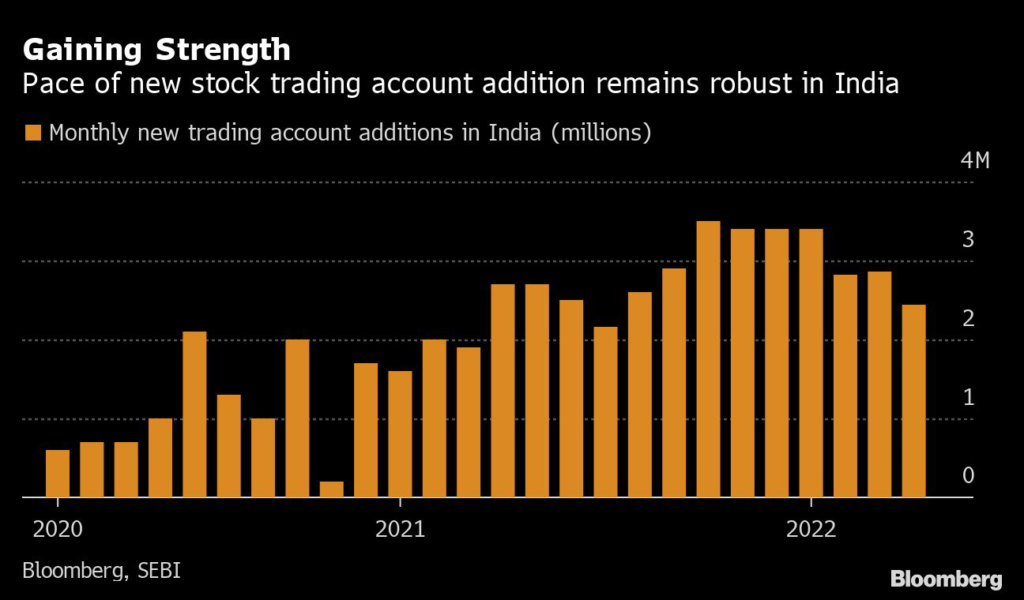
Regulators everywhere are grappling with those risks, but the absolute scale of the shift in India is creating unique new regulatory complexities for Prime Minister Narendra Modi’s government. Long a nation where households squirreled away their savings in the bank, about 43 million equity accounts have been added in India since the beginning of 2021, more than the total populations of Belgium, Greece and Portugal put together. 

As inflation has pushed past 6%, bank deposits have steadily become less attractive because the real return on fixed deposits turned negative. Consumer price increases have shot up to the highest levels in decades in many countries around the world, with a reading last week in the US that notched a 40-year high adding to a slate of troubling data. 

The renewed sense that central banks will have to do more to fight inflation is also making financial markets more volatile, as underscored by a renewed selloff across asset classes from late last week.

Many young Indians who want the chance at bigger returns are nonetheless venturing into even more volatile territory. 

Ekmmeet Singh, the chief executive officer of peer-to-peer lending platform Lendbox, estimates that Indians are making about $3 billion in annual investments across new-age alternative investment platforms. They separately had $6 billion invested in crypto assets, a member on a parliamentary panel said last year.

Retail investors have also been drawn in by the ease of investing created by the dozens of fintech startups that have sprung up, enabling investments within minutes over mobile phones or digital platforms.

India’s new fintech firms promise high returns on products that often carry greater risks. Jiraaf, an alternative asset platform, is marketing investment products tied to invoice discounting that can yield 9%-14% for 30-90 days and corporate debt with 1-3 year tenors that yield 8%-20%, according to its website. Grip says investors could make up to 21% pretax returns in leases. BondsIndia.com is advertising returns of 275% over what fixed deposits bring in.

But with the Reserve Bank of India raising rates and tightening cash to quell inflation, there’s a rising risk that the assets underlying these products could come under stress.

Jiraaf and the other companies say they work hard to protect investors. Lendbox said it uses data and other mechanisms to ensure the quality of its borrowers is of the highest order and to work towards the recovery of unpaid loans. Grip, the asset leasing firm, says it does rigorous due diligence on all deals and uses measures like security deposits to protect clients.  

“Indians have limited investment opportunities,” said Saurav Ghosh, co-founder at Jiraaf. “We wanted to bring high-yield fixed-income products that cater to the gap between equities and bank fixed deposits.”

Asset Leasing

In Mumbai, Anirudha Basak, 27, who works at a Mumbai-based fintech-platform, says he and his family have seen payoff from alternative investments. After a casual conversation with a product manager at another platform called Leaf, Basak invested about 500,000 rupees ($6,404) in asset-leasing on behalf of his mother, who he says is now receiving monthly interest payments.

But the big elephant in the room remains crypto, with exchanges reporting massive jumps in user base in smaller cities. The central bank has pushed back against the asset, citing financial stability concerns, but the government is yet to decide on its legal status.

Crypto markets have slumped recently as stagflation concerns drag on risk assets, with Bitcoin dropping to the lowest level since December 2020 and other major tokens like Ether also falling sharply Monday. 

The Reserve Bank of India has set up a department to oversee fintech and is regulating non-banking financial entities like peer-to-peer platforms. The capital markets regulator, the Securities and Exchange Board of India, is also planning to look into corporate bond platforms. 

“Traditional asset classes like equity, fixed income, real estate, etc., are well covered under the regulatory framework with adequate investor protection built into their respective governing regulations,” said Srikanth Subramanian, CEO-designate at Kotak Cherry, an investment platform providing an array of products to retail investors. “However, in case of emerging asset classes like crypto that are yet to come under the gamut of a dedicated securities regulator, the lacuna still exists that needs to be plugged by regulation.”

In recent years, the risks of alternative platforms with limited regulatory oversight have been on show elsewhere in the world. China saw a wave of defaults on peer-to-peer lending platforms in 2018, fueling a regulatory crackdown.

It can be hard for new investors anywhere to keep up. As a software engineer in New Delhi, Gagandeep Singh said he made a string of investments over the last few years that cost him money, and he lent on one peer-to-peer platform that left him with losses when some borrowers stopped paying him back. 

Now working for an information technology company in Canada, Singh, 37, focuses mostly on passive index funds, but isn’t completely shying away from risk. “I do keep 5-10% for risky bets,” he said. “That’s the money I play with. That gives me the thrill.” 

Singh’s latest obsession is cryptocurrencies, where he invested almost $10,000 at the peak though the value of that has dropped. “I might lose money,” he said. “It might go to zero – or it might make me rich.” 

Others are taking a similar approach. The head of marketing at a Mumbai education technology firm, Sunny Amlani, 38, has been stuck with a loss of 17% on his crypto investments. A tax regime that doesn’t make it possible to offset losses in crypto with any other income makes exiting digital currencies difficult. 

Yet, he isn’t fully giving up on cryto, he said. “I think it’s a good time to stick around and am definitely going to hold on for a while to see where it goes.” 

More stories like this are available on bloomberg.com

©2022 Bloomberg L.P.

Spain to Study Additional Tax for Utilities in Budget Debate

(Bloomberg) — Spain is set to study whether utilities should pay additional tax amid surging power prices, according to Deputy Prime Minister Teresa Ribera.

“It’ll be important to see whether we need additional fiscal measures for utilities,” Ribera, who’s also in charge with energy policy, said in an interview with state-owned broadcaster TVE Tuesday. 

The debate on the country’s budget is “probably the right environment” to discuss such changes, she said, while noting that power companies already face “various limitations” put in place to protect consumers, including a cap on gas prices. 

The government is also working on an extension of the measures it has implemented to lower fuel costs, one of the main driver of the country’s rising inflation, Ribera told TVE.

“We’re working with our technical teams to see how we’re going to extend this measure,” which includes a 20-cent discount per liter of fuel, said Ribera. The plan will be unveiled in the next days, she said. 

The government also needs to ascertain whether refining and fuel distribution companies are increasing their profits as a result of the current market environment to assess whether any exceptional fiscal measures should also be applied to them, she said.

More stories like this are available on bloomberg.com

©2022 Bloomberg L.P.

Atos Considers Spinoff of Cybersecurity Unit, CEO to Leave

(Bloomberg) — Atos SE shares tumbled the most on record after the company said Chief Executive Officer Rodolphe Belmer would resign just five months into his tenure, following a failure to agree on a potential restructuring that will lead to a breakup of the French IT business.

Atos is studying spinning off its Big Data and Cybersecurity business in a separate entity, while Belmer will leave before September, the company announced at a capital markets day on Tuesday. Appointed in late January this year, Belmer said he has “no choice but to resign” following this reorganization, according to the statement.

Atos shares fell as much as 27% in early trading in Paris. “We consider this restructuring will be painful and is unlikely to please investors in the short term,” said Gregory Ramirez, analyst at Bryan Garnier & Co. 

A series of setbacks and profit warnings has sent Atos from a market value of 8.2 billion euros ($8.6 billion) at the end of 2020 to 2.1 billion euros today. The firm was removed from the benchmark CAC 40 index in Paris and auditors uncovered accounting errors at two of the firm’s U.S. entities. The collapse attracted takeover interest. Thales has been studying teaming up with private equity on a potential takeover, Bloomberg reported in February.

“We see several negative elements here,” including the departure of the CEO “who just arrived,” Oddo BHF analysts wrote in a note to clients. “This may lead to further management changes. Moreover, this means that the team leader who designed the turnaround plan will not be there to carry it out.”

Belmer was appointed chief executive following the unexpected resignation of Elie Girard after a dire series of results. Previously CEO of Eutelsat Communications SA, Belmer was in charge of reorganizing Atos to focus on cloud-based products. 

The reorganization is the board’s “decision,” Belmer said during a call with reporters, refusing to comment on reported disagreements over the company’s strategy. He will receive nine months salary for his departure, while his contract allowed him to receive two years of pay if leaving before a period of two years after his nomination, he said.

Philippe Oliva has been appointed deputy CEO in charge of the BDS and Nourdine Bihmane deputy CEO in charge of the legacy business. 

If Atos goes ahead with its latest restructuring, the new data unit will be listed before the second half of 2023 under the name Evidian, while the ailing legacy IT services unit will continue as Atos. The two companies will have separate management.

To fulfill the project, Atos estimates total funding needs of 1.6 billion euros for the 2022 to 2023 period, with proceeds expected from the sale of 700 million euros of non-core assets. After the transaction, Atos shareholders will hold 100% of the restructured company, and 70% of Evidian. The remaining 30% stake in Evidian would be held by Atos.

“We appreciate the ambition but stay cautious on account of the uncertainty associated with a transformation of such magnitude against a challenging wider macro backdrop,” wrote Citi’s Amit Harchandani in a research note.

A near-term sentiment shift for Atos seems unlikely, even after the company’s June 14 announcement that it was contemplating a spinoff of its digital transformation and security services (SpinCo), a move that would effectively isolate the ailing legacy outsourcing unit (52% of 2021 sales). But tying the security business, which is the crown jewel, to transformation services, which have failed to grow in-line with market trends, could cap SpinCo’s possible valuation upside. And Rodolphe Belmer’s planned departure after just taking over as CEO in January suggests significant internal divisions over the plan, leaving the outlook unsettled.

Tamlin Bason. analyst at Bloomberg Intelligence

(Updated with context throughout. Shares.)

More stories like this are available on bloomberg.com

©2022 Bloomberg L.P.
Bitcoin Miners Are Flocking To Texas Despite Its Fragile Power Grid 

  • Listen to Bloomberg Crypto on the iHeartRadio App
  • Listen to Bloomberg Crypto on Apple Podcasts
  • Listen to Bloomberg Crypto on Spotify 

(Bloomberg) — Have you ever heard the saying, “Everything’s Bigger in Texas”? That same ethos applies to mining Bitcoin in the Lonestar state. The state of Texas is flush with bitcoin prospectors. The City of Fort Worth even started a small mining operation out of City Hall. In this episode, Bloomberg reporter Mike Smith shares his reporting about what makes this state so attractive to crypto enthusiasts. And Lee Bratcher, head of the Texas Blockchain Council explains why he sees Texas as the perfect environment for Bitcoin believers.

Follow us on Twitter @crypto, and subscribe to the Bloomberg Crypto Newsletter at https://bloom.bg/cryptonewsletter


More stories like this are available on bloomberg.com

©2022 Bloomberg L.P.

Finland Gives Fortum Time to Find Buyers for Russian Units

(Bloomberg) — Finland is prepared to give Fortum Oyj time to sell its Russian power plants and follow other western energy companies out of Russia.

The departure of the state-controlled utility is the next step in severing energy ties between the two neighbors after Russia halted exports of both electricity and gas in the past few weeks. Fortum, which operates seven thermal power plants in the Ural region and western Siberia, said last month it would prefer to sell them as part of the exit. 

“No country could allow power plants shutting overnight,” said Tytti Tuppurainen, the Finnish minister for European affairs, who oversees state holdings in Fortum and other important companies. “Therefore we understand that this exit has to be a managed one” and that it “cannot happen overnight.”

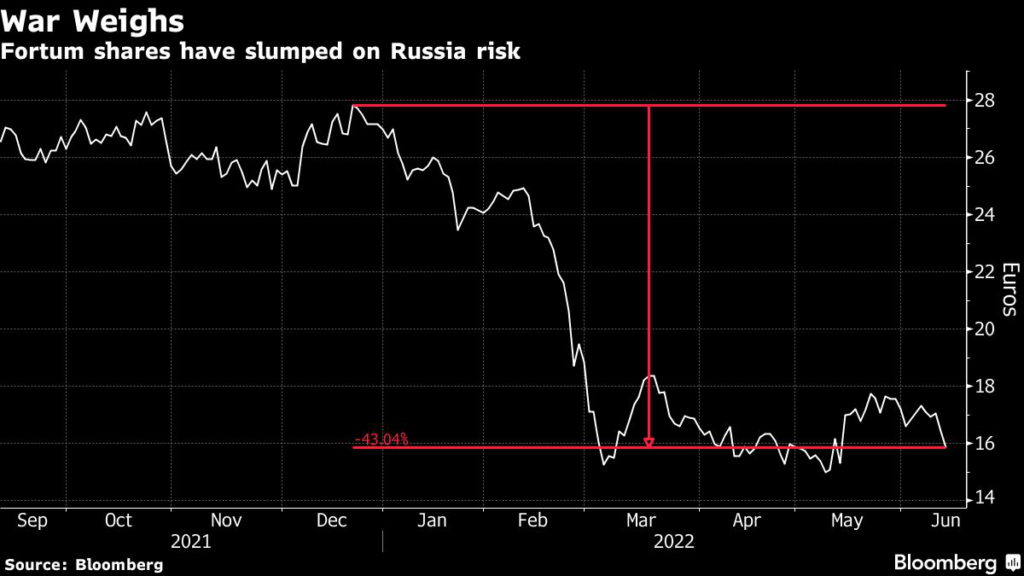
Europe’s biggest energy companies have already taken a financial hit of many billions as they are leaving or planning to withdraw from Russia amid the invasion of Ukraine. Fortum last month announced impairments of 2.1 billion euros ($2.2 billion) on assets that also include those owned by German subsidiary Uniper SE. 

Fortum is collecting binding offers for the sale of its and Uniper’s Russian assets until June 21, Kommersant reported. According to Fortum’s terms, the deal should be completed by July 1. Inter RAO UES PJSC, Gazprom PJSC and SUEK are among potential buyers, it said. Fortum rose as much as 8.7% at 10:44 a.m. in Helsinki, while Uniper gained 6.1%.

The Finnish state holds a 50.8% stake in the nation’s biggest power producer. Chief Executive Officer Markus Rauramo told the Kauppalehti newspaper in early June that he had interested buyers for the plants even before the war and that others, both from Russian and foreign firms, have emerged lately too. The company declined to provide further details when contacted by Bloomberg on Monday. 

“We’ve given the political guidance that we should cut our dependency on the Russian market, especially when it comes to fossil fuels and I’m certain that our companies, the management, have heard that message and they are acting accordingly,” Tuppurainen said in an interview at her office in Helsinki. “I’m satisfied to see that they’re also taking actions.” 

Fortum and Uniper’s combined net assets in Russia are worth 3.3 billion euros ($3.4 billion) after the impairments. In addition to the seven plants, Fortum owns the nation’s largest wind and solar portfolio, while Uniper owns five other power plants. 

The latest comments seem to suggest that the government is softening on the speed of the exit. Finnish Prime Minister Sanna Marin in early in April signaled that a withdrawal from Russia should come as soon as possible.

Russia accounts for about a fifth of Fortum’s operating income. Its shares have dropped by about 40% this year as the exposure has discouraged investors. By comparison, the Stoxx 600 Utilities Index is down less than 10%. 

Getting out is “the wise thing to do,” Tuppurainen said. “When it comes to Fortum, clearly the Russian market is no Eldorado,” she said, invoking a metaphor for immense wealth. It’s “no longer a reliable market for companies that want to get good profits out of their investments.”

(Adds Kommersant report, share moves in fifth paragraph)

More stories like this are available on bloomberg.com

©2022 Bloomberg L.P.
ResMed Nears Deal for Hg-Backed Software Provider MediFox

(Bloomberg) — ResMed Inc., a publicly traded medical equipment provider, will buy MediFox Dan Holding GmbH, a German health software company owned by private equity firm Hg.

San Diego-based ResMed announced the acquisition in a statement Tuesday that confirmed an earlier Bloomberg News report. The takeover, which will expand ResMed into the fast-growing software space, values MediFox at about $1 billion including debt.

That makes it ResMed’s largest deal to date, according to data compiled by Bloomberg. 

ResMed manufactures medical products that treat breathing disorders like sleep apnea. It generated almost 39% of its revenue for 2021 outside of the US, according to its latest annual report, though it doesn’t break down specific regions.

“We will expand ResMed’s SaaS business portfolio outside our current base in the US and strengthen our position as a global leader in health-care software solutions for lower-cost and lower-acuity care,” ResMed’s Chief Executive Officer Mick Farrell said in Tuesday’s statement.

Shares in ResMed closed down almost 3% on Monday at $202.39, giving the company a market value of about $30 billion. 

Hg first invested an undisclosed sum in Hildesheim, Germany-based MediFox in 2018. The company was founded in 1994 and merged with Dan in 2020, Hg’s website showed. 

Evercore Inc. advised ResMed on the acquisition, while Houlihan Lokey Inc. worked with the seller. 

More stories like this are available on bloomberg.com

©2022 Bloomberg L.P.

Ambani’s Venture Clinches $2.7 Billion Cricket Streaming Rights

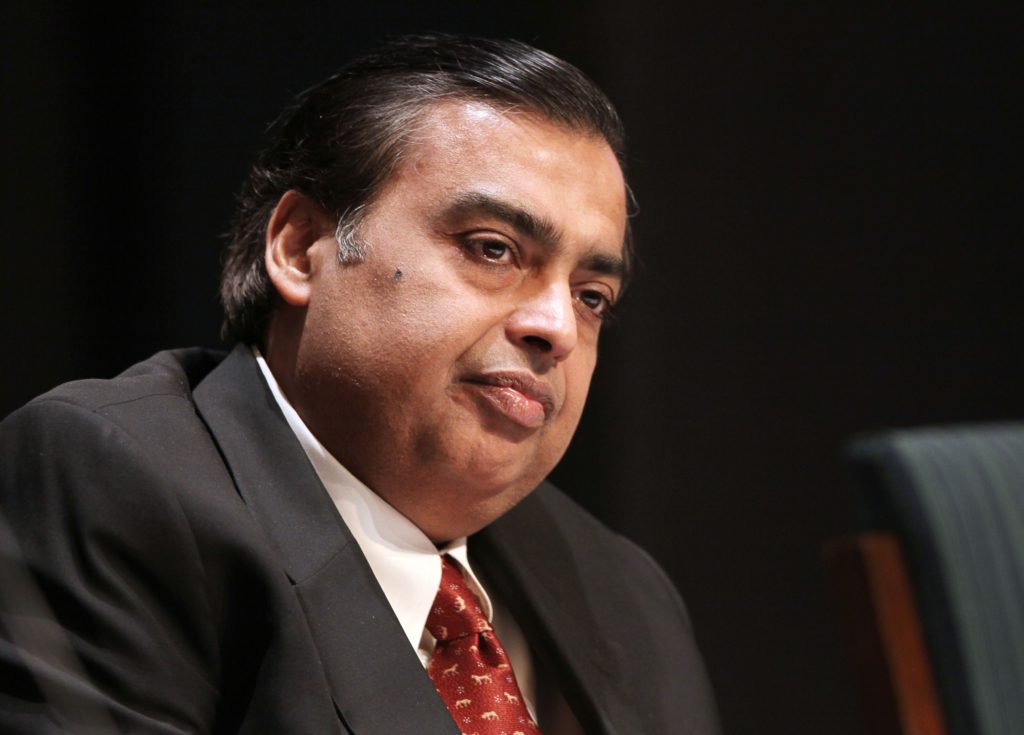
(Bloomberg) — Billionaire Mukesh Ambani’s media venture won the digital streaming rights to the Indian Premier League for as much as 210 billion rupees ($2.7 billion), outbidding entertainment giants including Walt Disney Co. and Sony Group Corp., according to people familiar with the matter.

Viacom18 Media Pvt., a joint venture between Paramount Global and Ambani’s Reliance Industries Ltd., clinched the online rights to the popular annual cricket tournament, the people said, asking not to be identified as the information isn’t public. The Board of Control for Cricket in India, the local governing body for the sport that kicked off the auction June 12, has yet to officially announce the winners.

In a partial win, Disney bagged the television broadcast rights to the matches for about 235 billion rupees, the people said. Initially, many analysts expected Reliance to pick up both the contracts. Representatives for Reliance and Disney didn’t respond to requests for comment.

The five-year digital contract is a crucial victory for Ambani’s conglomerate, which has ambitions to vault into the club of global media and online streaming behemoths. Described as the Super Bowl of cricket, the IPL is one of the world’s fastest-growing sporting events with a cult-like status in South Asia and among the subcontinent’s diaspora. Luring more than 600 million viewers, it’s also seen as the quickest way to pile on eyeballs and scale up any platform’s audience in India, the world’s largest consumer market with almost 1.4 billion people.

Disney shares fell 3.7% on Monday amid a broad market selloff, extending this year’s loss to 38%. Reliance shares slipped 1% as of 12:18 p.m. Mumbai on Tuesday.

Maximum Eyeballs

“There are media companies that are looking at IPL as the most important sporting event in the world,” Tarun Pathak, research director at consultancy Counterpoint Research told Bloomberg Television. “You’re getting the maximum eyeballs from a young nation. The key message here is that companies are betting on India’s future.”

Four contracts starting 2023 were up for grabs, broadly covering television and digital rights in the Indian subcontinent and overseas, as well as a pick of key matches. BCCI is auctioning IPL’s broadcast and streaming rights separately for the first time.

Despite Amazon.com Inc.’s surprise pullout at the last moment, the auction has seen heated competition. Total bids have surpassed 460 billion rupees, exceeding the 328 billion rupees floor-price set by the BCCI, Bloomberg News reported. That’s nearly three times the amount collected at the previous auction in 2017. 

Before Amazon exited the race, people familiar with the developments expected the auction to lure more than 400 billion rupees in total bids, with one analyst even predicting as much as 600 billion rupees.

Cricket, a quintessential English summer sport, has legions of fans in mostly the British Commonwealth countries, and particularly in the Indian subcontinent. Trailing only the English Premier League and the National Football League in global popularity, the IPL is increasingly being seen as a critical catalyst for any media company looking to capture the Indian consumer going online for shopping and entertainment. 

The IPL was valued at 458 billion rupees ($5.9 billion) in 2020 by Duff & Phelps, now known as Kroll. It could now be 25% higher, said Santosh N, managing partner at D and P India Advisory Services, aided in part by the inclusion of two new teams that increased the matches to 74 in the just-concluded season. The league now has 10 teams.

Started in 2008, the IPL is a much shorter and more entertaining format. Typically held in April and May, each match lasts between three and four hours, compared to the one-day version and the classic five-day test cricket known for its tea breaks. Stadiums hosting an IPL match feature merchandise and a carnival-like atmosphere, often with Bollywood actors cheering from VIP boxes. 

Little Impact

Though Disney lost the rights it inherited from its 2019 acquisition of 21st Century Fox Inc.’s global entertainment assets, some shareholders may breathe a sigh of relief. If Disney doesn’t bag the contract, it won’t have a material impact on earnings as “the profit potential out of India is minimal,” Ben Swinburne, an analyst with Morgan Stanley, wrote in a May 12 research note.

For Reliance, a first-time bidder in IPL’s 15-year history, the cricket streaming rights are also about fueling the e-commerce and retail ambitions of its technology venture Jio Platforms Ltd. 

Reliance “went in with the deepest pockets and the longest staying power to juice the IPL property,” said Utkarsh Sinha, managing director, Bexley Advisors, a boutique investment firm that focuses on technology and media. “As the consumer media wallet keeps getting divided into smaller pieces in an overcrowded market, Reliance may be approaching it with a ‘consolidate and dominate’ strategy. The IPL win is a strategic step in that direction.”

More stories like this are available on bloomberg.com

©2022 Bloomberg L.P.

Close Bitnami banner
Bitnami