Bloomberg

Homebuilders Boost Sales Tags to Fight Costs: The London Rush

(Bloomberg) — Here’s the key business news from London-listed companies this morning.

Bellway Plc: The rising costs of building a home has been offset by gains in house prices, with reservations ahead of last year.

  • The homebuilder says that despite a rising cost of living and rising interest rates, its expects strong demand for its homes this year

Crest Nicholson Holdings Plc: The homebuilder says many of its developments are in areas that benefit from a changing relationship between the home and the office, with many people citing this as a reason for moving home.

  • The firm is offsetting rising costs by increasing prices in a market it says has strong demand and “relatively poor levels of supply” 

Entain Plc: The gambling firm will buy Dutch online sports operator BetCity for up to 850 million euros, dependent on BetCity’s financial performance this year.

  • The companies currently expect the total consideration to be just 450 million euros

Outside The City

Boris Johnson is heading for a fresh fight with his Tories over a plan to override the Brexit deal with the EU. The plan published yesterday was immediately condemned by the bloc, panned by legal experts and may face stiff opposition in Parliament. 

And as the cost of filling up a car in the UK sits at an all-time high, the resulting stretch on budgets across the country is uneven. 

In Case You Missed It 

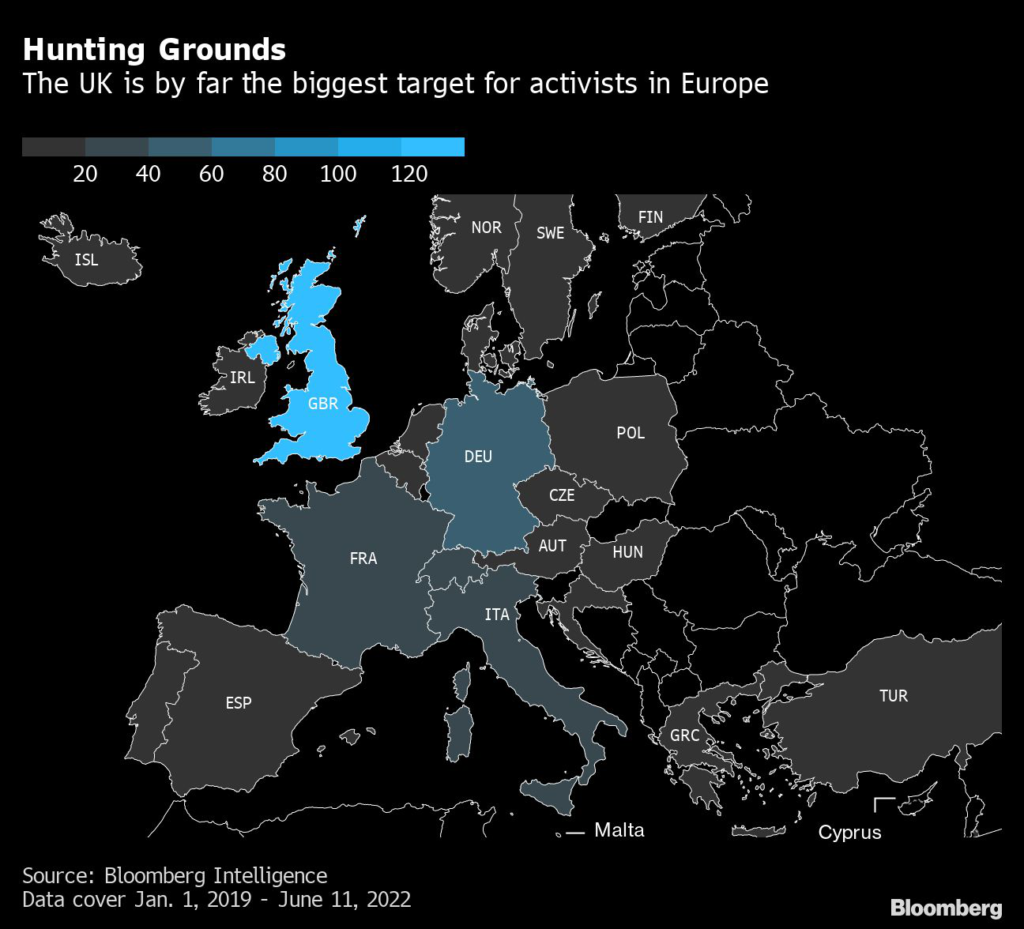
Activists are back and UK Plc is their main target in Europe.

London double-decker bus operator Go-Ahead Group Plc accepted a £648 million takeover bid from an investor group backed by Australian rival Kinetic. The offer represents a 24% premium to Go-Ahead’s Friday closing price, the last full trading day before Bloomberg reported takeover interest in the company. 

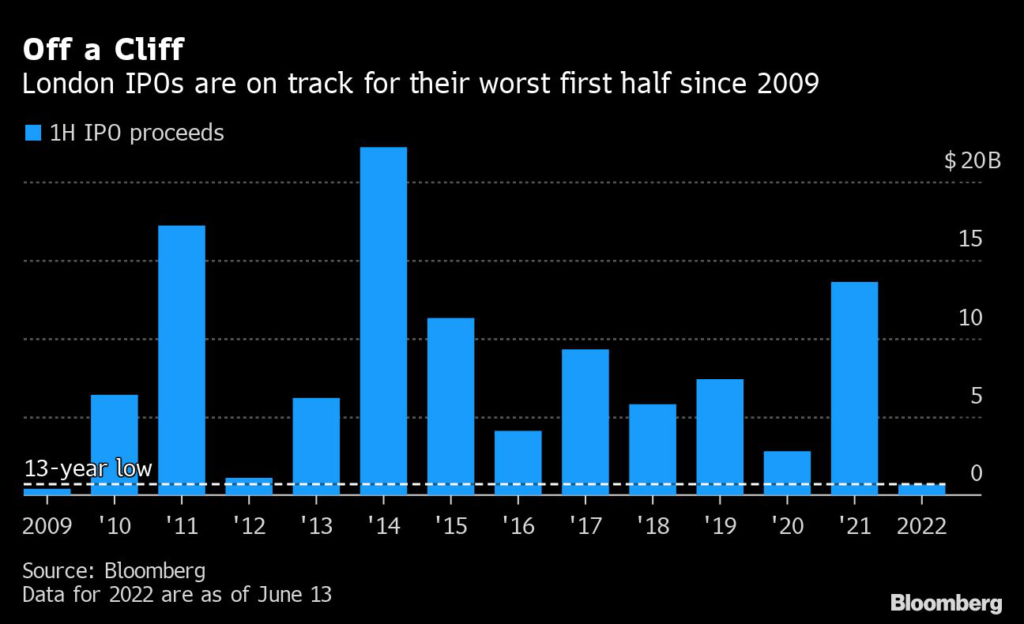
Meanwhile, the value of initial public offerings in London has fallen to the lowest since the global financial crisis: 

Looking Ahead

Bookstore chain WH Smith Plc and Harry Potter publisher Bloomsbury Publishing Plc are among the companies scheduled to report earnings tomorrow. 

More stories like this are available on bloomberg.com

©2022 Bloomberg L.P.

Proxy Advisers Back Toshiba Board Slate, Including Activists

(Bloomberg) — Two influential proxy advisers recommended that stock owners vote to elect all director candidates proposed by Toshiba Corp.’s board at the upcoming annual meeting, including two representatives of the company’s activist investors.

Investors should vote in favor of the election of Eijiro Imai and Nabeel Bhanji, who hail from activist shareholders Farallon Capital Management and Elliott Management Corp., Institutional Shareholder Services Inc. and Glass Lewis & Co. said in separate reports. Neither person’s presence on the board can be considered detrimental, ISS said.

The recommendations come after Toshiba external board member Mariko Watahiki spoke out publicly against appointing representatives of activist investors as directors, saying that if they were appointed, activists would take up too much of the board.

The reports increase the chances that the director candidates from activist shareholders will be appointed. That, in turn, may also raise the likelihood of a sale and privatization of the Japanese industrial giant. Toshiba has received eight buyout offers and two proposals for capital and business alliances as it carries out a process to seek strategic options for its future.

Toshiba’s annual general shareholder meeting is scheduled for June 28.

(Updates throughout with Glass Lewis report)

More stories like this are available on bloomberg.com

©2022 Bloomberg L.P.

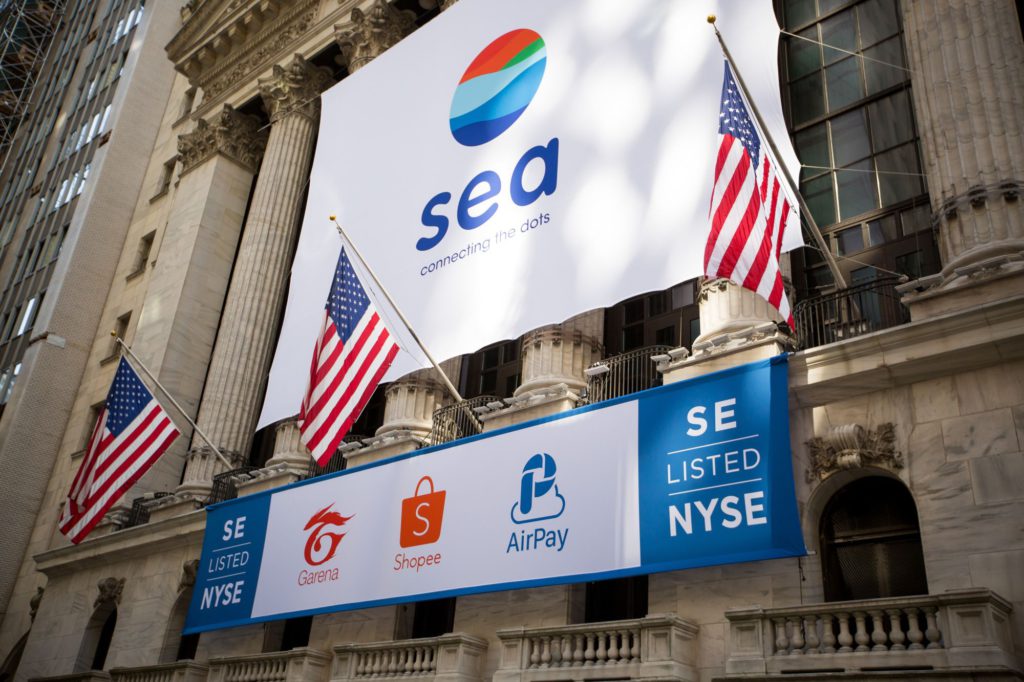
Sea Cuts Jobs in Shopping, Food in First Major Downsizing

(Bloomberg) — Sea Ltd. is making its first major job cuts in areas spanning shopping and food, joining other tech firms downsizing this year in anticipation of unprecedented market and economic volatility.

Southeast Asia’s largest tech firm plans to let employees go across its e-commerce division Shopee, Chris Feng, the unit’s chief executive, said in an email to employees seen by Bloomberg News. It will reduce headcount across its ShopeeFood and ShopeePay divisions in Southeast Asia. The cuts will also extend across its Mexico, Argentina, and Chile teams, as well as the cross-border team supporting Spain.

Sea faces increasing pressure to slash costs as growth in its main commerce business comes off a pandemic-era high. While mobile gaming has proven more resilient, the company has lost about $160 billion of its market value since an October high as investors begin to scrutinize its longer-term trajectory.

“Given elevated uncertainty in the broader economy, we believe that it is prudent to make certain difficult but important adjustments to enhance our operational efficiency and focus our resources,” Feng said in his email to staff. He emphasized that the job cuts are to ensure that the business remains in the “best possible position” to continue scaling sustainably.

Sea representatives weren’t immediately available to comment.

Consumers emerging from prolonged lockdowns are cutting back on online purchases, especially with the war in Ukraine and rising interest rates clouding the global economic outlook. More than 132,000 tech jobs have been cut since the start of the pandemic, according to tracking site Layoffs.fyi.

Read more: The Tech Rout Isn’t Just Cyclical—It’s Well-Earned, and Overdue

The dismissals come after Sea revised its full-year outlook for e-commerce sales, its main source of revenue, to $8.5 billion to $9.1 billion from its previous guidance of $8.9 billion to $9.1 billion. The company also posted a wider loss for the first three months as expenses soared.

The Singaporean giant is now gradually reducing its overseas footprint and periphery businesses as competition takes a toll. That’s a stark shift from the e-commerce and gaming platform’s previous stance of continued spending for global growth.

“This reallocation of resources to further focus on our priorities will help us grow our business even better,” Feng said in his email. “While we need to continue to optimize our efficiency, we are also generally still growing and hiring as needed to support that growth.”

Shopee will pull out of Spain as of the end of June 17, it said in an announcement on its website. The company pulled out of India and France after just a few months in the countries, and plans to focus on core markets in Southeast Asia and Brazil.

Read more: Sea’s Billionaire CEO Opens Up After 75% Stock Crash

More stories like this are available on bloomberg.com

©2022 Bloomberg L.P.

South Korea Strike Raises Concerns Over Nation’s Energy Security

(Bloomberg) — As South Korea’s trucker strike upends production of everything from steel to petrochemicals, worries are growing that the nation’s energy infrastructure may be at risk amid a global power crunch.

The work stoppage so far has had a limited impact on state-owned power generators, and an energy crisis isn’t imminent. But privately owned power plants may be feeling some strain, and the outlook for all providers becomes more uncertain the longer the strike drags on. 

Companies including Korea South-East Power Co. and Korea Western Power Co. said their coal supply hasn’t been disrupted as deliveries arrive directly by vessels and don’t require road transport. But if the strike goes on for months, there could be ripple effects on the power industry from a wider supply-chain disruption, they said. 

The strike is in its eighth day as truckers protest the removal of a minimum wage scheme as fuel prices soar. Talks between the union and government officials have failed to make progress, and deliveries of cars, petrochemicals, steel and materials for semiconductor chips have been suspended or delayed. 

South Korea almost entirely relies on imports to meet its fossil fuel consumption, due to its limited domestic resources. The country is among the biggest buyers of coal in the world, shipping in almost 138 million tons annually on average between 2017 and 2021.

Concerns are also growing over how the disruption of raw materials affects other parts of South Korea’s infrastructure and economy. The International Transport Workers’ Federation said there has been a complete halt of cement shipments, which is stopping work at some construction sites.

The spotlight was put on energy security after the ITF said late Monday that a shortage of coal has put some power plants on the brink of closure. Government officials said there are no signs of coal shortages. 

An official for the truckers union said Tuesday that coal supply to a power plant in an industrial complex in Yeosu has been disrupted as a result of industrial action, though said no particular industry is being targeted.

State coal-fired power plants are located near ports, allowing deliveries to be made directly from ships, and they only need a limited amount of other products such as ammonia and wood pallets that require road transport, according to officials. 

Still, shipping delays may create problems. At the port of Busan, import containers are waiting 14 days, up from four days before the strikes, according to logistics intelligence provider Project44.  

Meanwhile, the trucker strikes have created problems for coal shipments to privately owned power plants, a union official said, without providing details. 

Kumho Petrochemical Co., which runs its own power plants and boilers to produce electricity and steam required for its Yeosu complex, hasn’t seen any disruptions as the plants are running on coal inventories, a spokesman said. If the strike persists for longer, things look grimmer, he said. 

LG Chem Ltd. also operates its own steam boilers, but it can use fuels other than coal, a spokesman said. 

More stories like this are available on bloomberg.com

©2022 Bloomberg L.P.

DeFi in Turmoil as Eye-Popping Yields Prove Too Good to Be True

(Bloomberg) — The notion that the cryptocurrency industry has near-magical powers to pay out yields that dwarf those found in the traditional financial world without much added risk is undergoing a rapid and painful reality check.

Barely a month after the dramatic collapse of the Terra blockchain, whose Anchor protocol enticed investors with annual yields of almost 20%, crypto lender Celsius Networks halted withdrawals and some other transactions on its platform offering similarly eye-popping returns. Those active in the space insist that these are just growing pains for a young industry rather than glaring flaws that reveal profound existential issues, yet the episodes still have the power to shake up the ever-changing world of crypto finance.

“What is happening with Celsius will have serious repercussions for the industry,” said Mahin Gupta, founder of Liminal, a digital-asset custody platform. “It’s a not-insignificant player, and its apparent failure will have ripple effects.”

Gupta and other professionals involved in crypto draw a sharp distinction between Celsius and the world of DeFi protocols. While Celsius is one of the big participants in the DeFi space, the company itself is more like a centralized bank or other financial middleman than a collection of DeFi smart contracts and algorithms governed by the democracy of token holders spread out throughout the world. 

Still, the episode that followed so closely on the heels of the Terra implosion highlights the inherent risk that — like the traditional banking system during the global financial crisis — various digital assets can be so tightly linked that a problem in one area can set off a greater unraveling, putting the whole construct under distress.

Both Terra’s failure, which was triggered when that blockchain’s stablecoin lost its 1-to-1 peg to the U.S. dollar, and Celsius’ withdrawal freeze have exacerbated losses across a wide variety of cryptocurrencies. 

And both episodes have coincided with turmoil in traditional markets as the U.S. Federal Reserve embarks on a campaign to tame raging inflation by aggressively raising interest rates and reversing the easy-money policies it put in place during the Covid-19 pandemic. 

Read more: Market Rout Evokes Memories of Trading Before Lehman Blowup 

“Investors should be keenly aware of how interconnected the different DeFi products are, as well as that they are all being impacted by Federal Reserve policy,” said Hilary Allen, a law professor at American University who specializes in financial-stability regulation. “There is no crypto ‘safe haven.’”

Observers are blaming much of Celsius’s issues on a token called Staked ETH, or stETH, which is an IOU fully backed by the Ether cryptocurrency. The token is issued in return for Ether that is “staked,” or locked up, until Ethereum completes its merge with an updated version of the blockchain and a follow-up upgrade.

Staked ETH is 100% backed by Ether and while it has been trading at a discount to that token recently, that is “no big deal in normal markets,” according to Jeff Dorman, chief investment officer of Arca Capital Management.

“But this is not a normal market anymore — collateral values are shrinking, market liquidity is drying up, and lenders are struggling and pulling back,” he wrote in a recent note. That’s caused the price of Staked ETH to deviate significantly from the token it’s meant to track. “When that happens, trouble ensues since stETH is a token that can also be used as collateral for other loans. Said another way, a non-event suddenly becomes an event if cascading liquidations occur due to the temporary de-peg.” 

To Cam Harvey, a Duke University finance professor and author of a book on DeFi, Celsius’s woes are indicative of a failure of risk management on the company’s part, not a sign of a crisis that threatens the broader space. Celsius didn’t appreciate how illiquid that Staked ETH could be, Harvey said, ultimately leaving it in a poor position to meet demands for withdrawals akin to an old-fashioned bank run.  

“To go into something that’s relatively new that hasn’t been around for a while and just assume that this is super liquid? That to me is a stretch,” he said. “I do think it will change behavior in terms of other companies, who will say ‘Hey, we need to take scenarios like this into account.’”

The Celsius episode is also likely to lead to a higher emphasis on counterparty due diligence and transparency when it comes to the flow of funds and performance of loans built into DeFi lending protocols, according to Sid Powell, CEO of Maple Finance, a lending marketplace for institutions. 

But don’t expect the innovations of DeFi to disappear anytime soon, its proponents say, regardless of how widespread the pain is during the current bear market that’s referred to as a “crypto winter.” 

“Crypto and DeFi are stronger than any single participant,” said Henry Elder, head of DeFi at digital-asset manager Wave Financial.

Or, as Arca’s Dorman puts it: “This too shall pass, and it will again be a case study of whether or not we want to live in a fake world like TradFi where all problems are immediately ‘fixed’ with Too Big to Fail bailouts, or if we want to live in a new regime where these relationships will eventually work themselves out — but many will suffer pain as it plays out.”

More stories like this are available on bloomberg.com

©2022 Bloomberg L.P.

Pakistan E-Commerce Startup Raises Record $37 Million Series A

(Bloomberg) — Pakistan’s Dastgyr Technologies Pvt., which aims to create an e-commerce platform similar to Alibaba Group Holding Ltd. for emerging markets, raised $37 million in the country’s largest-ever Series A funding.

The venture arm of telecommunications operator Veon Ltd. led the fundraising by contributing about 40% of the investment. The Dutch-domiciled giant serves more than 217 million customers in nine countries and is the largest mobile phone service provider in Pakistan.

Dastgyr’s funding is a bright spot for the South Asian nation that has suffered from the global tech downturn after a breakout year in 2021. Uber Technologies Inc.’s Careem Inc. unit has suspended food deliveries in the country, Dubai-based Swvl Holdings has paused operations and Airlift Technologies Pvt. has fired a third of its workforce.

“Pakistan’s startup ecosystem is at a critical juncture and only startups focused on addressing key challenges and adopting local solutions will survive and thrive,” said Aamir Ibrahim, chief executive officer at Jazz, Veon’s local unit.

Pakistan is mostly a cash-based economy but startups are looking to change that. Dastgyr, which means “helper,” is a one-stop platform that connects retailers such as grocery stores with multiple suppliers such as Nestle SA and Reckitt Benckiser Group Plc. Most traditional stores currently meet 100 suppliers a week or physically browse different markets to stack its shelves.

The online marketplace that started less than two years ago has been used by about 100,000 retailers in the five cities it operates. It seeks to keep costs low by connecting buyers and sellers over a digital platform, rather than buying and storing everything in physical warehouses. It plans to expand into 15 new markets in Pakistan and expand into a new country in 2022.

The company continues “to work relentlessly toward our vision of building an Alibaba for emerging markets worldwide,” said Zohaib Ali, co-founder of Dastgyr.

The round also included Zinal Growth Fund, DEG, Khwarizmi Ventures, Oman Technology Fund, Cedar Mundi Ventures, Reflect Ventures, Century Oak Capital, Haitou Global, GoingVC, Astir Ventures, K3 Ventures, and Chandaria Capital. Existing investors SOSV, Edgebrook Partners, and EquiTie also participated.

Dastgyr has started a Buy Now Pay Later offering and plans to introduce lending products for its sellers as well. It aims to become a unicorn in the next few years, Muhammad Owais, another co-founder, said in an interview.

While the company started by catering to grocery stores, it’s now venturing into new business-to-business categories, including cement, steel and other building materials. It is also looking at electronics, pharmaceuticals and other retail sectors, said Owais. 

The funding marks another step in Veon’s evolution beyond traditional telecommunications. It has also applied for a digital banking license in Pakistan.

“As part of Veon’s transformation into a digital operator that delivers a growing range of services to our customers we are investing in leading digital companies like Dastgyr in the countries where we operate,” said Mohammad Khairil Abdullah, CEO at Veon Ventures. “These investments are the building blocks of the digital ecosystem that will enable us to deliver on our strategy.” 

More stories like this are available on bloomberg.com

©2022 Bloomberg L.P.

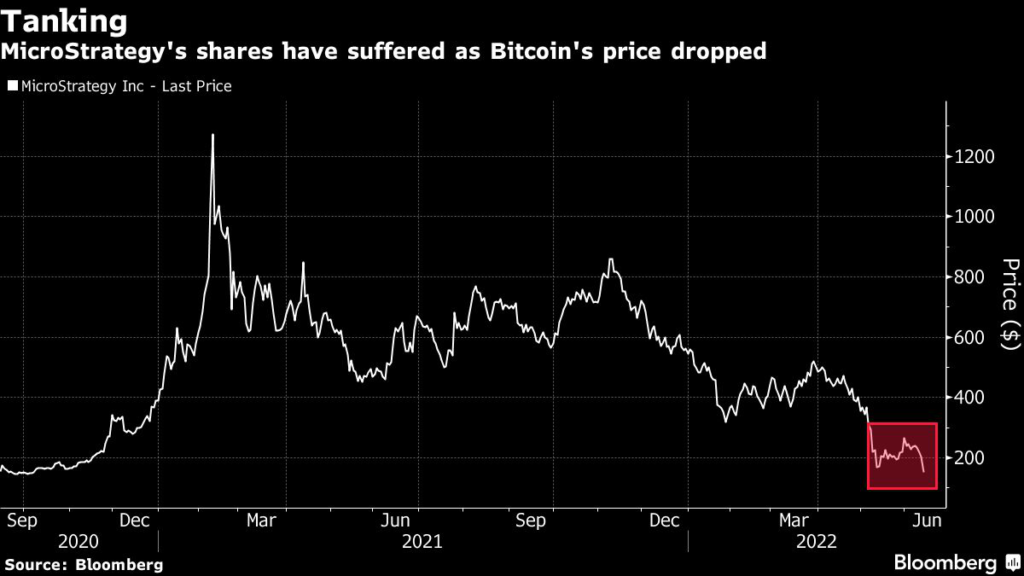
MicroStrategy Risks Margin Call as Bitcoin Drops Below $21,000

(Bloomberg) — MicroStrategy Inc. may need to post additional collateral for a loan as Bitcoin tests a key price range flagged by the company last month.

The software firm that invested heavily in Bitcoin said on a conference call in May that if the token’s price dropped enough, it would need to add to the digital asset originally pledged for the $205 million loan it took out in March. The initial value committed was around $820 million at the time but has since fallen to about half that.

MicroStrategy has become closely linked with Bitcoin, after it was one of the first major companies to buy the tokens for its corporate treasury. Chief Executive Officer Michael Saylor frequently touts the world’s largest cryptocurrency on social media and at conferences — including a tweet on Monday amid the selloff saying “In #Bitcoin We Trust.” The shares fell 25% Monday as cryptocurrencies tumbled. 

“Bitcoin needs to cut in half for around $21,000 before we’d have a margin call,” Phong Le, MicroStrategy’s president, said on the call in early May. “That said, before it gets to 50%, we could contribute more Bitcoin to the collateral package, so it never gets there.”

Bitcoin has now reached that level, falling for an eighth straight day to as low as $20,824 on Tuesday. As of May 2, MicroStrategy held about 129,218 Bitcoins, with an approximate average purchase price of $30,700 each, according to a company filing.

A tokenized version of MicroStrategy’s stock on crypto exchange FTX was down about 1% as of 12:30 p.m. in Hong Kong. The company’s market cap is around $1.7 billion.

Read more:

  • MicroStrategy Leads Crypto Stock Selloff as Bitcoin Unravels
  • MicroStrategy’s Losses From Bitcoin Bet Approach $1 Billion

More stories like this are available on bloomberg.com

©2022 Bloomberg L.P.

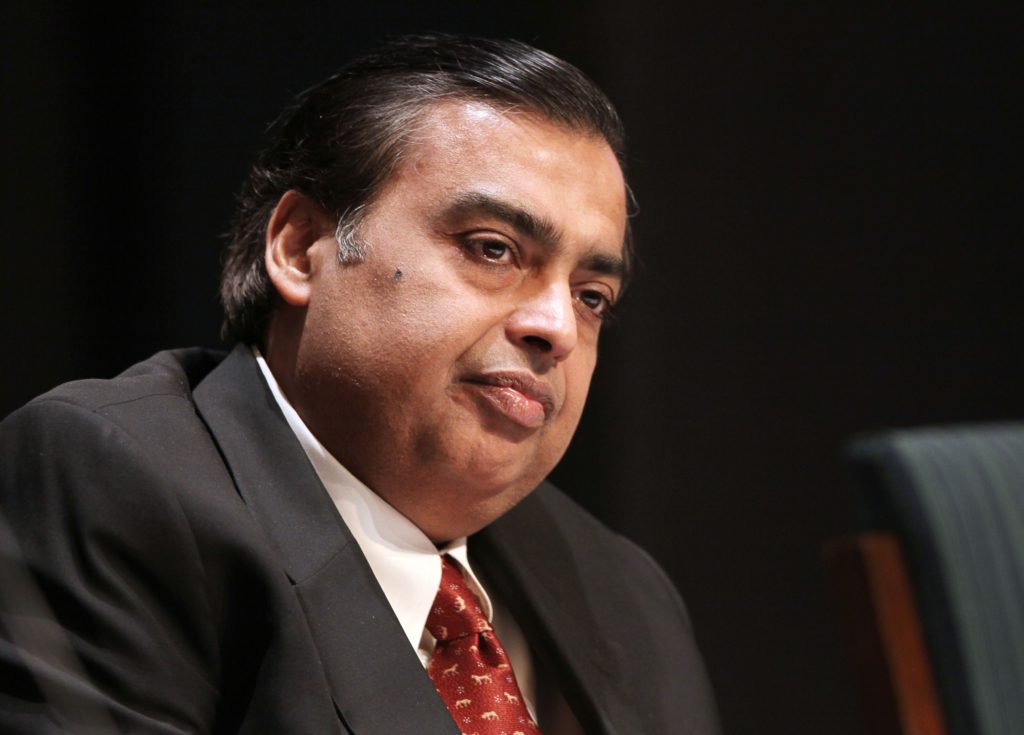
Ambani Venture Wins Cricket Streaming Rights in Bidding War

(Bloomberg) — Billionaire Mukesh Ambani’s media venture won the digital streaming rights to the Indian Premier League, outbidding entertainment giants including Walt Disney Co. and Sony Group Corp., according to a person familiar with the matter.

Online rights to the popular annual cricket tournament were awarded to Viacom18 Media Pvt., a joint venture between Paramount Global and Ambani’s Reliance Industries Ltd., the person said, asking not to be identified as the information isn’t public. The Board of Control for Cricket in India, the local governing body for the sport that kicked off the auction June 12, has yet to officially announce the winners.

The Financial Times reported that Viacom18 bought the rights for about $2.6 billion, while the New York Times reported that the deal was almost $3 billion. Disney, however, did bag the television broadcast rights to the matches for about $3 billion, FT said. 

The five-year digital contract is a crucial victory for Ambani’s conglomerate, which has ambitions to vault into the club of global media and online streaming behemoths. Described as the Super Bowl of cricket, the IPL is one of the world’s fastest-growing sporting events with a cult-like status in South Asia and among the subcontinent’s diaspora. Luring more than 600 million viewers, it’s also seen as the quickest way to pile on eyeballs and scale up any platform’s audience in India, the world’s largest consumer market with almost 1.4 billion people. 

Representatives for Reliance and Disney didn’t immediately respond to requests for comment. Disney shares fell 3.7% on Monday amid a broad market selloff, extending this year’s loss to 38%. Reliance shares slipped 0.6% as of 9:34 a.m. Mumbai on Tuesday.

Long-Term Stickiness

“IPL is one of the highest conversion-driving properties in a very hotly contested OTT marketplace, where consumer wallet saturation and fragmentation are fast becoming insurmountable challenges,” said Utkarsh Sinha, managing director, Bexley Advisors, a boutique investment firm that focuses on technology and media. “It gives long term stickiness, which again is difficult to achieve as users display fickle loyalty to platforms and move dynamically to where the content is.”

Four contracts starting 2023 were up for grabs, broadly covering television and digital rights, as well as a pick of key matches, in the Indian subcontinent and overseas. BCCI is auctioning IPL’s broadcast and streaming rights separately for the first time.

Despite Amazon.com Inc.’s surprise pullout at the last moment, the auction has seen heated competition. Total bids have surpassed 450 billion rupees ($5.8 billion), exceeding the 328 billion rupees floor-price set by the BCCI, Bloomberg News reported. That’s nearly three times the amount collected at the previous auction in 2017. 

Before Amazon exited the race, people familiar with the developments expected the auction to lure more than 400 billion rupees in total bids, with one analyst even predicting as much as 600 billion rupees.

Cricket, a quintessential English summer sport, has legions of fans in mostly the British Commonwealth countries, and particularly in the Indian subcontinent. Trailing only the English Premier League and the National Football League in global popularity, the IPL is increasingly being seen as a critical catalyst for any media company looking to capture the Indian consumer going online for shopping and entertainment. 

The IPL was valued at 458 billion rupees ($5.9 billion) in 2020 by Duff & Phelps, now known as Kroll. It could now be 25% higher, said Santosh N, managing partner at D and P India Advisory Services, aided in part by the inclusion of two new teams that increased the matches to 74 in the just-concluded season. The league now has 10 teams.

Started in 2008, the IPL is a much shorter and more entertaining format. Typically held in April and May, each match lasts between three and four hours, compared to the one-day version and the classic five-day test cricket known for its tea breaks. Stadiums hosting an IPL match feature merchandise and a carnival-like atmosphere, often with Bollywood actors cheering from VIP boxes. 

Sigh of Relief

Though Disney lost the rights it inherited from its 2019 acquisition of 21st Century Fox Inc.’s global entertainment assets, some shareholders may breathe a sigh of relief. Subscribers to Disney+ Hotstar pay only 76 cents a month on average for the service. That’s annualized revenue of less than $500 million, making it hard to justify the yearly rights fees.

Ben Swinburne, an analyst with Morgan Stanley, wrote in a May 12 research note that “the profit potential out of India is minimal” and won’t have a material impact on earnings if Disney doesn’t bag the contract. Chief Executive Officer Bob Chapek told investors in February that while cricket was an important component of its product offering, new local content the company is developing in India would mitigate the impact.

“It’s not like we see that business evaporating if we don’t get it,” Chapek said.

Still, the loss could weigh on the Burbank, California-based company’s ambitious goals of obtaining as many as 260 million subscribers globally by 2024. While rival Netflix Inc. lost subscribers last quarter, Disney+ added 7.9 million customers. More than half of those came from Disney+ Hotstar, which is offered in India and several other Southeast Asian nations. Ten additional IPL matches last quarter contributed to a jump in Disney’s international advertising revenue.

For Reliance, a first-time bidder in IPL’s 15-year history, the cricket streaming rights is also about fueling the e-commerce and retail ambitions of its technology venture Jio Platforms Ltd. 

Reliance “went in with the deepest pockets and the longest staying power to juice the IPL property,” Bexley Advisors’ Sinha said. “As the consumer media wallet keeps getting divided into smaller pieces in an overcrowded market, Reliance may be approaching it with a ‘consolidate and dominate’ strategy. The IPL win is a strategic step in that direction.”

(Updates with auction expectations in ninth paragraph.)

More stories like this are available on bloomberg.com

©2022 Bloomberg L.P.

Activist Investors Pounce on Vulnerable British Blue-Chip Firms

(Bloomberg) — Activists are back and UK Plc is their main target in Europe.

Having given CEOs a pass in the depths of the Covid-19 pandemic, activist investors big and small are once more doing battle in the boardrooms of UK blue-chips. Since late May, A-lister Nelson Peltz has stirred fresh expectations of a revamp at consumer group Unilever Plc, and up-and-comer Bluebell Capital Partners has renewed calls for reform at miner Glencore Plc. 

They’re among the agitators now ensconced in London-listed companies with a combined market value of about $500 billion, according to data compiled by Bloomberg Intelligence. Their peers have landed everywhere from energy giant Shell Plc to drugmaker GSK Plc, and telecommunications provider Vodafone Plc. 

British businesses are emerging from the coronavirus crisis to a multitude of new obstacles, and the investors — who specialize in forcing change at firms they deem to be underperforming — are unlikely to offer respite in the coming months, say bankers and advisers. 

“If you look at performance out of the pandemic overall, they are lagging in their recovery,” Rich Thomas, head of European shareholder advisory at Lazard Ltd., said of UK companies. “Remember that activists are value investors first and foremost.”

One of the UK’s biggest draws for activists is valuation: The FTSE 100 index trades at about 10 times this year’s estimated earnings, trailing the 11 times multiple for the Euro Stoxx 50 and 16 times multiple for the S&P 500. Robust governance rules and a lack of big controlling shareholders resistant to change also make Britain an attractive destination for activists.

“Covid, the rotation out of growth into value and Russia’s invasion of Ukraine have all created a dislocation between intrinsic and market values,” said Darren Novak, head of shareholder engagement and M&A capital markets for Europe, the Middle East and Africa at JPMorgan Chase & Co. “UK Plc is seen as being attractive because it is cheap on a multiple basis relative to other markets, particularly the US.”

All told, the UK accounts for almost half of the 336 campaigns launched in Europe since the start of 2019, the Bloomberg Intelligence data show. Indications are the trend will continue. A May report by global consulting firm Alvarez & Marsal Inc. identified 155 firms in Europe that’ll likely be targeted by activists in the next 18 months, with more than a third based in the UK.

Telecommunication company BT Group Plc and gambling operator Playtech Plc are seen among the most likely to attract activist interest in the UK, according to an informal Bloomberg News survey of 17 M&A desks, analysts, brokers and fund managers conducted earlier this month. Associated British Foods Plc, Burberry Group Plc, ITV Plc, Reckitt Benckiser Group Plc and J Sainsbury Plc were also mentioned by participants in the poll.

Representatives for the companies either declined to comment or didn’t immediately provide comment.

“UK is the first stop, particularly for US activists who are more comfortable with Anglo Saxon law,” said Giuseppe Bivona, chief investment officer at activist Bluebell. “Post Brexit valuations are also attractive.”

UK companies have been reassessing their businesses in the face of changing buyer habits, disruptive technologies and the global shift to cleaner energy. The consumer goods and industrials sectors are among those heavily exposed to such pressures and have found themselves strongly targeted by activists looking for ways to extract value from bloated corporates.

The arrival of Peltz at the board of Unilever will heighten pressure on the company’s Chairman Nils Andersen and Chief Executive Officer Alan Jope to boost returns after a failed effort to buy the consumer division of GSK. A split of Unilever’s food business from its household and personal-care operations is among the items analysts expect to be on Peltz’s agenda. 

GSK is now pushing ahead with a spinoff of the consumer unit, called Haleon, despite itself coming under pressure from Paul Singer’s Elliott Investment Management. The UK’s most active activist has been complaining about the performance of GSK’s Chief Executive Emma Walmsley, the lack of scientific know-how on the company’s board and its strategic decision making — in particular the choice not to pursue an outright sale of the consumer business. 

“Most activists’ desired outcomes are M&A-centric,” said JPMorgan’s Novak. “The thinking goes that 1+1 equals 3, so most demands are centered around selling, separating or spinning off divisions to create additional value. Some, of course, want an outright sale of mid- and small-cap companies in instances where the market is not ascribing the full value potential.”

In anticipation of more calls from spooked chief executives, investment banks have been staffing up. The number of vacancies for shareholder defense jobs in the UK rose almost 60% in 2021 to the highest level in at least five years, according to labor market data provider Vacancysoft.

“Over the past five years, a wealth of advisory capability for activists has popped up in London, with more shareholders now voicing their demands,” said Novak, who joined JPMorgan from rival UBS Group AG last year. More recently, Barclays Plc recruited Peter da Silva Vint from Moelis & Co. for its activism defense practice.

To be sure, some may welcome the role activists are playing at challenging management teams. In an era when passive investment funds have taken out large holdings in listed companies, the role of the activist investor has become even more important, according to Susannah Streeter, a senior analyst at Hargreaves Lansdown Plc.

“The arrival of a probing, questioning, powerful voice, could give senior executives a fresh sense of direction and ensure they are kept on their toes,” she said.

More stories like this are available on bloomberg.com

©2022 Bloomberg L.P.
Activists Pounce on Vulnerable British Blue-Chip Firms

(Bloomberg) — Activists are back and UK Plc is their main target in Europe.

Having given CEOs a pass in the depths of the Covid-19 pandemic, activist investors big and small are once more doing battle in the boardrooms of UK blue-chips. Since late May, A-lister Nelson Peltz has stirred fresh expectations of a revamp at consumer group Unilever Plc, and up-and-comer Bluebell Capital Partners has renewed calls for reform at miner Glencore Plc. 

They’re among the agitators now ensconced in London-listed companies with a combined market value of about $500 billion, according to data compiled by Bloomberg Intelligence. Their peers have landed everywhere from energy giant Shell Plc to drugmaker GSK Plc, and telecommunications provider Vodafone Plc. 

British businesses are emerging from the coronavirus crisis to a multitude of new obstacles, and the investors — who specialize in forcing change at firms they deem to be underperforming — are unlikely to offer respite in the coming months, say bankers and advisers. 

“If you look at performance out of the pandemic overall, they are lagging in their recovery,” Rich Thomas, head of European shareholder advisory at Lazard Ltd., said of UK companies. “Remember that activists are value investors first and foremost.”

One of the UK’s biggest draws for activists is valuation: The FTSE 100 index trades at about 10 times this year’s estimated earnings, trailing the 11 times multiple for the Euro Stoxx 50 and 16 times multiple for the S&P 500. Robust governance rules and a lack of big controlling shareholders resistant to change also make Britain an attractive destination for activists.

“Covid, the rotation out of growth into value and Russia’s invasion of Ukraine have all created a dislocation between intrinsic and market values,” said Darren Novak, head of shareholder engagement and M&A capital markets for Europe, the Middle East and Africa at JPMorgan Chase & Co. “UK Plc is seen as being attractive because it is cheap on a multiple basis relative to other markets, particularly the US.”

All told, the UK accounts for almost half of the 336 campaigns launched in Europe since the start of 2019, the Bloomberg Intelligence data show. Indications are the trend will continue. A May report by global consulting firm Alvarez & Marsal Inc. identified 155 firms in Europe that’ll likely be targeted by activists in the next 18 months, with more than a third based in the UK.

Telecommunication company BT Group Plc and gambling operator Playtech Plc are seen among the most likely to attract activist interest in the UK, according to an informal Bloomberg News survey of 17 M&A desks, analysts, brokers and fund managers conducted earlier this month. Associated British Foods Plc, Burberry Group Plc, ITV Plc, Reckitt Benckiser Group Plc and J Sainsbury Plc were also mentioned by participants in the poll.

Representatives for the companies either declined to comment or didn’t immediately provide comment.

“UK is the first stop, particularly for US activists who are more comfortable with Anglo Saxon law,” said Giuseppe Bivona, chief investment officer at activist Bluebell. “Post Brexit valuations are also attractive.”

UK companies have been reassessing their businesses in the face of changing buyer habits, disruptive technologies and the global shift to cleaner energy. The consumer goods and industrials sectors are among those heavily exposed to such pressures and have found themselves strongly targeted by activists looking for ways to extract value from bloated corporates.

The arrival of Peltz at the board of Unilever will heighten pressure on the company’s Chairman Nils Andersen and Chief Executive Officer Alan Jope to boost returns after a failed effort to buy the consumer division of GSK. A split of Unilever’s food business from its household and personal-care operations is among the items analysts expect to be on Peltz’s agenda. 

GSK is now pushing ahead with a spinoff of the consumer unit, called Haleon, despite itself coming under pressure from Paul Singer’s Elliott Investment Management. The UK’s most active activist has been complaining about the performance of GSK’s Chief Executive Emma Walmsley, the lack of scientific know-how on the company’s board and its strategic decision making — in particular the choice not to pursue an outright sale of the consumer business. 

“Most activists’ desired outcomes are M&A-centric,” said JPMorgan’s Novak. “The thinking goes that 1+1 equals 3, so most demands are centered around selling, separating or spinning off divisions to create additional value. Some, of course, want an outright sale of mid- and small-cap companies in instances where the market is not ascribing the full value potential.”

In anticipation of more calls from spooked chief executives, investment banks have been staffing up. The number of vacancies for shareholder defense jobs in the UK rose almost 60% in 2021 to the highest level in at least five years, according to labor market data provider Vacancysoft.

“Over the past five years, a wealth of advisory capability for activists has popped up in London, with more shareholders now voicing their demands,” said Novak, who joined JPMorgan from rival UBS Group AG last year. More recently, Barclays Plc recruited Peter da Silva Vint from Moelis & Co. for its activism defense practice.

To be sure, some may welcome the role activists are playing at challenging management teams. In an era when passive investment funds have taken out large holdings in listed companies, the role of the activist investor has become even more important, according to Susannah Streeter, a senior analyst at Hargreaves Lansdown Plc.

“The arrival of a probing, questioning, powerful voice, could give senior executives a fresh sense of direction and ensure they are kept on their toes,” she said.

More stories like this are available on bloomberg.com

©2022 Bloomberg L.P.

Close Bitnami banner
Bitnami