
Bloomberg

US Rates Have Biggest Two Days Since 1987, Jolting Global Assets

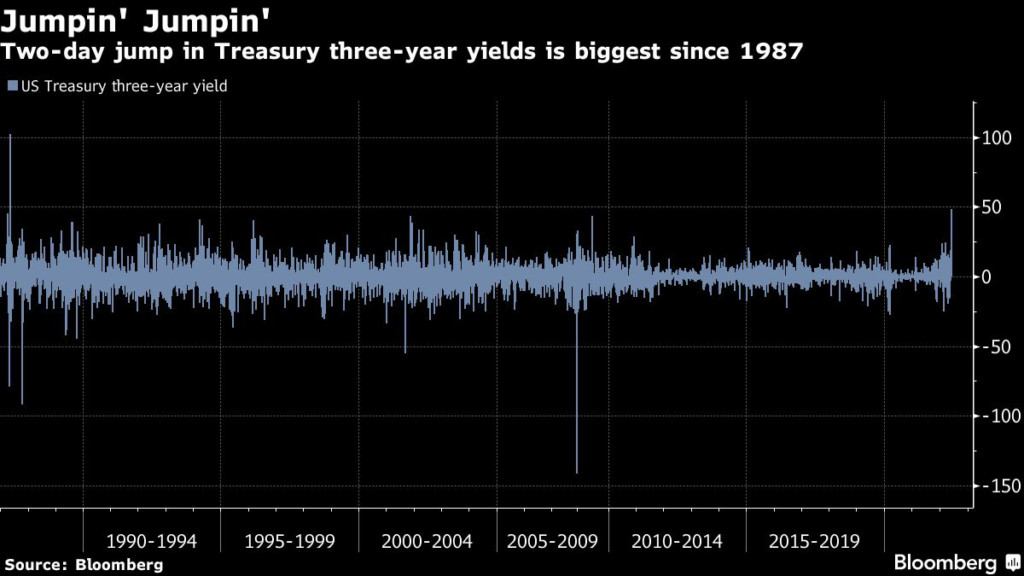
(Bloomberg) — Treasury yields posted their biggest two-day jump in decades on Monday, roiling assets around the world in one of the strongest signs yet that the era of easy money is coming to an end. 

Global markets blew through milestones that seemed far-fetched even a few days ago. Yields on three-year US Treasuries soared, capping the biggest two-day rise since 1987. The S&P 500 tumbled into a bear market, falling more than 20% from its record close in January. The spread between Italian and German benchmark yields — a key gauge of risk in the euro-area — grew to the widest since May 2020. And a gauge of the greenback rose to the highest since the onset of the coronavirus pandemic.

It all stemmed from a worse-than-expected US inflation report last week that underscored the stark choice before the Federal Reserve between fighting stubborn price pressures with aggressive interest-rate hikes and crash-landing the economy. That took on new weight Monday amid speculation that the Federal Reserve could raise rates by 75 basis points as soon as this week — prompting a widespread recalibration from Sydney to New York. 

“There are many cross-currents,” said Priya Misra, global head of rates strategy at TD Securities in New York. “The biggest issue is that central banks may be powerless to stop a recession and that is a tough message for markets to accept.” 

Money markets now see the Fed’s key overnight rate peaking at 4% by the middle of next year, and a 50% chance of a three-quarter-point hike coming as soon as this week. Short-term US Treasury yields led the advance in the curve, with the three-year jumping almost 25 basis points Monday to 3.49%, the highest since 2007.

Meanwhile, a closely-watched part of the US yield curve inverted amid worries that tighter monetary policy could hinder growth in the world’s largest economy.

The day’s moves became more extreme as the US afternoon wore on. 

The S&P 500 plunged 3.9% by the close as all 11 sectors finished in the red. At one point, every member of the S&P was falling and only five stocks recovered by the end of the day to notch gains.

Outside the US, a key index of equities from around the world slipped into a bear market and a gauge of volatility in global foreign-exchange markets surged to the highest level since 2020. 

Almost all of the 31 major currencies tracked by Bloomberg weakened against the dollar as commodity-linked currencies from Norway, New Zealand and Australia — traditionally favored when investors are optimistic on growth — led losses among Group-of-10 peers; oil prices wobbled and copper sank. 

The British pound fell to a two-year low against its US counterpart, after data showed the economy contracted unexpectedly and as traders await the Bank of England policy decision on Thursday. And elsewhere, the Brazilian real, the biggest laggard in the developing world on Monday, extended its longest losing streak since last July, weakening to the lowest level since mid-May. 

The moves in foreign exchange almost universally favored the dollar. Investors have chosen the US currency as the safe haven of choice in the recent bout of volatility, as the yen — another usual refuge in turbulent times — hovers near a 20-year low versus the greenback. The Bloomberg Dollar Spot Index has climbed almost 8% so far this year. 

Read more: Soaring Dollar Is ‘Only Safe Haven Left’ After Hot US Inflation

“Right now we have a strong directional view” said Olga Yangol, head of emerging-market research and strategy at Credit Agricole CIB. “We talk about active currency selection more often than not, but now it’s about getting the direction right. It’s about other currencies versus the dollar.”

More stories like this are available on bloomberg.com

©2022 Bloomberg L.P.
JPMorgan’s Marko Kolanovic Says US Will Avoid Recession

(Bloomberg) — A surge in bond yields that has rattled global stock and currency markets has gone “too far,” leaving the door open for the Federal Reserve to stun investors with less hawkish policy and help engineer a soft landing for the economy, according to JPMorgan Chase & Co. strategist Marko Kolanovic. 

“Friday’s strong CPI print that led to a surge in yields, along with the sell-off in crypto over the weekend, are weighing on investor sentiment and driving the market lower,” Kolanovic and his team wrote in a note to clients on Monday. “However, we believe rates market repricing went too far and the Fed will surprise dovishly relative to what is now priced into the curve.”

Read More: Wall Street Sours on S&P as Margin Woes Rattle Corporate America

Kolanovic expects the Fed to lift interest rates by a half percentage point on Wednesday. His stance diverges from JPMorgan economists, led by chief US economist Michael Feroli, who said they expect the Fed to raise interest rates by 75 basis points at their meeting after a survey showed Americans’ inflation expectations rising.

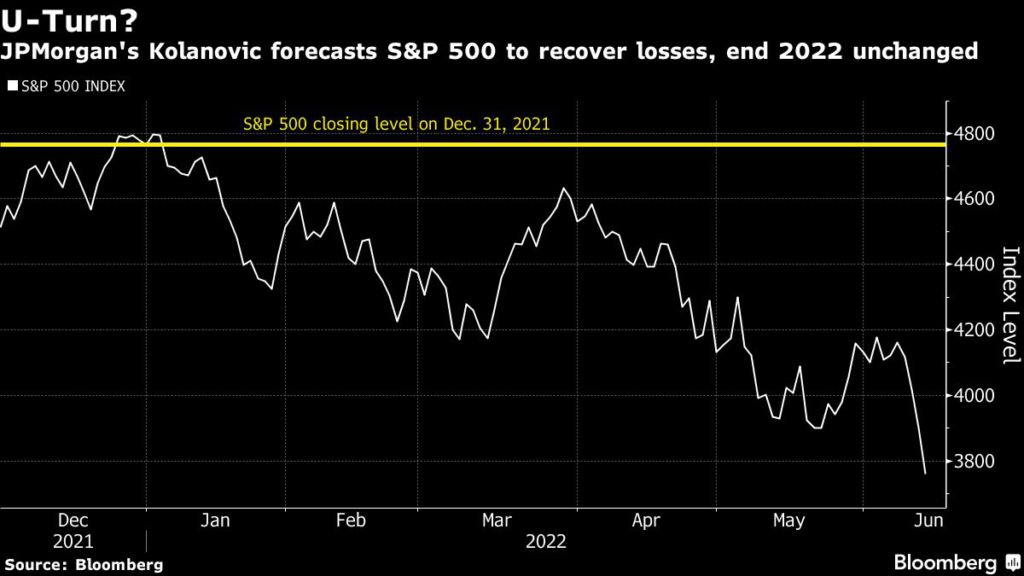
Kolanovic, who was ranked the No. 1 equity-linked strategist in last year’s Institutional Investor survey, reiterated his view that the US stock market is poised for a gradual recovery in 2022 and the S&P 500 Index will likely end the year unchanged. But he hasn’t had much success with his calls so far in 2022, as he has repeatedly urged investors to buy the dip during this year’s steep stock market selloff. 

A growing number of strategists disagree with Kolanovic’s optimistic view. Morgan Stanley’s Michael Wilson, who continues to be among Wall Street’s most prominent bears, sees depressed consumer sentiment as a key risk to the stock market and economy. Kolanovic, however, anticipates that US job growth will slow toward a 100,000 monthly pace later this year, which will likely force the Fed to moderate from its current pace of half-percentage point rate increases.

“The move in markets prices in more than enough recession risk, and we believe a near-term recession will ultimately be avoided thanks to consumer strength, Covid reopening/recovery, and policy stimulus in China,” Kolanovic and his team said. 

(Updates third graf with JPMorgan economist’s outlook)

More stories like this are available on bloomberg.com

©2022 Bloomberg L.P.
Stocks’ Pandemic Bull Run Ends With Recession Fear: Markets Wrap

(Bloomberg) — US stocks entered a bear market, Treasury yields spiked to levels not seen in a decade and the dollar rallied as the fallout from a hot inflation reading continued to rattle global trading already shaken by worries the Federal Reserve will plunge the economy into a recession.

Another brutal bout of selling sent the S&P 500 to the lowest since January 2021 and down more than 20% from its record. Highly valued tech shares bore the brunt of the rout, with the Nasdaq 100 slumping over 4.5%. The Cboe Volatility Index topped 30 and the futures curve inverted in a rare instance of traders pricing in more uncertainty in the here-and-now than in three months. Speculative areas of the market inflated by years of government largesse buckled. Profitless software firms, newly public companies and blank-check entities sold off. Bitcoin plummeted below $24,000 after a lending platform ceased operations.

Credit markets continued their historic repricing of rate trajectories. Treasury 10-year yields climbed to the highest since 2011, while two-year rates jumped to levels last seen before the 2008 financial crisis. The cost to protect investment-grade debt from default soared as a closely watched segment of the US bond curve inverted. Only the dollar provided a respite from the selloff, rallying to a two-year high.

“It’s going to get a little uglier,” said Victoria Greene, chief investment officer at G Squared Private Wealth. “It’s going to be very hard for stocks to rally when the Fed continues to put hawkish pressure. There’s no way they can slam on the brakes with inflation without slamming on the brakes economically speaking. It’s funny we still have recession deniers.”

Read: Sell-Everything Markets Are Serving Up Healthier Doses of Panic

Money markets now see the Fed’s key overnight rate peaking at 4% by the middle of next year as expectations for policy tightening ramp up. Pricing for the US central bank’s so-called terminal rate comes as traders bet on nearly 200 basis points of rate increases at the next three Fed rate decisions — with a 50% chance of a three-quarter point hike coming as soon as this week. Officials are muzzled before the decision on Wednesday and Chair Jerome Powell’s conference, where the characterization of inflation and long-term forecasts for the fed funds target — the so-called dot plot — will be critical.

As the Fed attempts to boost its credibility on inflation, it could reach for a more drastic increase if it’s compelled to demonstrate a “Volcker moment,” said Steven Englander, global head of Group-of-10 currency research at Standard Chartered Bank. He was referring to Fed Chair Paul Volcker, who crushed inflation with a series of historic rate increases, starting in 1979. With that possibility, Englander predicts there’s a 10% chance of a 100-basis-point increase Wednesday — with his baseline still a half-percentage point increase.

Read: Powell Facing Choice Between Elevated US Inflation and Recession

The dramatic moves in the world’s biggest bond market spell further trouble for battered US equities. Recent history shows that stocks tend to swoon when the 10-year Treasury yield hits 3%, as seen in early May and in late 2018, according to DataTrek Research’s Nicholas Colas. It hovered near 3.4% Monday.

Equities still aren’t fully reflecting the risks facing corporate earnings, according to strategists at Morgan Stanley, Goldman Sachs Group Inc. and BlackRock Investment Institute. Weaker consumer demand and aggressive tightening by the Fed in an attempt to fight the hottest US inflation in four decades can do further damage to bottom lines and, in turn, share prices. For Evercore strategist Julian Emanuel, “what’s been missing the last several months is sort of what I would call a ‘cathartic flush out,’ where you get the VIX above 40, which is one of the things you need for at least a trading bottom.”

The last bulwark in stocks is in danger of shattering, if the mood of chief executive officers is any indication. A survey of sentiment among corporate stewards by the Conference Board showed that CEO confidence declined sharply in the second quarter of the year for the fourth straight time. Similar skepticism in the past has always coincided with a recession in profits, wrote Lisa Shalett, chief investment officer at Morgan Stanley Wealth Management.

Read: Morgan Stanley CEO James Gorman Sees 50% Recession Risk

More comments:

  • “The idea that there is some Goldilocks outcome in the cards or soft landing is a mockery,” wrote Danielle DiMartino Booth, chief strategist of Quill Intelligence. “While tightening into a recession is no easy task, the Federal Reserve must indicate a willingness to raise interest rates by more than a half-percentage point at upcoming meetings if inflation continues to surprise to the upside.”
  • “Today, some people are just saying — ‘I don’t want my portfolio to go to zero, I want a couple of nickels out of it’,” said Paul Nolte, portfolio manager at Kingsview Investment Management. “There’s a lot of indiscriminate selling, there is a lot of fear about how far the Federal Reserve is ready to go to fight inflation.”
  • “There has been no follow-through by the bulls,” wrote JC O’Hara, chief market technician at MKM Partners. “Until they have a data point to celebrate, investors will continue to shed risk assets. The largest risk now is that interest-rate expectations are still too low and earnings expectations are still too high.”

The damage in the highly speculative crypto market took on staggering contours as the value of all assets sank below $1 trillion, down by two-thirds from the heady levels reached in November. Bitcoin and its cousins have largely tracked risk assets, but the latest leg down — as much as 17% for the world’s largest digital token — came with concern that the freezing of withdrawals at the Celsius lending platform might indicate systemic risk in the crypto world that could accelerate the meltdown.

“You can’t have these massive drawdowns without some real damage being done and real money being lost,” said Art Hogan, chief market strategist at National Securities.

What to watch this week:

  • US PPI, Tuesday.
  • FOMC rate decision, Chair Jerome Powell briefing, US business inventories, empire manufacturing, retail sales, Wednesday.
  • ECB President Christine Lagarde due to speak, Wednesday.
  • Bank of England rate decision, Thursday.
  • US housing starts, initial jobless claims, Thursday.
  • Bank of Japan policy decision, Friday.
  • Eurozone CPI, Friday.
  • US Conference Board leading index, industrial production, Friday

Some of the main moves in markets:

Stocks

  • The S&P 500 fell 3.9% as of 4 p.m. New York time
  • The Nasdaq 100 fell 4.6%
  • The Dow Jones Industrial Average fell 2.8%
  • The MSCI World index fell 3.7%

Currencies

  • The Bloomberg Dollar Spot Index rose 1.1%
  • The euro fell 1.1% to $1.0408
  • The British pound fell 1.5% to $1.2125
  • The Japanese yen was little changed at 134.38 per dollar

Bonds

  • The yield on 10-year Treasuries advanced 22 basis points to 3.38%
  • Germany’s 10-year yield advanced 12 basis points to 1.63%
  • Britain’s 10-year yield advanced eight basis points to 2.53%

Commodities

  • West Texas Intermediate crude rose 0.2% to $120.92 a barrel
  • Gold futures fell 2.7% to $1,824.60 an ounce

More stories like this are available on bloomberg.com

©2022 Bloomberg L.P.
Crypto Market Sinks Below $1 Trillion After Latest DeFi Blowup

(Bloomberg) — Bitcoin plunged to the lowest in about 18 months after the freezing of withdrawals by the Celsius lending platform added to concern that systemic risk in the crypto ecosystem will accelerate the digital-asset market meltdown. 

The world’s largest digital token tumbled as much as 17% to $22,603 — its lowest since December 2020. Other cryptocurrencies also declined as a broader sell-off continued. The MVIS CryptoCompare Digital Assets 100 Index, which measures 100 of the top tokens, dropped as much as 17%. And the total market value, which topped $3 trillion in November, dropped below $1 trillion during New York trading hours on Monday, according to CoinGecko.

“The fundamentals to support stabilization and recovery just aren’t there,” said Steven McClurg, co-founder and CIO at crypto fund manager Valkyrie Investments. “Things can and likely will get worse before they get better.”  

The shares of companies that have embraced crypto also tumbled. MicroStrategy Inc., the software company that made buying Bitcoin as part of its corporate strategy, fell 25%. Jack Dorsey’s Block Inc. dropped 13%. Bitcoin miners Marathon Digital Holdings Inc. and Riot Blockchain Inc. slumped 12% and 10%, respectively. 

Binance, the largest crypto trading platform, temporarily suspended withdrawals of the Bitcoin network because of an transaction processing issue. Withdrawals were later resumed. 

The selloff comes as traders are boosting bets for a more aggressive pace of Federal Reserve tightening after data Friday showed US inflation jumped to a fresh 40-year high in May. Cryptocurrencies, which have struggled amid the Fed’s policy in recent months, have been hit particularly hard. The collapse of the Terra/Luna ecosystem last month, and lender Celsius pausing withdrawals Monday morning Asia time, have further eroded confidence in the space.

“If you do get long, perhaps think about doing so with either a long call spread or short put spread to limit risk” on Bitcoin futures, said Rick Bensignor, president of Bensignor Investment Strategies and a former strategist at Morgan Stanley. “If this dives, there’s no reliable support nearby.”

Traders speculated that Celsius could face further risks if the broader market selloff deepens. A loan worth more than $278 million, one of the biggest single loans on decentralized lending platform MakerDAO, is labeled as a loan made by Celsius, according to data tracker Block Analitica. If Bitcoin falls below $22,534.89, the position will be liquidated, adding more sell pressure for Bitcoin, the analytics firm said. 

Data shows that the address used 17,919 wrapped Bitcoin, a version of Bitcoin that can be used in decentralized finance, as collateral for a loan worth $278,490,419 in the decentralized stablecoin DAI. While the blockchain explorer Etherescan didn’t labeled the wallet as Celsius, a wallet from Celsius sent additional 2,000 wrapped Bitcoin to support the position. Celsius did not immediately respond to a request for comment on the wallets.

Ether declined as much as 21% to its lowest level since January 2021. Avalanche dropped as much as 20%, Solana up to 19% and Dogecoin as much as 21%. 

Mike Novogratz, the founder and chief executive officer of Galaxy Digital Holdings Ltd., said that cryptocurrencies are closer to a “bottom” than the U.S. equity market. Bitcoin is down around 67%, while Ether has slumped 74%, respectively, since hitting record highs in early November. The S&P 500 is down around 21% this year. 

“Ethereum should hold around $1,000 and it’s $1,200 right now. Bitcoin is around $20,000, $21,000 and it is $23,000, so you are much closer to the bottom in crypto than you are where I think, stocks, are going to have another 15% to 20%” decline, Novogratz said at the Morgan Stanley Financials Conference.   

EXPLAINER: What is ‘DeFi’ and How Does It Work? 

More stories like this are available on bloomberg.com

©2022 Bloomberg L.P.

SpaceX Raises $1.68 Billion, Under Its Targeted Financing Goal

(Bloomberg) — Elon Musk’s SpaceX raised $1.68 billion in fresh financing, less than what it had offered investors for a stake in the closely held rocket launch and satellite company. 

Hawthorne, California-based Space Exploration Technologies Corp., as it’s formally known, sold the equity to a group of 74 investors having offered $1.72 billion of equity, the company said in a regulatory filing Monday.

SpaceX was in talks to raise the funds at a valuation of $125 billion, Bloomberg reported in May. The round would represent a jump from a previous valuation of around $100 billion reached in a round last year.

Read more: SpaceX said in talks to raise funds at $125 billion value

The added funds are expected to help SpaceX build out its Starlink satellite constellation, complete its next-generation Starship spaceship and heavy-lift rocket and continue to recruit aerospace engineering talent in a competitive industry.

More stories like this are available on bloomberg.com

©2022 Bloomberg L.P.
Bored Ape NFTs Face Steep Declines in Broad Cryptoasset Rout

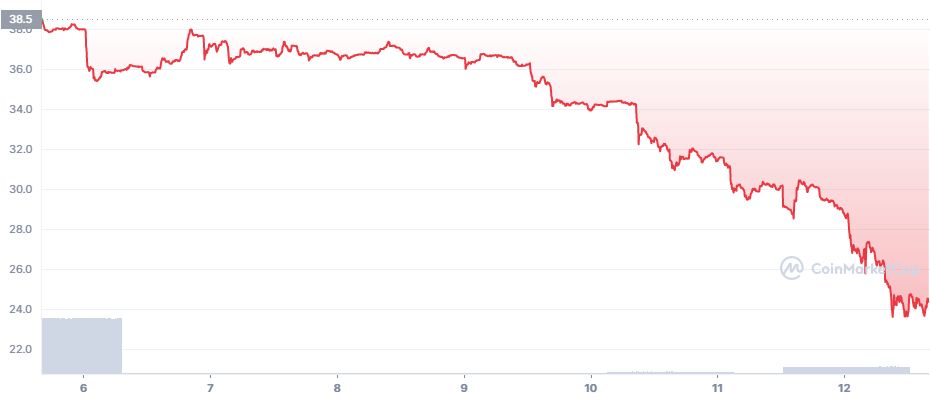
(Bloomberg) — Popular NFT collections, including the celebrity-favored Bored Ape Yacht Club (BAYC), are being hit hard as the crypto market sinks. 

The NFT Index, which tracks the performance of nonfungible tokens and is weighted based on each token’s circulating supply, fell about 23% in the past 24 hours. The BAYC NFTs saw a 25% decrease in average price in the same period, according to data from DappRadar and CoinMarketCap. Some of these tokens sold for millions of dollars in recent months.

The price drops are part of a broader crypto selloff occurring in part because of the surprise inflation readings that hit a 40-year high on Friday. Bitcoin fell as much as 15.5%, reaching an 18-month low and down more than 50% from its all-time record in November. Bitcoin was trading around $23,523 just after the stock market close in New York.

The NFT market had been a bright spot relative to the rest of assets in the crypto space during the market rout. Investors have built substantial portfolios of NFTs in the past six months despite their low liquidity compared to fungible tokes like Bitcoin and Ether. 

(Updates prices)

More stories like this are available on bloomberg.com

©2022 Bloomberg L.P.
MicroStrategy’s Losses on Its Bitcoin Bet Near $1 Billion

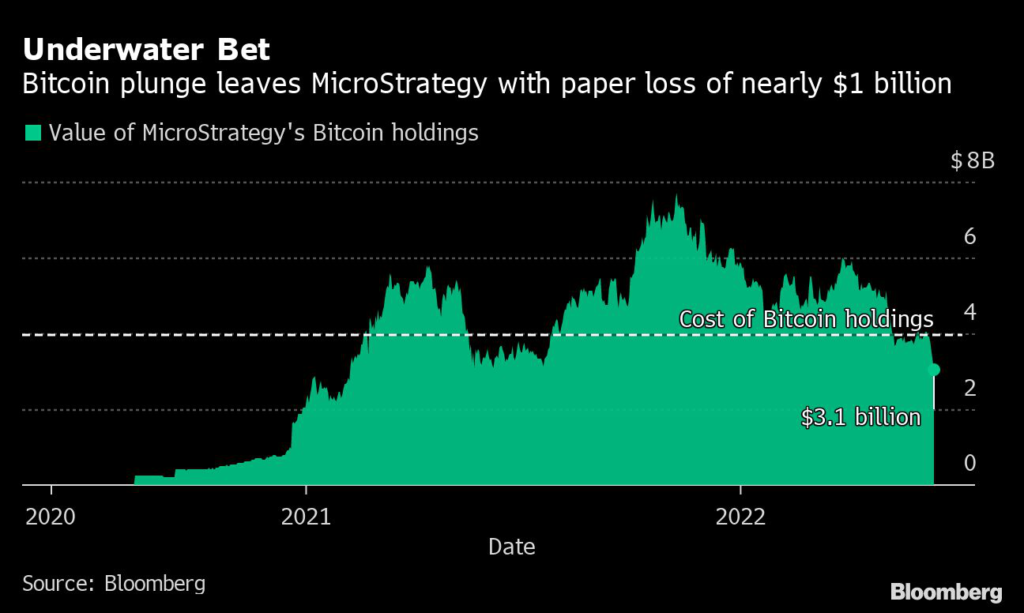
(Bloomberg) — MicroStrategy Inc. founder and Chief Executive Officer Michael Saylor’s big bet on Bitcoin has backfired in a major way as the paper loss for his firm’s holdings of the largest digital asset has reached roughly $1 billion.

Over the last two years the software-maker has shelled out $3.97 billion as it amassed nearly 130,000 Bitcoins. The firm’s average purchase price for those tokens has steadily risen with each additional purchase since 2020 and sits at $30,700 as of March 31, according to its latest quarterly filing with the US Securities and Exchange Commission.

READ: Crypto Debacle at Celsius Rattles Market Already Shaken by Terra

With Bitcoin plunging by as much as 17% to $22,603 on Monday after crypto lender Celsius Network Ltd. paused withdrawals, swaps and transfers on its platform, MicroStrategy’s holdings are now worth just over $3 billion. That puts the company’s Bitcoin related losses at nearly $1 billion.    

MicroStrategy plunged 25% to $152.15 on Monday as part of broader rout by cryptocurrency-exposed stocks. Shares of company have become highly correlated with Bitcoin since Saylor started adding the digital currency to its balance sheet in August 2020 as a hedge against inflation instead of holding cash in the corporate treasury.

The Tysons Corner, Virginia-based company was worth $1.2 billion on Aug. 10, 2020, the day before it announced its foray into crypto. Saylor appeared to be unfazed with the latest Bitcoin drop, sending tweets over Twitter that seemed to signify his confidence in the strategy. 

READ: MicroStrategy Leads Crypto Stock Selloff as Bitcoin Unravels (1)

Among the issues weighing on the company is the threat that an even deeper drop in Bitcoin prices will require it to post additional collateral for the $205 million loan it took out in March. MicroStrategy said on conference call in May that if Bitcoin drops to about $21,000 they would need to post more funds in addition to the $820 million it originally pledged. 

(Adds closing share price.)

More stories like this are available on bloomberg.com

©2022 Bloomberg L.P.
Big Tech’s Floor Collapses on Renewed Fears of Bigger Rate Hikes

(Bloomberg) — The world’s biggest technology stocks are crumbling on Monday as broad markets enter into bear market territory amid fears the Federal Reserve will send the US economy into recession.  

Amazon.com Inc. and Meta Platforms Inc. each fell more than 5% as Treasury yields surged to levels not seen in a decade after last month’s high inflation reading. Apple Inc. and Microsoft Corp. each fell more than 3% to the lowest in about a year, with tech again bearing the brunt of a global selloff that pushed the S&P 500 Index down more than 20% from its January peak.

Tech stocks with lofty valuations are particularly vulnerable to higher interest rates as it weighs on the current value of the companies’ future profits. After a rebound late last month, the group resumed declines on Friday after the consumer price index showed US inflation accelerated to a fresh 40-year high in May, raising the odds of more drastic interest rate hikes by the Fed. 

The selling deepened on Monday, with analysts noting a “bottom” was nowhere in sight. 

“Everyone’s crystal ball is so cloudy right now,” said Ted Mortonson, a technology strategist at Robert W. Baird & Co. “I don’t think we’ll get to a bottom until the Fed absolutely annihilates inflation and can pause, but no one knows when that will be.”

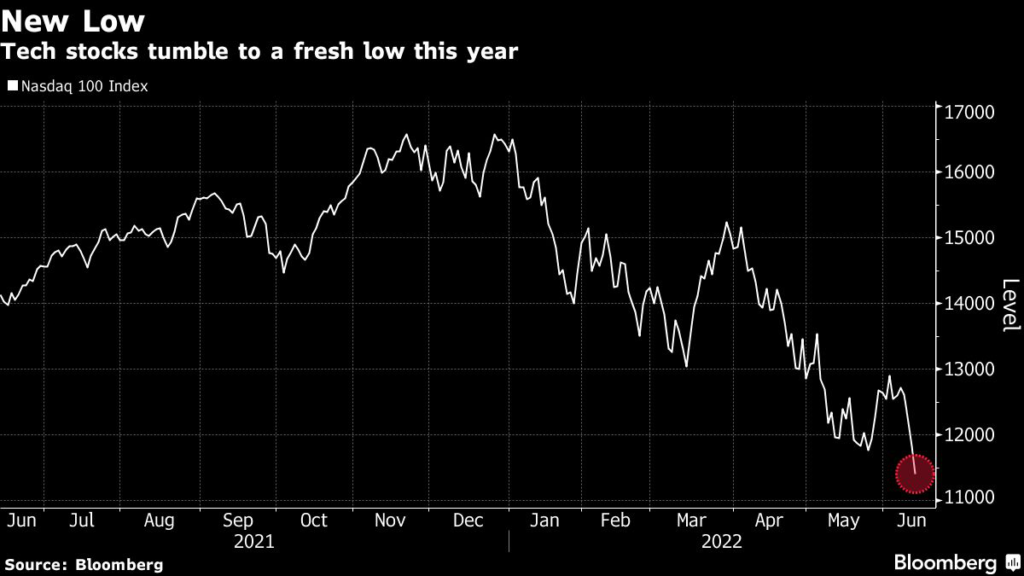
Tech stocks were the biggest drags on the S&P 500 Index Monday, which fell 3.9% to close at its lowest level since January 2021. The Nasdaq 100 is mired in its worst four-day slump since March 2020 after dropping more than 11% since last Tuesday. The index is now down about 32% from its peak last year, while the S&P 500 has slumped 22% from its own record.

Apple, a harbinger of the US stock market, with the biggest weighting in the S&P 500, declined 3.8% on Monday. The stock, which usually helps signal shifts in sentiment among investors, is down 26% this year.

Amazon is inching closer to falling below $1 trillion in market value, Meta closed at its lowest since April 2020 after three days of losses and Microsoft’s four-day losing streak is the longest since March. Chipmaker Nvidia Corp. has lost more than half its value from a peak last year.

“Today’s move is a sign that investors are throwing their hands in the air, looking at the data, and getting nervous about what they see,” said David Lebovitz, global market strategist at JPMorgan Asset Management, who helps oversee $2.6 trillion in assets.

(Updates with closing prices throughout.)

More stories like this are available on bloomberg.com

©2022 Bloomberg L.P.
MicroStrategy Leads Crypto Stock Selloff as Bitcoin Unravels

(Bloomberg) — Cryptocurrency-related stocks plunged on Monday as Bitcoin tumbled to its lowest level in 18 months amid a deepening selloff in risk assets and after a crypto lender halted withdrawals from its platform.

MicroStrategy Inc., which over the last two years has amassed more than 129,000 Bitcoins, led the slump, plunging 25% to close at its lowest level since October 2020. Other crypto stocks including Marathon Digital Holdings Inc., Riot Blockchain Inc. and Coinbase Global Inc. also saw outsized declines of at least 10% each. The MVIS CryptoCompare Digital Assets 100 Index, which measures the 100 largest digital assets, sank as much as 17%.

READ: MicroStrategy’s Bitcoin Bet Backfires as Losses Near $1 Billion

The sharp move lower in Bitcoin came as crypto lender Celsius Network Ltd. said it was pausing withdrawals, swaps and transfers on its platform. Concerns surrounding the sustainability of the high yields offered by the firm have surfaced in recent weeks following the collapse of the TerraUSD (UST) stablecoin, which promised yields of as much as 20% to depositors.

“Crypto fans have become used to volatile rides, but these rollercoaster descents are increasingly hard to stomach,” said Susannah Streeter, senior investment and markets analyst at Hargreaves Lansdown. “With the era of cheap money coming rapidly to an end, traders are becoming much more risk averse and turning their backs on crypto assets.”

Read more: Crypto Lender Celsius Stops Withdrawals, Fuels Market Slump 

Crypto stocks have been under pressure for months as the prospects of higher interest rates, a possible recession and the collapse of the Terra/Luna ecosystem in May weighed heavily on investor sentiment. The CoinShares Blockchain Global Equity Index, which tracks 49 firms from around the globe with crypto exposure, has fallen nearly 40% so far this year, on pace for its worst annual performance on record.

While risk assets more broadly are lower Monday morning, the plunge by crypto stocks has been exacerbated by the rapid drop in Bitcoin prices. The world’s largest digital asset toppled as much as 17% and briefly broke below the $23,000 level as it fell for a seventh day in a row.

“Sentiment for cryptos is terrible as the global crypto market cap has fallen below $1 trillion dollars,” said Ed Moya, senior market analyst at Oanda. “Bitcoin is attempting to form a base, but if price action falls below the $20,000 level, it could get even uglier,” he added.

(Updates with analyst comment in final paragraph, updates pricing throughout)

More stories like this are available on bloomberg.com

©2022 Bloomberg L.P.
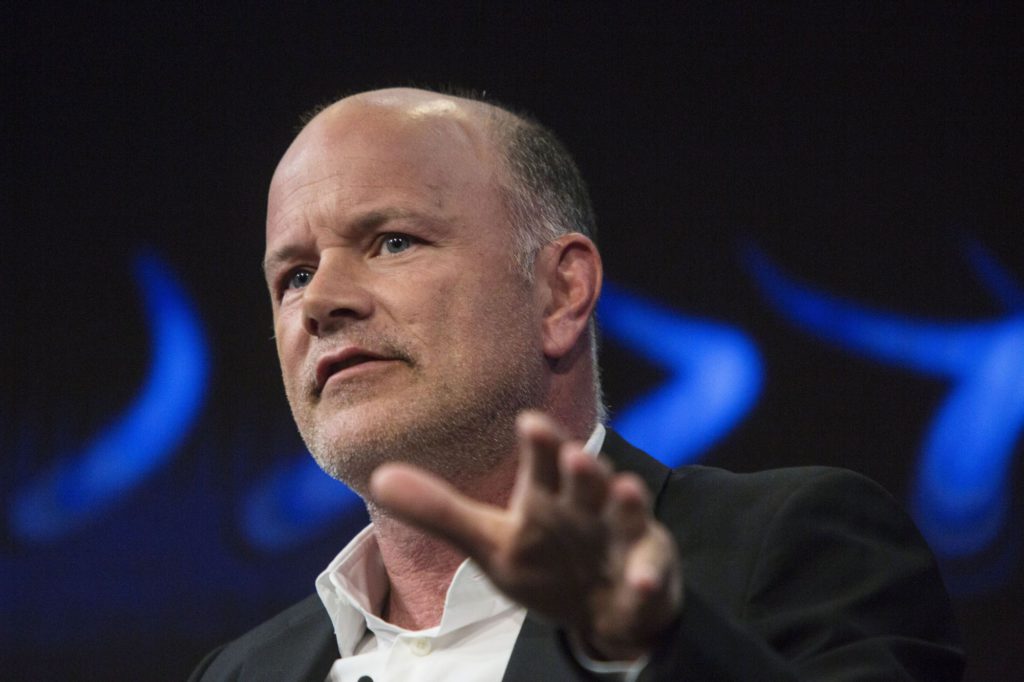
Novogratz Says Crypto Market Is Closer to a Bottom Than Stocks

(Bloomberg) — Mike Novogratz, the founder and chief executive officer of Galaxy Digital Holdings Ltd., said that cryptocurrencies are closer to a “bottom” than the U.S. equity market.

Both sectors tumbled Monday as investors brace for a more hawkish Federal Reserve to ratchet up interest rates, raising the risk of a US recession. Crypto has been especially hit hard with the lending platform Celsius halting withdrawals on Monday. 

Bitcoin, the largest digital asset, fell as much as 17% to $22,603, while smaller rival Ether dropped as much as 21% to $1,165. They’ve slumped 67% and 74% respectively since hitting record highs in early November.

“Ethereum should hold around $1,000 and it’s $1,200 right now. Bitcoin is around $20,000, $21,000 and it is $23,000, so you are much closer to the bottom in crypto than you are where I think, stocks, are going to have another 15% to 20%” decline, Novogratz said at the Morgan Stanley Financials Conference. 

The benchmark S&P 500 Index has declined about 22% from its record high in early January.

“Until I see the Fed flinch, until I really think, OK the economy is so bad, and the Fed is going to have to stop hiking and even think about cutting, I don’t think it is time to really deploy lots of capital,” Novogratz said.   


More stories like this are available on bloomberg.com

©2022 Bloomberg L.P.

Close Bitnami banner
Bitnami
