Bloomberg

Top Steelmaker in South Korea Halts Production on Trucker Strike

(Bloomberg) — South Korea’s top steelmaker Posco said it has halted output of some products as a prolonged strike by truck drivers adds more disruption to global supply chains. 

The Pohang-based company stopped production at its four wire-rod factories and two cold-rolled steel plants as of 7 a.m. Monday after the strike by truckers exhausted Posco’s warehouse space, it said in response to a Bloomberg query. The daily output of wire rod will be curbed by about 7,500 tons, and cold-rolled steel by 4,500 tons, the firm said. 

Shares of Posco Holdings Inc. fell as much as 3.4% in early trading in Seoul on Monday.

The strike — one of the first economic challenges for newly elected President Yoon Suk Yeol — is entering its seventh day as truckers in the nation protest the removal of a minimum wage scheme amid soaring fuel prices. Deliveries of automobiles, fuels, steel and materials for semiconductor chips have been suspended or delayed, exacerbating disruptions to global supply chains after Covid-19 lockdowns in China and Russia’s invasion of Ukraine. 

See also: Trucker Strike in South Korea Poses New Risk to Global Trade

It’s uncertain how long the strikes will continue, as talks between the union and government officials have so far made little progress. A prolonged dispute threatens to have ripple effects across the globe, as South Korea is the largest exporter of memory chips and is home to some of the world’s biggest car companies. 

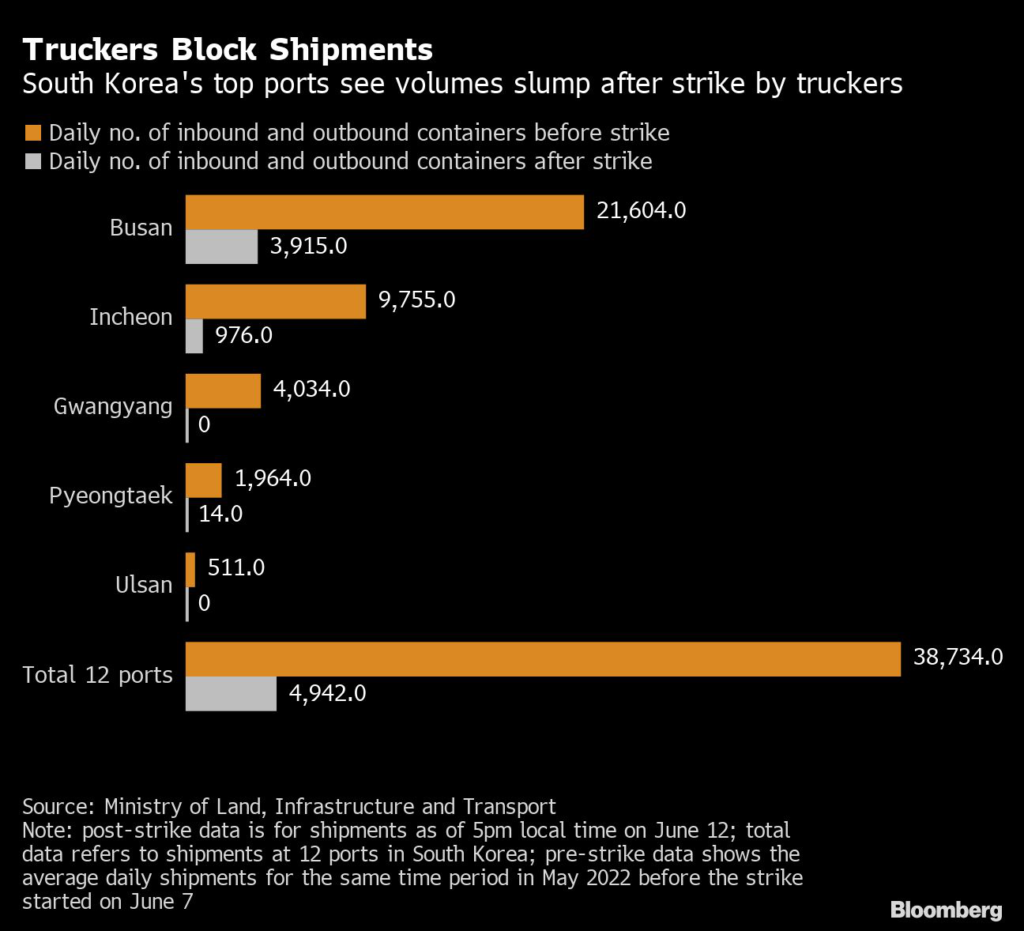
The daily volume of container boxes transported to and from the nation’s 12 ports dropped 87% on Sunday compared with the average for May, according to data from the Ministry of Land, Infrastructure and Transport. Inbound and outbound volumes at Busan, the world’s seventh-busiest port, were less than a fifth of their usual amount. 

Steel and cement are among the hardest hit industries so far, as drivers move to block deliveries of the Asian country’s most critical export items. Posco said last week it was struggling to ship a total of 35,000 tons of steel from its two plants to points within the country, down from the usual daily delivery of about 100,000 tons.

While Posco is working on minimizing the impact from the strike, there’s a possibility that the company may have to further reduce production depending on the scale and duration of the strike, according to a spokeswoman. The company is currently piling up products at parking lots and roads inside the mill, it said. 

More stories like this are available on bloomberg.com

©2022 Bloomberg L.P.

Bitcoin Drops to One-Month Low as US CPI Report Hurts Sentiment

(Bloomberg) — Bitcoin continued its selloff into Asia’s Monday morning as part of broader declines in cryptocurrencies after a sharp rise in US inflation triggered risk-off sentiment. 

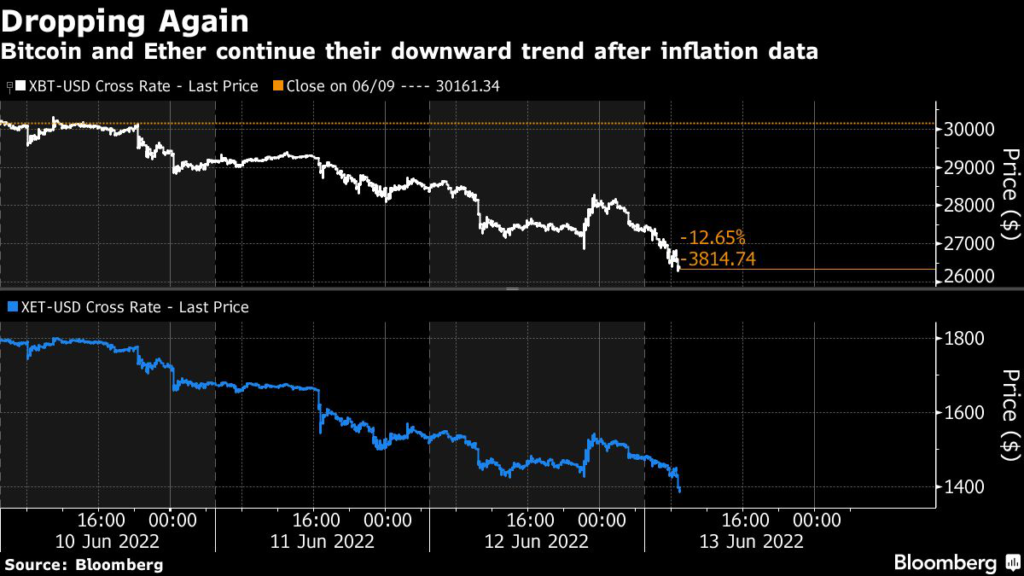
The world’s largest digital token tumbled as much as 6.4% to $25,593, its lowest level since May 12, in a seventh day of losses. Ether fell as much as 9% to $1,342.32. Other coins tracked by Bloomberg including Cardano, Dogecoin, Polkadot and Avalanche were also in the red. 

“Cryptos remain at the mercy of the Fed and stuck in a merry dance with the Nasdaq and other risk assets,” said Antoni Trenchev, co-founder and managing partner of crypto lender Nexo. “We’re hearing Bitcoin forecasts in the mid-teen and single-digit thousands which tells you the type of macro environment crypto is facing for the first time — and the levels of fear.”

Traders are boosting bets for a more aggressive pace of Federal Reserve tightening after data Friday showed US inflation jumped to a fresh 40-year high in May. This triggered a selloff in risk assets including crypto and stocks. 

More stories like this are available on bloomberg.com

©2022 Bloomberg L.P.

‘Squid Game’ Stock Jumps After Netflix Announces Second Season

(Bloomberg) — Netflix Inc.’s “Squid Game” will return for a second season, with the online streaming company returning to its global hit to recover from an unexpected drop in subscribers. 

“Join us once more for a whole new round,” Hwang Dong-hyuk, the drama’s director, writer and executive producer, said in a letter posted on Netflix’s website. Gi-hun returns he said, referring to the main character. And audiences will be introduced to Cheol-su, the “boyfriend” of the show’s large animatronic doll Young-hee.

Bucket Studio Co., which holds a stake in the agency representing Squid Game’s lead actor, jumped nearly 24% in Seoul on Monday amid a broader selloff in Asian stocks.

“Squid Game,” in which a group of indebted people compete in deadly versions of childhood games to win money as super-rich VIPs watch, was Netflix’s biggest launch ever. The series boosted the popularity of Korean content worldwide and prompting global players including Walt Disney Co., Apple Inc. and Warner Media to invest in local-language titles and original series to lure subscribers. 

Netflix is betting that a second season may help stymie this year’s 70% slump in shares after announcing in April that it had lost 200,000 subscribers in the first quarter, the first time it has shed customers since 2011. The company projected it will shrink by another 2 million customers in the second quarter. 

More stories like this are available on bloomberg.com

©2022 Bloomberg L.P.

These Are Four Challenges for $441 Billion Rebound in China Tech

(Bloomberg) — Chart patterns indicate that a revival in China’s technology stocks is running into key technical tests.

The Hang Seng Tech Index has rallied 39% since mid-March through Friday on bets that Beijing is drawing the curtain down on a regulatory clampdown on the sector. That’s added $441 billion in market value across the 30-member gauge. The index lost as much as 4.4% on Monday amid a global selloff after US consumer prices rose at a fresh 40-year high. 

There are also tentative hopes that the worst of China’s Covid lockdowns have passed, although virus flareups and repeated shutdowns remain a risk. Another challenge is damage to wider risk sentiment from the inflationary pressures cascading through the global economy.

While China’s economy “is likely to bottom out in April to June, it’s not clear if companies are willing to spend a lot of money on advertising, which is a vital factor for many tech shares,” said Wang Shenshen, senior strategist at Mizuho Securities Co. “Markets will probably need to see clear signs of solid growth in tech companies for their shares to rise.” 

Four charts sum up some of the technical challenges Chinese tech stocks face:

Hang Seng Tech

The Hang Seng Tech index, which includes firms such as Alibaba Group Holding Ltd. and Tencent Holdings Ltd., has broken above a bearish zone in Ichimoku Cloud analysis, a popular technical study. Both the gauge and the so-called lagging span — which shows closing levels plotted 26 days into the past — have broken above the zone. Proponents of the study argue this pattern has to hold to bolster the index’s outlook. 

US-Listed Shares

The Nasdaq Golden Dragon China Index added more than 6% last week to close just above its 20-week average for the first time since its plunge began in February last year. Holding above the average, and pushing through 8,300 to 8,700, are thresholds technicians are watching to cement nascent optimism about the prospects for the 81-member gauge of US-traded Chinese shares.

China Internet ETF

The $7.6 billion KraneShares CSI China Internet ETF (ticker KWEB) has jumped about 49% since mid-March. The rally is now meeting resistance at the $33 to $34 price zone. This zone is a region that includes the measured objective from a so-called reverse head and shoulders and a key Fibonacci level.

History Test

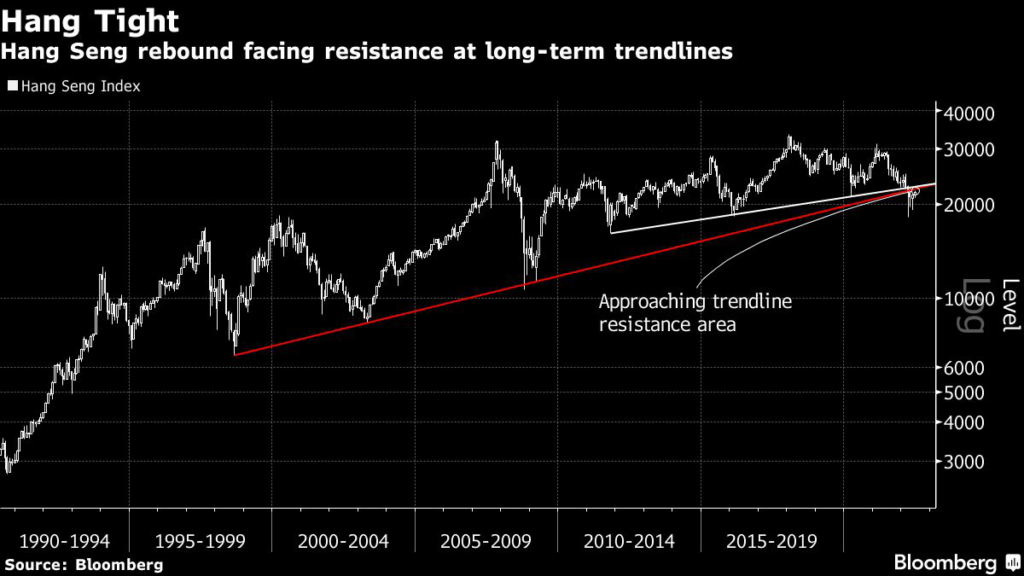
The broader Hang Seng Index has been lifted by the tech revival but also faces a test. Earlier this year it slid below a trendline originating from 1998 Asian financial crisis lows. The trendline, which earlier had acted as reliable support, is now a key resistance the gauge must overcome.

(Updates with Hang Seng Tech Index move in second paragraph)

More stories like this are available on bloomberg.com

©2022 Bloomberg L.P.

France Closes Gap on UK Finance Sector for Foreign Investments

(Bloomberg) — France’s financial sector is now the most popular destination in Europe for US backers, helping the country narrow the gap with the UK for foreign direct investment in the industry. 

The country recorded a total of 60 FDI projects in finance last year — its highest in a decade, according to a survey by the professional services firm EY. France overtook Germany for second place in 2020, when activity dropped across much of the region due to the Covid-19 outbreak.

American investors, who are the largest source of FDI in Europe, backed 19 deals in France, compared to 17 in the UK. However, Britain is still slightly ahead overall with 63 projects receiving cross-border funding in 2021, up seven from a year earlier.

Overall, the UK and France bucked the trend as FDI across Europe fell by 2.8%, representing the third successive annual decline.

Anna Anthony, UK financial services managing partner at EY, said financial systems worldwide had been tested “first with the pandemic and now with high levels of geopolitical uncertainty.”

Britain is flexing its muscles on international trade since leaving the European Union last year. The nation has signed a string of trade pacts and has courted foreign backers for promising growth sectors such as fintech. It’s also subjecting cross-border deals to greater scrutiny where they might pose national security risks. 

The UK could improve its attractiveness to investors by improving social infrastructure and workers’ skills, according to the survey conducted between February and May with over 100 international decision-makers in banking, insurance, wealth and asset management and fintech.

London remains the most popular city for financial services FDI, with 39 projects funded and about two-thirds of respondents saying it was attractive. Paris is catching up, with 38 projects last year, up from 21.

“There is never a time for complacency, however, and the industry must keep a strong focus on doing all it can to attract investors to our shores,” Anthony said in a statement. 

More stories like this are available on bloomberg.com

©2022 Bloomberg L.P.

Oracle’s Database Dominance Eroded by Rise of Cloud-First Rivals

(Bloomberg) — When Shutterfly decided recently to move the database where it clusters reams of customer photos to the cloud, one name was noticeably absent from its list of potential providers: Oracle Corp.

The company had for years relied on Oracle products to manage the photo libraries of its more than 20 million active customers. But as Shutterfly progressed on the effort to switch its systems to internet-based services from Amazon.com Inc.’s cloud division, Chief Technology Officer Moudy Elbayadi recognized it also needed to shift its database to something that was easier to use.

“The amount of time and energy that was consumed purely running just the plumbing was immense,” Elbayadi said in an interview. And reviewing other options in the marketplace, Shutterfly found that Oracle’s systems didn’t “fit our desires to have that level of openness and flexibility,” he added.

Shutterfly isn’t the only company taking advantage of the boom in database vendors to diversify beyond Oracle. Businesses are opting to align with newer providers such as MongoDB Inc., Databricks Inc. and Snowflake Inc. instead of Oracle, the sector stalwart, as a result of changes across the enterprise technology landscape. 

The move to the cloud is challenging the systems of the past. Newer providers are also making it much easier to adopt their technology directly, alleviating the need for corporate purchasers to negotiate large contracts with salespeople and allowing end users to more easily pick their own tools. Offerings from the newer software makers can also be deployed without large teams of database administrators that are typically needed to support Oracle’s products, a cost-saver for organizations that would otherwise have to fight against other businesses for these in-demand engineers.

The evidence of the shift is widespread. JPMorgan Chase & Co. chose Cockroach Labs Inc. as the database vendor to support its new retail banking application in Europe. Nasdaq Inc. is working with closely held Databricks and Amazon.com Inc.’s Amazon Web Services, among others, in its quest to upgrade from on-premises Oracle data repositories. Alongside AWS, database products from rival cloud vendors Microsoft Corp. and Alphabet Inc.’s Google Cloud are also growing quickly. And many businesses, like JetBlue Airways Corp. and Automatic Data Processing Inc., are tapping Snowflake to help store and analyze corporate data to power sales dashboards, among other uses.

“We have actually quite rapidly been reducing our Oracle footprint,” said Nikolai Larbalestier, Nasdaq’s senior vice president of cloud strategy and enterprise architecture. “There are plenty of good alternatives today.”

Collectively, the initiatives are just a small fragment of the estimated $155 billion database market. But it’s evidence of a tectonic shift happening within the industry, one that is threatening the leadership status Oracle cultivated over the past 43 years, ever since co-founder Larry Ellison and his team brought to market the first relational database, or one in which information was organized in tables that could be more easily accessed, manipulated and analyzed.

Still, Oracle remains an industry leader for its ability to provide consistent quarterly earnings growth. With the Austin, Texas-based company scheduled to release fiscal fourth-quarter results Monday, analysts project revenue will increase 4% to $11.7 billion — far more than its newer, smaller competitors. And the company just completed its $28.3 billion acquisition of electronic medical records provider Cerner Corp., opening a significant new area of potential expansion.

“Oracle presents an interesting opportunity for better-than-expected EPS growth in a choppy marketplace,” Keith Weiss, an analyst at Morgan Stanley, wrote in a report June 6.

Databases are critical to modern life. There isn’t an online service, retail transaction or medical procedure available today that doesn’t have a database supporting it on the back end, keeping track of people’s choices and results. And the corporate dashboards that executives rely on to manage day-to-day operations are propped up by curated data repositories long-sold by Oracle and others. 

It’s hard to overstate Oracle’s influence in the evolution of the technology. Despite all the hype of cloud computing, many large businesses still run their databases via on-site centers. Companies that were in existence before 2000 are almost certainly still using mainframes. Moving from either is difficult and companies don’t take make such changes lightly. Instead, many are opting for a step-by-step approach: keep the old Oracle systems running, but use another vendor for new projects.

“Someone is not going to wake up one day and say they need to replatform their Oracle database,” MongoDB Chief Executive Officer Dev Ittycheria said in an interview. “It’s not the bulk of our business because we are seeing so much explosion of new apps. But we are seeing a very healthy take-rate of customers migrating off of legacy relational databases like Oracle.”

That’s why, at least for the foreseeable future, Oracle will continue to be a force in the industry. The company’s database business pulled in an estimated $15.6 billion in 2020, according to research firm Gartner. Oracle doesn’t disclose financial results specifically for its database business. Much of that revenue comes from providing support and maintenance for existing customers versus new sales.

But Oracle’s influence is slowly fading. While it owned an estimated 27% of the database market in 2019, that fell to 24% in 2020, per Gartner. In the same time frame, Amazon went from 17% market share to almost 21%.

Oracle declined to comment for this story. 

Rivals are growing quickly. At MongoDB, for example, sales rose 57% to $285 million in the most recent quarter. Those results, analysts and company executives say, indicate businesses are using MongoDB for increasingly larger projects.

Part of what is driving that change is the emergence of the cloud, which is giving businesses an option to move away from legacy vendors and use more specialized systems that can be tailored to support certain applications or workloads.

“Every time there’s a transition of infrastructure, there’s a recasting of the core markets,” said Dave McJannet, CEO of HashiCorp Inc., a company that helps users manage applications across different cloud environments. “People are not deploying net-new Oracle.”

Databases from vendors like Timescale, for example, excel at pulling information within a specified time frame, such as how many sessions one user logged on a gaming platform in the previous five days. In-memory databases from Redis Labs Inc. can run queries in milliseconds by scanning data without the need to save it in a separate storage center, letting a client, for example, analyze the feed from internet-enabled sensor to determine if a machine needs maintenance.

The move to the cloud and changes to the way databases work have escalated demand for developers, a role that is gaining more influence within organizations. In the past, building an application required a team of administrators with high salaries who could work with the standard database to make it fit a company’s needs. That’s not feasible for many businesses. 

For example, Andreessen Horowitz-backed video-game creator Mythical Games is sitting at a $1.2 billion valuation, but CEO John Linden acknowledged it would be impossible for them to hire the staff needed to support Oracle.

“Oracle hits us up every week,” he said. But “we’d have to have a massive team in place to run it appropriately.”

With Cockroach, Mythical Games developers are able to immediately build applications and run them. For startups and large enterprises alike, that can be a major cost savings.

“I can’t even hire people if I told them that we majorly use Oracle,” said Yao Morin, chief data officer at JLL Technologies. “People are yearning for better tools.” 

Despite the migration from some businesses away from Oracle, there are big reasons why customers stay.   

Oracle has very powerful and reliable technology. When Moderna Inc. was running clinical trials for its Covid-19 vaccine, partner Medidata Solutions used an Oracle database to manage and analyze billions of records, a spokesperson confirmed. Oracle also has a deep history of working with the world’s largest businesses. While the mandate to invest in technology is clear, many companies are risk averse and are fine sticking with Oracle instead of undergoing a massive, complicated IT overhaul.

There’s a good business reason the company emphasizes its database: Oracle makes a significant portion of its revenue on existing customers. Every few years, when companies have to renew their contracts, Oracle can raise prices for maintenance and support — a business with margins hovering around 95%, according to Craig Guarente, a 16-year veteran of Oracle who is now CEO and co-founder of consulting firm Palisade Compliance. 

“The entire profit of the company comes from Oracle database maintenance,” he said. With each contract negotiation, “you go from paying $20 million a year, to $30 million a year, to paying $50 million a year.”

Oracle’s dominance has led to questions from analysts over just how much success smaller rivals will have persuading businesses to move away from the company, particularly when it comes to the most critical operations. 

Still, the competition is gaining. When American Tire Distributors Inc. was seeking to upgrade its on-premises databases to the cloud, it chose MongoDB. While the company declined to disclose which vendors it used previously, Chief Information and Digital Officer Murali Bandaru said the relational databases that dominated the landscape are no longer equipped to handle the digital-first nature of most businesses.

“We had systems that were built for the last decade of growth,” Bandaru said. “We had to liberate that data into more modern systems.”

More stories like this are available on bloomberg.com

©2022 Bloomberg L.P.

Microsoft Unveils New Titles as Xbox Game Pass Builds Momentum

(Bloomberg) — During a flashy 90-minute presentation full of game trailers, Microsoft Corp. revealed dozens of new titles for its subscription service, Xbox Game Pass, including several from the big publishers it purchased in recent years.

Sunday’s presentation in Los Angeles started and ended with two big games coming next year from publisher Bethesda, which Microsoft bought in 2020: Redfall, a first-person shooter in which players fight vampires, and Starfield, a role-playing game set in space. Microsoft also spotlighted Activision Blizzard Inc.’s Overwatch 2, which will enter early access in October with a free-to-play competitive multiplayer mode, and Diablo IV, which arrives in 2023.

All four games will be on Xbox Game Pass, the core of Microsoft’s gaming strategy and the reason it paid $7.5 billion for Bethesda and is buying Activision Blizzard for $69 billion. Game Pass allows users to pay monthly for unlimited access to a growing list of hundreds of games. Microsoft has bet big on Game Pass, which it said in January has 25 million subscribers, who pay at least $10 a month.

Rather than engage in a hardware duel with rivals Sony Group Corp., the maker of PlayStation, and Nintendo Co., Microsoft is working to create the Netflix of gaming — and by many accounts is already close to doing so. Almost every game at the showcase ended with a chyron saying, “Play it day one with Game Pass,” a constant reminder of the company’s strategy.

Microsoft’s showcase is an annual tradition that normally takes place during the E3 trade show, where the biggest video game publishers gather to show off new and upcoming projects. But E3 was canceled this year, and other publishers such as Ubisoft and Sony skipped their annual presentations, giving Microsoft the solo spot Sunday.

During the showcase, Microsoft also announced a new Minecraft spinoff called Minecraft Legends as well as several colorful indie titles such as an action game called Ravenlok and an adventure game called Cocoon, all of which will be available on Game Pass the day that they launch.

One highlight of the show was Pentiment, a medieval narrative adventure game with a unique art style, from Microsoft-owned developer Obsidian Entertainment Inc. Although the game has no combat and will likely have niche appeal, it may be a good fit for Game Pass, where experimental games can flesh out the lineup without necessarily needing to sell blockbuster numbers. 

Microsoft also positioned Game Pass as a service that will be beneficial for otherwise free games. During the show, Riot Games Inc. said it would partner with Xbox to give Game Pass subscribers access to paid content for its games, which include League of Legends and Valorant. Anyone who subscribes to Game Pass will get access to all of those games’ heroes, which are normally sold separately, for free.

More stories like this are available on bloomberg.com

©2022 Bloomberg L.P.
Why Bitcoin Sees Most Of Its Gains While US Traders are Asleep

(Bloomberg) — When Wall Street goes to sleep, Bitcoin is usually just getting going. It often parties all night long, and in the process, notches more robust gains than while US markets are open. 

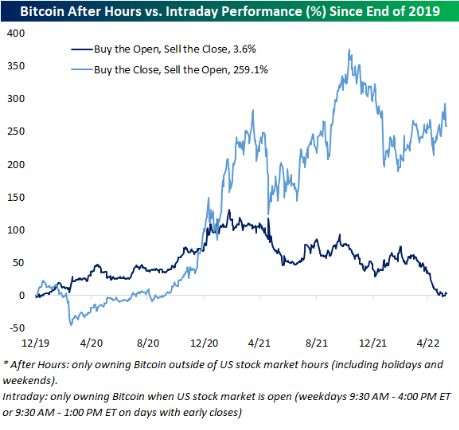
A hypothetical strategy that buys the coin at the equity-market close — at 4 p.m. in New York — and sells it at the next day’s open — at 9:30 a.m. — yields gains of roughly 260% going back to the start of 2020, according to Bespoke Investment Group. Conversely, buying it at the US market open and selling it at the close spits out an advance of 3.6%. The coin even tends to trend higher during weekends, the firm found, when stock investors are resting or barbecuing or doing whatever weekend activities they’re fond of. 

Yet no one seems to be able to agree on why this might be happening.

Theories abound, with some positing that investors have no choice — thanks to the market’s 24/7 nature — but to turn to crypto while stocks are closed for trading. Others suggest that crypto traders are forced to process loads of information overnight, which gives way to large price swings.  

Bitcoin fell as much as 5.3% to $26,876 on Sunday, the least since the aftermath of the collapse of the Terra blockchain at the start of May. It was down about 1.7% to $27,891 as of 12:52 p.m. in New York.

Here are a few views on why the phenomenon might be happening:

The Nature of a 24/7 Market

The fact that cryptocurrencies trade around the clock every day of the week makes Bitcoin, by default, the most watched and traded asset when traditional markets are closed, and that’s a top reason for the overnight phenomenon, says Bloomberg Intelligence’s Mike McGlone. “It’s the most fluid global 24/7 trading vehicle in history, which means it’s a leading indicator on the downside too,” he said.

Geographical Differences

In the US and certain other geographies, riskier assets have sold off this year as the Federal Reserve and other central banks institute policies to combat high inflation. But that might not be the case everywhere, and risk-on attitudes may still be at play across Asia, for instance, says Noelle Acheson, head of market insights at Genesis Global Trading. 

Back in 2015 and 2016, China had been a focal point for Bitcoin trading — that’s where mining took off and most of the trading volume originated, she said. “There are different cultural attitudes toward riskier investments.”

In addition, some investors might be more drawn toward using leverage, and international venues are sometimes more permissive in that way. Original crypto exchanges used to offer 125x leverage, said Acheson, though, in the US, regulators have looked to curtail such access. “So they are much more used to high leverage, it’s much more what they expect,” she said. 

Longer Span of Time

Bitcoin’s correlation to equities could be another factor at work, which is something analysts have been pointing to all year as both cryptos and equities have sold off. Both stocks and digital assets are considered riskier plays, so the two have moved hand-in-hand, says Jake Gordon at Bespoke Investment Group. 

Still, the correlation to stocks may not explain why the trend of after-hours outperformance also existed when the market was rallying over the past two years, he said. So another explanation is that the post-close strategy covers a longer span of time, “meaning there is the potential for more news/catalysts to account for.” 

Watching the Charts

From 2021 onwards, due to China’s crackdown on crypto, trading volumes and flows have tended to peak around 9:30 a.m. Eastern Time, according to Chiente Hsu, co-founder and CEO at ALEX, a DeFi platform. “So trading volume is highly correlated to the US stock market trading hours,” she said in an interview. Hsu, who used to work at Morgan Stanley, cited a research paper showing that the overnight trend of buying at the close and selling at the open was also prevalent in the stock market before the pandemic. 

But why might that be the case? Hsu says information flows build up overnight, though that’s mostly prevalent during uptrend markets. What about bear markets? “In a downtrend market, it shouldn’t work, particularly in very volatile, range-bound markets,” she said, adding that she’d like to see more research on these types of topics, as well as how transaction costs play a part. 

Correlations

Vetle Lunde, analyst at Arcane Research, says he expected US trading hours to be the most significant contributor to the Bitcoin selloff in recent months, but hadn’t expected to see that being the only contributor. “Then again, it confirms what we’ve seen elsewhere in the market,” Lunde said, citing the coin’s strong correlation to stocks this year. 

“We saw in mid-2020 to early 2021 that US trading hours were the key trading hours for the initial liftoff during the early bull market. That period was characterized as a period of huge institutional flows into Bitcoin,” Lunde wrote in a message. 

“Now, most of the institutional market has been focused on de-risking, with the macro backdrop related to inflation and interest-rate hikes being the key component behind the de-risking. This has most definitely had a severe impact on Bitcoin and is likely the root cause behind the very potent continuous selling pressure during US trading hours.”

(Updates prices in the fifth paragraph.)

More stories like this are available on bloomberg.com

©2022 Bloomberg L.P.
Crypto Pares Losses From Decline Fueled by US Inflation Data

(Bloomberg) — Bitcoin and Ether pared losses, after falling earlier on Sunday amid a broader retreat by the cryptocurrency complex in the wake of data showing US inflation hitting a fresh 40-year high.

Ether declined as much as 6.4% to $1,424.40, its lowest level since March 2021, while Bitcoin dropped to as low as $26,876.51, its lowest since May 12. Virtually all top tokens tracked by Bloomberg were down Sunday, with the likes of Dogecoin and Avalanche falling as much as 9.4% and 13% respectively. But they then showed some signs of life, rallying off their lows as of 11:45 a.m. Sunday in New York — and Ether even briefly made its way back to positive territory for the day.

US inflation data Friday topped expectations, dashing any hopes that rising prices may have peaked. Stocks sank while two-year Treasury yields climbed to the highest since 2008. Bitcoin and other cryptocurrencies have suffered in recent months as the Federal Reserve hikes rates and global policy makers step up efforts to combat price increases, and as risk assets like tech stocks retreat.

The inflation data is helping fuel the downward action and “very likely we see this bearishness continue on to the next week especially with the FOMC meeting coming up,” said Vijay Ayyar, vice president of corporate development and international at crypto platform Luno. 

“If one looks at previous bear markets, Bitcoin has declined around 80%-plus normally, with altcoins typically doing 90%-plus,” said Ayyar. “If that remains the case, we could see much lower Bitcoin prices over the next month or two.”

Some analysts have said that if Bitcoin got below the high-$20,000s level, it might gap down quickly, with levels like the 200-week moving average near $22,000 and even the 2017 high at $19,511.

Total long crypto liquidations were above $100 million for a third straight day on Sunday, after $258 million on Friday and $290 million on Saturday, according to data from Coinglass. And the MVIS CryptoCompare Digital Assets 100 index, a market cap-weighted measure tracking the performance of the 100 largest tokens, fell to the lowest level since January 2021.

More stories like this are available on bloomberg.com

©2022 Bloomberg L.P.

Bids for India Cricket Rights at $5.8 Billion on 1st Auction Day

(Bloomberg) — The auction of broadcast rights for India’s coveted cricket league saw heated competition on the first day as bids went past 450 billion rupees ($5.8 billion), according to people familiar with the proceedings.

The sum offered by the end of Sunday for the Indian Premier League’s rights already exceeded the floor price of 328 billion rupees set by India’s cricket board and is nearly three times what the sport’s local governing body got in the last auction in 2017. Bidding will resume Monday.

A representative for the Board of Control for Cricket in India, or BCCI, declined to comment on the bidding progress.

Global media giants are battling for a five-year contract for one of the world’s most popular sporting events. Bidders include current rights holder Walt Disney Co., Sony Group Corp., Viacom 18 Media Pvt. — a venture between Reliance Industries Ltd. and Paramount Global –and local entertainment firm Zee Entertainment Enterprises Ltd.

Amazon.com Inc. had initially planned to take part but reported to retreat at the last minute. Billionaire Mukesh Ambani’s Reliance was bidding out of a commercial office complex in Mumbai, once used to house a textile mill, but kept satellite teams on standby in case of a technology snag.

The auction started slow on Sunday as bidders navigated carefully through the e-auction process — this is the first time it’s being tried for the IPL — but heated up later, according to one of the people, who didn’t want to be named as the information is not public. Bidding was more intense for digital rights and may eventually even exceed the collection for television, a separate person said.

Indian viewers, coming out of two years of pandemic-led curbs, are steadily pivoting toward consuming entertainment online and away from TV — the staple source for middle-class Indian families until a few years ago. Acquiring IPL’s rights is a sure-shot way for any media firm to add millions of eyeballs in the cricket-crazy nation of almost 1.4 billion people.

The IPL is a multiweek tournament typically held in April and May every year. Ten teams comprising players from mostly the British Commonwealth countries play matches that last three hours each, a shortened and more entertaining format compared to the classic five-day test cricket. Drawing more than half-a-billion viewers, the annual IPL tournament trails only English soccer and the National Football League in popularity globally, according to organizer BCCI.

More stories like this are available on bloomberg.com

©2022 Bloomberg L.P.
Close Bitnami banner
Bitnami