Bloomberg

Changes to N. Ireland Protocol ‘Lawful,’ UK Minister Says

(Bloomberg) —

Legislation that would allow the UK government to override parts of the Brexit deal it struck with the European Union is “within the law,” Conservative minister Brandon Lewis said.

The government will go ahead with the legislation on Monday, Lewis said in an interview with Sophy Ridge on Sky News. The bill was meant to be presented last week, but last-minute changes by senior ministers, concerns that it breaches international law and consultations with pro-Brexit MPs caused a delay.

“We as a government will be outlining our legal position and be very clear about why this is within the law,” Lewis, the secretary of state for Northern Ireland, said on Sky on Sunday. “People will see what we are promising resolves the key issues of the protocol that don’t work.”

Boris Johnson’s government has long been pushing to rewrite the Northern Ireland protocol, an agreement that keeps the area in the EU’s single market while creating a customs border with the rest of the UK. The government hopes the bill will pass through the UK’s lower House of Commons before Parliament breaks at the end of July.

Johnson is fighting for his political survival after narrowly surviving a no-confidence vote within his party. He is still reeling from the partygate scandal and becoming the first prime minister found to have broken the law while in office.

READ MORE: UK Tweaks Northern Ireland Bill as EU Readies Legal Action

Any efforts to make unilateral changes to the protocol will provoke the ire of the EU, which would likely react by unfreezing infringement proceedings and ultimately could impose trade or financial penalties on the UK. The plan to change the protocol has been met with fury from EU member states as well as senior politicians in the US, who have said that peace and stability in Northern Ireland should not be jeopardized.

Irish Foreign Affairs Minister Simon Coveney said that his British counterpart, Liz Truss, has made no effort to seek any compromises in the dispute, telling Ireland’s Sunday Independent newspaper that she appeared to be jockeying for Johnson’s job.

Coveney told the paper that the protocol battle shouldn’t be used “within the Conservative Party to generate support for potential leadership” because Ireland “is the collateral damage to that political gamesmanship.”

(Updates with Coveney remarks in final paragraphs)

More stories like this are available on bloomberg.com

©2022 Bloomberg L.P.

Changes to Northern Ireland Protocol ‘Lawful,’ UK Minister Says

(Bloomberg) —

Legislation that will allow the UK government to override parts of the Brexit deal it struck with the European Union is “within the law,” Conservative minister Brandon Lewis said.

The government will go ahead with the legislation on Monday, Lewis said in an interview with Sophy Ridge on Sky News. The bill was meant to be presented last week, but last-minute changes by senior ministers, concerns that it breaches international law and consultations with pro-Brexit MPs caused a delay.

“We as a government will be outlining our legal position and be very clear about why this is within the law,” Lewis, the secretary of state for Northern Ireland, said on Sky on Sunday. “People will see what we are promising resolves the key issues of the protocol that don’t work.”

Boris Johnson’s government has long been pushing to rewrite the Northern Ireland protocol, an agreement that keeps the area in the EU’s single market while creating a customs border with the rest of the UK. The government hopes the bill will pass through the UK’s lower House of Commons before Parliament breaks at the end of July.

READ MORE: UK Tweaks Northern Ireland Bill as EU Readies Legal Action

Any efforts to make unilateral changes to the protocol will provoke the ire of the EU, which would likely react by unfreezing infringement proceedings and ultimately could impose trade or financial penalties on the UK. The plan to change the protocol has been met with fury from EU member states as well as senior politicians in the US, who have said that peace and stability in Northern Ireland should not be jeopardized.

More stories like this are available on bloomberg.com

©2022 Bloomberg L.P.

Saudi Telecom To Raise Capital by $8 Billion In Bonus Shares

(Bloomberg) —

Saudi Telecom Co., the most profitable mobile operator in the Middle East, will increase its capital by 30 billion riyals ($8 billion) through the issuance of bonus shares. The stock rose.

The company, which is controlled by the kingdom’s sovereign wealth fund, plans to issue 1.5 bonus shares for every existing share, through capitalizing retained earnings, according to a statement. This will raise STC’s capital to 50 billion riyals, making it the largest capital increase by a Saudi company, Chairman Prince Mohammad bin Khalid Al-Faisal, said in the statement.

STC shares jumped as much as 9.8% on Sunday before paring gains, posting its biggest daily rise in eight years, while the country’s benchmark index declined.

The capital increase comes as STC has been embarking on a plan to expand into new business lines, selling off stakes in some of its units, and looking for international acquisitions. In the past few years its grown its digital payments arm to be valued at over $1 billion, listed a stake in its Internet services arm, and said it would spin off its data center, submarine cables and points-of-presence assets into a new firm. 

In February, it invested in Pakistani tower company Awal Telecom, signaling a fresh push to expand outside its domestic market after talks in 2020 to acquire a majority stake in Vodafone Group Plc’s Egyptian unit ended without a deal.

The bonus share issue is positive for STC as it provides capital to fund a strategy of “pivoting away from a traditional telecom service provider to broader scope of a technology company,” said Talha Nazr, senior equity research analyst at SNB capital. The company also has “ample room to increase its debt levels,” he said.

STC also plans to change its dividend policy after the capital increase, committing to a minimum payout of 0.4 riyal per share, from a fixed dividend of 1 riyal a quarter, it said in a separate statement. The company is “still committed to pay 8 billion riyals in dividends per year,” it said.

Read More: Saudi Wealth Fund Raises $3.2 Billion From Sale of STC Stake

Sovereign wealth fund the Public Investment Fund raised $3.2 billion from selling some of its shares in STC last year. The deal was the largest secondary offering in the Europe, Middle East and Africa region in 2021, and left the PIF with a 64% stake in STC.

(Updates with share price, adds more details throughout)

More stories like this are available on bloomberg.com

©2022 Bloomberg L.P.

If You Thought the Tech Rout Was Bad, Spare a Dime for Retailers

(Bloomberg) — For all that the slump in technology stocks has headlined a treacherous year for global equity markets, there’s one sector that’s faring even worse.

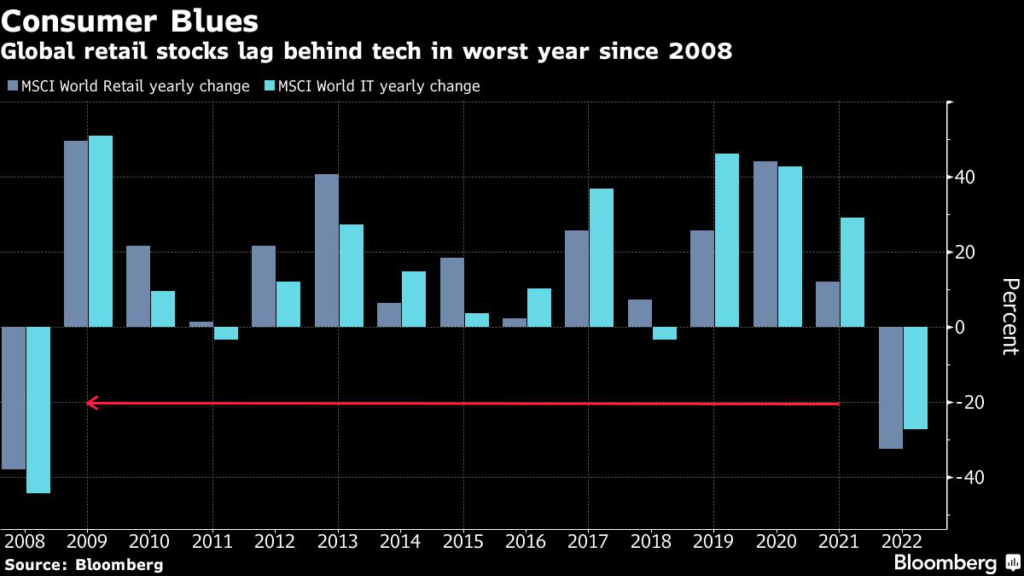
The MSCI World Retailing Index, which includes the likes of Target Corp., Zalando SE and Amazon.com Inc., is on track for its first negative year since 2008. The gauge was down about 29% in 2022 through Thursday, surpassing even the 24% decline of the MSCI World Information Technology Index.

The same inflation worries that have sent shivers through tech stocks are also taking a toll on retailers, leading to a squeeze on disposable incomes and pushing up costs of everything from transportation to labor. Warnings from behemoths like Walmart Inc. and Target have shaken investors, and many analysts say they may not be the last.

“We are at the beginning of an inflationary spiral,” said Alasdair McKinnon, chief investment officer of Sgurr Ventures, speaking before Friday’s data showing an unexpected acceleration in price gains in the US. “This squeeze in consumer incomes has come as a surprise to many investors.”

Take Target, whose profit warning on May 18 sent the stock down 25%, the biggest one-day drop since the Black Monday crash of 1987. What’s worse, just three weeks later the US retail giant cut its outlook again — one that raises worries of a fast-deteriorating consumer environment.

Walmart, meanwhile, said this month that it needs another two quarters or so to work through an inventory surge that prompted markdowns and contributed to May’s 16% decline in the retailer’s stock.

Cautious tones were also broadcast by several apparel retail companies including Abercrombie & Fitch Co., American Eagle Outfitters Inc. and Gap Inc. And after one of the worst first-quarter earnings seasons in recent memory for apparel names, there may be more misery to come.

Just The Start

“We’ve only really had one quarter of negative surprises,” said John Zolidis, founder of Quo Vadis Capital. “Normally in a recessionary cycle there will be several rounds of cuts before the outlook and stocks bottom. Unless we see a reversal of inflation data and a less hawkish approach from the Federal Reserve, our guess would be that we’re closer to the beginning of the pain than the end of it.”

Don’t just take his word for it though. According to the most powerful person in the banking industry, JPMorgan Chase & Co.’s Jamie Dimon, an economic “hurricane” is on the way.

“Investors are worried about every datapoint pointing to further incremental inflation,” said Michel Keusch, a fund manager at Bellevue Asset Management. “The wake-up call started with the comments from Walmart and Target, and since then we have seen many retailers warning, adding to the general pessimism.”

While such concerns have been reflected in reduced valuations this year, retail stocks still aren’t cheap. The MSCI World Index’s retailing subgroup remains more expensive than the main benchmark in terms of forward price-to-earnings ratios, due in large part to the presence of richly valued online merchants such as Amazon.com and Zalando.

Meanwhile, short sellers are seeing an opportunity, seeking to sell borrowed stock and buy it back for less. Pet products retailer Chewy Inc. and Swedish fashion chain Hennes & Mauritz AB are among the most shorted stocks in the sector, with average short interest rising to 5.4% of free float for the MSCI retail subgroup, from 3.5% in January, according to IHS Markit data.

UK Selloff

With inflation and living costs rising pretty much everywhere, few stocks are immune. In the UK, where power bills are surging and consumer confidence plunging, the likes of Next Plc, Marks & Spencer Group Plc and online fashion retailer Asos Plc have seen a sharp selloff.

In Asia, the sector is meeting a similar fate, with the Bloomberg Asia Pacific Retail Index down 20% this year and bellwether Australian retail-chain operator Wesfarmers Ltd. falling 26%.

There are some outliers. Sat Duhra, a portfolio manager at Janus Henderson Investors, says the quality domestic consumer names in China are beginning to appear attractive after a deep correction.

To be sure, not everyone is tightening their purse strings with some consumers still prepared to spend lavishly. Airlines bookings are surging, while luxury spending hasn’t fallen in the same way it did in 2008.

Retailers known for offering big discounts are also doing well as lower income households seek cheaper alternatives. T.J. Maxx owner TJX Cos.’ margin performance shone against peers, while discount-store operators Dollar Tree Inc., and Dollar General Corp. saw their shares rocket in one day after their sales both beat analyst expectations.

History Lesson

“It can seem hard to reconcile comments from Walmart on some consumers trading down in lunch meats due to inflation with those from Remy-Cointreau seeing healthy momentum for its Louis XIII cognac,” said Swetha Ramachandran, a portfolio manager at GAM Investments.

As if investors weren’t nervous enough already, they also have history against them: The MSCI World Retailing index’s previous annual declines — 2008, 2007, 2002 and 2000 — all came around recession years.

“We’re conscious of increasing our exposure to consumer discretionary as a segment overall, and that’s an area that we have been more underweight,” Louise Dudley, portfolio manager at Federated Hermes, said by phone.

More stories like this are available on bloomberg.com

©2022 Bloomberg L.P.

Ukraine Latest: Chemical Plant Reported Ablaze in Embattled City

(Bloomberg) —

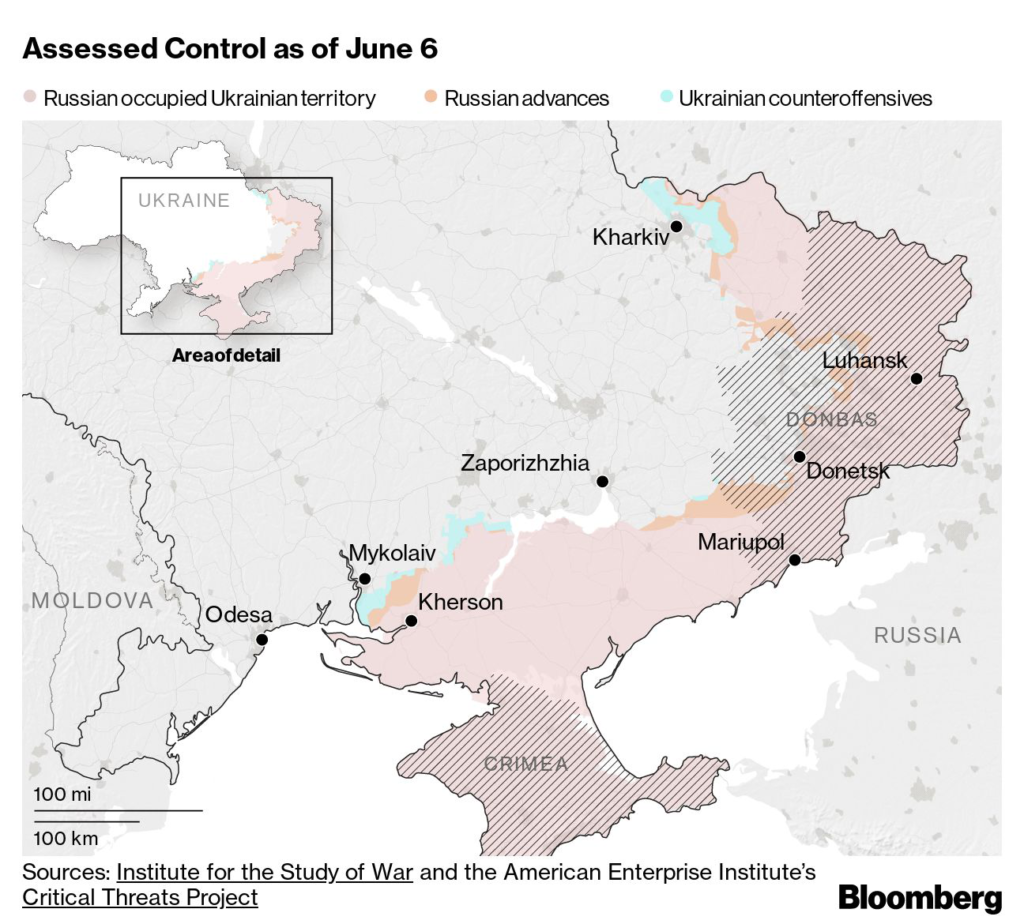
European Commission President Ursula von der Leyen visited Kyiv and said Ukraine is making progress on its bid to eventually join the European Union. Ukraine said Russian shelling set off a fire at a chemical plant in the country’s east.

In the US, the average price of gasoline climbed to more than $5 per gallon for the first time, exacerbated by western sanctions on Russian energy.

Discord emerged after US President Joe Biden said his Ukrainian counterpart, Volodymyr Zelenskiy, brushed off his warnings about an imminent invasion. Zelenskiy’s office said Ukraine’s partners didn’t heed its plea for preemptive sanctions that could have persuaded Russia to withdraw its troops from the border before Feb. 24.  

(See RSAN on the Bloomberg Terminal for the Russian Sanctions Dashboard.)

Key Developments

  • Von der Leyen Visits Kyiv Ahead of Key Week for Ukraine’s EU bid
  • Biden Says Zelenskiy Brushed Off Warnings of Russia’s Invasion
  • Iran Has Lessons on Grim Survival for Russia Under Sanctions
  • US Gasoline Tops $5 a Gallon on Average in New Inflation Marker

(All times CET)

Sri Lanka Open to More Russian Oil, AP Says (5 a.m.)

Sri Lanka may be forced to purchase more oil from Russia as the island struggles with a severe shortage of fuel amid an economic crisis, the Associated Press reported, citing Prime Minister Ranil Wickremesinghe.

Authorities are attempting to get oil and coal from suppliers in the Middle East, but “may have to go to Russia again,” he said. 

Ukraine Says Chemical Plant Ablaze (10:16 p.m.)

Russian shelling led to an “intense fire” at the Azot chemical plant at Sievierodonetsk, Ukrinform cited the head of the Luhansk regional military administration, Serhiy Haidai, as saying. Hours of heavy-weapons fire ignited leaking oil, he said.

Russian forces have been fighting to capture Sievierodonetsk, a city in the Luhansk region where Russia has made advances since focusing its attacks in eastern Ukraine.

EU Leaders Weighing Ukraine Trip, Bild Says (9:50 p.m.)

The leaders of Germany, France and Italy are considering a joint trip to Ukraine to signal concerted European support, according to Bild am Sonntag, which cited people close to French and Ukrainian governments it didn’t identify. Chancellor Olaf Scholz, President Emmanuel Macron and Prime Minister Mario Draghi could make the trip before Germany hosts a Group of Seven summit from June 26 to June 28, the German newspaper said. 

Ukraine Sees Reconstruction Plan by Early July (7:20 p.m.)

Ukraine is planning to finalize drafting its reconstruction plan in early July in time for a donors’ conference scheduled for July 4-5 in Lugano, Switzerland, members of the parliament said.

The plan aims to strengthen Ukraine’s economic resilience and modernize the country, Danilo Getmantsev, a governing-party lawmaker, told reporters in Kyiv. “We want to present something aligned with our partners” who will help finance reconstruction, opposition lawmakers Yaroslav Zheleznyak said.

The European Union has said it expects to finance the bulk of Ukraine’s reconstruction costs. 

US Average Gasoline Price Breaches $5 a Gallon (7:10 p.m.)

Gasoline topped an average of $5 per gallon in the US, the latest pain point for American consumers in a price rally that President Joe Biden blames in part on fallout from Russia’s invasion of Ukraine. 

A global shortage has been exacerbated by European and US efforts to sidestep oil from Russia to punish President Vladimir Putin for the invasion, and record prices at the pump are fueling the highest US inflation rate in 40 years. Pump prices rose to $5.004 a gallon early Saturday, according to auto club AAA. 

Von der Leyen: EU Will Be ‘Shoulder to Shoulder’ (6:13 p.m.)

European Commission President Ursula von der Leyen pledged wide-ranging cooperation with Ukraine, saying on Twitter that the two sides have much work to do on everything from infrastructure to climate action or resilience.

“We will do it, shoulder to shoulder,” she said.

Ukraine also has work to do on reforms to fight corruption, von der Leyen said earlier Saturday during an appearance with Zelenskiy in Kyiv. 

German Missile System for Ukraine Next Week (3:40 p.m.)

Ukraine expects to get the advanced German air defense system IRIS-T in August, the country’s ambassador to Germany, Andrij Melnyk, told NV.ua. The system can defend a territory the size of Kyiv from air attacks. Ukraine expects to put such systems near the major cities within next three to four years, said Melnyk, who has been a regular critic of German government for being hesitant to supply military aid to Ukraine.

Von der Leyen Visits Kyiv in Boost for Ukraine’s EU Bid (2:03 p.m.)

The head of the EU’s executive arm made her second visit to Kyiv since the start of the war and met Zelenskiy. She said officials were working day and night on Ukraine’s bid to join the European Union.

The European Commission is expected to recommend on June 17 that Ukraine be granted candidate status to join the bloc, starting a process that could last more than a decade in which the country must adopt EU rules and standards.

“We will take stock of the joint work needed for reconstruction and of progress made by Ukraine as it pursues its European path,” von der Leyen said before the visit. “This will feed into our assessment, which we will present soon.”

Ukraine Steps Up European Diplomacy (12:32 p.m.)

Ukrainian Foreign Minister Dmytro Kuleba tweeted that he spoke with Polish counterpart Zbigniew Rau to discuss the next deliveries of heavy weapons and a seventh EU sanctions package on Russia. Defense Minister Oleksii Reznikov met UK Defence Secretary Ben Wallace and had a “productive and frank discussion.” 

Ukrainian lawmaker Fedir Venislavskyi said the country was taking all necessary measures to save the two Britons and a Moroccan captured by Russia and sentenced to death, Reuters reported.

Ukraine Open to Prisoner Swap for Britons, Telegraph Says (9:19 a.m.)

Ukraine is open to a prisoner swap to secure the release of two Britons sentenced to death by Russia, the Telegraph reported, citing Vadym Prystaiko, Ukraine’s ambassador to the UK. The two men, who have lived in Ukraine for several years, were serving members of the Ukrainian military. The UK is keen to avoid treating their capture as a bilateral issue, the Telegraph said.

US, Ukraine Spar Over Invasion Warning (9:17 a.m.)

Biden said Zelenskiy tuned out warnings that Russia would invade Ukraine in the lead-up to the February attack.

“I know a lot of people thought I was maybe exaggerating, but I knew, and we had data to sustain, he was going in off the border. There was no doubt. And Zelenskiy didn’t want to hear it, nor did a lot of people,” Biden said Friday. The president acknowledged that the possibility of Russian President Vladimir Putin launching a full-scale invasion may have seemed far-fetched at that time.

Zelenskiy’s spokesman, Serhiy Nikiforov, said the Ukrainian president had had multiple calls with Biden before the invasion where the two leaders shared their assessments of the situation. Besides, Zelenskiy had called upon the country’s partners to prepare preemptive sanctions to push Russia to de-escalate, but “our partners didn’t want to hear us.”

BASF CEO Favors Technology Sanctions (9:00 a.m.)

The chief executive officer of BASF SE, which would have to shut down its main site in Ludwigshafen if Russian gas supplies are cut off, said he favors sanctions on the technology industry instead. Curbs on aircraft replacement parts, semiconductors or software updates would have a much bigger impact on Russia than a possible gas embargo, Martin Brudermueller said in an interview with Sueddeutsche Zeitung.

More stories like this are available on bloomberg.com

©2022 Bloomberg L.P.

Inflation Thunderbolt Primes Stocks, Bonds for More Volatility

(Bloomberg) — Stocks and bonds face more pain when markets open in Asia on Monday following a shock US inflation print that heaped pressure on the Federal Reserve to intensify monetary tightening.

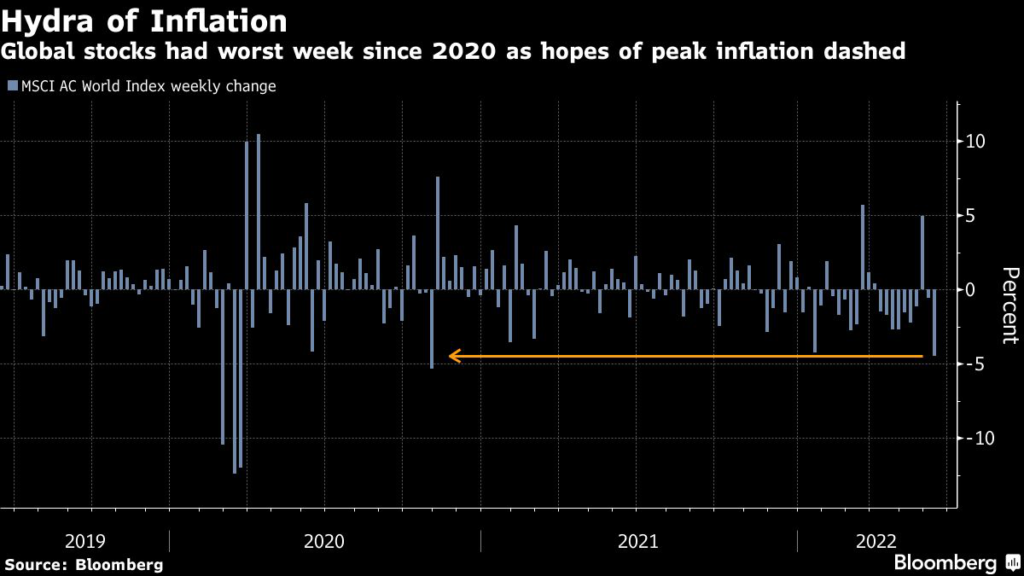
Equity futures indicate declines in Japan and Hong Kong after the worst drop in global stocks last week since October 2020. Asian sovereign bonds are set to slide in the slipstream of a Treasuries slump that propelled the US two-year yield to the highest in 14 years.

The move in short rates left 30-year Treasury yields below those on five-year notes, pointing to the risk of aggressive Fed interest-rate hikes leading to a hard economic landing. A dollar gauge hit the highest in a month as investors sought havens amid a toxic mix of rising costs and slowing growth.

“At some point financial conditions will tighten enough and/or growth will weaken enough such that the Fed can pause from hiking,” Goldman Sachs Group Inc. strategists including Zach Pandl wrote in a note. “But we still seem far from that point, which suggests upside risks to bond yields, ongoing pressure on risky assets, and likely broad US dollar strength for now.”

The US consumer price index rose 8.6% in May from a year earlier — a fresh 40-year high — in a broad-based advance, adding to a slate of troubling inflation data across a range of nations. Many investors expect three half-point Fed rate hikes this week and again in July and September. Barclays Plc and Jefferies LLC said an even bigger 75-basis-point move is possible at the June meeting.

The volatility in Treasuries “can’t be anything that any central bank would welcome,” Sonal Desai, Franklin Templeton’s fixed income chief investment officer, said on Bloomberg Television. “We’re going to see more of the same. It’s not going to be a nice, smooth grind upwards. The Fed is going to need to do more.”

China, Yen

Markets will also have to contend with Covid outbreaks in China, where Beijing and Shanghai resumed mass virus testing. The fear is China’s Covid-zero strategy will lead to repeated lockdowns that damage both its economy and global supply chains. The latter are also being affected by the war in Ukraine.

Asian currencies may also come under pressure following the spike in the dollar. The yen remains in sight of a 24-year-low against the greenback on the stark policy contrast between a hawkish Fed and a still dovish Bank of Japan.

But senior Japanese officials delivered a ramped-up warning on the yen Friday, seeking to keep a floor under the currency. Such communication suggests high short-term uncertainty about the yen and a “rising risk of change in Japan’s policy mix,” according to Pandl and the Goldman team.

Emerging Markets

Emerging markets, meanwhile, are being buffeted by rising food prices, with the risk that this could weaken their economies and trigger social instability, according to strategists at Standard Chartered Bank. 

The S&P 500 fell 2.9% on Friday, the most in three weeks, while the technology-heavy Nasdaq 100 shed 3.6%. For the week, the MSCI AC World index lost 4.4%. Poor sentiment was evident over the weekend in a cryptocurrency slide that took Bitcoin as low as $27,265, the weakest since mid-May.

Oil posted its seventh weekly gain as tight fuel-supply balances sustain bullish fundamentals, though headwinds brought on by accelerating US inflation capped crude’s advance.  

More stories like this are available on bloomberg.com

©2022 Bloomberg L.P.

Startup Kicks Off Sales of $265,000 First Solar Electric Car

(Bloomberg) — A Dutch company is starting deliveries of the world’s first production-ready solar car to customers later this year, promising months of charge-less driving in summer conditions. 

Lightyear, founded in the Netherlands in 2016, is making 949 of the models featuring curved solar panels across the car’s hood and roof. Power derived from the sun will add as much as 70 kilometers (43 miles) of driving range per day from the sun.

Lightyear@lightyear_cars

Sent via Meltwater Social.

View original tweet.

“Electric cars are a step in the right direction, but they are dependent on the grid, which is still dependent on mostly fossil fuel energy,” Chief Executive Officer and Co-Founder Lex Hoefsloot said at the reveal of the 250,000-euro ($263,000) Lightyear 0 model. “Adding a new source, the sun, adds certainty that you will always have that charge and you will have to charge a lot less often.” 

The company claims that the car, which will be made in Finland by Valmet Automotive, allows two months of driving without charging in Amsterdam during summer and as many as seven months in Portugal. Cars powered by the sun have struggled to make it beyond the prototype stage because of the large area solar panels require. 

Lightyear has driven the car more than 700 kilometers on a single charge of a 60 kilowatt-hour battery. 

Following the small production run of the Lightyear 0, the company plans to make a more affordable model at a starting price of 30,000 euros. Production is set to start in late 2024 or early 2025.

More stories like this are available on bloomberg.com

©2022 Bloomberg L.P.

Crypto Extends Tumble Into Weekend After US Inflation Data

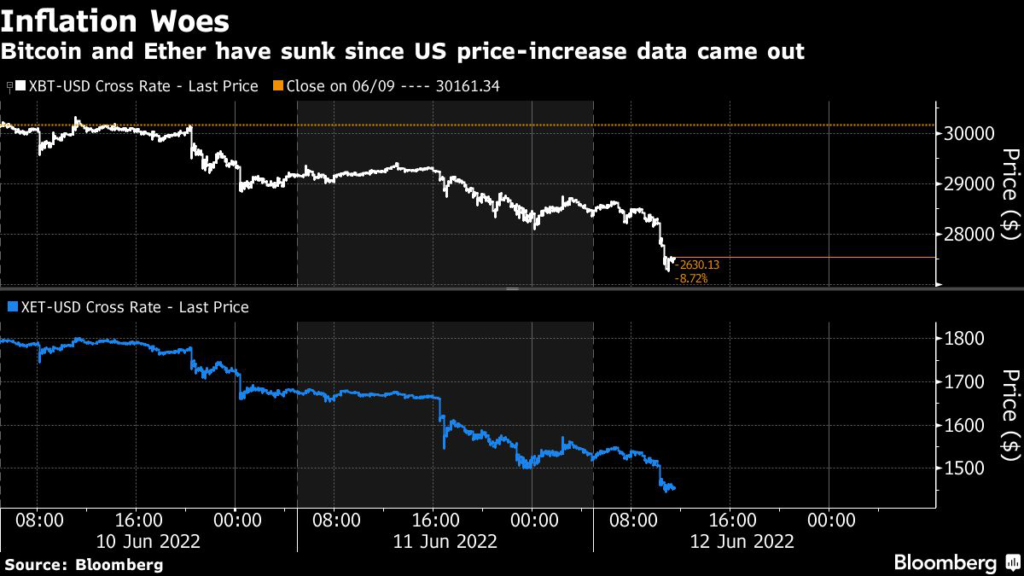
(Bloomberg) — Bitcoin and Ether fell on Sunday amid a broader retreat by the cryptocurrency complex in the wake of data showing US inflation hitting a fresh 40-year high.

Ether declined as much as 5% to $1,445.56, its lowest level since March 2021, while Bitcoin dropped to as low as $27,264.65, its lowest since May 12. Virtually all top tokens tracked by Bloomberg were down Sunday, with the likes of Dogecoin and Avalanche down more than 7% as of 11 a.m. Singapore time.

US inflation data Friday topped expectations, dashing any hopes that rising prices may have peaked. Stocks sank while two-year Treasury yields climbed to the highest since 2008. Bitcoin and other cryptocurrencies have suffered in recent months as the Federal Reserve hikes rates and global policy makers step up efforts to combat price increases, and as risk assets like tech stocks retreat.

The US inflation data is helping fuel the downward action into the weekend and “very likely we see this bearishness continue on to the next week especially with the FOMC meeting coming up,” said Vijay Ayyar, vice president of corporate development and international at crypto platform Luno. 

“If one looks at previous bear markets, Bitcoin has declined around 80%-plus normally, with altcoins typically doing 90%-plus,” said Ayyar. “If that remains the case, we could see much lower Bitcoin prices over the next month or two.”

Total long crypto liquidations were above $100 million for a third straight day on Sunday, after $258 million on Friday and $290 million on Saturday, according to data from Coinglass. And the MVIS CryptoCompare Digital Assets 100 index, a market cap-weighted measure tracking the performance of the 100 largest tokens, fell to the lowest level since January 2021.

More stories like this are available on bloomberg.com

©2022 Bloomberg L.P.
Canada Defense Minister Says China’s Behavior Is ‘Concerning’

(Bloomberg) — Canada’s defense minister said China’s behavior in a number of areas is “concerning,” with regards to rising geopolitical tensions.

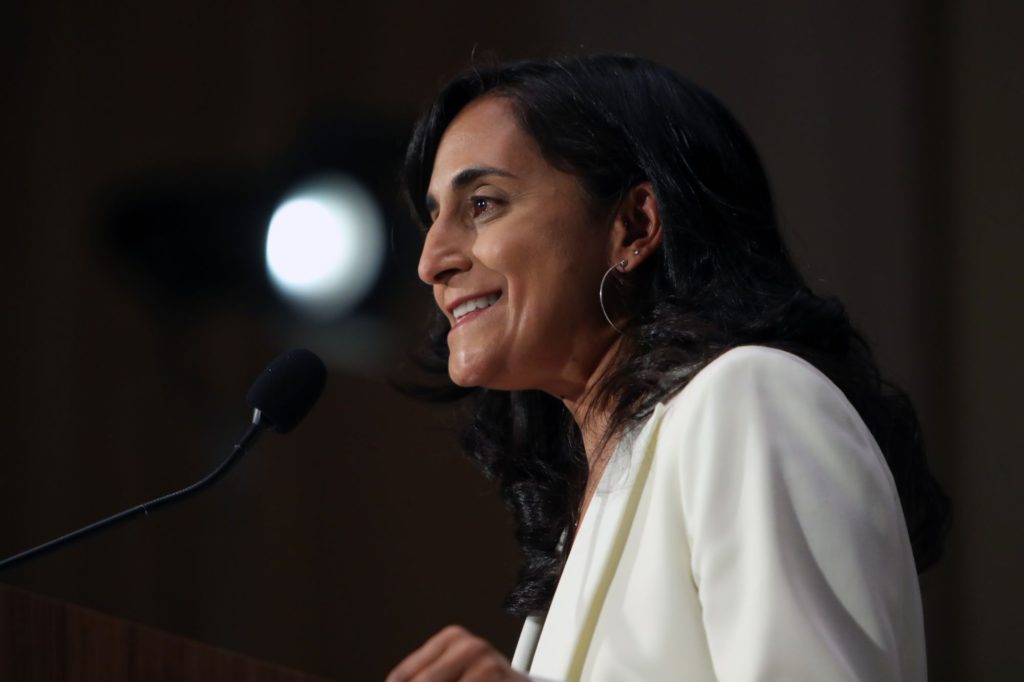
“We have to stand back and examine China’s behavior writ large: concerning behavior in diplomatic relations, concerning behavior in terms of theft of intellectual property, concerning behavior in cyberspace as well as in actual airspace,” said Anita Anand in an interview Saturday with Bloomberg News’ Haslinda Amin at the sidelines of the IISS Shangri-La Dialogue in Singapore. “These are all very worrisome and concerning behaviors.”

The comments come after recent reports of Chinese fighter jets buzzing Canadian planes helping to enforce sanctions on North Korea, an act Canada’s Prime Minister Justin Trudeau called “irresponsible and provocative.” Relations between Canada and China have also deteriorated over issues including Canada’s banning of Huawei Technologies Co. from fifth-generation wireless networks.

Anand did not directly respond to questions about whether Canada would defend Taiwan if it came under attack from China, saying instead her country remains committed to a “one-China policy” and is concerned about the level of Chinese military activity in the region. She also said continuing to build relationships with Taiwan is important.

Questioned whether Western unity toward responding to Russia’s war in Ukraine is fraying, Anand said that the North American nation remained “deeply committed” to Ukraine’s sovereignty. 

“Canada stands shoulder to shoulder with Ukraine in the short, medium and long term,” she said.


More stories like this are available on bloomberg.com

©2022 Bloomberg L.P.
Banker to 467 Million Indians Says Loan Demand Is Bouncing Back

(Bloomberg) — Consumer cutbacks due to raging inflation and higher borrowing costs are failing to dent investment plans at Indian businesses tapping the country’s biggest lender, a sign that a recovery in Asia’s third-largest economy is gathering pace.

Companies are steadily drawing down from a $71 billion loan pipeline, Dinesh Kumar Khara, chairman of State Bank of India, told Bloomberg News in an interview at his Mumbai office. Loan growth at the 216-year-old lender, a banker to one out of every three Indians, is expected to be robust, underpinned by demand from businesses after two straight years of credit contraction, Khara said.

That broadly mirrors a trend where loan growth in India’s 120 trillion rupees ($1.5 trillion) banking system is expanding annually at its fastest pace in three years. While part of the credit demand is to cover rising costs, the rest is going into business expansion and investments for capacity addition.

“Whether it is working capital loans or term loans, the draw downs have been rising, and the ratio of pipeline to loan book narrowed by at least six percentage points in recent months,” Khara said. “Capacity utilization at several sectors like iron and steel is full, and if we get a good monsoon too this year, things will get way better.”

The rise in business confidence and credit demand in India comes despite rising cost of funds. On Wednesday, the central bank’s rate-setting panel raised the key interest rate for a second straight month to tame inflationary pressures with policymakers pledging to withdraw the pandemic-era monetary stimulus in coming months.

The rising demand for loans means SBI will have to shore up its capital adequacy ratio, since it is hovering at less than two percentage points over the minimum regulatory requirement. The bank’s overall capital buffer of 13.8% is the lowest among the top lenders in the country.


Funding Growth

SBI will be aiming to sell bonds to augment its capital base, Khara said. The lender sold so-called Tier 1 bonds, which can be fully written down in a crisis, in December at the lowest coupon among Indian banks after the country started implementing the stringent Basel III capital rules in 2013. 

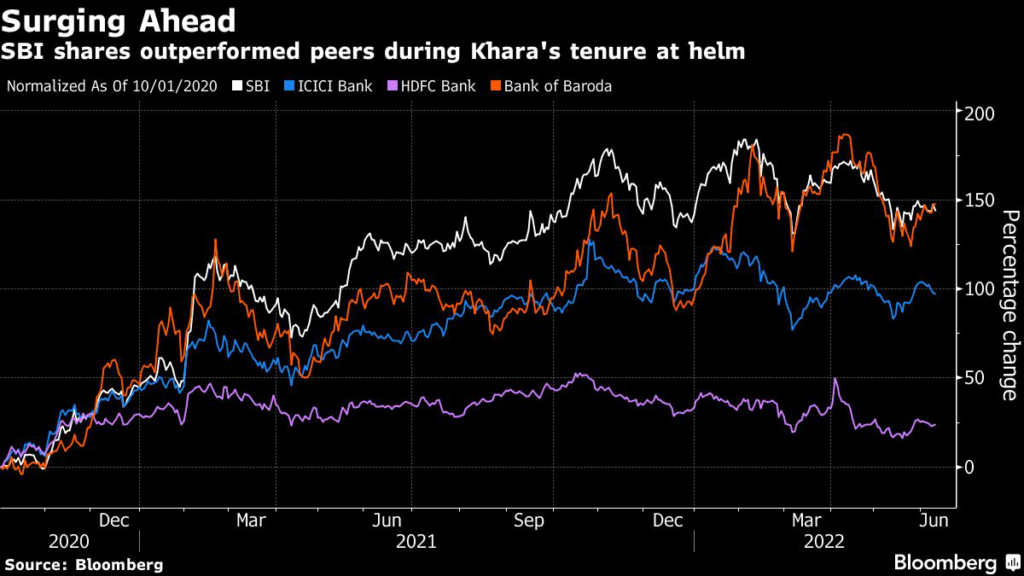
With Khara at the helm over the last 21 months, SBI shares have surged about 150%, making it the best performer on the 10-member BSE Bankex index for the period. The 61-year-old banker, the son of a Reserve Bank of India official, started working at the lender in 1984 and made his way to up become chairman in October 2020.

A challenge for Khara is the drop in investment profits at the lender as rallying yields erode prices of debt holdings. SBI held government securities — including federal and state securities — worth about 7 trillion rupees as of March 31, exchange filings show.

The higher returns on certain debt securities, including those of state governments, will soften the blow to the bank’s treasury earning, Khara said. As a portion of the overall assets, the debt securities holdings will also decrease as the credit growth outpace deposits.

Pushing Digital

Khara, who took to banking straight after college, considers the thrust on digital initiatives by the lender as his major achievement. The pace at which the bank’s 467 million customers are adopting its mobile banking app — Yono or You Only Need One — is several times higher than the pace at which they embraced digital banking years back, he said.

However, the lender has no plans for acquisitions to build its digital banking prowess, the banker who oversaw the mergers of 10 banks into SBI, said. It also shelved earlier discussions to carve out its digital app and instead ramped up investments into it.

“The plan is to grow in a profitable way. We have been on an upward move in most operational metrics in recent years, which we hope to sustain,” Khara said.


More stories like this are available on bloomberg.com

©2022 Bloomberg L.P.
Close Bitnami banner
Bitnami