
Bloomberg

Ukraine Latest: Von der Leyen Meets Zelenskiy in Kiev on EU Bid

(Bloomberg) — European Commission President Ursula von der Leyen made an unannounced visit to Kyiv, where she held talks with President Volodymyr Zelenskiy on the country’s request to join the European Union and its rebuilding after the war.

Meanwhile, Ukraine said its partners hadn’t heeded its plea for preemptive sanctions that could’ve persuaded Russia to withdraw troops before Feb. 24. The comment from Zelenskiy’s office was a response to U.S. President Joe Biden said the Ukrainian leader had brushed off his warnings about an imminent invasion. 


(See RSAN on the Bloomberg Terminal for the Russian Sanctions Dashboard.)

Key Developments

  • Von der Leyen Visits Kyiv Ahead of Key Week for Ukraine’s EU bid
  • Biden Says Zelenskiy Brushed Off Warnings of Russia’s Invasion
  • Iran Has Lessons on Grim Survival for Russia Under Sanctions
  • Ukraine Seeks New IMF Deal to Shore Up Its War-Ravaged Finances
  • Russia Cuts Rates to Pre-War Level With Eye on Ruble and Economy
  • Chef José Andrés Warns US Food Aid to Ukraine Going to Waste

(All times CET)

Von der Leyen Visits Kyiv in Boost for Ukraine’s EU Bid (2:03 p.m.)

The head of the EU’s executive arm made her second visit to Kyiv since the start of the war and met Zelenskiy. She said officials were working day and night on Ukraine’s bid to join the European Union.

The European commission is expected to recommend on June 17 that Ukraine be granted candidate status to join the bloc, starting a process that could last more than a decade in which the country must adopt EU rules and standards.

“We will take stock of the joint work needed for reconstruction and of progress made by Ukraine as it pursues its European path,” von der Leyen had said before the visit. “This will feed into our assessment, which we will present soon.”

Ukraine Steps Up Diplomatic Outreach (12:32 p.m.)

Ukraine’s foreign minister Dmytro Kuleba tweeted that he had a call with his Polish counterpart Zbigniew Rau to discuss the next deliveries of heavy weapons and the seventh EU sanctions package on Russia. Defense Minister Oleksii Reznikov met Britain’s Defence Secretary Ben Wallace and had a “productive and frank discussion.” Meanwhile Ukrainian lawmaker Fedir Venislavskyi said the country was taking all necessary measures to save the two Britons and a Moroccon captured by Russia and sentenced to death, according to the Guardian, citing Reuters.


Ukraine Open to Prisoner Swap for Britons, Telegraph Says (9:19 a.m.)

Ukraine is open to a prisoner swap to secure the release of two British men who have been sentenced to death, the Telegraph reported, citing Vadym Prystaiko, Ukraine’s ambassador to the UK. The two men, who have lived in Ukraine for several years, were serving members of the Ukrainian military. The UK is keen to avoid treating their capture as a bilateral issue, the Telegraph said.

US, Ukraine Engage in War of Words Over Invasion Warning (9:17 a.m.)

Biden said Zelenskiy tuned out warnings that Russia would invade Ukraine in the lead-up to the February attack.

“I know a lot of people thought I was maybe exaggerating, but I knew, and we had data to sustain, he was going in off the border. There was no doubt. And Zelenskiy didn’t want to hear it, nor did a lot of people,” Biden said Friday. The president acknowledged that the possibility of Russian President Vladimir Putin launching a full-scale invasion may have seemed far-fetched at that time.

Zelenskiy’s spokesman, Serhiy Nikiforov, said the Ukrainian president had had multiple calls with Biden before the invasion where the two leaders shared their assessments of the situation. Besides, Zelenskiy had called upon the country’s partners to prepare preemptive sanctions to push Russia to de-escalate, but “our partners didn’t want to hear us.”

More Children Die in Mariupol (9:09 a.m.)

Ukraine’s prosecutor general has learned of the death of 24 more children in Mariupol, Guardian report. That means at least 287 children have died so far in the war, while 492 have been injured, the paper said, citing a statement from the prosecutor general’s office.

“These figures are not final, as work is under way to establish them in places of active hostilities, in the temporarily occupied and liberated territories,” according to the statement.

BASF CEO Bats for Tech Sanctions (9:00 a.m.)

The chief executive officer of BASF SE, which would have to shut down its main site in Ludwigshafen if Russian gas supply is cut off, said he favors sanctions on the technology industry instead. Curbs on aircraft replacement parts, semiconductors or software updates would have a much bigger impact on Russia than a possible gas embargo, Martin Brudermueller said in an interview with Sueddeutsche Zeitung.

Japan Says China-Russia Ties May Deepen Further (4:20 a.m.)

Japanese Defense Minister Nobuo Kishi said ties between Moscow and Beijing may deepen further as Russia is under intense international sanctions. The joint military activities carried out by the two countries are also a cause for concern, he said at the IISS Shangri-La Dialogue in Singapore. 

More stories like this are available on bloomberg.com

©2022 Bloomberg L.P.
Ukraine Latest: Von der Leyen, Zelenskiy to Hold Talks in Kiev

(Bloomberg) — European Commission President Ursula von der Leyen made an unannounced visit to Kyiv, where she was to hold talks with President Volodymyr Zelenskiy on the country’s request to join the European Union and its rebuilding after the war.

Meanwhile, Ukraine said its partners hadn’t heeded its plea for preemptive sanctions that could’ve persuaded Russia to withdraw troops before Feb. 24. The comment from Zelenskiy’s office was a response to U.S. President Joe Biden said the Ukrainian leader had brushed off his warnings about an imminent invasion. 


(See RSAN on the Bloomberg Terminal for the Russian Sanctions Dashboard.)

Key Developments

  • Von der Leyen Visits Kyiv Ahead of Key Week for Ukraine’s EU bid
  • Biden Says Zelenskiy Brushed Off Warnings of Russia’s Invasion
  • Iran Has Lessons on Grim Survival for Russia Under Sanctions
  • Ukraine Seeks New IMF Deal to Shore Up Its War-Ravaged Finances
  • Russia Cuts Rates to Pre-War Level With Eye on Ruble and Economy
  • Chef José Andrés Warns US Food Aid to Ukraine Going to Waste

(All times CET)

Ukraine Steps Up Diplomatic Outreach (12:32 p.m.)

Ukraine’s foreign minister Dmytro Kuleba tweeted that he had a call with his Polish counterpart Zbigniew Rau to discuss the next deliveries of heavy weapons and the seventh EU sanctions package on Russia. Defense Minister Oleksii Reznikov met Britain’s Defence Secretary Ben Wallace and had a “productive and frank discussion.” Meanwhile Ukrainian lawmaker Fedir Venislavskyi said the country was taking all necessary measures to save the two Britons and a Moroccon captured by Russia and sentenced to death, according to the Guardian, citing Reuters.

Von der Leyen Visits Kyiv in Boost for Ukraine’s EU Bid (9:30 a.m.)

The head of the EU’s executive arm made her second visit to Kyiv since the start of the war.

“We will take stock of the joint work needed for reconstruction and of progress made by Ukraine as it pursues its European path,” von der Leyen said. “This will feed into our assessment, which we will present soon.”

The commission is expected to recommend on June 17 that Ukraine be granted candidate status to join the bloc, starting a process that could last more than a decade in which the country must adopt EU rules and standards.

Ukraine Open to Prisoner Swap for Britons, Telegraph Says (9:19 a.m.)

Ukraine is open to a prisoner swap to secure the release of two British men who have been sentenced to death, the Telegraph reported, citing Vadym Prystaiko, Ukraine’s ambassador to the UK. The two men, who have lived in Ukraine for several years, were serving members of the Ukrainian military. The UK is keen to avoid treating their capture as a bilateral issue, the Telegraph said.

US, Ukraine Engage in War of Words Over Invasion Warning (9:17 a.m.)

Biden said Zelenskiy tuned out warnings that Russia would invade Ukraine in the lead-up to the February attack.

“I know a lot of people thought I was maybe exaggerating, but I knew, and we had data to sustain, he was going in off the border. There was no doubt. And Zelenskiy didn’t want to hear it, nor did a lot of people,” Biden said Friday. The president acknowledged that the possibility of Russian President Vladimir Putin launching a full-scale invasion may have seemed far-fetched at that time.

Zelenskiy’s spokesman, Serhiy Nikiforov, said the Ukrainian president had had multiple calls with Biden before the invasion where the two leaders shared their assessments of the situation. Besides, Zelenskiy had called upon the country’s partners to prepare preemptive sanctions to push Russia to de-escalate, but “our partners didn’t want to hear us.”

More Children Die in Mariupol (9:09 a.m.)

Ukraine’s prosecutor general has learned of the death of 24 more children in Mariupol, Guardian report. That means at least 287 children have died so far in the war, while 492 have been injured, the paper said, citing a statement from the prosecutor general’s office.

“These figures are not final, as work is under way to establish them in places of active hostilities, in the temporarily occupied and liberated territories,” according to the statement.

BASF CEO Bats for Tech Sanctions (9:00 a.m.)

The chief executive officer of BASF SE, which would have to shut down its main site in Ludwigshafen if Russian gas supply is cut off, said he favors sanctions on the technology industry instead. Curbs on aircraft replacement parts, semiconductors or software updates would have a much bigger impact on Russia than a possible gas embargo, Martin Brudermueller said in an interview with Sueddeutsche Zeitung.

Japan Says China-Russia Ties May Deepen Further (4:20 a.m.)

Japanese Defense Minister Nobuo Kishi said ties between Moscow and Beijing may deepen further as Russia is under intense international sanctions. The joint military activities carried out by the two countries are also a cause for concern, he said at the IISS Shangri-La Dialogue in Singapore. 

More stories like this are available on bloomberg.com

©2022 Bloomberg L.P.
Ukraine Latest: Von der Leyen, Zelenskiy to Hold Talks in Kyiv

(Bloomberg) — European Commission President Ursula von der Leyen made an unannounced visit to Kyiv, where she was to hold talks with President Volodymyr Zelenskiy on the country’s request to join the European Union and its rebuilding after the war.

Meanwhile, Ukraine said its partners hadn’t heeded its plea for preemptive sanctions that could’ve persuaded Russia to withdraw troops before Feb. 24. The comment from Zelenskiy’s office was a response to U.S. President Joe Biden said the Ukrainian leader had brushed off his warnings about an imminent invasion. 


(See RSAN on the Bloomberg Terminal for the Russian Sanctions Dashboard.)

Key Developments

  • Von der Leyen Visits Kyiv Ahead of Key Week for Ukraine’s EU bid
  • Biden Says Zelenskiy Brushed Off Warnings of Russia’s Invasion
  • Iran Has Lessons on Grim Survival for Russia Under Sanctions
  • Ukraine Seeks New IMF Deal to Shore Up Its War-Ravaged Finances
  • Chef José Andrés Warns US Food Aid to Ukraine Going to Waste

(All times CET)

Ukraine Steps Up Diplomatic Outreach (12:32 p.m.)

Ukraine’s foreign minister Dmytro Kuleba tweeted that he had a call with his Polish counterpart Zbigniew Rau to discuss the next deliveries of heavy weapons and the seventh EU sanctions package on Russia. Defense Minister Oleksii Reznikov met Britain’s Defence Secretary Ben Wallace and had a “productive and frank discussion.” Meanwhile Ukrainian lawmaker Fedir Venislavskyi said the country was taking all necessary measures to save the two Britons and a Moroccan captured by Russia and sentenced to death, according to the Guardian, citing Reuters.

Von der Leyen Visits Kyiv in Boost for Ukraine’s EU Bid (9:30 a.m.)

The head of the EU’s executive arm made her second visit to Kyiv since the start of the war.

“We will take stock of the joint work needed for reconstruction and of progress made by Ukraine as it pursues its European path,” von der Leyen said. “This will feed into our assessment, which we will present soon.”

The commission is expected to recommend on June 17 that Ukraine be granted candidate status to join the bloc, starting a process that could last more than a decade in which the country must adopt EU rules and standards.

Ukraine Open to Prisoner Swap for Britons, Telegraph Says (9:19 a.m.)

Ukraine is open to a prisoner swap to secure the release of two British men who have been sentenced to death, the Telegraph reported, citing Vadym Prystaiko, Ukraine’s ambassador to the UK. The two men, who have lived in Ukraine for several years, were serving members of the Ukrainian military. The UK is keen to avoid treating their capture as a bilateral issue, the Telegraph said.

US, Ukraine Spar Over Invasion Warning (9:17 a.m.)

Biden said Zelenskiy tuned out warnings that Russia would invade Ukraine in the lead-up to the February attack.

“I know a lot of people thought I was maybe exaggerating, but I knew, and we had data to sustain, he was going in off the border. There was no doubt. And Zelenskiy didn’t want to hear it, nor did a lot of people,” Biden said Friday. The president acknowledged that the possibility of Russian President Vladimir Putin launching a full-scale invasion may have seemed far-fetched at that time.

Zelenskiy’s spokesman, Serhiy Nikiforov, said the Ukrainian president had had multiple calls with Biden before the invasion where the two leaders shared their assessments of the situation. Besides, Zelenskiy had called upon the country’s partners to prepare preemptive sanctions to push Russia to de-escalate, but “our partners didn’t want to hear us.”

More Children Die in Mariupol (9:09 a.m.)

Ukraine’s prosecutor general has learned of the death of 24 more children in Mariupol, Guardian report. That means at least 287 children have died so far in the war, while 492 have been injured, the paper said, citing a statement from the prosecutor general’s office.

“These figures are not final, as work is under way to establish them in places of active hostilities, in the temporarily occupied and liberated territories,” according to the statement.

BASF CEO Bats for Tech Sanctions (9:00 a.m.)

The chief executive officer of BASF SE, which would have to shut down its main site in Ludwigshafen if Russian gas supply is cut off, said he favors sanctions on the technology industry instead. Curbs on aircraft replacement parts, semiconductors or software updates would have a much bigger impact on Russia than a possible gas embargo, Martin Brudermueller said in an interview with Sueddeutsche Zeitung.

Japan Says China-Russia Ties May Deepen Further (4:20 a.m.)

Japanese Defense Minister Nobuo Kishi said ties between Moscow and Beijing may deepen further as Russia is under intense international sanctions. The joint military activities carried out by the two countries are also a cause for concern, he said at the IISS Shangri-La Dialogue in Singapore. 

More stories like this are available on bloomberg.com

©2022 Bloomberg L.P.

Apple Resolves Dating Apps Payment Dispute With Dutch Regulator

(Bloomberg) —

The Dutch consumer protection regulator said Apple Inc. “has changed its unfair conditions” and will now allow different methods of payment in dating apps, ending a dispute after penalizing the tech firm 50 million euros ($53 million) for rule breaking.

“With this concession, Apple will meet the requirements that the Netherlands Authority for Consumers and Markets set under European and Dutch competition rules,” the ACM said in a statement on Saturday.

Apple usually requires developers to use its own payment system, which helps it ensure a commission for apps on its platform. That tight control over app payments has attracted lawsuits and antitrust scrutiny, often focusing on Apple’s refusal to allow developers to steer users to other payment methods. 

The ACM insisted Apple isn’t complying with its antitrust regulations, slapping the company with a series of weekly fines. The Cupertino, California-based company had filed a proposal to fully comply with an order to offer payments outside the app store to dating app providers after being fined.

Apple didn’t immediately respond to a request for comment.

“In the digital economy, powerful companies have a special responsibility to keep the market fair and open; Apple avoided that responsibility, and abused its dominant position vis-à-vis dating-app providers,” said Martijn Snoep, chairman of the board of ACM, according to today’s statement. 

“We are glad that Apple has finally brought its conditions in line with European and Dutch competition rules,” he said. “That offers app providers more opportunities to compete. And consumers will ultimately reap the benefits, too.”

More stories like this are available on bloomberg.com

©2022 Bloomberg L.P.
Australia Resets France Ties With Failed Subs Deal Payment

(Bloomberg) —

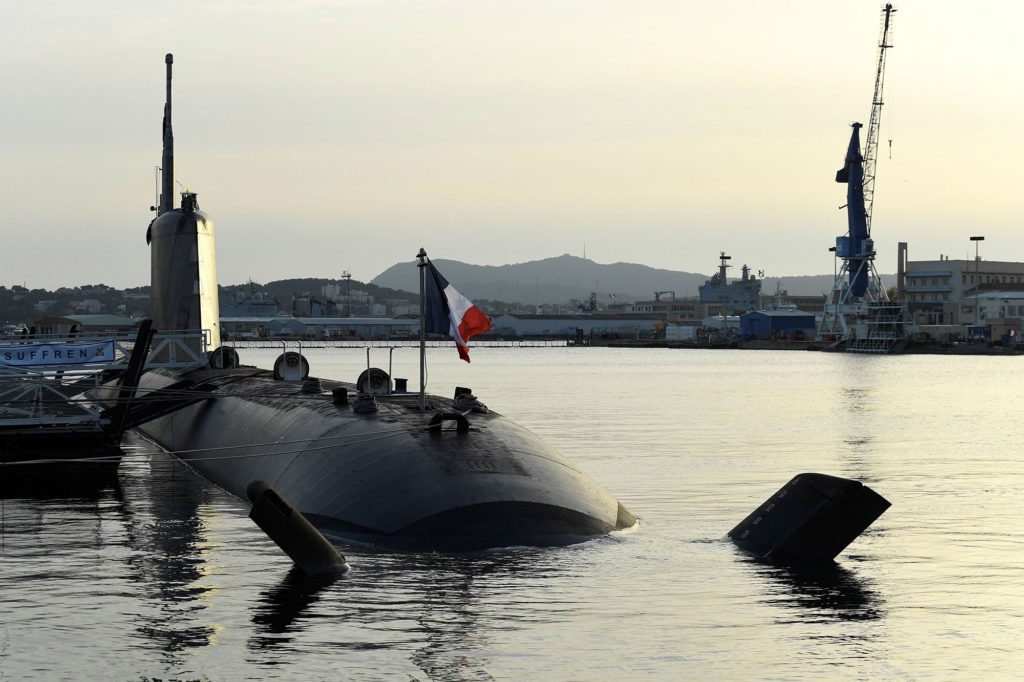
Australia will pay 550 million euros ($579 million) compensation to Naval Group SA as Prime Minister Anthony Albanese seeks to reset relations with France that soured over a canceled submarine-purchase agreement.

“Now we can move forward with our relationship with France,” Albanese said in a press conference on Saturday. “This draws a line under this issue,” he said, adding that he’s had “cordial” discussions with French President Emmanuel Macron and accepted an invitation to visit him in Paris.

France and Australia will “look to the future and rebuild cooperation on a new basis,” French Defense Minister Sebastien Lecornu said in a tweet. 

For its part, state-controlled Naval Group confirmed in a statement the signing of a “fair agreement” with Australia to end the submarine program. 

France was blindsided when Albanese’s predecessor Scott Morrison scrapped the deal last year and revealed he’d been in secret talks with the US and UK for a security partnership to acquire nuclear-powered submarines. The move was a personal blow for Macron and qualified by the government as a stab in the back.

Australia’s newly elected Labor government is sticking with the so-called AUKUS partnership, which has been slammed by China for fueling an arms race in the region.

The failed deal with France has cost Australia A$3.4 billion ($2.4 billion), Albanese said. He declined to comment on whether Australia could potentially purchase some nuclear submarines from the US as an interim measure before any vessels are built under the AUKUS pact.

Under this agreement, Australia is planning to build and begin operating a fleet of nuclear submarines in the coming decades with US and UK assistance. No decision has been conveyed yet on whether Australia will use a UK or US design for the fleet.

Albanese said he had yet to set a date for his trip to France.

(Adds comments from French defense minister and Naval Group from third paragraph.)

More stories like this are available on bloomberg.com

©2022 Bloomberg L.P.

Ukraine Latest: Von der Leyen Visits Kyiv to Talk EU Membership

(Bloomberg) — European Commission President Ursula von der Leyen made an unannounced visit to Kyiv, where she’ll meet President Volodymyr Zelenskiy to discuss the country’s request to join the European Union and its rebuilding after the war.

Meanwhile, Ukraine said its partners hadn’t heeded its plea for preemptive sanctions that could’ve persuaded Russia to withdraw troops before Feb. 24. The comment from Zelenskiy’s office was a response to U.S. President Joe Biden said the Ukrainian leader had brushed off his warnings about an imminent invasion. 


(See RSAN on the Bloomberg Terminal for the Russian Sanctions Dashboard.)

Key Developments

  • Biden Says Zelenskiy Brushed Off Warnings of Russia’s Invasion
  • Iran Has Lessons on Grim Survival for Russia Under Sanctions
  • Ukraine Seeks New IMF Deal to Shore Up Its War-Ravaged Finances
  • Russia Cuts Rates to Pre-War Level With Eye on Ruble and Economy
  • Chef José Andrés Warns US Food Aid to Ukraine Going to Waste

(All times CET)

Von der Leyen Visits Kyiv in Boost for Ukraine’s EU Bid (9:30 a.m.)

The head of the EU’s executive arm made her second visit to Kyiv since the start of the war.

“We will take stock of the joint work needed for reconstruction and of progress made by Ukraine as it pursues its European path,” von der Leyen said. “This will feed into our assessment, which we will present soon.”

The commission is expected to recommend on June 17 that Ukraine be granted candidate status to join the bloc, starting a process that could last more than a decade in which the country must adopt EU rules and standards.

Ukraine Open to Prisoner Swap for Britons, Telegraph Says (9:19 a.m.)

Ukraine is open to a prisoner swap to secure the release of two British men who have been sentenced to death, the Telegraph reported, citing Vadym Prystaiko, Ukraine’s ambassador to the UK. The two men, who have lived in Ukraine for several years, were serving members of the Ukrainian military. The UK is keen to avoid treating their capture as a bilateral issue, the Telegraph said.

US, Ukraine Engage in War of Words Over Invasion Warning (9:17 a.m.)

Biden said Zelenskiy tuned out warnings that Russia would invade Ukraine in the lead-up to the February attack.

“I know a lot of people thought I was maybe exaggerating, but I knew, and we had data to sustain, he was going in off the border. There was no doubt. And Zelenskiy didn’t want to hear it, nor did a lot of people,” Biden said Friday. The president acknowledged that the possibility of Russian President Vladimir Putin launching a full-scale invasion may have seemed far-fetched at that time.

Zelenskiy’s spokesman, Serhiy Nikiforov, said the Ukrainian president had had multiple calls with Biden before the invasion where the two leaders shared their assessments of the situation. Besides, Zelenskiy had called upon the country’s partners to prepare preemptive sanctions to push Russia to de-escalate, but “our partners didn’t want to hear us.”

More Children Die in Mariupol (9:09 a.m.)

Ukraine’s prosecutor general has learned of the death of 24 more children in Mariupol, Guardian report. That means at least 287 children have died so far in the war, while 492 have been injured, the paper said, citing a statement from the prosecutor general’s office.

“These figures are not final, as work is under way to establish them in places of active hostilities, in the temporarily occupied and liberated territories,” according to the statement.

BASF CEO Bats for Tech Sanctions (9:00 a.m.)

The chief executive officer of BASF SE, which would have to shut down its main site in Ludwigshafen if Russian gas supply is cut off, said he favors sanctions on the technology industry instead. Curbs on aircraft replacement parts, semiconductors or software updates would have a much bigger impact on Russia than a possible gas embargo, Martin Brudermueller said in an interview with Sueddeutsche Zeitung.

Japan Says China-Russia Ties May Deepen Further (4:20 a.m.)

Japanese Defense Minister Nobuo Kishi said ties between Moscow and Beijing may deepen further as Russia is under intense international sanctions. The joint military activities carried out by the two countries are also a cause for concern, he said at the IISS Shangri-La Dialogue in Singapore. 

Chef Warns US Food Aid to Ukraine Going to Waste (12:30 a.m.)

José Andrés urged US lawmakers to funnel aid into Ukrainian infrastructure to help the war-shattered nation more effectively, rather than spending money on food donations. He is the founder of World Central Kitchen, a nonprofit organization that uses locally sourced food to feed those affected by natural and human-made disasters. 

“Large quantities of unwanted food are being delivered today with little regard for what the people of Ukraine can or want to eat,” the star chef told lawmakers on Friday. “There is only so much dry pasta a Ukrainian family needs.”

The Senate in May cleared a more than $40 billion Ukraine aid package, which included billions of dollars in funding for international disaster assistance, as well as $760 million in global food aid through the State Department.

More stories like this are available on bloomberg.com

©2022 Bloomberg L.P.
Coldplay Incentivized Its Fans to Make Greener Choices. Are They?

(Bloomberg) —

British band Coldplay is trying to turn its fans into climate rock stars with an app that rewards them for taking low-carbon transportation to concerts during the group’s current world tour.

There were 80,000 downloads of the smartphone app during the first leg of the 2022 tour, according to Coldplay, and the band says estimated emissions from fan travel fell nearly 50% compared to its 2016-2017 shows. A review of those numbers, though, indicates the limits of using motivational apps to calculate and offset carbon emissions.

Coldplay says it aims to make its “Music of the Spheres” tour as sustainable as possible. To that end the band is doing everything from installing solar arrays at concert venues to traveling via biofueled jets and electric vehicles.

Much of a global tour’s carbon footprint, however, is made by the tens of thousands of fans traveling to see the band. The app developed by SAP SE shows fans their estimated carbon emissions for a round trip to a show if they travel by car, train, plane, bicycle and other forms of transportation. Concertgoers are encouraged to choose a climate-friendly mode of travel and those who do so receive a code for 10% off Coldplay merchandise. 

The transportation data collected by the app is used to calculate the audience’s carbon footprint. “We pledge to drawdown all of these emissions via nature-based solutions like rewilding and conservation,” the band says on its concert website, stating that it will also plant and sustain at least one tree for each ticket sold.

“Generally these type of small incentives tend to have a small effect,” said Seth Wynes, a postdoctoral fellow at Concordia University in Montreal who researches consumer behavior and climate change. “Transportation tends to be habit-driven. I would expect a few people to change their minds about how they travel to a show — just not a ton of them.”

He also noted that nothing would prevent fans from pledging to travel by train, for instance, so they could collect a discount on Coldplay swag and then on the day of the concert drive an SUV to the venue, which would skew the band’s carbon calculations. 

SAP senior vice president Ferose V R said “that is always a possibility” but noted that “our goal was to create awareness by providing very gentle nudges.”

“If you can change one person’s mindset, that’s a good starting point,” he added. “Sometimes we don’t realize that when a band like Coldplay does it and it multiplies over hundreds of thousands of fans, it can have a significant effect.”

The app’s calculation of fans’ carbon footprint is based on UK “conversion factors” that convert emissions from various types of transportation into estimates of pounds of CO₂ emitted per person. But such conversion factors differ for transportation in other parts of the world where Coldplay is touring, such as the United States and Latin America. 

“We did an approximation, but I think it’s a reasonably good approximation,” V R said. “We have to project the data for the entire number of fans who come to a stadium. Hence, we don’t get to very accurate data for everybody.”

Emissions from 2022 are based on data collected by the app, which did not exist for the 2016-2017 tour. Emissions from those shows are estimates based on “post-event surveys, ticket information, venues and promoters in each area the previous tour visited,” according to a statement provided by the band’s management to Bloomberg Green. “Total distance travelled by fans in each common vehicle type was then assessed and internationally recognized carbon emission conversion factors … was used to estimate the resulting carbon footprint.” 

At concerts, Coldplay has been playing its hit song “The Scientist,” with Chris Martin singing, “I was just guessing at numbers and figures.” The band’s estimate that fan emissions in the first leg of the current tour dropped almost by half from 2016-2017 is not a guess. But it is misleading, since different data and methodologies were used to calculate the carbon footprint of each tour. 

Still, Wynes applauded Coldplay’s efforts to reduce the climate impact of its shows and raise concertgoers’ awareness of their transportation choices. “It might just help send a broader signal that the members of a band that potentially a lot of people idolize really care about this, and so it tells their fans that maybe it’s something that they should care about as well,” he said.

More stories like this are available on bloomberg.com

©2022 Bloomberg L.P.

UK Cost-of-Living Crisis Piles More Pressure on Dire IPO Market

(Bloomberg) —

It’s been seven months since a consumer-facing firm last listed in London, and offerings look scarce for the rest of the year as a cost-of-living crisis rips through people’s wallets.

Rampant inflation, already at a 40-year high and heading toward double digits, is heaping fresh misery on retailers after a torrid few years dominated by pandemic lockdowns. Add in volatile stock markets and plunging valuations, and initial public offerings look like a hard sell.

The toxic combination means London’s IPO market is on track for its worst first half since the depths of the financial crisis in 2009, with just over $800 million raised so far in 2022, according to data compiled by Bloomberg. 

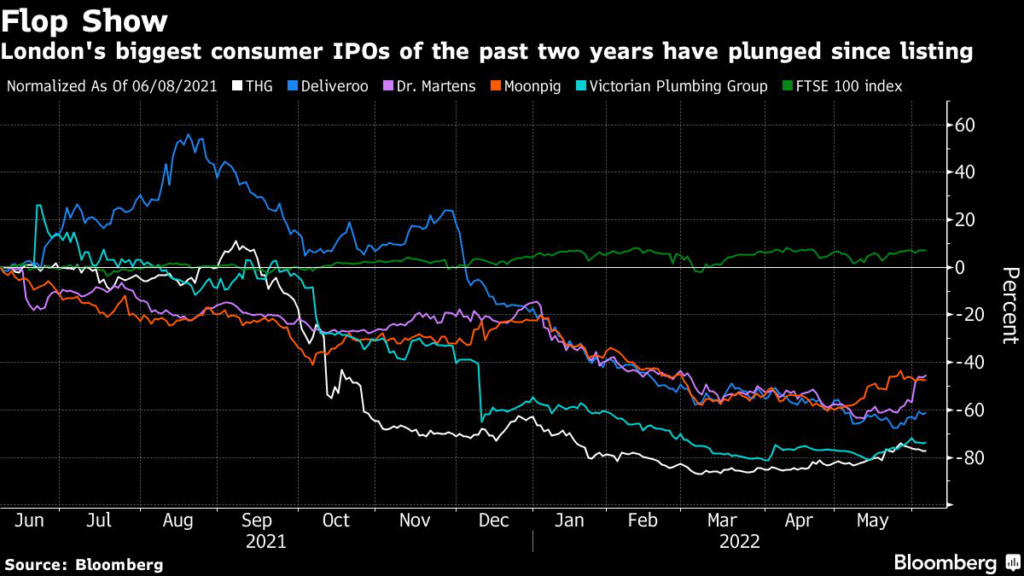
That’s a sharp reversal in fortune after a record year in 2021, which included the likes of bootmaker Dr. Martens Plc, greeting card retailer Moonpig Group Plc and food-delivery platform Deliveroo Plc. In total over the past two years, firms raised $34.7 billion in London, with consumer-facing businesses accounting for $13 billion, more than a third of the total.

But any initial hype surrounding those retail listings has long faded. Many have tanked since going public, with Deliveroo, e-commerce group THG Plc and furniture retailer Made.com Group Plc all down more than 60%.

“I haven’t seen an IPO cross my desk in almost three months, which is very telling,” said Alexandra Jackson, manager of the Rathbone UK Opportunities Fund. “I felt like a full-time IPO analyst this time last year, but the market has cycled from frenzied to desolate since then.”

There’s a long line of potential IPO candidates in London, among them Burger King’s UK franchise, fitness apparel business Gymshark, plant-based food firm Huel, YO! Sushi-owner Snowfox Group, online retailer Very Group and leisure firm Virgin Experience Days.

But with almost two-thirds of UK listings since the start of 2021 trading in the red, any IPO right now would face an uphill struggle.

For consumer-facing firms, there’s the additional inflation hurdle that’s dominated the investment backdrop this year. Food and gasoline prices are surging, retail sales fell 1.1% in May from a year earlier, and households are cutting back on everything from essentials to dining out. The FTSE 350 Retail Index is down more than 30% this year, compared with 3.6% for the broader stock index.

Some businesses are looking at the option of a sale over a listing, given the impact of market volatility on investor interest right now. 

LELO, a Swedish sex-toy designer, is exploring that route after pulling the plug on a London IPO, Bloomberg reported. It had at one point been seeking a valuation of more than £1 billion in a listing.

Mishcon de Reya LLP, which has already delayed its share sale twice, on Wednesday said it’s stopped working on its London IPO, halting plans to create the world’s largest listed law firm.

When IPO activity resumes “will depend on investor appetite for new issues and a sustained period of lower volatility,” said Lawrence Jamieson, head of UK equity capital markets at Barclays Plc. “While many fund managers are prioritizing opportunities within their existing portfolios amidst equity outflows, others are more optimistic and are taking the view that the market has already digested much of the worries about inflation and rising interest rates.”

That optimistic argument may soon be tested, as there’s one large London listing in the offing. GlaxoSmithKline Plc, the UK drugmaker, plans to spin off a unit that makes Panadol painkillers and Sensodyne toothpaste. While the new company, Haleon, won’t raise any money, investor reaction will be closely watched to gauge appetite for other offerings from the sector. 

“Consumer stocks have sold off so much, with some down 40% to 60%, that investors are pricing in very rough scenarios, but it’s important to remember that the UK stock market is not the economy and vice versa,” said Jackson. “The spinoff of GSK’s consumer health unit will be an interesting valuation exercise.”

More stories like this are available on bloomberg.com

©2022 Bloomberg L.P.

Mercedes-AMG Considered Cancelling Its F1 Supercar, Says Chief

(Bloomberg) — It’s no secret that Mercedes-AMG has struggled to birth the Project ONE.

The company’s moon-shot supercar—developed with the Petronas Motorsport Team as a Formula 1-style vehicle owners could legally drive on public roads—was announced in 2016. But after more than six years still has yet to hit the street. 

Mercedes had remained mum regarding details of the delay of the 275 planned cars. (Somewhere along the way, the name changed to the Mercedes-AMG ONE, although almost everyone including Mercedes brass still refer to it as Project ONE.) But on May 31, the company announced that it had finally made an actual production model. On June 1, it got AMG ONE buyers in the United States on a video call to tell them that the AMG ONE would not be legal to drive on public roads in the U.S.

“Constant development and refinement have left us with a difficult decision for the US market,” said the official written notice of the decision not to homologate the car for the US, which was shared to Bloomberg by a Mercedes-Benz spokesperson June 9. “In order to preserve the unique character of its Formula 1 powertrain, we have concluded that meeting U.S. road standards would significantly compromise its performance and its overall driving character. We have taken the strategic decision to offer the car for road usage in Europe, where it meets applicable regulations.”

The spokesperson declined to clarify whether full, sustained production had started or the company had simply made a single production car. It was also unclear how many cars had been slated for the United States and whether any or all of those cars would still be delivered. Despite being illegal to drive as a commuter car, it could still be used for track days and showing off in garages and parking lots. A federal government “Show and Display” exemption law would presumably allow it to be imported as a special car limited to just 2,500-miles of driving annually. The spokesperson declined a Bloomberg request for further comment. 

Jochen Hermann, who leads the Project ONE development team, recently divulged the specific challenges of developing the 1,063-horsepower hybrid. The goal was to adapt the 2016 Mercedes F1 team car into something that would meet street safety, sound and emissions requirements—and run on conventional gasoline, not race fuel. Among other criteria, it would need to start with the push of a button—not a whole team of engineers checking every system for “go”—and be sturdy and practical enough to navigate the normal dips and bumps of highways and city roads. (Lightweight carbon fiber used in F1 is notoriously fragile, easily broken, and very expensive to replace.) Meanwhile it needed to retain the mind-blowing speed of an F1 racer.

The team worked for years to eventually adapt the race-car engine into a 1.6-liter V6 with direct injection and electrically assisted turbocharging; they paired it with four electric motors, an automated seven-speed transmission, all-wheel-drive and multiple drive modes. AMG ONE’s most distinctive exterior feature is the rooftop air intake that looks like the dorsal fin of a shark.  

During a conversation in Monte Carlo May 19, Hermann detailed why the €2.27 million ($2.41 million) marvel from back in 2016 is still relevant today—and why the majority of those who signed up years ago to buy one ago are still on-board. 

This conversation has been edited for length and clarity.

There have been no deliveries of the AMG ONE, yet — right?  

We will deliver cars in the second half of 2022. We will stick to that plan.  

This has been a challenge to produce.

Yeah. Actually I was in the room when the idea was born and I said, “Can we make sure [to say] that we were drunk?” Not drunk at the board meeting, but I was in the room when a few guys came together and said, “Why don’t we bring a Formula 1 car to a street legal version?”

I was sitting in the room and said, “Okay.” Not really realizing that I was going to be the guy who finally has finished it.

 It is refreshing that you guys are now open about discussing the challenge.

It is, it really is. It took me a while. As an engineer, you’re kind of embarrassed, right? Because you don’t want to tell people. Especially in my position, I only get problems the whole day. This is what I’m there for. So, it’s okay with me. But then I spoke to a customer and he opened my eyes because he said, “You know what? I don’t want to buy a car which is not a problem to be developed.”

I said, ‘You have no idea how complex it is.’ And he said, “Yeah, I understand. But I really think you should not even apologize because of some delay.” That is something only a customer can say, I cannot say that. And ever since, I stole this argument from him.

Did you consider cancelling the car altogether?

Two or three times we said, “You know what, why don’t we just stop the project. Give people the money back or make a race car or whatever.”

What was the biggest problem?

Actually, there were many. First of all, the foremost people think of, it’s the exhaust treatment. If you look at a Formula 1 car, it’s running at more than 3000 RPM in idle. So when the team talked to the [race engineers], they said we cannot run at 3000 RPM at idle.  

It’s not right for normal driving on the street.

Right. Then we had the after-treatment of the exhaust to be street legal for emissions. Once we had solved that one, now, looking back we more or less finished with the car, I think the most challenge we had was on the software side.

How so?

If Lewis [Hamilton] sits into his car and he wants to start the engine, you can see four or five people standing around the car with blocks and mechanical pieces stuck into the car. There’s a whole team helping him starting the engine.

It takes a village.

We had to put these people into sensors and hardware sensors and so forth because with Project ONE you can start the car like you can start any car. Here’s another example: if Lewis is going on test run, there’s a whole team sitting in the back office with their computers. They decide how he’s doing. We, again, had to put this into software and into hardware for the car. And that was really so complicated.

Now that it’s close to being brought to customers, people say, “Oh yeah, it’s a nice car.” 

Over many years we have all seen it splashed around a lot as an exciting upcoming thing.

Even in internal presentations, even if there’s a guy coming in to talk about tires for an SL, the opening picture would be Project ONE. So we always making fun and say, “Oh, we just use it for that.” But this car really helped us to understand this future of electric driving.

But it’s not an all-electric car.

No. However, it has a battery in it for electric motors. You can only drive this car quick on a racetrack if you know how to handle the energy. You have to have a strategy and you have to make a decision—What kind of vehicle are you going to drive?—which is completely different to a regular combustion engine.  

Is there a concern that because the car was conceived more than six years ago and is coming out now, it’s going to seem outdated to the people who put their name down on a list to buy it?

No. One thing we started the last two years is to talk with the customers because they are part of the project. Without these people, we would not be able to work in a dream car like that. They are paying us, having fun with these challenges. Sometimes it’s not so much fun, you know what I mean?

Painful fun.

It’s painful fun. That’s a good one. We went through all this pain, but now that we talked to the customers, they said, “No, no. Just explain us what is happening. We are part of it.”  

The customers are invested financially but also emotionally. 

We engage people. We had video talks to customers. We were explaining, “We have problems here and there and there.” For instance, we had a bearing issue in the engine. We found out we had to have a stronger bearing than in the Formula 1 car.

Why?

Because on a Formula 1 car, the engine lasts only for a few races. And with all the electric changes that we did, this bearing had to see more wear than you see on the Formula 1 car. So then [a developer] came to me and said, “You know the pressure that we have in this bearing is close to the pressure people use for industrial diamonds production.” So, if you talk about this to customers, they say, “Well, that’s a cool story. I like that car.”

I’m still apologizing for being late, because it’s a German attitude. Maybe other car brands would say, “You’re getting something special. We don’t apologize. It’s part of the game.” So, coming back to the question, is it outdated? No.

Have you had people pull their deposits?

I don’t know. Maybe one or two for maybe some other reasons, but we still have a waiting list.

One more question. In light of all of this news that Mercedes-Benz is prioritizing growth on the high end and getting rid of some low-end stuff, how does the AMG One play into that strategy? Can we expect any other forthcoming supercars? On top of the AMG GT, for instance.

I am not telling any secrets. If you are at the point of time where we are close to bringing the car to the customers, you don’t want to even think about the next one. But never say never.

The Mercedes-AMG ONE will officially be seen in motion for the first time later this month during the Goodwood Festival of Speed in England.

More stories like this are available on bloomberg.com

©2022 Bloomberg L.P.

Billionaire Drahi Soon Gets a Fresh Shot at BT. Will He Take It?

(Bloomberg) —

French billionaire Patrick Drahi is mulling his next steps with BT Group Plc as UK rules that prevent him from launching a takeover offer expire on Tuesday. 

The moment — a year since the founder of Altice Europe NV unexpectedly became BT’s biggest shareholder — brings back into play a company now part-owned by two of Europe’s biggest broadband groups, opening the door to long-awaited restructuring in the continent’s telecoms sector. Aside from the former British monopoly, German giant Deutsche Telekom AG has skin in the game, with US assets also potentially involved.

“You’ll hear all the CEOs around Europe talking about the theme, about further consolidation,” Chief Executive Officer Philip Jansen said at a dinner with reporters in London last month. BT’s two biggest shareholders “recognize that the industry structure could be improved.”

Since securing a 12% stake last June and then expanding the holding to 18% in December, the 58-year-old has kept close tabs on BT’s development. Jansen said he regularly hears from Drahi after quarterly results and said the billionaire pushes for faster execution on rolling out fiber infrastructure.

While Drahi publicly supports the British carrier’s strategy, the Moroccan-born investor has a track record of debt-fueled dealmaking, raising questions over his ultimate plans. Deutsche Telekom, which owns 12% of BT, may be a willing partner if a deal moves forward — though the timing could still be months away.

BT’s board is preparing for the possibility it will receive a takeover offer at some point, said people familiar with the company’s thinking, who asked not to be identified because the discussions are private. 

Representatives for Altice and BT declined to comment. 

Drahi would need help financing a deal. BT is currently valued at 17.6 billion pounds ($21.8 billion), while the investor’s wealth has dwindled by $1.4 billion so far this year to $7.9 billion, according to the Bloomberg Billionaires Index.

Securing the resources may be difficult. Credit markets are getting tighter, and already three Altice entities and Drahi’s auction house Sotheby’s hold combined net debt totaling some $58.5 billion.

Even if his liquidity is solid and he has until 2025 before a significant amount of debt matures, “rising interest rates will impact him,” said Pierre-Francois Merveille, a credit analyst with Oddo BHF. 

Meanwhile, a possible sale of Altice Portugal, which could have raised resources, has gone nowhere, and it’s not a good time for listing some of his assets like Sotheby’s and digital-advertising business Teads, Merveille said. 

German ‘Kingmaker’

Deutsche Telekom Chief Executive Officer Tim Hoettges has hinted that the German company is prepared to be a “kingmaker” in deals involving BT. That cooperation could involve trading its stake in BT for Drahi’s American cable group Altice USA Inc., according to New Street Research analyst James Ratzer.

Such a deal could help both sides. Altice US shares have plunged more than 70% in the last 12 months as it loses customers and dials up spending on fiber. A swap could be a welcome exit for Deutsche Telekom after the value of its BT stake has declined by billions since acquiring it for half of mobile carrier EE in 2016. The German company declined to comment.

Hoettges has been increasing Deutsche Telekom’s stake in T-Mobile USA Inc. The unit now accounts for more than half of the Bonn-based carrier’s profits and could benefit from a broader American presence. Drahi’s BT holding would rise to 30% in such a deal — potentially without sucking up capital — though that would trigger a formal takeover offer under UK rules. 

A breakup is also an option. The separation of Openreach, BT’s nationwide fixed-infrastructure unit, would overhaul the British telecom market and has long been speculated. But Drahi hasn’t expressed interest in the idea with BT, a person familiar with the matter said.

Even when the ban on making an offer lifts, there are reasons for Drahi to bide his time. The UK government is still investigating his stake-building on security grounds and that may encourage caution as long as the outcome is pending, according to a person familiar with his thinking. 

The inquiry is due to conclude in the first week of July, though officials could choose to extend the probe for 45 working days.

More stories like this are available on bloomberg.com

©2022 Bloomberg L.P.

Close Bitnami banner
Bitnami