Bloomberg

MultiChoice to Spend Half Content Outlay on Africa-Made Shows

(Bloomberg) —

Multichoice Group Ltd. is looking to spend half its content investment on African-made shows with local actors and producers within the next two years.

The aim by Africa’s largest pay-TV company could result in more cost savings — given the expense of buying rights to shows in the US and elsewhere — and more viewers on the continent, Chief Executive Officer Calvo Mawela said in an interview. The Johannesburg-based company’s streaming service Showmax increased paying subscribers by 68% in the year through March, in part due to the decision to “double down” on local content offerings, he said. 

“Making African content and paying actors and staff in local currencies comes at a fraction of the cost of buying dollar-denominated international content,” said Mawela. Many stories can be redeployed in different African countries and still resonate, adding to savings, he said. 

The MultiChoice production “The River” — about wealthy businessmen and exploited township people — was made in South Africa and successfully adapted for audiences in countries such as Ethiopia and Kenya, said Mawela. Two Portuguese channels have been rolled out in Angola and Mozambique, where the language is spoken, and are proving very popular, according to Mawela.

Netflix Inc., which has been trying to make inroads in Africa, has also channeled cash into continent-made shows such as “Blood and Water”. The U.S. giant said this year it will invest 929 million rand ($59 million) into the South Africa creatives industry by 2023, 

The company, spun out of e-commerce giant Naspers Ltd. in 2019, has been operating on the continent for 28 years and has almost 22 million customers. The group is offering cheaper packages on mobile phones to access a younger, less affluent audience and making deals with other content providers such as Netflix and Amazon.com Inc. to come onto its decoders. 

“People tend to go onto our decoder and use all the different platforms through us,” said Mawela. The company recently started offering Disney Plus, adding a further revenue stream, he said. 

More stories like this are available on bloomberg.com

©2022 Bloomberg L.P.

Foxconn Reproaches Chinese Rivals for Poaching Vietnam Workers

(Bloomberg) — Foxconn Technology Group is facing a battle of talent in Vietnam as major suppliers to Apple Inc. continue to shift some capacity from China to the Southeast Asia country on prolonged tensions between Beijing and Washington.  

The chairman of Hon Hai Precision Industry Co., Foxconn’s flagship unit, said its Chinese rivals in Vietnam have set up operations near its campuses to poach the company’s employees. 

“The move shouldn’t be condoned,” Young Liu told reporters in Taipei on Saturday, without naming any companies. 

Three of Foxconn’s China-based competitors are now in Vietnam: Luxshare Precision Industry Co. and GoerTek Inc. make AirPods there while BYD is preparing to produce iPads.

The key Apple assembly partner now employs about 60,000 people in Vietnam, the company’s largest manufacturing base outside of China, Liu said. Liu said Foxconn will “significantly” increase the numbers of employees in Vietnam over the next one to two years, without providing a specific number.

During the Trump administration, the U.S. implemented various measures including tariffs on certain products imported from China in an attempt to reshape global supply chains. The Biden administration is looking to reconfigure the China tariffs, but U.S. officials have not made major changes so far. 

While Foxconn still relies on China for most of its production, the world’s largest contract electronics maker has had to make adjustments to mitigate risks from the trade war. 

The Taiwanese company had planned to move some production of iPads and MacBooks to a new plant in the northern Vietnamese province of Bac Giang, Bloomberg News reported in 2020. The site was originally slated to begin production in 2021, with the Vietnamese government saying the company could invest $700 million that year. 

It is unclear whether that site is now up and running, and Liu did not offer an update on the construction progress on Saturday. Foxconn has been making electronics in Vietnam for years, even before the US trade war with China began under the Trump administration. 

More stories like this are available on bloomberg.com

©2022 Bloomberg L.P.

Oracle Women Stumble in Pay Bias Suit While Google Cuts a Deal

(Bloomberg) — Women at Oracle Corp. suing over alleged pay disparities took a big step backward, while more than 15,000 female workers at Google crossed the finish line.

Under a judge’s tentative ruling Friday, the Oracle women are poised to lose the class-action status they earlier won that gave them powerful leverage in a five-year court fight with their employer.

Alphabet Inc.’s Google, meanwhile, agreed to pay $118 million to resolve claims filed under California’s Equal Pay Act that the company pays men more than women for doing the same job.

Read More: Google Women Suing Over Gender Bias Win Class-Action Status

A California state judge agreed with Oracle on that it would be unmanageable to proceed to trial with a class of more than 3,000 female employees in 125 different job classifications. 

In 2020, the three women leading the suit against Oracle achieved a milestone by becoming the first to win class-action status in a discrimination case against a large technology company. Aggregating claims on behalf of a large group allows plaintiffs to pool resources and negotiate for a much bigger payout.

Female engineers at both Twitter Inc. and Microsoft Corp. failed to persuade judges to let their gender-bias cases proceed as class actions and those rulings were upheld on appeal. 

The women suing Google fared better, winning a ruling in 2021 that allowed the case to advance on behalf of 11,000 women seeking more than $600 million.

The women said in a court filing that the company paid female employees approximately $16,794 less per year than a “the similarly situated man,” citing an analysis by an economist at University of California at Irvine.

The accord announced Friday by lawyers for the plaintiffs covers about 15,500 women at Google in 236 different job titles.

In addition to the settlement fund, an independent expert will analyze Google’s hiring practices and and independent labor economist will review the company’s pay equity studies, Lieff Cabraser Heimann & Bernstein LLP and Altshuler Berzon LLP said in the statement Friday. The settlement couldn’t be confirmed on the court docket.

“As a woman who’s spent her entire career in the tech industry, I’m optimistic that the actions Google has agreed to take as part of this settlement will ensure more equity for women,” Holly Pease, one of the plaintiffs, said in the statement.

The Google deal must be approved by a judge. A hearing on a preliminary approval is scheduled for June 21, the law firms said. Alphabet representatives didn’t respond after regular business hours to a request for comment.

In the Oracle case, San Mateo County Superior Court Judge V. Raymond Swope, who tentatively granted the company’s request to decertify the class, set a hearing on the matter for June 13 in Redwood City. 

Before the 2020 ruling, Oracle argued that the lawsuit wrongly compares women and men tagged with the same job codes even though such coding doesn’t mean the work requires similar skills, effort or responsibility, because Oracle’s products and services vary so widely.

Oracle Women Score Major Win in Court Battle Over Equal Pay 

Jim Finberg, an attorney representing the women, said he plans to persuade the judge to change his tentative ruling. If that doesn’t work, “it is fair to say that, at some point, we will appeal the decision,” he said.

An Oracle spokesperson didn’t immediately respond to a request for comment.

The Oracle case is Jewett v. Oracle America Inc., 17-CIV-02669, California Superior Court, County of San Mateo (Redwood City). The Google case is Ellis v. Google LLC, CGC-17-561299, California Superior Court, County of San Francisco.

More stories like this are available on bloomberg.com

©2022 Bloomberg L.P.

Google Agrees to Pay $118 Million to Settle Pay Equity Suit

(Bloomberg) — Alphabet Inc.’s Google agreed to pay $118 million to settle a gender discrimination lawsuit with about 15,500 female employees, lawfirms representing the women said in a statement.

In addition, an independent expert will analyze Google’s hiring practices and and independent labor economist will review the company’s pay equity studies, Lieff Cabraser Heimann & Bernstein LLP and Altshuler Berzon LLP said in the statement Friday. The settlement couldn’t be confirmed on the court docket.

“As a woman who’s spent her entire career in the tech industry, I’m optimistic that the actions Google has agreed to take as part of this settlement will ensure more equity for women,” Holly Pease, one of the plaintiffs, said in the statement.

The settlement was reached on the same day a judge in another long-running Silicon Valley pay bias case — involving Oracle Corp. — tentatively decertified its class action status, ruling that it would be unmanageable to proceed to trial with a class of more than 3,000 employees in 125 different job classifications suing. 

The Google settlement involves women in 236 different job titles, according to the law firms. Similar lawsuits against Twitter Inc. and Microsoft Corp. have failed to gain class-action status.

The Google deal must be approved by a judge. A hearing on a preliminary approval is scheduled for June 21, the law firms said.

The women leading the Google suit said in a court filing that the company paid female employees approximately $16,794 less per year than a “the similarly situated man,” citing an analysis by David Neumark, an economist at University of California at Irvine.

The case is Ellis v. Google LLC, No. CGC-17-561299, San Francisco Superior Court.

(Updates with comment from plaintiff in third paragraph)

More stories like this are available on bloomberg.com

©2022 Bloomberg L.P.

Jeweler Blue Nile Set to Return to Public Market Via SPAC Deal

(Bloomberg) — Online jewelry retailer Blue Nile Inc. agreed to go public again through a merger with a blank-check firm valuing the combined company at $873 million.

The transaction with Mudrick Capital Acquisition Corp. II is expected to generate about $450 million of capital before expenses, the companies said in a statement Friday.

The deal includes $80 million of committed capital — about $50 million of it pre-funded — from Bain Capital Private Equity, Bow Street, Adama Partners and Mudrick Capital. The deal also includes $50 million in new preferred equity provided by Mudrick Capital, according to the statement.

The $873 million pro forma implied equity value of the combined company is based on the $10.15 a share price of the private investment in public equity, assuming no redemptions by the SPAC’s stockholders.

The company, based in Bellevue, Washington, will be named Blue Nile and is expected to be listed on Nasdaq. The company will be led by the current management team, including Blue Nile Chief Executive Officer Sean Kell.

Blue Nile is returning to the public market after Bain and Bow Street agreed in 2016 to take it private in a $500 million deal.

The Mudrick SPAC raised $316 million in its initial public offering in 2020, including so-called greenshoe shares.

More stories like this are available on bloomberg.com

©2022 Bloomberg L.P.

Cyber CEO’s US Advisory Work Echoed Sales Pitch His Firm Uses

(Bloomberg) — An executive’s involvement in drafting White House-backed cybersecurity guidelines for energy companies that could potentially benefit his firm rankled competitors and prompted an effort by the Biden administration to remedy the potential conflict, according to documents and emails reviewed by Bloomberg News and interviews with four people involved in the process.

Soon after President Joe Biden took office, the White House began developing a plan to harden the cyber defenses of the electric grid. Robert M. Lee, chief executive officer of the cybersecurity firm Dragos Inc., was brought in for advice.  

Lee helped prepare guidelines that could direct utility firms in choosing a cybersecurity product, a plan that was intended to strengthen their digital defenses and encourage the sharing of threat intelligence. But some of the wording he inserted resembled the language his company uses to market a product, documents show.

In an early 2021 email to other industry experts involved in crafting the action plan, Lee said he needed to show support for the plan “without appearing to have authored anything.” In a separate email to the group, he wrote, “We’re trying to say Keeper without saying Keeper,” referring to his company’s Neighborhood Keeper program, which finds potential threats and shares anonymized information about them with the government. 

The others on the email chain didn’t appear to be potential beneficiaries of the guidelines.

By inserting descriptors of his company’s own product into the guidelines — such as “high-fidelity sensor-based” monitoring — Lee’s efforts prompted complaints from competitors who felt they were effectively excluded from a major federal initiative. Government ethics experts said it also creates the appearance of favoritism. 

Closely held Dragos has a valuation of $1.7 billion, and its backers include Koch Disruptive Technologies, as well as funds and accounts managed by BlackRock. 

In interviews, Lee defended his actions and said the wording he chose simply mirrored language used “for years” by the U.S. government. “I have done, in my opinion, nothing wrong,” he said. “I’ve worked for over a decade in government and in the private sector to try to make infrastructure more secure. And finally something got going that was a good effort.”

Lee said he edited the guidelines to be “solution agnostic,” and he said he made that clear to others involved in the process. Asked about the “trying to say Keeper without saying Keeper” email, Lee said he often uses the term “keeper” as short hand for products like his own that share data anonymously.

“My intent was not to see Neighborhood Keeper itself get pushed but that this type of capability and information sharing be considered and recommended,” he wrote in an email to Bloomberg.Lee said he was brought into the process by an independent contractor, whom he declined to name, but wanted to avoid being directly involved over perceptions that he stood to benefit. He said he wanted to encourage anonymous data sharing on cyber threats in order to protect critical systems. “I know the way it’s worded in my email is shady but you can believe me or not that was the intent,” he said in an email to Bloomberg, adding he stopped participating after White House lawyers were “concerned of optics.”After publication, Lee said he was brought in by the White House for general advice on industrial control systems that are used by a wide swath of critical infrastructure. He said the edits that he made were for a white paper by the independent contractor, not the White House, though some ended up in the White House-backed plan.

It’s not known how many utilities ultimately hired Dragos as a result of the initiative. Lee declined to elaborate, saying information about Dragos’s customers isn’t public.

Government ethics experts said that when business executives influence policy that could benefit them, it runs counter to transparency norms and potentially exposes US taxpayers to products or services that haven’t been scrutinized by an open process. “We need a level playing field when it comes to government policies and decisions, not cozy relationships,” said Scott Amey, the general counsel for the Project on Government Oversight.

Dragos’s involvement in helping shape the plan unfolded amid a series of devastating cyberattacks made public in late 2020 and during the first half of 2021, including a ransomware attack on Colonial Pipeline Co. that caused fuel shortages along the East Coast. The new administration vowed to make improving the nation’s digital defenses a priority, though it has been limited because much of the nation’s critical infrastructure is in private hands. 

Emails reviewed by Bloomberg show that Lee exchanged messages about the plan with Anne Neuberger, the deputy national security adviser for cyber and emerging technology, in early 2021. Neuberger brought in Lee to help because of his expertise in the relatively small field of industrial control system cybersecurity and his company’s investigation of an attack on Ukraine’s electric grid, according to a person familiar with her thinking.

The guidelines, for instance, urged utilities to pick a cybersecurity product that provides “high-fidelity sensor-based continuous network cybersecurity monitoring” and anonymize data by using a “technologically irreversible” process. Dragos described its platform in nearly identical language, according to an archive of Dragos’s website dating from weeks earlier.

A document obtained by Bloomberg tracks where Lee himself inserted references to some of those descriptors, which he said can be found in other government documents. Bloomberg couldn’t immediately find similar phrases on the websites of several of Dragos’s competitors, which declined to comment or didn’t respond to messages seeking comment. 

On April 20, 2021, the Biden administration publicly announced a 100-day plan to bolster cyber defenses of the electric grid, including helping utilities modernize their own cybersecurity.  A few weeks later, the industry’s point person on the White House plan, Berkshire Hathaway Energy Chief Executive Officer Bill Fehrman, sent an email to energy companies endorsing Dragos’s product. 

“As part of the initiative and after a significant assessment of 18 different technologies, we are recommending Dragos Neighborhood Keeper,” he said, according to a May 2021 email from Fehrman on behalf of an industry group he was part of. He wasn’t aware of Lee’s involvement, according to his spokesperson.​​

In June, the National Security Council sent the draft guidelines to energy executives and other government officials, emails show.

But news of the Dragos endorsement made its way to the White House, and Neuberger told Fehrman’s group, the Electricity Subsector Coordinating Council, that such a claim could limit competition, according to a senior administration official. The guidelines were reworked and expanded before being made public by the Department of Energy last August.

A National Security Council spokesperson said, “When we became aware of concerns early last summer about the criteria that were then in development, we worked closely with the Department of Energy to ensure that the final guidance reflected the input of all government agencies with expertise in this area and did not favor any particular company.”

The DOE, which is leading the initiative, declined to comment. 

In response to inquiries about Fehrman’s letter endorsing Dragos, Berkshire Hathaway Energy spokesperson Jessi Strawn said the “only sensor technology that was open to all investor-owned utilities at the time was Dragos Neighborhood Keeper.” As a result of the White House-backed plan, Berkshire Hathaway Energy adopted the use of Dragos within its organization, she said.

Competitors complained to an industry group that the guideline’s wording tracked closely to Dragos’s product, according to two people involved. One company planning to hire a competitor hired Dragos instead, believing Fehrman’s recommendation amounted to a government endorsement, one of those people said. 

Neighborhood Keeper is free but requires buying Dragos’s platform, which could cost a municipal utility about $15,000 to $45,000 a year, according to a company presentation from 2019. An update on the program last August said at least 150 electric utilities, serving almost 90 million electric customers, “have adopted or committed to adopting technologies” to bolster cyber defenses.

Experts say the government has several ways to limit private firms from being able to craft policy in their favor, including prohibiting the executive branch from endorsing a product unless it has followed a defined process.

“It’s important that the public be able to have confidence in procedures the government uses,” said Kathleen Clark, a legal ethics professor at Washington University in St. Louis, after learning of Lee’s involvement. “There is reason not to have confidence in this case.”

(updates with additional detail from Rob Lee in 13th paragraph)

More stories like this are available on bloomberg.com

©2022 Bloomberg L.P.

Ethereum’s ‘Difficulty Bomb’ Delay Is Bad News for Revamp

(Bloomberg) — Ethereum’s big transition to a more energy efficient system that developers have been promising for years could be kicked down the road yet again as they plan to delay a so-called difficulty bomb that’s designed to slowly boot miners off the blockchain.

The difficulty bomb, which is a special code that’s always been a part of Ethereum, swiftly increases the computing difficulty of mining the underlying token, eventually making it impossible to do so. When the bomb goes off and is allowed to run its course, it’s an indication that the days until the so-called Merge — Ethereum’s switch to the proof-of-stake system for ordering transactions — are numbered. In proof of stake, people stake coins to order the transaction, a process which is supposed to consume 99% less power.

Developers decided to delay the difficulty bomb on Friday after they discussed ironing out various bugs they’ve discovered when they ran the software for the Merge on Ropsten, one of the oldest testnets of the network. While developers hadn’t officially set a particular date for the Merge — Ethereum co-founder Vitalik Buterin said it could happen as soon as August if there are no major issues — the decision to push back the difficulty bomb raises fears that the much-anticipated upgrade could take more time. 

“Delaying it gives you time,” said Thomas Jay Rush, a participant in the call. “It looks bad to the community, but there’s nothing you can do about that.”

The difficulty bomb had been delayed multiple times before. Though it went off this month, developers are planning to disable it and then deploy it again at another time. It is unclear when they’d do so. Many hoped it wouldn’t have to be delayed, as the Merge would happen soon. 

The Merge could be pushed back to September or October if developers need more time, Buterin said last month. There’s only a 1% to 10% chance that the Merge won’t happen this year, Tim Beiko, who coordinates Ethereum developers, said in a recent interview with Bloomberg. During the Friday call, developers emphasized the difficulty bomb delay has no implications for the timing of the Merge. 

Beiko, who also facilitated the Friday call, said he is worried about developer burnout if they rush to get the Merge done without delaying the difficulty bomb for a reasonable amount of time.

“If we do delay this, I think it should be a realistic delay to still maintain a sense of urgency,” Beiko said. “But too much pressure pushes teams to burn out, that’s also a situation we don’t want to be in.”

The potential delay dampens the excitement around the Merge after the developers carried out the upgrade on Ropsten on Wednesday. Since it’s one of the oldest testnet for Ethereum, Ropsten is able to provide one of the most realistic technical environments to test out the Merge, check for bugs, and evaluate the outcome of the final process. Developers have uncovered a number of issues in the test so far.

“Maybe we are not quite at the mainnet code,” Beiko said on the call. 

The second largest token by market value after Bitcoin has fallen as much as 6.4% on Friday and has plummeted about 66% from its record high in November 2021. Ether traded at $1,673 on Friday evening. 

(Adds price of Ether; a previous version corrected the name of Ethereum co-founder in the third paragraph)

More stories like this are available on bloomberg.com

©2022 Bloomberg L.P.

Dyal Agrees to Buy Minority Stake in Lead Edge Capital

(Bloomberg) — Blue Owl Capital Inc.’s Dyal Capital has agreed to acquire a minority stake in growth-equity investment firm Lead Edge Capital, according to people with knowledge of the matter. 

The transaction is set to close in coming months, said one of the people, all of whom requested anonymity. Terms couldn’t immediately be learned.

Representatives for Blue Owl and Lead Edge declined to comment.  

Lead Edge, led by founding partner Mitchell Green in April said it raised $1.95 billion for a fund dedicated to backing both private and public software, internet, consumer, and tech-enabled service companies. At the time, he said valuations had “gotten ahead of themselves,” and the firm was ready to seize opportunities that may arise in a downturn.

Read more: Lead Edge Capital Raises $1.95 Billion for Growth-Equity Bets

The firm, which has offices in New York and Santa Barbara, California, backed companies including Bumble Inc., Toast Inc. Wise Plc and FIGS Inc. before their public listings. It counts unicorns including Talkdesk, Guild Education and Workhuman in its portfolio, its website shows. 

Minority stake sales, which provide firm founders with liquidity, have proliferated in recent years. Last year, Great Hill Partners and Arsenal Capital Partners, which both make growth-equity bets, sold stakes to Blackstone Inc. and Petershill Partners Plc, respectively. 

Dyal has backed other firms that make growth-equity bets including Iconiq Capital and venture firm New Enterprise Associates. It is in the process of raising $9 billion for a fifth fund for stakes investments.

“We’ll see exactly where we land that plane, certainly confident in that number and we’ll see if we go above,” Blue Owl co-President Michael Rees said during a May earnings call. The target size of its sixth Dyal fund hasn’t yet been set, he said.

More stories like this are available on bloomberg.com

©2022 Bloomberg L.P.

About 19 Million People Watched First Night of Jan. 6 Hearings in Prime Time

(Bloomberg) — An estimated 19 million people watched live prime-time broadcasts of Congressional hearings into the Jan. 6 attack on the US Capitol, according to early audience numbers released Friday.

CNN, MSNBC, CBS and ABC all aired the investigative hearing live Thursday evening. NBC News devoted a special report to the hearing while its online services, Peacock and NBC News NOW, streamed it. 

The audience numbers are preliminary and are subject to revision. The total number of viewers who watched the hearing across all participating networks may be released later Friday.

Still, they offer a measure of how interested the American public is in the investigation into Trump’s effort to overturn the election. By comparison, the audience fell far short of President Donald Trump’s chaotic first debate with Joe Biden in 2020, which drew 73.1 million viewers.

The hearing portrayed then-President Trump’s effort to subvert his election loss. Among other testimony, it featured Trump’s attorney general, William Barr, and the president’s daughter Ivanka saying they didn’t believe the election was stolen. 

The Fox News Channel relegated the hearings to other platforms like its website, Fox News Audio and Fox Business Network. Instead, the most-watched cable network stuck with regular prime-time hosts Tucker Carlson and Sean Hannity, who scorned the hearings as a political attack on former President Trump.

Read more: Fox debates Jan. 6 significance while US watches bloody video

ABC drew the largest audience among the broadcast networks, with 4.9 million viewers, according to data released by the networks. MSNBC led cable outlets with an audience of 4.2 million. Nearly 3 million tuned in for Fox News’ regular programming that aired at the same time as the hearing. 

The House committee investigating the Jan. 6 attack has planned at least six sessions and hired James Goldston, a former president of ABC News, to help with the presentation. 

Even with the help of a veteran TV executive, the House committee faced a challenge in drawing a large audience. The media landscape has fractured across TV, streaming and social media, and people have more entertainment options than ever. 

In addition, ESPN carried an NHL conference final between the Tampa Bay Lightning and New York Rangers.

More stories like this are available on bloomberg.com

©2022 Bloomberg L.P.

Jan. 6 Hearings Need to Deliver Additional Viral Moments to Reach Americans

(Bloomberg) — The Jan. 6 hearings opened with a shocking portrayal in prime time of how then-President Donald Trump’s efforts to subvert his election loss touched off a deadly riot at the US Capitol.

Yet the House investigation’s ultimate impact on public attitudes will turn on whether the committee continues to deliver moments that will etch themselves into the consciousness of an American public focused on rising prices for gasoline and food as inflation hits a fresh 40-year high, shortages resulting from supply-chain snarls and rising crime. 

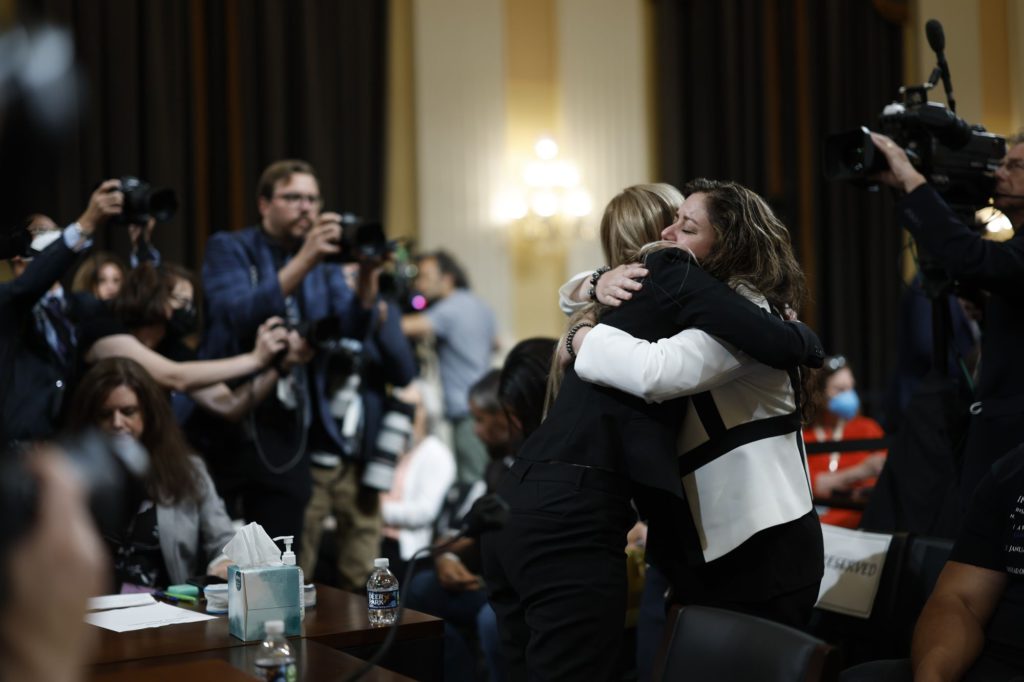
In an age when viral memes and social media conversations shape perceptions, two highlights of Thursday’s session may prove the most durable: Trump Attorney General William Barr and the former president’s daughter Ivanka saying they didn’t believe his claims of a stolen election, and the live testimony of a Capitol Police officer. The officer, who was injured in the melee, described a “war scene” in which she and her fellow officers were pummeled by rioters and slipping in blood.

“Ivanka” and “Barr” were among the top trending topics on Twitter Friday morning, along with “Pence,” inspired by a preview Representative Liz Cheney presented in Thursday’s hearing of coming testimony from White House aides that Trump reacted approvingly to rioters’ chants to “hang” his vice president and angrily rebuffed pleas to call off supporters.

The moments, along with chilling video of Trump supporters clashing with police and a rioter reading a Trump tweet from a bullhorn as insurrectionists charged up the Capitol steps, directly discredit continuing claims the presidential election outcome was illegitimate and efforts by Republican political figures to dismiss the significance of the Jan. 6, 2021, attack.

The committee succeeded with its immediate aim of “trying to shock the senses of everyone,” said Thomas Spulak, a King & Spalding LLP partner who served as staff director to the House Rules Committee and later as general counsel to the chamber in the 1990s.

“Really, the bar was set high,” Spulak said. “The goal last night was to get people’s attention — and maybe open up minds to pay attention to what comes next. And they did that.”

Trump seemed to sense danger, posting statements on social media during the hearing disparaging his daughter as “checked out” and his former attorney general as “a coward.”

The committee did succeed in solidifying and amplifying its major thesis for these hearings — that Trump’s rhetoric and actions instigated the Jan. 6th attack on the US Capitol, said Cayce Myers, an associate professor of public relations at Virginia Tech who specializes in media history.

“Despite establishing that narrative, it’s difficult to know if the committee’s narrative has enough traction with American viewers to keep them watching or even to get them to watch,” Myers said.

In addition to difficulty breaking through to typical voters concerned about the risk of a recession, motivated members of Trump’s populist base are engaged with a conservative media ecosystem that continues to push narratives of a stolen election and casts efforts to investigate the riot as partisan.

“It’s not likely to break through to the Republican Fox voter at all,” said Joe Lockhart a former White House press secretary for Democrat Bill Clinton who is now a public relations strategist. “There are two sets of facts now, the Fox facts and the real facts.”

The first hearing was carried live on prime-time television by most major networks — except Fox News, the highest rated cable news channel, where hosts devoted the time to dismissing the event as a partisan stunt.

The House committee is trying to break through to a weary public by packaging its hearings in a concentrated barrage of episodes released during a single month, similar to the way premium channels such as HBO, Apple TV and Netflix market television series, Lockhart said.

“They structured this for the way we watch television now, and it’s in episodes,” Lockhart said. “It was structured as this is going to be a program, and we hope you’ll watch the whole program.”

The committee has a difficult climb to sustain public attention over six more hearings — including three next week — with none of next week’s hearings set to be aired on major national TV networks, Spulak said.

“I think we will see a gradual fall-off,” he said.

More stories like this are available on bloomberg.com

©2022 Bloomberg L.P.
Close Bitnami banner
Bitnami