Bloomberg

Sony PlayStation’s New God of War Video Game Planned for November

(Bloomberg) — The highly anticipated PlayStation game God of War Ragnarok is planned for release this November, according to three people familiar with the game’s development, despite reports this week that it had slipped to 2023.

Publisher Sony Group Corp. is expected to announce the release date later this month, two of the people said.

God of War Ragnarok, the latest entry in the long-running series and a direct sequel to 2018’s God of War, was announced in 2020 for PlayStation consoles. Sony has delayed the game several times since then, both publicly and internally, as its developers deal with the pandemic and other production challenges. Earlier this year it was planned for September, but it was recently bumped to November. A spokesman for Sony didn’t immediately respond to a request for comment.

The new game is expected to be a big hit and one of Sony’s key pieces of software as it works through hardware challenges. The Japanese video game publisher and manufacturer has been unable to make enough PlayStation 5 consoles to keep up with demand, costing it market share. God of War Ragnarok will be available both on the new console and on the old PlayStation 4, which has sold more than 117 million units, giving the game a substantial install base. The first game sold nearly 20 million copies.

A recent report from the European gaming website GameReactor, combined with the game’s absence at big industry events such as the Summer Games Fest and Sony’s own State of Play, led to speculation that God of War Ragnarok wouldn’t be out until 2023.

No dates are certain in the turbulent world of game development and it may still be delayed again. But as of this week it’s still on track for November, the people said, asking not to be identified discussing information that isn’t public.

More stories like this are available on bloomberg.com

©2022 Bloomberg L.P.

China Tech Titans Make a Comeback as US Peers Stumble 

(Bloomberg) — An easing of China’s regulatory crackdown is lifting the shares of the nation’s giant technology companies, helping them to finally outperform their US counterparts after a dismal year. 

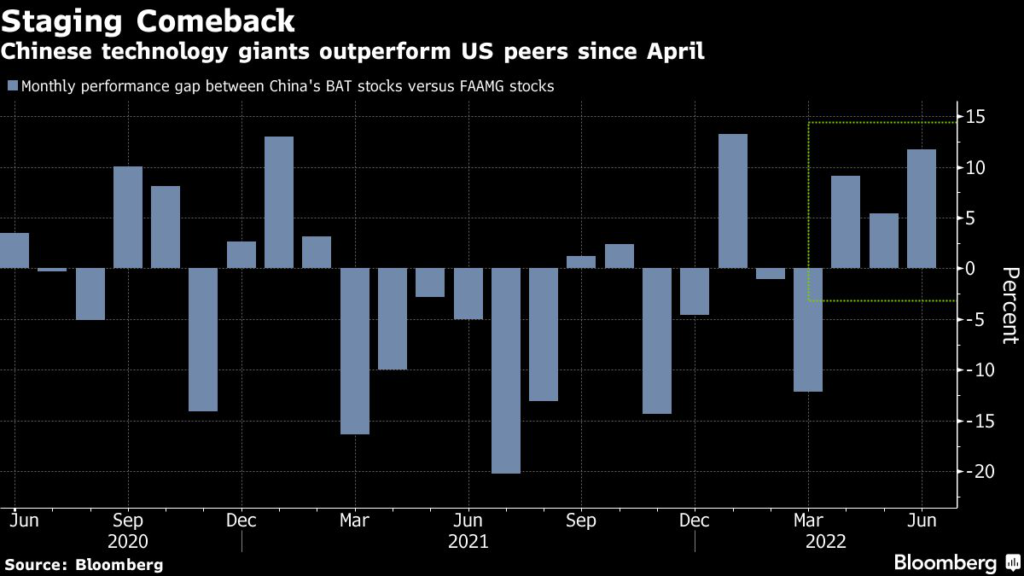
An equal-weighted basket of China’s three internet giants — Baidu Inc., Alibaba Group Holding Ltd. and Tencent Holdings Ltd. — has rallied 37% since mid-March, according to calculations by Bloomberg. In contrast, a portfolio of their US peers — Meta Platforms Inc., Amazon.com Inc., Apple Inc., Microsoft Corp. and Google parent Alphabet Inc. — has declined 11%.

The turnaround has gathered momentum in recent weeks after Alibaba and Baidu posted better-than-expected quarterly results and regulators sent strong signals the crackdowns are nearing an end. 

The Wall Street Journal reported that Beijing is about to conclude its probe of tax-hailing Didi Global Inc. and authorities approved a second batch of video games this year following a monthslong freeze. Chinese financial regulators were said to have started early stage discussions on a potential revival of Ant Group Co.’s initial public offering. The China Securities Regulatory Commission said it wasn’t conducting such work.

“A lot of negatives have been already factored in at the current valuations,” said Summer Xia, equities strategist at UBS Global Wealth Management Chief Investment Office. “We think recent positive policy signals could imply a short-term relief from the regulatory overhang. Investors are likely to focus more on the mid-to-long term growth prospects with these near-term risks being addressed.”

On the other hand, U.S. technology stocks have been hit hard this year as the Federal Reserve raises interest rates to rein in soaring inflation. 

The trio of China giants, known as the BAT stocks, is set to outperform the US cohort for the third consecutive month, the longest such string since the epic tech rout in China began in February last year. The Nasdaq Golden Dragon Index of U.S.-listed Chinese companies has rebounded 43% since mid-March, versus a 6% drop for the Nasdaq 100 Index. The HXC index is on track to close up for its fourth consecutive week, its longest rising streak since January 2020. 

China Tech Stocks Rise as Investors See End to Regulatory Woes

“What is different this time around is that the government seems more determined to encourage positive economic growth in 2022 with specific policies, versus 2021 or start of the year, when they didn’t seem too desperate to promote growth,” said Louis Lau, a fund manager at Brandes Investment Partners. “Chinese Internet companies appear more attractive in valuation than US tech peers.”

Tech Chart of the Day

E-commerce stocks have slumped this year as the pandemic-driven boom faded because of surging inflation and concerns of a recession that are weighing on consumers. While Shopify Inc. leads the pack with a year-to-date plunge of 73%, Amazon.com Inc. and eBay Inc. are faring the best — down about 30%. The sector has underperformed the Nasdaq 100 Index, which is down 25% for the year. 

Top Tech Stories

  • Amazon.com Inc. is planning to withdraw from a heated competition for the rights to stream Indian Premier League cricket matches, according to people familiar with the matter, ceding one of the world’s most popular sporting contests to rivals from Walt Disney Co. to Mukesh Ambani’s Reliance Industries Ltd.
  • Advanced Micro Devices Inc., the second-biggest maker of computer processors, expects revenue to grow 20% annually over the next three to four years as it attempts to take more market share from Intel Corp.
  • Apple Inc. plans to expand the lineup of laptops using its new, speedier in-house chips next year, aiming to grab a bigger share of the market, people with knowledge of the matter said.
  • The UK kicked off a fresh probe into the Google Play app store over suspicions of anticompetitive conduct as the antitrust watchdog wrapped a sweeping study of Alphabet Inc. and Apple Inc.’s dominance of mobile systems.
  • The share price slump that’s erased about $100 billion from the market value of Taiwan Semiconductor Manufacturing Co. this year means little to the legion of analysts who see the stock as a screaming buy.
  • Denso Corp., one of the world’s top automotive semiconductor manufacturers and a key supplier to Toyota Motor Corp., may consider spinning off its chip business, the company’s chief technology officer said Friday.
  • Just Eat Takeaway.com NV’s US unit Grubhub is attracting preliminary interest from private equity firms including Apollo Global Management Inc., according to people with knowledge of the matter.
  • Ericsson’s governance woes continued to pile up after the US Securities and Exchange Commission started a probe into the company’s handling of a corruption scandal in Iraq.

(Adds stock move in seventh paragraph)

More stories like this are available on bloomberg.com

©2022 Bloomberg L.P.

The Era of Descending Capital Costs Planted Seeds for Tomorrow

(Bloomberg Markets) — When the first issue of Bloomberg Markets appeared in July 1992, little did we know that we were entering three halcyon decades of the easiest credit since the 1950s and, most recently, the strongest growth in modern times.

The catalyst was the diminishing cost of capital, abetted by disinflation as China and the Pacific Rim became globalization’s primary source of cheap labor. Having raised borrowing costs to conquer inflation in the early ’80s, the Federal Reserve and other major central banks found themselves taking unprecedented measures to restore growth after the 2008 financial crisis and the onset of the coronavirus pandemic. Soaring demand for debt, equity, and money in all its forms created a 24-hour Wall Street bazaar of wealth such as the world had never seen.

Today, some Wall Street strategists and investors see an end to this golden era. Trade disputes and war are straining the global supply chains that helped keep prices low. The Fed is committed to raising interest rates to bring down the highest inflation since 1983. Recession fears are growing. Prices of stocks and bonds are tumbling.

And yet, what if the past three extraordinary decades in markets have provided businesses with just the resources they need to be resilient through a period of higher rates and help the economy rebound?

CENTRAL BANKS’ aggressive response to the 2008 credit crisis and the pandemic in 2020—reducing overnight rates to little more than zero and purchasing vast quantities of bonds—caused inflation-adjusted interest rates to vanish. That helped drive demand for financial assets. The value of debt sold by developed- and emerging-market issuers increased 11‑fold during the past three decades, to $63 trillion from $5.9 trillion, according to the Bloomberg Global-Aggregate Total Return Index. In the two years since 2019, companies raised a record $6.5 trillion worldwide, more than four times what was borrowed in the same period two decades ago.

The cost of borrowing for US companies is about 14% below the 30-year average; Coca-Cola Co. paid only 2.25% in 2021, or about a third of its rate in 1992. The average cost for emerging-market borrowers plummeted to 2.5% in 2020 from 18% in 1995, or 25% below the average over three decades.

Corporate America was never so healthy, thanks to the least burdensome debt ratios in modern times. Even with record borrowing in recent years, the total debt-to-asset ratio of the companies in the S&P 500 declined to 23.7% as of mid-May, about the lowest in three decades and substantially below the 31.2% average since 1990, according to data compiled by Bloomberg. At the same time, total earnings per share of the S&P 500 jumped to a record-high $203.

Innovation was the biggest prize of descending interest rates. All but one of the world’s 10 biggest companies by market value are based in the US, and four of these publicly traded giants—Alphabet, Amazon, Meta Platforms, and Tesla—didn’t exist when this magazine was born.

Total publicly traded equity raised in 2021, including $684 billion of initial public offerings, climbed to a record $1.42 trillion, 18 times the amount sold in 1992. The New York Stock Exchange’s value tripled, to $31.8 trillion from $10.6 trillion in 2002, and London’s $3.25 trillion FTSE All-Share Index is one and a half times its 2000 valuation. In Hong Kong as much as $22 billion changed hands daily last year on the stock exchange, 65 times the volume in 1992.

The MSCI World Index increased sevenfold, to $54.2 trillion, since 1995. Technology, the fastest-growing industry, expanded by 26 times, led by Apple Inc. and Microsoft Corp. Health-care companies, including UnitedHealth Group Inc. and Johnson & Johnson, followed with 14 times growth. The value of communication services like Alphabet Inc.’s Google and Meta Platforms Inc.’s Facebook increased 10 times.

The auto industry provides some of the strongest evidence of the economy’s transformation. Toyota was No. 1 in 1992, followed by General Motors, Ford, and Daimler-Benz. Three decades later, Tesla Inc., which joined the top 10 in 2017, is the leader. By early 2022 the company’s market cap had ratcheted up its $1.8 billion IPO value by almost 1,000 times, to $1.1 trillion.

Tesla debt, initially rated noninvestment-grade at B- by Standard & Poor’s in 2014, was subsequently upgraded four times to the cusp of investment-grade. Its credit-default swaps outperformed the strongest automakers, including BMW, Honda, Mercedes, and Toyota, in 2022.

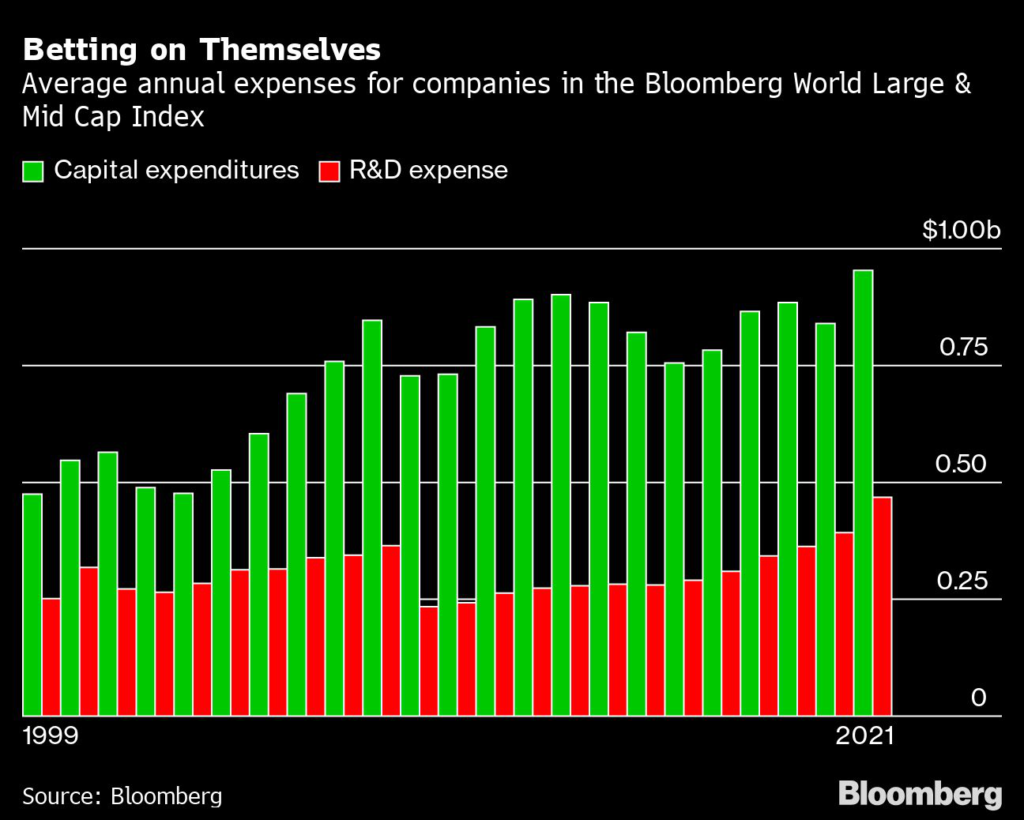
AS MONEY became cheaper, the 3,000 companies in the Bloomberg World Large & Mid Cap Index in 2021 spent on average:

$954 million on capital expenditure, twice what they spent two decades ago ($476 million in 1999).

$414 million to buy back their shares, or 3.5 times what they spent in 1999 ($116 million).

$694 million to pay cash dividends to shareholders, or 4.7 times what they paid two decades ago ($148 million).

$468 million on research and development, or twice the amount spent in 1999.

AMONG THE LEADING companies, R&D expenditure had really soared by 2021:

Apple spent $22 billion, or 49 times its expense 20 years ago.

Microsoft spent $21 billion, or five times its expense in 2001.

Tesla spent $2.6 billion, or 41 times its expense in 2007, when data became available.

Alphabet and Amazon.com Inc. spent more than 1,000 times what their R&D expense had been when they initially traded as public companies.

None were among the 10 largest companies in 1992.

CORPORATE AMERICA wasn’t the only beneficiary of declining capital costs. The historical dichotomy between developed and emerging markets also diminished during the past three decades. By 2021, equity as measured by the MSCI World Index increased 15 times, to $21.4 trillion, in emerging markets, growing faster than in developed markets, where it grew by 11 times, to $64 trillion.

Not surprisingly, financial assets as a percentage of global gross domestic product hover near all-time highs, with average bank assets as a percentage of GDP in 142 countries totaling 73.3% as of 2020, the latest available data, dwarfing the 43.9% in 1992. The ratio was 49.1% in 2002 and 66.1% in 2012, according to Bloomberg data.

So, will the low cost of capital become a distant memory? Is the halcyon era finished?

The answer likely resides with the people who live in the bond market. That would include Dan Ivascyn, who manages the $128 billion Pimco Income Fund, the largest fund tracking the Bloomberg US Aggregate Bond Index, for Newport Beach, Calif.-based Pacific Investment Management Co.

Ivascyn, who’s also Pimco’s group chief investment officer, says that though there’s much uncertainty about inflation, markets and consumers aren’t assuming it will continue the way it did in the ’70s. “Your expectations are still that inflation will decline, and that’s supported by themes in the market now for at least a couple of decades,” he says.

Additionally, after a sustained period of very low interest rates and strong equity and credit market performance, households and companies have been able to borrow and raise money more than ever before, Ivascyn says. “So there’s an inherent cushion in the economy now that could create much more resiliency in the face of rising rates,” he says.

As the last 30 years have proven, markets can defy the skeptics. —With Shin Pei, Jennifer Liu, Samarth Dua, and Sumit Sinha

Winkler is editor-in-chief emeritus of Bloomberg News. This column doesn’t necessarily reflect the opinion of Bloomberg LP and its owners.

More stories like this are available on bloomberg.com

©2022 Bloomberg L.P.

Texas Bakes While California Faces Record Heat Over Weekend

(Bloomberg) — Record heat will sear down across California and the US Southwest through the weekend before pushing east into Texas and the southern Great Plains. 

The high in Odessa, in the heart of the oil-rich Permian Basin in Texas, topped 100 degrees Fahrenheit (38 degrees Celsius) three times so far in June and is forecast to get that hot for the next four days. First break may come Tuesday, when readings will drop to 99 degrees.

Houston has opened cooling centers for people to beat the heat, as temperatures are expected to hit 99 degrees Friday and 100 on Saturday. In addition to the soaring temperatures, dust from Africa’s Saharan Desert will drape itself across Houston and east Texas, turning skies a milky gray, keeping temperatures high and making allergies worse for some, the National Weather Service said. 

Scorching heat will probably increase electricity demand, pushing Texas natural gas plants to run harder and provide more backup electricity. The operator of the Texas power grid is forecasting electricity demand will soar to an all-time high Friday afternoon as millions of people crank up air conditioners to cope with the heat, shattering a record set in 2019.

The heat is also likely to limit Bitcoin mining operations in the state. Texas has become one of the largest crypto mining hubs in the world by computing power and the state’s energy operator expected the miners to use 6 gigawatts of electricity from its grid in 2023.

Excessive heat warnings are also out across California’s Central Valley, where Friday’s high could reach 105 degrees. Fresno could hit 104; Modesto, 103; and Bakersfield, 102. 

“The peak of the heat is today and Saturday and then it starts to cool down,” said Bob Oravec, a senior branch forecaster at the US Weather Prediction Center. “It doesn’t last for very long, but in respect to records, there is a lot of record potential. It is pretty much the same story for Saturday.” 


More stories like this are available on bloomberg.com

©2022 Bloomberg L.P.

Searing US Heat Threatens to Break Records From California to Texas

(Bloomberg) — Record heat will sear California and the US Southwest in the coming days before pushing east and adding fuel to the sweltering weather that’s been pummeling Texas and the southern Great Plains. 

Temperatures in Sacramento are forecast to soar Friday to 105 degrees Fahrenheit (41 Celsius). Phoenix will hit 114 on Saturday. And Dallas, which has already been baking for days, will be 103 on Sunday.

The brutal weather stems from a high pressure that’s settled over the area allowing the heat to build. It will even be hot at night. Sacramento, for instance, will only dip as low as 70 Friday evening. Dallas has a low of 80 on Saturday. That round-the-clock heat is driving up demand for electricity as millions of people kick air conditioners into high gear to cope.

In Texas,  the power-grid operator is forecasting record demand for electricity on Friday, which would topple the all-time high set in 2019. Officials have expecting that record to fall for days, but power use has been coming in slightly below forecast. 

Read More:  Texas Grid Gets Surprise Break as Thunderstorms Ease Heat Wave

Houston has opened cooling centers for people to beat the heat, as temperatures are expected to hit 99 degrees Friday and 100 on Saturday. In addition to the soaring temperatures, dust from Africa’s Saharan Desert will drape itself across Houston and east Texas, turning skies a milky gray, keeping temperatures high and making allergies worse for some, the National Weather Service said. 

Also See:  African Dust Will Add to Texas Weather Woes This Weekend


More stories like this are available on bloomberg.com

©2022 Bloomberg L.P.
GM Dangles $6,000 Discount to Stay in the Electric Car Race

(Bloomberg) —

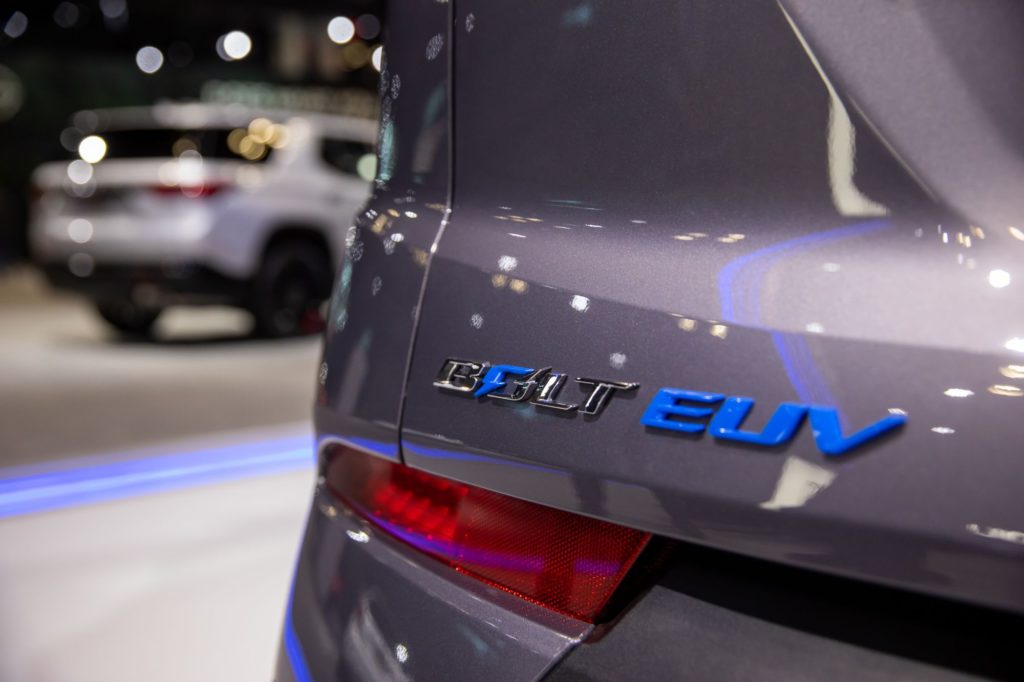
General Motors made an eyebrow-raising move this month with the Chevrolet Bolt hatchback and its slightly bigger cousin, the Bolt EUV.

At a time of incredibly scant car supply, with dealers often charging thousands of dollars above sticker and consumers waiting weeks or months to take delivery, GM slashed the price of these electric models by about $6,000.

GM only just started building these vehicles again in April after stopping assembly for around nine months while it wrestled with a vexing safety issue. The automaker recalled all of the roughly 142,000 Bolts ever sold over a rare tendency for their batteries to catch fire. Two months is hardly enough time to restock dealerships and get a good sense of demand.

So what’s happening here? It appears GM is trying to buy a bigger share of the EV market while it ramps up production of newer, top-dollar models. It had to be painful for Chief Executive Officer Mary Barra to watch fierce rival Ford pass her company in US electric-vehicle sales last year, with the Mustang Mach-E carrying the Blue Oval to a second-place finish behind Tesla.

This race for the silver medal will remain a fun one to watch, with Ford rolling out the F-150 Lightning pickup and GM countering with the GMC Hummer truck and Cadillac Lyriq SUV. Next year, Barra will launch electric versions of the Chevy Silverado pickup and Equinox and Blazer SUVs. The cavalry is still over the hill.

Counting on the Bolt hatchback and EUV for volume in the meantime will be tricky. Both are on the small side for a nation of consumers who love their big pickups and SUVs. Both run on GM’s older-generation batteries rather than its much-ballyhooed Ultium packs. Chevy kicked off an advertising blitz in April to jumpstart sales when production resumed, but flooding the airwaves is no way to make up for being outclassed by new competition.

Before the price cut, the Bolt EUV sold for $33,500. GM and Tesla both have used up the $7,500 federal tax credits their US customers were eligible for, putting their electric models at a disadvantage. Kias are still eligible for this incentive, which brought the cost of the Korean brand’s sharp-looking EV6 down to only about $1,000 more than the much older Chevy. Hyundai’s Ioniq 5 is similarly priced. The perk also puts Ford’s $45,000 Mustang Mach-E within a few thousand dollars of the Bolt EUV, and it’s bigger, newer and sportier.

To be fair, the Bolts do offer competitive range. The hatchback can go 247 miles on a charge, and the EUV gets 259 miles. This compares with 232 miles for the Ioniq 5 and around 220 miles for the Kia EV6 and Mustang Mach-E.

Electric vehicles are now coming to market at a much faster clip. GM may have gotten out ahead of many automakers other than Tesla with the Bolt, but it didn’t prove to be the antidote to the Model 3.

GM wants to stay in the EV race in the US while scaling production of Ultium-based vehicles. To do so, the company had little choice but to bring Bolt prices down.

These won’t be the last discounted EVs we’ll see. At some point, Ford, Kia and Hyundai’s models will be challenged by something newer and more stylish with better batteries. Shoppers will always have shiny new objects to admire along with duller, marked-down ones to consider.

More stories like this are available on bloomberg.com

©2022 Bloomberg L.P.
CEO Helped to Shape US Plan Urging Utilities to Hire Cyber Firms — Like His Own

(Bloomberg) — An executive’s involvement in drafting White House-backed cybersecurity guidelines for energy companies that could potentially benefit his firm rankled competitors and prompted an effort by the Biden administration to remedy the potential conflict, according to documents and emails reviewed by Bloomberg News and interviews with four people involved in the process.

Soon after President Joe Biden took office, the White House began developing a plan to harden the cyber defenses of the electric grid. Robert M. Lee, chief executive officer of the cybersecurity firm Dragos Inc., was brought in for advice. 

Lee helped prepare guidelines that could direct utility firms in choosing a cybersecurity product, a plan that was intended to strengthen their digital defenses and encourage the sharing of threat intelligence. But some of the wording he inserted resembled the language his company uses to market a product, documents show.

In an early 2021 email to other industry experts involved in crafting the action plan, Lee said he needed to show support for the plan “without appearing to have authored anything.” In a separate email to the group, he wrote, “We’re trying to say Keeper without saying Keeper,” referring to his company’s Neighborhood Keeper program, which finds potential threats and shares anonymized information about them with the government. 

The others on the email chain didn’t appear to be potential beneficiaries of the guidelines.

By inserting descriptors of his company’s own product into the guidelines — such as “high-fidelity sensor-based” monitoring — Lee’s efforts prompted complaints from competitors who felt they were effectively excluded from a major federal initiative. Government ethics experts said it also creates the appearance of favoritism. 

Closely held Dragos has a valuation of $1.7 billion, and its backers include Koch Disruptive Technologies, as well as funds and accounts managed by BlackRock. 

In interviews, Lee defended his actions and said the wording he chose simply mirrored language used “for years” by the U.S. government. “I have done, in my opinion, nothing wrong,” he said. “I’ve worked for over a decade in government and in the private sector to try to make infrastructure more secure. And finally something got going that was a good effort.”

Lee said he edited the guidelines to be “solution agnostic,” and he said he made that clear to others involved in the process. Asked about the “trying to say Keeper without saying Keeper” email, Lee said he often uses the term “keeper” as short hand for products like his own that share data anonymously.

“My intent was not to see Neighborhood Keeper itself get pushed but that this type of capability and information sharing be considered and recommended,” he wrote in an email to Bloomberg.

Lee said he was brought into the process by an independent contractor, whom he declined to name, but wanted to avoid being directly involved over perceptions that he stood to benefit. He said he wanted to encourage anonymous data sharing on cyber threats in order to protect critical systems. “I know the way it’s worded in my email is shady but you can believe me or not that was the intent,” he said in an email to Bloomberg, adding he stopped participating after White House lawyers were “concerned of optics.”

It’s not known how many utilities ultimately hired Dragos as a result of the initiative. Lee declined to elaborate, saying information about Dragos’s customers isn’t public.

Government ethics experts said that when business executives influence policy that could benefit them, it runs counter to transparency norms and potentially exposes US taxpayers to products or services that haven’t been scrutinized by an open process. “We need a level playing field when it comes to government policies and decisions, not cozy relationships,” said Scott Amey, the general counsel for the Project on Government Oversight.

Dragos’s involvement in helping shape the plan unfolded amid a series of devastating cyberattacks made public in late 2020 and during the first half of 2021, including a ransomware attack on Colonial Pipeline Co. that caused fuel shortages along the East Coast. The new administration vowed to make improving the nation’s digital defenses a priority, though it has been limited because much of the nation’s critical infrastructure is in private hands. 

Emails reviewed by Bloomberg show that Lee exchanged messages about the plan with Anne Neuberger, the deputy national security adviser for cyber and emerging technology, in early 2021. Neuberger brought in Lee to help because of his expertise in the relatively small field of industrial control system cybersecurity and his company’s investigation of an attack on Ukraine’s electric grid, according to a person familiar with her thinking.

The guidelines, for instance, urged utilities to pick a cybersecurity product that provides “high-fidelity sensor-based continuous network cybersecurity monitoring” and anonymize data by using a “technologically irreversible” process. Dragos described its platform in nearly identical language, according to an archive of Dragos’s website dating from weeks earlier.

A document obtained by Bloomberg tracks where Lee himself inserted references to some of those descriptors, which he said can be found in other government documents. Bloomberg couldn’t immediately find similar phrases on the websites of several of Dragos’s competitors, which declined to comment or didn’t respond to messages seeking comment. 

On April 20, 2021, the Biden administration publicly announced a 100-day plan to bolster cyber defenses of the electric grid, including helping utilities modernize their own cybersecurity.  A few weeks later, the industry’s point person on the White House plan, Berkshire Hathaway Energy Chief Executive Officer Bill Fehrman, sent an email to energy companies endorsing Dragos’s product. 

“As part of the initiative and after a significant assessment of 18 different technologies, we are recommending Dragos Neighborhood Keeper,” he said, according to a May 2021 email from Fehrman on behalf of an industry group he was part of. He wasn’t aware of Lee’s involvement, according to his spokesperson.​​

In June, the National Security Council sent the draft guidelines to energy executives and other government officials, emails show.

But news of the Dragos endorsement made its way to the White House, and Neuberger told Fehrman’s group, the Electricity Subsector Coordinating Council, that such a claim could limit competition, according to a senior administration official. The guidelines were reworked and expanded before being made public by the Department of Energy last August.

A National Security Council spokesperson said, “When we became aware of concerns early last summer about the criteria that were then in development, we worked closely with the Department of Energy to ensure that the final guidance reflected the input of all government agencies with expertise in this area and did not favor any particular company.”

The DOE, which is leading the initiative, declined to comment. 

In response to inquiries about Fehrman’s letter endorsing Dragos, Berkshire Hathaway Energy spokesperson Jessi Strawn said the “only sensor technology that was open to all investor-owned utilities at the time was Dragos Neighborhood Keeper.” As a result of the White House-backed plan, Berkshire Hathaway Energy adopted the use of Dragos within its organization, she said.

Competitors complained to an industry group that the guideline’s wording tracked closely to Dragos’s product, according to two people involved. One company planning to hire a competitor hired Dragos instead, believing Fehrman’s recommendation amounted to a government endorsement, one of those people said. 

Neighborhood Keeper is free but requires buying Dragos’s platform, which could cost a municipal utility about $15,000 to $45,000 a year, according to a company presentation from 2019. An update on the program last August said at least 150 electric utilities, serving almost 90 million electric customers, “have adopted or committed to adopting technologies” to bolster cyber defenses.

Experts say the government has several ways to limit private firms from being able to craft policy in their favor, including prohibiting the executive branch from endorsing a product unless it has followed a defined process.

“It’s important that the public be able to have confidence in procedures the government uses,” said Kathleen Clark, a legal ethics professor at Washington University in St. Louis, after learning of Lee’s involvement. “There is reason not to have confidence in this case.”

More stories like this are available on bloomberg.com

©2022 Bloomberg L.P.

Apollo Among Possible Suitors for Just Eat’s Grubhub

(Bloomberg) — Just Eat Takeaway.com NV’s US unit Grubhub is attracting preliminary interest from private equity firms including Apollo Global Management Inc., according to people with knowledge of the matter. 

New York-based Apollo is among possible suitors evaluating the business, the people said, asking not to be identified because the information is private. Just Eat Takeaway may struggle to get a price near the $7.3 billion it paid for Grubhub last year, with some suitors considering offers close to $1 billion, the people said. 

Several investment firms have been considering teaming up with Grubhub co-founder Matt Maloney, the people said. While a number of potential buyers are studying Grubhub, it’s unclear which will decide to proceed with formal offers, the people said. 

Shares of Just Eat Takeaway rose as much as 9.1% Friday morning in Amsterdam trading after the news.

Representative for Apollo and Just Eat declined to comment.

Amsterdam-based Just Eat Takeaway had seen its shares sink 74% in the past year, amid a slowdown in growth and broader plunge in the value of technology stocks due to rising interest rates and concerns over an economic slowdown. The company also faces internal turmoil after it launched an investigation into its chief operating officer’s personal conduct and its chairman stepped down last month. 

Read more: Just Eat COO Under Misconduct Investigation, Chairman Exits 

Shareholders including Cat Rock Capital Management LP have called for the company to separate from Grubhub since last year. In April, Just Eat said it was considering a partial or full sale of the Grubhub unit. 

“The more rumors, leaks about interested parties around Grubhub, the more the market will believe in a disposal by year end. In this context, valuation is secondary,” Clement Genelot, analyst at Bryan Garnier, wrote in an email.

(Updates with shares, Just Eat comment, analyst commentary from fourth paragraph)

More stories like this are available on bloomberg.com

©2022 Bloomberg L.P.
Google Hit With UK Probe Into Suspected Competition Breaches

(Bloomberg) — The UK’s antitrust watchdog launched an investigation into the Google Play app store over suspected anticompetitive conduct, alongside a sweeping study taking aim at Alphabet Inc. and Apple Inc.’s “strong grip” over mobile technologies. 

Marking the latest broadside against Silicon Valley from an increasingly interventionist UK regulator, the Competition and Markets Authority will probe suspected breaches of competition law in Google’s rules over in-app payments in its mobile store in the UK, it said Friday. 

It set out various other possible interventions to tackle the apparent dominance of the two Big Tech giants in a flurry of statements on Friday. It announced a deeper planned study into Apple and Google’s market power in mobile browsers and Apple’s in cloud gaming.

“When it comes to how people use mobile phones, Apple and Google hold all the cards,” CMA Chief Executive Officer Andrea Coscelli said in a statement. “As good as many of their services and products are, their strong grip on mobile ecosystems allows them to shut out competitors, holding back the British tech sector and limiting choice.”

Why Apple and Google Face a U.K. Regulatory Clampdown: Quicktake

He said today’s announcements add to 8 cases currently open against major tech companies. Google is currently subject of at least two other British investigations mainly focused on its ad tech. 

The watchdog published a 356-page market study into mobile ecosystems which took a year to compile, researching devices, operating systems and apps, after it previously voiced fears Google and Apple’s dominance could stifle competition.

“We respectfully disagree with a number of conclusions reached in the report, which discount our investments in innovation, privacy and user performance,” Apple said in a statement.

Android phones offer more choice than rival platforms and Google Play has launched businesses and helped create jobs, a Google spokesperson said. “We regularly review how we can best support developers and have reacted quickly to CMA feedback in the past. We will review the report and continue to engage with the CMA.”

The CMA is waiting for the government to pass legislation which gives its new Digital Markets Unit the power to enforce more types of intervention. 

The CMA found Apple and Google have “a gatekeeper role” in various parts of the mobile ecosystem and it suggested various remedies it could consider, including:

  • Removing or changing restrictions on third-party app stores and third-party browsers
  • Making it easier for users to choose alternatives to Apple and Google, and to switch from Apple to Google operating systems
  • Addressing the sales commissions charged in app stores

Although software giant Oracle Corp. said competition would benefit if Google’s Android mobile operating system was split out from its parent company, the report shows the CMA didn’t find a case to pursue structural breakups.

“Should Apple and Google act against consumers’ interests by making it unreasonably difficult for competing apps to successfully enter and expand, then separation could be reconsidered as an alternative,” the report said. 

(Updates with context throughout)

More stories like this are available on bloomberg.com

©2022 Bloomberg L.P.

‘No Future:’ Analysts Weigh In on New Luna Token’s Prospects

(Bloomberg) — Since the backers of the failed Terra blockchain launched a new digital token to compensate investors burned by one of crypto’s biggest busts, the blows have kept coming. 

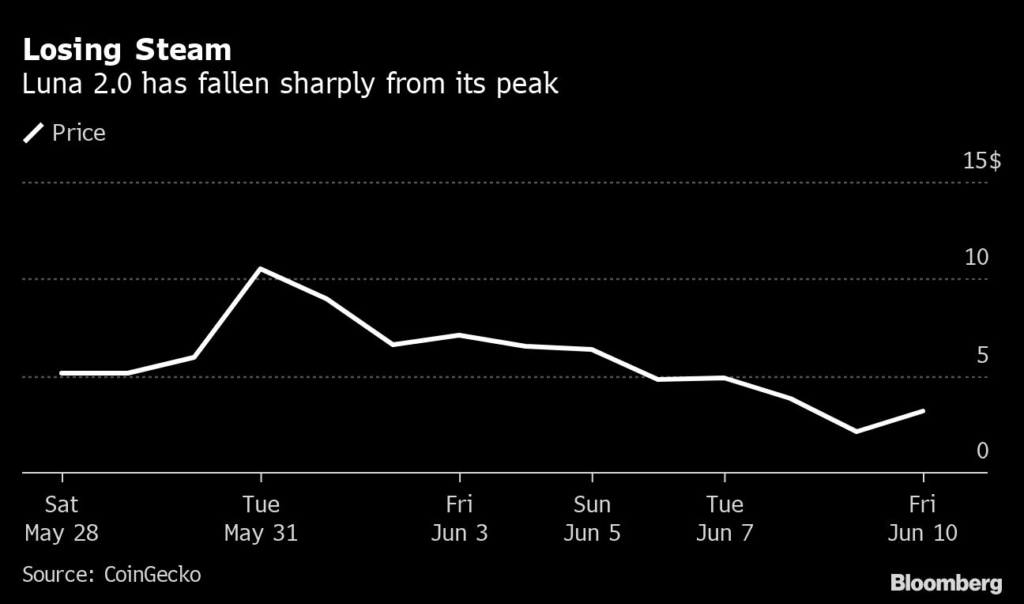
Luna 2.0, as the coin is known, emerged out of the ashes of crypto entrepreneur Do Kwon’s ecosystem, which collapsed after the TerraUSD algorithmic stablecoin at the center of it dropped from its dollar peg in early May. But any hopes of a quick recovery for investors who lost billions of dollars in the crash are fading, with the token losing more than half of its value in the past week alone, based on data from CoinGecko. 

Scrutiny from securities regulators in the US and police in South Korea is adding to the woes. The US Securities and Exchange Commission is investigating whether the marketing of TerraUSD violated federal investor-protection regulations, Bloomberg News reported Thursday. In Seoul, police are examining allegations that staff of Luna backer Terraform Labs embezzled Bitcoin holdings amassed to help defend TerraUSD’s peg to the dollar. 

Four market watchers asked about their views on Luna 2.0 expressed skepticism about the coin’s prospects, and that of the new blockchain it runs on. Here’s what they had to say:

Mati Greenspan, founder of Quantum Economics:

“Luna 2 was never meant to survive, it was simply a mechanism for some who were heavily invested to recoup some of their losses at the expense of new money coming in from the hype. I don’t see any reason for the price to go up ever.” 

Kunal Goel, research analyst at Messari:

“Terra 2.0 suffers from multiple problems. It has gone live in an unfavorable macro and crypto environment. Without an algorithmic stablecoin, it has no clear point of differentiation from other smart contract platforms. Finally, the regulatory overhang is a key concern in investors’ minds.”

Riyad Carey, research analyst at Kaiko:    

“Luna 2 will have a difficult time distinguishing itself in a crowded L1 ecosystem with large players like Avalanche and Solana and of course Ethereum. While the original Terra had a fairly robust ecosystem, much of that activity was centered around UST and aUST (UST earning yield in Anchor). Additionally, some of the price action was based around the burning of LUNA to create UST. So now Luna 2 doesn’t have this mechanism, will be facing inflation in the form of vesting/unlocks, and obviously has the baggage of being tied to the largest ever crypto collapse. So it will definitely be a tough path forward.”

Khaleelulla Baig, founder and CEO of KoinBasket:

“Everyone wants to exit the new Luna as the founder Do Kwon has lost credibility among the community. Luna has no future. The founder didn’t build firewalls around the algo even when they had an opportunity to do so. That’s why they have lost credibility. Building the new Luna within the existing community will not make any sense now. Smart money will move to fundamental coins from such risky coins.”

More stories like this are available on bloomberg.com

©2022 Bloomberg L.P.

Close Bitnami banner
Bitnami