

Bloomberg

Goldman Sachs, Citigroup, Bridgewater Leaders Imagine Markets in 2052

(Bloomberg Markets) — The internet, smartphones, the euro, and crypto­currencies are just a few of the innovations that have revolutionized markets in the past three decades. So Bloomberg Markets asked some finance industry leaders for their best guesses about what might drive the biggest changes between now and 2052. Their comments have been edited for length and clarity.

Adena FriedmanPresident and CEONasdaq Inc.

The next 30 years I think are going to be really focused on value-added intermediation in the markets. The technology will exist to allow for every asset on the planet to be digitized and available to be bought and sold in an instantaneous way.

So what are the technologies that underpin that? I think moving markets into a cloud infrastructure is going to be a critical component. Bringing more machine learning into market decisions, into crime management, into managing markets for fairness. And then I definitely think that the ­digital-asset ecosystem will mature very materially, to become mainstream.

But there are big caveats to that. One is crime management. If the digital-asset ecosystem does not take crime management seriously, governments just won’t allow it to be adopted in a mainstream way. And then the second is the scalability of the digital-asset ecosystem has to match—and frankly, surpass—the scalability of what the traditional markets are able to achieve today.

If the blockchain can scale a lot more than it can today, I think you would see regulators get more comfortable bringing the digital- asset construct into traditional markets. You could see potential for a central bank digital currency really forming the basis for a much more digital payment structure. And then you could see capital markets opening up into a much more globalized format.

David SolomonChairman and CEOGoldman Sachs Group Inc.

The big macro trends are around artificial intelligence, biopharma, and biotech—changes that are going to have a profound impact on the way we all live. Big-picture issues. Also, investments in trying to find ways for our energy sources to be greener over time.

How do we bring together the capital that’s necessary to drive innovation? Some of that can be done through private-sector risk capital. Some of the capital can come from governments. Some of the capital can also come from partnerships between the private sector and governments to try to find ways to encourage more investment.

There’s a lot of capital going into artificial intelligence already. With respect to medtech and biotech, we had a pandemic, and the government intervened. But generally speaking, for regular technological advancement and innovation, I don’t think we need to have public-private partnerships in the medtech or biotech space. But to drive innovative climate technologies and a faster transition to clean energy will require a much greater amount of capital than those other areas.

Most businesses are dealing with accelerating trends of digitization around their business—and automation. I happen to think that blockchain technology is an early version of technologies that will ultimately be used to further digitize the infrastructure of financial services. Because while there are a lot of good things with blockchain, it’s not a great technology for a large number of transactions at a very high speed.

It’s not a perfect analogy, but the way to think about it is the way you accessed the internet 25 years ago vs. the way you access the internet now.

Jane FraserCEOCitigroup Inc.

As I think about the next 30 years and the innovations that will change and define markets, it is not a single product that comes to mind. Instead, I’m focused on the new ways we will be doing business across the industry. There are fundamental changes on the horizon that will reconstruct the infrastructure of global markets and the architecture of finance as we know it today.

We are moving towards a boundless virtual economy in which markets do not open or close, digital asset on- and off-ramps are limitless and metaverse activities are widespread. Digital assets will be widely embraced and securitized and we will see asset “avatars” that exist in more than one form between traditional assets, digital native assets, and tokenized versions of traditional assets. In this world, market participants will be able to respond to “after hours” announcements and overseas events at any time of day and across time zones. The 24/7 nature of these transactions will reduce operational risk, streamline payments across platforms globally, and enhance the consumer and client experience.

Making this a reality will require industry-wide operational standards and improved market infrastructure across both the private and public sectors. We will need the appropriate regulatory frameworks, a new generation of risk management and governance tools, and the right infrastructure to support the digital twins of physical systems and objects. 

That will mean more widespread institutionalization of retail opportunities and intangible assets, which we’re already seeing signs of today. Adoption of digital assets by institutions is increasing, and there is growing “financialization” of objects that previously only existed in the hands of retail individuals, such as individual real estate properties, art and other collectibles.

One thing is certain, 2050 will be virtual and it will be boundless.

David SiegelCo-founder and co-chairmanTwo Sigma Investments LLC

We can look at what we have right now that might be in the early stages that the internet was in ’92. There’s a lot of stuff going on. The impact of crypto is unknown. The impact of new medical technologies, for example mRNA technology, is unknown. The ability to advance many fields using AI. These three areas, in a way, remind me of 1990 and the internet.

It is possible that 30 years from now the advances going on now in medical technology will lead to real, meaningful cures to terrible diseases like cancer. Imagine the transformation to our civilization if we can develop treatments for some of the diseases that have plagued humanity forever. That may actually change the lives of more people than anything else.

It may turn out that accelerating climate problems—it appears we’re entering a bad spot here—will truly be the dominant problem. I’m most excited about technologies that are advancing the decarbonization of the world.

So many of these breakthroughs are the result of being able to apply computational approaches to more traditional fields—computational chemistry, computational biology, and so forth. So I personally feel that the application of computation to solving problems with medicine and climate and so on is going to be the area that we will find AI offers the most promise to make your world better.

Nir Bar DeaCo-CEOBridgewater Associates LP

Humanity’s most difficult problems have always been solved by collaboration: people sharing information, building on each other’s progress, debating different viewpoints, and working together to shape solutions that are greater than what any individual could accomplish alone.We’re living in an increasingly polarized world characterized by conflict between and within nations, with trust in the institutions and systems that fostered collaboration for decades sharply degrading.

The most important innovations of the next few decades will be the evolution of a suite of technologies to successfully support an “open collaboration” approach. By “open collaboration” I mean the dynamic where the best thinking is made transparent to people all over the world, so that others can digest it, learn from it, improve on it, and—ultimately, if truth and merit win out—trust it.

Today’s best collaboration technologies are often used to produce the opposite outcomes, which is precisely why their evolution to enable open collaboration rather than polarization is critical. These technologies can enable us to make the most of our collective knowledge and resources in the face of shared problems and have the potential to meaningfully shape not only financial markets, but everything about how we interact, how we work, and how we innovate.

They can serve as a way around the many walls that divide us, allowing people to transcend geographic and ideological boundaries, circumvent mistrusted institutions, and create connection with people outside of our narrowly defined, exclusive circles.

Shemara WikramanayakeCEOMacquarie Group Ltd.

There’s no end of opportunity in terms of the climate response. We’ve done really well with wind and solar, but we really need firming solutions in energy. That means battery technology, microgrid, hydrogen—potentially a large part—distributed grids, etc. Electric vehicles are really now reaching a price point where they can scale up a lot, but then in ­longer-haul transport we need things like biofuels and sustainable aviation fuel.

Agriculture is a big emitter, and we still haven’t got the solutions there. We’re investing in a whole lot of precision agriculture, but we need things—methane-­reducing foodstock would be a great solution because that’s a big source of emissions. In industry, of course, there’s no end of solutions needed. We’re investing in things like projects for hydrogen, ammonia, charging infrastructure to try and help big industrial fleets move to electric vehicles. The solutions are myriad, and we’re investing in many of them. We’re also working on solutions for plastics and recycling. So there’s a lot to do. I wouldn’t try and pick winners, but rather try everything and see what works.—With assistance from Harry Brumpton in Sydney

Basak covers finance for Bloomberg News, Television, and Radio in New York.

More stories like this are available on bloomberg.com

©2022 Bloomberg L.P.

Signs of Cautious Optimism for UK Crypto Investors Post-Brexit

  • Listen to Bloomberg Crypto on the iHeartRadio App
  • Listen to Bloomberg Crypto on Apple Podcasts
  • Listen to Bloomberg Crypto on Spotify

(Bloomberg) — The UK officially withdrew from the European Union in January 2020 — but the fallout from Brexit, as we all came to know it, is still being measured across all industries. Brexit even affected the crypto market, especially as far as regulations are concerned.  In this episode, Bloomberg reporter Emily Nicolle sees cautious optimism among investors about the UK’s approach to digital-asset regulation, and Blair Halliday, the UK head of cryptocurrency exchange Gemini, agrees.

Follow us on Twitter at @crypto, and subscribe to the Bloomberg Crypto newsletter at https://bloom.bg/cryptonewsletter

More stories like this are available on bloomberg.com

©2022 Bloomberg L.P.

Amazon Plans to Exit $7.7 Billion Race for Cricket Rights

(Bloomberg) — Amazon.com Inc. is planning to withdraw from a heated competition for the rights to stream Indian Premier League cricket matches, ceding one of the world’s most popular sporting contests to rivals from Walt Disney Co. to Mukesh Ambani’s Reliance Industries Ltd.

The rights had been estimated to fetch an unprecedented $7.7 billion. The US giant, led by Jeff Bezos, is planning to throw in the towel rather than get into a bidding war at the June 12 auction, according to people familiar with the matter. While Amazon has already invested more than $6 billion in the country, more spending merely for the online streaming rights to the league didn’t make business sense, they said, asking not to be identified discussing internal deliberations. 

Representatives for Amazon didn’t respond to a request for comment.

Amazon’s surprise pullout leaves the field open to Ambani’s Reliance, Disney and Sony Group Corp., who’re betting the game will help them dominate an Indian consumer market increasingly going online. Whichever company scores the deal could also bolster their position in a country of 1.4 billion where the English sport enjoys cult-like status. 

“Amazon has a great balance sheet but as a standalone, digital-only bidder, it would’ve had a challenge recouping such a big investment on streaming,” said Mumbai-based Mihir Shah, vice president and India head at Media Partners Asia. “There’s a global shift toward saner valuations, and companies including Amazon are thinking harder about acquisition costs and unit economics.” 

Amazon, which identified IPL among a half-dozen global sports franchises it’s interested in, had initially been determined to score a victory, Bloomberg News reported. The retail titan has spent hundreds of millions of dollars on European soccer rights, and has forged a deal to broadcast Thursday Night Football in the US at $1 billion a season until 2033. 

The IPL is a multiweek tournament typically held in April and May every year. Ten teams comprising players from mostly the British Commonwealth countries play matches that last three hours each, a shortened and more entertaining format compared to the classic five-day test cricket. Drawing more than half-a-billion viewers, the annual IPL tournament trails only English soccer and the National Football League in popularity globally, according to its organizer, the Board of Control for Cricket in India, or BCCI.

The IPL was valued at about $5.9 billion in 2020 by Duff & Phelps, now known as Kroll. That number could now be 25% higher, according to Santosh N, managing partner at D and P India Advisory Services. The BCCI estimates it’s worth $7 billion.

For the first time, the BCCI will auction IPL’s broadcast and streaming rights separately. Four contracts are up for grabs, broadly covering television and digital rights, as well as a pick of key matches, in the Indian subcontinent and overseas. 

Total Bids

Given the intense competition, total bids could reach even 600 billion rupees ($7.7 billion), said Karan Taurani, a media analyst at Elara Capital. That would be more than triple the 163 billion rupees 21st Century Fox Inc. paid in 2017.

Disney, which inherited the rights when it took over Fox’s entertainment assets in 2019, is flying in top executives from its headquarters to Mumbai for the auction, according to people familiar with the matter. Hotstar, a local streaming service popular among cricket fans and now with Disney after the Fox deal, accounts for more than a third of Disney’s 138 million streaming users globally.

Representatives for Disney, Reliance and Sony declined to comment.

Should Amazon exit, it may bolster the prospects for Reliance. Ambani, 65, has been assembling a team of veteran executives starting mid-2021 to ensure a winning bid at the auction, people familiar with the matter said, asking not to be identified discussing internal processes. They include Anil Jayaraj and Gulshan Verma, who helped Fox clinch the previous contract. 

Reliance’s war room also comprises Ambani’s trusted lieutenant Manoj Modi and older son Akash Ambani, people familiar with the developments said. A recent alliance forged with Uday Shankar, a former head of Fox’s and later Disney’s India and Asia Pacific operations, will also add heft to the team.

Amazon and Reliance have been locked in a battle for control of India’s retail market for years. Most recently, the two companies fought a bitter court battle over acquiring Future Group, a struggling retailer, but neither succeeded. Both are betting content will serve as a gateway to their retail goal as more and more Indians go online for shopping and entertainment.

Despite the exit of Amazon, the cricket auction would still be hyper-competitive and an expensive affair, said Media Partners Asia’s Shah.

The aim of winning the auction isn’t grounded in the conventional profit and loss logic, but a hypothesis that a few hundred million internet users will become committed users of a variety of digital businesses, said Tarun Pathak, a research director at consultancy Counterpoint Technology. 

“Amazon took commerce and built the Prime Video content business on top of it,” Pathak said. “If Reliance wins, it’ll take the opposite approach — building commerce on top of content to make Jio a household name,” he said, referring to its technology arm.

(Updates with analyst’s comment in fifth paragraph.)

More stories like this are available on bloomberg.com

©2022 Bloomberg L.P.
Singapore’s Kacific in Talks for $1 Billion SPAC Merger, Sources Say

(Bloomberg) — Kacific Broadband Satellites Ltd. is in advanced talks to go public via a special purpose acquisition company, with Singapore’s Pegasus Asia Corp. the leading contender, according to people familiar with the matter.

Kacific, which provides high-speed internet access by satellite, has agreed to enter into exclusive negotiations with one SPAC after months of negotiations, giving the potential partner a few weeks to conduct due diligence and finalize a deal, said the people, asking not to be named as the matter is private. Pegasus Asia, led by Chief Executive Officer Neil Parekh, won the exclusivity in part because of its deep-pocketed backers and its location in Singapore, said one of the people.

If completed, the deal would be the first blank-check merger in the city-state. Kacific’s valuation after a merger is expected to be about $1 billion, according to one of the people. Terms including valuation are preliminary and talks could still break down, the people said.

Pegasus Asia declined to comment. A representative for Kacific responded to a request for comment on several details by calling it “inaccurate,” but declined to elaborate or specify which point they were referring to.

Founded in 2013 by Christian Patouraux and Cyril Annarella, Kacific is a satellite operator which provides high-speed internet access to governments and businesses across 25 countries in Southeast Asia and the Pacific, according to its website. The company, headquartered in Singapore with main operations in Vanuatu, is hoping to solve the lack of affordable broadband internet in remote regions of the world.

Since last year, the company was looking to merge with blank-check firms in the US but changed course in part because of unfavorable market conditions and elevated risk for a regulatory crackdown.

The US blank-check boom has turned into a bust, leaving 78 of the roughly 371 firms that merged with a SPAC floundering under $2 a share, data compiled by Bloomberg on June 8 show. About 25 ex-SPACs are trading below $1, a sign that they may soon be banished from high-profile exchanges.

Rising redemption rates — investors’ ability to swap their shares for cash if they don’t like the merger — have added to the SPAC industry’s woes. The average redemption rate remained at about 80% level in May, compared with 29% a year ago, Boardroom Alpha data showed.

Shares of Pegasus Asia held steady at S$4.70 in Singapore on Friday. The company raised S$170 million ($123 million) in a January initial public offering. It is the first Singapore-listed SPAC with international backers, which include European asset manager Tikehau Capital and Financière Agache, a holding company of Bernard Arnault, head of French luxury group LVMH.

Tikehau Capital could make an announcement on one of its SPACs in the coming weeks, co-founder Antoine Flamarion said in an interview with Bloomberg TV in April. Tikehau also declined to comment for this story.

More stories like this are available on bloomberg.com

©2022 Bloomberg L.P.

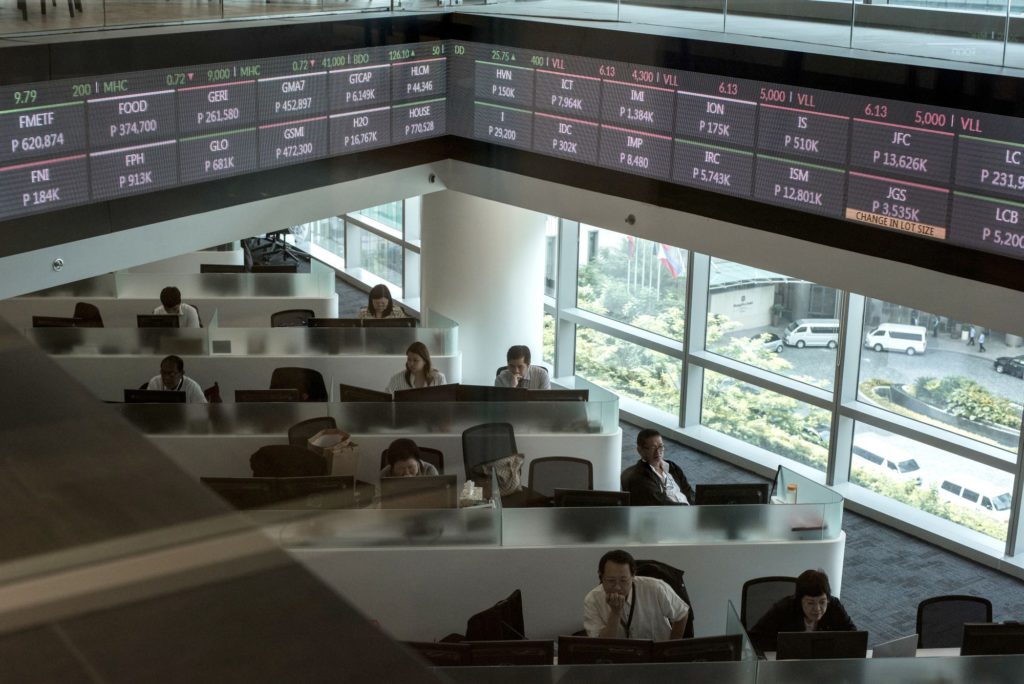
Philippines’ Bourse Shuts Trading Floor as Punters Favor Digital

(Bloomberg) — The Philippine Stock Exchange Inc will permanently close its trading floor after the pandemic hastened its migration to “floorless trading” amid a digital shift that’s changing the operations of capital markets.

The ruckus of a trading floor at one of Asia’s oldest bourses, which goes back to 1927, will give way to a more “efficient and responsive” set-up to meet the “needs of the investing public,” bourse President Ramon Monzon said in a statement. 

The exchange said online stock market accounts grew 23.8% in 2021 to 1.16 million and accounted for 71.5% of total accounts — up from only 4.3% in 2008.

Online investors made up 74.7% of total trades in 2021, accounting for 21.45 million trades; this was 21% more than the 17.78 million transactions in 2020.  

The value of online trades jumped 44% to 744.49 billion pesos ($14.1 billion) from 518.27 billion the previous year. In comparison, non-online accounts were up 11% from 2020 at 2.92 trillion pesos.

The pandemic helped drive the digitalization and automation of trading, prompting brokers to trade offsite, Monzon said. The trading floor will be completely shut once brokers pull out their trading booths, he added.

The Philippine Stock Exchange was created in December 1992 with the merger of the Manila Stock Exchange, which began in 1927, and the Makati Stock Exchange, which was established in 1963. The combined exchange began operations in 1994.


More stories like this are available on bloomberg.com

©2022 Bloomberg L.P.
Top Toyota Supplier Denso Mulls $3 Billion Chip Unit Spinoff

(Bloomberg) — Denso Corp., one of the world’s top automotive semiconductor manufacturers and a key supplier to Toyota Motor Corp., may consider spinning off its chip business, which generates around 420 billion yen ($3.1 billion) in sales, the company’s chief technology officer said Friday.

Well known as the world’s second-biggest auto-parts maker, Denso has also quietly built up a presence in automotive chips. Now, with semiconductor-related capital expenditures totaling around 160 billion yen over the past three years, Denso ranks as the world’s fifth-largest supplier of automotive chips by sales.

“We need to think about whether the time will come when we sell semiconductors, alone, externally,” CTO Yoshifumi Kato said in an interview at Denso’s headquarters in Aichi prefecture. “It’s worth looking into whether that kind of structure is possible.”

Today, the semiconductors Denso makes in-house go into automotive parts that it then sells to carmakers or other suppliers. When examining the possibility of supplying semiconductors on their own, Denso will consider whether the division is better positioned outside of the company, Kato said.

To date, nothing has been decided regarding a split, Kato said, adding that Denso’s focus for the time being is on meeting internal chip demand. Denso shares erased earlier losses late Friday, jumping as much as 2.4% in Tokyo trading.

A shortage of chips used in cars first began in late 2020, when Covid-induced lockdowns of millions of people around the world spurred a huge uptick in the purchase of consumer electronics goods. That resulted in semiconductors being diverted away from automakers, which had also reduced their own orders in expectation of falling demand for cars. 

The chip dearth quickly became symptomatic of a broader supply chain crisis that’s upended the smooth delivery of goods globally.

Chip supply today appears to be getting back to normal in some industries, amid concerns around how well consumer demand can hold up against the backdrop of accelerating inflation and higher interest rates.

Read more: Carmakers Feel Chip Crisis Easing as Global Growth Slows

According to Denso’s Kato, demand for automotive semiconductors, on a tear amid the industry’s shift to electric, internet-connected and autonomous cars, is likely to continue going from strength to strength.

Facing such conditions, funding directed toward its chip business will grow and make up over 10% of Denso’s research, development and equipment-investment expenditure, Kato said. Denso said at a briefing earlier this month that it’s targeting 500 billion yen in sales from its in-house power and analog chip business, up from around 420 billion yen currently. 

Denso’s also looking to external partners to help strengthen its hand in the semiconductor market. In February, the Japanese parts giant announced it’s joining a project led by Taiwan Semiconductor Manufacturing Co. to build its first chip plant in Japan. 

Still, there’s a significant lag between setting aside funding and when actual chip production can commence. At the moment, it appears that chip shortages, which have caused billions of dollars in lost revenue for the car industry, will ease late in the current fiscal year, Denso Senior Director Yoshinobu Tao said.

(Updates with share move, context throughout.)

More stories like this are available on bloomberg.com

©2022 Bloomberg L.P.
Cash, Stocks Attract Billions as Investors Seek Inflation Havens

(Bloomberg) — Investors are putting billions of dollars into cash and stock funds as they seek protection from surging inflation. 

Cash saw the biggest inflows in six weeks at about $54 billion, while exchange-traded funds led additions of about $12 billion into equities in the week through June 8, according to Bank of America Corp. note, which cited EPFR Global data. US stocks were the primary beneficiaries of inflows with about $13 billion, while bond fund outflows resumed, the data showed.

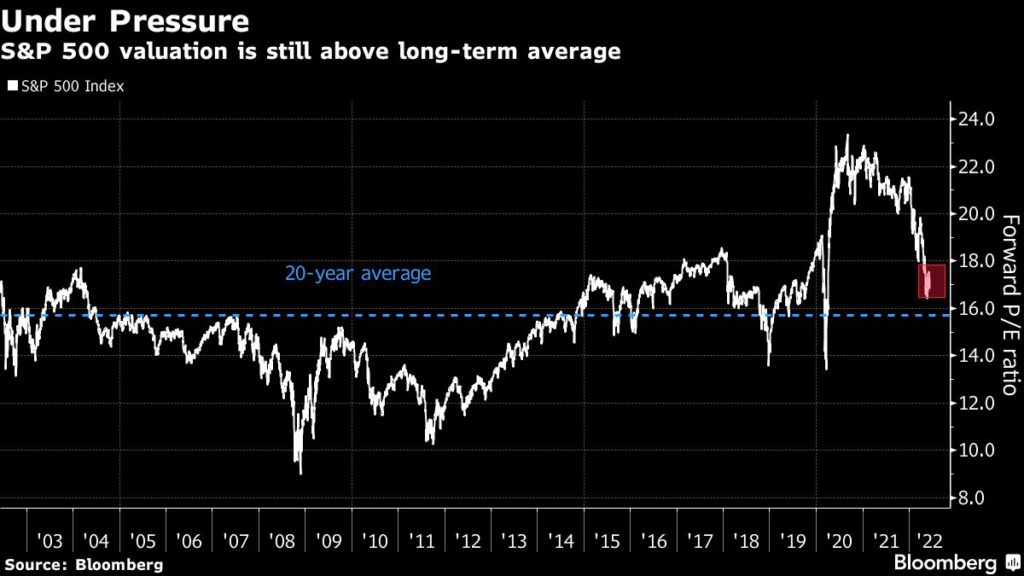
After being hammered this year by surging inflation and hawkish central banks, stock markets have struggled to recover amid fears of a potential recession. The S&P 500 has bounced back after flirting with a bear market last month, but it remains more than 16% below its January record high and is on track for its ninth weekly decline in 10. Investors will be closely watching US inflation data today for clues on the pace of monetary tightening. 

Bank of America’s Michael Hartnett said in the note that the US economy is “a couple of bad data points away from ‘recession’.”

“We’re in technical recession but just don’t realize it,” he wrote. “In short, inflation shock not over, rates shock just starting, growth shock coming, no release valve from peak in yields, bear market rally too consensus.”

US large-caps saw inflows of $14.5 billion in the week through Wednesday, while outflows hit US small-caps, value and growth shares, according to BofA’s note. Among sectors, materials and health care had the biggest inflows, while financials, communication services, and technology saw the biggest outflows. 

Among regions, European stocks continued to face outflows for the seventeenth week, while emerging-market and Japanese equity funds also saw redemptions. 

More stories like this are available on bloomberg.com

©2022 Bloomberg L.P.
Amazon Plans to Pull Out of $7.7 Billion Race for Cricket Rights

(Bloomberg) — Amazon.com Inc. is planning to withdraw from a heated competition for the rights to stream Indian Premier League cricket matches, according to people familiar with the matter, ceding one of the world’s most popular sporting contests to rivals from Walt Disney Co. to Mukesh Ambani’s Reliance Industries Ltd.

The rights had been estimated to fetch an unprecedented $7.7 billion. The US giant is planning to throw in the towel rather than get into a bidding war, the people said, asking not to be identified discussing internal deliberations. While Amazon has already invested more than $6 billion in the country, more spending merely for the online streaming rights to the league didn’t make business sense, they said. 

Representatives for Amazon didn’t immediately respond to a request for comment.

Amazon’s surprise pullout leaves the field open to Ambani’s Reliance, Disney and Sony Group Corp., who’re betting the game will help them dominate an Indian consumer market increasingly going online. Whichever company scores the deal could also bolster their position as a leading media player in a country of 1.4 billion where the English sport enjoys cult-like status. 

Read more: Bezos and Ambani Set to Battle Over $7.7 Billion Cricket Rights

Amazon, which identified IPL among a half-dozen global sports franchises it’s interested in, had initially been determined to score a victory, Bloomberg News reported. The retail titan has spent hundreds of millions of dollars on European soccer rights, and has forged a deal to broadcast Thursday Night Football in the US at $1 billion a season until 2033. 

The IPL is a multiweek tournament typically held in April and May every year. Ten teams comprising players from mostly the British Commonwealth countries play matches that last three hours each, a shortened and more entertaining format compared to the classic five-day test cricket. Drawing more than half-a-billion viewers, the annual IPL tournament trails only English soccer and the National Football League in popularity globally, according to its organizer, the Board of Control for Cricket in India.

IPL was valued at about $5.9 billion in 2020 by Duff & Phelps, now known as Kroll. That number could now be 25% higher, according to Santosh N, managing partner at D and P India Advisory Services. The BCCI estimates it’s worth $7 billion.

More stories like this are available on bloomberg.com

©2022 Bloomberg L.P.

Ericsson Probed by US SEC Over Corruption Scandal in Iraq

(Bloomberg) — Ericsson’s governance woes continued to pile up after the US Securities and Exchange Commission started a probe into the company’s handling of a corruption scandal in Iraq.

The SEC “has opened an investigation concerning the matters described in the company’s 2019 Iraq investigation report,” Ericsson said in a statement after market close on Thursday. The company added that it’s “fully cooperating” and that “it is too early to determine or predict the outcome.”

The Swedish maker of 5G mobile networks has been in the eye of the storm over its mishandling of operations in Iraq ever since a fresh round of allegations emerged in Swedish media in February. The company admitted it may have paid the ISIS terror organization to gain access to transport routes in a scandal that goes as far back as 2011.

Ericsson’s share price opened 2.5% down when trading started in Stockholm on Friday morning. Analysts at Svenska Handelsbanken said the company could face fines in the range of $100 million to $300 million when the US investigations are resolved. News of the SEC probe “is obviously negative for the share, but should come as no major surprise to the market,” Daniel Djurberg said in emailed comments.

Read Our Street Wrap: Ericsson SEC Investigation Expected, Priced In

This year’s revelations have a prompted a series of new probes from authorities in both the US and Sweden. The US Department of Justice in March said that Ericsson had failed to make adequate disclosures about its operations in Iraq before entering a deferred prosecution agreement in 2019. In its home market, the company is facing a preliminary investigation by the Prosecution Authority into suspected bribery.

At the company’s recent annual general meeting, shareholders voted against discharging Chief Executive Officer Borje Ekholm from legal liability.

(Adds share price in fourth paragraph)

More stories like this are available on bloomberg.com

©2022 Bloomberg L.P.

Philippines’ Globe Telecom Seeking $1.5 Billion for Towers

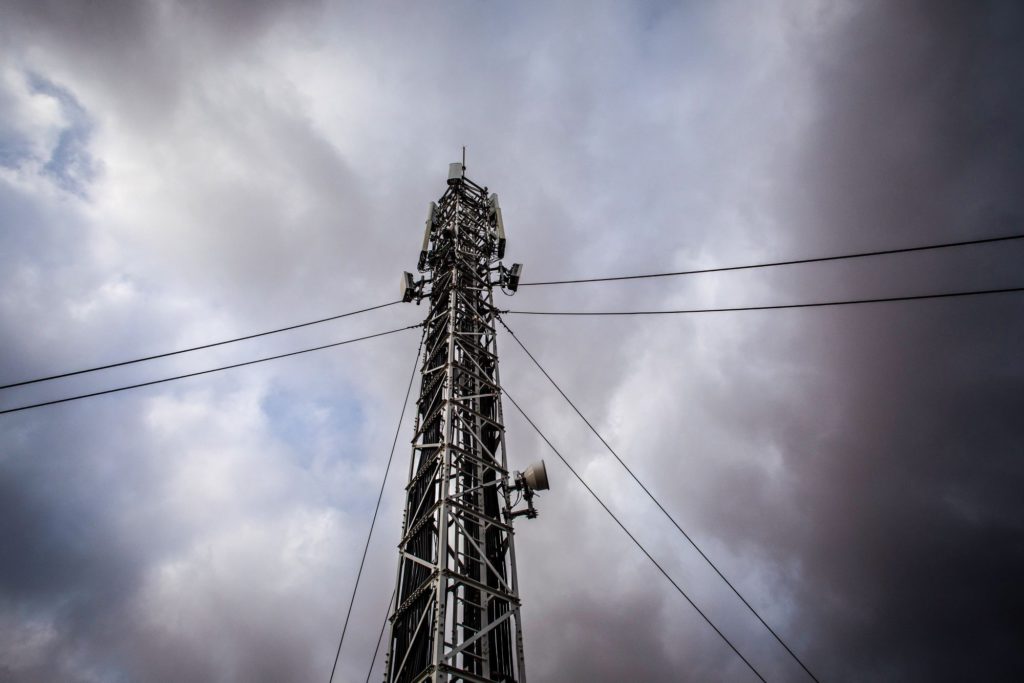
(Bloomberg) — Globe Telecom Inc. is weighing selling around half of its telecommunications tower portfolio in a deal that could be worth as much as $1.5 billion, according to people with knowledge of the matter. 

The Manila-listed company, which counts Singapore Telecommunications Ltd. and Filipino conglomerate Ayala Corp. among its largest shareholders, is considering including about 6,000 of its towers in the planned sale, the people said. Globe Telecom is working with an adviser to gauge interest from potential bidders ahead of starting a formal sale process, said the people, who asked not to be identified as the information is private.

Deliberations are at an early stage and the company could decide not to proceed with a sale, the people said. 

Globe Telecom has not received board approval to date for a sale or leaseback transaction of its tower assets, a company representative said in response to queries from Bloomberg News. Globe Telecom is focused on working with different tower companies for its network rollout, the representative added.

Globe Telecom’s divestment plan comes after its rival PLDT Inc. sold its towers for 77 billion pesos ($1.5 billion) in April to Axiata Group Bhd.’s edotco Group Sdn. and EdgePoint Infrastructure Sdn., backed by DigitalBridge Group Inc. Digital infrastructure such as telecom towers and data centers have increasingly become targets for deal activity in the region.

Globe Telecom remains keen on divesting its tower assets, and the recent transaction from PLDT has made the environment more friendly with respect to a sale, chief finance officer Rizza Maniego-Eala told local newspaper The Philippine Star in May. The company has a total of 12,194 cell towers as of the end of March, according to a press release.

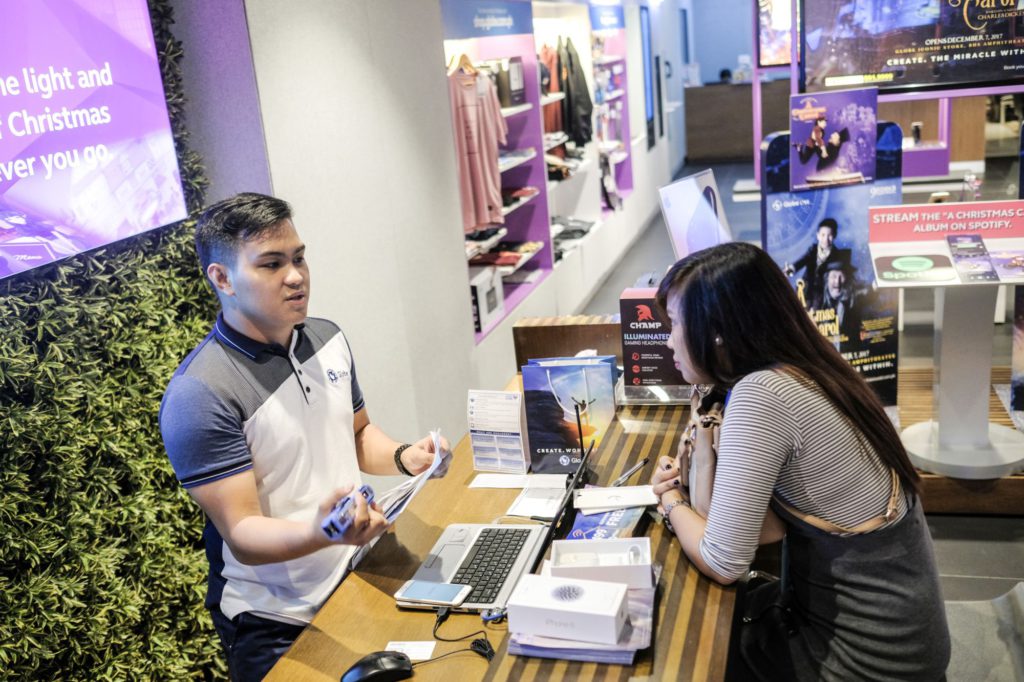
The telecommunications company, which has a market value of about $6 billion, has 87.4 million mobile subscribers, according to its latest financial statement. It has brought 91 tower company sites on air since the start of the year, in 16 provinces across the country. Singtel, Globe Telecom’s largest shareholder, is backed by state investment giant Temasek Holdings Pte. 

More stories like this are available on bloomberg.com

©2022 Bloomberg L.P.

Close Bitnami banner
Bitnami