Bloomberg

Senators Wary of China’s Tech Prowess Seek Competition Office

(Bloomberg) — A bipartisan group of senators, including the head of the Intelligence Committee, is pressing to create a government office dedicated to ensuring the US keeps its competitive edge in key technologies such as artificial intelligence and quantum computing.

A bill being introduced Thursday calls for an Office of Global Competition Analysis that would combine intelligence and commercial data to gauge where the US is falling behind, come up with strategies to keep up with developments and protect areas where it has competitive advantages.

“To compete with countries like China, we have to secure US leadership in critical emerging technologies, such as semiconductors and artificial intelligence,” said Senator Michael Bennet, a Colorado Democrat, who is sponsoring the bill along with Democrat Mark Warner of Virginia and Republican Ben Sasse of Nebraska. “Today, we have no idea where the United States stands in these growing sectors compared to our competitors and adversaries.”

Sponsors say the measure was shaped in part by the US’s failure to stay ahead of the rise in 5G technology.

Warner, chair of the Intelligence Committee, said during a hearing in May that the US was “caught flatfooted” by the rise of Huawei Technologies Co.’s dominant role in 5G technology, saying there were no US alternatives at the time. He said the US needs to “safeguard” its advantage in some areas, including semiconductor design.

The American Technology Leadership Act takes its inspiration from the Pentagon programs tasked with assessing the US’s battlefield capabilities relative to other countries and would be staffed by people from the Treasury, Commerce and Defense Departments along with members of the intelligence community. Outside experts would be consulted on a case-by-case basis and some projects may be handled by think tanks or federally funded R&D centers.

The bill would authorize $20 million to set up the office, and Bennet plans to advocate to include it in the Intelligence Authorization Act, his office said in a statement.

More stories like this are available on bloomberg.com

©2022 Bloomberg L.P.

Substack Says Emails Offline at Newsletter Service

(Bloomberg) — Substack, the online publisher known for hosting columnists like Robert Reich and Bari Weiss, says the email portion of its services is currently offline due to a “service outage at an upstream provider.”

Emails have been offline for over an hour. The company says it is investigating the issue.

It may explain why your inbox isn’t overflowing this morning.

Read More: Substack Drops Fund-Raising Efforts as Market Sours: New York Times

More stories like this are available on bloomberg.com

©2022 Bloomberg L.P.

As Meta Ditches FB Ticker, Investors Shun Metaverse 

(Bloomberg) — Wall Street is pounding the table on the next big thing in technology, predicting the metaverse could be a $13 trillion industry by the end of the decade. Investors remain to be convinced. 

Investing in the building blocks of the metaverse — digital worlds where users can socialize, play games and conduct business — or in companies that help create the experience, are viable early investment opportunities, Andre Lin, a Citigroup Inc. analyst, said in a note this week. He pegs the size of the industry at $8 trillion to $13 trillion by 2030. 

Facebook’s parent company, one of the biggest corporate proponents of the new world, changed its name to Meta Platforms Inc. in October and pledged billions of dollars of metaverse investments. The next step in the transformation came Thursday, when the company changed its stock symbol to META from FB. The stock was little changed as it traded on its new ticker.

For now, though, skepticism is high: The Roundhill Ball Metaverse ETF, the biggest of the seven U.S. exchange-traded funds that aim to capitalize on the trend, has plunged 39% in the past year. Meta shares have collapsed by almost half from their 2021 peak. 

The risk is that the promise of a new world turns out to be overblown hype that costs investors billions, as was the case with e-commerce in the late 1990s and cannabis and the blockchain more recently. It’s still not clear that social media users will shift to the new technology, and if they do, how soon advertisers will follow, said Morningstar Investment Service’s Ali Mogharabi.

“The metaverse will certainly become bigger than it is now, but whether it really takes over social media, and users start using the metaverse versions of Instagram or Facebook — as opposed to the current versions — that remains to be seen,” he said in an interview.  

When Meta chief Mark Zuckerberg dove headfirst into the idea of building a metaverse last year, he propelled the once-niche term into one of the top Silicon Valley buzzwords. A study by research firm GlobalData found that 40% more companies globally mentioned “metaverse” in their filings in the first quarter than in the same period a year earlier. 

Facebook’s shift also added fuel to shares of companies that were expected to benefit from the metaverse, which were already rallying: Chipmaker Nvidia Corp. and gaming company Roblox Corp. both more than doubled last year. 

Read more: Facebook Touts Metaverse, Future During Maelstrom of Bad News

The subsequent bear market in technology stocks has seen investors flee the most speculative stocks, including metaverse plays, for safer alternatives. 

There are still no profitable large-scale business models for a metaverse-focused company. Nvidia and Roblox have slumped 44% and 76%, respectively, from their peaks as the Federal Reserve tightened monetary policy to fight rising inflation, spooking investors away from highly valued stocks. 

At Citigroup, Lin is advising investors to stick with the companies that provide the pipes and gear that make the metaverse possible. “For the near term, telco operators and equipment vendors look to be the most investible plays on the metaverse, as greater data usage lifts incremental revenues,” Lin wrote, mentioning T-Mobile US Inc. and Qualcomm Inc. among many others.

And the bulls aren’t letting up. 

Much like the impact of mobile technology, metaverse adoption in key segments of the economy such as education, health care, manufacturing, job training, communications and entertainment will be transformative, said Pedro Palandrani, director of research at Global X, a New York firm that created the Global X Metaverse ETF in April. The fund has $2.4 million in assets. 

“So clearly, when we’re considering such a long-term shift, with trillions in addressable market at disposal, it is always a great time to jump in -– especially for investors with the appetite to play the long game,” he said.

Tech Chart of the Day

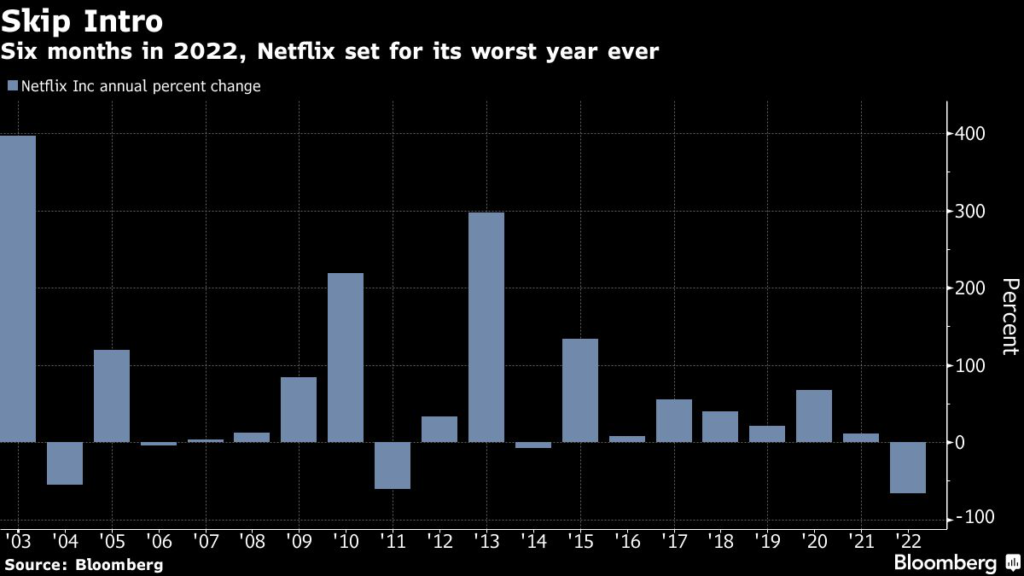
Netflix Inc. has shocked Wall Street in two consecutive quarterly reports, leading its stock to slump on both occasions. The streaming giant’s shares are down 66% this year, the biggest decline in the S&P 500 and Nasdaq 100 benchmark stock indexes. If the losses hold, the company would register its worst annual performance ever. 

Top Tech Stories

  • Chinese financial regulators have started early talks on a potential revival of Ant Group Co.’s initial public offering, according to people familiar with the matter, one of the clearest signs yet that authorities are dialing back a crackdown on the tech industry that began with the scuttling of the world’s biggest listing almost two years ago.
    • Shares of Alibaba Group Holding Ltd., which owns a third of Ant, jumped on the report.
  • Facebook parent Meta has halted development of a smartwatch with dual cameras and is instead working on other devices for the wrist, according to a person with knowledge of the matter.
  • Elon Musk’s bid for Twitter Inc., which has been upended by the billionaire’s threat to walk away, has attracted backing from a Dubai-based investment firm whose assets have surged to more than $5 billion under its secretive founder, Alexander Tamas.
  • Apple Inc. will handle the lending itself for a new “buy now, pay later” offering, sidestepping partners as the tech giant pushes deeper into the financial services industry.
  • Intel Corp., the largest maker of computer processors, dragged down chip industry stocks after executives said a weaker economy will affect demand and hurt financial performance.
  • Online cosmetics retailer Purplle raised capital at a $1.1 billion valuation, becoming the second billion-dollar company to be created in India this week despite souring investor sentiment on startups.
  • Uber Technologies Inc. Chief Executive Officer Dara Khosrowshahi said the company is “recession resistant” and doesn’t see a need for job cuts, even as market volatility and the prospect of a global recession loom over technology companies.

(Adds share moves in third paragraph.)

More stories like this are available on bloomberg.com

©2022 Bloomberg L.P.

Fanatics Signs Deals With 100 Schools for College Sports Cards

(Bloomberg) — Fanatics Inc. has signed deals with more than 100 universities as it moves aggressively into the college-sports trading-card market.

In recent months, Fanatics has quietly gone around the nation to negotiate these arrangements school by school in an effort to muster a comprehensive NCAA lineup. It also signed agreements with more than 200 student-athletes, such as Alabama quarterback and Heisman Trophy winner Bryce Young and South Carolina basketball star Aliyah Boston.

Fanatics added rights from the majority of the schools in the top five conferences, including exclusive long-term deals with Alabama, Georgia, Penn State, Texas A&M, Kentucky and Kansas that begin as early as 2023. Initial cards from nonexclusive deals with institutions such as Duke, North Carolina, Syracuse and Oklahoma will be released first under its Topps subsidiary’s Bowman U brand for football and men’s and women’s basketball. 

College athletes have been able to sign deals for their name, image and likeness since last July after the NCAA changed its rules, and by securing deals with both current players and their schools, Fanatics is able to put all the appropriate trademarks on the cards. Collegiate collections have been sold for years, but companies previously had to wait until athletes left school. Last year, rival Panini SpA signed a deal with marketing firm OneTeam Partners for group licensing of college athletes who opt into that service.

“Fanatics has been closely monitoring the ever-evolving NIL landscape, and we felt this was the perfect time to launch multiple, strategic college trading card programs,” Derek Eiler, executive vice president of Fanatics College, said in a statement.

Fast-Tracked

Chief Executive Officer Michael Rubin barreled into the trading-card industry last year as part of a push to expand beyond Fanatics’ roots as an apparel merchandiser, adding card licensing deals across football, basketball and baseball. Trading cards have been a red-hot alternative asset in recent years, with prices for cards rising immensely as investors flocked to the hobby.

Fanatics’ card business was valued at $10.4 billion last September, after a $350 million funding round led by entertainment company Endeavor Group Holdings Inc., private equity firm Silver Lake and venture capital firm Insight Venture Partners. In January, Fanatics acquired Topps for about $500 million and added its 350 employees to fast-track its growth in the sector. 

Management wants to operate a portfolio of trading-card brands under the Fanatics Collectibles umbrella. In March, it debuted its first new label — a brand called Zerocool, focused on a pop culture and entertainment — and said it’s looking to sign licensing deals with production studios, musicians and fashion houses.

(Updates list of colleges in third paragraph.)

More stories like this are available on bloomberg.com

©2022 Bloomberg L.P.

Zendesk Completes Strategic Review, Decides Against a Sale

(Bloomberg) — Zendesk Inc., a software company that became a takeover target during a failed purchase of SurveyMonkey’s parent, said it has ended a strategic review of its operations and has concluded that it will remain an independent public company. The shares tumbled about 7% in early trading.

The San Francisco-based firm conducted a “thorough process,” with the help of advisers, Qatalyst Partners, and Goldman Sachs Group Co., legal advisors at Wachtell, Lipton, Rosen & Katz, which included soliciting interest from a wide range of potential buyers and financial sponsors, according to a statement on Thursday. 

Over the course of several months, Zendesk reached out to 26 potential counterparties, including 16 potential strategic partners and 10 financial sponsors. Only a handful of financial sponsors, and none of the potential strategic partners, chose to continue the process. Ultimately, “no actionable proposals were submitted,” Zendesk said, and final bidders cited “adverse market conditions and financing difficulties at the end of the process.”

Read more: Zendesk fields takeover offer from private equity group

Zendesk had put itself in play after trying to buy SurveyMonkey parent Momentive Global Inc. Zendesk nixed that takeover in February after shareholders in both software companies questioned the merits of the deal.

“In response to investor input and our own self-assessments following the termination of our proposed acquisition of Momentive, our board decided it was in the best interest of our stockholders to assess all opportunities to enhance stockholder value,” said Chief Executive Officer and founder, Mikkel Svane. “The process did not yield any actionable options for Zendesk, and our Board unanimously determined that the right path to sustainably grow stockholder value lies in advancing Zendesk as an independent business.”

More stories like this are available on bloomberg.com

©2022 Bloomberg L.P.

Coatue, JPMorgan Weigh Funds to Buoy Startups Seeking Capital

(Bloomberg) — Coatue Management is raising a structured equity fund that could help cash-strapped startups stave off raising money at lower valuations amid turbulent public markets, and JPMorgan Chase & Co. is weighing a similar fund, according to people familiar with the matter. 

Philippe Laffont’s Coatue has begun discussing its planned Tactical Solutions Fund with potential investors, some of the people said. While it will mostly provide capital to publicly traded companies, about 20% will be earmarked for closely held startups, potentially including those the hedge fund has previously backed, one of the people said. 

The fund will deploy capital to the same sectors where Coatue typically invests, including enterprise software, health care, climate technology, consumer internet and financial technology. The alternatives arm of JPMorgan’s asset-management unit is in the early stages of exploring whether to raise a fund that would pursue a related strategy, some of the people said.

Representatives for Coatue and JPMorgan declined to comment.

Coatue has told investors that structured equity may appeal to dilution-sensitive companies whose boards may be reluctant to issue equity at depressed valuations, even as they burn cash to maintain their rapid growth, according to a presentation reviewed by Bloomberg. It may also be a capital alternative for firms whose shares have tumbled this year that are seeking cash as an insurance policy or to consolidate or restructure themselves. 

More companies may be seeking capital in part because of a slowdown in the market for initial public offerings as well as scarcity of private funding, the presentation shows. 

Structured equity, which features both debt and equity characteristics, generally includes convertible debt, senior equity or debt plus warrants. It differs from traditional growth equity funding, which tends to take the form of common equity.

Annualized returns on structured investments, which often resemble convertible debt, outperformed in past episodes of market turmoil, particularly the 2000 dot-com crash and 2008 financial crisis, according to the presentation. 

Coatue’s flagship hedge fund — which invests in publicly traded stocks and private startups — fell about 2% last month, extending its decline for the year to roughly 17%, according to a person familiar with the matter. Peers including Dan Sundheim’s D1 Capital Partners and Chase Coleman’s Tiger Global Management are also deep underwater so far in 2022. 

If portfolio companies turn to structured equity as an alternative to common equity, investment firms may be able to continue marking companies’ valuations at the level in which they last raised common equity. To be sure, such marks may face scrutiny from limited partners if rivals or mutual funds write down their holdings in the same companies to varying degrees.

More stories like this are available on bloomberg.com

©2022 Bloomberg L.P.

Outsourcing Company iEnergizer’s Owners Weighing Sale

(Bloomberg) — iEnergizer Ltd., the digital content and business process outsourcing company, said it’s in preliminary talks about a potential sale to buyout firm Baring Private Equity Asia. 

The London-listed company is undertaking a review of strategic options “in order to maximize value for all existing shareholders,” it said in a statement Thursday, confirming an earlier Bloomberg News report. Discussions with BPEA are ongoing, and there’s no certainty they will lead to a deal, iEnergizer said. 

BPEA has until July 7 to announce a firm intention to bid for iEnergizer, according to the statement. Shares of the Guernsey-based company jumped as much as 9.1% on Thursday, their largest intraday gain since February, after Bloomberg News reported iEnergizer was exploring a sale. They were up 8.1% at 1:06 p.m. in London, giving iEnergizer a market value of £810 million ($1 billion). 

iEnergizer has been working with an adviser to gauge interest from potential bidders, people with knowledge of the matter said earlier. Anil Aggarwal, iEnergizer’s founder and chief executive officer, is the controlling shareholder, according to its annual report. 

iEnergizer offers customer management and custom content development services, according to its website. Founded in 2000 in India, the company employs more than 22,000 people across nine delivery centers worldwide. Its customers are based primarily in the US and India, the annual report shows.

The company acquired content production and digital media firm Aptara Inc. in 2012 for $150 million.

Outsourcing firms have benefited from the digitization that accelerated during the Covid-19 pandemic, driving a wave of deals. Mindtree Ltd. and Larsen & Toubro Infotech Ltd., two software firms controlled by Larsen & Toubro Ltd., agreed to merge last month at a combined $18 billion market value. 

(Updates with share price increase in third paragraph.)

More stories like this are available on bloomberg.com

©2022 Bloomberg L.P.

Ex-Credit Suisse Boss Thiam Loses Pimco Backing for Fintech SPAC

(Bloomberg) — Tidjane Thiam, the former chief executive officer of Credit Suisse Group AG, has lost the backing of fund management giant Pimco for his fintech SPAC. 

Pimco, which was one of the financial backers behind the creation of Thiam’s Freedom Acquisition I Corp., has agreed to sell its entire stake in the sponsor vehicle for the blank-check firm to an affiliate of China Bridge Capital, according to a filing Wednesday.

Jamie Weinstein, Pimco’s head of corporate special situations, has resigned from the board of the special purpose acquisition company effective June 6. China Bridge Capital founder Edward Zeng has been appointed as a director in his place, Freedom Acquisition said in the filing. 

It’s very rare for one of a SPAC’s early backers to end their involvement after it starts trading. Walking away at this stage is a bold move, particularly as blank-check firms often attract investors based on their sponsors’ credentials. 

Sponsors help front the money to set up a blank-check firm and, in return, stand to benefit handsomely from a successful deal. That’s become less of a sure bet as souring sentiment leaves hundreds of SPACs scrambling to find a target in a difficult environment. 

Soured Market

Freedom Acquisition raised $345 million in its February 2021 initial public offering after Thiam increased the size of the transaction. It’s seeking a merger with a technology-enabled business in the financial services industry, according to previous filings. One of Pimco’s private funds was part of its sponsor group and committed to buying shares in the IPO. 

Pimco’s move shows the sharp turnaround in sentiment from last year, when high-profile investors were flocking to support SPACs from financiers in Europe. Thiam’s blank-check IPO attracted investors including Francois Pinault, the billionaire founder of luxury conglomerate Kering SA. 

The listing recorded an oversubscription level in the mid-teens, and about a third of the deal went to rich individuals’ family offices, Bloomberg News reported at the time.  

Thiam is executive chairman of the SPAC, which is run by one of his key lieutenants, ex-investment banker Adam Gishen. Freedom Acquisition, which is still hunting for a deal, has until February 2023 to complete a transaction or it will need to return investors’ capital. 

Silicon Valley venture capital firm Tribe Capital also announced this week it’s abandoning a SPAC it helped set up. The investment firm will no longer back the sponsor of Tribe Capital Growth Corp. I, which started trading last year and hasn’t found a target yet. 

More stories like this are available on bloomberg.com

©2022 Bloomberg L.P.

China Weighs Reviving Jack Ma’s Ant IPO as Crackdown Eases

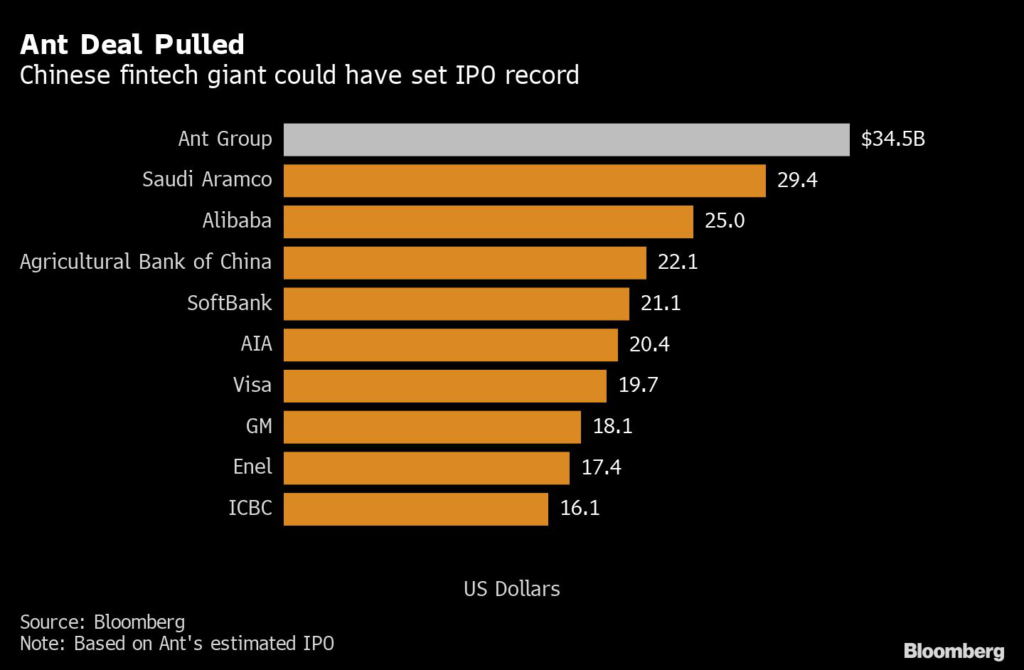
(Bloomberg) — Chinese financial regulators have started early stage discussions on a potential revival of Ant Group Co.’s initial public offering, according to people familiar with the matter, one of the clearest signs yet that authorities are dialing back a crackdown on the tech industry that began with the scuttling of the world’s biggest listing almost two years ago.

The China Securities Regulatory Commission has established a team to reassess the fintech giant’s share sale plans, said one of the people, who asked not to be named discussing private information. Authorities are also nearing the final stages of issuing Ant a long-awaited license that would clear the path for an IPO and make the company regulated more like a bank, the people said.

China’s central leadership has given a tentative nod to restarting plans for listings in both Shanghai and Hong Kong, Reuters reported after Bloomberg’s story, citing people with knowledge of the matter. The CSRC said in a statement late Thursday that it isn’t conducting work on reviving the Ant IPO, although it supports eligible platform companies going public in China and overseas. 

While the timeline for an Ant license and its potential listing would hinge on approvals from senior Chinese leaders, evidence of progress on both fronts is likely to reinforce investor optimism that the worst is over for the country’s embattled private sector. Chinese tech stocks have soared in recent weeks, buoyed by a report that authorities are preparing to wrap up a probe into Didi Global Inc. and restore the ride-hailing company’s main apps to mobile stores.

A meaningful relaxation of curbs on Ant and Didi — the most high-profile casualties of President Xi Jinping’s sweeping clampdown on the country’s tech giants — would send a powerful signal that policy makers are following through on recent pledges to support the industry. The Communist Party’s evolving stance toward the private sector has become one of the most closely watched developments in global markets in recent years, with some observers going as far as to call China’s sprawling internet sector uninvestable.

Alibaba Group Holding Ltd., which owns a stake in Ant, climbed as much as 7% in pre-market trading on Thursday, before sliding after the CSRC’s statement.

Ant, controlled by billionaire Jack Ma, said on its WeChat official account that it is working on restructuring the company under the guidance of regulators and doesn’t have plans to initiate an IPO. China’s central bank didn’t immediately respond to requests for comment. 

The government supports domestic and offshore listings of platform businesses in accordance with rules, Chinese Premier Li Keqiang said last month, without naming any companies.

“We now firmly believe that the worst is past us for China tech in particular from a regulatory point of view,” said Kerry Goh, the Singapore-based chief investment officer at Kamet Capital Partners Pte. “The impact from the economic slowdown we don’t know yet.” 

The crushing of Ant’s $35 billion IPO in November 2020 sent shock waves across the financial world, burning investment firms from Carlyle Group Inc. to Temasek Holdings Pte that had expected a windfall. It also marked the beginning of a broader crackdown that ensnared some of China’s fastest-growing companies, erased more than $1 trillion of market value and caused a reckoning within the country’s billionaire class.

Ma, China’s most famous entrepreneur, has mostly disappeared from public view since giving a speech that criticized regulators on the eve of the scuttled Ant IPO. Many of his peers have relinquished their formal corporate roles and increased donations to charity to align with Xi’s vision of achieving “common prosperity.”

While investors are likely to welcome any signs that the tech crackdown is easing, a return to the heady days of 2020 appears unlikely. Myriad regulations imposed on Ant over the past two years mean the company is worth a fraction of its former self, according to some early backers. Fidelity Investments, for instance, slashed its valuation estimate for the firm to about $78 billion last June from $235 billion just before the IPO was abruptly suspended.

China’s securities regulator is initially looking at Ant’s plans for a Shanghai listing, one of the people familiar said. The company eventually expects to conduct a dual-listing in Shanghai and Hong Kong, another person said. Ant aims to file a preliminary prospectus for its offering as soon as next month, Reuters reported.

In one sign of progress, Ant recently appointed Hong Kong stock exchange Chairman Laura Cha as an independent director. The move was blessed by regulators in Beijing, people familiar with the matter said. Authorities have also been expediting decisions on Ant’s restructuring proposals in recent weeks, one of the people added. 

Alibaba has surged in US trading since the Wall Street Journal reported that China is close to wrapping up probes into Didi and two other firms, moves investors have interpreted as a signal that some of the most beaten-down tech stocks are finally due for a reprieve.

The Hang Seng Tech Index has advanced 36% in Hong Kong from this year’s low in March, while the Nasdaq Golden Dragon China Index of US-listed shares has jumped 53%. The latter index is still down 62% from its peak in early 2021.

After derailing Ant’s IPO, regulators ordered the Hangzhou-based company to overhaul its operations and set up a financial holding company for its wealth management, lending and credit scoring businesses so they can be more closely regulated.

Authorities are now preparing to issue Ant a financial holding company license, the people said, though it’s unclear how quickly a final decision on this will come.

As part of the restructuring, Ant has ramped up its capital base to 35 billion yuan ($5.2 billion) and moved to build firewalls in an ecosystem that once allowed it to direct traffic from its payment app Alipay, with a billion users, to services like wealth management, lending and delivery. 

Consumer loans jointly made with banks — previously a major engine of growth — were split from its “Jiebei” and “Huabei” brands. Assets under management at its money-market fund Yu’ebao — once the world’s largest — dropped 15% from a year earlier to 825 billion yuan as of March.

(Updates with Reuters report in third paragraph, Ant statement in seventh)

More stories like this are available on bloomberg.com

©2022 Bloomberg L.P.

Europe Moves Closer to Cutting Off Its Lifeblood Combustion Engine

(Bloomberg) — Europe’s effort to snuff out the internal combustion engine a little more than a dozen years from now just took a key step forward.

Members of Parliament voted Wednesday in favor of mandating that carmakers eliminate emissions from the cars they sell from 2035 onward. They rejected an attempt by some right-leaning lawmakers to let up on the industry even just a little bit, voting down an amendment that would have set a 90% fleetwide CO2 average reduction instead.

The 19th-century invention by men named Maybach and Daimler isn’t dead yet. The Parliament has only voted on its position for negotiations with national governments. And member states haven’t decided yet whether they will back the 2035 date or not, but will do so by the end of the month.

After that, it’ll be time for negotiations between representatives of the Parliament and the Council of the European Union, which will start around September or October at the earliest. This will take several months.

While the 2035 plan has been well-telegraphed (the EU unveiled it 11 months ago) and the decision still needs more finalizing, the European consumer organization BEUC isn’t exaggerating when it calls this vote historic and says this would have been unthinkable years ago.

“We have set a clear direction of travel for the industry,” Pascal Canfin, chair of the the European Parliament’s environment committee, said after the vote. Phasing out combustion engines any faster, as some political groups including the Greens have proposed, would make it “impossible to manage the social and industrial consequences associated with the transition of Europe’s leading industry in terms of employment.”

So what does this mean for automakers and their suppliers?

Several of the industry’s lobby groups remain wary. The European Automobile Manufacturers’ Association wants a review of post-2030 targets. Germany’s VDA similarly says it’s too early to set a zero-emission objective. The director of France’s PFA warns Europe is making a radical move and not properly protecting its industry.

On the other hand, manufacturers including Volkswagen, Stellantis and Mercedes-Benz have already spent the last several years accelerating their transition to battery-electric vehicles and ratcheting up their investments by tens of billions of euros. Even Toyota, which remains circumspect about how quickly consumers will be ready to make the jump, has said it’ll be ready to sell only zero-emission cars by 2035.

Where it gets trickier will be less-well-off carmakers like Renault, and suppliers whose fortunes remain too closely tied to combustion. The French manufacturer reeling from having to write-off operations in Russia, its second-largest market, is exploring drastic moves including a partial sale of its stake in Nissan and carve-outs of its EV and combustion-engine businesses. A wave of consolidation is taking place among parts makers, surely with more to come.

Other companies for which Wednesday’s vote was a big setback are high-end manufacturers such as Ferrari and Aston Martin. A measure poised to take effect from 2030 onward would end emissions-target exemptions for carmakers that produce fewer than 10,000 vehicles a year.

Italy wasted little time after the EU formalized its 2035 proposal last year to put the word out that it wants ways for the likes of Lamborghini to get around restrictions.

Ferrari investors are eager to get a look at the electrification plan Chief Executive Officer Benedetto Vigna has been crafting since he took over in September. The maker of 1,000-horsepower supercars is staging a highly anticipated investor day next week, and faces a daunting task of making up for its late start. Ferrari’s first fully electric vehicle isn’t slated to arrive until 2025.

“We would expect OEMs that have exhibited a more cautious stance on EV adoption to revisit their plans and consider an acceleration of their electrification strategies,” Bernstein analyst Daniel Roeska wrote Thursday in a note.

More stories like this are available on bloomberg.com

©2022 Bloomberg L.P.
Close Bitnami banner
Bitnami