

Bloomberg

Former BlackRock Rising Star Has No Regrets About Defection to DeFi

(Bloomberg) — Mary-Catherine Lader had been on the job for all of two weeks at BlackRock Inc. when she decided she had a difference of opinion with Chief Executive Officer Larry Fink. This was in the fall of 2015 and Lader, then 30, was a recent dual graduate of Harvard’s business and law schools — with a firm conviction in the power of crypto.

Lader heard Fink express what she interpreted as skepticism about blockchain at a town-hall meeting, prompting her to fire off a memo to the head of her group defending the technology and explaining how she thought BlackRock should take advantage of its strengths. The missive got noticed and soon after, she was named co-head of BlackRock’s first blockchain working group — a position that made her both an advocate and an architect for the technology within the firm.

It was a big step, one that eventually helped lead to roles as chief of staff to the global chief operating officer and a leader at BlackRock Digital Wealth, among other positions at the asset-management giant. Lader’s blockchain efforts “were an important early step to where we are as a company,” Rob Goldstein, BlackRock’s COO, said in an interview.

Perhaps more stunning, though, was Lader’s decision last June to leave her high-flying career at BlackRock to become COO of Uniswap Labs, the creator of the world’s biggest decentralized exchange protocol and a key player in the free-wheeling world of DeFi — crypto’s largely unregulated answer to traditional finance. The way she saw it, the game-changing potential meant “it felt riskier to stay in a traditional institution than to jump into crypto full time,” Lader said.

She now faces a formidable challenge: convincing Wall Street and more mainstream consumers to have the confidence to start using Uniswap — a must step to expand the company beyond the crypto world. And it’s become even more daunting after the collapse last month of the TerraUSD stablecoin and its sister token Luna, which highlighted just how high the risks are in an industry that remains under threat from regulators and is likened by critics to a house of cards.

Lader believes Terra’s implosion, which destroyed tens of billions of dollars in market value, will actually speed up changes that will ultimately pave the way for decentralized finance.

“The tragic outcomes of Terra and Luna do demonstrate that we do need rules for the road, whether they come from regulators or the investment community, so the investors know the risks they are taking,” Lader, known as “MC,” said.

Where skeptics see danger in the wild swings, scams and hacks that are still all too common in DeFi, believers like Lader continue to see promise in a financial system that is intended to be more inclusive, where users are meant to be in control and the lack of middlemen can allow for potential efficiencies like faster transaction times and lower costs. 

Uniswap is a four-year-old effort governed by a community of holders of its token, Uni — regular folks as well as Silicon Valley venture capitalists like Andreessen Horowitz. Token holders have a say in everything from the project’s fee structure to possible new features. The project’s code is freely available and has been copied, creating rivals like SushiSwap. The Uniswap protocol’s daily trading volume has already roughly matched that of Coinbase Global Inc., the U.S.’s biggest crypto exchange, according to Uniswap’s own data and CoinMarketCap.

Lader sees Terra’s collapse as an opportunity to make DeFi — which she admits is imperfect — better. Developers at Uniswap Labs are tinkering with their existing warning system, aiming to flag the hundreds of coins traded on the exchange with color codes in red, yellow or green depending on their level of risk, according to a person familiar with the matter.

Even before the Terra collapse, regulators frowned upon decentralized exchanges’ anonymous trading and easy token listings, which can enable scams. A recent class-action lawsuit alleges unlawful sale of unregistered securities through Uniswap, which last year axed some tokens meant to mimic stocks, and there have been reports of a Securities and Exchange Commission investigation. A spokesman for Uniswap Labs said the company is “committed to complying with the laws and regulations governing our industry and to providing information to regulators that will assist them with any inquiry.” 

Despite crypto’s bouts of upheaval, the market has continued to grow and gain adherents. Now, Lader — whose resume also includes a stint at Goldman Sachs Group Inc. — thinks that after years of alternating between fearing and dismissing crypto, Wall Street is ready to engage. In his most recent annual shareholder letter, JPMorgan Chase & Co. CEO Jamie Dimon — who once called Bitcoin “worthless” — noted that “decentralized finance and blockchain are real, new technologies.” In April, BlackRock invested in Circle, which is behind popular stablecoin USDC that’s widely used in DeFi. And Jane Street recently started borrowing from a DeFi app. 

Read more: Wall Street Firms Make Crypto Push to Catch Up With ‘Cool Kids’

“The level of interest that’s been piqued on Wall Street, it’s not going to go away,” Lader said in the aftermath of Terra. Traditional financial players “are no strangers to high-risk financial products and unfortunate outcomes.”

Hiring Push

Over the past year, Lader has led a hiring push at Uniswap Labs, growing the team from 17 to 61 people, with 50% of employees now women, up from 24% previously. About 40% of the staff are also people of color. The diversity is an anomaly in the tech world and especially crypto, dominated by men. And the spree is set to continue, even as some rivals such as Coinbase and Gemini Trust Co. are freezing hiring or even cutting staffs.

Uniswap’s new hires include some high-profile additions: former Federal Reserve economist Gordon Liao was brought on to lead research, and former Snap Inc. senior director of engineering Chad DePue to lead engineering. Salman Banaei recently became head of policy; in the past he held various roles at the U.S. Commodity Futures Trading Commission.

Lader’s team is talking with major investors to bring them to DeFi; it’s considering special institutional interfaces, according to two people familiar with the work. It’s also looking into offering tools for trading in traditional assets like fiat currency and commodities, one of the people said.

“Given her background at Goldman and BlackRock and given that she understands traditional finance and also understands crypto, she is really bridging those two worlds,” Ben Forman, founder of ParaFi Capital, an investor in Uniswap, said. “One of her focuses will be on bringing traditional financial institutions into DeFi in a way that makes sense to them.”

Widgets and More

To rev up its presence on consumer sites and apps, Uniswap in April unveiled a venture arm, widening its influence throughout the crypto world. It also pushed out a “widget” — a piece of code that any website can embed to let users swap tokens without leaving a site — that could ramp up its usage. 

Lader imagines many uses for DeFi and Uniswap, including in developed markets. Back in 2011, she worked on promoting a mobile-money service in Kenya, pitching grocery stores and micro-lenders to use it to reach more rural communities that otherwise might not have access to their services. Partly because her father, Philip Lader, was U.S. ambassador to the UK under former President Bill Clinton, she has lived in six countries and traveled to 87.

Read more: Crypto’s Top Decentralized Spot Market Aims to Dominate Web3 

“She was always someone who found herself right at the epicenter of figuring out how to democratize finance, new technologies and how do we not talk about them as concepts but actually figure out practical applications,” Goldstein said. 

Lader moved to Uniswap in the middle of the pandemic, which she mostly spent in New York. She also volunteered for Crisis Text Line, a free mental-health counseling service started by a friend.

“I was surprised by the move,” BlackRock’s Goldstein said. “At the same time, I think that she is really passionate about this whole concept of mission and democratization of finance.”

More stories like this are available on bloomberg.com

©2022 Bloomberg L.P.

Microsoft Xbox Brings Cloud Gaming to Samsung Smart TVs Without Console

(Bloomberg) — Microsoft Corp. is partnering with Samsung Electronics Co. to allow gaming fans to play Xbox games directly on smart TVs without a console. Starting June 30, hundreds of cloud-enabled games attached to the Xbox Game Pass Ultimate subscription, which costs $14.99 a month without promotional pricing, will be available through Samsung’s Gaming Hub, similar to using any other streaming app on a TV.

Later this year, Game Pass Ultimate subscribers will be able to play some of the games they already own using the cloud and without a download, even if the games aren’t currently in the Game Pass library. That expands the cloud-gaming features, which let users play on various devices and are presently only available for Game Pass titles.

“We’re building a platform that can reach billions of players, whether it’s on console, whether it’s on PC, whether it’s through Xbox cloud streaming,”  said Phil Spencer, chief executive officer of Microsoft Gaming.  “That’s just fundamental to where Xbox is going.”

The agreement, announced Thursday, is part of an effort by Microsoft’s Xbox business to keep expanding beyond the console and to get more gamers to pony up for Game Pass, a monthly service that helps smooth revenue fluctuations in an industry driven by big-hit titles. Game Pass has 25 million subscribers, Microsoft said in January. Xbox hasn’t updated subscriber numbers since then and last month Kotaku reported some gaming writers and tastemakers said they may drop Game Pass at least temporarily as they wait for big game releases that have been delayed until next year, like two highly anticipated upcoming games from Xbox’s Bethesda Softworks studio. 

The company is getting more subscribers to play on PCs — that number has tripled since last November, Xbox said.

Last month, Xbox said the other part of its plan to bring cloud gaming to TVs, a streaming stick device, needs more time and a new strategy. The company told Windows Central it had “made the decision to pivot away from the current iteration” of the device and “refocus our efforts on a new approach that will allow us to deliver Xbox Cloud Gaming to more players around the world in the future.” 

Microsoft will also start a new program within the next year that lets independent game developers promote upcoming titles by sharing demos of their work to Game Pass members. With the program, called Project Moorcroft, participating developers will be able to track how their demos perform and Microsoft plans to compensate them for their content. 

More stories like this are available on bloomberg.com

©2022 Bloomberg L.P.
Online US Inflation Slows Again, But Groceries Rise Most of All

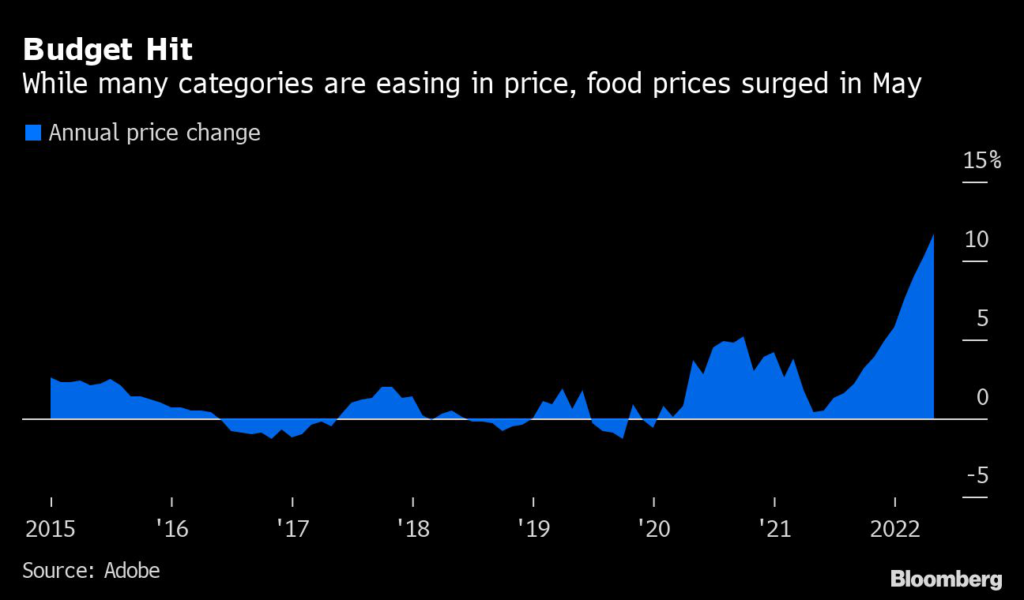
(Bloomberg) — Price growth of goods online in the US decelerated in May for a second month but grocery prices surged, the first time in which they’ve risen the most of any category tracked by Adobe Inc.

Online inflation rose 2% in May from a year ago, down from 2.9% in April and the record 3.6% in March, Adobe said in a release Thursday. Ten of the 18 components tracked, including electronics and toys, saw prices fall in the month, indicating consumers may be pulling back on discretionary spending.

Grocery prices jumped 11.7% in May from a year earlier, the most on record, and 1.3% from April, Adobe said. This was the first month that the category overtook apparel, which was in the top spot for price growth for over a year.

“Despite the modest increase in consumer spending online, an uncertain economic climate and rising costs in core areas like groceries are putting a hamper on overall demand,” said Patrick Brown, vice president of growth marketing and insights at Adobe.

Online prices have been rising for 24 months, but there are signs they may be peaking. On a monthly basis, prices dropped 0.7% in May, dragged down by other goods such as personal care products, jewelry and books.

Consumers are facing some of the highest inflation in 40 years — especially for essentials like food and gas — which is leaving little leftover for other purchases. However, spending has held firm as Americans dip into savings and load up on credit cards.

The data comes a day before the release of the May consumer price index, which is forecast to show prices rose 0.7% from April and 8.2% from a year ago, which would be the second straight deceleration on an annual basis. 

The Adobe index analyzes 1 trillion visits to retail sites and over 100 million stock keeping units across 18 product categories.

More stories like this are available on bloomberg.com

©2022 Bloomberg L.P.

China Regulator Says Not Conducting Work on Ant IPO Revival

(Bloomberg) — China’s securities watchdog said it’s not conducting a review and research work on an Ant Group Co. initial public offering.

The China Securities Regulatory Commission issued a statement on Thursday in response to a Bloomberg report that regulators are holding early stage discussions on a revival of the fintech company’s listing. The CSRC added that it supports platform companies that meet qualifications to list in mainland China and overseas.

Bloomberg reported earlier that Chinese financial regulators have started early stage discussions on a potential revival of Ant’s listing, citing people familiar with the matter.

The CSRC has established a team to reassess the fintech giant’s share sale plans, said one of the people, who asked not to be named discussing private information. Authorities are also nearing the final stages of issuing Ant a long-awaited license that would clear the path for an IPO and make the company regulated more like a bank, the people said.

China’s securities regulator is initially looking at Ant’s plans for a Shanghai listing, one of the people familiar said. The company eventually expects to conduct a dual-listing in Shanghai and Hong Kong, another person said.

More stories like this are available on bloomberg.com

©2022 Bloomberg L.P.
China Stock Bulls See End of Crackdown as Ant IPO Revival Mulled

(Bloomberg) — After being wrong many times in calling a bottom, China tech stock bulls may finally be having their moment.

Alibaba Group Holding Ltd.’s US-listed shares jumped as much as 7% in pre-market trading after a Bloomberg News report that authorities may allow Jack Ma’s Ant Group Co. to revive its initial public offering. That’s bolstering conviction that the days of tech crackdown are nearing an end. Other large-cap Chinese internet stocks also pared losses on the news while the yuan gained. 

The report is one of the clearest signs yet that Beijing is loosening its grips following more than a year of regulatory squeeze on the sector which at one point erased nearly $2 trillion in market value from a February 2021 peak. Chinese stocks staged strong rallies in Hong Kong and New York this week following news of a likely wrap-up of a probe into Didi Global Inc. and a slew of new game approvals. 

“We were only saying a few days ago that if Ant was rehabilitated it would mark a major positive. This, in a sense, was where the trouble started,” said Gary Dugan, chief executive officer of the Global CIO Office. “If true, it would be very good news and a major potential turning point for the China tech sector and broader Chinese markets.”

The sudden scuttling of Ant’s IPO in November 2020 — just days before the fintech juggernaut was to go public — marked the beginning of China’s hallmark regulatory crackdown that has swept across the country’s internet sector. The crackdown has seen foreign investors flee and the sector labeled “uninvestable.” Alibaba owns about a thrid of Ant.

The China Securities Regulatory Commission has established a team to reassess the fintech giant’s share sale plans, according to Bloomberg’s Thursday report. Authorities are also nearing the final stages of issuing Ant a long-awaited license that would clear the path for an IPO and make the company regulated more like a bank.

Bullish Pivot 

While a number of strategists has started to turn bullish from late 2021, citing cheap valuation and expectations of better policy environment, a sustainable rally had seemed elusive with rebounds barely lasting a few days. Goldman Sachs Group Inc. and Jefferies Financial Group Inc. have been among the early believers of a China turnaround, only to see the Hang Seng Tech Index slide to new lows. 

Sentiment took a turn for the better in mid-March this year, when China’s economic czar — Vice Premier Liu He — promised to swiftly end tech scrutiny, stabilize financial markets, and deploy measures to prop up the economy. While the pledges initially seemed to ring hollow with no concrete action, those doubts were likely put to rest this week. 

The Ant news “is a sign that regulators are following through on their pledge to end the crackdown on tech platforms, which will continue to improve sentiment on the sector,” said Marvin Chen, analyst at Bloomberg Intelligence. “Potential revival of the Ant IPO may also help support financial markets in the region as fundraising activity has dried up this year.”

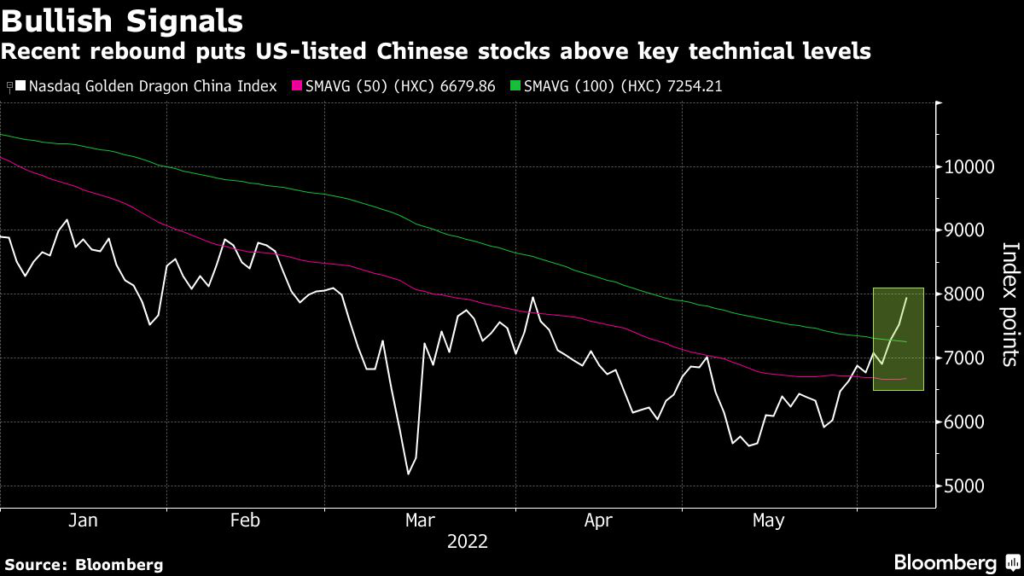
Chinese tech shares have outperformed US peers in recent sessions, with the Nasdaq Golden Dragon Index is down 11% this year, compared with the Nasdaq 100’s 23% slump.

One big market overhang, though, still remains — China’s Covid Zero policy. Having earlier moved to lift lockdowns in Shanghai and reopen Beijing’s economy, partial movement restrictions are returning as authorities remain determined to stamp out the highly-transmissible omicron. 

Still, the number of strategists and money managers saying it’s time to buy China has been growing by the day, with even the most bearish participants seeing opportunities, at least for the short term. 

Various market indicators also suggest the nascent rally in both local and overseas-listed Chinese shares may have further momentum, partially aided by the lifting of Covid-induced lockdowns in Shanghai and Beijing.

Foreign investors have been net buyers of mainland equities for nine straight sessions through Thursday, the longest streak since December, Bloomberg-compiled data show. The tech gauge in Hong Kong has breached its 50-day and 100-day moving averages, key technical hurdles that indicate more gains may be in store.

It “may be considered as the official end of regulatory risk” as the crackdown started with the freezing of Ant’s IPO, said Steven Leung, executive director at Uob Kay Hian (Hong Kong) Limited.

(Updates throughout)

More stories like this are available on bloomberg.com

©2022 Bloomberg L.P.
Zilingo Board Approves Debt Repayment to Creditors

(Bloomberg) — Zilingo Pte’s board has authorized the repayment of loans demanded by creditors as the troubled startup fights to stave off a liquidity crisis, according to people familiar with the matter.

Weeks after the ouster of Ankiti Bose from her post as chief executive officer, company directors on Wednesday authorized co-founder Dhruv Kapoor to transfer funds demanded by the creditors behind a $40 million debt facility with immediate effect, said the people who asked not to be named as the matter is private. Kapoor and Bose started Singapore-based Zilingo together in 2015.

The move puts the embattled fashion startup in a precarious financial position, given its money-losing operations and limited access to fresh capital.

“The board has and continues to evaluate all options for the business,” the firm said in an emailed statement. “All significant decisions related to the company are taken collectively with the full involvement and authorization of the majority of investors.”

Since Bose was fired on May 20, investors and top management have debated whether Zilingo can keep operating. Key investors including Sequoia Capital India and Koru Partners have proposed putting the firm into liquidation, clashing with creditors who want to consider other possible financial options, as well as Kapoor who wants to save the company, according to several people.

“I do not believe that liquidation is either necessary or meaningful for the interest of the company and its customers, shareholders, note holders and lenders,” Kapoor wrote in an email seen by Bloomberg News, sent on May 31 to shareholders of Zilingo. In the email, Kapoor, who serves as chief technology officer, asked for their support, saying the company needs just $6 million to $8 million for next year. 

“While we do have many multiples of this figure in our accounts today, there is a real risk that these monies will be swept away by the lenders,” he wrote. He added that he’d been approached by companies expressing interest in a merger or acquisition.

Zilingo’s Fired CEO Responds to Questions of Mystery Payments

Creditors do not favor the liquidation option partly because that process can take six to nine months in Singapore, a relatively long period for the quick-paced world of startups, and it can be costly, one of the people said.

Zilingo employees, who are facing an uncertain future, are walking out. About 100 workers across Zilingo’s eight offices have departed in recent months, according to a person familiar with the matter. Chief Financial Officer Ramesh Bafna, a former CFO at fashion e-commerce platform Myntra, left in May, a mere two months after joining. Other senior managers including the startup’s head of Thailand are also leaving, according to the people.

In May, Zilingo halted some of its operations in Indonesia, the struggling startup’s biggest market in Southeast Asia, the people said. Some staff in the country, totaling more than 100 before the crisis, have been told by their managers to start looking for jobs elsewhere, one of the people said.

Zilingo Appoints Financial Adviser as Creditors Recall Loan

Indies Capital Partners and Varde Partners, the companies behind Zilingo’s creditor Zorro Assets Ltd., provided the $40 million mezzanine debt facility in 2021. In March, Varde and Indies told the firm that it was in default of their loan agreement, citing a wide range of documents it had not yet provided, including audited filings from fiscal 2020 and fiscal 2021, ordering it to cease drawing on funds. By May, they decided to recall the loan.

Varde declined to comment and Indies Capital did not respond to requests for comment.

The Zilingo board said on May 13 that it had appointed an independent financial adviser to explore options for the company’s future.

More stories like this are available on bloomberg.com

©2022 Bloomberg L.P.

Shanghai to Lock Down Parts of City Again as Virus Fears Return

(Bloomberg) — Shanghai will lock down seven districts this weekend to conduct mass Covid-19 testing drives, its first major movement restrictions since the financial hub exited a bruising two-month shutdown at the start of June.  

The temporary lockdown, which will cover millions of people across the Pudong, Huangpu, Jing’an, Xuhui, Hongkou, Baoshan and Minhang districts, comes as infections found in the community rebounded to six as of 5 p.m. on Thursday, up from zero the day before. 

Four of the six cases were found in Minhang, a district of 2.65 million in the south west of Shanghai. Minhang will be sealed on Saturday morning for mass testing, said a local statement, while the other districts didn’t specify how long their lockdowns would last. 

The moves are raising concerns that the city’s reopening is backsliding as officials fear a resurgence of infection after social and economic activity resumed. Residents face the risk of being confined to their homes for another two weeks if any Covid infections are discovered during mass testing, in line with China’s Covid Zero policy. 

The government also appears to be escalating curbs and placing apartment blocks back under lockdown over the slightest hint of infection risk. Some housing compounds in the central Jing’an and Xuhui districts were sealed for 14 days from Tuesday, although only close contacts – no confirmed cases – were found among residents.

The threat of renewed restrictions is looming over all of Shanghai as the city tentatively emerges from the lockdown implemented in late March. While most residents have regained their freedom since the start of June, millions are still grappling with varying limitations and the abrupt imposition of new curbs. 

The constant risk of resurgence and the measures needed to prevent them underscores the stress stemming from the zero-tolerance strategy still followed in the world’s most populous country. In the capital Beijing, which has been struggling with a long but low-level flareup, authorities ordered the tightening of rules again after a bar cluster ended a five-day streak of zero community spread.  

Mass testing resumed Thursday in several neighborhoods in Beijing’s eastern Chaoyang district, known for its skyscrapers and glistening retail outlets, while entertainment venues like internet cafes and karaoke parlors were closed, with more inspections planned city-wide. 

“The risk of Covid’s covert spread remains and it sounds an alarm once again that our epidemic control and prevention must not have an iota of relaxation,” said Xu Hejian, a spokesman for the Beijing municipal government at a briefing on Thursday.

Experts See China Stuck in a Slowly Evolving Covid-Zero Loop

Nationwide, China reported 164 infections for Wednesday, including nine in Shanghai. Most of the country’s cases were in Inner Mongolia, in China’s north, where the number rose to 130 from 81 the previous day and some areas remain locked down. 

China Fears Wind Is Blowing Covid Virus in From North Korea

Even before mass testing drives, people in some affected areas in Shanghai’s Xuhui and Jing’an districts have been barred from leaving their homes and are subject to a daily Covid test, according to the latest policy. Others will be quarantined for seven days, followed by another week of health monitoring at home. During the control period, all vehicles in regions except for buses and ambulance are banned, according to government statements.

While the vigilance in China’s mega-cities escalated, national health leaders are trying to rein in some over-zealous efforts to root out the virus in smaller, less economically important places. 

Not every city in China needs to do regular Covid mass testing, and results shouldn’t always be required for riding public transportation and entering public venues, officials at China’s National Health Commission said on Thursday. Testing should focus on people with high risk exposure and those in places with outbreaks, said He Qinghua, an official from the National Health Commission.

(Adds new developments throughout)

More stories like this are available on bloomberg.com

©2022 Bloomberg L.P.
How Wind-Prediction Tech Will Change Clean Energy

(Bloomberg) —

Last week, French utility Engie SA announced that it will use Google’s AI-powered wind-prediction capabilities to optimize operations of its German wind assets. The pilot program is an extension of Google’s in-house work that it says allows it to capture higher revenues by scheduling hourly wind-power commitments to the grid up to one day in advance. A Google executive calls this offering “a trading recommendations tool,” which it is — but it is also a source of intriguing and important strategic questions for Google, Engie, and Big Tech in energy in general.

Google’s artificial intelligence sister company, DeepMind, continues to expand its scope, scale and capabilities. Essentially, feed DeepMind with a big and difficult set of problems to solve and it can often solve them. In 2020, for instance, DeepMind’s AlphaFold initiative determined the structures of proteins, a problem that a scientist in 1969 said would take longer than the age of the known universe if done by brute force. 

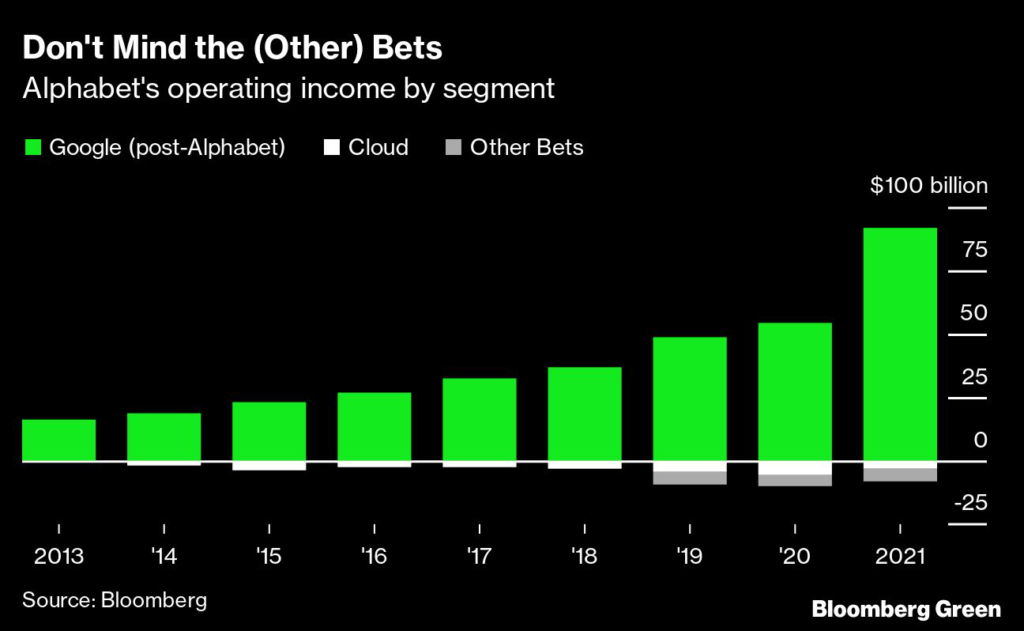
At the same time, this remarkable capability is ancillary, at best, to Google parent company Alphabet Inc.’s key business of search, which generated more than $90 billion in operating income in 2021, while its cloud and “other bets” groups working on health and transportation and AI had negative operating income. 

Perhaps underscoring that, less than a year after DeepMind announced its protein-folding success, it made AlphaFold free to the world. Better wind-prediction capabilities could mean almost nothing to Alphabet besides allowing it to sell more cloud services to utility customers.

For Engie, the first and most obvious application for Google’s AI is to better understand what the utility might expect from wind patterns in the future. This is fundamentally about averting risk. Predicting a day and a half out will allow Engie to plan for when wind is available and, just as important, to plan around when it is not. It should allow the utility to better schedule its other generators in order to meet demand when wind supply is low. 

But there are other approaches that these capabilities could unlock for Engie as well. Knowing wind patterns 36 hours in advance could also let it take on more market risk. Engie could be more willing to make commitments about when wind projects will generate energy, and could do so further into the future than was possible before. The company could become more confident in playing in spot electricity markets at times when prices are very high. In theory, it could even use its wind assets in a purely “merchant” fashion — completely exposed to the market price of electricity, with all of the potential upsides to be captured and downsides to be planned for. 

Anticipating what comes next for a DeepMind wind application requires us to ask several sets of questions. The first set is technical. To what extent can this technology improve? How much further out can its predictions reach in time, and how much more accurate can they become? Does Google’s set of predictions integrate well with a utility or independent power producer’s own planning and prediction systems? 

These sorts of questions should be relatively easy to answer, company-to-company. Engineers meet engineers, software developers talk to each other, corporate risk offers get together and so on.

The second set of questions are power-market questions, and these are very different in nature. How open is a power market to merchant generation? How far ahead do grid operators schedule their power dispatch? Will state or national electricity regulators allow companies to take full merchant risk with variable renewable generation? These questions may take some time to answer. 

A final set of questions concern regulation, policy and perhaps politics too. Will a state public service commission decide that DeepMind-based wind-prediction technology is impossible to evaluate and forbid its use? Will there be any political blowback to Big Tech having influence, however narrowly and technically defined, in power markets? There may not be clear answers to these questions, at least not at first. But they may not ultimately matter that much. 

In his 2021 essay “Outgrowing Software,” independent analyst Benedict Evans says that “when software eats the world, the questions that matter stop being software questions.” That is, technology can enter a market like books, music, retail or movies — but eventually, the defining questions are those rooted in the incumbent industry. Take Netflix, for instance. It “used tech as a wedge to enter the TV industry,” Evans writes, but “all the questions that matter for its future are TV questions,” like what the lifespan of its shows will be and what will happen with sports rights. 

I imagine that the same will hold true of artificial intelligence in energy. Better prediction should make for better-run markets. But at the same time, technology cannot change everything — and the most consequential questions that technology will need to answer will be the energy industry’s fundamental questions, not its own. 

Nathaniel Bullard is BNEF’s Chief Content Officer. 

More stories like this are available on bloomberg.com

©2022 Bloomberg L.P.
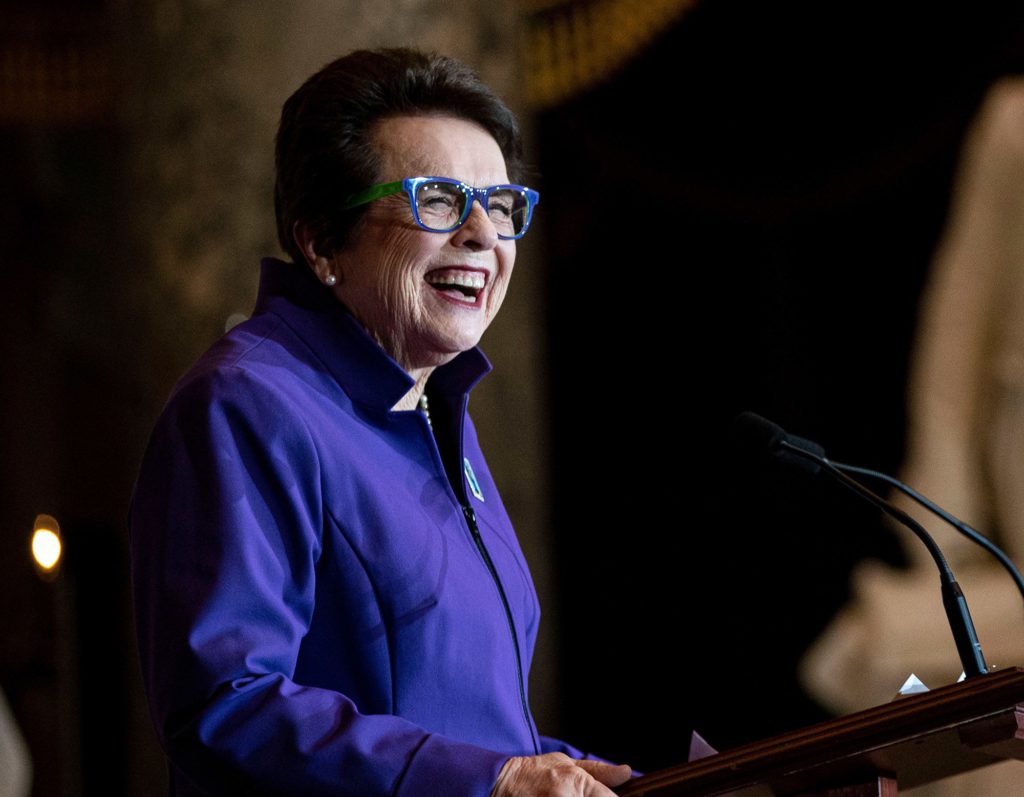
Billionaire Joe Tsai, Billie Jean King Back Just Women’s Sports

(Bloomberg) — Just Women’s Sports, a media platform, raised $6 million in a funding round led by Blue Pool Capital, the family office of billionaire Joe Tsai.

“The business case for women’s sports has never been clearer, and Just Women’s Sports is positioned to be the leading media platform in the space,” Tsai and his wife, Clara Wu Tsai, said in an emailed statement. Joe Tsai is co-founder of Alibaba Group Holding Ltd. and owner of the New York Liberty and Brooklyn Nets basketball teams.

Bolt Ventures, the family office of David Blitzer, investment firm SC Holdings, women’s tennis pioneer Billie Jean King, Washington Spirit owner Michele Kang, and sports NFT marketplace Dapper Labs also participated in the round, JWS founder and Chief Executive Officer Haley Rosen said in an interview. The startup is now valued at $36 million.

“Just Women’s Sports is building on the foundation of earlier pioneers by creating a media platform that celebrates and elevates the incredible athletes and stories in women’s sports,” King said in an emailed statement. “Haley and her team have the vision and talent necessary to usher in a new era in sports media.”

Other new investors include Allyson Felix, Abby Wambach, Sam Kerr, Lynn Williams, Paul Rabil and Apolo Ohno, Rosen said. Founded in 2020, the company earns the majority of its revenue from advertising and sponsorships from brands including Nike, Puma, Under Armour, Cisco, Heineken and Dick’s Sporting Goods. JWS is also beginning to drive revenue from merchandise sales, she said. 

“For women’s sports to be mainstream, we need to make it accessible,” Rosen said. “We want to make it possible to be a casual fan of women’s sports.”

JWS aims to to provide highlights, statistics and schedules for U.S. women’s basketball and soccer leagues, and bolster coverage of women’s tennis, golf softball, volleyball and surfing, among other sports, she said. The funding round provides resources to drive audience and revenue growth, build the brand and add staff, Rosen said.

Returning investors in JWS include Isaiah Kacyvenski’s Will Ventures; Kevin Durant and Rich Kleiman’s Thirty Five Ventures; and Drive by DraftKings, Rosen said. Earlier athlete investors include Kelley O’Hara, who hosts a JWS podcast. 

More stories like this are available on bloomberg.com

©2022 Bloomberg L.P.

‘Worst Over’ Call for China Tech Booms on Ant IPO Revival News

(Bloomberg) — A growing chorus of traders are saying that the bottom for China’s technology stocks may finally be here, bolstered by a report Thursday that China may allow Ant Group Co. to revive its initial public offering.

Chinese financial regulators have started early stage discussions on the listing, people familiar with the matter told Bloomberg.

READ: Alibaba Shares Jump as China Considers Reviving Ant Group IPO

Here’s what market participants are saying:

Global CIO Office (Gary Dugan)

  • “We were only saying a few days ago that if Ant was rehabilitated it would mark a major positive. This, in a sense, was where the trouble started”
  • “This would be sufficient” to mark the bottom
  • “If true, it would be very good news and a major potential turning point for the China tech sector and broader Chinese markets”
  • It would suggest a major shift of government policy that is pro markets

Bloomberg Intelligence (Marvin Chen)

  • It is a sign that regulators are following through on their pledge to end the crackdown on tech platforms, which will continue to improve sentiment on the sector
  • “Potential revival of the Ant IPO may also help support financial markets in the region as fund-raising activity has dried up this year”

Kamet Capital Partners (Kerry Goh)

  • “We now firmly believe that the worst is past us for China tech in particular from a regulatory point of view, but the impact from the economic slowdown, we don’t know yet”
  • The high frequency of positive news this week seems very coordinated and gives the clear signal that the regulatory stresses of the sector are over
  • The next thing China stock traders would like to see is the property-sector overhang removed for the economy

UOB Kay Hian (Steven Leung)

  • The report could be “big good news” to market
  • It “may be considered as the official end of regulatory risk” as the crackdown started with the freezing of Ant’s IPO

More stories like this are available on bloomberg.com

©2022 Bloomberg L.P.

Close Bitnami banner
Bitnami
