Bloomberg

ApeCoin Owners Vote Against Leaving the Ethereum Blockchain

(Bloomberg) — ApeCoin owners have decided to keep the token, which is expected to be key to snagging exclusive metaverse game items and deals, on the Ethereum blockchain despite its high transaction fees.

About 54% voted in favor of keeping the token on Ethereum, according to tracker Snapshot. Around 3.8 million tokens voted in favor of staying with 3.3 million against, Snapshot showed. A large chunk of the coins belongs to its creators including Andreessen Horowitz and Animoca Brands.

The debate over whether to stay on Ethereum was sparked when the network’s transaction fees spiked during the sale of virtual land called Otherdeeds in May. Buyers, some of whom were ApeCoin owners, ended up paying more in transaction fees than for the virtual land itself. Startup Yuga Labs, which helped facilitate the sale and is known for creating Bored Ape Yacht Club nonfungible tokens, said the ApeCoin community governing the token needs to consider creating its own chain. 

Read More: Buyers in the $320 Million ‘Otherdeeds’ NFT Sales Are Underwater

ApeCoin advanced about 2.2% after the vote to $5.86, according to CoinGecko pricing. The token remains 78% below its peak in late April. 

A number of crypto apps have swapped chains before, and even some decentralized exchanges including Uniswap that got started on Ethereum have expanded onto other networks. Startup Dapper Labs, for example, has created its own chain, Flow, for games and digital collectibles.

But the decision to move to another blockchain is not straightforward. 

“Migrating to a different chain is a costly, risky, and complex endeavor with many moving parts that may, if not thoughtfully considered, result in catastrophic loss, or at worst, abandonment by Yuga Labs and other entities” that are important to ApeCoin, according to the proposal the owners voted.

The vote in favor of staying on Ethereum doesn’t preclude ApeCoin owners from considering moving the token to a so-called Layer 2 blockchain which uses Ethereum as its backbone but offers lower transaction costs, the proposal said.

(Updates with ApeCoin price in fourth paragraph.)

More stories like this are available on bloomberg.com

©2022 Bloomberg L.P.

Expensive DeFi Hacks Are the Price of Doing Business in Crypto

  • Listen to Bloomberg Crypto  on the iHeartRadio App

  • Listen to Bloomberg Crypto  on Apple Podcasts

  • Listen to Bloomberg Crypto  on Spotify

    In March of 2022, hackers stole about $600 million from a crypto network. It was one of the biggest exploits of this asset class to date, and left many investors shaken. Can a decentralized financial system work if investors get spooked when significant assets are lost? This episode features a roundtable discussion with Bloomberg reporter Olga Kharif and Bloomberg opinion columnist Parmy Olson about the scope and the effect these attacks are having on the decentralized financial marketplace.

  •  


    Follow us on Twitter @crypto, and subscribe to the Bloomberg Crypto Newsletter at https://bloom.bg/cryptonewsletter


More stories like this are available on bloomberg.com

©2022 Bloomberg L.P.

Toomey Demands Answers From Kansas City Fed on Fintech’s Account

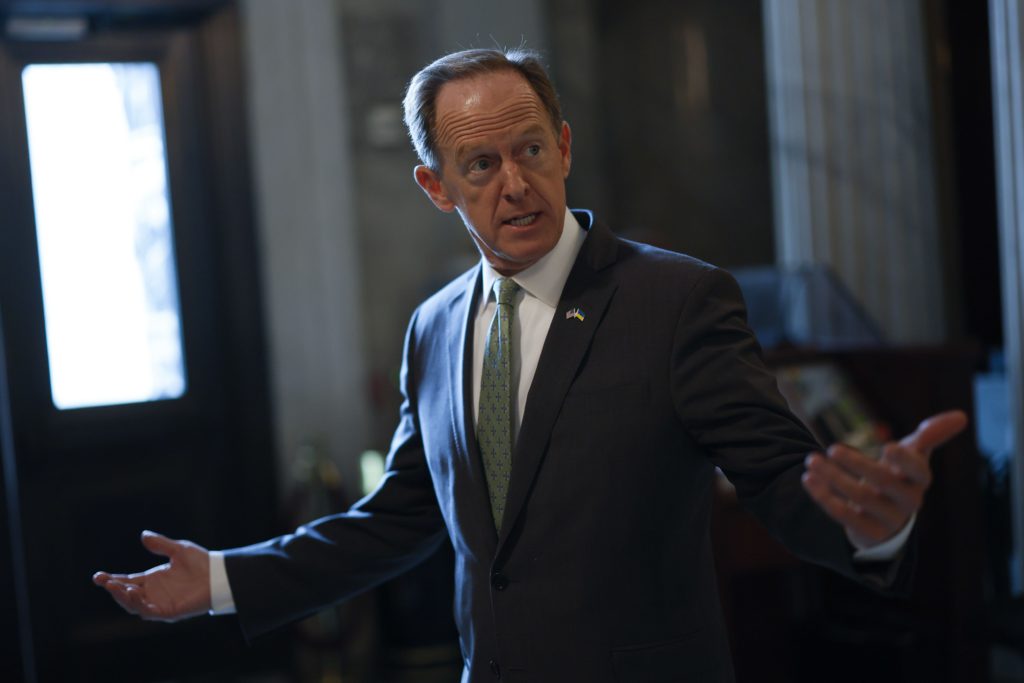
(Bloomberg) — Senator Pat Toomey, the top Republican on the Banking Committee, is demanding answers from the Federal Reserve Bank of Kansas City about the status of a Fed master account for Colorado fintech firm, Reserve Trust, which had figured in a recent confirmation controversy.

“It has been brought to my attention that the Kansas City Fed recently revoked Reserve Trust’s master account after determining, among other things, that the company is no longer eligible for one,” Toomey said in a letter obtained by Bloomberg News to Kansas City Fed President and CEO Esther L. George.

Toomey said he had been “stonewalled” when he sought details on why the company received its master account in 2018, when former Fed governor and former deputy Treasury Secretary Sarah Bloom Raskin was on its board, and asked for a briefing and documents regarding the bank’s actions.

The bank’s awarding of the master account — and Raskin’s inability to recall a role in seeking it — helped unite GOP opposition to her nomination to become the Fed vice chair for supervision earlier this year.

“It is critical that the Federal Reserve System be transparent with the public and Congress on all matters,” Toomey wrote. “That principle becomes even more important when serious concerns are raised that undermine the public’s faith that the Fed makes decisions when granting a public good to a private actor in a fair and consistent manner on behalf of the American people, rather than what might be best for well-connected operators.”

The firm had touted its master account and direct access to the Fed payments system as a way to enable business-to-business transactions that bypass traditional banks. But it has since scrubbed its website of any mention of the account, though it’s still listed in the company’s LinkedIn profile.

The company has not returned numerous calls and emails in recent weeks from Bloomberg News. A Bloomberg reporter found no one answering the door at a Reserve Trust office in Colorado on multiple business days.

Reserve Trust’s public website has shrunk to just two pages — a main page with a lengthy legal disclaimer and a privacy policy page. Google links to the company’s “about us” page and other pages now lead to error messages.

The Kansas City Fed had declined to comment on the status of Reserve Trust’s master account to Bloomberg News.

Other companies have been seeking Federal Reserve master accounts without success.

Read more: Crypto Bank Custodia Sues Fed For Access to Central Bank Funding

Reserve Trust announced a $30.5 million Series A investment round in 2021. “Reserve Trust’s unique trust structure allows customers to store funds in custody accounts that are backed by Reserve Trust’s Federal Reserve master account, and to transfer funds via ACH, FedWire, SWIFT, and other emerging payment systems,” the company said in announcing the investment in August.

Dennis Gingold, a lawyer and Raskin supporter who founded and previously chaired the company, said he and other board members, including Raskin, cashed out by selling their shares to QED Investors in December 2020. He said in an interview he and QED Investors had differed on the path of the company and he has no idea what is going on now. 

He said they were organized as a Colorado-chartered trust company, a kind of financial institution with robust consumer protections, not a fintech company, and during board meetings he told people not to call themselves a fintech.

“Obviously somebody didn’t like that instruction,” he said.

QED Investors of Alexandria, Virginia, didn’t respond to phone calls and emails requesting comment in recent weeks.

More stories like this are available on bloomberg.com

©2022 Bloomberg L.P.

China’s Appetite for Commodities Sapped by Virus, Surging Prices

(Bloomberg) — China’s appetite for many of its key commodities remained subdued in May as a cocktail of surging international prices and domestic virus restrictions, including the city-wide shutdown of Shanghai, sapped demand.

Coal and gas shipments continued to languish, according to customs data on Thursday, due to milder weather, and as a weaker economy and the impact of the war in Ukraine on energy markets dissuaded importers. Crude imports were a bright spot, rising to 45.8 million tons and the highest since January, although the figure may have been inflated by more oil arriving at discounted prices from origins like Russia, Iran and Venezuela. 

Coal imports dropped to 20.5 million tons, lower than both April and a year earlier, with shipments also affected by strong domestic production and price controls, as well as increased electricity generation from hydropower. Gas imports picked up from April to 9.1 million tons, but were still 12% lower on year.

For metals, copper imports stayed around the lows hit earlier in the year, while copper concentrate purchases hit a record of 2.19 million tons as domestic smelting capacity continued to expand. Iron ore shipments also improved, including from Australia’s main port for shipments, rebounding above 90 million tons for the first time since January as traders stocked up in anticipation of government infrastructure spending to arrest the slowdown in the economy.

On the export front, aluminum sales from the world’s biggest producer rose to a record of 677,000 tons, fueled by growing shortages outside China due to disruptions to supply caused by Russia’s invasion of its neighbor.

Among farm goods, soybean purchases hit an 11-month high of 9.67 million tons. Some of that demand may have been due to buyers replacing other oilseeds, as edible oil imports remained depressed amid a global spike in prices and export restrictions on palm oil from top supplier Indonesia. 

The broader trade figures showed a pick-up in both imports and exports, reflecting China’s success in bringing the outbreak under control, albeit at a bruising cost, which allowed for a partial recovery in operations at factories and the world’s largest port in Shanghai. 

Still, it’s a risky proposition to expect commodities demand to be back on track from June. The renewed lockdown of one district in Shanghai has raised concerns that a full reopening of the financial center could be delayed by a resurgence in cases, with China’s Covid Zero policy likely to act as a brake on trade flows for as long as it persists. 

Events Today

(All times Beijing unless shown otherwise.)

  • China to release May aggregate financing & money supply by June 15
  • China’s 1st batch of May trade data, incl. steel, aluminum & rare earth exports; steel, iron ore & copper imports; soybean, edible oil, rubber and meat & offal imports; oil, gas & coal imports; oil products imports & exports, from 11:00
  • China Photovoltaic Industry Association hosts webinar, 14:00
  • USDA weekly crop export sales, 08:30 EST

Today’s Chart

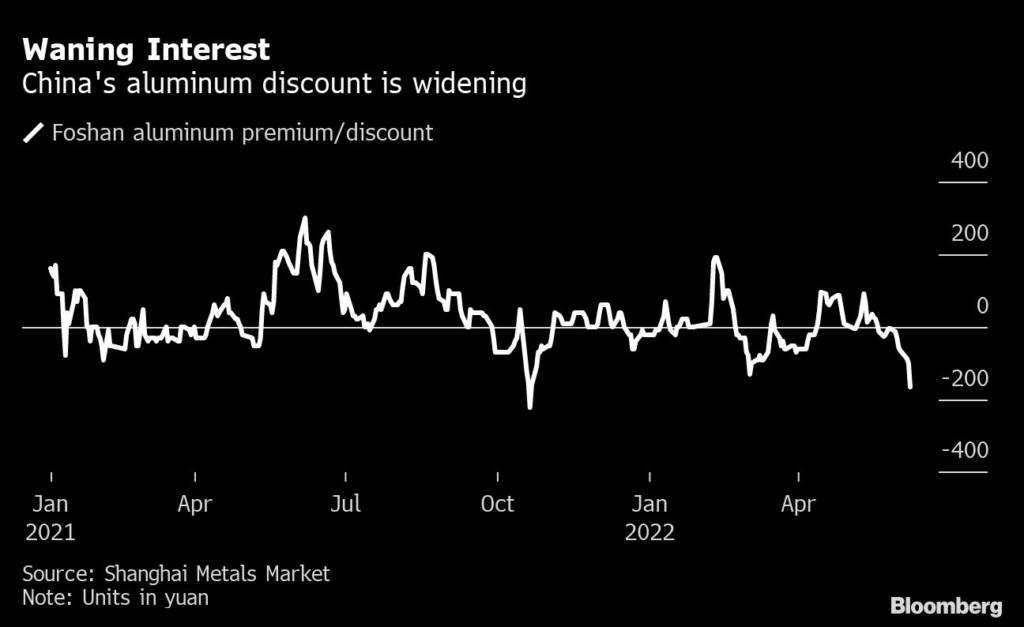
Claims that aluminum stockpiles have been over-pledged continue to hurt confidence in the market. Spot prices in Foshan city, where the allegations surfaced last week, are trading at the steepest discount to futures since October, according to Shanghai Metals Market, as buyers remain wary given the uncertainties around ownership of the metal.

On The Wire

China’s fertilizer exports from January to May tumbled to the lowest level in four years, signaling that supply constraints persist on the global market even as prices retreat from a record. 

China’s factory-gate inflation likely continued to slow in May due to a higher year-earlier base in commodity prices and the impact of lockdowns.

  • China’s Carbon Market Faces New Delays on Data Collection
  • Battery Giant CATL Denies Rumor of Poor Earnings on Futures Loss
  • Major Chinese Hog Breeder Reports Overdue Debt After Big Losses
  • China’s Xi Hears Efforts to Boost Grain Output Amid Food Worries
  • Shanghai’s Logistics Capacity Almost Recovered, Sec. News Says
  • China Property Market Has Not Bottomed Out Yet, Sec. Times Says
  • China’s Copper Output Slips as Aluminum Continues to Expand: SMM
  • IRON ORE FLOWS: Australian Exports Up 1.1% W/w to 17.9 Mln Tons
  • Sungrow Downgraded at Daiwa Over Risks on Vietnam Impairment
  • China Coal Demand’s Rebound May Not Boost CO2 Emissions in 2022
  • Russia-China 2021 Pipeline Gas Flows Jumped to 10.4Bcm: Gazprom
  • WAF CRUDE: Angolan Oil Sells Faster as China Buying Rises

The Week Ahead

Friday, June 10

  • China inflation data for May, 09:30
  • China weekly iron ore port stockpiles
  • Shanghai exchange weekly commodities inventory, ~15:30
  • China farm ministry’s monthly crop supply-demand report (CASDE)
  • USDA’s monthly world crop supply-demand report (WASDE), 12:00 EST

More stories like this are available on bloomberg.com

©2022 Bloomberg L.P.

Goldman-Backed Beauty Startup Becomes India’s Newest Unicorn

(Bloomberg) — Online cosmetics retailer Purplle raised capital at a $1.1 billion valuation, becoming the second billion-dollar company to be created in India this week despite souring investor sentiment on startups.

The Mumbai-based firm raised $33 million of Series E financing from South Korea’s Paramark Ventures as well as existing backers Blume Ventures, Kedaara and billionaire Azim Premji’s Premji Invest, the company said in a statement.

Backed by Goldman Sachs Group Inc., Purplle is a prominent rival of Nykaa, whose parent FSN E-Commerce Ventures Ltd. pulled off one of India’s most successful market debuts just before global investment conditions tanked. Nykaa is currently valued at $8.7 billion.

“Consumer products makers may be seeing inflationary pressures, but Purplle continues to clock 70% year-on-year volume growth,” co-founder Manish Taneja said in an interview, without specifying timeframes. “Innovation in the beauty market is digital-first.”

India now has over 100 unicorns. This week, edtech startup Physicswallah raised $100 million from backers including WestBridge Capital and GSV Ventures at a $1.1 billion valuation. 

Purplle, which has secured $215 million of total funding, will use the new capital to step up investments in technology, develop its private labels and strengthen its product.

Read more: Goldman-Backed Beauty Startup Raises Cash to Ride India Boom

Known formally as Manash Lifestyle Pvt, Purplle was set up in 2012 by Taneja, Rahul Dash and Suyash Katyayani, three engineers from the Indian Institute of Technology. It handled $180 million of gross merchandise value in the year ending March, offering 60,000 beauty and personal care products and accessories from over 1,000 brands on its website and app.

Niche players in beauty, fashion, grocery and other industries have experienced rapid online sales growth since the start of the pandemic. Purveyors of beauty products in particular have seen growth spike by targeting young consumers. The beauty and wellness category is under-served by brick-and-mortar retailers, leaving opportunities for internet-based startups like Purplle.

Purplle targets middle-class buyers from smaller Indian towns who look for value. Like Nykaa, it sells its own products under a private label. Indian consumers are increasingly taking to these newer, aggressively-priced brands, many of which tout chemical-free products. But the market is heating up with new competition emerging from players such as MyGlamm, backed by Amazon.com Inc.

(Updates with co-founder’s comment from the fourth paragraph)

More stories like this are available on bloomberg.com

©2022 Bloomberg L.P.

Silencing the ‘Noise’ Behind Bad Corporate Decision Making

(Bloomberg) — Much of the appeal of McDonald’s comes from the chain’s consistency. A cheeseburger in the US or a McSpicy Chicken in India should taste the same every time. But what if a business had wildly different outcomes depending on which leader was making decisions? Renowned psychologist Daniel Kahneman calls this variability “noise,” and suggests controlling it is key to ensuring the best decisions get made.

In this week’s episode of “Stephanomics,” host Stephanie Flanders interviews Kahneman, a best-selling author and professor emeritus at Princeton University, and Olivier Sibony, a professor of strategy at HEC Paris, about their new book, “Noise: A Flaw in Human Judgment.” (Their co-author is US legal scholar Cass Sunstein of Harvard Law School.) Kahneman and Sibony argue businesses often wrongly assume their decisionmakers will make similar judgments given similar circumstances. Kahneman relates an experiment he conducted with an insurance firm and dozens of its underwriters. It’s fair to predict underwriters would reach similar conclusions about a case’s risk and put a similar dollar value on it, right? Wrong. Kahneman found judgments often varied by 50%, or five times the divergence one would reasonably expect.

Silencing that noise often means adopting good decision “hygiene,” the authors said. Many job interviews start with employers having an initial impression and spending the rest of the interview justifying it. Instead, companies should use structured interviews with standard questions that might help disprove false impressions, Kahneman said. And while many firms use artificial intelligence to weed out job candidates, they’re likely doing themselves a disservice, Sibony said. Too often, the algorithms themselves are faulty, he said. “My worry is that companies are using this mostly to save time and money, not to actually improve the quality of their decisions,” Sibony said.

More stories like this are available on bloomberg.com

©2022 Bloomberg L.P.

Seoul Police Probe Allegation of Embezzlement by Terraform Staff

(Bloomberg) — Seoul police are investigating allegations that staff of Terraform Labs, the company behind the collapsed TerraUSD algorithmic stablecoin, embezzled Bitcoin holdings amassed to help defend the token’s peg to the dollar. 

The Seoul Metropolitan Police Agency is investigating a report about a “suspicious” crypto wallet that may have been used to embezzle Bitcoin, an official said by phone on Thursday. It wasn’t clear whether the wallet belonged to one or several employees, and the amount of Bitcoin possibly stolen isn’t yet known, the official said. 

TerraUSD crashed from its dollar peg in early May, rocking cryptocurrency markets and spawning efforts by governments around the world to more tightly regulate stablecoins. The token’s collapse, and the accompanying plunge in its sister coin Luna, wiped out some $40 billion of market value. Do Kwon, the entrepreneur behind Terraform Labs, is a South Korean native. 

Read more: Bitcoin’s Most-Watched Whale Is the King of the ‘Lunatics’

Terraform Labs didn’t immediately respond to en email seeking comment. 

The allegedly embezzled Bitcoin appears to have belonged to Luna Foundation Guard, the entity set up by Terraform Labs to maintain TerraUSD’s peg to the dollar, Yonhap News TV reported on Thursday, without citing anyone. 

LFG had amassed crypto reserves that at one point reached $3.5 billion to use as a backstop for defending the link. It held 80,394 Bitcoin as of May 7 — worth about $2.9 billion at the time — according to a tweet from the entity. As of May 16, that hoard had dwindled to 313 Bitcoin. 

Separately, South Korean prosecutors are investigating allegations that TerraUSD and Luna tokens were used in a Ponzi scheme, Yonhap News reported in late May. 

More stories like this are available on bloomberg.com

©2022 Bloomberg L.P.

China Sees an Exodus of South Korean Giants as Relations Wane

(Bloomberg) — China’s appeal as a gold mine for foreign businesses is waning, and while some multinationals ponder their future in the world’s biggest consumer market, one group of companies is already headed for the exit.

South Korean firms are at the vanguard of what’s threatening to be a global shift away from China, with the higher tariffs and inconveniences of the trade war now compounded by disruptions wrought by the country’s zero-tolerance approach to Covid-19.

Read more: US, European Firms Rethink China Investment After Lockdowns

Retail giant Lotte Group, known for its department stores and supermarkets, is in the final stages of shutting its China headquarters and is pivoting its focus to other Asian markets, a person familiar with the situation told Bloomberg News, asking not to be identified because they’re not authorized to speak publicly. 

Seoul-based cosmetics maker Amorepacific Group has closed more than 1,000 stores as the disruptions of the pandemic added to worsening consumer confidence in China, though it’s seeking to push more sales online.

Meanwhile, Korean manufacturing giants like Samsung Display Co. and LG Electronics Inc. are already selling off or shutting some factories in China, pressured by cheaper local rivals. They’ve also grappled with the uncertainty caused by China’s ongoing and intensive lockdowns.

“China is not a land of opportunity anymore for Korea,” said Scott Kim, who formerly worked as head of Shanghai and Beijing offices at Kotra, a unit under the Korean trade ministry. “China’s zero-Covid policy is too much, and Chinese companies are catching up with Korean companies. It would be better for Korean companies to abandon their fantasy about making money in China.” 

Is China ‘Uninvestable’ and What Does That Even Mean?: QuickTake

It’s a sea change for Korean companies that in recent decades had joined Western peers in betting much of their future growth on the giant pool of consumers across the Yellow Sea, helped by the cultural influence of Korean entertainment, makeup and fashion. China’s total retail sales reached 44 trillion yuan ($6.6 trillion) in 2021, including 402.6 billion yuan spent on cosmetics, according to government data.

But the seeds of the Korean retreat predate the virus curbs that are disrupting global supply chains and even the trade war, which triggered an initial rush by manufacturers to diversify their operations to places like Vietnam. South Korea and its companies landed in Beijing’s cross-hairs in 2017, when China channeled its anger at Seoul agreeing to host a US anti-missile system into consumer boycotts and bans. Korea’s close diplomatic ties to Washington are an ongoing source of tension with China.

Explaining Thaad, and Why It So Bothers China: QuickTake Q&A

About 86% of 131 South Korean companies surveyed by the Federation of Korean Industries said in December that business conditions in China had deteriorated over the past decade. Political risk was the biggest reason, followed by discrimination against foreign companies, US-China trade conflicts, stricter environmental regulations and higher production costs. 

About 80% of the 108 firms that have moved back to South Korea since 2014 had quit China, according to Korea’s Ministry of Trade, Industry and Energy. 

And once they exit, they aren’t likely to return to China with new investments, said Han Jong-Hoon, deputy general manager at the Federation of Korean Industries.

No Korean company encapsulates the country’s difficulties in China quite like Lotte. The retail conglomerate’s aggressive expansion in the nation since 2008 hit a snag in 2017 when it agreed to provide land to the South Korean government to house the US missile defense system known as Thaad. The backlash from China, which saw the system as a threat, was swift and Lotte’s business there never recovered.

A Lotte company representative declined to comment on its operating outlook in China. 

Amorepacific earned 208 billion won ($165 million) in China in 2016, its biggest market outside of Korea, before the missile-system scandal hurt demand for Korean goods in China and stanched Chinese travel to Korean duty-free shops. The company is now expanding into the US and Southeast Asia, and shifting its focus to online sales and premium brands like Sulwhasoo.

Meanwhile, with President Joe Biden wanting to make the US a center for electric vehicle production and supply chains, Hyundai Motor Group is increasing its planned investment in America to more than $10 billion by 2025, and Samsung Electronics Co. is building an advanced chip plant at its sprawling $17 billion complex in Austin, Texas.

It’s near-impossible for Korea’s corporations or those from any other country to completely break their reliance on China. About 80% of Korea’s 228 most-needed import goods, including raw materials like graphite used in EV batteries, an industry Korea is trying to dominate, come from China, according to Namsuk Choi, an international trade studies professor at Jeonbuk National University. 

Still, the Korean government is trying to help reduce companies’ reliance on China. They launched a task force to help private companies diversify their sources of key raw materials, particularly inputs for semiconductors, batteries, petrochemicals and automobiles, according to the Korea International Trade Association. Companies are also making their own efforts, with LG Energy Solution Ltd. signing an agreement with Chilean giant SQM to provide an alternative source of lithium. 

For some companies, moves in China are more about streamlining than a complete exit. Samsung SDI Co. closed two battery-pack plants last year to focus on its battery cell business. Samsung Display sold its LCD plant to a Chinese company in 2020 but will continue run two factories that make modules for OLED panels. LG Electronics Inc. shut two units in China last year, though still runs 16 units.

For businessmen like Park Sang-Min, who’ve bet their careers on the China opportunity, uncertainty reigns.

“I don’t know what to do — I still can’t decide whether I need to stay here or pack everything and go back to South Korea,” said Park Sang-Min, a 49-year-old Korean businessman who runs a marketing and online platform business in China, where he has lived for two decades. “The ‘China risk’ is unpredictable.”

(Updates to add details on Korean companies returning home in 10th paragraph.)

More stories like this are available on bloomberg.com

©2022 Bloomberg L.P.

European Chip Stocks Crumble as Investors Fast Forward to 2023

(Bloomberg) — European semiconductor stocks have gotten swept up in the sell-everything-tech environment even as the industry enjoys red-hot demand that’s bolstering this year’s earnings, because investors are already looking ahead to a tougher 2023.

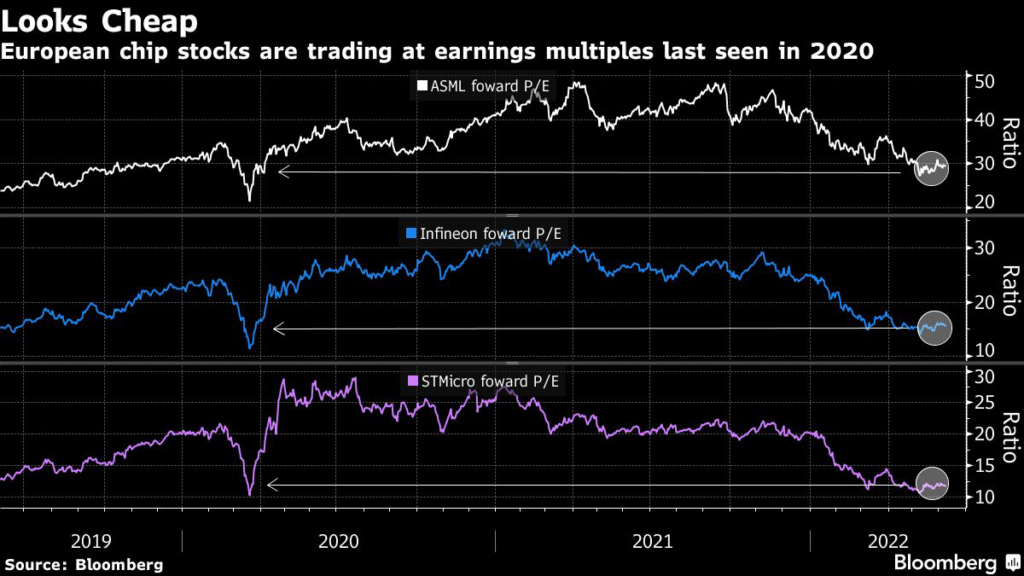
The region’s biggest chip-related companies, ASML Holding NV and Infineon Technologies AG, have lost a quarter of their value this year and are trading at their lowest earnings multiples since before the pandemic. The eight chip companies in the Stoxx Europe 600 Index have had an average share-price decline of 26% this year, Bloomberg data shows. 

Analysts expect earnings for the eight semiconductor stocks to rise on average by 41% this year, faster than the 39% predicted at the start of 2022, according to a Bloomberg calculation. The rising estimates are a result of resilient demand and the sector’s ability to command higher prices amid a global chip shortage.

“The truth is investors at the moment don’t care about the reported numbers,” said Neil Campling, head of tech, media and telecom research at Mirabaud Securities. “There is an expectation that when we get to later this year, there is going to be risk on the demand side.” 

Like the rest of tech, the shares have been hurt because the fastest inflation in decades is triggering a global cycle of higher interest rates. That has hit first and foremost the high-growth, high-multiple tech companies, in software and consumer services. But the stock selloff is also affecting the more cyclical chip business, on the view that demand for industrial and consumer goods will suffer as rising rates threaten to tip the economy into a recession. 

For now, none of the industry’s typical warning bells — a decline in orders, an oversupply in chips and a drop in sales — are ringing. 

In fact, first-quarter revenue at STMicroelectronics NV, which gets more than a third of its revenue from the auto industry, topped analyst expectations. Infineon, another maker of auto and industrial chips, raised its full-year sales outlook. And Taiwan Semiconductor Manufacturing Co., the industry bellwether, projected sales growth to accelerate this year despite macroeconomic uncertainties.

Beyond those stellar headline figures, though, the semiconductor shortage is easing and stockpiles are rising at companies in the US and Europe, usually a sign of impending doom for the industry. Global smartphone shipments posted their biggest drop since the Covid outbreak, bad news for manufacturers of chips that go into these handsets. Another bad omen: Intel Corp., the largest maker of computer processors, said Wednesday that a weaker economy will affect demand and hurt financial performance.

Shares of some European chipmakers look like bargains now. Infineon trades at 16 times estimated earnings for the next year while STMicro is priced at less than 12 times profit, in both cases about a third cheaper than their five-year averages. And consensus estimates for their fiscal 2022 earnings have marched steadily higher.

But the question is how reliable those forecasts are, given the various headwinds the industry will potentially face this year and next.

Almost every semiconductor company in the first quarter pushed back against the idea that a downturn is coming, said Richard Windsor, founder of independent researcher Radio Free Mobile, making him doubt if the market has priced in risks of the next chip glut “at all.” He expects an industry decline between the fourth quarter and the first quarter of 2023.

Equipment suppliers ASML and ASM International NV may turn out to be more insulated when the industry swings from boom to bust, according to Keagan Bryce-Borthwick, an analyst at Barclays Plc. With major customers from Intel to TSMC sticking to their long-term investment plans, “there’s very little downside risks to estimates,” he said.

But for the chip sector as a whole, “we don’t have a good view yet necessarily of what the trough of the cycle looks like,” Bryce-Borthwick said. “There is just a great sense of hesitation.”

More stories like this are available on bloomberg.com

©2022 Bloomberg L.P.
$12 Billion UAE IPO Rush: Fertiglobe Tops in Returns, DEWA Lags

(Bloomberg) —

Another week, another IPO in Dubai and Abu Dhabi. State-owned Dubai Holding on Wednesday announced plans to sell shares in business park operator Tecom Group starting June 16.

Here are Abu Dhabi and Dubai IPOs in the past 12 months, which raised a combined $11.9 billion, and how the shares performed since their listing.

Fertiglobe in Abu Dhabi gave investors the highest return, while Al Yah Satellite went below its IPO price. Dubai Electricity & Water Authority, which surged 20% on its trading debut, trimmed the gains and is up 2.8% since its listing in April.

Al Yah Satellite Communications (July 2021)

  • IPO price: 2.75 dirhams
  • Highest trading price: 3.10 dirhams
  • Last traded: 2.65 dirhams

Adnoc Drilling (October 2021)

  • IPO price: 2.30 dirhams
  • Highest trading price: 3.92 dirhams
  • Last traded: 3.33 dirhams

Fertiglobe (October 2021)

  • IPO price: 2.55 dirhams
  • Highest traded price: 5.95 dirhams
  • Last traded: 5.47 dirhams

Abu Dhabi Ports (February 2022)

  • IPO price: 3.20 dirhams
  • Highest trading price: 5.85 dirhams
  • Last traded: 5.10 dirhams

Dubai Electricity & Water Authority (April 2022)

  • IPO price: 2.48 dirhams
  • High: 3.05 dirhams
  • Last traded: 2.55 dirhams

ADC Acquisition – SPAC (May 2022)

  • IPO price: 10 dirhams
  • High: 15.9 dirhams
  • Last traded: 12.90 dirhams

Borouge (June 2022)

  • IPO price: 2.45 dirhams
  • High: 3.27 dirhams
  • Last traded: 3.11 dirhams

Read more: Middle East IPOs on Track for Best Ever First Half as Oil Surges

More stories like this are available on bloomberg.com

©2022 Bloomberg L.P.
Close Bitnami banner
Bitnami