Bloomberg

World’s Biggest EV Battery Maker CATL Denies Rumor of Poor Earnings on Futures Loss

(Bloomberg) — Contemporary Amperex Technology Co. Ltd., the world’s biggest maker of batteries for electric cars, has hit back at market rumors of a large futures loss that may have dented its second-quarter earnings.

“Our company’s hedging business is backed by spot trading,” Ningde, Fujian-based CATL, as the company is better known, said in a response to online questions from investors.

“Fluctuation in earnings or losses from futures trading is hedged correspondingly with spot cargo, and hence that will have relatively small impact on the company’s results.”

Shares in CATL slumped as much as 5.2% Thursday morning. The Shenzhen-traded stock is down around 26% this year.

CATL in May posted its sharpest-ever drop in quarterly earnings for the first quarter, and disclosed a sizable derivatives liability.

Net income slid 24% to 1.49 billion yuan ($222 million) for the three months through March, while underlying profit dropped 41% to 977 million yuan. CATL’s 1.79 billion yuan derivatives liability was its first such charge since listing, and it didn’t explain the origins of it to investors.

Read more: BYD May Sell Batteries to Tesla, Executive Tells State Media

The Chinese battery giant has been grappling with higher input costs and has used its dominance in the market to help pass on some of those rising costs to customers including Tesla Inc., Nio Inc. and Xpeng Inc.

CATL’s recent share-price weakness may also be related to reports earlier this week that Chinese rival BYD Co. is planning to sell its batteries to Tesla, CATL’s biggest customer.

“We are good friends with Elon Musk and we are preparing to supply batteries to Tesla,” BYD’s executive vice president Lian Yu-bo said in the short video clip with state television broadcaster CGTN, released Wednesday. Musk is Tesla’s chief executive officer.

BYD, which is aiming to become more directly involved in the mining of lithium, the raw material that’s crucial for EV batteries, pledged earlier this year to stop producing cars entirely powered by fossil fuels.

CATL’s Thursday morning response came after rumors online and in local Chinese media that the company may post poor results for the second quarter because it plans to realize over 1 billion yuan in losses from futures trading in the first quarter.

“The above-mentioned rumor is not true,” CATL said.

The company is scheduled to release its second-quarter earnings on Aug. 25.

(Adds detail on BYD news from 8th paragraph.)

More stories like this are available on bloomberg.com

©2022 Bloomberg L.P.

Dollar Squeeze, Accelerating Inflation Pummel Ethiopian Currency

(Bloomberg) — Surging inflation and a shortage of hard currency in Ethiopia are driving up the price of US dollars on the black market and spurring increased use of cryptocurrencies.

The birr traded at 82 per dollar on the informal market on June 6, down 26% since the start of last month, according to two traders in the capital, Addis Ababa, who asked not to be identified for fear of reprisals by the authorities. The Ethiopian currency’s official rate is currently 52 birr per dollar. 

The central bank this week said it’s detected a rise in the use of cryptocurrencies and other virtual assets, some of which “are being used for illicit financial flows and money laundering.” 

Read more: Africa Faces Unrest as Thumping Food Prices Hit It Hardest 

A shift away from formal currency trading channels undermines the National Bank of Ethiopia’s “ability to conduct monetary policy and retain its traditionally tight control of the foreign-exchange market,” said Connor Vasey, an associate at Eurasia Group. “It would also worsen dollar illiquidity issues, which have always been pervasive,” because the government has tightly controlled the market, he said. 

Consumer prices rose an annual 37% in April, mainly driven by soaring food and fuel costs, latest available data from the Central Statistics Agency show, and costs have continued to rise as Russia’s war with Ukraine grinds on. The government has made spending cuts to try to counter price pressures and reduced foreign-exchange allocations to the private sector, forcing increased numbers of importers to tap the informal market. 

A civil war that broke out in late 2020 and cost Ethiopia donor support and its duty-free access to US markets has added to pressure on the currency, as have supply-chain disruptions stemming from the coronavirus pandemic and a devastating drought.

Read more: The Misery Behind the Truce in Ethiopia’s Civil War: QuickTake

The foreign-currency squeeze is translating into a shortage of products such as cooking oil, and stock-outs are expected to worsen as businesses hoard dollars in anticipation of it becoming ever more difficult to import, according to Irmgard Erasmus, an economist at Oxford Economics Africa. She warned that maintaining an artificially high birr exchange rate will undermine the competitiveness of Ethiopian exports.  

Eurasia’s Vassey said the government itself should be able to “muddle through” foreign exchange shortages by ensuring it has enough hard currency to meet its own needs, but its market interventions will be at the expense of the private sector and the longer they persist, the greater the damage to the economy. 

“The government could accelerate the controlled depreciation of the birr but the immediate effect would be an inflationary spike,” he said. “Tight control of the foreign exchange market and a closed capital account are both key pillars of Ethiopia’s traditional coping mechanisms. For now the government’s options are limited and it looks as though it will just need to ride out the current storm with the tools it has.”

More stories like this are available on bloomberg.com

©2022 Bloomberg L.P.

Paul Allen’s Institute Helps South Africa Thwart Locust Swarms

(Bloomberg) — South Africa is bracing for a repeat of last season’s locust swarms, the worst in decades, and is banking on a tracking technology backed by the institute of Microsoft Corp.’s late co-founder, Paul Allen, to tackle the infestation. 

Agri Eastern Cape, which represents farmers in the coastal province, started using the Allen Institute for AI’s Earth Ranger system in April to pinpoint where swarms will erupt in September and October, according to Jason Kümm, manager of rural safety and communications, at the organization.

“Things are quietening down but these locusts have laid eggs,” he said in an interview. “Earth Ranger has allowed us to understand where this has taken place. When conditions are right and these eggs hatch, we will have the resources in place.

” 

Swarms that spread across the Eastern Cape and neighboring provinces in the summer growing season were as big as 10,000 hectares (24,711 acres) in some cases and the infestation rivaled those seen in 1935 and 1983. 

The locusts razed pastures used to feed livestock across large parts of the region, including in areas that were recovering from eight-year droughts. The heaviest rains since records began in 1921 in many districts allowed the insects to multiply rapidly. While citrus-growing areas were infested, the locusts didn’t cause significant damage to fruit trees. 

The area is also home to dairy farms and sheep and angora goats, whose hair is used in mohair garments.

“This is one of the biggest we have experienced in history,” said Gunther Pretorius, manager for economics and natural resources at Agri Eastern Cape. 

Earth Ranger allows farmers to call in reports of swarms, and whether the locusts are at a juvenile hopping stage or already airborne. Those are then logged and tracked on the system, allowing for more efficient allocation of pesticides and resources. They can also decide whether ground teams or aircraft are needed to tackle the insects. 

Offered as a free service, the tracking system was developed in 2015 and was first used to measure the size of Africa’s savanna elephant population by assessing data from aerial surveys.

More stories like this are available on bloomberg.com

©2022 Bloomberg L.P.

Alibaba Sued in US Over Man’s Death From Fire Caused by Printer

(Bloomberg) — Alibaba Group Holding Ltd. was sued by the parents of a San Francisco man who died when a 3D printer he bought from the retailer’s US portal caught fire in 2020.

Calvin Yu’s parents fault the giant online retailer for selling a printer that they said it knew, or should have known, was defective. They also sued the makers of the pinter, the Chinese electronic firm Tronxy Technology Co.

Customers are increasingly attempting to hold online marketplaces responsible for the goods sold through their sites, even by third-party sellers. Amazon.com Inc. has faced dozens of product-liability claims in recent years from people harmed by products sold through its site.

Read more: Amazon to Pay Up to $1,000 For Injuries Caused by Sellers’ Goods

Amazon instituted a new policy in September, saying it would pay shoppers for injury or property claims of less than $1,000, and in some cases more than that, even as it argued in court that’s it’s not liable.

Yu bought the printer in November 2019 from Alibaba’s US portal, AliExpress, the parents said in the lawsuit, filed Tuesday in state court in San Francisco. He used the printer as intended at home, they said.

Fire investigators “concluded that the fire was caused by the above-mentioned 3D printer, overheating and igniting the couch,” the parents said. Yu was found dead in the apartment.

The case is Yu v. Alibaba Group U.S. Inc., CGC22600050, California Superior Court (San Francisco)

More stories like this are available on bloomberg.com

©2022 Bloomberg L.P.

Musk’s Twitter Bid Leans on Financier Linked to Russian Tycoon

(Bloomberg) — Elon Musk’s bid for Twitter Inc., which has been upended by the billionaire’s threat to walk away, attracted a bevy of big-name backers and Silicon Valley mainstays. There were some notable exceptions.

High on that list is a Dubai-based investment firm whose assets have surged to more than $5 billion under its secretive founder Alexander Tamas, according to regulatory filings and people familiar with the matter. Vy Capital — whose main website consists of one page, with no address and no contact details — has committed $700 million to finance Musk’s bid for the social network, making it the third-biggest outside equity investor in the deal that’s drawn money from billionaire Larry Ellison and Sequoia Capital, securities filings show.

The ability of Vy to help finance one of the largest leveraged buyouts in history — if it goes ahead despite a dispute over fake accounts — is noteworthy for a firm with few public records showing its funding sources or the nature of its investments. Vy, whose equity commitment to the $44 billion deal topped those by Brookfield Asset Management and Qatar, has also backed companies such as Musk’s Boring Co. and crypto exchange ErisX, according to PitchBook data. 

Tamas has a history of connecting himself to big-name investors. Before setting up Vy, he worked closely with Russian-Israeli billionaire Yuri Milner and now appears to be cultivating links to Musk. He’s also put money into the Tesla Inc. boss’s rocket company SpaceX and brain-machine maker Neuralink Corp. And according to LinkedIn, one of Vy’s summer analysts is currently Benjamin Birchall, a son of Musk’s key aide Jared Birchall. 

A representative for Tamas declined to comment. During a recent visit to the firm’s office in Dubai, only an assistant was present. She said the rest of the staff — about 10 in the emirate including Tamas — work remotely. Worldwide some 25 people are employed for the firm, according to LinkedIn. 

A 2020 document from blank-check company Vy Global Growth said that Vy has more than $2 billion in assets under management. Those assets have since more than doubled and consist of a limited number of funds with about $1 billion in money to deploy, according to people familiar with the firm’s operations. Backers include large American endowments, said the people, asking not to be identified because the details are private.

A Twitter account for Tamas has existed since March 2009. It has the same picture as his LinkedIn profile and a banner image showing Lego figures of Star Wars Stormtroopers, but no posts. The account liked an April 21 tweet from Musk that called on the social-media platform to authenticate “all real humans” as part of the bot dispute. 

While Tamas might be obscure, his connections are not. 

After working on technology deals for Goldman Sachs Group Inc. in London, the German national joined Milner’s investment firm DST Global as a partner in 2008, where he led lucrative bets on companies including Airbnb Inc., Facebook before it became Meta Platforms Inc., as well as an early investment in Twitter. 

Before Goldman, he was a founding member of Arma Partners, which provides corporate-finance advice to companies and investors in the tech sector. 

‘Human Supercomputer’

Tamas and former Goldman colleague Mateusz Szeszkowski set up Vy in 2013 with a vision to “invest in some of the world’s leading companies and own them for decades,” according to a regulatory document. 

He now runs the fund with John Hering, founder of cloud-software company Lookout Inc., who doesn’t mention Vy on his LinkedIn profile. Tamas and Hering have the biggest individual holdings in Vy Global Growth, according to a securities filing. One of the other investors is Javier Olivan, who will become Meta’s chief operating officer this fall.

The company’s public assets have included holdings in Canadian e-commerce platform Shopify Inc., audience tracker ComScore Inc., online lender LendingClub Corp. and gamemaker Activision Blizzard Inc., according to regulatory filings. It appears the holdings were wound down by 2018. The firm has also backed private technology companies like Blockchain.com and Reddit Inc. 

His expertise and investment acumen prompted venture capitalists Ben Horowitz and Marc Andreessen to dub him “Milner’s human supercomputer.” Dubai’s ruler Sheikh Mohammed bin Rashid Al Maktoum appointed Tamas to an advisory council focused on the digital economy.

Free-Speech Advocate

Tamas is currently based in Europe, and when he’s in Dubai, he partially runs Vy from a palatial mansion in the Al Barari neighborhood, a secluded suburb with luxury homes, the people said. The firm also has an office in the San Francisco Bay area.

Aside from his investment activities, Tamas founded data-science company Synaptic and supported artificial intelligence research at the University of Oxford’s Future of Humanity Institute. He also seems to share Musk’s interest in promoting free speech. 

“What I think is misguided is the idea that our social media platforms should govern what we can and cannot see,” said Tamas in a 2019 interview with the Berggruen Institute, adding that allowing private companies to determine what is acceptable free speech “would actually be dangerous.”

More stories like this are available on bloomberg.com

©2022 Bloomberg L.P.

Musk’s Twitter Bid Includes Financier Linked to Russian Tycoon

(Bloomberg) — Elon Musk’s bid for Twitter Inc., which has been upended by the billionaire’s threat to walk away, attracted a bevy of big-name backers and Silicon Valley mainstays. There were some notable exceptions.

High on that list is a Dubai-based investment firm whose assets have surged to more than $5 billion under its secretive founder Alexander Tamas, according to regulatory filings and people familiar with the matter. Vy Capital — whose main website consists of one page, with no address and no contact details — has committed $700 million to finance Musk’s bid for the social network, making it the third-biggest outside equity investor in the deal that’s drawn money from billionaire Larry Ellison and Sequoia Capital, securities filings show.

The ability of Vy to help finance one of the largest leveraged buyouts in history — if it goes ahead despite a dispute over fake accounts — is noteworthy for a firm with few public records showing its funding sources or the nature of its investments. Vy, whose equity commitment to the $44 billion deal topped those by Brookfield Asset Management and Qatar, has also backed companies such as Musk’s Boring Co. and crypto exchange ErisX, according to PitchBook data.

Tamas has a history of connecting himself to big-name investors. Before setting up Vy, he worked closely with Russian-Israeli billionaire Yuri Milner and now appears to be cultivating links to Musk. He’s also put money into the Tesla Inc. boss’s rocket company SpaceX and brain-machine maker Neuralink Corp. And according to LinkedIn, one of Vy’s summer analysts is currently Benjamin Birchall, a son of Musk’s key aide Jared Birchall. 

A representative for Tamas declined to comment. During a recent visit to the firm’s office in Dubai, only an assistant was present. She said the rest of the staff — about 10 in the emirate including Tamas — work remotely. Worldwide some 25 people are employed for the firm, according to LinkedIn. 

A 2020 document from blank-check company Vy Global Growth said that Vy has more than $2 billion in assets under management. Those assets have since more than doubled and consist of a limited number of funds with about $1 billion in money to deploy, according to people familiar with the firm’s operations. Backers include large American endowments, said the people, asking not to be identified because the details are private.

A Twitter account for Tamas has existed since March 2009. It has the same picture as his LinkedIn profile and a banner image showing Lego figures of Star Wars Stormtroopers, but no posts. The account liked an April 21 tweet from Musk that called on the social-media platform to authenticate “all real humans” as part of the bot dispute. 

While Tamas might be obscure, his connections are not. 

After working on technology deals for Goldman Sachs Group Inc. in London, the German national joined Milner’s investment firm DST Global as a partner in 2008, where he led lucrative bets on companies including Airbnb Inc., Facebook before it became Meta Platforms Inc., as well as an early investment in Twitter. 

Before Goldman, he was a founding member of Arma Partners, which provides corporate-finance advice to companies and investors in the tech sector. 

‘Human Supercomputer’

Tamas and former Goldman colleague Mateusz Szeszkowski set up Vy in 2013 with a vision to “invest in some of the world’s leading companies and own them for decades,” according to a regulatory document. 

He now runs the fund with John Hering, founder of cloud-software company Lookout Inc., who doesn’t mention Vy on his LinkedIn profile. Tamas and Hering have the biggest individual holdings in Vy Global Growth, according to a securities filing. One of the other investors is Javier Olivan, who will become Meta’s chief operating officer this fall.

The company’s public assets have included holdings in Canadian e-commerce platform Shopify Inc., audience tracker ComScore Inc., online lender LendingClub Corp. and gamemaker Activision Blizzard Inc., according to regulatory filings. It appears the holdings were wound down by 2018. The firm has also backed private technology companies like Blockchain.com and Reddit Inc. 

His expertise and investment acumen prompted venture capitalists Ben Horowitz and Marc Andreessen to dub him “Milner’s human supercomputer.” Dubai’s ruler Sheikh Mohammed bin Rashid Al Maktoum appointed Tamas to an advisory council focused on the digital economy.

Free-Speech Advocate

Tamas is currently based in Europe, and when he’s in Dubai, he partially runs Vy from a palatial mansion in the Al Barari neighborhood, a secluded suburb with luxury homes, the people said. The firm also has an office in the San Francisco Bay area.

Aside from his investment activities, Tamas founded data-science company Synaptic and supported artificial intelligence research at the University of Oxford’s Future of Humanity Institute. He also seems to share Musk’s interest in promoting free speech. 

“What I think is misguided is the idea that our social media platforms should govern what we can and cannot see,” said Tamas in a 2019 interview with the Berggruen Institute, adding that allowing private companies to determine what is acceptable free speech “would actually be dangerous.”

More stories like this are available on bloomberg.com

©2022 Bloomberg L.P.

Musk Twitter Bid Counts Secretive $5 Billion Fund Among Backers

(Bloomberg) — Elon Musk’s bid for Twitter Inc., which has been upended by the billionaire’s threat to walk away, attracted a bevy of big-name backers and Silicon Valley mainstays. There were some notable exceptions.

High on that list is a Dubai-based investment firm whose assets have surged to more than $5 billion under its secretive founder Alexander Tamas, according to regulatory filings and people familiar with the matter. Vy Capital — whose main website consists of one page, with no address and no contact details — has committed $700 million to finance Musk’s bid for the social network, making it the third-biggest outside equity investor in the deal that’s drawn money from billionaire Larry Ellison and Sequoia Capital, securities filings show.

The ability of Vy to help finance one of the largest leveraged buyouts in history — if it goes ahead despite a dispute over fake accounts — is noteworthy for a firm with few public records showing its funding sources or the nature of its investments. Vy, whose equity commitment to the $44 billion deal topped those by Brookfield Asset Management and Qatar, has also backed companies such as Musk’s Boring Co. and crypto exchange ErisX, according to PitchBook data.

Tamas has a history of connecting himself to big-name investors. Before setting up Vy, he worked closely with Russian-Israeli billionaire Yuri Milner and now appears to be cultivating links to Musk. He’s also put money into the Tesla Inc. boss’s rocket company SpaceX and brain-machine maker Neuralink Corp. And according to LinkedIn, one of Vy’s summer analysts is currently Benjamin Birchall, a son of Musk’s key aide Jared Birchall. 

A representative for Tamas declined to comment. During a recent visit to the firm’s office in Dubai, only an assistant was present. She said the rest of the staff — about 10 in the emirate including Tamas — work remotely. Worldwide some 25 people are employed for the firm, according to LinkedIn. 

A 2020 document from blank-check company Vy Global Growth said that Vy has more than $2 billion in assets under management. Those assets have since more than doubled and consist of a limited number of funds with about $1 billion in money to deploy, according to people familiar with the firm’s operations. Backers include large American endowments, said the people, asking not to be identified because the details are private.

A Twitter account for Tamas has existed since March 2009. It has the same picture as his LinkedIn profile and a banner image showing Lego figures of Star Wars Stormtroopers, but no posts. The account liked an April 21 tweet from Musk that called on the social-media platform to authenticate “all real humans” as part of the bot dispute. 

While Tamas might be obscure, his connections are not. 

After working on technology deals for Goldman Sachs Group Inc. in London, the German national joined Milner’s investment firm DST Global as a partner in 2008, where he led lucrative bets on companies including Airbnb Inc., Facebook before it became Meta Platforms Inc., as well as an early investment in Twitter. 

Before Goldman, he was a founding member of Arma Partners, which provides corporate-finance advice to companies and investors in the tech sector. 

‘Human Supercomputer’

Tamas and former Goldman colleague Mateusz Szeszkowski set up Vy in 2013 with a vision to “invest in some of the world’s leading companies and own them for decades,” according to a regulatory document. 

He now runs the fund with John Hering, founder of cloud-software company Lookout Inc., who doesn’t mention Vy on his LinkedIn profile. Tamas and Hering have the biggest individual holdings in Vy Global Growth, according to a securities filing. One of the other investors is Javier Olivan, who will become Meta’s chief operating officer this fall.

The company’s public assets have included holdings in Canadian e-commerce platform Shopify Inc., audience tracker ComScore Inc., online lender LendingClub Corp. and gamemaker Activision Blizzard Inc., according to regulatory filings. It appears the holdings were wound down by 2018. The firm has also backed private technology companies like Blockchain.com and Reddit Inc. 

His expertise and investment acumen prompted venture capitalists Ben Horowitz and Marc Andreessen to dub him “Milner’s human supercomputer.” Dubai’s ruler Sheikh Mohammed bin Rashid Al Maktoum appointed Tamas to an advisory council focused on the digital economy.

Free-Speech Advocate

Tamas is currently based in Europe, and when he’s in Dubai, he partially runs Vy from a palatial mansion in the Al Barari neighborhood, a secluded suburb with luxury homes, the people said. The firm also has an office in the San Francisco Bay area.

Aside from his investment activities, Tamas founded data-science company Synaptic and supported artificial intelligence research at the University of Oxford’s Future of Humanity Institute. He also seems to share Musk’s interest in promoting free speech. 

“What I think is misguided is the idea that our social media platforms should govern what we can and cannot see,” said Tamas in a 2019 interview with the Berggruen Institute, adding that allowing private companies to determine what is acceptable free speech “would actually be dangerous.”

More stories like this are available on bloomberg.com

©2022 Bloomberg L.P.

Expedia CEO Doesn’t See High Prices Stopping Summer Travel

(Bloomberg) — Travelers are ready to pack their suitcases and get on airplanes in the coming months even with disruptions due to labor shortages and higher inflation, Expedia Group Inc. Chief Executive Officer Peter Kern said.

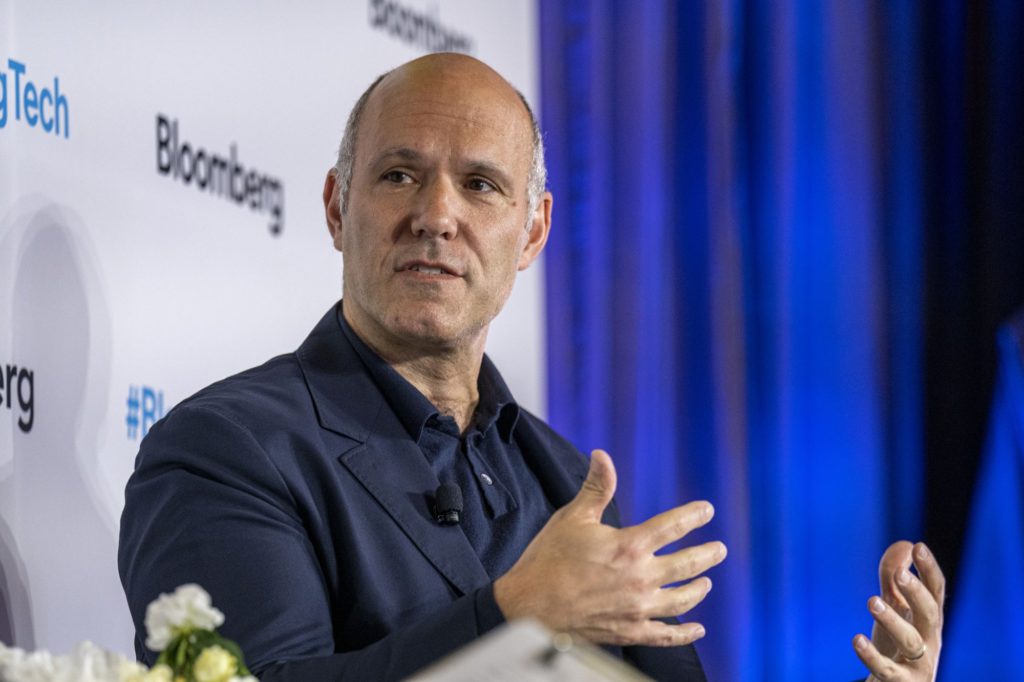
“Are there going to be places where things start to reach their peak or come off their peak, sure,” Kern said of travel demand Wednesday at the Bloomberg Technology Summit in San Francisco. “Broadly, we’re not seeing any discernible moment or time line where it’s all going to fall off.”

Travel executives have talked for months about a robust season after two years of Covid-19 restrictions. Travelers don’t seem to be dissuaded by high inflation, soaring energy costs, labor shortages or the spread of variants in some areas. During earnings last month, Expedia, Booking Holdings Inc. and Airbnb Inc. all provided upbeat forecasts for the next few months. 

“From what we can see of the US markets and western markets, there’s tons of pent-up demand,” Kern said in an interview Wednesday with Bloomberg Television’s Emily Chang. “We’ve seen people wanting to rebound and overspend into travel.” 

Strategists at Goldman Sachs Group Inc. estimate oil will remain above $100 a barrel through the next year, which could raise travel prices higher and potentially curb demand.

Those more expensive tickets, however, have helped airlines handle the higher energy prices so far, Kern said. “I think they’ve built in some cushion there,” he said.

Seattle-based Expedia and competitor Airbnb are finding ways to reinvent their brands, with Expedia introducing travel boards that allow multiple people to help plan a trip in addition to providing more of its own technology to large and small travel partners. The company also is unifying the rewards program across all its brands, which include Hotels.com and Orbitz. Airbnb launched a categories search function that lets users look for destinations like tiny homes, beach accommodations or island get-aways. 

Aside from traditional hotels, short-term rentals have been a boon for Expedia’s Vrbo platform during the pandemic as employees took advantage of flexible remote work policies. Vrbo specializes in home vacation rentals outside of urban areas. 

“We won’t see the kind of outsized growth we saw during Covid, but I think there’s plenty of runway to continue to grow,” Kern said at the technology summit. “In our markets we’re very strong and we’ve seen great demand and I think that will continue.”

More stories like this are available on bloomberg.com

©2022 Bloomberg L.P.

UK Should Not Raise Hopes That Peak Inflation Is Imminent

(Bloomberg) — Sign up for the New Economy Daily newsletter, follow us @economics and subscribe to our podcast.

A fall in the prices of a few key global commodity indicators has raised hopes that the world economy may have reached peak inflation. But UK households best not get carried away, economists warn.  

Bloomberg analysis in the US found that a bellwether semiconductor price has dropped 14% since the middle of last year, the spot rate for shipping containers is down 26% from its September high and a 24% fall in North American fertilizer prices since March bodes well for food prices.

As four fifths of the inflation overshoot above the Bank of England’s 2% target can be blamed on “sharp increases in global energy and tradeable goods prices,” as the BOE said in May, any evidence that the external shock is easing would appear to be welcome. UK inflation is currently at a 40-year high of 9% and may rise further when the latest data is released on June 22.

However, George Buckley, European economist at Nomura, said it would be wrong “to take too much comfort” as other indexes show little sign of easing and the UK energy price-cap will almost certainly delay peak inflation until October, when it next resets. Gas and electricity bills jumped 54% in April and a further 42% increase is expected.

Bloomberg Economics has also pointed out that the outlook for inflation will turn on the tight labor market, switching the focus to domestic price pressures.

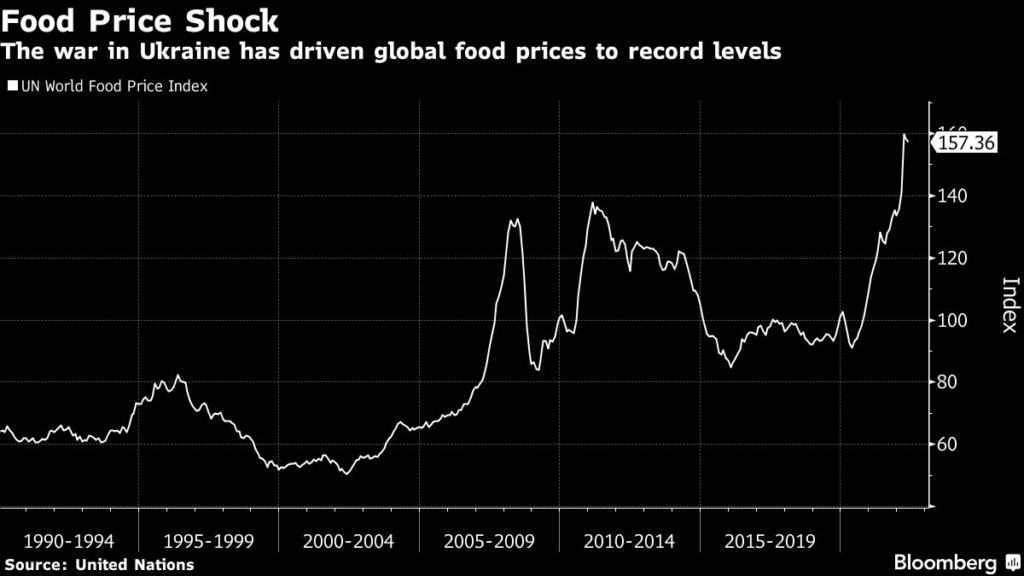
Buckley said a better indicator of the trajectory of UK food prices than North American fertilizer was the UN Food and Agriculture World Food Price Index. That has been at a record high since March and tends to operate on UK grocery prices with a seven-month lag.

That would suggest food and household energy prices rising in tandem just in time for Christmas, when energy demand will be peaking too. The BOE has warned that inflation is likely to reach double-digits at that point.

Ana Andrade and Dan Hanson of Bloomberg Economics have written that the outlook for inflation will hinge in a large part on “the 400,000 workers missing from the labor force …  when compared with the start of the pandemic.” Their absence is contributing to acute labor shortages and forcing employers to hike wages, raising the risk of an inflationary spiral as firms try to protect their profit margins. 

Households are shifting their spending back to services, such as going out, from the goods they bought when much of normal life was closed during the pandemic. Just as the enforced shift in demand to goods led to soaring prices, there are signs that the switch back to services will have a similar impact due to the shortage of workers.

Year-on-year increases in prices for core services, like hospitality, have decoupled from the pre-pandemic five-year average recently, in a muted echo of the decoupling witnessed in core goods prices during lockdowns.

“You can see the gap opening up,” Buckley said. “Everyone wants experiences and that demand is driving up services prices.” He added that the services industry was not immune to global inflation, with hospitality big buyers of energy and food, and would be looking to recover some of those costs. As the BOE pointed out in May, “a quarter of the air transport sector’s costs are accounted for by fuel.”

A levelling off in shipping, semiconductor and energy prices will automatically bring down inflation in those areas as inflation is a measure of annual price growth. There the signs are promising. Bloomberg’s Freightos Index on container shipping rates from China to Europe has fallen from recent highs but remains as elevated as it was in June last year, and the same is true of the Baltic Dry Index, the key global measure of shipping costs.

The question will then be whether companies can continue to rebuild their margins by raising prices and how much pressure workers can bring to bear on employers to close the gap between wage and price levels that will open up this year. Andrade and Hanson believe the UK participation rate will recover only a third of its decline since the end of 2019, leaving the labor market “red hot” despite the economic slowdown that the cost of living crisis will bring.

With public inflation expectations for the coming 12 months at a record high of 6.1%, even if peak inflation is reached later this year, it is unlikely to fall fast.

More stories like this are available on bloomberg.com

©2022 Bloomberg L.P.

Apple Will Handle Lending Itself With New Pay Later Service

(Bloomberg) — Apple Inc. will handle the lending itself for a new “buy now, pay later” offering, sidestepping partners as the tech giant pushes deeper into the financial services industry.

A wholly owned subsidiary will oversee credit checks and make decisions on loans for the service, which is called Apple Pay Later. The business — Apple Financing LLC — has necessary state lending licenses to offer the feature, though it operates separately from the main Apple corporation, the company said in response to Bloomberg questions. 

The move marks the first time Apple is handling key financial tasks like loans, risk management and credit assessments. It’s a significant shift for a company that got its start selling computers. Until now, Apple’s financial services have been backed by third-party credit processors and banks. The Apple Card credit card, for instance, relies on Goldman Sachs Group Inc. for lending and credit assessment.

Goldman Sachs retains a smaller role in the new program. The financial firm is the issuer of the Mastercard payment credential that’s used to complete Apple Pay Later purchases. Apple Financing doesn’t have its own bank charter.

Apple has been working to move many elements of its financial services in-house as part of a secret initiative dubbed “Breakout.” In addition to taking on lending, credit checks and decision-making, Apple is working on its own payment processing engine that may eventually replace CoreCard Corp., Bloomberg reported in March. It’s also working on new customer-service functions, fraud analysis, tools for calculating interest and rewards for other services.

Few companies can match Apple’s financial resources. It had nearly $200 billion in cash and marketable securities at the end of the last quarter and generated almost $95 billion in profit during the latest fiscal year. Still, Apple wouldn’t be taking on much risk with the latest effort: Apple Pay Later transactions will be capped depending on a user’s credit history. 

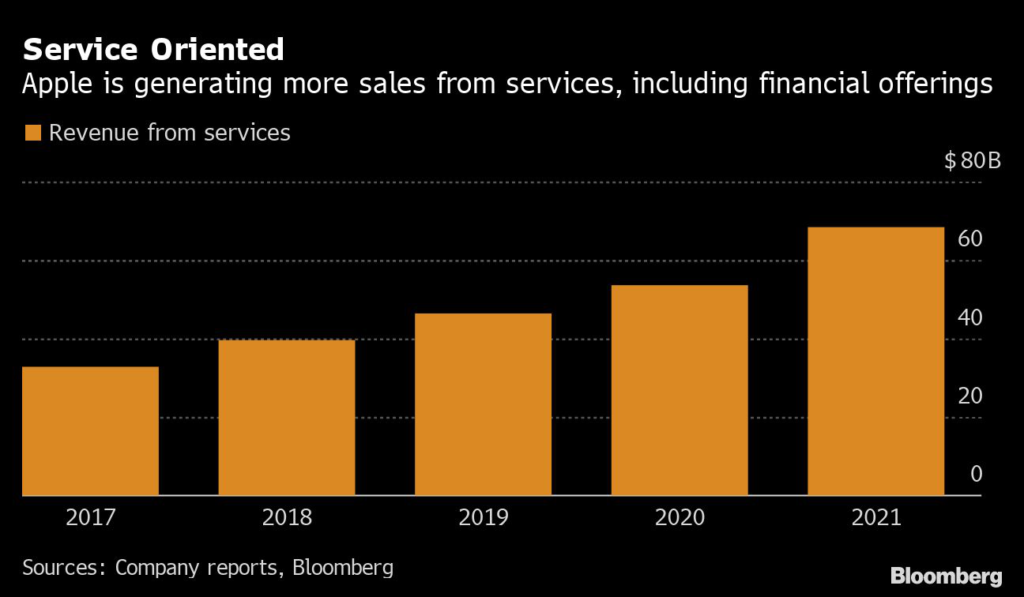
Financial services help keep users glued to their iPhones. That’s why the company wants greater control over the process, letting it roll out new options more quickly and potentially collect more revenue.

Apple Pay Later — introduced Monday at the company’s Worldwide Developers Conference as part of the iOS 16 operating system — will let customers split up the cost of any Apple Pay transaction over four installments across six weeks. The program will start in the US at first, though Apple plans to eventually expand its newer financial services to more regions. 

The company is also working on a longer-term “buy now, pay later” program called Apple Pay Monthly Installments, Bloomberg has reported. While the shorter-term Apple Pay Later offering doesn’t use Goldman Sachs or other major partners, the longer-term plan is likely to rely on an array of other companies — including Goldman Sachs — that could offer different plans and interest rates. In April, Goldman Sachs Chief Executive Officer David Solomon said his company was “very comfortable” with the Apple partnership.

Earlier this year, Apple acquired UK-based startup Credit Kudos Ltd., which uses bank data to make lending decisions. The iPhone maker’s in-house risk assessment engine will take into account consumers’ history as Apple customers, such as if they have routinely paid off purchases or ever had their credit card attached to iTunes or the App Store declined, Bloomberg reported in March. 

Beyond the pay-later service, Apple plans to use its in-house lending and technologies for an upcoming iPhone hardware subscription program. It doesn’t, however, have immediate plans to drop Goldman Sachs for the Apple Card or other banking partners for normal Apple Pay transactions.

Apple’s push into the “buy now, pay later” realm is seen as a threat to Affirm Holdings Inc. and Klarna Bank AB, which provide similar services. On Tuesday, Affirm CEO Max Levchin said he isn’t worried about Apple’s offering.

“There’s a lot of room for growth for all involved,” he said.

(Updates with more on Apple Pay Later transactions starting in sixth paragraph.)

More stories like this are available on bloomberg.com

©2022 Bloomberg L.P.
Close Bitnami banner
Bitnami