
Bloomberg

UK Wants to Regulate Tech Firms Deemed ‘Critical’ to Finance

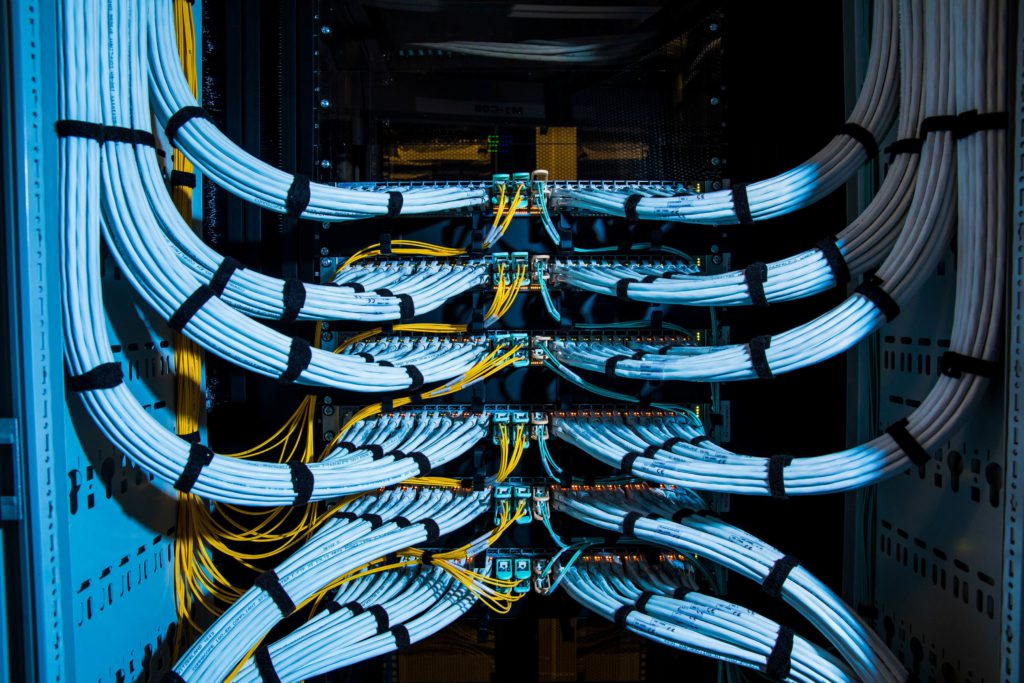
(Bloomberg) — The UK wants its financial watchdogs to directly oversee tech firms that provide critical services to the industry as regulators increasingly fret about the growing dependence of banks on cloud computing.

The UK Treasury is proposing designating certain non-finance firms as “critical” to the operating of the industry, according to a policy statement Wednesday. Regulators will be able to make rules relating to the provision of these material services, gather relevant information from those firms, and take formal action including enforcement.

The release didn’t name any firms likely to fall within the proposal’s remit but regulators worldwide are increasingly concerned about finance’s shift to cloud computing, services that are supplied by a handful of firms including Amazon.com Inc. and Microsoft Corp. As of 2020, more than 65% of UK firms used the same four cloud providers for cloud infrastructure services, according to the Treasury statement.

Proposals include allowing the financial regulators to set minimum resilience standards that the third parties will be “directly required to meet in respect of any material services that they provide to the UK finance sector,” the statement said. The firms will be required to “take part in a range of targeted forms of resilience testing.”

Last year, the Bank of England said it wanted additional powers to police the finance industry’s switch to cloud computing. Firms are moving their most sensitive IT systems into the cloud, allowing them to spend less on their own data centers while relying on the security and computing power of tech firms. The largest providers include Amazon Web Services, Microsoft Azure and Alphabet Inc.’s Google Cloud.

More stories like this are available on bloomberg.com

©2022 Bloomberg L.P.

Inditex’s Profitability Hits 10-Year High on Zara Price Hikes

(Bloomberg) — Inditex SA reported its highest profitability in a decade as the Zara owner offset inflation with tight cost control and kept attracting shoppers even as prices rose. 

Operating income rose 82% in the three months through April, exceeding pre-pandemic levels, the company said Wednesday, and gross margin reached a 10-year record. The stock rose as much as 5.3% as of 1 p.m. in Madrid, the most intraday in three months. 

Inditex is dealing with garment price inflation in part by buying more clothes from suppliers in Spain, Morocco and Turkey that give flexibility in order size. It’s shifting strategy by allowing inventory to rise 27%, which the company said is helps protect against supply-chain issues. 

Marta Ortega, daughter of Inditex founder Amancio Ortega, became chairwoman of the company in April, and Oscar Garcia Maceiras became chief executive officer in November.

Last month, Gap Inc. lowered its full-year forecast and reported first-quarter profit that missed estimates due to operational missteps. While shares of the US retailer have dropped 40% this year, Inditex is down about half as much.

Inditex’s first-quarter sales rose 36% to 6.7 billion euros ($7.2 billion), exceeding analysts’ estimates. Tighter budgets may be leading some consumers to buy more fast-fashion and fewer high-end items. The company has also recently implemented fees for online returns, an incentive for consumers to bring goods back to brick-and-mortar stores, where they may be tempted to shop more.

Cash has continued piling up this quarter, jumping 28% to 9.1 billion euros compared to the same period last year. Dividends have increased accordingly over the years, but analysts suggested that it may be a good time to invest more in the business. 

“For example, the US is Inditex’s second-largest market but with only 99 Zara stores present in the country and none of the other concepts represented,” said Societe Generale analyst Anne Critchlow.

Still, the world’s largest clothing retailer faces pressures on all sides. The company took a 216 million-euro provision for shutting operations in Russia and Ukraine, while many shops are still closed in China due to lockdowns. Inflation is also sapping consumer spending in almost every market.

Revenue rose 17% in constant currencies in the five weeks of this fiscal quarter, which is less than half the level of growth Inditex had in the full fiscal year through January. In the two weeks through June 5, growth decelerated even further to 13%.

Online sales dropped 6% in the three months through April after the retailer leaned on those operations to get through the pandemic.

Zara’s prices are at least 10% higher than last year’s levels since January, UBS said, based on data from the website in 12 markets. The company doesn’t plan any more significant changes to pricing, CEO Garcia Maceiras told analysts on a call. He said that the changes haven’t impacted sales volume. Compared to mass-market rivals, Zara has more pricing power because its offerings often imitate the latest high-end fashions.

Last year was an exceptionally good one with operating profit almost tripling, which will make for difficult comparisons in coming months.

(Updates with comments from conference call and analyst.)

More stories like this are available on bloomberg.com

©2022 Bloomberg L.P.

Turkey Plans Temporary Cap on Home Rents as Inflation Rages

(Bloomberg) —

Turkey aims to cap annual increases in home rentals at 25% as a surge in inflation pressures the government a year ahead of scheduled elections.

Anger is deepening over soaring rents, which online marketplace sahibinden.com said rose an average 147% in Istanbul for new tenants who signed deals in May. 

Landlords are attempting to evict occupants and sign up new ones at much higher prices, with the number of lawsuits launched against tenants doubling, Sozcu newspaper reported in April. 

Justice Minister Bekir Bozdag said on Wednesday that officials would include a new clause in the code of obligations stipulating the change, which might apply from July and would run for a year.

Under current law, once-a-year price hikes for existing tenants are capped at the average annual rate of inflation over the past 12 months. 

In May, that level stood at 39.3% and is set to jump further. Consumer inflation last month surged to 73.5% and President Recep Tayyip Erdogan has signaled there’s little chance of the central bank raising interest rates anytime soon as he seeks to boost the economy before seeking re-election.

Turkey Will Continue Cutting Interest Rates, Erdogan Says

“This is not a normal market anymore,” said Nizameddin Asa, head of an association of Istanbul realtors. “Over the past three months, we’ve seen fights, threats, intimidations and lawsuits. Both the landlord and the tenant are right, both have been struggling to make a living.”

Inflation Is Erdogan’s Old Nemesis and His Key Rival Standing

A parliamentary whip for Turkey’s main opposition party said the rental cap “embodies the bankruptcy of a 20-year-long economic policy” focused on helping the construction industry.

Engin Altay of the Republican People’s Party urged the president to instead “cap hikes in natural gas, diesel and electricity.”

(Updates with opposition reaction in final paragraph.)

More stories like this are available on bloomberg.com

©2022 Bloomberg L.P.

Ford’s Electric F-150 Comes Equipped With Adapter to Rescue Teslas

(Bloomberg) — Ford Motor Co.’s electric F-150 Lightning pickups are poised to come to the rescue of any Tesla drivers in need of a jolt.

Initial owners of the model that beat the Cybertruck to market have shared images online of an adapter that came with their pickup enabling them to charge Teslas, which use plugs distinct from the rest of the auto industry. When an electric-vehicle enthusiast blog wrote this week that Ford appeared to be trolling its rival, Chief Executive Officer Jim Farley assured his Twitter followers that the automaker means well.

Ford has made the F-150 Lightning’s bi-directional charging capability a key selling point of the pickup, emphasizing use cases for customers who’d like to use their truck as a backup generator at worksites or for their home. Enabling EVs to both take and provide a charge has the potential to help utilities manage peaks in demand and even allow their owners to sell electricity back to the grid.

Tesla owners may not need the help. The carmaker boasts the second-largest US public charging network, with 19% of all connectors, and dominates the fast- and ultra-fast segments, with more than half of those connectors in the country, according to BloombergNEF estimates. Drew Baglino, Tesla’s senior vice president of powertrain and energy engineering, said in October that the company planned to triple the size of its supercharger network over the next two years.

Of course, Fords have already come to Tesla owners’ aid in another way. Ford Transit vans are among the models Tesla uses as mobile service vehicles.

More stories like this are available on bloomberg.com

©2022 Bloomberg L.P.
Ford’s Electric F-150 Comes With Adapter to Charge Stalled Teslas

(Bloomberg) — Ford Motor Co.’s electric F-150 Lightning pickups are poised to come to the rescue of any Tesla drivers in need of a jolt.

Initial owners of the model that beat the Cybertruck to market have shared images online of an adapter that came with their pickup enabling them to charge Teslas, which use plugs distinct from the rest of the auto industry. When an electric-vehicle enthusiast blog wrote this week that Ford appeared to be trolling its rival, Chief Executive Officer Jim Farley assured his Twitter followers that the automaker means well.

Ford has made the F-150 Lightning’s bi-directional charging capability a key selling point of the pickup, emphasizing use cases for customers who’d like to use their truck as a backup generator at worksites or for their home. Enabling EVs to both take and provide a charge has the potential to help utilities manage peaks in demand and even allow their owners to sell electricity back to the grid.

Tesla owners may not need the help. The carmaker boasts the second-largest US public charging network, with 19% of all connectors, and dominates the fast- and ultra-fast segments, with more than half of those connectors in the country, according to BloombergNEF estimates. Drew Baglino, Tesla’s senior vice president of powertrain and energy engineering, said in October that the company planned to triple the size of its supercharger network over the next two years.

Of course, Fords have already come to Tesla owners’ aid in another way. Ford Transit vans are among the models Tesla uses as mobile service vehicles.

More stories like this are available on bloomberg.com

©2022 Bloomberg L.P.

Alibaba, Bilibili Eye Fresh Gains as China Approves More Games

(Bloomberg) — US-listed Chinese stocks are on track for a third day of gains after China approved a second batch of video games this year, marking a further softening in the country’s stance toward internet firms.

Live-streaming platform Bilibili Inc. was among the top gainers of the group, rising 8% in premarket trading. In large-cap names, Alibaba Group Holding Ltd. jumped 5% and peer JD.com gained 4.2%. The KraneShares CSI China Internet Fund, an exchange-traded fund that tracks Chinese tech stocks, rose as much as 4.4%, extending a 9% rally in the previous two sessions.

After a tech crackdown that ensnared sectors from e-commerce to fintech and even online education, Beijing has recently taken a more lenient line, introducing a raft of policies aimed at propping up the group and the Chinese economy. The Wall Street Journal reported that regulators are preparing to wrap up their investigation into Didi Global Inc. and restore the ride-hailing giant’s main apps to mobile stores as soon as this week.

“I think the worst is behind us in terms of earnings and regulations,” said Adam Montanaro, investment director at Aberdeen Asset Management. The gaming approvals are a continuation of “the government’s more supportive tones and gestures toward the internet economy,” he said.

Bruised Chinese internet stocks have emerged as a bright spot at a time when US peers are still gripped by prospects of higher interest rates. Easing of lockdown measures in major cities, together with a string of better-than-expected earnings, are also boosting risk sentiment. 

That said, Beijing’s persistence with its Covid Zero strategy remains a source of concern and some bearish strategists, including DZ Bank AG’s Manuel Muehl, view the current optimism as premature.

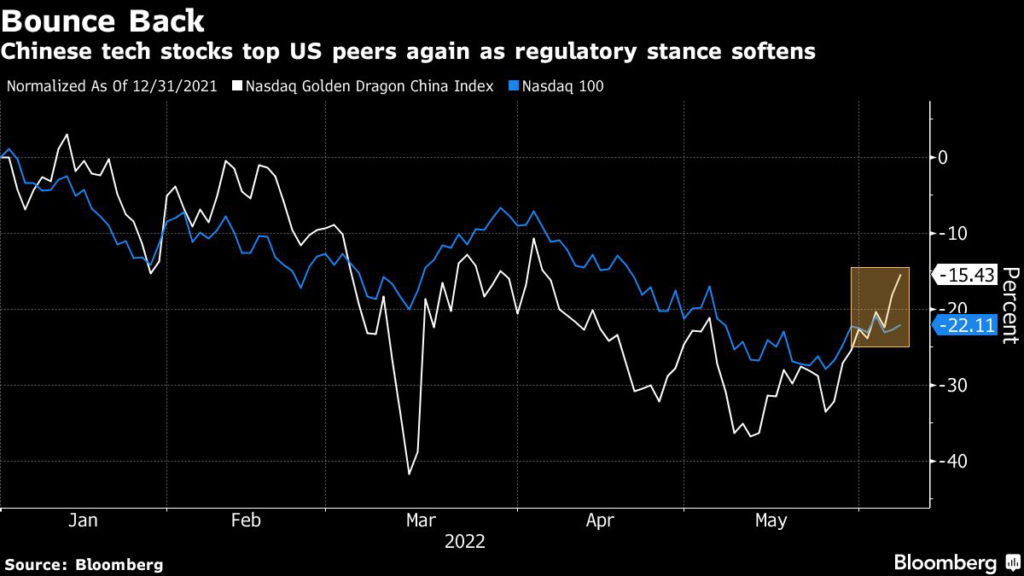
Recent gains have trimmed the Nasdaq Golden Dragon China Index’s drop this year to 15%, beating the Nasdaq 100’s 22% slump. While the basket has topped a key moving average, it’s still down more than 60% from its peak set in February last year.

More stories like this are available on bloomberg.com

©2022 Bloomberg L.P.

Elon Musk’s 180 on Tesla Job Cuts Did Damage to His Credibility

(Bloomberg) —

In November, I wrote that Elon Musk appeared to be entering an Icarus Phase. Tesla and SpaceX were on a roll, Musk’s wealth was reaching new heights — his fortune peaked a day after the column published, at more than $340 billion — and he was flying awfully close to the sun.

Musk has acted even more recklessly since then, venturing far beyond Twitter swipes and potshots at the president. His antics are undermining his credibility.

Set aside the $44 billion Twitter merger agreement from which Musk is trying to renege, and consider the drama at Tesla stoked entirely by its chief executive officer.

Last Thursday evening, Reuters reported that Musk had sent an email to other Tesla executives saying he had a “super bad feeling” about the economy, and wanted to dismiss 10% of the company’s employees.

It was a big scoop, and no other news organization was able to match. Tesla’s overwhelming tendency the last few years has been to not engage with mainstream media. There was no blog post, no regulatory filing, no confirmation, denial, clarification or elaboration on what Reuters reported.

On Friday, Tesla’s stock plunged. Long-time Tesla watchers figured a follow-up email from Musk was surely coming, and we were right. This one went to everybody in the company, with Musk writing that the cuts he’d conjured will only apply to salaried positions.

He wasn’t done. In response to one of his biggest fans declaring Tesla’s headcount will increase over the next 12 months, Musk tweeted Saturday that Tesla’s total number of employees will increase, and that its salaried ranks “should be fairly flat.” Lest he be criticized for this complete 180, that fan and others began attacking Reuters and its initial report. Musk’s mother even got in on the act.

There are big differences between cutting 10% of Tesla employees, trimming 10% of its salaried workforce, and keeping salaried personnel fairly flat. At what point does changing one’s tune from one, to the next, to the next, in a three-day span lead people to stop taking the messenger seriously? This is beyond clumsy for the CEO of a company that’s no longer a scrappy startup and now one of the most valuable members of the S&P 500.

Musk’s admirers have been forgiving of his misfires, often because his faulty statements could be explained away as optimistic stretch goals meant to motivate his team. In May 2019, for instance, Tesla raised billions of dollars from Wall Street after Musk told investors self-driving technology had become the company’s new calling. He claimed the carmaker would have 1 million robotaxis on the road the following year. Some customers are now beta-testing Full Self-Driving features, but this is a misnomer — Tesla itself acknowledges FSD is merely a driver-assistance product.

It’s harder to be magnanimous when Musk writes loosely about the fate of Tesla’s roughly 100,000 employees. Communicating carelessly like this will lead even Musk’s staunchest supporters to be more circumspect about what he says his companies will do next.

More stories like this are available on bloomberg.com

©2022 Bloomberg L.P.

JPMorgan Backs Software Startup Codat at $825 Million Valuation

(Bloomberg) — Codat, a software startup that connects small businesses with financial institutions, raised $100 million in an equity funding round led by JPMorgan Chase & Co.’s growth-equity arm.

The transaction values the London-based company at roughly $825 million, Codat co-founder and Chief Executive Officer Pete Lord said in an interview, more than doubling since a Tiger Global-led round last July. New investors Canapi Ventures and Shopify Inc. participated in the latest financing, as did existing backers Index Ventures and PayPal Ventures, Lord said.

“We believe Codat has the potential to fundamentally change the way data is shared across the small-business economy,” J.P. Morgan Growth Equity Partners’s Patrick McGoldrick, who is joining the board, said in an emailed statement. “JPMorgan Chase has an extensive small-business customer base so we understand the power of connecting and standardizing data.”

Founded in 2017, Codat has seen its revenue more than double each year since inception, Lord said. The company is targeting $30 million in annualized run-rate revenue by the end of 2022, a person familiar with the matter said. 

“Small businesses are the backbone of the economy but the majority of their systems still don’t speak to one another — which is a problem our technology solves,” Lord said. “We see our role as being the data infrastructure layer for small business at scale.”

An example of Codat’s data connectivity in practice is enabling a coffee shop owner to link accounting software with PayPal’s point of sale platform, Lord said. The startup can offer data sharing with third parties such as banks, so lenders considering providing financing have real-time visibility into a business’s financial health, he said. 

Proceeds from the latest funding round will be used to increase the number of integrations to small business financial applications, Lord said. Earlier investors in the company include Plaid and American Express Ventures. 

More stories like this are available on bloomberg.com

©2022 Bloomberg L.P.

Microsoft Slashes Russia Operations After War Clouds Outlook

(Bloomberg) — Microsoft Corp. is substantially reducing its business in Russia, joining the list of prominent technology firms cutting back or exiting the country altogether after the Russian invasion of Ukraine. 

“As a result of the changes to the economic outlook and the impact on our business in Russia, we have made the decision to significantly scale down our operations in Russia,” the company said in an emailed statement. “We will continue to fulfill our existing contractual obligations with Russian customers while the suspension of new sales remains in effect.”

More than 400 employees will be affected, a company spokesperson said. “We are working closely with impacted employees to ensure they are treated with respect and have our full support during this difficult time,” Microsoft said in the statement.

In March, the company suspended new sales of products and services in Russia but continued to support existing customers and maintain offices there. 

US companies in tech and other fields have been winding down operations in Russia after Vladimir Putin’s invasion of Ukraine. IBM said it’s beginning to suspend its business operations there, a decision announced in March. Apple Inc. and Nike Inc. have halted sales. German business software maker SAP SE  said in April it’s taking steps toward an “ orderly exit” of its operations in Russia, with plans to stop offering support for on-premise products in the country while winding down cloud services.

More stories like this are available on bloomberg.com

©2022 Bloomberg L.P.

Saudi Wealth Fund Makes Second $1 Billion Bet on Swedish Gaming

(Bloomberg) —

Saudi Arabia’s wealth fund has made its second $1 billion foray into the Swedish gaming industry this year as part of a drive to build stakes in video game makers and e-sports firms globally.

The Public Investment Fund’s Savvy Gaming Group will become the second largest owner in Embracer Group AB after acquiring almost 100 million shares in the Karlstad-based company. The move follows a similarly sized acquisition in January, when Savvy bought the e-sports division of Modern Times Group at an enterprise value of $1.05 billion. 

The PIF, as the $500 billion fund is known, continues to deepen its push into a gaming sector that is in the grip of consolidation. Last month, the fund took a 5.01% stake in Nintendo Co., marking its third investment in a Japanese games company.

Read More: Saudi Wealth Fund Boosts Gaming Bets With Capcom, Nexon Stakes

The announcement of a rights issue directly to Savvy sent Embracer’s shares up nearly 10% during early trading in Stockholm on Wednesday. As a result of the deal, PIF will take an 8.1% stake in the Swedish company for 10.3 billion kronor ($1.05 billion). The price of 103.47 kronor per share represents a premium of 15% from the closing price on June 7. 

Embracer last month said it was in talks with potential long-term strategic investors. A rapid pace of acquisitions has helped the company become one of Europe’s largest gaming firms, and it is currently weighing a move to Nasdaq Stockholm’s main market to help broaden the investor base. 

The relationship with Savvy will let Embracer set up a regional hub in Saudi Arabia from which it will be able to make investments in the region, Embracer’s chief executive officer Lars Wingefors said in a statement. The proceeds from the share issue will be used to continue its acquisition strategy.

(Updates with context throughout)

More stories like this are available on bloomberg.com

©2022 Bloomberg L.P.

Close Bitnami banner
Bitnami