
Bloomberg

Apple Debuts Pay-Later Service, iPhone Updates to Developers

(Bloomberg) — Apple Inc. unveiled a flurry of new software features and services at its Worldwide Developers Conference, including an updated iPhone lock screen, multitasking features for the iPad and a pay-later service that vaults it further into finance. 

The presentation Monday, part of a weeklong event, previews key features for Apple’s developers, which now number 34 million, according to Chief Executive Officer Tim Cook. The wide-ranging upgrades are meant to keep customers loyal and prod them to use more Apple products together — a key strategy of the world’s most valuable tech company.

Apple’s latest iPhone software, iOS 16, will include the new lock screen, letting users personalize elements like their photo and the font used for the time. The lock screen is also getting widgets — bits of software that show simple information like the weather — for the first time. And a feature called Live Activities will make it easier to keep track of plans and events, such as an NBA game or an Uber ride, Senior Vice President Craig Federighi said at the event in Cupertino, California.

The roughly two-hour presentation was packed with new features, though there were few bombshells for investors. The shares were little changed following the announcements, closing at $146.14 on Monday.

With Apple’s shares down 18% this year — and concerns mounting that the economy is headed for a recession — the electronics behemoth is under added pressure to generate buzz for software that will run on a new lineup of gadgets debuting later in 2022. Apple uses the annual conference in a bid to set itself apart from rivals such as Samsung Electronics Co., Alphabet’s Inc.’s Google and Amazon.com Inc.

The new iPhone software adds features for filtering content, allowing users to prioritize messages and emails depending on whether they’re driving, at work or at home. The lock screen also will display different styles depending on the time of day. Overall, iOS is getting some highly requested features, such as a joint cloud photo library for families and the ability to unsend or edit iMessages. 

Many of the offerings announced for iOS 16 extend to the Mac and iPad. The company also announced changes to its Mail app, introducing improved search and the ability to schedule the sending of messages. And Apple previewed what it called a future without passwords, showing a Passkeys feature that uses cryptography instead of text-based codes. 

Apple’s Maps, Home and Health apps are getting upgrades as well. Apple Maps, for instance, will let you add as many as 15 stops when planning a route. The Home app will work better with camera feeds and support Matter, a cross-platform protocol for smart-home devices that has also been embraced by Amazon and Google. 

The Health and Fitness apps on the iPhone will now be able to track fitness and medication without the need of an Apple Watch. Apple also previewed its latest smartwatch operating system — watchOS 9 — adding revamped fitness-tracking software, new watch faces and a redesigned calendar app. And the Apple Watch is getting less obtrusive notifications that no longer take over the entire screen.

The device will have improved atrial fibrillation detection, allowing users to see a summary of their so-called aFib over time. The software also will better track sleep to indicate what stage users are experiencing at different times at night. In some of these areas, Apple is playing catch-up to rivals such as Fitbit, which have offered similar features for years. 

The company also previewed its long-in-development “buy now, pay later” feature, which splits up the cost of Apple Pay purchases over four payments across six weeks. The feature, called Apple Pay Later, includes no interest or fees, the company said. Bloomberg previously reported that the service was coming, part of an expansion into the finance world that also includes bringing more of its infrastructure in-house. 

Monday’s announcement hurt shares of Affirm Holdings Inc., which offers a similar service. It was down 5.5% to $23.72 at the close.

Apple previewed a major update to CarPlay to take advantage of cars with more sprawling displays. The new software, which will be formally introduced in vehicles in 2023, can replace instrument clusters, climate controls and radios for the first time.

The peek at the software features comes a few months ahead of the launch of new iPhones, iPads and Apple Watches, which typically get unveiled in the fall. Those devices account for about 80% of the company’s revenue. 

The iPad’s software, iPadOS, also is getting a major update aimed at professional users. The device will be able to resize windows, show more content on the display at once and offer a new multitasking view that makes it easier to use several apps simultaneously. The iPad is also getting additional collaboration features and a productivity app called Freeform — as well as a weather app for the first time.

A similar multitasking view — called Stage Manager — is coming to the Mac as well with the new macOS Ventura update. 

The new Mac operating system will also let customers use their iPhone as a webcam with their computer. Apple said it’s working with accessory maker Belkin on attachments for release later this year.

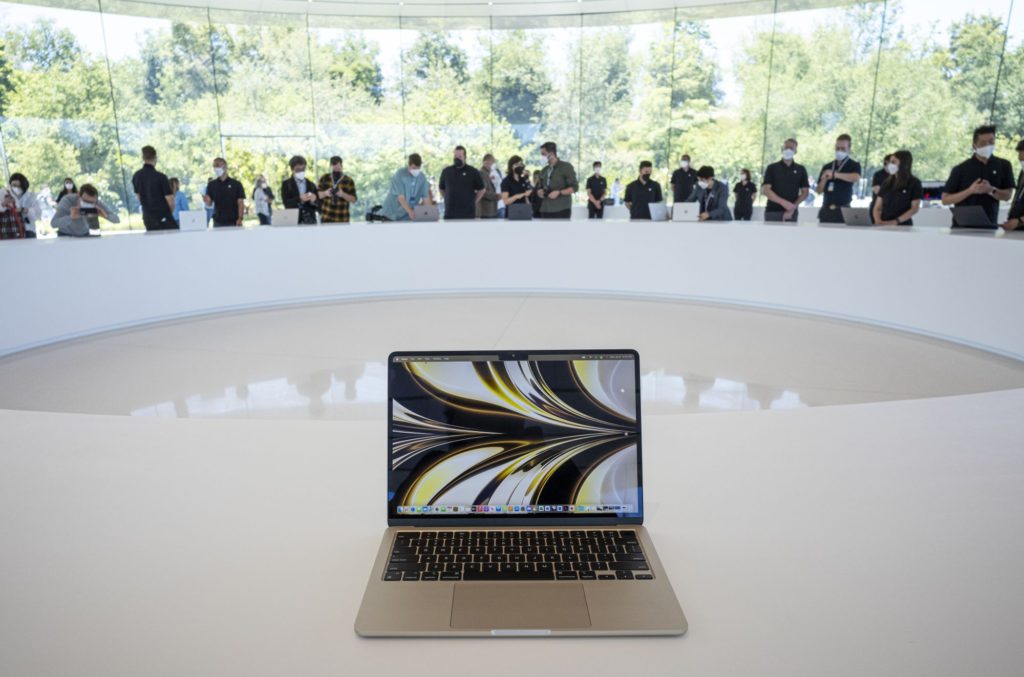
On the hardware side, Apple unveiled two new Macs, including the biggest refresh of its Air model in more than a decade. The new computers will use the company’s homegrown M2 chip, which it developed after splitting from Intel Corp. The other new machine, a low-end 13-inch MacBook Pro, looks like the prior version. Neither laptop will ship to consumers until July. 

The operating system updates will be available to developers as part of a beta test on Monday. And the public will be able to see them in a broader beta test next month. 

(Updates with more on share reaction starting in fourth paragraph.)

More stories like this are available on bloomberg.com

©2022 Bloomberg L.P.
This Is Why Your Airline Tickets Are So Expensive Right Now

(Bloomberg) — For more than two years, the main topic of conversation pretty much everywhere has been about the impact of Covid-19. Now that the worst of the pandemic seems to be over and people are traveling more freely again, another hot topic is on the tips of everyone’s tongues: expensive plane tickets. 

People are looking for flights — sometimes their first in years — in a rush of what’s been termed “revenge travel.” Internet searches show sky-high airfares for many routes, yet travelers with wanderlust are opting to stomach the higher costs after being grounded for so long.

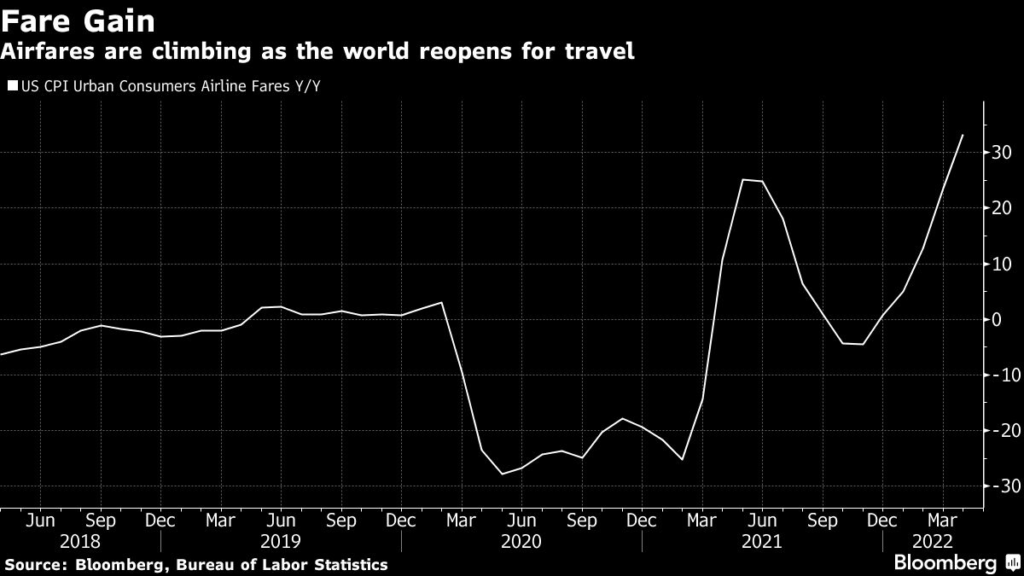
“The demand is off the charts,” Delta Air Lines Inc. Chief Executive Officer Ed Bastian said at an industry conference last week, noting that fares this summer may be 30% higher than pre-pandemic levels. “It’s coming with leisure, it’s coming with premium customers, it’s coming with business, it’s coming with international. It doesn’t matter what the category is.”

Global Movement

The trend is across geographies, though some places are more squeezed than others. Searches for a return economy-class ticket between Hong Kong and London on Cathay Pacific Airways Ltd. in late June turn up prices as high as HK$42,051 ($5,360), which is more than five times the typical cost before the pandemic. Direct flights between New York and London around the same time cost more than $2,000 in economy. 

“Ticket prices are really expensive these days,” said Jacqueline Khoo, who works in tourism. Her company paid S$5,000 ($3632) for a colleague’s return trip with Singapore Airlines Ltd. to Hamburg later this month. That used to cost about S$2,000, she said. “It’s really amazing that an economy seat ticket would cost you so much.” 

A Mastercard Economics Institute study found the cost of flying from Singapore was on average 27% higher in April than in 2019, while flights from Australia were 20% more. Increasingly, travelers are booking tickets months in advance as they’re worried about the cost of buying at the last minute, said David Mann, chief economist for Asia Pacific, Middle East and Africa at the institute.  

There are several reasons for the higher fares, not all of which are within the control of airlines. 

Giant Jets Parked 

Carriers are cautious about bringing back all their idled jets, even though most countries have eased cross-border restrictions. That’s particularly true for giant aircraft like Airbus SE’s A380 superjumbos and Boeing Co.’s older 747-8s, as airlines turn to more fuel-efficient models like A350s and 787 Dreamliners. The pinch is most acute in Asia, which was the slowest to ease restrictions, and as China, the biggest market in the region, remains essentially closed. 

After navigating varied and changing government policies for the past two years, it will take time for airlines to rebuild fleets given that many restrictions only eased in May, said Subhas Menon, director general of the Association of Asia Pacific Airlines. “It’s still early days,” he said. “We’re just in June, so it’s not like turning on the tap.”  

Carriers also scaled down their networks during Covid, none more so than Cathay, which has been hemmed in by Hong Kong’s onerous travel and quarantine rules. That’s left people considering lengthy journeys with one or more stopovers, whereas before they might have flown direct. British Airways Plc doesn’t even fly to Hong Kong at the moment. 

With fewer planes in the skies, there are fewer seats to meet the recovery in demand, which in turn has pushed up fares.

Skyrocketing Fuel Prices

Russia’s invasion of Ukraine has exacerbated a steady rise in crude oil prices over the past 18 months. Jet fuel now represents as much as 38% of an average airline’s costs, up from 27% in the years leading to 2019. For some budget airlines, it can be as high as 50%.

Spot jet fuel prices in New York have soared more than 80% this year, though prices vary from region to region depending on refining costs and local taxes. Many US carriers have been able to cover the increased fuel costs so far — but only by passing them along to travelers in the form of higher fares.

Some investors believe airlines may seek to boost fuel surcharges as a way to cope, analysts at Citigroup Inc. said in March. Most of Asia’s airlines don’t hedge jet fuel, which means they are more vulnerable to price increases. 

Deep-Pocketed Travelers 

Higher ticket costs don’t seem to be dissuading people from making trips now that many travel restrictions have eased. Some consumers are tapping dormant holiday budgets and upgrading to more expensive aircraft cabins for leisure trips, the International Air Transport Association’s Director General Willie Walsh said last month. 

The so-called revenge traveler is “an individual that has been emotionally affected by the lockdowns and has craved travel over the last two years and they’ve dreamt about it,” said Hermione Joye, sector lead for travel in Asia Pacific at Alphabet Inc.’s Google. “They are very spontaneous.”

Lack of Staff

Hundreds of thousands of pilots, flight attendants, ground handlers and other aviation workers lost their jobs over the past couple of years. With travel picking up, the industry now finds itself unable to hire fast enough to allow for seamless operations at its pre-pandemic levels. 

Read more: Fewer Pilots Will Lead to a Summer of Flight Cancellations

Singapore’s Changi Airport — regularly voted the world’s best — is looking to recruit more than 6,600 people. Many workers who were let go have found other, less volatile careers, and aren’t willing to come back to a cyclical industry. An operator at Changi is offering a joining bonus of S$25,000 to auxiliary police officers, a job that pays a maximum of S$3,700 a month.

In the US, smaller regional airlines can’t fly at full capacity because bigger carriers have hired away too many pilots. Hundreds of flights have been canceled in the UK, scuppering holiday plans and leading to long delays and scenes of passengers sleeping at airports. In Europe, major airports have faced delays and cancellations after failing to hire adequate staff. That has disrupted airline schedules and added to costs. 

Repairing Balance Sheets 

Aviation is a capital-intensive industry with historically wafer-thin margins. Covid has made that operating climate even more challenging: globally, airlines lost more than $200 billion in the three years to 2022. 

Elevated fares provide carriers with a path to recover from losses and return to the black.

Read more: US Airlines Face Crucial Summer Test in Quest for Profitability

“We’ve never seen a revenue environment like this, led by domestic leisure,” American Airlines Group Inc. Chief Executive Officer Robert Isom said at an industry conference last week. “On top of that, we see large corporates coming back in. Small- and medium-sized businesses have been really off the charts for a number of months now.”

How Much Longer? 

It’s unclear how long these high prices will persist, even as many travelers seem willing to pay up.

“The rise in prices is a short-term phenomenon,” estimates Stephen Tracy, chief operating officer at Milieu Insight, a Singapore-based consumer insight and analytics firm. “Let’s all just hope that once these things equalize again, the prices come back down. I am fairly confident that they will.” 

In a few cases, fares are actually lower than pre-pandemic levels, according to Michael O’Leary, chief executive officer of Ryanair Holdings Plc. While there’s a prospect of more fares returning to levels they were at before Covid, the war in Ukraine and virus outbreaks are still risks, he said. 

More stories like this are available on bloomberg.com

©2022 Bloomberg L.P.
Inflation Is Poised to Ease According to These Three Key Indicators

(Bloomberg) — Three of the key supply-side factors driving today’s global inflation levels have already turned around, meaning relief could be on the horizon for shoppers worldwide.

A bellwether semiconductor price — a barometer of costs of finished electronics products as diverse as laptops, dishwashers, LED bulbs, and medical devices delivered worldwide — is now half its July 2018 peak and down 14% from the middle of last year. 

The spot rate for shipping containers — which tells us more about expenses we can expect later in the pipeline for apparel in Chicago, luxury items in Singapore or home furnishings in Europe — has declined 26% since its September 2021 all-time high. 

North America’s fertilizer prices — an indicator of where global food inflation is going, including bills for tomatoes in London or onions for sale in a Johannesburg market — is 24% below its record high in March.

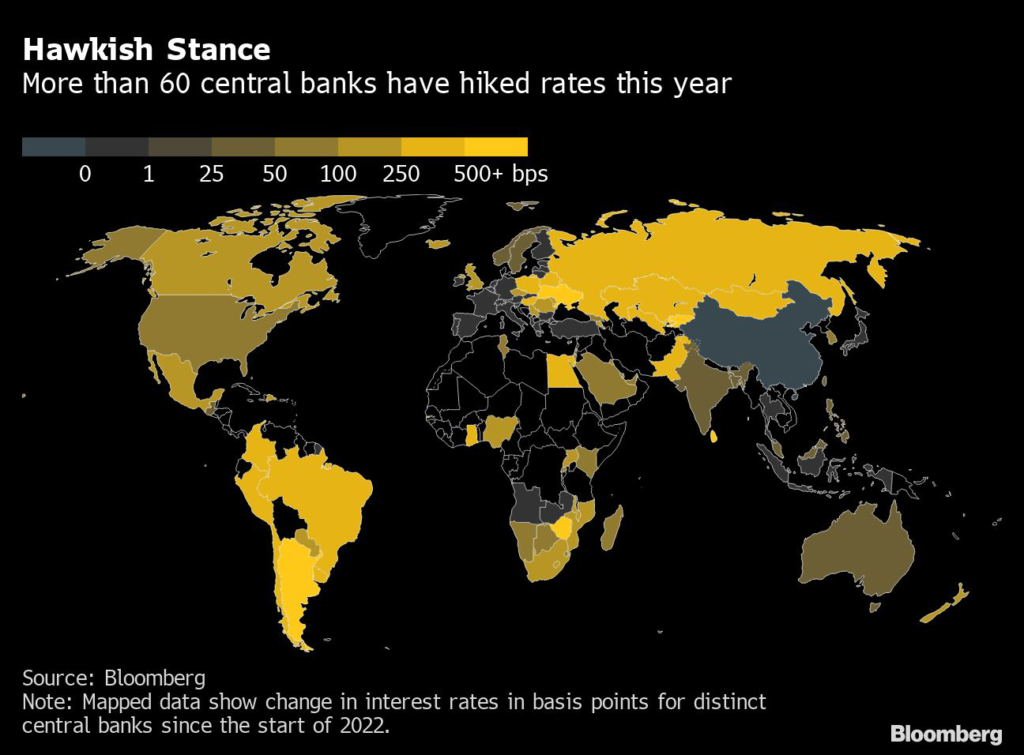
With inflation now exceeding 8% in the euro area, expected to stay above that level in the US when May data comes out on Friday and on the march in Asia too, central bankers around the world are scrambling to contain it. 

Even as central bankers raise rates, more economists are coalescing around the idea that peak inflation is behind us — though there will be a lag before the lower costs of raw materials filter through to the prices shoppers see. 

Though few forecasters are predicting a return to pre-pandemic prices in the short run, global retail giants like Walmart Inc. are now struggling to unload bloated inventory to a less enthusiastic shopper. So a moderation in those supply-side pressures could eventually allow central bankers to slow their tightening cycles. 

“While inflation in some parts of the world are yet to peak, there are at least some signs emerging that we may not be too far off in terms of a turning point at which we start to see the annual inflation rate start to head lower,” said Khoon Goh, Singapore-based head of Asia research at Australia & New Zealand Banking Group.

China’s producer prices peaked in late 2021 and are beginning to moderate. Economists are forecasting a 6.5% rise in factory prices in May from a year earlier, down from 8% in April. 

That’s a promising development for relief in imported-goods inflation worldwide, said Goh. In addition, lower container freight rates and improving supplier delivery times in purchasing managers indexes point to easing bottlenecks that should curb price pressures later this year, he said.

More stories like this are available on bloomberg.com

©2022 Bloomberg L.P.

Peloton Names Amazon Executive to CFO Post in Latest Reshuffle

(Bloomberg) — Peloton Interactive Inc. named Amazon.com Inc. executive Liz Coddington as its chief financial officer, marking the latest shake-up at the fitness company as it pursues a turnaround. 

Coddington, who previously was vice president of Amazon Web Services, will take the new job on June 13, the company said in a statement Monday. Current CFO Jill Woodworth, who joined Peloton in 2018, will remain a consultant during the transition.

Peloton overhauled its management ranks in February, bringing in new Chief Executive Officer Barry McCarthy, a veteran of Spotify Technology SA and Netflix Inc. The company — a highflier during pandemic lockdowns — is trying to revive a business that’s fallen into a slump. But investors have grown impatient with the turnaround efforts, and the shares have lost roughly two-thirds of their value this year.

Before Amazon, Coddington worked at Adara Media Inc. and Walmart Inc.’s e-commerce arm as well as McCarthy’s former company, Netflix. 

“Having worked at some of the strongest and most recognizable technology brands, she not only brings the expertise needed to run our finance organization, but she has a critical understanding of what it takes to drive growth and operational excellence,” McCarthy said in the statement.

More stories like this are available on bloomberg.com

©2022 Bloomberg L.P.
Alibaba, US-Listed China Stocks Soar as Crackdown Fears Ease

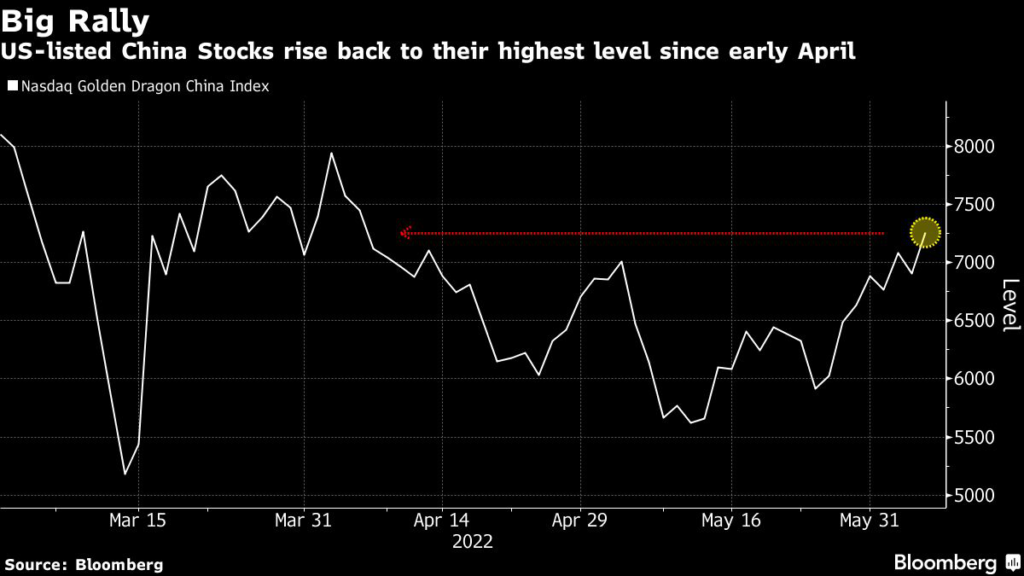
(Bloomberg) — US-listed China stocks surged Monday to the highest since early April on increased speculation that a year-long government crackdown on the technology industry is easing.

While the S&P 500 Index struggled to mount much of an advance, the Nasdaq Golden Dragon Index closed 5.4% higher after surging as much as 8.3%, as Chinese regulators were said to be close to wrapping up their investigation of Didi Global Inc. The company’s American depositary receipts soared 68% at the start of US trading before paring some of those gains, leaving them up more than 24% from Friday’s close. 

Chinese authorities are said to be finishing their probe into Didi and appear set to restore its main apps to mobile stores as soon as this week, the Wall Street Journal reported. The nation’s major technology firms were among the leading gainers amid more optimistic sentiment toward the industry, with Alibaba Group Holding Ltd. aand JD.com each advancing more than 6.2%. 

“This is the most tangible sign that the government is in fact easing back on its regulatory scrutiny of the tech industry,” said Adam Crisafulli, the founder of Vital Knowledge. China tech stocks had momentum building up for a few weeks on back of easing Covid restrictions and stepped-up stimulus measures, he added.

The string of positive news drew traders back to the battered stocks on bets that the worst is over for the sector, especially since recent actions suggest policy makers may make good on repeated promises to soften their stance in recent months as economic growth slowed. 

Read more: Worst May Be Over for China Stocks as Tech Probe Nears End (1)

That also echoes the increasingly bullish outlooks from Wall Street analysts and strategists, including JPMorgan Chase & Co’s Marko Kolanovic, who says the past year’s deep selloff in the group could finally be on the cusp of a turnaround. Kolanovic sees a buying opportunity in Chinese stocks, citing easing lockdowns, continued growth support measures and the potential conclusion of tech probes.

Read more: JPMorgan’s Kolanovic Sees Buying Opportunity in Chinese Stocks

Still, The Nasdaq Golden Dragon Index has dropped some 65% from its 2021 high, falling 18% this year, with lingering market jitters that China’s zero-Covid approach could cause lockdowns to be implemented again.

(Updates with share moves at close)

More stories like this are available on bloomberg.com

©2022 Bloomberg L.P.
Amazon Gains as Stock Split Lowers Price Tag for Retail Buyers

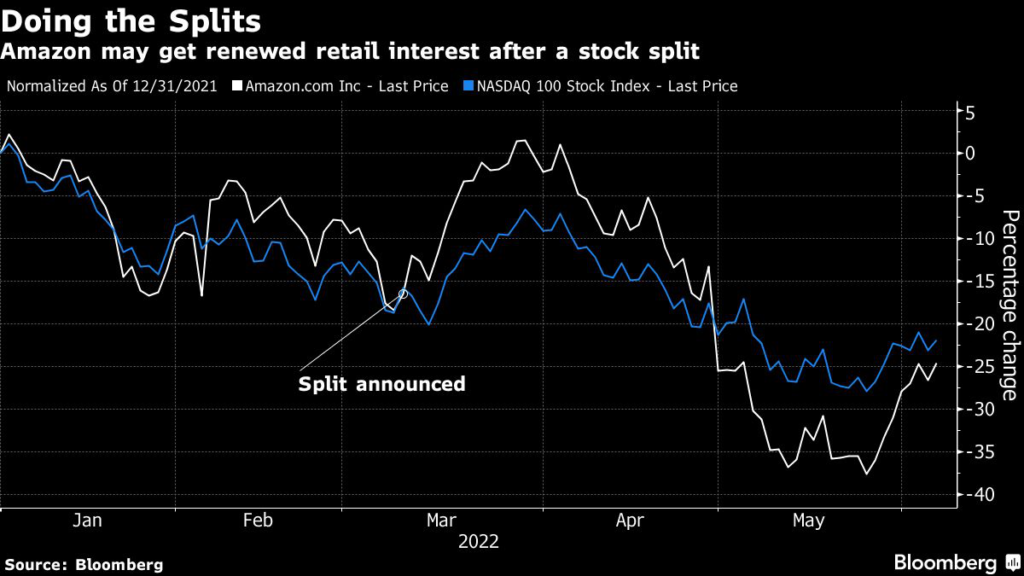
(Bloomberg) — Amazon.com Inc. shares rose on Monday, in the first trading session following a 20-for-1 stock split, the e-commerce company’s first such move in more than two decades.

Shares gained 2%, easily outperforming the Nasdaq 100 Index, which rose 0.4%, though tech stocks gained broadly after China eased Covid restrictions. The split could make the stock more attractive to retail investors, and nearly 134 million shares exchanged hands on Monday, above the stock’s daily average volume over the past three months. 

“While we view this event as a largely non-fundamental one, we believe a stock split and potential retail trading activity could provide an incremental catalyst to turn sentiment,” wrote Rohit Kulkarni, an analyst at MKM Partners.

When the split was first announced in March, Amazon said making the stock “more accessible” for average investors was a reason behind the decision.

The stock is coming off a two-week gain of about 14%, but it remains down more than 10% since March 9, when the split was first announced. So far this year, Amazon shares are down 25%, compared with a 23% decline in the Nasdaq 100 Index.

Among other notable names, Apple Inc shares rose 0.5% on Monday, while Microsoft Corp. slipped 0.5%, Alphabet Inc. added 2%, and Meta Platforms Inc. rose 1.8%.

The year’s weakness has come as investors dump tech and other growth names amid an economic backdrop marked by rising interest rates, slowing economic growth, and high inflation. Analysts have also recently pared back their expectations for online retail revenue growth.


Despite the recent weakness in the stock, Wall Street remains almost universally positive on Amazon’s prospects, as about 95% of the analysts tracked by Bloomberg recommend buying it, given long-term growth prospects in online retail and cloud computing. Compared with the 56 positive analysts, there is just one firm that recommends holding it, and two advocating selling. The average analyst price target points to upside of more than 40%.

Amazon is not the only major company to announce a split this year. Google parent Alphabet announced a 20-to-1 of its own in early February; that is scheduled to take place next month. Shopify announced a 10-for-1 stock split in April, and electric-vehicle company Tesla Inc. in March said it would ask investors this year to approve the creation of additional shares for the purposes of another split, following a 5-for-1 exchange in 2020.

(Updates with the close of trading.)

More stories like this are available on bloomberg.com

©2022 Bloomberg L.P.

Stocks Rise as Higher Yields Keep Check on Rally: Markets Wrap

(Bloomberg) — The push and pull between bond yields and equities continued Monday, with stock gains kept in check by a drop in Treasuries that pushed a swath of rates above 3%. 

The S&P 500 held onto a gain in a choppy session that saw the index climb as much as 1.5% before paring it back. Blue chips in the Dow Jones Industrial Average were little changed. Amazon.com Inc. rose after implementing a 20-for-1 stock split. Twitter Inc. fell after Elon Musk said he believes the company is breaching their merger agreement by not providing information about spam and fake accounts he demanded.

Stocks rallied early in the session after Beijing’s latest move to ease Covid restrictions boosted speculation this would help abate supply-chain pressures. Meanwhile, the selloff in Treasuries sent 10-year yields back above 3%, a level not seen since mid-May and a potential headwind for risk sentiment. Equities have struggled to mount a sustainable rebound amid fears rising borrowing costs will hurt growth and corporate earnings.

“I am actually surprised the market was up as strongly as it was this morning,” said Joe Gilbert, portfolio manager for Integrity Asset Management. “It will be tough to rally, I believe, with the 10-year yield moving meaningfully above 3.00%.”

The pound held gains after UK Prime Minister Boris Johnson survived a leadership vote. In a secret ballot on Monday evening, 211 Tory MPs voted for Johnson compared with 148 against.

Data last week showing stronger-than-forecast US hiring for May suggested the Federal Reserve won’t waver from its tightening path to rein in price pressures. But Goldman Sachs Group Inc. economists said the Fed may be able to pull off its aggressive rate-hike plan without tipping the country into recession. 

Chinese regulators are set to ease curbs on ride-hailing giant Didi Global Inc. and other US-listed tech firms, sending Didi’s shares up more than 20%. Chinese internet stock JD.com Inc. led gains on the Nasdaq 100. Bitcoin rose back above the $31,000 mark.

Read more: JPMorgan’s Kolanovic Sees Buying Opportunity in Chinese Stocks

Market commentary

  • “This year’s decline has not priced-in much of the slowdown in economic growth that we’re going to get this year,” said Matt Maley, chief market strategist at Miller Tabak + Co. “The decline so far has only worked off the overvaluation that existed at the beginning of the year.”
  • “Markets are naturally taking it all in and are navigating monetary policy and economic transition,” wrote John Stoltzfus, chief investment strategist at Oppenheimer. “Times like these we have found over the years require patience, prudent diversification and a sense of context. In spite of their troublesome nature in hindsight such downdrafts create opportunity for traders and investors.”
  • “A strong consumer that keeps inflation too high for the Fed for too long is a significant risk,” wrote Dennis DeBusschere, the founder of 22V Research. “This week’s CPI report will help determine if price gains are slowing enough to give the Fed comfort or if more aggressive rate hikes/rhetoric will be needed to slow growth. Investors are much more focused on CPI than payroll or other data points.”
  • “The upbeat mood was lifted further by signs of Beijing and Shanghai returning to everyday life,” Fiona Cincotta, senior financial markets analyst at City Index, said in a note. “Still, inflation concerns are not going anywhere fast. Rising crude oil prices and a strong labor report have lifted bets that the Fed may need to act aggressively to rein in inflation. US CPI data and consumer confidence data, both due on Friday, will be the key focus of the market this week.”

The US jobs report Friday quelled some concern that the world’s biggest economy is slowing too sharply, but also strengthened the view that the Fed will keep hiking rates to combat inflation. Investors bought equities last week, with US stocks seeing a fourth straight week of inflows as a bear market rally continues, according to Bank of America strategists, citing EPFR Global data.

Read: Team Transitory Is Back Warning Big Rate Hikes Are a Big Mistake

Meanwhile, the European Central Bank is set to announce an end to bond purchases this week and formally begin the countdown to an increase in borrowing costs in July, joining global peers tightening monetary policy in the face of hot inflation. The ECB is planniing to strengthen its support of vulnerable euro-area debt markets if they are hit by a selloff, Financial Times reported. 

Tech stocks and crypto are vulnerable in the era of quantitative tightening, our latest MLIV Pulse survey shows. Read more here.

Key events to watch this week:

  • Reserve Bank of Australia policy decision Tuesday
  • World Bank’s “Global Economic Prospects” report Tuesday
  • Reserve Bank of India rate decision Wednesday
  • OECD Economic Outlook, a twice-yearly analysis of major global economic trends and prospects for the next two years. Wednesday
  • European Central Bank rate decision, Christine Lagarde briefing, Thursday
  • China trade, new yuan loans, money supply, aggregate financing. Thursday
  • US CPI, University of Michigan consumer sentiment Friday
  • China CPI, PPI Friday

Some of the main moves in markets:

Stocks

  • The S&P 500 rose 0.3% as of 4 p.m. New York time
  • The Nasdaq 100 rose 0.4%
  • The Dow Jones Industrial Average was little changed
  • The MSCI World index rose 0.4%

Currencies

  • The Bloomberg Dollar Spot Index rose 0.2%
  • The euro fell 0.2% to $1.0695
  • The British pound rose 0.4% to $1.2536
  • The Japanese yen fell 0.8% to 131.87 per dollar

Bonds

  • The yield on 10-year Treasuries advanced 10 basis points to 3.04%
  • Germany’s 10-year yield advanced five basis points to 1.32%
  • Britain’s 10-year yield advanced nine basis points to 2.25%

Commodities

  • West Texas Intermediate crude fell 0.5% to $118.31 a barrel
  • Gold futures fell 0.3% to $1,844.70 an ounce

More stories like this are available on bloomberg.com

©2022 Bloomberg L.P.
US Probes Binance Over Token That Is Now World’s Fifth Largest

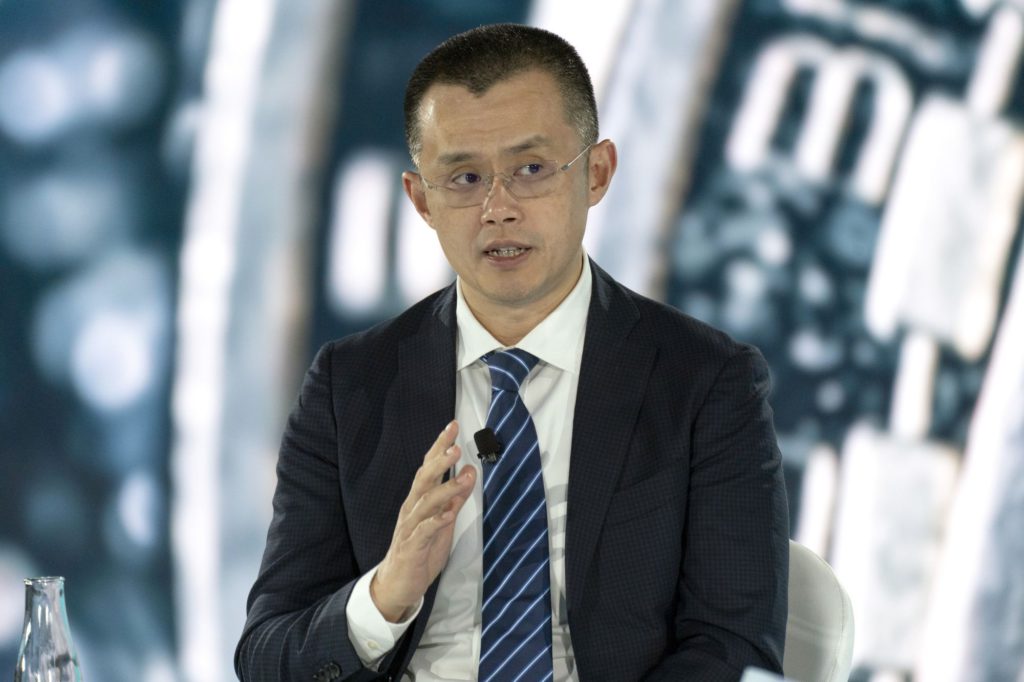
(Bloomberg) — US regulators are investigating whether Binance Holdings Ltd. broke securities rules by selling digital tokens just as the crypto exchange was getting off the ground five years ago, according to people familiar with the matter.

The Securities and Exchange Commission’s review pries into the firm’s origins and those of its BNB token, which is now the world’s fifth-biggest. Investigators are examining if the 2017 initial coin offering amounted to the sale of a security that should have been registered with the agency, said the people who were granted anonymity to discuss the confidential probe.

Scrutiny of BNB’s beginnings may be a troubling development for Binance as it faces multiple investigations in Washington. The SEC has brought dozens of enforcement actions over ICOs, which involve issuing virtual coins to raise money. BNB has been a feature of Binance’s expansive crypto empire

In a statement, Binance said “it would not be appropriate for us to comment on our ongoing conversations with regulators, which include education, assistance, and voluntary responses to information requests.” The company added that it works with authorities and “we will continue to meet all requirements set by regulators.” 

The SEC declined to comment.

A virtual currency may fall under the SEC’s remit if investors buy it to fund a company or project with the intention of profiting from those efforts. That determination is based on a 1946 US Supreme Court decision defining investment contracts. 

Binance, which runs the world’s biggest exchange and says it’s not domiciled in any one country but has affiliates scattered across the globe, has emerged as a focal point for American investigators seeking to rein in the crypto industry. Bloomberg News has previously reported it faces investigations from the Justice Department, the Commodity Futures Trading Commission and the Internal Revenue Service.

Funds raised

Ahead of BNB’s launch in 2017, Binance laid out its plans in a white paper. The document said its circulation would be limited to 200 million with half of the tokens being sold through the ICO, which took place on multiple platforms throughout the world. Another 80 million would be reserved for Binance’s founding team, which includes its billionaire chief executive officer, Changpeng Zhao. 

In the white paper, which was reviewed by Bloomberg, Binance said as much as 85% of the funds raised in the ICO were to be used to build and market Binance’s global exchange. It made no mention of restrictions on who could participate. 

In order to entice investors to BNB, Binance has offered lower fees for traders paying with the token. It’s also paid many of its contractors in the currency, including at least one US resident who said said he purchased BNB during the ICO — a detail that could be key for the SEC asserting jurisdiction in any case it might bring.

An SEC enforcement investigation may not lead to the regulator suing a firm or individuals. The probe involving BNB is likely months away from any conclusion, one of the people familiar with the matter said.

Beyond BNB, the SEC is also probing possible trading abuses by Binance insiders and whether Binance.US, an American affiliate formed in 2019, is appropriately hived off from its global counterpart, one of the people said. 

Binance.US

Another person with direct knowledge of the review said the SEC is also looking at market-making companies tied to Zhao, who is widely known as CZ. The SEC has expressed interest in Zhao’s ownership stakes of market makers on Binance.US and whether the exchange has conducted broker-dealer activities, the person said. 

Binance emphasized that Binance.com and Binance.US “are separate entities,” with the former only for non-US users. “Binance.US is a separate US-focused trading platform that services US users by offering products and services that are compliant with US federal and state regulations,” the firm said.

In a separate statement, Binance.US said it was “committed to upholding the highest standards of compliance.”

Amid crypto’s meteoric rise during the Covid-19 pandemic, BNB has surged in value. The coin is currently valued around $300 and has a market capitalization of about $48.5 billion. It’s also been an integral part of Binance’s ever-expanding crypto ecosystem, which now includes everything from digital wallets to its own blockchain.

Binance Coin

Recently, as part of a broader rebranding of its blockchain, Binance switched BNB’s full name to Build and Build from Binance Coin. The company said it made the changes based on feedback from users about “the need to further solidify the decentralized nature of the chain and reinforce the community’s governance over the chain.”

The firm also backed away from plans laid out in the ICO’s white paper to spend 20% of the exchange’s profits every quarter to buy back BNB. Zhao in a 2020 blog post said the change was made in response to legal advice “indicating the potential for being misunderstood as a security” in some regions.

A finding that the BNB is a security could put Binance in a similar position as Ripple Labs Inc., which is locked in a bitter court battle with the SEC after the regulator sued the firm and two of its executives in December 2020 for allegedly breaking rules in selling a crypto token known as XRP. Ripple argues the token functions as a medium of exchange for virtual currency rather than a security, and that the SEC’s legal theory is flawed.

Since taking over in April 2021, SEC Chair Gary Gensler has said that virtually all ICOs are securities and should be regulated by his agency. 

More stories like this are available on bloomberg.com

©2022 Bloomberg L.P.
Marxism Makes a Comeback in China’s Crackdown on ‘Disorderly Capital’

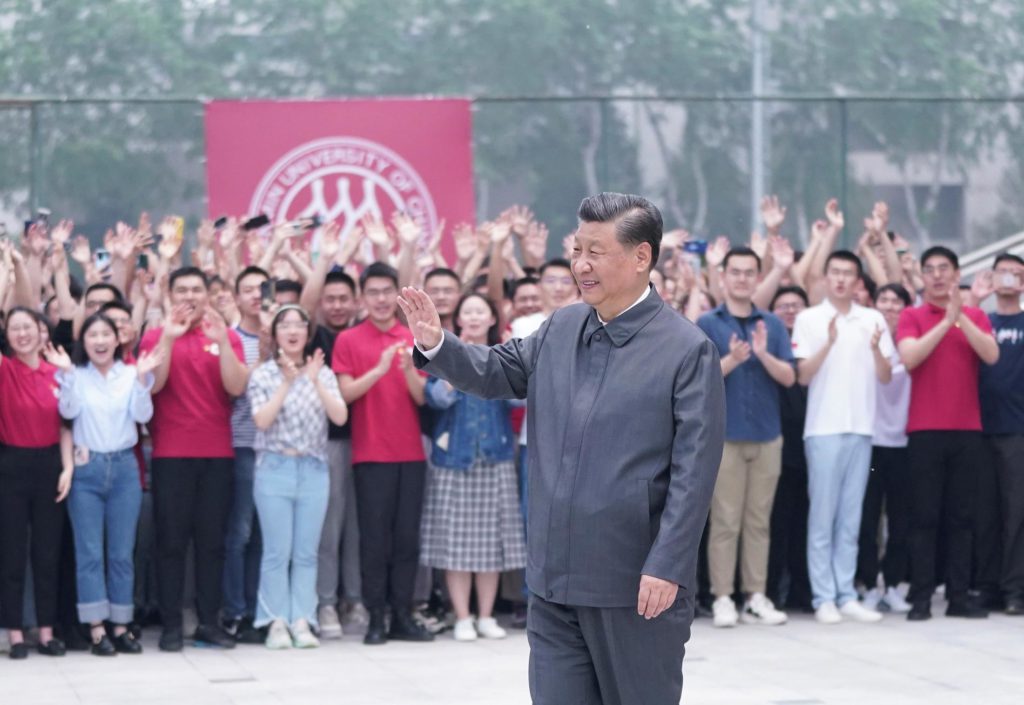
(Bloomberg Markets) — Cheers greeted China President Xi Jinping as he toured Beijing’s Renmin University of China in April, telling students and teachers: “We must continue to promote the modernization of Marxism.” Social science research, he said, should have “Chinese characteristics” and contribute to “China’s independent knowledge system.”

It was a notable contrast to 11 years earlier, when Hu Jintao, Xi’s predecessor, visited the same campus, “listening carefully” to discussions on macroeconomics. That was in China’s boom years. The economy was growing faster than 10% a year, and private entrepreneurs in sectors such as real estate and technology operated with more autonomy than ever. Corruption and pollution were rampant. Karl Marx wasn’t mentioned.

Now, Xi was meeting with two “political economists”—Liu Wei, the university’s president, and Zhao Feng—who blend Marxism with elements of Western economics. The visit highlighted China’s pivot to funding and supporting researchers who are suspicious of the power of private business, with some advocating barring private capital from entire sectors. The message was clear: In today’s China, Marxism is back, and investors had better take note.

The intellectual shift hasn’t happened overnight, but it has become more evident in the past two years. Since the end of 2020, when China’s Communist Party began vowing to rein in the “disorderly expansion of capital,” a regulatory onslaught has swept through the economy and stock market. Beijing reduced the power of the country’s largest internet and video game companies with new rules backed by tough fines and launched a campaign to slow debt growth, choking the private-­sector-dominated real estate industry. Then the huge industry offering for-profit tutoring to schoolchildren was outlawed entirely.

At first, economists at investment banks interpreted the party’s statements on disorderly capital expansion as a call to rein in the power of big companies that was similar to antitrust efforts the US and Europe were bringing to bear on tech platforms. But political economists empowered by Xi have seen it differently: as calling for a wholesale revamp of the relationship between the state and private business.

“What Xi is trying to do is use the state to order away the problems of capitalism,” says Yuen Yuen Ang, an assistant professor at the University of Michigan and an expert on Chinese policy.

Xi and thinkers in his circle don’t put it that way, of course. Capitalism doesn’t officially exist in China’s “socialist market economy.” Any scholar who wants to publish openly must not deviate too far from the party line.

The party’s definition does capture something ­important: China combines state planning and ownership in critical areas such as heavy industry and finance with a more hands-off approach to sectors seen as less strategic. Since the 1980s, under the influence of Western theories that markets promote efficiency, Beijing allowed companies to determine prices and production for almost all products based on supply and demand. The state hardly intervened in labor markets, except through the hukou policy that bars migrant workers from social security benefits available in cities. With little redistribution of wealth, rich entrepreneurs often exerted influence on policy, some developing cronyish ties to local officials.

The model endured for more than three decades, but soaring inequality and corruption eroded its legitimacy. With his intense crackdowns on graft and calls for “common prosperity,” Xi has put key elements of it in question—and he’s not done yet.

Read More:  What ‘Common Prosperity’ Means and Why Xi Wants It

Xi, who turns 69 in June, formed his early political views in the 1960s, at the high point of Marxist influence on China. Although he made his name running provinces with some of China’s largest private businesses, he remains true to those early lessons. “Marx and Engels’s analysis of the basic contradictions of capitalist society is not outdated,” Xi said in one of his last major speeches as party leader before becoming president in 2013. “Nor is the historical materialist view that capitalism is bound to die out and socialism bound to win.”

By 2015, Xi was calling for a break from the stranglehold of Western-influenced economics, urging academics to summarize the nation’s experience into a new body of theory, which he referred to as “Chinese Marxist Political Economy.” The 2008 financial crash had already convinced many that Western economists no longer had the answers. With the party in charge of universities, the new theory has become a major research priority for academics, who now refer to it as “Socialist Political Economy With Chinese Characteristics” (SPECC).

Money is flowing in. Before 2016 a handful of “political economy” studies appeared on the annual list of social science research projects eligible for the central government’s support. By 2019 the number had risen to 18. Beijing created seven SPECC research centers at the country’s top universities, where researchers write policy suggestions and draft textbooks. Both of the economists Xi met during his April university visit were from the college’s SPECC center, led by Liu.

Western economics “cannot be blindly worshipped or simplistically copied,” states a SPECC textbook for undergraduates. Marxist theories such as exploitation and surplus value are used to explain the economy.

China’s political economists aren’t calling for a ­wholesale nationalization of the economy, but some are calling for sectors to be closed off to private business. According to the SPECC textbook, since capitalist profits represent exploitation of workers, the fact that state-owned companies’ profits are owned by the state (and used to benefit the people) makes China’s system superior to capitalism. Zhao, one of the political economists who met Xi in April, says that “only in a society of public ownership” can common prosperity be realized.

In 2021 investors struggled to predict which industries the regulatory storm would hit next, shaking confidence and adding a headwind to economic growth. This year, Xi and top leaders vowed to create a “traffic light” system to provide a clearer guide. Political economists are likely to shape that system.

Bruce Pang, head of macro and strategy research at China Renaissance Securities, says he watches the output of research institutes at leading Chinese universities and think tanks that operate under the State Council, the body that runs the government on a daily basis. They act as channels for information and intelligence gathering and for policy testing and dissemination. “Regulatory pressure could be the new normal,” he says.

After the party introduced the phrase “disorderly expansion of capital,” Jiang Yu, one of the younger generation of SPECC theorists (he was born in the 1980s), explained that it was meant to warn private entrepreneurs against challenging the party’s policies.

“The fundamental criterion for judging whether there is disorderly expansion of capital is whether capital’s role has crossed the bottom line of the socialist system,” wrote Jiang, a researcher at the Development Research Center of the State Council. “The bottom line includes not jeopardizing the party’s leadership.”

Jiang started his career by researching China’s health-care system, which has been progressively opened to ­private-sector ownership since the 1990s. “When I first studied Western economics, I thought that the market could have a guiding role in the health-care sector. But on-the-ground investigation changed my viewpoint. I saw that privatization was hurting patients,” he wrote in 2019. Now, “legislation should keep profit-seeking capital out of the medical service system,” he argues. Such sentiments indicate health care could be a possible target for future regulatory campaigns.

Other SPECC economists argue that the expansion of capital relates specifically to the financial system, which they refer to in Marxist terms as “fictitious capital.” Entrepreneurs are speculating on financial assets and real estate to make quick returns instead of investing in the “real” economy, such as manufacturing, they say. Their views provide intellectual heft to Xi’s battle to reduce leverage in the economy and make housing “for living in, not for speculating on”—even at the cost of slower economic growth.

Some political economists are more positive about the benefits of private business, however. And lately there are signs Xi is leaning toward this camp as coronavirus ­lockdowns and a property slump weigh on the economy. In early May, veteran economist Liu Yuanchun, who provided macro­economic forecasts to Hu’s administration, was summoned from Renmin University’s SPECC center to lecture the party’s top decision-making body, the Politburo.

Liu has highlighted Marx’s view that capitalism, though bloody, “created more wealth than human beings have ever seen,” and points to European-style welfare states as a model for taming the free-market system. He also looks to early 20th century America’s Progressive Era, with its efforts to rein in monopolistic corporations, tackle corruption, and avert credit-driven booms and busts through tougher financial rules. For now, China should “strike a relative balance between labor and capital, not taking one side or the other,” he argued in a recent article.

Following the meeting, Xi repeated the mantra about preventing the disorderly expansion of capital and warned that failure to regulate its growth “will cause inestimable damage.” But he added that “it is necessary to stimulate the vitality of capital of all types, including nonpublic capital, and give full play to its positive role.” Chinese capitalists breathed a sigh of relief. For now.

Hancock is the senior reporter covering China’s economy for Bloomberg News.

More stories like this are available on bloomberg.com

©2022 Bloomberg L.P.
Ukraine Latest: Russia Bans Americans Including Yellen, Fink

(Bloomberg) — Ukraine is in talks with the United Nations on potential ways to export grain from ports blocked by Russia’s military, President Volodymyr Zelenskiy said, but Kyiv remains skeptical toward a tentative deal between Turkey and Moscow to restart shipments.

India, meanwhile, is in talks to boost crude imports from Rosneft PJSC as refiners in Asia’s second-biggest oil market have been enjoying a windfall from discounted Russian oil. 

Russian Foreign Minister Sergei Lavrov was prevented from visiting Serbia after that country’s neighbors banned his flight from their airspace. And Russia slapped back at what it called “constantly expanding sanctions” against its citizens by barring visits by Americans including Treasury Secretary Janet Yellen and BlackRock Inc.’s Larry Fink.

The UK plans to send rocket systems to Ukraine that will let it strike locations as far as 80 kilometers (50 miles) away, less than a week after the US said it would provide similar weapons. Russian President Vladimir Putin threatened to strike new targets in Ukraine if longer-range missiles are delivered. 

(See RSAN on the Bloomberg Terminal for the Russian Sanctions Dashboard.)

Key Developments 

(All times in CET)

  • The Internet Pioneer Brought Low as Kremlin Ally by EU Sanctions
  • Ukraine’s Tactics Show Smaller Countries How to Fight Back
  • Putin Critic Kallas Needs New Allies to Stay in Power in Estonia
  • Oil Tankers Make Rare Mid-Atlantic Switch of Russian Crude Cargo
  • Ukraine Migration Maps ‘What’s Possible’ for Climate Displaced


Serbian Opposition to Russia Sanctions Will Continue, Vucic Says (9:09 p.m.)

Serbia still “refuses to be part of the pack” that imposed sanctions against Russia, President Aleksandar Vucic said. He deplored the ban by some of its neighbors on Russian Foreign Minister Sergey Lavrov’s flight to Belgrade as blocking Serbia’s leadership from even talking to the Russian official.

The embargo on Russian oil would cost the Balkan country an estimated $600 million a year because it will have to pay instead for Iraqi crude that costs some $30 more per barrel, he said in live interview on state broadcaster RTS.

More pressure on Serbia to align its policy with the European Union, which it aspires to join, is expected on Friday when German Chancellor Olaf Scholz visits Belgrade, he said. “Serbia must hurry up on its European path, no matter how contradictory this may sound,” Vucic said.

Tough action on Russia would be politically difficult for Vucic. Serbia has deep, historic ties with Russia. It relies on Russia for natural gas, geopolitical support over the disputed secession of its former province Kosovo, and for substantial defense equipment.

Russia Bans Entry to 61 Americans, Including Yellen and Fink (8:17 pm)

Russia banned entry to the country “indefinitely” by 61 US nationals, including Treasury Secretary Janet Yellen, to retaliate for “constantly expanding sanctions” against its citizens,the Foreign Ministry said in a statement on its website.

Executives covered by the symbolic travel ban include BlackRock’s Larry Fink, Delta Airlines CEO Edward Bastian, Fitch Group CEO Paul Taylor and Universal Pictures President Peter Cramer as well as Nasdaq and NYSE executives.

The Foreign Ministry said the “indefinite ban” targets leaders of the US defense industry, media platforms and rating agencies, air- and ship-building companies and several State Department officials cited for spreading allegedly fake news about Russian cyberattacks, the country’s Foreign Ministry said on its website.

US Goes After Billionaire Abramovich’s Planes (6:35 p.m.)

The US obtained a warrant to seize two jets owned or controlled by Russian billionaire Roman Abramovich.

US Magistrate Judge Sara Cave signed a warrant of seizure Monday for a Boeing 787-8 Dreamliner and a Gulfstream G650ER, according to documents released by the office of Manhattan US Attorney Damian Williams.

The Boeing has remained in Dubai since March, while the Gulfstream has been in Moscow since then, according to an FBI affidavit.

Zelenskiy Cites Intel Saying Russia Wants to Occupy Zaporizhzhia (5:46 p.m)

Zelenskiy said that “the most dangerous situation” of the war at present is in Zaporizhzhia, a region west of Donetsk that is partly occupied by Russian forces.

“We understand, and we see from intercepted calls, that the enemy wants to occupy Zaporizhzhia,” Zelenskiy told journalists at a press conference in Kyiv. Ukrainian forces are still fighting in Sievierodonetsk, although they are outnumbered by Russian personnel and heavy weapons, he said.

Russia’s Crude Oil Revenues Take a Hit Even as Exports Swell (5:43 p.m.)

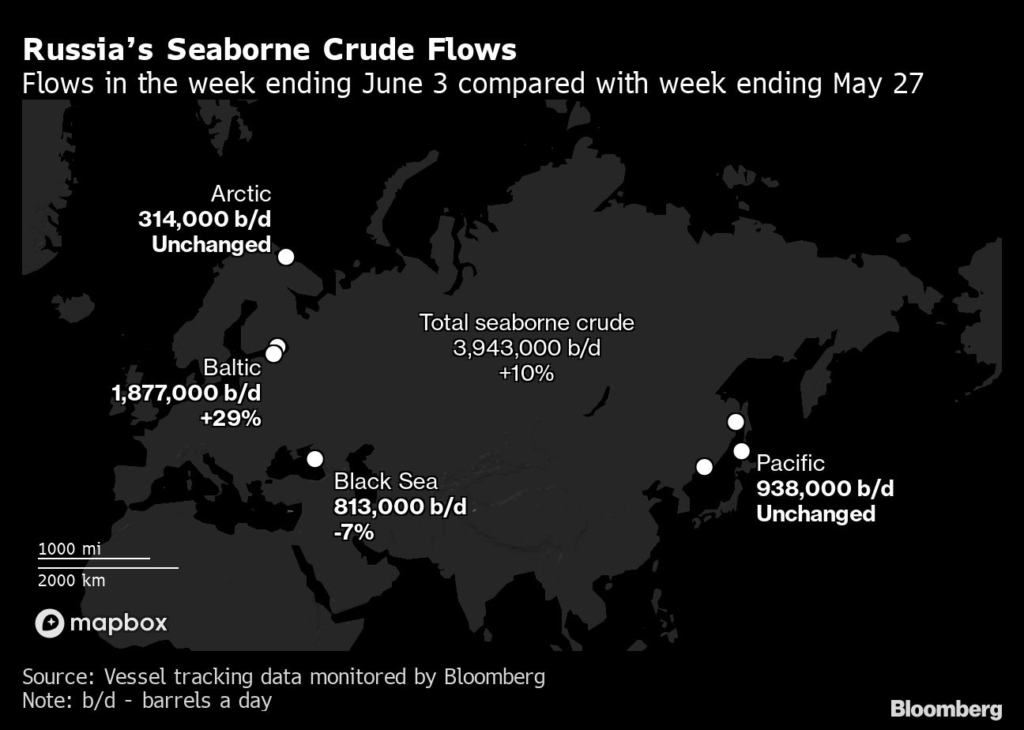
Russia is earning less from its oil exports, even as seaborne crude shipments surge to a six-week high. That’s because of the big discounts that Moscow is having to offer Asian buyers to snap up barrels shunned by Europe, which translate into a drop in export duties. Read more here.

Ukraine in Talks With UN to Export Grain, President Says (4:47 p.m.)

Ukraine is in talks with the United Nations on ways to arrange grain exports, Zelenskiy said, adding that he has discussed the situation with Turkish President Recep Tayyip Erdogan.

As much as 25 million tons of grain is blocked from export in Ukraine’s ports, and that may rise to 75 million tons by autumn, Zelenskiy said. Ukraine rejected an offer to use Belarus’s rail links, he said, adding that Kyiv wasn’t invited to talks between Russia and Turkey.

While Ukraine wants guarantees from “countries which we can trust and which will have accords with Russia,” the best guarantee for safe exports will be weapons Ukraine can use to strike Russian ships if they attack Ukrainian ports, Zelenskiy said.

Latvia Bans 80 Russian TV Channels Until War Ends (2:01 p.m.)

Latvia banned the remaining 80 Russian-registered TV channels operating there from broadcasting until Russia ends its war in Ukraine and returns Crimea to Kyiv’s control, the Leta news service reported, citing Ivars Abolins, the chairman of the National Electronic Mass Media Council.

The Baltic country, which neighbors Russia and has a large Russian-speaking minority, is one of Europe’s harshest critics of the war in Ukraine. Abolins said Monday that Latvia had given a broadcasting license to TV Rain, an independent Russian TV channel that was banned by Moscow in March.

Read more: Putin’s Crackdown Pushes Independent Russian Media Into Crypto

Serbian Leader Decries Derailing of Lavrov Visit (1:42 p.m.)

Serbian President Aleksandar Vucic, who was supposed to host Lavrov this week in Belgrade, said he was displeased how neighboring countries prevented the visit by banning Lavrov’s flight from their airspace.

Still, Lavrov will soon meet his Serbian counterpart, Nikola Selakovic, at an undisclosed location and time, Vucic said. In Moscow, Lavrov called the move by Bulgaria, North Macedonia and Montenegro to block him from their airspace “unprecedented.”

Lavrov is a great and proven friend” of Serbia, Defense Minister Aleksandar Vulin said in separate comments in Belgrade. “Serbia is proud of not being part of the anti-Russia hysteria,” Vulin said.

Russian Car Sales at Record Low as Sanctions Sting (12:39 p.m.)

Russian car sales plunged 84% in May, as sanctions and international isolation brought an industry that had once been a showcase for foreign investment to a near standstill.

Fewer than 25,000 vehicles were sold last month, according to the Association of European Businesses, the lowest since at least 2006 and less than a tenth of the monthly levels seen in peak months in the past.

Read more: Russian Car Sales Collapse as Isolation Hits Once-Hot Industry

India in Talks to Increase Oil Imports From Rosneft (12:21 p.m.)

India is looking to boost Russian oil imports, with state-owned refiners eager to take more heavily-discounted supplies from Rosneft after Europe enacted a partial ban.

State processors are collectively working on securing new six-month supply contracts for Russian crude to India, according to people with knowledge of the companies’ procurement plans. They are in talks with Rosneft, Russia’s state-owned oil champion, with the seller set to handle shipping and insurance matters, they said.

China and India have snapped up millions of barrels of Russian crude to take advantage of hefty discounts as sanctions by the US, UK and European Union have caused most western buyers to stop buying oil from the country.

Read more: India in Talks to Increase Russian Oil Imports From Rosneft

Ukraine Skeptical of Turkey-Russia Deal to Ship Grain (11:31 a.m.)

Turkish President Recep Tayyip Erdogan’s government has offered military help to clear mines off the coast of Odesa and escort grain ships but Ukraine has yet to endorse the plan, worried that removing defenses could leave the vital port open to Russian attack, people familiar with the deal said, speaking on condition of anonymity to discuss matters that aren’t yet public.

Russian Foreign Minister Sergei Lavrov is expected to hold talks in Ankara on the plan on Wednesday. It remains unclear whether Ukraine will send a representative. “By commenting in advance on reaching the deal, Russia is seeking to shift responsibility to Ukraine” for disrupting supplies, Ukraine’s Deputy Economy Minister Taras Kachka said. 

The Kremlin’s invasion has cut off shipments of grain and other farm products from Ukraine, threatening millions of people in its traditional markets with food shortages. Moscow has denied responsibility for the disruption but demanded relief from US and European sanctions limiting its exports of fertilizer and agricultural products.

Read more: Ukraine Cautious as Turkey, Russia Push Black Sea Grain Deal

Ukraine Says Russian General Killed (8:31 a.m.)

Russian Major General Roman Kutuzov was killed, Ukraine’s army said on its Facebook page. Earlier, Meduza reported Kutuzov died in fighting in the Luhansk region, citing a journalist for Russian state-run television station. Russia’s Defense Ministry hasn’t commented.

UK to Send Rocket Systems (12:01 a.m.)

The UK is to send multiple-launch rocket systems to Ukraine, Defence Secretary Ben Wallace announced. The move has been coordinated closely with the US decision to send the High Mobility Artillery Rocket System variant of MLRS to Ukraine, where forces have requested longer-range precision weapons.

“As Russia’s tactics change, so must our support to Ukraine,” Wallace said. “These highly capable multiple-launch rocket systems will enable our Ukrainian friends to better protect themselves against the brutal use of long-range artillery, which Putin’s forces have used indiscriminately to flatten cities.”

The M270 weapons system, manufactured by Lockheed Martin, can strike targets up to 80 kilometers (50 miles) away with high accuracy, according to a statement released by the Ministry of Defence. The UK will also supply M31A1 munitions “at scale.”

Russia Seeks Buyers for Plundered Grain, New York Times Says (12:01 a.m.)

The US has told more than a dozen countries that Putin’s government is trying to sell plundered wheat from Ukraine to drought-stricken African nations, the New York Times reported citing a diplomatic cable.

The paper said that in mid-May, the US sent a notification to 14 countries, mostly in Africa, of Russian cargo vessels leaving ports near Ukraine laden with what the cable said was “stolen Ukrainian grain.”

Ukraine has accused Russia of looting grain in occupied areas and selling it abroad, and local traders have said Russian troops have confiscated grain, equipment and fertilizers in occupied areas in the country’s southeast. 

Read more: Egypt Says It Refused Undocumented Ukrainian Grain Shipment

More stories like this are available on bloomberg.com

©2022 Bloomberg L.P.

Close Bitnami banner
Bitnami
