

Bloomberg

US Stocks Pare Gains as Treasury Yields Climb: Markets Wrap

(Bloomberg) — US stocks pared gains as investors assessed prospects for growth in markets rattled by inflation and rate-hike concerns. Treasuries fell across the board, while the dollar caught bids.

The S&P 500 rose 0.3% after climbing more than 1%, while the tech-heavy Nasdaq 100 was marginally higher. Amazon.com Inc. advanced after implementing a 20-for-1 stock split. Twitter Inc. fell after Elon Musk said he believes the company is breaching their merger agreement by not providing information about spam and fake accounts he demanded.

Stocks rallied early in the session after Beijing’s latest move to ease Covid restrictions boosted speculation this would help abate supply-chain pressures. Meanwhile, the selloff in Treasuries sent 10-year yields back above 3%, a level not seen since mid-May and a potential headwind for risk sentiment. Equities have struggled to mount a sustainable rebound amid fears rising borrowing costs will hurt growth and corporate earnings.

“This year’s decline has not priced-in much of the slowdown in economic growth that we’re going to get this year,” said Matt Maley, chief market strategist at Miller Tabak + Co. “The decline so far has only worked off the overvaluation that existed at the beginning of the year.”

Data last week showing stronger-than-forecast US hiring for May suggested the Federal Reserve won’t waver from its tightening path to rein in price pressures. But Goldman Sachs Group Inc. economists said the Fed may be able to pull off its aggressive rate-hike plan without tipping the country into recession. 

Chinese regulators are set to ease curbs on ride-hailing giant Didi Global Inc. and other US-listed tech firms, sending Didi’s shares up more than 50%. Bitcoin rose back above the $31,000 mark.

Market commentary

  • “Markets are naturally taking it all in and are navigating monetary policy and economic transition,” wrote John Stoltzfus, chief investment strategist at Oppenheimer. “Times like these we have found over the years require patience, prudent diversification and a sense of context. In spite of their troublesome nature in hindsight such downdrafts create opportunity for traders and investors.”
  • “A strong consumer that keeps inflation too high for the Fed for too long is a significant risk,” wrote Dennis DeBusschere, the founder of 22V Research. “This week’s CPI report will help determine if price gains are slowing enough to give the Fed comfort or if more aggressive rate hikes/rhetoric will be needed to slow growth. Investors are much more focused on CPI than payroll or other data points.”
  • “The upbeat mood was lifted further by signs of Beijing and Shanghai returning to everyday life,” Fiona Cincotta, senior financial markets analyst at City Index, said in a note. “Still, inflation concerns are not going anywhere fast. Rising crude oil prices and a strong labor report have lifted bets that the Fed may need to act aggressively to rein in inflation. US CPI data and consumer confidence data, both due on Friday, will be the key focus of the market this week.”

The US jobs report Friday quelled some concern that the world’s biggest economy is slowing too sharply, but also strengthened the view that the Fed will keep hiking rates to combat inflation. Investors bought equities last week, with US stocks seeing a fourth straight week of inflows as a bear market rally continues, according to Bank of America strategists, citing EPFR Global data.

Read: Team Transitory Is Back Warning Big Rate Hikes Are a Big Mistake

Crude oil held around $119 a barrel in New York after Saudi Arabia signaled confidence in demand with a larger-than-expected price increase in Asia. Meanwhile, the US was said to be considering allowing more sanctioned Iranian oil onto global markets to counter the decline in Russian supplies.

Meanwhile, the European Central Bank is set to announce an end to bond purchases this week and formally begin the countdown to an increase in borrowing costs in July, joining global peers tightening monetary policy in the face of hot inflation. The ECB is planniing to strengthen its support of vulnerable euro-area debt markets if they are hit by a selloff, Financial Times reported. 

Tech stocks and crypto are vulnerable in the era of quantitative tightening, our latest MLIV Pulse survey shows. Read more here.

Key events to watch this week:

  • Reserve Bank of Australia policy decision Tuesday
  • World Bank’s “Global Economic Prospects” report Tuesday
  • Reserve Bank of India rate decision Wednesday
  • OECD Economic Outlook, a twice-yearly analysis of major global economic trends and prospects for the next two years. Wednesday
  • European Central Bank rate decision, Christine Lagarde briefing, Thursday
  • China trade, new yuan loans, money supply, aggregate financing. Thursday
  • US CPI, University of Michigan consumer sentiment Friday
  • China CPI, PPI Friday

Some of the main moves in markets:

Stocks

  • The S&P 500 rose 0.3% as of 12:17 p.m. New York time
  • The Nasdaq 100 rose 0.2%
  • The Dow Jones Industrial Average was little changed
  • The MSCI World index rose 0.4%

Currencies

  • The Bloomberg Dollar Spot Index rose 0.2%
  • The euro fell 0.2% to $1.0697
  • The British pound rose 0.4% to $1.2539
  • The Japanese yen fell 0.5% to 131.55 per dollar

Bonds

  • The yield on 10-year Treasuries advanced eight basis points to 3.02%
  • Germany’s 10-year yield advanced five basis points to 1.32%
  • Britain’s 10-year yield advanced nine basis points to 2.25%

Commodities

  • West Texas Intermediate crude rose 0.2% to $119.11 a barrel
  • Gold futures fell 0.3% to $1,845 an ounce

More stories like this are available on bloomberg.com

©2022 Bloomberg L.P.

Spotify Names New Leader to Strategize Creator Growth

(Bloomberg) — Spotify Technology SA named a new executive to oversee its creator and talk-content strategy, the latest in a series of management shuffles at the company.

Maya Prohovnik, most recently the director of research and development for talk content, has been named the head of talk, according to people familiar with the situation who asked not to be named because the news hasn’t been made public. She will replace Michael Mignano, who announced his plans to leave in May. In her new role, Prohovnik will oversee Spotify’s efforts to court creators, including podcasters, and build features that will bring them to the platform. This includes managing the company’s live-audio product, video podcasting and Anchor, a podcast hosting and creation service. Chief Executive Officer Daniel Ek wants to reach 50 million creators on Spotify. Ek reportedly told employees in February that the company had 11 million creators.

Prohovnik was the first employee hired at Anchor in 2016 and joined Spotify when it acquired Anchor in 2019. Spotify has widely credited Anchor with growing the number of podcasts on its platform. In 2020, the company said Anchor powered around three quarters of new podcast releases. 

Prohovnik’s promotion comes only a few weeks after other reshuffling in Spotify’s leadership. The Ringer’s Bill Simmons, as well as Max Cutler, the founder of podcast network Parcast, and Julie McNamara were all promoted to oversee various parts of the company’s content strategy. Their team oversees Spotify’s homegrown content and high-profile talent deals.

Spotify shares have fallen 51% so far this year and traded at a record low in May as investors questioned whether the company’s podcast strategy is panning out. The business has also lost some high-profile executives in recent months.

More stories like this are available on bloomberg.com

©2022 Bloomberg L.P.
Citigroup Plans to Hire 4,000 Tech Staff to Tap Into ‘Digital Explosion’

(Bloomberg) — Citigroup Inc. plans to hire more than 4,000 tech staff to help move its institutional clients online in the wake of the pandemic. 

More than 1,000 of the recruits will join the markets technology team as part of an aggressive growth strategy, Jonathan Lofthouse, head of markets and enterprise risk technology, said in an interview.

“We’re trying to digitalize as much of our client experience as possible, front and back, and modernize our technology,” he said. “Those firms that can digitalize fastest are going to create competitive advantage.”

Banks are upgrading decades-old technology platforms to make services available remotely for both clients and workers, with multibillion-dollar programs that investors are watching closely for signs that this largess will eventually boost returns. At Citi, Chief Financial Officer Mark Mason said in March the lender raised tech spending by 10% to $10 billion last year. JPMorgan Chase & Co. boss Jamie Dimon said last month he just wants “to get it done” on the technology front, amid broader shareholder scrutiny of the bank’s expenses.

Data specialists are in particular demand across banking and the wider jobs market. Lofthouse said pay was a factor in getting new workers through the door, but training and flexible working models would help to keep them. Citi currently has more than 30,000 software engineers.

“Everyone in lockdown suddenly had to do everything digitally, whether that was getting groceries delivered or watching more Netflix,” he said. “We’ve always seen the tech market to be competitive but particularly at the moment, coming out of the pandemic, we’ve seen a digital explosion across industries.”

More stories like this are available on bloomberg.com

©2022 Bloomberg L.P.

Louisiana Probes Source of Methane Cloud Spotted From Space

(Bloomberg) — Louisiana is investigating the source of a cloud of methane that was spotted from space near multiple natural gas pipelines.

The state began its probe after Bloomberg News contacted the Louisiana Department of Natural Resources about a concentration of the planet-warming gas detected May 28 by a European Space Agency satellite. The plume had an emissions rate of 44 tons of methane an hour and was the most severe detected in the US since March 19, according to an analysis of the data by Kayrros SAS.If the release lasted an hour at the rate estimated by the geoanalytics firm, it would have roughly the same short-term impact as the annual emissions from about 800 US cars. A second plume identified the same day by the satellite that was roughly 25 miles (40 kilometers) southwest of the original release didn’t have enough information for Kayrros to estimate its emissions rate. 

Halting methane releases from fossil fuel operations is one of the most important steps that can be taken to slow global warming. Venting and non-emergency flaring of methane from oil and gas should be significantly reduced or eliminated to keep global temperatures from rising more than 1.5 degrees Celsius (2.7 degrees Fahrenheit), according to the International Energy Agency. 

The release under investigation likely originated within 6 miles of gas pipelines owned by Kinder Morgan Inc. and Boardwalk Pipelines LP and about 8 miles from an Energy Transfer pipeline, according to Kayrros. None of the three operators contacted by Bloomberg said they were responsible. Louisiana’s Department of Natural Resources said it was first made aware of the methane cloud by Bloomberg.“We are currently trying to see if there are any potential sources (wells or pipelines) that look to be close enough to have caused such a release,” Patrick Courreges, a representative for the state department, said in an email Friday. He said the agency is reaching out to the nearby operators and its field agents are looking for any physical evidence, such as a ruptured pipeline or disturbed ground.

Read more: As gas prices soar, nobody knows how much methane is leaking

The plume over Louisiana wasn’t caused by Kinder Morgan’s Midcontinent Express Pipeline, a company representative said. A Boardwalk spokesperson said its Gulf South pipeline didn’t have any leaks or maintenance work that could have caused the cloud. An Energy Transfer representative said there’s no indication the release is related to its pipeline.The Louisiana Department of Environmental Quality said its air assessment team hasn’t seen evidence of the release.

The US Pipeline and Hazardous Materials Safety Administration didn’t receive any reports of a release from pipeline operators in the area, a representative said in an email. The agency began enforcing a requirement that pipeline operators take steps to minimize emissions this year, the representative added. 

More stories like this are available on bloomberg.com

©2022 Bloomberg L.P.

StockX Denies Nike’s Accusations That It Sells Counterfeit Shoes

(Bloomberg) — Sneaker marketplace StockX LLC denied Nike Inc.’s accusation that it is selling counterfeit shoes, saying the platform has one of the strongest authentication processes in the industry and has devoted millions of dollars to battle the spread of fake products.

The world’s largest sneaker maker claimed in a February lawsuit that StockX is infringing trademarks through a service called Vault NFTS. Nike escalated the battle last month, saying it has purchased counterfeit shoes on the site despite promises that everything sold on the platform is authentic.

StockX fired back on Monday. In a court filing, the company said its authenticators use their own knowledge along with the company’s own artificial intelligence-based technology to ensure all products sold on the site are real. 

Nike’s suit is “nothing more than a baseless and misleading attempt to interfere with an innovative and efficient method to trade in current culture,” StockX said. The shoemaker’s allegations “show a fundamental misunderstanding of the various functions NFTs can serve,” StockX said.

“StockX is no different than major e-commerce retailers and marketplaces who use images and descriptions of products to sell physical sneakers and other goods online, and which consumers see (and are not confused by) every single day,” StockX said. “Nike’s suit threatens the legitimate use of NFTs as claim tickets not just by StockX, but by other innovators that also use NFTs to track title to physical goods held in a vault, such as fine art, whiskey, and wine.”

Read More: Nike Escalates StockX Feud, Says Site Is Selling Fake Shoes

The case is Nike Inc. v StockX LLC, 22-cv-983, U.S. District Court, Southern District of New York.


More stories like this are available on bloomberg.com

©2022 Bloomberg L.P.

Cathie Wood-Backed VC Group, Walmart Heirs Explore Mobility

(Bloomberg) — Billionaires and their sweet dreams of flying machines are converging on northwest Arkansas this week, where a Cathie Wood-backed venture capital group and heirs to the Walmart Inc. fortune are hosting a conference on the future of mobility.

The invitation-only UP.Summit brings together investors, executives, startups and founders to discuss everything from battery-electric planes to drone technology, EV batteries and developments in autonomy. Organizers say more than $1 trillion of assets under management will be represented at the conference, drawing 250 attendees from 30 countries.

In his pitch for the event, Cyrus Sigari, co-founder of VC firm UP.Partners, lays out a vision of other venues where minds and money meet: “Think Sun Valley meets CES meets the Oshkosh Airshow meets Burning Man meets TED meets Davos.” Co-hosts include Walmart board member Steuart Walton, his brother Tom Walton and Ross Perot Jr. — all scions of families of vast wealth.

For UP.Summit, the 2022 gathering is a reboot following a hiatus during the pandemic. The conference started in 2017 and rotates annually between Bentonville and the Dallas-Fort Worth area. This year’s theme is “Transforming the Moving World,” with executives from Ford Motor Co., Joby Aviation Inc., Boeing Co. and Alaska Air Group Inc. scheduled to attend. 

A Bentonville air show sponsored by the summit on Sunday featured displays of drones, electric air taxis and electric cars, vans and trucks, as well as World War II-era fighter planes. The display included an electric aircraft from Beta Technologies Inc. that traveled some 1,400 miles to the summit. South Burlington, Vermont-based Beta is one of the companies in the UP.Partners portfolio. 

For private-market investors, startups that have something to do with moving people or goods have been hot properties. BloombergNEF calculates that more than $54 billion was invested across transport and mobility startups last year, a figure that includes connected-car businesses, autonomous-vehicle developers, car-and scooter-sharing services, and electric-vehicle makers.

Read More: Cathie Wood backs new mobility-focused VC fund

But the glitzy group is gathering at a time of growing economic uncertainty and upheaval in public markets, where higher-multiple, pre-revenue mobility and transport companies have been among the worst hit in the sell-off. An economic downturn could create a mixed bag of challenges and opportunities for mobility startups, Pitchbook analysts said in a May 25 report.

“The pullback is likely to focus attention on startups with distinct technological advantages; marginal and me-too competitors are likely to find the environment challenging,” the Pitchbook analysts wrote. “Capital for growth at any cost will likely fade over the medium term, and startups will have to start operating with an eye toward margins and profitability.”

Walmart’s Efforts

Walmart itself has emerged as a significant force in advanced transportation technologies. It announced plans last month to expand its drone-delivery hubs with DroneUp LLC, a company in which it owns a stake. The retailer also has drone operations with other providers, as well as a project with Gatik for autonomous-truck deliveries. 

For the heirs of Walmart founder Sam Walton, the conference is another way to promote their bucolic corner of Arkansas and Bentonville, the fast-growing headquarters city of the retailer that is the basis of their wealth. Walton’s three surviving children, Alice, Jim and Rob, plus daughter-in-law Christy and Christy’s son Lukas, had a combined net worth of about $206 billion as of June 2, according to the Bloomberg Billionaires Index.

Steuart and Tom Walton — Sam’s grandsons, sons of Jim — have helped make Bentonville a center of mountain biking and are looking to bolster other amenities. They’re co-founders of the Runway Group, which invests in real estate, hospitality and other businesses in Northwest Arkansas. Tom is also the managing principal of Ropeswing, a hospitality group that backs restaurants and cultural events. Their aunt Alice Walton, the driving force behind the city’s Crystal Bridges Museum of American Art, is among the scheduled speakers.

The goal of holding the summit in Bentonville is to position the area as a leader in environmentally friendly transportation technology that brings jobs and innovation, Steuart Walton told attendees at Sunday’s air show — just before he climbed into the cockpit of his Goodyear F2G Corsair and performed aerial maneuvers with a Spitfire and a P-51 Mustang.

“How long is it until all of us can get up in one of these things? I think it might be a little while,” Walton said of the new technologies on display at UP.Summit. “But this is about a long-term vision.”

(Updates with Walmart projects in ninth paragraph, Tom Walton’s involvement in Runway Group in 11th paragraph.)

More stories like this are available on bloomberg.com

©2022 Bloomberg L.P.
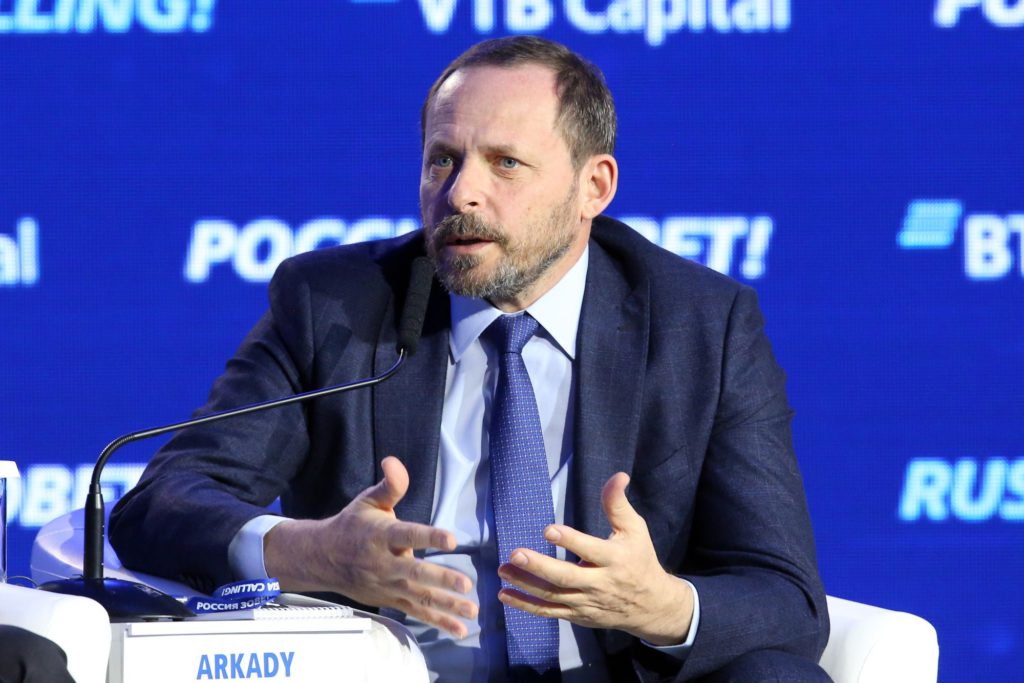
The Internet Pioneer Brought Low as Kremlin Ally by EU Sanctions

(Bloomberg) — European Union sanctions on the founder and former head of Russia’s most popular Internet search engine show how an increasing number of Russian businessmen are facing measures that aim to punish the Kremlin for the invasion of Ukraine. 

Arkady Volozh promptly resigned from the board and as chief executive officer of Yandex NV after being sanctioned on Friday by the bloc, which said the company omitted content critical of the Russian government from its search results. 

The EU said Volozh backed the Kremlin and “is responsible for supporting actions or policies which undermine or threaten the territorial integrity, sovereignty and independence of Ukraine.”

Volozh, 58, is a rare example of a Russian businessman who built a company with international ambitions that isn’t tied to natural resources or state structures. He started in business importing computers in the 1980s and created Yandex, which stands for “yet another indexer,” with his high school friend Ilya Segalovich.

It controls over 60% of the Russian search engine market and has grown to offer ride hailing, online shopping and self-driving services around the world. Once dubbed the “Google of Russia,” its 2011 initial public offering in New York was the year’s biggest technology IPO.

But the company in recent years found it increasingly difficult to navigate between the Kremlin’s tightening grip on internet resources and western investors. In 2019, the government forced it to change its corporate-governance structure and give a golden share to an outside group in a move Volozh said at the time would “protect the interests of the country.” 

The tensions burst to the forefront after the invasion of Ukraine, when the company’s US-traded shares were frozen, sanctions on technology imports threatened its ability to purchase hardware needed to power its products, and the Kremlin introduced harsher internet censorship. 

Russia Internet Giant Risks Running Out of Vital Tech in a Year

After the 2019 restructuring, Volozh moved his shares to a family trust, which now controls 45.5% of voting power and an 8.6% economic interest in the company. He currently lives in Israel.

“While I consider this decision to be misguided and ultimately counterproductive, I do not intend to give any instructions to my family trust as long as sanctions are in place,” Volozh said in a statement after the EU’s measures were announced. 

The tycoon “isn’t a controlling shareholder of Yandex, and consequently these sanctions do not apply to Yandex NV or its subsidiaries,” according to the company. 

He was hit by sanctions after the EU in March targeted Yandex’s Deputy Chief Executive Officer Tigran Khudaverdyan. 

Yandex shares were down 5.8% to 1,410.60 rubles ($22.94) at 3:35 p.m. in Moscow, following a 6% slump on Friday. The stock is down 69% this year.

More stories like this are available on bloomberg.com

©2022 Bloomberg L.P.
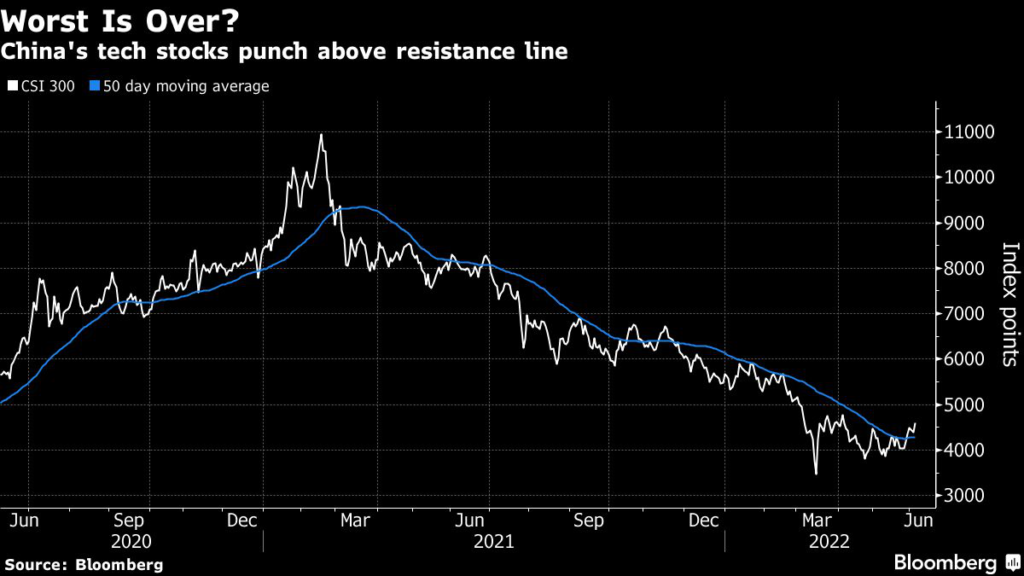
The Worst May Be Over for China Stocks With Tech Probe’s End in Sight

(Bloomberg) — When it comes to inflection points for Chinese stocks, there’s rarely been this much anticipation.

Traders who complained all year about how the country’s equities were stuck in an uninvestable state may at last be getting what they wanted. American depositary receipts in Didi Global Inc. traded as much as 68% higher in New York trading Monday after the Wall Street Journal reported regulators could effectively end a yearlong probe into its business as soon as this week. The Hang Seng Tech Index closed 4.6% higher in Hong Kong, a two-month high, while the Nasdaq Golden Dragon China Index jumped as much as 7.8%.

The news added to a more upbeat tone around Chinese assets, where the prospect of a sizable rebound is too good to pass up for many investors. Policy makers in Beijing appear to be delivering on pledges made in March to support the economy, prevent a downward spiral in the housing market and wrap up a crushing crackdown on tech companies. The offshore yuan added 0.2% by 9:45 p.m. in Hong Kong and was headed for its highest closing level in five weeks. 

“I think we are bumping along the bottom here,” Chi Lo, senior Asia Pacific investment strategist at BNP Paribas Asset Management, said in a Bloomberg Television interview before the Wall Street Journal report. “When you look at the biggest drag on Chinese equities — which was the regulatory tightening on the tech sector — the worst is over.”

Authorities are taking more conspicuous steps to shore up growth. In the past week alone, Shanghai’s government freed the majority of its residents from a Covid Zero lockdown, while China’s finance ministry and central bank said they would press ahead with policies to offset damage to the economy. A state-owned entity stepped in to rescue a private property developer, triggering a record rally in its bonds and signaling that government support could help pull the industry from its most severe downturn in years.

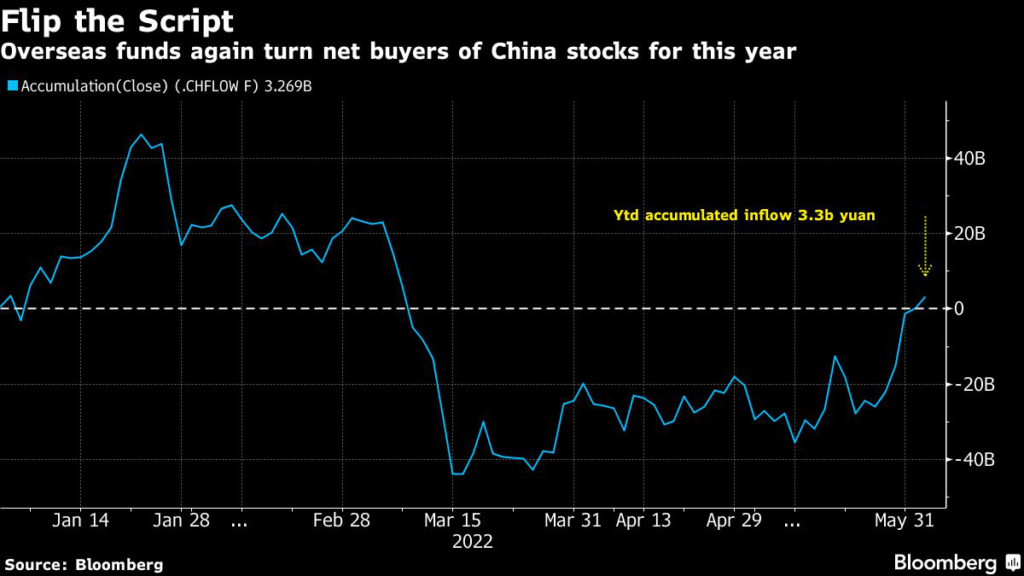
The moves appear to be having the intended effect. The CSI 300 Index of onshore stocks is up 10% since a two-year low in late April, outperforming almost every national benchmark tracked by Bloomberg. Foreign outflows turned to inflows last week for the first time since March, while falling short interest shows speculators are unwinding their most bearish bets.

There are multiple threats to the stock rebound. China’s Covid Zero strategy means strict containment could continue to disrupt manufacturing, shipping and consumption. Hopes that Beijing was nearing the end of a crackdown on the tech industry have been dashed many times before. Even if China ramps up stimulus, it’s unclear whether it will work, with banks struggling to lend and consumers unwilling to spend.

But while a bullish case on China based on value alone keeps failing, it’s becoming harder to say that the more optimistic views aren’t finally playing out. Even Morgan Stanley’s strategists — among the only team on Wall Street to recommend staying clear of Chinese assets for the past year — said sentiment is improving onshore.

To Du Kejun, a partner at Beijing Gelei Asset Management Center Ltd., allowing Didi to grow its user base again would mark the start of a sustained recovery in Chinese stocks.

“This is likely to be the inflection point — this action speaks louder than words,” said Du.

(Adds details on Golden Dragon China Index, updates pricing throughout.)

More stories like this are available on bloomberg.com

©2022 Bloomberg L.P.
US Stocks Rise as Tech Rebounds; Treasuries Fall: Markets Wrap

(Bloomberg) — US stocks gained on Monday as Beijing’s latest move to ease Covid restrictions injected a note of optimism into markets rattled by inflation and rate-hike concerns. Treasuries and the dollar slipped.

Both the S&P 500 and tech-heavy Nasdaq 100 rose at least 1% amid gains in megacaps including Apple Inc. and Microsoft Corp. Amazon.com Inc. advanced after implementing a 20-for-1 stock split. Twitter Inc. fell more than 3% in early trading after Elon Musk said he believes the company is breaching their merger agreement by not providing information about spam and fake accounts he demanded.

Chinese regulators are set to ease curbs on ride-hailing giant Didi Global Inc. and other US-listed tech firms, sending Didi’s shares up more than 50%. 

Stronger-than-forecast US hiring data for May suggested the Federal Reserve won’t waver from its tightening path to rein in price pressures. But Goldman Sachs Group Inc. economists said the Fed may be able to pull off its aggressive rate-hike plan without tipping the country into recession. The easing of Chinese lockdowns will help abate supply-chain pressures, said Diana Mousina, a senior economist at AMP Capital.

“Positive news around Chinese economic activity and cheaper equity valuations could offer value from a long-term investment perspective, but volatility will remain high in the short-term,” Mousina said in a note. 

Basic resources led an advance in the Stoxx Europe 600 index as copper rose to its highest since April, with sentiment across industrial metals bolstered by China’s gradual reopening. The technology sector outperformed. 

The UK’s equity benchmark climbed more than 1% as traders returned after a four-day break. The pound gained and gilts fell amid speculation Prime Minister Boris Johnson will survive a leadership vote later Monday.

Crude oil held around $119 a barrel in New York after Saudi Arabia signaled confidence in demand with a larger-than-expected price increase in Asia. Meanwhile, the US was said to be considering allowing more sanctioned Iranian oil onto global markets to counter the decline in Russian supplies.

The US jobs report Friday quelled some concern that the world’s biggest economy is slowing too sharply, but also strengthened the view that the Fed will keep hiking rates to combat inflation. Investors bought equities last week, with US stocks seeing a fourth straight week of inflows as a bear market rally continues, according to Bank of America strategists, citing EPFR Global data.

Read: Team Transitory Is Back Warning Big Rate Hikes Are a Big Mistake

Meanwhile, the European Central Bank is set to announce an end to bond purchases this week and formally begin the countdown to an increase in borrowing costs in July, joining global peers tightening monetary policy in the face of hot inflation. The ECB is planniing to strengthen its support of vulnerable euro-area debt markets if they are hit by a selloff, Financial Times reported. 

Tech stocks and crypto are vulnerable in the era of quantitative tightening, our latest MLIV Pulse survey shows. Read more here.

Key events to watch this week:

  • Reserve Bank of Australia policy decision Tuesday
  • World Bank’s “Global Economic Prospects” report Tuesday
  • Reserve Bank of India rate decision Wednesday
  • OECD Economic Outlook, a twice-yearly analysis of major global economic trends and prospects for the next two years. Wednesday
  • European Central Bank rate decision, Christine Lagarde briefing, Thursday
  • China trade, new yuan loans, money supply, aggregate financing. Thursday
  • US CPI, University of Michigan consumer sentiment Friday
  • China CPI, PPI Friday

Some of the main moves in markets:

Stocks

  • The S&P 500 rose 1% as of 9:45 a.m. New York time
  • The Nasdaq 100 rose 1.5%
  • The Dow Jones Industrial Average rose 0.7%
  • The Stoxx Europe 600 rose 1.1%
  • The MSCI World index rose 1%

Currencies

  • The Bloomberg Dollar Spot Index was little changed
  • The euro was little changed at $1.0711
  • The British pound rose 0.4% to $1.2544
  • The Japanese yen was little changed at 130.91 per dollar

Bonds

  • The yield on 10-year Treasuries advanced four basis points to 2.98%
  • Germany’s 10-year yield was little changed at 1.28%
  • Britain’s 10-year yield advanced two basis points to 2.17%

Commodities

  • West Texas Intermediate crude rose 0.5% to $119.45 a barrel
  • Gold futures rose 0.3% to $1,855.90 an ounce

More stories like this are available on bloomberg.com

©2022 Bloomberg L.P.

Crypto-Linked ETFs Are 2022’s Biggest Losers With 60% Drawdowns

(Bloomberg) — Crypto-flavored exchange-traded funds are cluttering the industry’s worst-performing list so far this year. 

The six worst-performing, non-leveraged ETFs in the $6.6 trillion arena in 2022 are all crypto-linked equity funds, according to data compiled by Bloomberg. The $63 million Global X Blockchain ETF (ticker BKCH) is the biggest loser with a year-to-date drop of 64%. 

While crypto-linked ETFs have swelled in ranks over the past year, performance has been grim. Fading speculative fervor and tightening monetary policy has dragged Bitcoin lower by more than 30% this year, slamming the stocks of public companies involved with digital assets. 

Read more: Tech and Crypto in Peril as Fed Ends Liquidity Binge: MLIV Pulse

The silver lining is that even as the number of funds has ballooned, inflows have been light — minimizing the overall blow to portfolios, according to UBS.  

“Crypto ETFs have proliferated like crazy over the past year, with more varieties and cheaper fees, but inflows have been miserable,” said James Malcolm, head of foreign exchange and crypto research at UBS. “So I don’t think the overall impact on ordinary people’s portfolios is material. This is still such a niche asset class, and the retail frenzy ended a year ago.”

The $32 million VanEck Digital Transformation ETF (DAPP) is a close second to BKCH with a 63% drawdown, followed by a 62% plunge in $63 million Bitwise Crypto Industry Innovators ETF (BITQ). The First Trust SkyBridge Crypto Industry and Digital Economy ETF (CRPT), the Viridi Cleaner Energy Crypto-Mining & Semiconductor ETF (RIGZ) and the Defiance Digital Revolution ETF (NFTZ) all follow with falls of 55% or more. 

More stories like this are available on bloomberg.com

©2022 Bloomberg L.P.

Close Bitnami banner
Bitnami
