Bloomberg

Buffett-Backed BYD Jumps Ahead of Tesla in Battery Metal Push

(Bloomberg) —

China’s BYD Co. is once again the largest shipper of electric vehicles in the world’s top market, after rivals including Tesla Inc. were disrupted by Shanghai’s lockdown.

The Warren Buffett-backed car producer is also working on plans to deliver a longer-term advantage over competitors, aiming to become more directly involved in the mining of lithium, the raw material that’s crucial for EV batteries.

In March, BYD agreed to invest up to 3 billion yuan ($449 million) in Chengxin Lithium Group Co., a supplier that has projects and interests in China’s Sichuan province and locations including Indonesia and Argentina. In January, the auto firm won a contract to produce the metal in Chile, the world’s No. 2 lithium producer.  

A Chinese media report last week suggested the automaker is dramatically accelerating this strategy by striking a deal to buy six mines in Africa capable of producing enough lithium for more than 27 million EVs. That could be sufficient to cover BYD’s lithium demand for the next 10 years, according to the report by The Paper, a Chinese digital newspaper. BYD hasn’t responded to requests to comment.

BYD’s reported shopping spree in Africa indicates the carmaker expects “a prolonged lithium shortage”, according to a note from Daiwa Capital Markets.

Automakers are contemplating ever-closer involvement in their supply chains, including in the mining and refining of key battery metals, after a year of escalating costs that have pushed many manufacturers, including BYD, to raise sticker prices. One measure of lithium prices had an eye-popping rally of almost 500% in a year, and metals remain elevated now, even with some early signs the gains are cooling off.

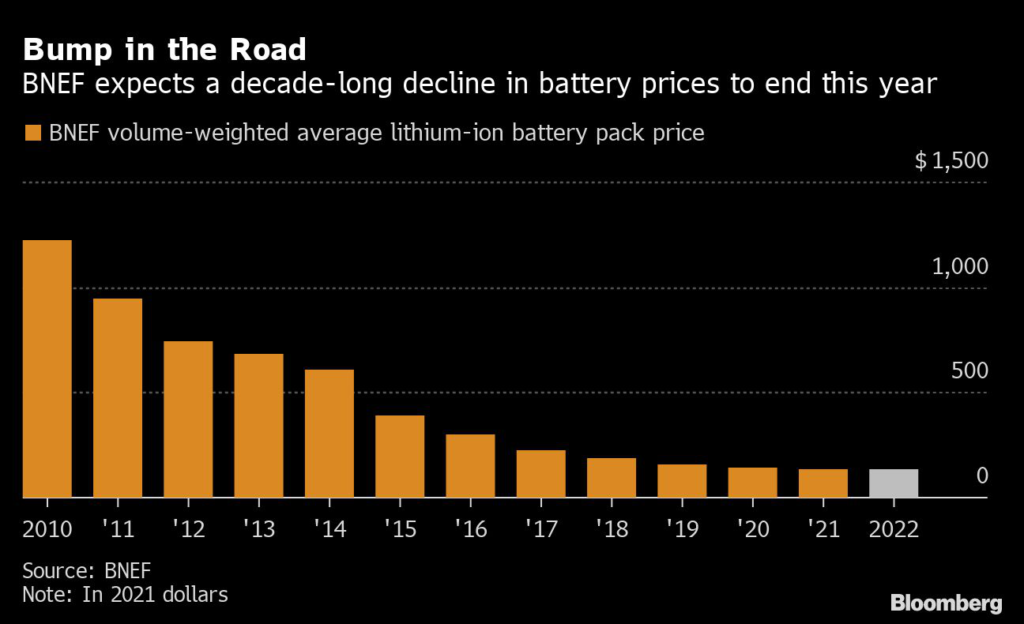
EV battery prices are expected to tick up this year for the first time in more than a decade, and broader inflation could delay the point at which electric models are as affordable as conventional cars, according to BloombergNEF.

Though Elon Musk tweeted in April that Tesla “might actually have to get into the mining & refining directly at scale,” and said two years ago the company had acquired rights to a lithium clay deposit in Nevada, the company has mainly focused on sealing future supply agreements with existing producers. Liontown Resources Ltd., developing a project in Western Australia, confirmed on Monday it expected to begin shipping material to the carmaker from 2024.

There are potential pitfalls for auto producers considering a leap into commodities production themselves. The mining sector has a patchy record of delivering projects as planned, a wave of resource nationalism is complicating developments in some key nations and ESG investors are closely scrutinizing extractive industries over potential environmental damage.

Securing sufficient supplies of raw materials is likely to be “the biggest challenge for all automakers for most of this decade,” Seth Goldstein, a Chicago-based equity strategist at Morningstar Research Services, told me last week.

The best solution would be for carmakers to lock in more long-term agreements with the industry’s major producers like Albemarle Corp. and Ganfeng Lithium Co., which have the most ability to bring on new supply, Goldstein says. 

“Investing in junior miners who have never produced lithium, or new technologies, is relatively more risky and could result in not being able to secure enough lithium,” he said.

Like getting this newsletter? Subscribe to Bloomberg.com for unlimited access to trusted, data-driven journalism and subscriber-only insights.

More stories like this are available on bloomberg.com

©2022 Bloomberg L.P.

Gojek Chief to Step Back to Non-Executive Role Following Merger

(Bloomberg) — Kevin Aluwi, co-founder and head of Indonesian ride-hailing service provider Gojek, is set to step back to a non-executive role after helping to carry out the company’s merger that created the enlarged internet giant GoTo Group.

Aluwi, 35, is set to become a commissioner of GoTo Group and its electric-vehicle joint venture Electrum, according to the company’s statement on Monday. GoTo Group Chief Executive Officer Andre Soelistyo, 38, will assume Aluwi’s responsibilities, provided that shareholders approve the changes at GoTo’s annual general meeting on June 28.

The move comes after GoTo Group raised $1.1 billion in one of the world’s largest initial public offerings for 2022. GoTo was formed last year via a merger between Indonesia’s two biggest internet companies — ride-hailing and food-delivery platform Gojek and e-commerce firm Tokopedia.

Aluwi founded Gojek in Jakarta in 2010 with Nadiem Makarim to arrange courier deliveries in the city. The co-founders launched a motorbike-hailing mobile app in early 2015. Soelistyo joined Gojek as president that year and the company now provides about 20 consumer services.

Aluwi and Soelistyo were named co-CEOs of the ride-hailing company in 2019, when Makarim accepted a minister’s post in Indonesia’s government and resigned form Gojek. Aluwi became the sole head of Gojek when the firm merged with Tokopedia last year.

Prior to founding the ride-hailing company, Aluwi was head of business intelligence at online shopping platform Zalora Indonesia.

More stories like this are available on bloomberg.com

©2022 Bloomberg L.P.

Bitcoin Gains Some Momentum as It Tries to Escape $30,000 Level

(Bloomberg) — Bitcoin advanced, rising beyond the $30,000 level after languishing at the weekend.

The largest cryptocurrency gained as much as 5.1% on Monday to $31,442. Other cryptocurrencies also rose, with Ether advancing up to 5.2% and Polygon adding as much as 8.6%.

“Bitcoin has stabilized over the past few weeks on improved short-term momentum,” Katie Stockton, co-founder of Fairlead Strategies, wrote in a note Friday. She said a short-term counter-trend buying signal was logged by Tom DeMark’s TD Sequential model, which is employed by technical analysts to spot trends, “increasing the probability of a more pronounced oversold bounce. We assume the 50-day moving average will provide resistance.”

Bitcoin and the rest of the cryptocurrency complex has struggled in recent months as the Federal Reserve hikes interest rates and risky assets like tech stocks have fallen back. The collapse of the Terra/Luna ecosystem further undermined confidence in the space. 

Bitcoin has been stuck around the $30,000 level for weeks now, defying predictions of a potential further decline but also struggling to gain upward momentum.

(Updates with prices in the second paragraph)

More stories like this are available on bloomberg.com

©2022 Bloomberg L.P.

Crypto Bridges, Staking, Yield Farming: An Audio Crypto Glossary

  • Listen to Bloomberg Crypto on the iHeartRadio App
  • Listen to Bloomberg Crypto on Apple Podcasts
  • Listen to Bloomberg Crypto on Spotify

(Bloomberg) — You might already consider crypto to be synonymous with the word volatility. But what about all the other words that get thrown around by enthusiasts? What’s staking all about? How are bridges created and used? And why are so many folks on Twitter sending messages that just say, “GM”? Never fear: Bloomberg reporters Hannah Miller and Vildana Hajric are here to help with a crypto glossary.  Because it’s good to define our terms.

Follow us on Twitter @crypto, and subscribe to the Bloomberg Crypto Newsletter at https://bloom.bg/cryptonewsletter

More stories like this are available on bloomberg.com

©2022 Bloomberg L.P.

Ukraine Latest: Putin Warns of New Targets as UK to Send Rockets

(Bloomberg) — The UK plans to send rocket systems to Ukraine that will let it strike locations as far as 80 kilometers (50 miles) away less than a week after the US said it would provide similar weapons. Russian President Vladimir Putin threatened in an interview with state TV aired Sunday to strike new targets in Ukraine if longer-range missiles are delivered.

Ukrainian President Volodymyr Zelenskiy visited troops near the front in the southern region of Zaporizhzhia, about 60% of which is occupied by the Russian army. Kyiv said a Russian general was killed in fighting. 

Russia has agreed with Turkey and Ukraine on a preliminary plan to ship Ukrainian grain from Odesa, Izvestia reported, citing an unidentified person familiar with the matter. The New York Times reported the Kremlin has been looking to profit from grain it plundered from Ukraine.

(See RSAN on the Bloomberg Terminal for the Russian Sanctions Dashboard.)

Key Developments 

(All times in CET)

  • Ukraine’s Tactics Show Smaller Countries How to Fight Back
  • Putin Critic Kallas Needs New Allies to Stay in Power in Estonia
  • What Are War Crimes? Could Putin Face Prosecution?: QuickTake
  • China’s Yuan-Ruble Trading Volumes Fail to Match Russian Frenzy
  • Rusal Starts Legal Action Over Rio’s Refinery Block, Paper Says

Ukraine Says Russian General Killed (8:31 a.m.)

Russian Major General Roman Kutuzov was killed, Ukraine’s army said on its Facebook page. Earlier, Meduza reported Kutuzov died in fighting in the Luhansk region, citing a journalist for Russian state-run television station. Russia’s Defense Ministry hasn’t commented.

Report Says Russia, Turkey Agree on Plan to Ship Grain (5:24 a.m.)

According to the plan, Turkish warships would demine the coastal area near Odesa and escort grain vessels to neutral waters of the Black Sea, Russia’s Izvestia reported. A “road map” will be approved as early as Wednesday during a visit of the Russian foreign and defense ministers to Turkey, the newspaper said.

UK to Send Rocket Systems (12:01 a.m.)

The UK is to send multiple-launch rocket systems to Ukraine, Defence Secretary Ben Wallace announced. The move has been coordinated closely with the US decision to send the High Mobility Artillery Rocket System variant of MLRS to Ukraine, where forces have requested longer-range precision weapons.

“As Russia’s tactics change, so must our support to Ukraine,” Wallace said. “These highly capable multiple-launch rocket systems will enable our Ukrainian friends to better protect themselves against the brutal use of long-range artillery, which Putin’s forces have used indiscriminately to flatten cities.”

The M270 weapons system, manufactured by Lockheed Martin, can strike targets up to 80 kilometers (50 miles) away with high accuracy, according to a statement released by the Ministry of Defence. The UK will also supply M31A1 munitions “at scale.”

Russia Seeks Buyers for Plundered Grain, New York Times Says (12:01 a.m.)

The US has told more than a dozen countries that Putin’s government is trying to sell plundered wheat from Ukraine to drought-stricken African nations, the New York Times reported citing a diplomatic cable.

The paper said that in mid-May, the US sent a notification to 14 countries, mostly in Africa, of Russian cargo vessels leaving ports near Ukraine laden with what the cable said was “stolen Ukrainian grain.”

Ukraine has accused Russia of looting grain in occupied areas and selling it abroad, and local traders have said Russian troops have confiscated grain, equipment and fertilizers in occupied areas in the country’s southeast. 

Read more: Egypt Says It Refused Undocumented Ukrainian Grain Shipment

Lavrov’s Visit to Serbia Abandoned After Flight Ban (9:49 p.m.)

Russian Foreign Minister Sergei Lavrov’s planned visit to Serbia on June 6-7 won’t take place after Bulgaria, North Macedonia and Montenegro didn’t grant permission for his plane to fly in their airspace, Interfax news wire reported, citing an unidentified, high-ranking official from the ministry.  

More stories like this are available on bloomberg.com

©2022 Bloomberg L.P.

Stocks Rise as China Reopening Offsets Rate Fears: Markets Wrap

(Bloomberg) — Stocks in Europe gained along with US equity futures Monday as Beijing made another move to ease Covid restrictions, helping soothe a fragile mood amid inflation and rate-hike concerns.

Travel stocks led gains in the Stoxx Europe 600 index, while basic resources outperformed as copper surged to its highest since April, with sentiment across industrial metals bolstered by China’s gradual reopening. The UK benchmark climbed more than 1% as traders returned after a four-day break. Futures on the S&P 500 and Nasdaq 100 rose. Treasuries were steady and the dollar slipped.

Stronger-than-forecast US hiring data for May suggested the Federal Reserve won’t waver from its pace of hiking rates to rein in price pressures. But Goldman Sachs Group Inc. economists said the Fed may be able to pull off its aggressive rate-hike plan without tipping the country into recession. The easing of Chinese lockdowns will help abate supply-chain pressures, said Diana Mousina, a senior economist at AMP Capital.

“Positive news around Chinese economic activity and cheaper equity valuations could offer value from a long-term investment perspective, but volatility will remain high in the short-term,” Mousina said in a note. 

Brent crude oil traded above $120 a barrel after Saudi Arabia signaled confidence in demand with a larger-than-expected price increase in Asia. Meanwhile, the US was said to be considering allowing more sanctioned Iranian oil onto global markets to counter the decline in Russian supplies.

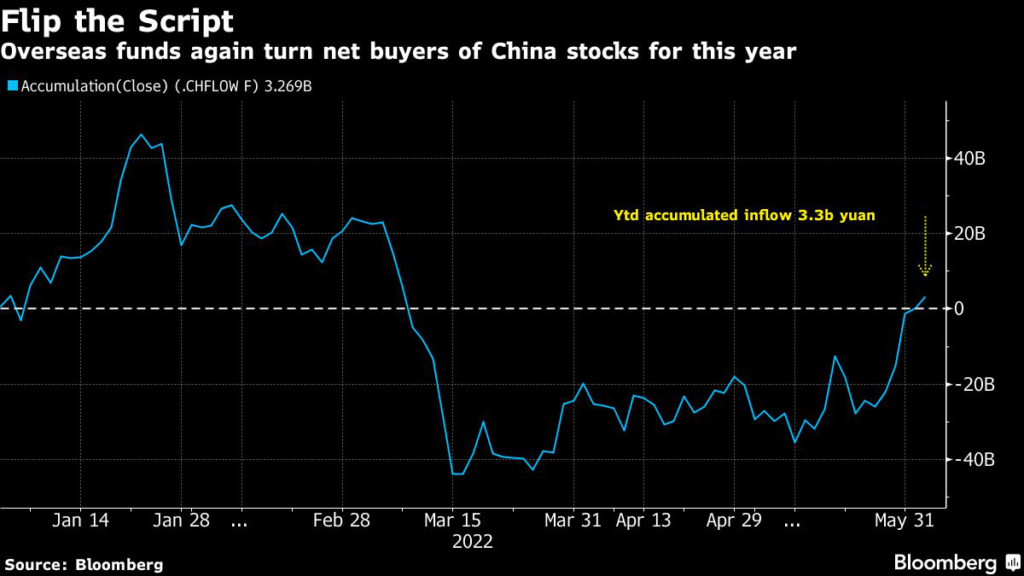
Japanese equities rose, while technology shares jumped in Hong Kong. China’s shares advanced as the capital took a step closer to returning to normal. Australian stocks bucked the trend, dropping ahead of an expected second consecutive interest-rate increase Tuesday.

The US jobs report quelled some concern that the world’s biggest economy is slowing too sharply, but also strengthened the view that the Fed will keep hiking rates to combat inflation. Cleveland Fed President Loretta Mester said she would back a half-point hike in September if inflation isn’t retreating. Market-derived odds for a third 50-basis-point increase in September are about 85%. 

The European Central Bank is set to announce an end to bond purchases this week and formally begin the countdown to an increase in borrowing costs in July, joining global peers tightening monetary policy in the face of hot inflation. The central bank is set to strengthen its commitment to support vulnerable euro-area debt markets if they are hit by a selloff, Financial Times reported.

Read: Team Transitory Is Back Warning Big Rate Hikes Are a Big Mistake

“Liquidity is going out of the market and what that means is it will have an impact on the equity markets,” Charu Chanana, Saxo Capital Markets market strategist, said on Bloomberg Television. “We do expect that the drawdown in the equity markets still has some room to go.”

Elsewhere, the pound edged higher and gilts fell amid risks around a confidence vote on British Prime Minister Boris Johnson’s leadership.

Tech stocks and crypto are vulnerable in the era of quantitative tightening, our latest MLIV Pulse survey shows. Read more here.

Key events to watch this week:

  • Reserve Bank of Australia policy decision Tuesday
  • World Bank’s “Global Economic Prospects” report Tuesday
  • Reserve Bank of India rate decision Wednesday
  • OECD Economic Outlook, a twice-yearly analysis of major global economic trends and prospects for the next two years. Wednesday
  • European Central Bank rate decision, Christine Lagarde briefing, Thursday
  • China trade, new yuan loans, money supply, aggregate financing. Thursday
  • US CPI, University of Michigan consumer sentiment Friday
  • China CPI, PPI Friday

Some of the main moves in markets:

Stocks

  • The Stoxx Europe 600 rose 0.7% as of 8:19 a.m. London time
  • Futures on the S&P 500 rose 0.7%
  • Futures on the Nasdaq 100 rose 0.9%
  • Futures on the Dow Jones Industrial Average rose 0.6%
  • The MSCI Asia Pacific Index rose 0.3%
  • The MSCI Emerging Markets Index rose 0.5%

Currencies

  • The Bloomberg Dollar Spot Index fell 0.1%
  • The euro rose 0.1% to $1.0734
  • The Japanese yen rose 0.2% to 130.58 per dollar
  • The offshore yuan was little changed at 6.6552 per dollar
  • The British pound rose 0.3% to $1.2528

Bonds

  • The yield on 10-year Treasuries was little changed at 2.94%
  • Germany’s 10-year yield declined one basis point to 1.26%
  • Britain’s 10-year yield advanced four basis points to 2.19%

Commodities

  • Brent crude rose 0.2% to $119.96 a barrel
  • Spot gold rose 0.2% to $1,854.38 an ounce

More stories like this are available on bloomberg.com

©2022 Bloomberg L.P.

Toshiba’s Dissenting Director Speaks Out on Activists on Board

(Bloomberg) — A Toshiba Corp. external board member said the company’s plan to appoint two directors representing activist investors lacks fairness and balance, opposing their election in a shareholder vote this month.

Mariko Watahiki, a former judge who became a Toshiba board member last year, spoke out against the proposed election of two director candidates from Elliott Management Corp. and Farallon Capital Management, saying that if they were appointed, activists would take up too much of the board. Toshiba announced a slate of 13 proposed directors last month ahead of its shareholder meeting scheduled for June 28.

“Toshiba has many types of shareholders, such as hedge funds, institutional investors and individual investors, who would seek profits from their investment in different ways,” Watahiki said in an interview with Bloomberg News. “If we take people from just one specific group, it’s impossible to avoid conflicts of interest.”

It’s an unusual show of public opposition to a board decision by an outside director at one of Japan’s most famous companies. It highlights the tensions that exist within Toshiba as the conglomerate considers its future, including whether to sell itself to private equity and go private.

Watahiki said she wanted to let people know the board isn’t unanimously recommending the candidates. Directors linked to activists would pursue short-term profit, she said.

Watahiki pointed out that Raymond Zage, another Toshiba director who is nominated to continue in the role, also previously worked for Farallon.

Farallon didn’t immediately respond to a request for comment. A representative for Elliott didn’t immediately comment.

Zage said Toshiba’s nomination committee, which he chairs, went through an extensive review of candidates over a long period. He said he was specifically asked by the committee and the board to identify shareholder representatives to serve as directors. The objective of the process was to help rebuild trust with stock holders, he said.

Toshiba said last week it received eight offers to buy out the conglomerate and two proposals for capital and business alliances as part of its process to solicit strategic options for its future. While it didn’t disclose the bidders, Bain Capital, Blackstone Inc. and CVC Capital Partners are among buyout firms that were weighing bids, Bloomberg has reported.

Toshiba named Eijiro Imai, a managing director at Farallon Capital Japan, as one of its proposed director candidates, while Nabeel Bhanji, who hails from Elliott, is another.

Read more: Toshiba Taps Activists for Board, Boosting Odds of Buyout

Toshiba’s leaders had long fought against the idea of privatization, with former Chief Executive Officer Satoshi Tsunakawa laying out five reasons why it would be the wrong decision just in February of this year. His management team instead argued the company should be split in two, but investors voted down that approach.

Watahiki said it’s reasonable for Toshiba to have some board representation from its activist shareholders, but the balance isn’t right with the current candidate slate. Toshiba should give more board seats to people who have a deeper understanding of its businesses, she said.

More stories like this are available on bloomberg.com

©2022 Bloomberg L.P.

Hard-Landing Dread Eclipses Brief Rally in Emerging Stocks

(Bloomberg) — The nascent rebound from a two-year low in emerging-market stocks is faltering on concern the Federal Reserve and other global policy makers will fail to orchestrate a soft landing for the world economy. 

“It’s too early to say this is the bottom — too early to say the only way is up,” said Wei Li, global chief investment strategist at BlackRock Inc. “We need to see a dovish pivot from the Fed” before buying-the-dip returns, she said.

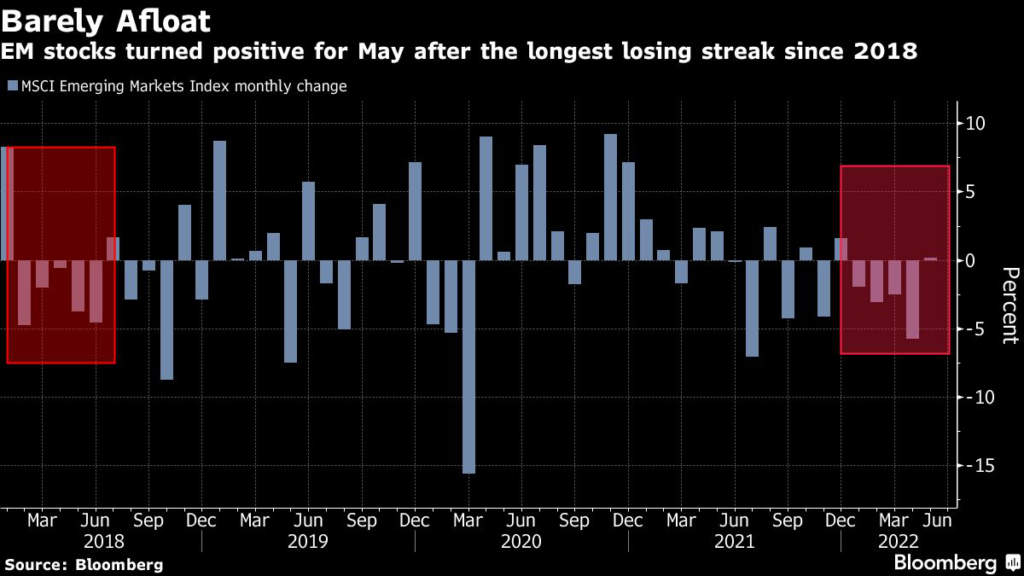
The MSCI Emerging Markets Index has rebounded about 8% since dropping to a two-year low on May 12, posting a gain in May after the longest monthly losing streak in four years. So far in June, however, the gauge is again trailing its developed-market peers.

Fed Chair Jerome Powell warned last month the US will keep raising interest rates until there’s “clear and convincing” evidence inflation is in retreat. His tough stance was supported on Friday by better-than-expected US data that signaled economic optimism even as monetary support is stripped back. Still, concern about the world’s economic outlook is keeping a lid on emerging-market stock valuations.

State Street Global Markets said a bigger rally in developing-market equities may not be on the cards this year, while Goldman Sachs Group Inc. said investor focus is on risks to growth as central banks act to cool surging prices.

The MSCI gauge has dropped almost 14% this year, roughly in line with dollar-term returns from the Stoxx Europe 600 Index and the S&P 500. Emerging stocks advanced in May on news from China, which relaxed Covid restrictions and moved toward peace with big tech firms, as well as inflows targeted at the safest, least volatile companies. 

EM Weekly Podcast: Nascent Rally in Stocks Hurt by Growth Risks

The iShares MSCI Emerging Markets Minimum Volatility Factor ETF attracted a record $2.4 billion of inflows last month. But the biggest US exchange-traded fund tracking the MSCI EM index lost $474 million in May, its fourth month of outflows this year.

Most Vulnerable

Developing countries, where consumers generally have lower disposable incomes and are more affected by surging prices, are grappling with multiple headwinds caused by soaring energy and commodity costs, supply-chain issues as well as slower growth in the developed world. This is worsening the outlook for company earnings, especially for retailers and consumer-facing staples. 

“Discretionary companies will see margin pressure given higher input costs and slower growth if they try to pass higher prices on to the already pinched consumers,” said Daniel Grana, a portfolio manager at Janus Henderson Investors in Boston. “That is particularly true for consumer facing sectors in commodity importing countries” as raw-material exporters benefit from higher prices, he said.

Consumer-price readouts from China, Egypt and Mexico this week are set to provide a better insight into just how entrenched inflation has become across developing nations, potentially piling more pressure on central bankers to act decisively to reduce price growth without derailing growth.  

“Like all risky assets, emerging markets equities are facing the ‘narrow path’ predicament with policy makers aiming to engineer a soft landing,” Goldman Sachs strategist Caesar Maasry said. “Cooling inflationary data would certainly take pressure off equity markets, but growth risks are still in focus.”

Future Prospects

There are some exciting long-term prospects in emerging equities, “but the second half is going be too early for that,” said Daniel Gerard, a senior multi-asset strategist at State Street Global Markets. “We need to see the impact of quantitative tightening” and “get some sense that inflation is in check,” he said.

Gerard is betting on Latin America to continue to be the most attractive emerging region due to its exposure to materials and commodities as well as defensive sectors like telecommunication. The MSCI Emerging Markets Latin America Index has gained about 15% this year, with Brazilian stocks returning 23%.

Here are the main things to watch in emerging markets in the week ahead:

  • Russia is likely to cut interest rates by 100 basis points as policy makers focus their attention on the strength of the exchange rate and cushioning the blow to the economy
  • China’s PMIs for May suggested the economy is moving out of the worst part of its slump; a barrage of data in the week ahead will probably give further indications that the recovery will be a struggle
  • In Chile, the central bank to expected to increase its benchmark interest rate by 75 basis points to 9.0% on Thursday; its quarterly monetary policy report is likely to point to additional hikes and a more challenging outlook
  • For Brazil, the coming week brings May inflation print, which may show a slight deceleration in consumer prices, and April retail sales

(Updates figures in 3rd, 6th paragraphs.)

More stories like this are available on bloomberg.com

©2022 Bloomberg L.P.

Ukraine Latest: UK to Send Rockets; Zelenskiy Visits Troops

(Bloomberg) —

The UK plans to send rocket systems to Ukraine that will let it strike locations as far as 80 kilometers (50 miles) away. Last week, the US said it would send similar systems, with Washington rejecting Russian claims the move would escalate the war dragging into its fourth month.

Ukrainian President Volodymyr Zelenskiy visited troops in the southern region of Zaporizhzhia, about 60% of which is occupied by the Russian army and where fighting is ongoing. 

Russia has agreed with Turkey and Ukraine on a preliminary plan to ship Ukrainian grain from Odesa, Izvestia reported, citing an unidentified high-ranked person familiar with the matter. The New York Times reported the Kremlin has been looking to profit from grain it plundered from Ukraine.

(See RSAN on the Bloomberg Terminal for the Russian Sanctions Dashboard.)

Key Developments 

(All times in CET)

  • Ukraine’s Tactics Show Smaller Countries How to Fight Back
  • Putin Critic Kallas Needs New Allies to Stay in Power in Estonia
  • Kazakhs Vote on New Constitution as Tokayev Cements His Power
  • What Are War Crimes? Could Putin Face Prosecution?: QuickTake
  • Putin’s War Forces Biden to Rewrite Security Plan, Nod to Europe
  • France Is Talking to UAE About Replacing Russian Oil, Diesel

Russia, Turkey Agree on Plan to Ship Grain (5:24 a.m.)

Turkish ships would escort vessels with grain from Odesa to neutral waters of the Black Sea, the report from the Izvestia newspaper said. A “road map” will be approved as early as Wednesday during a visit of Russia’s foreign and defense Ministers to Turkey, it said.

UK to Send Rocket Systems (12:01 a.m.)

The UK is to send multiple-launch rocket systems to Ukraine, Defence Secretary Ben Wallace announced Monday. The move has been coordinated closely with the US decision to send the High Mobility Artillery Rocket System variant of MLRS to Ukraine, where forces have requested longer-range precision weapons.

“As Russia’s tactics change, so must our support to Ukraine,” Wallace said. “These highly capable multiple-launch rocket systems will enable our Ukrainian friends to better protect themselves against the brutal use of long-range artillery, which Putin’s forces have used indiscriminately to flatten cities.”

The M270 weapon system, manufactured by Lockheed Martin, can strike targets up to 80 kilometers (50 miles) away with high accuracy, according to a statement released by the Ministry of Defence. The UK will also supply M31A1 munitions “at scale.”

Russia Seeks Buyers for Plundered Grain, New York Times Says (12:01 a.m.)

The US has told more than a dozen countries that Putin’s government is trying to sell plundered wheat from Ukraine to drought-stricken African nations, the New York Times reported citing a diplomatic cable.

The paper said that in mid-May, the US sent a notification to 14 countries, mostly in Africa, of Russian cargo vessels leaving ports near Ukraine laden with what the cable said was “stolen Ukrainian grain.”

Ukraine has accused Russia of stealing grain in occupied areas and selling it abroad, and local traders have said Russian troops have confiscated grain, equipment and fertilizers in occupied areas in the country’s southeast. 

Read more: Egypt Says It Refused Undocumented Ukrainian Grain Shipment

Lavrov’s Visit to Serbia Won’t Happen After Flight Ban (9:49 p.m.)

Russian Foreign Minister Sergei Lavrov’s planned visit to Serbia on June 6-7 won’t take place after Bulgaria, North Macedonia and Montenegro didn’t grant permission for the plane he would travel in to fly in their airspace, Interfax news wire reported, citing an unidentified, high-ranking official from the ministry.  

Russian Foreign Minister Lavrov’s Visit to Serbia in Question (4:50 p.m.)

A two-day visit of Russia’s Foreign Minister Sergei Lavrov to Serbia is in question as Montenegro, Northern Macedonia and Bulgaria are banning his plane from their air space, Vecernje Novosti reported, without saying where it got information.

Due to the recent developments, Serbia’s President Aleksandar Vucic will meet with Russian Ambassador Alexander Botsan-Kharchenko Monday morning, according to the Serbian publication.

Lavrov was planning to visit Serbia on June 6-7 to meet the nation’s leader as well as his counterpart, Tass reported, citing Russian Foreign Ministry’s spokeswoman Maria Zakharova. They were expected to discuss in-depth bilateral political and economic relations and exchange their views on the situation in the Balkan region and also talk about other international problems, according to Tass.

Ukraine Denies Russia Destroyed Tanks (3 p.m.)

There were no tanks at Ukraine’s coach-repair plant hit in Russia’s missile attack, state-run railway company Ukrzaliznytsia’s Chief Executive Office Oleksandr Kamyshev said.

Earlier today, four Russian missiles hit Darnytsia coach-repair plant that fixed wagons to transport grain and other exports, Kamyshev said. (See 11:30 a.m. item)

“I officially state that there is no military equipment at the premises of the plant,” he said, inviting journalists for a tour tonight. “Russia again told a lie. Their real goal is Ukraine’s economy and civilians. They want to stop our ability to export Ukrainian products to the west.”

EU’s Breton Says Putin Using Gas to Divide Europe (12 p.m.)

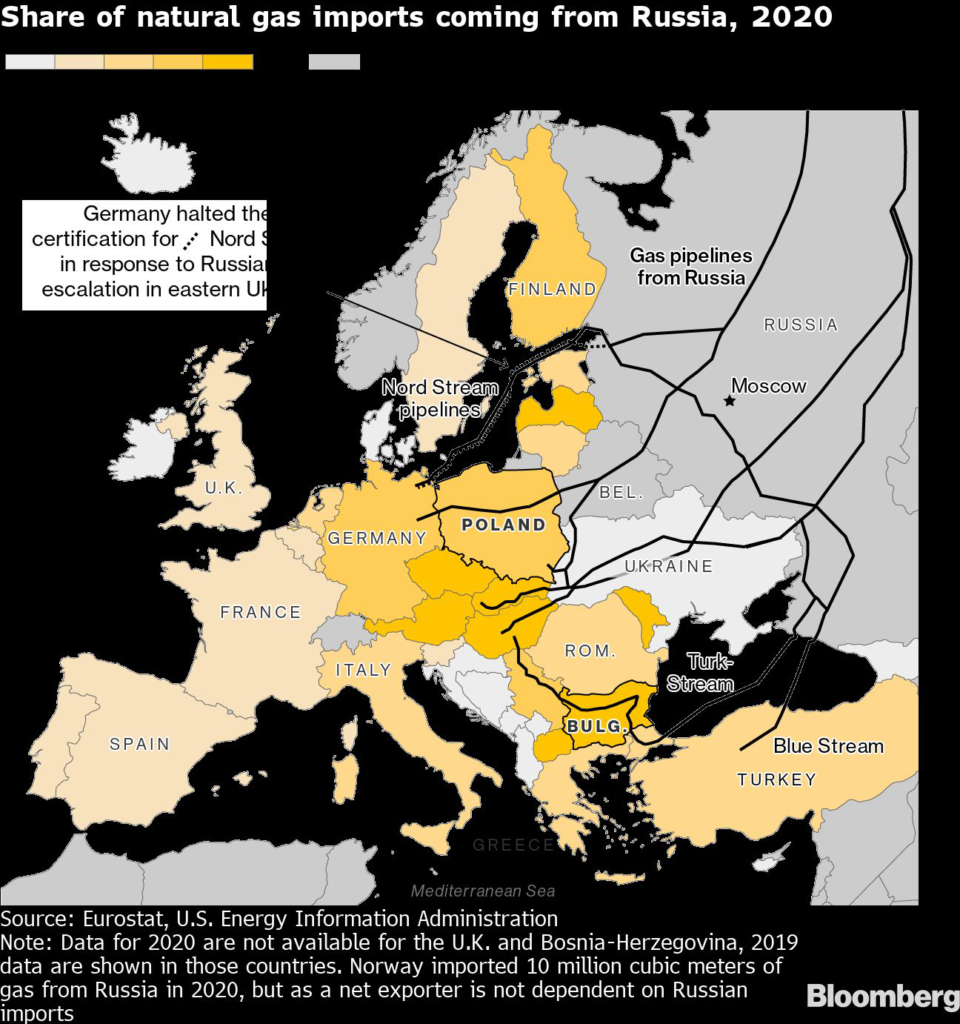
Breton in an interview with CNews and Europe1 on Sunday that plans are in place if Putin takes further steps to switch off Russian gas after cutting supplies to Poland, Bulgaria, Netherlands, Finland and Denmark. This includes boosting LNG imports, partly from the US and Qatar, accelerating solar and offshore wind power, and extending the life of nuclear and coal-fired plants.

“We must also free ourselves from gas, because Russian gas today, we must get our autonomy back as quickly as possible as Vladimir Putin doesn’t like the European project,” Breton said, “For years, he’s done everything to divide Europe,” he added, citing Brexit, Covid vaccines and TV channel Russia Today as examples. “Now he’s using gas precisely to divide us.”

Russia Says It Destroyed Weapons on Outskirts of Kyiv (11:30 a.m.)

“The Russian Aerospace Forces destroyed T-72 tanks and other armored vehicles placed in the buildings of a coach-repair plant with high-precision long-range air-based missiles on the outskirts of Kyiv,” Tass reported, citing Defense Ministry spokesman Igor Konashenkov. 

Destroyed tanks and equipment were supplies by Eastern European countries, according to Konashenkov.

Bloomberg News couldn’t independently verify the claim.

Putin Says Russia to Set New Targets If Ukraine Gets Longer-Range Missiles (10:45 a.m.)

Russia will strike targets that it hasn’t hit previously, if longer-range missiles are delivered to Ukraine, Putin said in an interview with Rossiya-1 TV channel.

All the “hassle” about additional weapon deliveries has “only one goal — to drag out the armed conflict as much as possible,” he said. If long-range missiles are supplied, “we will draw appropriate conclusions from this and will use our means of destruction, which are ample, to strike objects that we have not yet struck.”

Ukraine has been asking its partners to provide long-range weapons so it can defend itself in Donbas, where Russian troops are making slow but steady advances. The US said it will ship the systems, which can fire missiles as far as 80 kilometers as Kyiv promised it won’t strike targets inside Russia

Russian Missile Flew Low Over Nuclear Power Plant (8:15 a.m.)

A Russian cruise missile “flew critically low over the South Ukraine nuclear power plant,” Ukrainian state-run nuclear power producer Energoatom said on Telegram. It said the rocket flew overhead in the direction of Kyiv, where explosions were heard this morning.

Russia targeted railway infrastructure in Kyiv, Serhiy Leshchenko, an adviser to President Volodymyr Zelenskiy’s chief of staff said.

Luhansk Governor Reports More Damage (7 a.m.)

The situation in Luhansk region, where Russian troops continue to storm the city of Sievierodonetsk, remains “extremely difficult,” Governor Serhiy Haiday said on Telegram. There are damages reported at the Azot chemical factory in Sievierodonetsk, as well as in another large city, Lysychansk, and other areas, he said.

Russian troops now control the eastern part of Sievierodonetsk, Ukrainian authorities said.

Several Explosions in Kyiv on Sunday Morning (5:40 a.m.)

Several explosions occurred in Darnytskyi and Dniprovskyi districts in Kyiv, the capital’s mayor Vitali Klitschko said on his Telegram channel on Sunday morning. There are currently no casualties as a result of “missile strikes on infrastructure” targets, he said, adding one person was sent to hospital and rescue services are still working in the affected areas.

Ukrainian air defense shot down a missile over Obukhiv district in the Kyiv region on Sunday morning, the regional administration reported on Telegram.


US General Milley Holds Briefing With Swedish Leader (11:50 p.m.)

US General Mark Milley reiterated the US’s support for Sweden and Finland for NATO membership during a press conference with Swedish Prime Minister Magdalena Andersson in Stockholm, AFP reported.

Milley also visited the USS Kearsarge, the largest US warship ever to dock in Stockholm and which houses Osprey transport aircraft, Harrier attack helicopters and more than 1,200 Marines, the report said.

Ukraine, Russia Exchange Bodies of Deceased Soldiers (4:46 p.m.)

Ukraine and Russia exchanged the bodies of 160 soldiers each, in the first such public move since the start of war. 

The exchange took place at the contact line in Zaporizhzhia region on June 2, according to Ukraine’s Ministry on Issues of Reintegration of Temporary Occupied Territories.

More stories like this are available on bloomberg.com

©2022 Bloomberg L.P.

Tech and Crypto in Peril as Fed Ends Liquidity Binge: Bloomberg Markets Survey

(Bloomberg) — The speculative darlings of the easy-money era — technology stocks and cryptocurrencies — are acutely vulnerable now that the Federal Reserve is shrinking its nearly $9 trillion balance sheet. 

At the same time, central bankers from Canada to Europe are about to test the resilience of global markets as they follow hawkish US policy makers on a liquidity-sapping mission to unwind the pandemic bond-buying spree.

That’s the broad outlook for Wall Street and beyond, according to the most-popular responses from 687 contributors to the latest MLIV Pulse survey, as the Fed this month starts reducing its asset holdings in a process known as quantitative tightening.

The historic shift is seen as a notable threat to tech equities and digital tokens — both risk-sensitive assets that soared in the Covid-era market mania before cratering in this year’s cross-asset crash.

The era of ultra-cheap money looks over for now. The Fed’s balance-sheet drawdown is seen lasting more than a year, while nearly two-thirds of survey respondents say the four-decade bull run in Treasuries has come to an end. 

All this comes against the risky backdrop of the Fed hiking interest rates at the fastest pace in decades to combat red-hot inflation, as officials seek to quash talk of a September pause.

Recent gyrations in stocks, bonds and other markets have done little to deter the US central bank from its hawkish posture, with policy makers widely expected to raise rates by another half point on June 15. The Fed began shrinking its balance sheet this month by allowing assets to mature without reinvestment at a monthly pace of $47.5 billion, increasing to as much as $95 billion per month in September.

“It’s where that quantity of capital and quantity of liquidity has been most beneficial that its withdrawal is going to continue to be felt — and that is in the most speculative parts of the market,” Lisa Shalett, chief investment officer at Morgan Stanley Wealth Management, said on Bloomberg Television.

The MLIV survey of most-at-risk assets in the QT era canvassed a group ranging from retail investors to market strategists. Just 7% picked mortgage-backed bonds — securities that were at the heart of the 2008-09 meltdown — with almost half citing tech and crypto.

Draining money from the system tends to tighten financial conditions, all else equal, which acts as a brake on economic growth. That can reduce valuations for tech stocks given their reliance on optimism about future profits.

Read more: Team Transitory Is Back Warning Big Rate Hikes Are a Big Mistake

The end of Fed bond-buying also forces the Treasury to sell more debt in the open market, potentially putting upward pressure on bond yields, which play a big role in how Wall Street values listed companies — a headwind for so-called growth stocks in particular.

Fueled by pandemic-era policy easing, the tech-heavy Nasdaq 100 Index climbed more than 130% from its March 2020 low before plunging this year. 

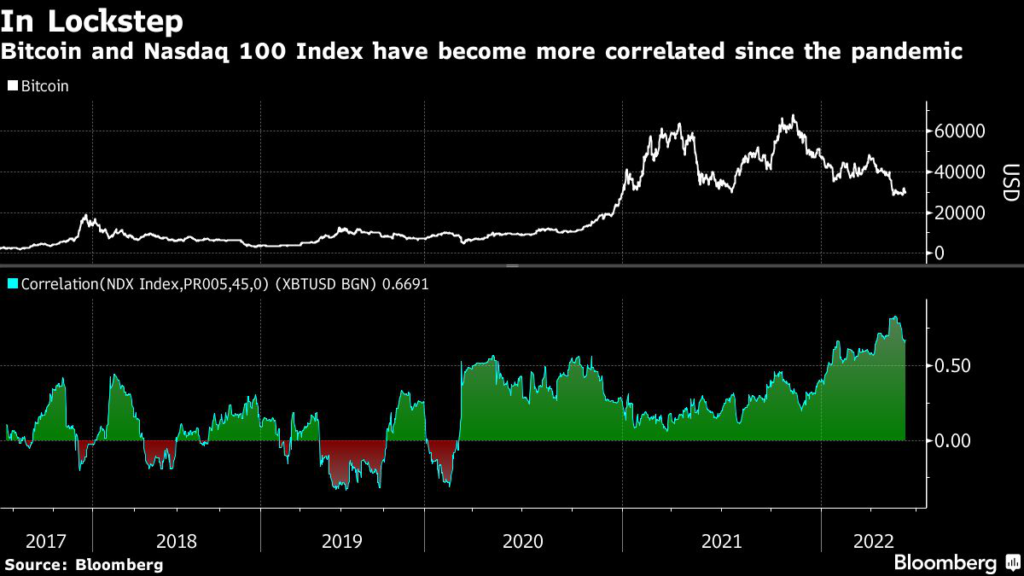
Meanwhile, cryptocurrencies have increasingly been driven by fluctuations in tech stocks. Since March 2020, there has been a strong positive correlation between Bitcoin and the Nasdaq 100, with the relationship intensifying in this year’s selloff.

The thinking goes that when money is cheap, traders can speculate about future digital trends en masse. But when the liquidity party fades, those bets become more costly.

“I don’t think people fully realize how much QE caused investors to add a lot of leverage to their positions,” said Matt Maley, chief market strategist for Miller Tabak + Co. “Now that we’re going through QT, that leverage has to be unwound.”

Respondents who were active in the market during the financial crisis more than a decade ago are particularly concerned that the Fed’s balance-sheet shrinkage will hurt junk bonds. Newer entrants are more inclined to worry about its impact on crypto and tech shares.

Readers more broadly are sounding the alarm about global trading conditions as the likes of the European Central Bank — which meets this week — and the Bank of England look to rein in their expanded balance sheets. Nearly 53% said they’re concerned markets are underestimating the liquidity importance of central banks outside the US.

Only 8% described QT in general as overhyped. Yet the principal concern of MLIV readers remains how far the US central bank will lift benchmark borrowing costs in this cycle. Some 61% said the level at which the terminal fed funds rate peaks is more important than the amount by which the balance sheet shrinks.

As for QT’s end game, around two thirds say the primary catalyst is more likely to emerge from negative developments than victory on the inflation front. Some 38% said economic pain would prompt an end to the balance-sheet rundown, while 20% pointed to market turmoil. 

Just 10% voted for problems related to bank reserves and short-term funding markets. That’s an implicit vote of confidence in the measures the Fed has taken to avert logjams in the financial plumbing that caused it to intervene in 2019 during its previous tightening program.

For many, the era of ultra-low rates and big central bank balance sheets is all they’ve known professionally. Some 46% of MLIV respondents weren’t active in markets before the widespread global adoption of quantitative easing in the aftermath of 2008.

Fewer still rode the early long-dated Treasury bull market in the decades past. A strong majority of readers — 64% — say the four-decade bullish stretch has finally ended, with experienced market players notably more hawkish than younger counterparts.

“Whenever you’re seeing major shifts in liquidity, there’s potential you could see some disruption in the market and that could trigger some violent trading behavior,” said Ed Moya, senior market analyst at Oanda.

  • For more markets analysis, see the MLIV blog. For previous surveys, and to subscribe, see NI MLIVPULSE.

(Updates with reference to inflation debate in 12th paragraph.)

More stories like this are available on bloomberg.com

©2022 Bloomberg L.P.
Close Bitnami banner
Bitnami