Bloomberg

Bali Sun-Seekers Make Way for Digital Nomads, Spiritual Tourists

(Bloomberg) — Bali’s bars and beaches may have to take the backseat as Indonesia looks to promote its spiritual getaways and booming tech scene to lure longer-staying, higher-spending travelers back to its islands.

Ecological tourism, sporting events and a special five-year visa for remote workers should bring 3.6 million overseas travelers back to the archipelago now that borders have reopened, Tourism Minister Sandiaga Uno said in an interview on Monday. This should help create over 1 million jobs for Indonesians, he added.

“In the past, the three S was: sun, sea and sand. We’re moving it to serenity, spirituality and sustainability. This way we’re getting better quality and better impact to the local economy,” Uno told Bloomberg Television’s Yvonne Man and Rishaad Salamat.


Southeast Asia’s largest economy has scrapped most of its travel restrictions, allowing fully-vaccinated visitors to come without testing or quarantine requirements, as Covid-19 cases stay low and booster doses are rolled out. Tourist arrivals jumped 500% to 111,000 in April, its highest monthly tally since the pandemic.

Digital Nomads

Streamlined visa processing and more frequent flights should help the nation lure employees of global companies like Airbnb Inc. and Twitter Inc. that are letting their people work from anywhere. Around 95% of surveyed “digital nomads” have said Indonesia — particularly Bali — is their “top of mind” destination for remote work and they are ready to travel, Uno said.

The ministry has mulled granting a special visa for remote workers and business-leisure travelers since early 2021, before the plan was derailed by coronavirus resurgences, stringent border controls and a lack of flights. The visa would allow its holders to stay for as long as five years without paying taxes if they don’t earn their income within Indonesia.

“Now with the pandemic handled and all the ministries getting involved and cooperating from the health side to the immigrations office, we believe that this is an opportune time to relaunch this idea,” Uno said.

(Recasts throughout with Indonesia’s new tourism strategy)

More stories like this are available on bloomberg.com

©2022 Bloomberg L.P.

Biden Plans Solar Manufacturing Push to End Project Slowdown

(Bloomberg) — President Joe Biden will take executive action to boost the US solar sector, seeking to revive clean energy projects stalled by a trade dispute and bolster domestic manufacturing so the nation’s climate efforts are less reliant on foreign suppliers. 

Biden plans to invoke the Defense Production Act to provide support for US-made solar panels, said people familiar with the matter, who asked for anonymity to discuss private details before a public announcement expected as soon as Monday. 

At the same time, the president is set to announce a two-year halt in new solar tariffs, which would allow domestic project developers to continue using foreign-made equipment while US manufacturing ramps up, two of the people said.

Read more: Tariff Fight Paralyzing US Solar Threatens American Steelmakers

The moves are aimed at boosting oft-competing political priorities: combating climate change and nurturing domestic solar manufacturing that has struggled to compete with cheap imports. It’s possible Biden’s plan could do both in one swoop.

The White House did not immediately respond to requests for comment on details of the plans. Some elements of Biden’s proposals were reported earlier by Reuters.

Biden’s expected announcement caps days of brainstorming by administration officials over methods to revive clean energy projects that have been hampered by a Commerce Department trade investigation that’s led some exporters to halt or slow equipment sales into the US.

“The president’s action is a much-needed reprieve from this industry-crushing probe,” Abigail Ross Hopper, chief executive officer of the Solar Energy Industries Association, said in a statement. “During the two-year tariff suspension window, the US solar industry can return to rapid deployment while the Defense Production Act helps grow American solar manufacturing.”

Biden has come under increasing pressure to compel the production of solar panels and other clean energy technology using the Defense Production Act, the same authority wielded by President Harry Truman to make steel for the Korean War and Donald Trump to spur mask production to battle the spread of coronavirus.

The White House is also set to use the federal government’s purchasing power to help support American clean energy manufacturers, one of the people said. 

The Commerce Department has been investigating whether some Chinese companies are circumventing decade-old tariffs by assembling solar cells and modules in Cambodia, Malaysia, Thailand and Vietnam — nations which now constitute about 80% of annual panel imports into the US.

The case raised the prospect of retroactive tariffs, prompting manufacturers to halt shipments to the US and slowing solar installations. That disruption is undermining the country’s fight against climate change and Biden’s efforts to pare greenhouse gas emissions from the power sector. 

At least one US utility had made plans to keep a coal plant operating longer as a result of delays to solar projects.

Yet administration officials have been steadfast that they could not interfere with the Commerce Department investigation, which is tied to antidumping and countervailing duties imposed against China a decade ago to offset subsidization and predatory pricing.

Biden would not be taking action to dismiss the case, which is a quasi-judicial proceeding meant to be apolitical, said the people. 

The Commerce Department is set to issue preliminary findings in the case by late August.  

One route to end the matter would be if Auxin Solar Inc., the small California-based panel maker that instigated the probe, decides to withdraw its petition, according to trade lawyers. Executive action under the Defense Production Act could support purchases of panels from Auxin and other domestic manufacturers.

Chinese solar panel makers gained on news of Biden’s plans, with Longi Green Energy Technology Co., shares rising as much as 7.6% in Shanghai.

(Updates with details of case and strategy from fourth paragraph.)

More stories like this are available on bloomberg.com

©2022 Bloomberg L.P.

Engineer Who Fled Charges of Stealing Chip Technology in US Now Thrives in China

(Bloomberg) — Few companies are better positioned to benefit from the crippling shortage of computer chips than ASML Holding NV, a Dutch manufacturer whose equipment plays an integral role in making the world’s most advanced semiconductors.

But four lines tucked halfway into an otherwise upbeat, 281-page annual report from February hinted at a potentially incendiary problem. ASML accused a Beijing-based firm, regarded by Chinese officials as one of the country’s most promising tech ventures, of potentially stealing its trade secrets. Behind the brief disclosure is an extraordinary multiyear tale of intellectual property theft and a broader threat facing the $556 billion semiconductor industry.

In the report, ASML said the Chinese company, Dongfang Jingyuan Electron Ltd., is related to a defunct Silicon Valley firm, Xtal Inc., which ASML sued for intellectual property theft. A 2018 trial in California, which received scant attention at the time, provided more detail. Dongfang and Xtal were essentially the same, created a month apart in 2014 by a former ASML engineer named Zongchang Yu, ASML’s attorney told the court. The two companies worked in tandem toward the same goal: obtaining ASML’s technology and transferring it to China, which is seeking to foster its own semiconductor industry, often at the expense of Western companies, the attorney argued.That technology was secured in sometimes audacious fashion: one engineer was accused of stealing all 2 million lines of source code for critical ASML software and then sharing part of it with Xtal and Dongfang employees in the US and China, according to transcripts of the proceedings.“It’s not an accident. It’s not anything else,” Patrick Ryan, ASML’s lead attorney, told the court. “But it is a plot to get technology for the Chinese government.” Xtal lost and filed for bankruptcy protection. It was ordered to pay $845 million, which ASML deemed “uncollectable.”ASML declined to comment for this story. A Dongfang representative declined to comment.  Yu, 60, who has an outstanding arrest warrant in California on allegations of stealing trade secrets from ASML, couldn’t be reached for comment. He now runs Dongfang in Beijing with ample support from the Chinese government, according to company statements and other Chinese documents. The allegations the company made in court and in its annual report reflect the delicate position ASML finds itself in, trying to grow its business in China while pursuing claims of IP theft against a Chinese company.   


China is the world’s largest market for semiconductors. Its electronics factories and growing middle class are vital consumers of chips. Semiconductor companies have struggled for years to balance access to China against concerns the country is seeking to pilfer their intellectual property and overtake them.

For now, China lags in semiconductor manufacturing, leaving its most important industries dependent on technology dominated by foreign companies. Making its own advanced chips is a priority that’s complicated by US sanctions that limit access to the latest equipment. Beijing has taken unprecedented steps to clear such hurdles, including launching a $150 billion semiconductor initiative in 2014 to turbocharge domestic production.

China has also encouraged people to steal technology that advances Beijing’s interests, according to the FBI. “China recognizes it needs to make leaps in cutting-edge technologies,” FBI Director Christopher Wray said. “Instead of engaging in the hard slog of innovation, China often steals American intellectual property and then uses it to compete against the very American companies it victimized.”

ASML’s allegations offer a detailed example of what national security authorities describe as China’s playbook to acquire advanced technology. It’s a set of strategies, they say, that depends on inducements from Beijing, theft by well-placed workers, and in at least some cases, a reluctance to complain by corporate victims seeking to preserve or enhance access to the Chinese market.

“Taken individually these cases can seem really anecdotal, and some victim companies might say there’s not really any master plan,” said Anna Puglisi, senior fellow at the Center for Security and Emerging Technology at Georgetown University. “But take this together with other cases over time and you can see the silent—and in some cases not so silent—hand of the Chinese government.”

China’s Ministry of Foreign Affairs called the allegations “malicious hype.” “Anti-China politicians in the US have been using ‘IP theft’ topics to tarnish China,” the ministry said in a statement. “China didn’t make its technology achievements by stealing or robbing from others.”

Veldhoven, Netherlands-based ASML makes technology that’s crucial for manufacturing the fastest, most powerful computer chips. According to research firm Gartner Inc., as of 2021, ASML controlled more than 90% of the $17.1 billion global market for lithography equipment, which is used to shrink and then print patterns of transistors onto silicon wafers that are then sliced into individual chips.

A single machine can be the size of a small house and cost roughly $170 million. That technology is why the company’s market capitalization has more than quadrupled in four years, to $284 billion at the end of 2021. 

At the center of the litigation is software called optical proximity correction, or OPC. It makes up less than 1% of ASML’s revenue. But without it, lithography machines can’t accurately print tiny circuits, according to trial testimony. 

“If you didn’t do any OPC, then the pattern on the chip is totally scummed,” testified Yu Cao, an ASML executive who was general manager of the division that develops the software. “This would be a chip that doesn’t work.” 

China is developing its own lithography machines, but it could take years to catch up to ASML, if ever, according to Robert Castellano, president of The Information Network, a Pennsylvania-based semiconductor research firm. Mastering OPC software could close some of the gap by allowing Chinese manufacturers to improve those machines and pack more transistors onto chips they produce, he said. 

That leap could have implications beyond consumer devices. “This is not about making a better smartphone,” Castellano said. “It’s about making weapons that are more sophisticated than they are right now.”

The year 2014 was important for China’s semiconductor ambitions. That’s when the country created its $150 billion fund to jumpstart companies to compete with foreign behemoths.

It’s also when Yu started his two companies. Educated in China, he had worked mostly in Japan and the US, including at ASML, which he left in 2012, according to court documents. In January 2014, he incorporated Xtal, based in an office park near San Jose International Airport. A month later, he founded Dongfang, in a government-funded industrial enclave in Beijing. 

Yu created the companies at the direction of Jingyuan Han, a member of China’s economic elite who retains close ties to the Communist Party, Ryan, ASML’s attorney, alleged in court. Han serves as chairman and chief executive officer of China Oriental Group Co., a large steel producer, where his biography lists multiple Communist Party roles.

The goal was to tap into incentive programs while delivering critical technologies for China’s semiconductor initiative, Ryan alleged.

Despite its industrial-age specialization, China Oriental is a player in the country’s race to become a global technology superpower, often through investments by the company or by Han personally, according to corporate filings and Ryan’s courtroom arguments. Until 2019, China Oriental, through subsidiaries, owned more than 50% of Dongfang, according to Datenna, a Dutch firm that tracks the ownership of Chinese companies. It has since sold its stake as other investors have come onboard, Datenna said.

Representatives for China Oriental didn’t return messages seeking comment. 

As trial testimony alleged, Yu recruited engineers from the ASML division where they worked developing OPC software, and the departing employees assured their managers they would be working on unrelated technologies.

But after Song Lan, director of engineering, resigned in August 2015, ASML examined his computer. Investigators found he was working for both companies at the same time and had downloaded ASML files to a hard drive that he took to his new employer, according to a filing by the Dutch company in Xtal’s bankruptcy proceedings. The company said it found similar violations involving others who left for Xtal.After Xtal began marketing OPC software, ASML sued. 

The data taken by Lan, who became Xtal’s vice president of engineering, included source code for ASML’s OPC software, according to the filing. Lan testified that he took the code inadvertently, while backing up his ASML email to preserve personal data. The code was in a file attached to an email that Lan said he never opened.

ASML’s attorneys said they weren’t able to learn the full scope of Lan’s activities. After ASML informed Xtal of its intent to sue, Lan used a wiper program on the hard drive and erased as much as 61 gigabytes of data, according to the filing. Lan didn’t address the deletion in his testimony, as Xtal’s attorneys objected to a question about it.

Another former employee, Wanyu Li, who became Xtal’s IT director, downloaded the source code for ASML’s OPC software—all 2 million lines of it—to a hard drive, according to testimony from ASML forensic experts. Investigators found evidence that Li used it immediately at Xtal, uploading part of the code to a GitHub server where it was accessible to about 30 engineers with Xtal and Dongfang, according to the testimony. 

The judge informed the jury that Li admitted to destroying evidence, breaking the hard drive’s circuit board into pieces before turning it over to Xtal’s attorneys on the eve of trial, according to trial transcripts.

Xtal’s attorney, Donald Putterman, acknowledged that Li stole the source code and damaged the hard drive. “There’s no sugarcoating with what Wanyu Li did,” Putterman told the court. “You can’t do it. It was wrong. It was illegal. Off the charts.”

However, he said no one at Xtal knew that Li had the stolen code. “It was never actually used by Xtal,” he said. “Xtal never made a penny on it.”

ASML attorneys referred the case to Santa Clara County’s District Attorney’s Office, which filed criminal charges in April 2019 alleging theft of trade secrets against Yu, Li and Lan, according to court documents. 

Li, 56, pleaded guilty to a felony charge and Lan, 48, to a misdemeanor charge, both for taking computer data, according to prosecutor Erin West. Li was sentenced to seven months of electronic monitoring, and Lan to 90 days of community service, she said.

Both men, through their attorneys, declined to comment. When authorities went to arrest the three men in May 2019, Yu had left for China, West said.

ASML’s attorneys accused Yu of orchestrating the thefts. Yu was on emails where his employees discussed using the Dutch company’s source code to help speed up Xtal’s software development, according to testimony from ASML’s forensic experts. He also had copies of confidential ASML technical manuals and emailed them to his staff, they testified.

Yu testified that at the time he didn’t believe there was a problem using some internal ASML materials to help guide Xtal’s work.

“It is very good reference for our modeling work,” Yu wrote in one email.

By using stolen data as a roadmap, Xtal shaved years off the time needed to develop the software, Ryan argued.

In January 2016, Xtal won a $27 million contract with South Korea’s Samsung Electronics Co., a longtime ASML customer, to supply OPC software, according to trial testimony. In two years, Yu’s company had replicated a technology that ASML said it had spent $100 million and 10 years developing. 

“Xtal didn’t have to go down dead ends, because it knew which ones were dead ends, and it knew which ones were the path to glory, the path to speed, the path to development, the path to the money,” Ryan told the jury.

Samsung said it doesn’t have a current relationship with Xtal or Dongfang. The company pointed to a statement by ASML saying that Samsung wasn’t involved in “any malicious actions against ASML.” The Dutch company didn’t lose any business because the work between Samsung and Xtal was “thwarted” when the theft was discovered, according to the statement. 

After ASML’s court victory, a Dutch newspaper Het Financieele Dagblad published a report alleging a link between the thefts and China. ASML refuted it and offered a different motive that didn’t involve China.  “The wide speculation about a government-directed ‘conspiracy’ to steal our IP and trade secrets is therefore just that: wide speculation,” ASML said, in an April 2019 press release.

Chief Executive Officer Peter Wennink reiterated that position. “The suggestion that we were somehow victim of a national conspiracy is wrong.”“The facts of the matter are that we were robbed by a handful of our own employees based in Silicon Valley who had broken the law to enrich themselves,” he said.

“The suggestion that we were somehow victim of a national conspiracy is wrong” — ASML CEO Peter Wennink

However, months earlier, ASML’s own attorneys had directly linked Yu’s companies to China’s technology ambitions.  “It’s consistent with a broader strategy that is being employed the Chinese government,” Andrew Winetroub, an ASML attorney, told the court. ASML had evidence, he argued, that Dongfang was receiving funds from the Chinese government and that “Xtal is intimately involved.”“They want to essentially be ASML in China,” Ryan, the lead ASML attorney, argued. “Stealing our software was a step in the right direction.” 


ASML sought to introduce evidence that its lawyers said would support those claims. Putterman, Xtal’s attorney, argued that it amounted to “repetitive efforts” to “back-door prejudicial intonation” about China. The judge instructed ASML to focus on allegations limited to the US company, Xtal.

ASML’s case highlights the complications many Western companies face dealing with China.

China is ASML’s third-biggest market. Since 2019, the Dutch government has prevented the company from selling its most advanced lithography equipment there because the chips the equipment makes have potential military uses. ASML has opposed the restrictions.

Nick Eftimiades, a senior fellow at the Atlantic Council, said China “put ASML in an extraordinarily awkward position.”

“This isn’t the first time that a company’s been stolen from and refused to make it a big issue publicly,” said Eftimiades, a former US Department of Defense official who tracks Chinese IP theft and espionage cases. “Many companies go to extraordinary lengths to keep these events from being known to the public, stockholders and investors.”

For Yu, Xtal’s troubles did little to slow Dongfang’s ascent. 

In 2015, Dongfang signed a research agreement with the Institute of Microelectronics of the Chinese Academy of Sciences, the government’s semiconductor research center, according to Chinese documents. There, Yu caught the attention of Tianchun Ye, the institute’s director and the chief scientist directing China’s chip equipment development. Dongfang and the institute created a joint venture for chip technology development. Since then, Dongfang has won repeated honors and praise from the Chinese government.

Despite losing the Xtal case, Chinese authorities granted Dongfang a wide-ranging patent in 2019 that includes OPC software. Last year, Dongfang announced that it was named a “little giant” by China’s Ministry of Industry and Information Technology, a designation often followed by significant new investment and expectations of rapid growth. 

Since returning to Beijing, Yu has raised millions of dollars while being courted by Chinese officials. He appeared on the reviewing stand for a military parade marking the 70th anniversary of China’s founding—an invitation-only affair reserved for elites.   

A 2020 book of interviews with Chinese tech entrepreneurs portrayed Yu as a “flagbearer” for semiconductor development. He told the authors one of his biggest dreams was to help China create its own OPC software—and “break the foreign monopoly.” 

More stories like this are available on bloomberg.com

©2022 Bloomberg L.P.

Banks and Tech Giants Are Losing Skilled Staff to Flexible Fintechs

(Bloomberg) — Staff at major banks and some of the world’s biggest technology giants are increasingly leaving for fintech startups, new analysis shows. 

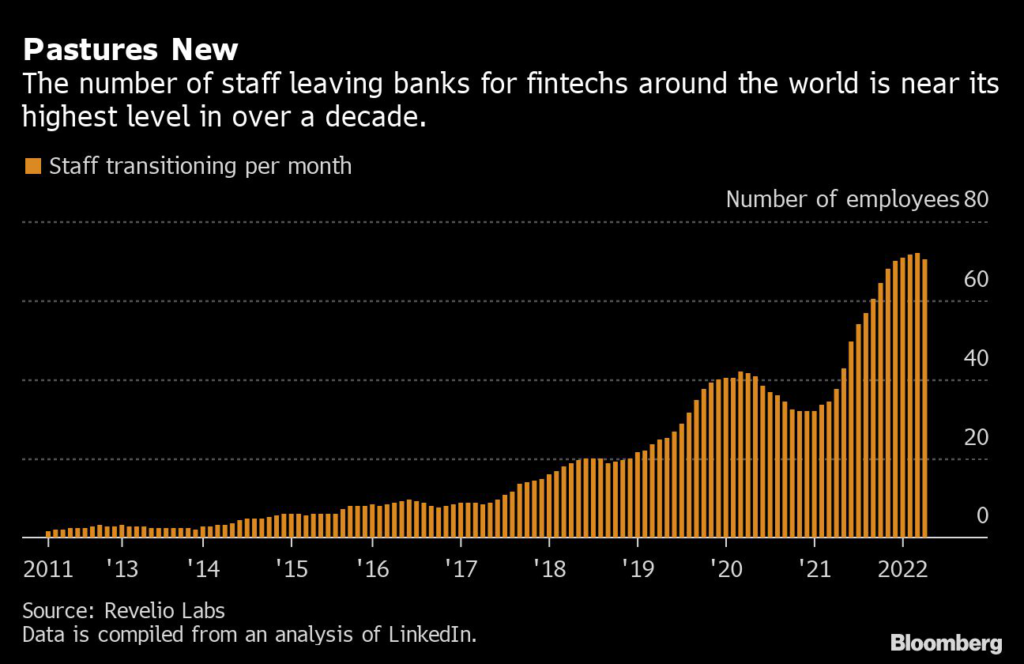
Bankers, engineers, data scientists and sales staff from Wall Street, the City of London and Silicon Valley are among those joining an exodus that picked up speed during the pandemic, according to data compiled by Revelio Labs, a workplace intelligence company. 

Departures from traditional banks, such as Goldman Sachs Group Inc and HSBC Holdings Plc,. to fintech companies including Coinbase Global Inc. and Revolut Ltd. are up 75% since the start of the pandemic, Revelio said. Monthly job changes peaked at 72 in March this year — the highest figure since records began in 2011. Significant numbers of employees are also moving from tech firms like  Amazon.com Inc. and Microsoft Corp.

The growth in highly qualified staff switching to roles in new sectors comes as tight job markets allow many tech employees to change jobs, seeking higher salaries and more flexible routines. 

“People have stopped and re-evaluated what’s important to them,” Lisa Simon, economist at Revelio, said in an interview. She cited a better work-life balance, improved pay and better career prospects as key drivers. 

Goldman Sachs saw 37 staff move to Coinbase, the largest US-based cryptocurrency exchange, from Jan. 2020 through April 2022. Another 21 Goldman staff joined corporate credit card start-up Brex Inc., while 18 went to SoFi Techologies, Inc., the fintech firm led by former Twitter Inc. executive Anthony Noto.

To be sure, the numbers of staff leaving for fintechs and startups are small in comparison to the overall numbers employed in major financial services firms or Silicon Valley tech giants. Goldman employs 45,100 people worldwide. A representative for the bank declined to comment.

Elsewhere, some 28 workers have gone from Morgan Stanley to Coinbase and 12 to Wise Plc, which has almost 400 jobs available, according to a company spokeswoman. Some 38 HSBC employees have gone to Revolut and 21 to Monzo Bank Ltd. Challenger bank Monzo has also hired 32 former staff from Lloyds Banking Group Plc and 27 from Barclays Plc. 

Morgan Stanley and HSBC made no comment. In emailed statements, Barclays’ Chief Operating Officer Mark Ashton-Rigby and a spokeswoman for Lloyds  — which was recently ranked second in a LinkedIn list of the UK’s top 25 employers — each pointed to the importance their banks place on workplace culture. 

“The number of people working in technology roles at Barclays has grown by more than 10% in the past two years which is testament to the compelling proposition we offer,” Ashton-Rigby said.

“There’s a war for talent,” said Christian Faes, co-founder of LendInvest and chair of the industry group Fintech Founders, citing high levels of regulation in traditional banking as well as “legacy processes, legacy people and technology.”

“We’re literally hiring people out of Facebook and Amazon, really high-tech engineers, and they don’t naturally gravitate toward banks with coding systems from the 1980s,” Faes said.

Coinbase alone has snagged 197 staff from Amazon, 97 from Alphabet Inc., the parent company of Google, 73 from Microsoft and 72 from Meta Platforms Inc., Revelio’s data show. Microsoft and Amazon declined to comment. A spokesman for Coinbase said the company is “pleased that so many employees from top banks and tech giants want to rebuild the future of the crypto economy.” Meta and Alphabet didn’t respond to requests for comment.

Despite the shift into fintech there are already signs the trend is easing off. Inflation is darkening the global economic outlook, and a major tech selloff has put future funding rounds in doubt. Against that backdrop, the pace of staff movement from banking to fintech already appears to have slowed.

The Tech Rout Isn’t Just Cyclical—It’s Well-Earned, and Overdue

In that environment, some employees will choose stability over change. Crypto firms are looking especially risky: Coinbase’s market value has plummeted in the past six months, with the stock down more than 60% from its IPO price in April 2021.

That’s leading some to stick up for the key benefits of a mature, stress-tested financial sector. “The basic story is we have customers and they don’t,” Zach Anderson, chief data and analytics officer at NatWest Group Plc, said in an interview.

“If you want to have an impact on 19 million customers in a substantive way, you go to a bank.”

More stories like this are available on bloomberg.com

©2022 Bloomberg L.P.

Ant Unveils Singapore Digital Bank in Southeast Asian Push

(Bloomberg) — Billionaire Jack Ma’s Ant Group Co. launched its digital bank in Singapore, as China’s largest online financial platform branches out of its home market amid regulatory headwinds. 

ANEXT Bank will provide digital financial services to micro, small and medium-sized enterprises, particularly those with cross-border operations, it said in a statement on Monday. 

The fintech giant is entering an arena dominated by traditional incumbents including DBS Group Holdings Ltd. and Oversea-Chinese Banking Corp. Using Singapore as a base for its business in Southeast Asia may offset slower growth prospects at home after government-ordered regulatory overhauls. Part-owned by Alibaba Group Holding Ltd., Ant can also benefit from the e-commerce operator’s unit in the region, Lazada.

“Banking services are essentially a very central part of the holistic suite of financial services that we’re doing within Southeast Asia and hopefully using Singapore as a launchpad,” Toh Su Mei, chief executive officer of ANEXT Bank, said at a news briefing.  

Asked about staffing, Toh said the wholly owned bank will build a “Singapore-first team,” with 75% of workers based in the city-state and the rest in China. 

Toh, a former executive at DBS, has more than 20 years of experience in the banking industry. She led DBS’s lending arm for small and medium-sized enterprises in the region before joining Ant, according to her LinkedIn profile.

The digital bank is starting by offering a preview of its dual-currency deposit account, which includes three-factor authentication verification, remote on-boarding and daily interest, it said. Accounts will be made available from the third quarter. 

Toh said the bank will offer interest rates that are in line with the market. “We are not here to create a price war,” she said. 

Local Partner

Ant was one of two groups to get a wholesale digital banking license in December 2020, allowing it to serve small and midsized firms and other non-retail segments. It requires a capital commitment of S$100 million ($73 million). That compares with a full digital bank license, which can serve all kinds of customers and eventually requires S$1.5 billion in capital as well as local control.

Ant will also partner with Proxtera, a local entity that’s part of a public initiative led by the Monetary Authority of Singapore and Singapore’s Infocomm Media Development Authority, to create an open framework for collaboration with financial institutions. 

Singapore’s efforts to open up the banking industry to technology companies come on the heels of a similar move in Hong Kong, where Ant and Chinese competitors including Tencent Holdings Ltd. obtained licenses in 2020.

“Continuous innovation and new capabilities that digital banks are slated to bring will no doubt add more engines of growth to Singapore’s financial sector,” MAS Chief Fintech Officer Sopnendu Mohanty said in the statement. 

Ant’s payments app Alipay had about a billion annual active users as of August 2020. The company has invested in 10 digital wallet operators outside China, including Paytm in India and Dana in Indonesia.

(Updates with digital bank CEO’s comments from fourth paragraph)

More stories like this are available on bloomberg.com

©2022 Bloomberg L.P.
Stocks Gain as Beijing Normal Counters Rate Fears: Markets Wrap

(Bloomberg) — Stocks in Asia and US futures rose Monday as Beijing reopened further, helping soothe a fragile mood as inflation and rate hike concerns weigh. Oil gained.

Japan equities erased losses, while technology shares jumped in Hong Kong. China advanced with the capital walking back Covid-19 restrictions. Australian stocks fell, bucking the trend, ahead of an expected second consecutive interest-rate increase Tuesday. S&P 500 and Nasdaq 100 futures rose. 

Treasury yields stabilized. Strong US hiring data for May suggested that the Federal Reserve won’t waver from its pace of steep interest-rate hikes to rein in price pressures. The next focus is consumer prices due this week, which can help gauge whether inflation has peaked. A dollar gauge was steady.

Crude oil traded near $120 a barrel as shortage worries persist. Saudi Arabia raised prices for its biggest market of Asia by more than expected, and the US was considering allowing more sanctioned Iranian oil onto global markets to counter the drop in Russian supplies. Copper hit the highest since April on China’s easing of virus measures.


Investors are fretting that a restrictive Fed could plunge the economy into recession, while China’s lockdowns to control virus outbreaks have chocked economic activity and snarled supply chains, adding to inflation worries. 

The easing of Chinese lockdowns will help abate supply-chain pressures, while ramped up policy measures also boost optimism over China, according to Diana Mousina, a senior economist at AMP Capital. Still, the nation’s services activity contracted more than expected in May amid the restrictions.

“Positive news around Chinese economic activity and cheaper equity valuations could offer value from a long-term investment perspective, but volatility will remain high in the short-term,” Mousina said in a note. 

The US jobs report quelled some concern that the economy is slowing too sharply, but also strengthened the view that the Fed will keep hiking rates to tamp down on rising inflation. Cleveland Fed President Loretta Mester said she would back a half-point hike in September if inflation is not retreating. Market-derived odds for a third 50-basis-point increase in September held steady near 85%. 

The European Central Bank will this week announce an end to bond purchases and formally begin the countdown to an increase in borrowing costs in July, joining global peers tightening monetary policy in the face of hot inflation.

Elsewhere, the pound was steady amid risks around a confidence vote on British Prime Minister Boris Johnson’s leadership.

Key events to watch this week:

  • Reserve Bank of Australia policy decision Tuesday
  • World Bank’s “Global Economic Prospects” report Tuesday
  • Reserve Bank of India rate decision Wednesday
  • OECD Economic Outlook, a twice-yearly analysis of major global economic trends and prospects for the next two years. Wednesday
  • European Central Bank rate decision, Christine Lagarde briefing, Thursday
  • China trade, new yuan loans, money supply, aggregate financing. Thursday
  • U.S. CPI, University of Michigan consumer sentiment Friday
  • China CPI, PPI Friday

Some of the main moves in markets:

Stocks

  • S&P 500 futures rose 0.4% as of midday in Tokyo. The S&P 500 fell 1.6% on Friday
  • Nasdaq 100 futures rose 0.6%. The Nasdaq 100 fell 2.7%
  • Topix index rose 0.1%
  • Australia’s S&P/ASX 200 Index lost 0.4%
  • Hang Seng Index rose 1.1%
  • CSI 300 Index rose 1.1%
  • Euro Stoxx 50 futures gained 0.6%

Currencies

  • The Bloomberg Dollar Spot Index was steady
  • The Japanese yen rose 0.2% to 130.60 per dollar
  • The offshore yuan traded at 6.6554 per dollar
  • The euro was at $1.0722

Bonds

  • The yield on 10-year Treasuries was at 2.94%
  • Australia’s 10-year bond yield was at 3.48%

Commodities

  • West Texas Intermediate crude rose 0.8% to $119.82 a barrel
  • Gold was at $1,854.41 an ounce

More stories like this are available on bloomberg.com

©2022 Bloomberg L.P.

SoftBank-Backed Carro Buys 50% Stake in Indonesia’s MPM Rent

(Bloomberg) — Carro, one of Southeast Asia’s biggest online marketplaces for used cars, has agreed to buy a 50% stake in Indonesian automotive financing and rental company MPM Rent for S$75 million ($54.5 million) to expand in the world’s fourth most populous country. 

The deal will lead to a strategic partnership between Carro and PT Mitra Pinasthika Mustika Tbk, which owns the rest of MPM Rent, according to a statement reviewed by Bloomberg News. 

“We remain steadfast and committed to investing and advancing our business in Indonesia despite the uncertain global macro environment,” Aaron Tan, Carro Chief Executive Officer, said in the statement.

Shares of Mitra Pinasthika surged as much as 6.3% in Monday trading, their largest intraday increase in more than two weeks, according to data compiled by Bloomberg.

Formally known as Trusty Cars Pte, Carro has raised more than $500 million since its inception in 2016, including a $360 million funding round last June led by SoftBank Vision Fund II. The startup, valued at more than $1 billion, also counts Mitsubishi Corp. and the venture arm of MS&AD Insurance Group Holdings Inc. among its backers.

The company has over 2,000 staff and competes with Carousell and Carsome in Southeast Asia. It’s targeting an initial public offering in the U.S. within the next two years, Tan said in an interview in 2021.

MPM Rent has a fleet size of about 13,000 cars with 2,500 drivers, providing vehicle rental services across Indonesia, its website shows.

(Updates with share price move in fourth paragraph.)

More stories like this are available on bloomberg.com

©2022 Bloomberg L.P.
Ukraine Latest: Zelenskiy Visits Troops; UK to Send Rockets

(Bloomberg) —

Ukrainian President Volodymyr Zelenskiy visited troops in the southern region of Zaporizhzhia, about 60% of which is occupied by the Russian army and where fighting is ongoing. 

The UK plans to send rocket systems to Ukraine that will let it strike locations as far as 80 kilometers (50 miles) away. Last week, the US said it would send similar systems, with Washington rejecting Russian claims the move would escalate the war dragging into its fourth month.

Thierry Breton, the EU’s internal market commissioner, said Russian President Vladimir Putin is using gas in an effort to split Europe as he wages war on his neighbor.

(See RSAN on the Bloomberg Terminal for the Russian Sanctions Dashboard.)

Key Developments 

(All times in CET)

  • Kazakhs Vote on New Constitution as Tokayev Cements His Power
  • What Are War Crimes? Could Putin Face Prosecution?: QuickTake
  • Putin’s War Forces Biden to Rewrite Security Plan, Nod to Europe
  • France Is Talking to UAE About Replacing Russian Oil, Diesel

UK to Send Rocket Systems (12:01 a.m.)

The UK is to send multiple-launch rocket systems to Ukraine, Defence Secretary Ben Wallace announced Monday. The move has been coordinated closely with the US decision to send the High Mobility Artillery Rocket System variant of MLRS to Ukraine, where forces have requested longer-range precision weapons.

“As Russia’s tactics change, so must our support to Ukraine,” Wallace said. “These highly capable multiple-launch rocket systems will enable our Ukrainian friends to better protect themselves against the brutal use of long-range artillery, which Putin’s forces have used indiscriminately to flatten cities.”

The M270 weapon system, manufactured by Lockheed Martin, can strike targets up to 80 kilometers (50 miles) away with high accuracy, according to a statement released by the Ministry of Defence. The UK will also supply M31A1 munitions “at scale.”

Russia Seeks Buyers for Plundered Grain, New York Times Says (12:01 a.m.)

The US has told more than a dozen countries that Putin’s government is trying to sell plundered wheat from Ukraine to drought-stricken African nations, the New York Times reported citing a diplomatic cable.

The paper said that in mid-May, the US sent a notification to 14 countries, mostly in Africa, of Russian cargo vessels leaving ports near Ukraine laden with what the cable said was “stolen Ukrainian grain.”

Ukraine has accused Russia of stealing grain in occupied areas and selling it abroad, and local traders have said Russian troops have confiscated grain, equipment and fertilizers in occupied areas in the country’s southeast. 

Read more: Egypt Says It Refused Undocumented Ukrainian Grain Shipment

Lavrov’s Visit to Serbia Won’t Happen After Flight Ban (9:49 p.m.)

Russian Foreign Minister Sergei Lavrov’s planned visit to Serbia on June 6-7 won’t take place after Bulgaria, North Macedonia and Montenegro didn’t grant permission for the plane he would travel in to fly in their airspace, Interfax news wire reported, citing an unidentified, high-ranking official from the ministry.  

Russian Foreign Minister Lavrov’s Visit to Serbia in Question (4:50 p.m.)

A two-day visit of Russia’s Foreign Minister Sergei Lavrov to Serbia is in question as Montenegro, Northern Macedonia and Bulgaria are banning his plane from their air space, Vecernje Novosti reported, without saying where it got information.

Due to the recent developments, Serbia’s President Aleksandar Vucic will meet with Russian Ambassador Alexander Botsan-Kharchenko Monday morning, according to the Serbian publication.

Lavrov was planning to visit Serbia on June 6-7 to meet the nation’s leader as well as his counterpart, Tass reported, citing Russian Foreign Ministry’s spokeswoman Maria Zakharova. They were expected to discuss in-depth bilateral political and economic relations and exchange their views on the situation in the Balkan region and also talk about other international problems, according to Tass.

Ukraine Denies Russia Destroyed Tanks (3 p.m.)

There were no tanks at Ukraine’s coach-repair plant hit in Russia’s missile attack, state-run railway company Ukrzaliznytsia’s Chief Executive Office Oleksandr Kamyshev said.

Earlier today, four Russian missiles hit Darnytsia coach-repair plant that fixed wagons to transport grain and other exports, Kamyshev said. (See 11:30 a.m. item)

“I officially state that there is no military equipment at the premises of the plant,” he said, inviting journalists for a tour tonight. “Russia again told a lie. Their real goal is Ukraine’s economy and civilians. They want to stop our ability to export Ukrainian products to the west.”

EU’s Breton Says Putin Using Gas to Divide Europe (12 p.m.)

Breton in an interview with CNews and Europe1 on Sunday that plans are in place if Putin takes further steps to switch off Russian gas after cutting supplies to Poland, Bulgaria, Netherlands, Finland and Denmark. This includes boosting LNG imports, partly from the US and Qatar, accelerating solar and offshore wind power, and extending the life of nuclear and coal-fired plants.

“We must also free ourselves from gas, because Russian gas today, we must get our autonomy back as quickly as possible as Vladimir Putin doesn’t like the European project,” Breton said, “For years, he’s done everything to divide Europe,” he added, citing Brexit, Covid vaccines and TV channel Russia Today as examples. “Now he’s using gas precisely to divide us.”

Russia Says It Destroyed Weapons on Outskirts of Kyiv (11:30 a.m.)

“The Russian Aerospace Forces destroyed T-72 tanks and other armored vehicles placed in the buildings of a coach-repair plant with high-precision long-range air-based missiles on the outskirts of Kyiv,” Tass reported, citing Defense Ministry spokesman Igor Konashenkov. 

Destroyed tanks and equipment were supplies by Eastern European countries, according to Konashenkov.

Bloomberg News couldn’t independently verify the claim.

Putin Says Russia to Set New Targets If Ukraine Gets Longer-Range Missiles (10:45 a.m.)

Russia will strike targets that it hasn’t hit previously, if longer-range missiles are delivered to Ukraine, Putin said in an interview with Rossiya-1 TV channel.

All the “hassle” about additional weapon deliveries has “only one goal — to drag out the armed conflict as much as possible,” he said. If long-range missiles are supplied, “we will draw appropriate conclusions from this and will use our means of destruction, which are ample, to strike objects that we have not yet struck.”

Ukraine has been asking its partners to provide long-range weapons so it can defend itself in Donbas, where Russian troops are making slow but steady advances. The US said it will ship the systems, which can fire missiles as far as 80 kilometers as Kyiv promised it won’t strike targets inside Russia

Russian Missile Flew Low Over Nuclear Power Plant (8:15 a.m.)

A Russian cruise missile “flew critically low over the South Ukraine nuclear power plant,” Ukrainian state-run nuclear power producer Energoatom said on Telegram. It said the rocket flew overhead in the direction of Kyiv, where explosions were heard this morning.

Russia targeted railway infrastructure in Kyiv, Serhiy Leshchenko, an adviser to President Volodymyr Zelenskiy’s chief of staff said.

Luhansk Governor Reports More Damage (7 a.m.)

The situation in Luhansk region, where Russian troops continue to storm the city of Sievierodonetsk, remains “extremely difficult,” Governor Serhiy Haiday said on Telegram. There are damages reported at the Azot chemical factory in Sievierodonetsk, as well as in another large city, Lysychansk, and other areas, he said.

Russian troops now control the eastern part of Sievierodonetsk, Ukrainian authorities said.

Several Explosions in Kyiv on Sunday Morning (5:40 a.m.)

Several explosions occurred in Darnytskyi and Dniprovskyi districts in Kyiv, the capital’s mayor Vitali Klitschko said on his Telegram channel on Sunday morning. There are currently no casualties as a result of “missile strikes on infrastructure” targets, he said, adding one person was sent to hospital and rescue services are still working in the affected areas.

Ukrainian air defense shot down a missile over Obukhiv district in the Kyiv region on Sunday morning, the regional administration reported on Telegram.


US General Milley Holds Briefing With Swedish Leader (11:50 p.m.)

US General Mark Milley reiterated the US’s support for Sweden and Finland for NATO membership during a press conference with Swedish Prime Minister Magdalena Andersson in Stockholm, AFP reported.

Milley also visited the USS Kearsarge, the largest US warship ever to dock in Stockholm and which houses Osprey transport aircraft, Harrier attack helicopters and more than 1,200 Marines, the report said.

Ukraine, Russia Exchange Bodies of Deceased Soldiers (4:46 p.m.)

Ukraine and Russia exchanged the bodies of 160 soldiers each, in the first such public move since the start of war. 

The exchange took place at the contact line in Zaporizhzhia region on June 2, according to Ukraine’s Ministry on Issues of Reintegration of Temporary Occupied Territories.

More stories like this are available on bloomberg.com

©2022 Bloomberg L.P.

Bitcoin Heads Higher in Attempt to Escape $30,000 Level

(Bloomberg) — Bitcoin advanced, rising beyond the $30,000 level after languishing at the weekend.

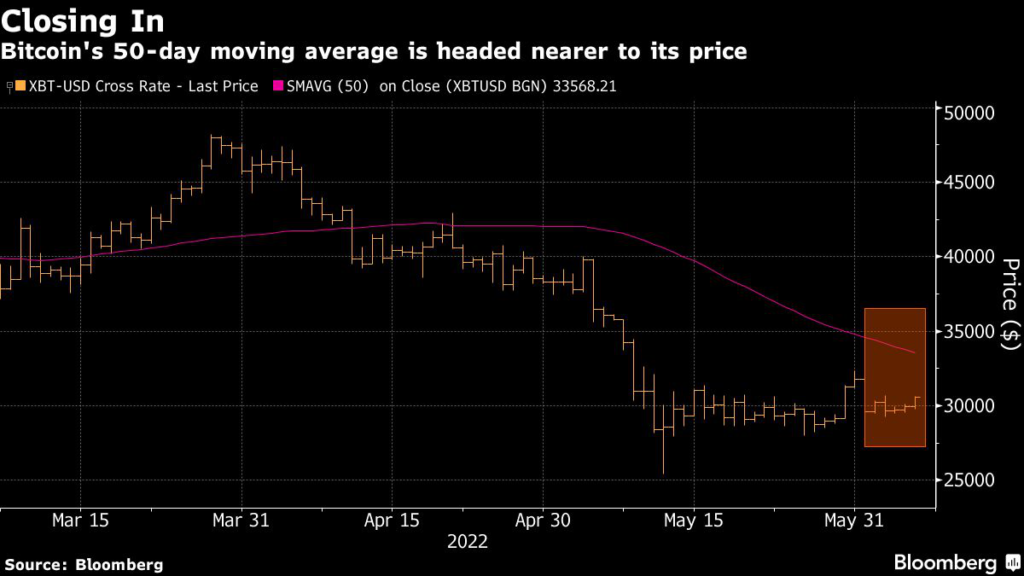
The largest cryptocurrency gained 2.1% to $30,559 as of 9:29 a.m. in Singapore on Monday. Other cryptocurrencies also rose, with Ether rising 2.4% and Polygon advancing 3.4%.

“Bitcoin has stabilized over the past few weeks on improved short-term momentum,” Katie Stockton, co-founder of Fairlead Strategies, wrote in a note Friday. She said a short-term counter-trend buying signal was logged by Tom DeMark’s TD Sequential model, which is employed by technical analysts to spot trends, “increasing the probability of a more pronounced oversold bounce. We assume the 50-day moving average will provide resistance.”

Bitcoin and the rest of the cryptocurrency complex has struggled in recent months as the Federal Reserve hikes interest rates and risky assets like tech stocks have fallen back. The collapse of the Terra/Luna ecosystem further undermined confidence in the space. 

Bitcoin has been stuck around the $30,000 level for weeks now, defying predictions of a potential further decline but also struggling to gain upward momentum.

More stories like this are available on bloomberg.com

©2022 Bloomberg L.P.
Terra Investors in India Lost Big. Now They Face the Taxman

(Bloomberg) — Terra investors around the world lost billions of dollars when the algorithmic-stablecoin project crashed but they recovered a small part of their bets when a new token was distributed as compensation. Investors in India aren’t as fortunate.

Because the country’s tax system is punitive to crypto investing, TerraUSD and Luna token holders who got the new coin — known as Luna 2.0 — in a so-called airdrop face a double whammy. They could be taxed as much as 30% of the value of tokens received and they won’t be able to offset any gains in the new token against losses from the previous one, tax experts said.

Under the new crypto tax regime, effective April 1, any income from the “transfer” of a “virtual digital asset” will be taxed at a flat rate of 30%. It does not explicitly mention how airdrops should be taxed, but Jay Sayta, a technology and gaming lawyer, and Manhar Garegrat, executive director of policy at crypto exchange CoinDCX, said the distributions can be seen as income and are subject to the tax.

“The wordings in the law are so vague, including the definition of virtual digital asset and the definition of transfer, that it would be open to litigation of challenge by the tax department,” said Sayta. “They normally consider the most aggressive view possible with a view to collecting higher taxes, notwithstanding the fact that such a view may result in absurdity.”

There were over 160,000 investors that held Luna on the exchange on May 9 and by May 15 the number grew by 77% in India, according to Rajagopal Menon, vice president at Binance-owned WazirX. It’s unclear how many more investors held TerraUSD.

“The increase can be attributed to a surge in buyers post 9th May where the buyer-to-seller ratio was 5:1. In terms of the volumes, 11th and 12th May saw the highest volumes in Luna – 53 million USDT combined for both days,” Menon wrote in an email.

Anoush Bhasin, founder of crypto asset tax advisory firm Quagmire Consulting, said that the Luna 2.0 airdrops may fit into the existing definition of gifts so a flat 30% tax may not apply but gifts are taxed based on a taxpayer’s income range, or slab rate.

The Worst Case

Whether considered as a gift or income from crypto, experts Bloomberg spoke to said that under the new tax regime there will be two stages of taxation. First, at the time of receiving the airdrop, a gift tax or a flat 30% tax, will be levied based on the valuation of tokens at time of credit. Second, if the tokens are sold, a flat 30% tax will be applied on the incremental income earned regardless how the tokens are categorized, if the tokens rose in value. 

“There could be a scenario where people have received tokens above INR50,000 and if its treated as gift, you’ll have to pay taxes on it, but by the time they sell it if the price falls then you’ll actually realize lesser money, and you may actually go more out of pocket in paying taxes than what you recover and that is the worst case scenario for them as Luna 2.0 was actually issued to compensate,” said Meyyappan Nagappan, leader, digital tax at Nishith Desai Associates.

Luna 2.0 started trading on May 28 and as of June 3 at 2 p.m., US East Coast time, it was trading at $6.59, down 9% in the last 24 hours, according to CoinGecko and Huobi Global. 

The quandary is reflective of an Indian government that’s long had an uneasy relationship with crypto. The tax structure unveiled this year treats digital assets unfavorably compared with stocks and bonds, leading to warnings of a crypto exodus. Trading has withered as a government-backed payment network was made unavailable to cryptocurrency exchanges, leaving clients unable to fund their accounts with rupees. 

Why Token Airdrops 

An airdrop is a way of sending a token directly to wallets and can be used for various purposes. Airdrops are a common tool for early-stage crypto projects to attract users by offering free tokens and can be used to reward early adopters.

“Airdrops are a way of showing gratitude,” said Harsh Rajat, co-founder of Ethereum Push Notification Service or EPNS, which airdropped its native token PUSH to early adopters and those who donated to the project last year. “In web3 the concept is that this is made by the people and for the people, if people are testing out a protocol, spending their time then you should be rewarded some rights to the protocol either through governance or utility of token and that’s why airdrops exists.”

In the case of Terra, backer Terraform Labs used an airdrop to compensate investors and revive its project after the stablecoin collapsed, sending the value of sister token Luna spiraling to near zero, wiping out billions of dollars of wealth. Terraform Labs used a snapshot of the old blockchain, now known as Terra Classic, to determine which user wallets should receive Luna 2.0, and how much.

Rajat said that global projects won’t stop giving airdrops but they will find it difficult to do them in India since crypto investors there may stand to lose a lot of money. 

“Airdrops attract a lot of users, it generates a lot of noise,” Rajat said. “Sometimes you will be able to recover the tax, sometimes you won’t be able to.”

More stories like this are available on bloomberg.com

©2022 Bloomberg L.P.

Close Bitnami banner
Bitnami