Bloomberg

Tron Modifies USDD Stablecoin to Avoid Woes of TerraUSD

(Bloomberg) — Tron, which debuted the USDD algorithmic stablecoin last month, is looking to avoid the trouble its fellow token TerraUSD ran into by boosting transparency and adding collateral.

Total USDD supply stands at about $668 million, the Tron DAO Reserve website and CoinGecko indicate. USDD had a collateralization ratio of 218% as of Monday morning Asia time, according to the TDR website, while a statement from the company on Sunday said a guaranteed minimum collateral ratio of 130% will be maintained.

TDR’s site shows reserves in Bitcoin, Tether and Tron’s TRX of $787 million, helping comprise a total of about $1.4 billion of assets backing USDD in circulation.

The moves come just a few weeks after the Luna and TerraUSD ecosystem collapsed, all but erasing a combined market value that had once exceeded $60 billion.

“This has been in the plan, but Terra/Luna definitely accelerated and prioritized this for our team,” Tron founder Justin Sun said in a recent interview. “We want to have USDD to be overcollateralized, which I think will make market participants more comfortable about using us in the future.”

Algorithmic stablecoins — which are meant to stay at a constant price, often $1 — have a troubled history. Efforts such as Neutrino and Basis have lost their dollar pegs, some in spectacular fashion, after price declines in the stabilizing token. 

Last month’s implosion of Luna and TerraUSD caused further devastation to the cryptocurrency complex, which has struggled as the Federal Reserve hikes rates and inflation remains high. Bitcoin and Ether, the two biggest tokens, are more than 50% lower than their November highs and many digital assets have down even further.

Sun said in an interview last month that the Terra/Luna collapse offered a chance for other projects to adjust, and that USDD would aim to raise $10 billion through TDR to defend its peg.

Tron has fared relatively well amid the efforts on USDD. In late April, the TRX token was the 24th-biggest by market capitalization. It now sits at the 13th spot, according to pricing from CoinGecko.

Sun said one of his takeaways on Luna and TerraUSD was the Luna Foundation Guard was very passive, and had a strategy to buy and sell Bitcoin that was “very easy to predict,” which would have made it easier to be attacked. Do Kwon, the founder of the Terra ecosystem, didn’t respond to an emailed request for reaction to Sun’s comments.

“Tron DAO will be very active in the market and less predictable,” he said in the recent interview. “You make the market feel comfortable, but without telling too much information.”

(Updates statistics starting in second paragraph, adds no comment from Do Kwon in 10th paragraph.)

More stories like this are available on bloomberg.com

©2022 Bloomberg L.P.

Bitcoin Miners Are Selling Tokens as Prices Linger Near Lows

(Bloomberg) — Bitcoin miners are beginning to sell tokens they’ve hoarded to cover burgeoning costs with the prospects for industry growth slowing and the price of the largest cryptocurrency showing few signs of rebounding following the recent collapse from record highs. 

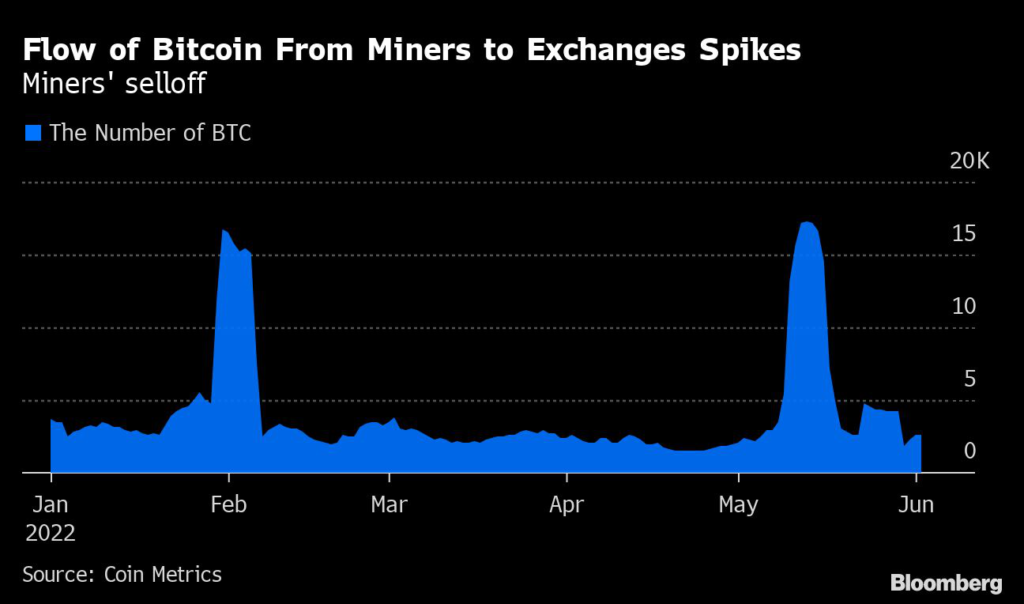
Miners transferred about 195,663 coins to exchanges in May, the biggest monthly increase since January, according to data from Coin Metrics compiled by Compass Mining. Based on Bitcoin’s average price of around $32,000 in May, the total value of the tokens was about $6.3 billion. 

That indicates companies may be moving large amounts of coins stored in their digital wallets to exchanges for sale. To be clear, the number does not necessarily mean miners are selling that many tokens since some miners would put their coins in exchanges for other transactions and not sell. 

Sellers include publicly traded miners such as Riot Blockchain Inc. that had been stockpiling Bitcoin on a bet that prices would keep appreciating. They had served as a proxy for equity investors that wanted to gain crypto exposure without actually owning the tokens. Smaller miners who face large liquidations are also selling their Bitcoin. The token has dropped about 35% this year. 

“I think miners are just talking about the macro environment and think it is probably prudent to sell Bitcoin in these levels in order to keep the operations safe,” said Will Foxley, director of content at mining hardware marketplace and hosting services provider Compass Mining. 

More large-scale public miners have become cash-strapped as it became harder to raise capital through debt or stock sales during a recent bear market. They’re also seeking wider profit margins as the companies expand. Riot is building a mining facility with one gigawatt capacity in Texas after it has completed its 750-megawatt site, which is one of the largest mining farms in the US. 

Miners are also trying to pay for mining machines they ordered months ago while putting down non-refundable deposits in millions of dollars. 

A wave of small miners that came in during the bull cycle and bet big on Bitcoin prices rising are now at risk of needing to liquidate their mined coins, said Matthew Schultz, executive chairman of crypto-mining company CleanSpark. 

Cathedra Bitcoin Inc., a small-scale miner, had to sell almost all their holdings to maintain their mining operation.  

“We have spent the last several weeks restructuring our balance sheet and operations to ensure Cathedra is well positioned to endure a prolonged economic downturn,” Cathedra Chief Executive Officer AJ Scalia said in a statement.

The flow data tracking transactions between miners and exchanges is one of the best proxies for sales of mined coins, but it has limitations. While the data includes digital wallets from major exchanges such as Binance and Gemini, it doesn’t have data from Coinbase due to the biggest US exchange’s wallet design.  Some of the miners also opt to liquidate their crypto holdings through over-the-counter trading desks, whose trading data is typically not public, Foxley said.

Shares of public miners have been hit hard this year. Riot is down 72% since December, while Marathon Digital Holdings Inc. has slumped a similar amount.

More stories like this are available on bloomberg.com

©2022 Bloomberg L.P.

Bitcoin Miners Are Selling Tokens as Prices Linger Near Lows

(Bloomberg) — Bitcoin miners are beginning to sell tokens they’ve hoarded to cover burgeoning costs with the prospects for industry growth slowing and the price of the largest cryptocurrency showing few signs of rebounding following the recent collapse from record highs. 

Miners transferred about 195,663 coins to exchanges in May, the biggest monthly increase since January, according to data from Coin Metrics compiled by Compass Mining. Based on Bitcoin’s average price of around $32,000 in May, the total value of the tokens was about $6.3 billion. 

That indicates companies may be moving large amounts of coins stored in their digital wallets to exchanges for sale. To be clear, the number does not necessarily mean miners are selling that many tokens since some miners would put their coins in exchanges for other transactions and not sell. 

Sellers include publicly traded miners such as Riot Blockchain Inc. that had been stockpiling Bitcoin on a bet that prices would keep appreciating. They had served as a proxy for equity investors that wanted to gain crypto exposure without actually owning the tokens. Smaller miners who face large liquidations are also selling their Bitcoin. The token has dropped about 35% this year. 

“I think miners are just talking about the macro environment and think it is probably prudent to sell Bitcoin in these levels in order to keep the operations safe,” said Will Foxley, director of content at mining hardware marketplace and hosting services provider Compass Mining. 

More large-scale public miners have become cash-strapped as it became harder to raise capital through debt or stock sales during a recent bear market. They’re also seeking wider profit margins as the companies expand. Riot is building a mining facility with one gigawatt capacity in Texas after it has completed its 750-megawatt site, which is one of the largest mining farms in the US. 

Miners are also trying to pay for mining machines they ordered months ago while putting down non-refundable deposits in millions of dollars. 

A wave of small miners that came in during the bull cycle and bet big on Bitcoin prices rising are now at risk of needing to liquidate their mined coins, said Matthew Schultz, executive chairman of crypto-mining company CleanSpark. 

Cathedra Bitcoin Inc., a small-scale miner, had to sell almost all their holdings to maintain their mining operation.  

“We have spent the last several weeks restructuring our balance sheet and operations to ensure Cathedra is well positioned to endure a prolonged economic downturn,” Cathedra Chief Executive Officer AJ Scalia said in a statement.

The flow data tracking transactions between miners and exchanges is one of the best proxies for sales of mined coins, but it has limitations. While the data includes digital wallets from major exchanges such as Binance and Gemini, it doesn’t have data from Coinbase due to the biggest US exchange’s wallet design.  Some of the miners also opt to liquidate their crypto holdings through over-the-counter trading desks, whose trading data is typically not public, Foxley said.

Shares of public miners have been hit hard this year. Riot is down 72% since December, while Marathon Digital Holdings Inc. has slumped a similar amount.

More stories like this are available on bloomberg.com

©2022 Bloomberg L.P.

Capitol Riot Apologists Go Unpunished as Memories of Horror Fade

(Bloomberg) —  The deadly assault on the US Capitol on Jan. 6, 2021 shocked viewers watching live around the world and, at least in the moment, infuriated Republican congressional leaders who fulminated among themselves against the role Donald Trump and his allies played in egging on the rioters.

But the short-lived horror over the worst attack on the seat of US democracy since British troops burned the building in 1814 wasn’t enough to shake the tribal political divisions that drove the insurrection. 

As Congress prepares for a series of televised hearings on the assault starting Thursday, polls show the Republican party is on track to make big gains in midterm elections despite fielding candidates who embrace the false narrative of election fraud that fueled the riot and shun efforts to investigate the attack.

Much of that is driven by the highest inflation in 40 years, soaring gasoline prices and President Joe Biden’s slumping approval ratings. But in some of the early primary races, candidates who dispute the presidential election outcome are winning Republican primaries. Doug Mastriano, who won the party’s nomination for Pennsylvania governor in a landslide, attended the rally that preceded the riot and has called for decertifying the state’s 2020 election results. Representative Ted Budd of North Carolina, who voted against certifying Biden’s election, beat a well-known former governor for the Senate nomination by more than 30 percentage points. Other candidates, including in key races in Georgia, were defeated by opponents who defended the vote counting in their state.

“The fact that it wasn’t a game-changing moment is pretty remarkable,” Julian Zelizer, a Princeton University presidential historian, said. “It’s historically pretty hard to believe.”

Less than a year after the attack, a poll showed more than half of Republican voters opposed continuing to identify and prosecute the people who carried it out. The few Republicans politicians who criticized Trump and his allies immediately after the riot have mostly remained silent. Some have decided to retire from Congress.

EXPLAINER: What the Jan. 6 Committee Has Done, and What’s Next

It’s a remarkable turnabout for an event documented in graphic video — much of it taken by the celebratory participants themselves — of broken glass, bloody fights with police and the emergency evacuation of the vice president from the ornate Senate chamber. More than a hundred officers were injured and one participant was shot and killed by police.

Explanations for the shift in attitudes range from the political re-alignment of the major parties, deep-seated cultural divisions to a newly balkanized news media. And voters who already endured a second impeachment of Trump over the insurrection are preoccupied with other matters.

“I really think politically it’s a dead issue for most voters,” said Representative Guy Reschenthaler, a Pennsylvania Republican. “There’s immediate problems they’re facing. Kitchen table issues. And that’s what I’m picking up when I’m back in the district. Literally no one is talking to me about Jan. 6.”

Instead, ambitious Republican politicians travel to Mar-a-Lago to compete for Trump’s blessing while the two GOP members of Congress who joined the investigative panel are ostracized. A Republican National Committee resolution earlier this year characterized the events on Jan. 6 as “legitimate political discourse.” Only two Republicans showed up at a Capitol event marking the riot’s one-year anniversary: Representative Liz Cheney and her father, former Vice President Dick Cheney.

“It is not just what happened on that day. It is an effort by the former president to overturn an election, to use multiple tools and sources of pressure to try to stay in office, to try to delay our counting of electoral votes — ultimately, the violence we all lived through,” Liz Cheney, who is vice chair of the committee investigating the insurrection, said during a hearing in April.  “You have a duty to stand up against that. We’re not bystanders.”

Democrats, meanwhile, are being urged to focus on more pressing concerns for voters. President Joe Biden and his congressional allies have shifted to the crises at the top of voters’ priorities: the pandemic, supply-chain issues, rising inflation and more recently the Russian invasion of Ukraine. 

That is a political imperative if Democrats are to compete for votes in the midterm elections, especially among moderate independents likely to decide key races, said Democratic pollster Joel Benenson, who advised President Barack Obama on both his 2008 and 2012 campaigns and Hillary Clinton on her 2016 campaign. 

“We’re a year and a half removed” from the riot. “That is not the dinner-table conversation anywhere in America,” Benenson said. 

The House panel’s upcoming hearings include prime-time televised testimony and may be the best remaining shot at making a case for broader accountability for the insurrection. 

Representative Zoe Lofgren, a California Democrat who is on the committee, said she is not concerned about whether the hearings turn out to be a loser for Democrats.

“We’re just trying to do our jobs. Trying to get the truth out in way that’s coherent and understandable,” Lofgren said. “And the American people will have to take it from there.”

Committee organizers will do it with little help from Republican colleagues whose early expressions of disgust quickly dissipated. 

Audio obtained by the New York Times documents House Republican leader Kevin McCarthy in the days after the attack complaining to fellow party leaders about Trump’s “atrocious” conduct and weighing ways to remove him from office, including pushing him to resign or invoking the 25th amendment’s provisions to oust an incapacitated president. 

But barely three weeks afterward, McCarthy was in Mar-a-Lago to stand beside a smiling Trump and declare the congressional leader’s support for a “united conservative movement.”

The price for that unity would be acquiescence to a continuing campaign to portray the 2020 election results as illegitimate and resistance to efforts to investigate the origins of the attack on the Capitol.

“The turning point is the people in the Republican party who know it is a lie and don’t believe it — with the exception of a few people like Liz Cheney and Mitt Romney — for the most part acquiesce to it because they traded principles that they said they believed in for power,” said Stuart Stevens, a long-time Republican strategist who opposed Trump’s elections.

One practical matter: Trump remained popular with Republican voters and was reported to be considering forming a breakaway “Patriot Party.” That could prove a potentially devastating blow to Republicans who would then find their conservative base siphoned off to a competing party.

Anger in the GOP rank and file over false claims of a stolen election and a range of other cultural and economic grievances is stronger than any dismay over the attack on the Capitol. 

“A hard core of Republicans have talked themselves into believing that the Democrats are so dangerous that almost any measures are justified to keep them out of office,” H. W. Brands, a presidential historian at the University of Texas at Austin.

Just after the riot, two-thirds of Republican voters said the presidential election results were marred by widespread fraud. Three-quarters of Republicans without a college degree held that view, according to a January 2021 poll by the center-right American Enterprise Institute. Half of Republicans said the left-wing group Antifa was mostly responsible for violence at the Capitol, a discredited theory advanced by some conservative commentators. Those views have hardened with time.

The narratives have been nurtured on the right by conservative news media and social media as Americans’ sources of information fragment along ideological lines. Long gone are the days of news coverage by three common-denominator television networks and one or two mass-market local papers. Conservative Fox News now competes for viewers with harder-line cable networks such as Newsmax and One America News. 

In November, Tucker Carlson, one of the most prominent television voices on the right, aired the “Patriot Purge” documentary series on Fox News’ streaming service pushing debunked claims the assault was a false-flag operation set up to entrap Trump supporters. Social media and the rising popularity of political podcasts are another channel for amplifying conspiracy theories. 

Conflict over Jan. 6 and the election outcome often merges in populist conservative circles with grievances over Covid masking measures, suspicion of vaccines and division over the Black Lives Matter movement’s calls for racial justice, said Russell Moore, the former head of the Southern Baptist Convention’s public policy arm and an early evangelical critic of Trump. 

“We live in a time of partisan conceptions of truth. I think the old George Orwell rule applies,” said Moore, now public theologian at Christianity Today, an evangelical magazine founded by Billy Graham. “People tend to be able to justify any atrocities on their side or able to not hear about them. People are able to filter out news based on their partisan identities.”

More stories like this are available on bloomberg.com

©2022 Bloomberg L.P.

Hungary Unveils Windfall Taxes, $6.1 Billion in Spending Cuts

(Bloomberg) — Sign up for the New Economy Daily newsletter, follow us @economics and subscribe to our podcast.

Hungarian Prime Minister Viktor Orban used his emergency powers to publish decrees on a sweeping set of windfall taxes and to order about $6.1 billion in spending cuts for this year and next.

The measures, which will hit industries from banking to energy and airlines to telecommunications, underscore the extent of the budget imbalance that has spooked investors at a time when the European Union has blocked billions of euros in funding over concerns about graft.

The government said last month that public spending cuts and savings will constitute 60% of the budget consolidation while revenue from windfall taxes will make up 40%.

The spending cuts include a 10% reduction in central government expenditure in 2022 and 2023, accounting for 581 billion forint ($1.6 billion) and 500 billion forint respectively. State investments to the tune of 1.15 trillion forint will be suspended for this year and next while lavish utility price subsidies will be restricted to households, according to the decrees published on Sunday.

Windfall taxes will be paid according to the following:

  • Banks will pay a 10% levy on net revenue in 2022 and 8% in 2023 in two equal tranches; in 2022, the first tranche must be paid by Oct. 10, the second by Dec. 10
  • Oil companies importing Russian crude — a reference to refiner Mol Nyrt. which was granted an EU exemption from the bloc’s oil embargo — will pay a 25% tax on the difference in price levels between Russian crude and Brent. The tax must be paid by July 1 for 2022
  • Telecommunication and retail companies will pay a progressive tax based on net sales that rises to 7% for revenue for telecom firms and 4.1% for retail for revenue in excess of 100 billion forint
  • Airlines must pay a departure fee per traveler of 3,900 forint, or about 10 euros, for those flying to within the EU and most of Europe. For those traveling further afield, the departure fee is 9,750 forint
  • Financial transaction and excise taxes as well as a sprinkling of other smaller levies in the economy will also be raised or expanded, according to the decree

Hungarian assets were battered last week as confusion over the central bank’s monetary policy, plans to tax windfall profits and the outlook for the government to secure crucial EU funds spooked markets, sending the forint to near a record low against the euro.

More stories like this are available on bloomberg.com

©2022 Bloomberg L.P.

N. Korea Fires 8 Missiles, Testing Biden With Launch Record

(Bloomberg) — North Korea fired eight short-range ballistic missiles Sunday, pushing it to a record number of launches in a single year under Kim Jong Un, who appears ready to further ratchet up tensions with his first test of a nuclear device since 2017.

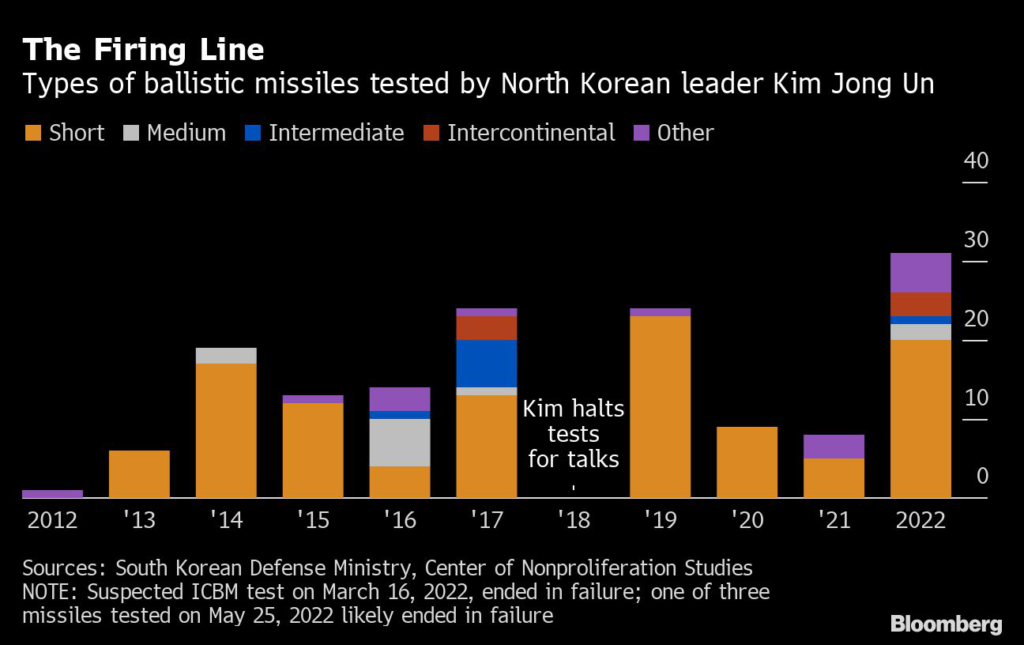
South Korea’s military said it detected the missiles being fired between 9:08 a.m. and 9:43 a.m. from four different sites, including an area around Pyongyang’s main airport toward waters off its east coast. The single-day ballistic barrage is likely the biggest since Kim took power a decade ago, with launches for this year beating the previous record of 24. North Korea has so far fired off 31 ballistic missiles in 2022, which include at least two failed attempts.

“While our military has reinforced surveillance and vigilance to prepare for any additional launches, we are maintaining a full readiness posture in close cooperation with the US,” South Korea’s Joint Chiefs of Staff said in a statement.

Japanese Prime Minister Fumio Kishida said he was informed the missiles landed outside of his country’s exclusive economic zone, calling the launches a threat to peace. South Korea’s National Security Council convened to discuss the North Korean activities. 

The missiles reached a maximum altitude of between 25 and 90 kilometers (16-56 miles) at speeds approaching Mach 3 to 6, and traveled for roughly 110 to 670 kilometers, South Korea said. Japan’s Ministry of Defense said at least one missile had an irregular trajectory.

US envoy for North Korea policy Sung Kim, along with his South Korean and Japanese counterparts, strongly denounced the latest launches as an outright violation of the United Nations Security Council resolutions and serious provocation that raises tension on the Korean peninsula and the neighboring region, South Korea’s foreign ministry said in a statement.

The latest test comes after South Korea and the US staged a joint naval drill in international waters off of Japan’s island prefecture of Okinawa. New South Korean President Yoon Suk Yeol has pledged closer security cooperation with Biden and a stepping up joint military exercises — which have been decried by Pyongyang for years as a prelude to an invasion.

“For Kim to have kept silent after this would have been a tacit sign of resignation,” said Soo Kim, a policy analyst with the Rand Corp. who previously worked at the Central Intelligence Agency. 

“Yet Kim Jong Un has not conducted a nuclear test. We know it’s coming, so it’s a matter of when, not if,” she said, adding Pyongyang will be watching how Biden and Yoon respond to this latest spate of missile tests “as a barometer of their actions to an even more intense provocation.”

The U.S. Indo-Pacific Command said it’s aware of the latest launches, saying in a statement they “highlight the destabilizing impact of the DPRK’s illicit weapons program,” referring to North Korea by its official name.

The purpose of latest launch carries a tactical meaning since eight missiles were fired from four different locations, said Park Won-gon, a North Korea studies professor at Ewha Womans University in Seoul. 

“It becomes difficult to detect and defend against multiple missiles when they are fired simultaneously from different locations,” he said. “Pyongyang is trying to portray a message saying that the bolstered deterrence Biden and Yoon agreed to and the latest military drills will not help fight their provocation.”

North Korea last fired off missiles on May 25, just hours after Joe Biden finished his first trip as president to South Korea and Japan. It was one of the biggest provocations that coincided with a US president’s visit to the region and tested Biden’s efforts to strengthen defense ties with the two American allies.

Biden and US allies might not have much leverage in trying to slow down the tests or ratchet up global sanctions to punish Pyongyang for its provocations. The US push to isolate Russia over Vladimir Putin’s war in Ukraine, coupled with increasing animosity toward China, has allowed Kim to strengthen his nuclear deterrent without fear of facing more sanctions at the UN Security Council. 

There’s almost no chance Russia or China, which have veto power at the council, would support any measures against North Korea, as they did in 2017 following a series of weapons tests that prompted then-President Donald Trump to warn of “fire and fury.” The two countries in late May vetoed a council resolution drafted by the US to ratchet up sanctions on North Korea for its ballistic missile tests this year.

North Korea may also soon conduct a nuclear test, according to US, South Korean and Japanese government officials in a meeting last week. North Korea is barred from testing ballistic missiles and nuclear devices by United Nations Security Council resolutions. 

Kim has also found ways to evade sanctions through cybercrimes and crypto-currency theft. Investigators from the U.S. and United Nations have said his regime has already taken in nearly $3 billion  — or about 10% of its annual economy — through cybercrimes, and is poised to rake in even more.

South Korea said the May 25 test included a suspected intercontinental ballistic missile that reached an altitude of about 540 kilometers and traveled a distance of about 360 kilometers. Weapons experts said North Korea also appeared to have launched a short-range ballistic missile with a maneuverable warhead as well as another rocket that failed soon after lift-off. The ICBM is designed to carry a nuclear warhead capable of reaching the US mainland.

(Updates with details on launch from paragraph two)

More stories like this are available on bloomberg.com

©2022 Bloomberg L.P.
Elon Musk Says Tesla’s Total Headcount Will Rise Despite Cuts

(Bloomberg) — Chief Executive Officer Elon Musk said Tesla Inc.’s total headcount will increase, a day after telling employees he plans to reduce salaried staff by 10%. 

The number of salaried employees will be “fairly flat” even as overall headcount rises, the billionaire said in a tweet Saturday. Musk had previously told staff that the job cuts won’t apply to those who build cars or battery packs, according to people who received an internal memo Friday.

Shares of the automaker slumped more than 9% Friday after news of the job cuts emerged. Reuters had previously reported that Musk told some company executives he was cutting the number of Tesla employees broadly because he had a “super bad feeling” about the economy. 

About 39% of roughly 100,000 workers at Tesla were “production line employees,” according to the company’s annual report. 

More stories like this are available on bloomberg.com

©2022 Bloomberg L.P.

Lessons Learned From an Analyst’s Journey Into Covid-Zero China

(Bloomberg) — Wenting Shen usually travels to China annually as part of her job as an analyst and portfolio manager at investment firm Harding Loevner, but the country’s strict “Covid Zero” policies and this year’s Winter Olympics in Beijing made it almost impossible to book a flight.

Finally, she found one ticket available “and I just jumped on it.” What followed was a journey through a labyrinth of restrictions that included two separate 14-day periods of isolation in hotel rooms before she was able to get out and visit the companies she covers. 

Shen joined the “What Goes Up” podcast to discuss the adventure and share what she’s learned about how China’s economy and corporations have changed due to Covid and the trade war. Below are condensed and lightly edited highlights of the conversation. Click here to listen to the entire podcast, and subscribe on Apple Podcasts or wherever you listen.  

Q. So you’ve finally been able to get out and move about the country a little bit. Are you able to visit the companies you cover and invest in? 

A. Yes, it’s pretty amazing that I’m finding my way around cities. So I have been to six cities at this point, where our companies are based, and it’s pretty amazing that the companies are taking the risks by accepting my meeting requests. But wherever I go, I just find overwhelming hospitality from people — to not only see me in real life, to see each other in real life — but also looking to find out from me what is happening out there and what kind of impressions have shifted around China out there. 

Q. Can you tell us about some of the companies you visited and what you’re learning about the economy during “Covid Zero”? 

A. So one interesting observation that I saw during the pandemic, actually probably dating from a couple of years ago, was this entire rise of local companies, not only in consumer brands, but also in manufacturing spaces. So I have been seeing some companies during this visit that are replacing global suppliers, if you will. They are expanding their market share, the companies have invested in R&D much higher than other spaces, and they have closed that gap with their global peers, if you will. 

So companies making inverters and server motors, for example, a company called Inovance, which is based in Shenzhen. And also a company called Shuanghuan, making precision gears in Hangzhou, which is another city that I visited. 

Q. So they’re getting more domestic business. I guess is that just a function of Covid having made it much more difficult to sort of import and export equipment, that they’re actually supplying domestic Chinese companies more than they used to?

A. Yeah, there is definitely that element to it. But I would also say even dating to 2018, the trade wars, some companies suddenly realized that there’s this supply-chain safety concern. Some components might not be available to them some day. So they have started this contingency planning process and scrambling to find out what local suppliers could there be. So they started this process and this helped these local companies to really climb up that learning curve by having these relationships and manufacturing at larger scales, and that helped their capability to move up over the last few years. 

Q. And what sort of level are they operating at? Are most companies in manufacturing back to 100% or is the pandemic still keeping them at somewhere below 100% of their former capacity? 

A. Some companies are really feeling the pinch from the pandemic, the logistics pains. And while other companies located in cities which are better managed, for example Shenzhen, which is very close to Hong Kong, actually they are feeling less pain than those other companies based in Shanghai. So I think Shenzhen is better managed because of its rolling testing policies, which basically requires people to produce a Covid test voluntarily every 48 to 72 hours. So when I was in Shenzhen, I was even a little tighter on myself and asked myself to get a test every day. So I got a test when the lines are smaller, but it still takes like, you know, 40 minutes to an hour every day for me to get those tests. But under zero-Covid, I think that is the least invasive way to maintain that daily life. 

Q. So when you speak to the management, I’m assuming you speak to sort of the CFO-type level and that type of person, what is their mood? I’m assuming everyone’s kind of tired of all the Covid prevention measures? Are they ready to reopen? Is there an eagerness to be done with this and sort of get past “Covid Zero” or do they appreciate this effort to contain the virus? 

A. First, I think everybody is excited to see people in person, so they were excited to see me. And yes, I think that the companies are looking for some sort of certainty policy-wise, for sure. So they would like to be able to get a timeline, they’re hoping to have some clearer idea about how the policies will be going forward so that they can know, for example, whether they should diversify their capacity to Vietnam, for example. And then they can plan that for the next few months and they can allocate that capital. People are definitely looking for some clarity. 

Q. And I’m curious about the consumer companies that you cover and invest in. Obviously, my impression is that consumer spending must be very much curtailed in some ways, not in others. I’m sure there’s still people getting takeout food and that sort of thing, but how has the consumer economy been changed during “Covid Zero”? And are any of the companies you cover sort of struggling to deal with that and adapt?

A. Yes. We definitely see some impact in the last couple of months. At the end of March, Shanghai entered this big lockdown, and that’s a big economic hub and a big part of a lot of consumer companies’ revenues. And, you know, April and May were worse. But I think that, again, a very consistent trend that I’m observing is that consumer spending, where it is going higher is spending on these local brands. 

For example, these local sportswear brands, cosmetic brands, even infant-milk formula brands, which is known to have had some quality concerns. People used to always prefer multinational brands. And now consumers’ impression has shifted a little bit around these spaces. And I guess that has to do with the rising spending power of the younger consumers. And these consumers have grown up in an age where the quality of made-in-China products has risen, and they didn’t really have that baggage in their mind. And they’re more willing to pay for these domestic brands at a higher premium. They’re willing to consider them as higher quality.

Q. Are there any big, major shifts in the economy that you’ve noticed? Not just from Covid but, as you pointed out, the trade war during the Trump administration. Could you describe if you’ve seen any sort of major themes in the economy change because of both of these events? 

A. So as you mentioned, there is sort of this shift, priority shift, from the internet economy or the quote-unquote intangible part of the economy to the more tangible parts, the manufacturing space, the making of things. And I think that’s where the focus of the government, but also investors, from venture capital to the secondary market, are focusing right now. 

And I think that that is going to be a longer-term trend. As for the internet part of the economy, we are already seeing an organic slowdown of growth as China has been reaching a high penetration rate of internet users. So that high growth in the prior years is probably not going to be maintained in the next few years. But at the same time, there are industries like electric vehicles, renewable energy, solar, for example, where China is already a leader or is becoming a leader.

These were just the highlights. Click here to listen to the whole show. 

More stories like this are available on bloomberg.com

©2022 Bloomberg L.P.

‘No Longer Sure Bets’: Tech Giants Are Dropping Bad News Daily

(Bloomberg) — From Seattle to Silicon Valley to Austin, a grim new reality is setting in across the tech landscape: a heady, decades-long era of rapid sales gains, boundless jobs growth and ever-soaring stock prices is coming to an end.

What’s emerging in its place is an age of diminished expectations marked by job cuts and hiring slowdowns, slashed growth projections and shelved expansion plans. The malaise is damaging employee morale, affecting the industry’s ability to attract talent, and has wide-ranging implications for US economic growth and innovation.

Illustrations of a dour new business climate surface daily against the backdrop of a prolonged economic slowdown, a grinding war in Europe, rising interest rates and inflation, and a global pandemic dragging into its third year. In the past two weeks, a parade of big names joined the crowd. Social media app Snap Inc. on May 23 pruned sales and profit forecasts and said it will slow hiring. The next day, Lyft Inc. said it will bring on fewer people and look for other cost cuts. Days later, Microsoft Corp. tapped the brakes on hiring in several key divisions, and Instacart Inc. said it will dial back hiring plans to nip costs ahead of a planned initial public offering.

The drumbeat continued yesterday, as Tesla Inc. Chief Executive Officer Elon Musk told employees the electric-vehicle maker needs to reduce its salaried workforce by 10% and pause hiring worldwide. Cryptocurrency exchange Coinbase Global Inc. also said  it will extend a hiring freeze and rescind a number of accepted job offers, citing market conditions.

Similarly gloomy pronouncements had already been dribbling out for weeks. Amazon.com Inc. has too many workers and too much warehouse space, and its business is hurting from rapidly rising inflation costs. Facebook parent Meta Platforms Inc. is easing hiring and paring expenses, and Twitter Inc. instituted a hiring freeze and withdrew some job offers ahead of a planned takeover by Musk. Apple Inc. warned in April that restrictions related to Covid-19 lockdowns in China will shave as much as $8 billion from revenue in the current quarter.

The humbled corporate ambitions signify a vibe shift for an industry that had seemed invulnerable, once offering workers and investors protection from the instability of the larger economy.

“They are no longer sure bets,” said Tom Forte, a tech analyst at D.A. Davidson, of the technology industry’s behemoths. “They aren’t sure bets because there are a number of fundamental things working against them.”

The Nasdaq Composite Index has lost a quarter of its value since Nov. 19, when it reached an all-time high. That’s even taking into account the index’s 5.8% rebound in the past two weeks.

Read more: The Tech Rout Isn’t Just Cyclical—It’s Well-Earned, and Overdue

The specter of job cuts has begun to haunt the Silicon Valley psyche. On Blind, an app that employees can use to talk anonymously about their employers, discussions about hiring freezes increased by 13 times from April 19 to May 19 compared with a year earlier. Layoff discussions increased by five times, and talk about a recession is up by 50 times. Unfounded speculation that Meta was gearing up for a round of firings ripped through social media in May, resulting in the creation of the hashtag #metalayoff, which began trending on LinkedIn. Dozens of recruiters and employers began using the hashtag to offer alternative job openings. A Meta spokesperson says the company has no current plans for staff reductions.

Still, what was once an engine of growth for the US economy has sputtered of late. More than 126,000 tech workers have lost their jobs since the beginning of the pandemic, according to Layoffs.fyi. Netflix Inc. said last month it’s laying off about 150 workers after reporting an unexpected subscriber loss; the streaming giant’s shares have tumbled 71% since mid-November. At Meta, managers are slowing hiring for many mid-to-senior level positions companywide, and in April cut back on adding engineers with limited experience.

Twitter employees, meanwhile, are bracing for potential layoffs as the company awaits the arrival of new owner Musk, whose pitch to bankers included cost cuts. CEO Parag Agrawal jumped ahead in early May, sending Twitter’s 7,500-plus employees a note explaining the social network would start with reductions in travel, marketing and event costs, with leaders told to “manage tightly to your budgets, prioritizing what matters most.”

Likewise Uber’s Dara Khosrowshahi said in a memo to staff that the ride-hailing giant would “treat hiring as a privilege and be deliberate about when and where we add headcount.” The sentiment is taking a toll on morale internally, said an Uber employee who asked not to be identified.

Read more: Big Tech Loses Luster as Talent Magnet After $2 Trillion Wipeout

The shock is probably the biggest at companies like Meta, Twitter and Uber, which were still in relative infancy the last time the tech industry was hit, during the financial crisis in 2008. Things were worse still when the dot-com bubble burst at the turn of the century. The difference this time is that the pandemic reinforced how important and necessary many of these tech products are, giving them some cushion against the initial economic ravages of the Covid-19 shutdowns.

“Everybody discovered that tech was not only nice, it was indispensable,” said Russell Hancock, CEO of Joint Venture Silicon Valley, a nonprofit that studies Silicon Valley and its economy. What’s happening now appears to be a market correction, Hancock added, though he also worries that some of the shine and innovation of the tech industry is going away as products like streaming services and social networking become more of a utility.

It’s possible “we’ll start to think about [tech] sort of like the gas lines going into our homes, or electricity,” he said. “That’s kind of a new thing for Silicon Valley. It’s sort of a Detroit kind of existence where cars just became the backdrop, the furniture of the region.”

Read more: High-Flying Startups Feel the Pain of a Long-Predicted Downturn

With the companies preparing for a long season of uncertainty about their business, they’re having to make hard choices about investments beyond hiring and marketing. Amazon, which in 2020 invested heavily in the staffing and warehouse space it needed to meet a pandemic-related surge in delivery demand, now finds itself with too many warehouses and too many workers.

The Seattle-based company’s announcement that it has more space than it needs spooked hundreds of employees in its real-estate division, according to a person familiar with the situation. Employees who previously juggled multiple construction projects suddenly have little to do, and have been advised by their managers to use extra time to focus on “learning and development,” which hasn’t been reassuring, the person said.

Mark Zuckerberg, CEO of Meta, said in February that the company was prioritizing some product efforts like its TikTok competitor Reels, private messaging, and the metaverse. “We’re shifting the bulk of the energy inside the company towards those high-priority areas,” Zuckerberg said in April. The company said it was scaling back expenses by $3 billion for 2022, the first signal that it’s becoming more judicious with its investments.

The aura of invincibility might be wearing off, but Silicon Valley is far from dead. Unemployment in the California region is just 2% — the lowest it’s been since 1999, according to Joint Venture. Additional data from the Center for Continuing Study of the California Economy found Bay Area job growth over the past year of 5.8%, brisker than the national and state averages.

Any slowdown in hiring needs to be framed within the context of tech’s meteoric rise, says Stephen Levy, director and senior economist at CCSCE. “Does the world want more of the goods and services that tech produces, and is that a growth sector over time?” Levy said. “The answer is yes.”

More stories like this are available on bloomberg.com

©2022 Bloomberg L.P.
Lunatics See Meager Gains Since Relaunch of Failed Crypto Token

(Bloomberg) — Results aren’t living up to expectations for a quick recovery held by many of the investors who received new Luna tokens following last month’s collapse of the cryptocurrencies tied to the failed Terra blockchain. 

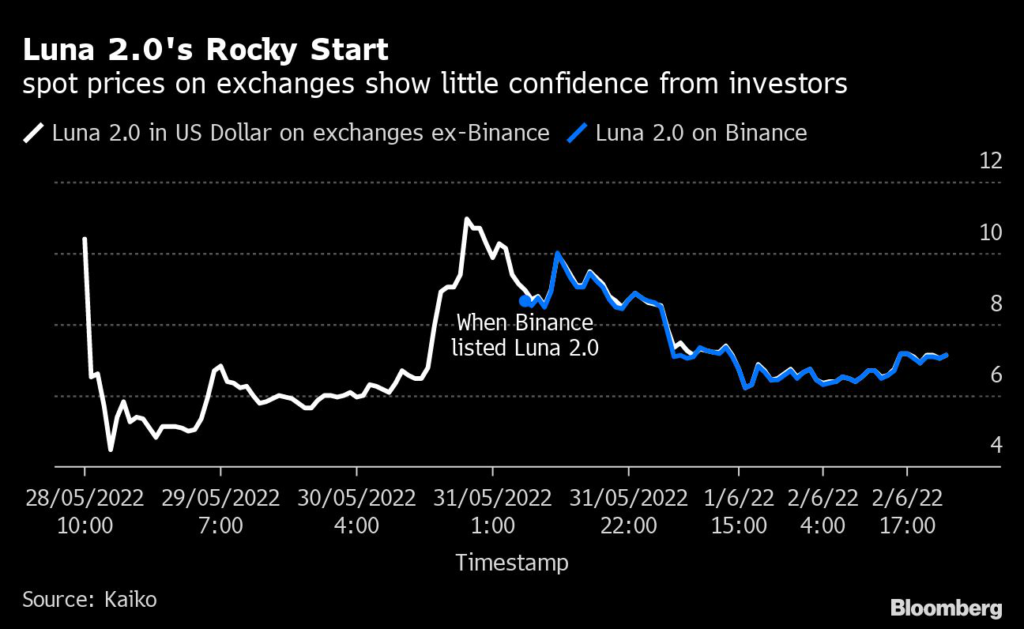
The average price of the Luna 2.0 token has remained below $11 in the week since they were distributed by Terra, according to data complied by tracker Kaiko. Just a day before the TerraUSD (UST) stablecoin began to lose its 1-to-1 peg to the dollar on May 7, its affiliated token Luna was trading at about $86.

Around $40 billion in market value was erased for holders of UST and Luna — whose devotion to the project had earned them the nickname Lunatics — when the stablecoin depegged. Still, that didn’t prevent champions of Luna 2.0 from hyping the token with predictions that it would surge back “to the moon,” a popular crypto market catchphrase.  

While there is not a widely recognized data point to calculate a market value for Luna 2.0, a rough estimate by data tracker CoinMarketCap puts the total value at about $1.37 billion. That is based on 210 million new Luna tokens in circulation, using amounts claimed by the those who run the Terra project. Luna had a market value of about $27.8 billion on May 6, before it crashed. 

A representative of the Terra project declined to comment on the performance of Luna 2.0.

UST was designed to maintain its dollar peg through both algorithms and trading incentives involving Luna. The growth of Terra had exploded over the past two years, with investors attracted by the 20% interest rate offered by its quasi-bank app Anchor. The blockchain, however, wound down in a few days, as a chain of events trigged a “death spiral,” a long-existing flaw of the project, that sent prices of UST and Luna to virtually zero. 

Clara Medalie, research director at Kaiko, explained that to verify independently and accurately the market capitalization of a cryptocurrency, the data source essentially needs to run software, or a node, to validate and store the full history of the transaction of the blockchain.

“I imagine no data provider, including Kaiko, wants to invest engineering resources into running a Terra node assuming that the whole ecosystem is pretty much dead,” Medalie said.

The new Terra blockchain, which went live just about a week ago, was part of a plan in a community-approved proposal by Terra’s main backer Do Kwon. The original Terra blockchain was abandoned and is known now as Terra Classic. The new Terra blockchain does not include stablecoins.  Seven projects have gone live on the blockchain so far, according to Terra.

“The airdrop was really poorly structured. It rewarded equity holders — LUNA holders — over savers or bond holders — Anchor depositors or UST holders,” said Thomas Dunleavy, a senior analyst at crypto research firm Messari. “Any network in crypto is built on trust, by not only users but also builders who commit their time and capital to grow the network.”  

More stories like this are available on bloomberg.com

©2022 Bloomberg L.P.

Close Bitnami banner
Bitnami