Bloomberg

Social Media Buzz: Jubilee, New York Rangers, French Open

(Bloomberg) — Here’s what’s buzzing on social media:

BUZZING HEADLINES 

Queen Elizabeth II skipped out on festivities during the third day of her Platinum Jubilee, which included the Epsom Derby horse race. According to her granddaughter, Zara Tindall, the 96-year-old queen is watching at home in more comfortable attire. Meanwhile, Prince Harry and Meghan Markle made headlines on Friday for attending the celebration, marking their first public appearance in the UK in two years. 

The New York Rangers won against the Tampa Bay Lightning on Friday in the NHL playoffs, spurring a wave of celebrations across New York including the lighting of the Empire State Building with the team’s colors. The Tampa Bay team had previously won 18 consecutive games before the defeat. 

Polish tennis star Iga Swiatek won the French Open women’s title for the second time on Saturday, defeating American Coco Gauff in two sets. Swiatek, who’s 21, has won 35 straight matches. 

Pop icon Shakira confirmed on Saturday through her publicist that she had split from her boyfriend of 11 years, Gerard Piqué, a soccer player for FC Barcelona. Fans erupted in response to the announcement online. Meanwhile, Shakira and Piqué stayed quiet. The pair have two children together. 

More stories like this are available on bloomberg.com

©2022 Bloomberg L.P.

Trump’s Summer Plans Include 7-Hour Grilling in Fraud Suit

(Bloomberg) — Donald Trump and three of his children agreed to be questioned under oath for up to seven hours each in a class-action lawsuit over their yearslong promotion on “Celebrity Apprentice” of a troubled multi-level marketing company.

The former president, along with Donald Trump Jr., Eric Trump and Ivanka Trump, are among more than a dozen people who will be deposed in June and July, including unspecified contestants on the reality-TV show, lawyers for all those involved in the case said in a letter to a judge Friday night.

They’ll be questioned about Trump’s paid endorsement of ACN Opportunity LLC and its clunky desktop video phones on “Celebrity Apprentice.” Plaintiffs say Trump falsely claimed he wasn’t being paid for the promotions and lied about his belief in the product and the risks involved.

Hope Hicks, former counselor to Trump, and Rhona Graff, Trump’s longtime personal executive assistant, will also be interviewed under oath, while Trump has agreed to hand over transcripts of his past depositions in fraud suits tied to his failed Trump University, according to the filing.

Read More: Trump’s Doomed Video Phones Loom in Backdrop of Media Foray

The filing is the first indication of how long the Trumps will be questioned and who else tied to the Trump Organization will be deposed. The Trumps, who failed to get the 2018 case dismissed, had agreed in March to sit for questioning by the end of June as ordered by a judge, but will miss those dates due to a delay in handing over related documents.

Trump’s lawyer, Alina Habba, didn’t immediately respond to a message seeking comment.

The depositions were arranged after negotiations with investors who claim Trump duped them into paying thousands of dollars to become independent sellers with ACN. The company’s video-phone device was praised by Trump for years as the next big thing in communication before flopping.

The depositions will by conducted by attorneys at Kaplan Hecker & Fink LLP, whose founder Roberta Kaplan has been a thorn in Trump’s side. She’s also representing Trump’s estranged niece Mary Trump in a fraud suit against the former president, as well as New York advice columnist E. Jean Carroll in a defamation suit against him.

Kaplan didn’t immediately respond to a message seeking comment.

The case is: McKoy v. Trump Corp., 1:18-cv-9936, US District Court, Southern District of New York (Manhattan).

(Updates with detail from the deposition plan)

More stories like this are available on bloomberg.com

©2022 Bloomberg L.P.

For Intangible-Asset Craze, It’s Midnight in the Stock Market

(Bloomberg) — An idea and a dream. Time was in markets, that’s all you’d need. But now the easy money has stopped flowing, and good luck if it’s all you’ve got.

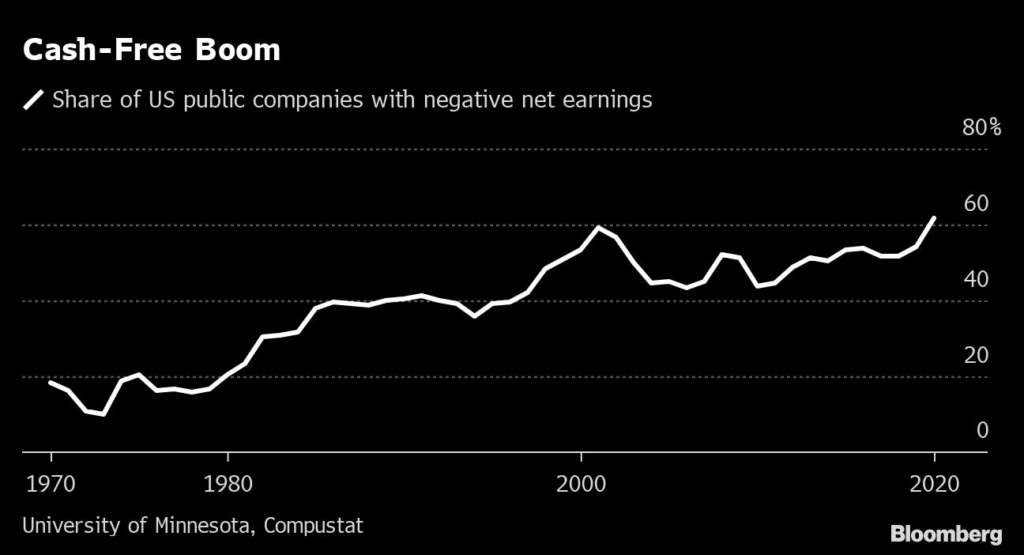
And while the travails of profitless companies are well known to anyone who’s watched the Nasdaq plunge this year, the extent to which such firms have come to clog the equity landscape is only beginning to be understood. New research shows that over the last five decades, the percentage of US firms trading publicly with zero earnings has more than tripled to more than half of the total market. 

Until very recently, they were the belle of the stock-market ball, intangible-asset-laden businesses like Uber and Airbnb — built not on factories or resources, but ideas — unleashed in the hope something will catch on and make them the next Facebook or Google. All of which is fine when times are good. When optimism dries up and the market appetites switch from hot intellectual property to cold hard cash, intangible-laden companies have started to become a luxury no one can afford.

US public firms with negative net earnings reached a record at the end of 2020, accounting for 62% of the group, compared with 18% in 1970, according to a new paper by University of Minnesota academic. Unsurprisingly, the trend is strongest among newly minted companies, with 77% of initial public offerings not making money when they came to market in 2019. That’s up from 24% in 1980. 

It’s not just in tech. Unprofitable companies have flourished everywhere, from farms to electric cars. Their numbers are multiplying fast in the heart of the real economy: manufacturing. Around 63% of US publicly listed manufacturers didn’t turn a profit in 2020, compared with 19% in 1970. Their numbers include household names like Casper Sleep and Peloton.

The proliferation of money-losing public firms is being driven not just by tolerance among investors, but an overt preference for a certain kind of loss-making firm: one built on intangible assets, the author suggests. Businesses are being encouraged to sell stock years before they’re profitable because of a belief that some formula or idea will gradually attract a network of users that will one day prove exceedingly valuable.

To see the connection, the study measures characteristics tied to intangible assets — elevated customer-spending and research and development expenses — and plots them against loss-making firms. It finds a very high correlation between the two, suggesting most of these companies went public on the assumption their intangible assets will one day pay off in earnings.

“This is a long-term trend due to some economic fundamental changes,” said Dan Su, a PhD graduate from the University of Minnesota and author of the paper. “But if we focus on the business-cycle perspective, monetary policy is important for these companies’ market valuation as they cannot make positive profits until many years later.”

Investors were quick to follow and quick to exit. In the US, the biggest 100 unprofitable companies as of 2019 gained more than 130% in the three years prior to their February 2021 peak, according to data compiled by Su and Bloomberg. Since that high, those firms have plunged 65% while the Russell 1000 gained 1.8% in the same 16-month period. From the peak in the gauge, the returns are minus 38% and minus 15%, respectively.

The rapid growth came at a time when private equity flush with cash was willing to bankroll loss-making companies like Uber and WeWork — businesses years away from being profitable, but that promised the scale to one day rewire and dominate existing industries. That was the bet, and the cash to fund them was dirt cheap.

“You basically win more by growing faster and if you grow faster you are not required to be profitable, because then that’s a drag on growth,” said Peter Garnry, head of equity strategy at Saxo Bank A/S. 

A lot has changed since — even among the biggest believers. From Uber chief Dara Khosrowshahi saying that “the market is experiencing a seismic shift” and announcing cost cuts in a letter obtained by CNBC to Bill Gurley of venture capital firm Benchmark warning that the process of shifting perceptions on valuations formed during the bull market could be “painful, surprising, and unsettling to many.”

That pain is already on display as the tide goes out on easy-money liquidity that kept profitless companies aloft and inflated their valuations. These days, investors want cash-rich companies, not cash burners built on hopes. 

As low interest rates fostered the boom in unprofitable companies, the reverse — higher rates — suggests their demise. Loss-making tech firms have erased pandemic gains as the Federal Reserve steps up its fight against inflation.

The avenues to take profitless companies public are also shrinking. Worldwide, proceeds in the market for IPOs sank 75% in the first quarter compared with a year earlier. So far in the second quarter, fund-raising is less than any other on record both globally and in the US.

It’s not all bad news though. Business models and ways of exploiting digital technologies have improved dramatically since the dotcom bubble, and there will be survivors, according to Garnry at Saxo Bank. 

“Inside these massive casualties, there will be companies — that are now down 90% — that long-term will have a very interesting business model,” he said. 

Su argues that conditions are different from two decades ago because of lasting changes in how society and companies function. The intangible economy’s tentacles reach beyond tech, growing more pronounced in nine of 10 industries, Su analyzed. That means it may be more than just an easy-money phenomenon.

“We are likely to see more highly valued firms with negative net earnings now and also in the future,” he said. “We will see more Amazon-like or Tesla-like firms with massive profits come much later. This shouldn’t be interpreted as bubbles.” 

More stories like this are available on bloomberg.com

©2022 Bloomberg L.P.

What If Electric Bikes Were as Cheap as Conventional Bicycles?

(Bloomberg) — Last month, as part of our series on how to speed up the transition away from fossil fuels in the wake of Russia’s invasion of Ukraine, I wrote about how protected bike lanes are the single best way to encourage the use of electric bikes (and traditional ones) for daily transit. As a rule, people don’t ride bikes of any kind where they don’t feel safe, so infrastructure is paramount. But bike lanes alone are not always enough.

Take, for example, Portland. The city has been steadily adding to its network of greenways and bike lanes for decades, yet the share of vehicle miles traveled by bike has hovered stubbornly around 7%. In recent years, it’s even begun to erode, taking the city further away from its climate goal of getting to 25% mode share for bikes by 2035. “They’ve done an amazing amount of bike infrastructure development in the city,” says John MacArthur, sustainable transportation program manager at Portland State University’s Transportation Research and Education Center (TREC), “And we’re still bumping against the 7%.”

What else can be done to break through? MacArthur believes e-bikes themselves can be a catalyst. The boost of the electric motor helps to lower barriers that stand in the way even when people have access to safe streets — shortening the time and effort that it takes to make long trips, making it easier to haul cargo, and allowing riders to arrive at their destination without breaking a sweat.

But that additional utility comes at an additional expense. According to a white paper published last month by MacArthur and three other researchers, the average cost of a conventional bike purchased at a specialty shop in the US is $753, while the average cost for commuter or leisure e-bikes is $2,600. For cargo e-bikes, the average sticker price is a whopping $5,000. Policymakers looking to unlock the power of e-bikes and help push transit cycling into the mainstream, says MacArthur, should consider shouldering some of this expense.

The Build Back Better spending bill that passed the House last November included a tax credit of up to $900 for the purchase of an e-bike, but the legislation’s death in the Senate left slim hope of seeing a federal incentive anytime soon. The action now is at the state and local level. In their white paper, titled “Using E-Bike Purchase Incentive Programs to Expand the Market,” MacArthur and his co-authors identify more than 40 active and pilot programs in the U.S. and Canada, with incentives ranging from $100 to over $1,000. One recently launched program in Denver, which provided rebates of up to $1,200 for income-qualified buyers, reached budget capacity in less than three weeks. 

MacArthur is planning a survey that would help inform policymakers about how much consumers say they are willing to pay for different types of e-bikes. In the meantime, he says, a good target is to bring the cost of an e-bike down to that of a well-built conventional bike, just as incentives for electric cars have aimed at achieving price parity with comparable combustion engine models.

“At a lower cost, people are more willing to try it,” he says of e-bikes. “And we found in our research is that once people try them, they stick.”

More stories like this are available on bloomberg.com

©2022 Bloomberg L.P.

Carmakers Feel Chip Crisis Easing as Global Growth Slows

(Bloomberg) —

The global semiconductor shortage that’s bogged down the auto industry for almost two years is showing signs of easing, at least for now. 

Mercedes Benz AG, Daimler Truck Holding AG, and BMW AG are among carmakers now getting enough of the high-tech components to produce at full capacity after experiencing crippling outages for months. 

The breakthrough comes earlier than the companies predicted and marks a bright spot for an industry facing a deteriorating economy and inflation while managing an historic transition to electric-vehicle production. Manufacturers are cheering the chip-supply improvement but aren’t declaring victory yet.

“We’re still monitoring it week to week, but up to now basically worldwide, we had no issues running production,” said Joerg Burzer, Mercedes’s head of production and supply-chain management. Supply issues occur “here and there,” he said, “but nothing compared to what it was like last year.”

Even as demand for cars boomed, auto manufacturers have had to curtail output as plants globally couldn’t source enough chips critical for increasingly computerized vehicles. The outages have been so severe that global passenger car output has barely shown signs of recovery to pre-pandemic levels. 

As the chip supply improves, carmakers are working down their order backlogs, and concerns are turning to how consumer demand will hold up amid accelerating inflation and higher interest rates. Tesla Inc. Chief Executive Officer Elon Musk said the electric-car maker needs to cut staff by 10% and that he has a “super bad feeling” about the economy, according to Reuters, which cited an internal memo.

But not everyone is as pessimistic as Musk. German carmakers’ sentiment improved significantly in May, according to an Ifo Institute survey. The survey showed growing confidence among the carmakers that they’ll be able to raise prices to cope with soaring raw material costs. 

Some of the new availability of chips stems from the weakening economic outlook and inflation, which has cut into demand for consumer electronics that also use the components. Karin Radstrom, head of the Daimler Truck’s Mercedes brand, said the company is now getting the chips it needs to work down a backlog of orders.

“It’s not perfect, but it’s better than last year,” Radstrom said in an interview. “I try to not celebrate too early. We’re still monitoring the situation closely.”

BMW expressed similar reserved optimism, saying all plants are up and running and the company isn’t experiencing any stoppages due to chip supplies.

“Currently, the situation is a little bit more stable,” a spokesman said, adding that BMW still monitors the chip supply on a daily basis and doesn’t rule out the possibility of fresh disruptions in the coming weeks and months. 

Volkswagen AG, which like others estimated that the logjam would begin to ease in the second half of 2022, is also seeing steady supplies, according to a spokesperson, who underscored that there’s still significant uncertainty about the coming months.

Harry Wolters, president of Paccar Inc.’s DAF Trucks unit, has seen the same trend. 

“We’ve seen better supply of components than we maybe anticipated five, six weeks ago,” Wolters said. “So in the U.S. and Europe, we’ve been able to increase build rates.”

But not all companies are enjoying the same relief. Volvo Trucks said it’s still seeing limited chip availability and expects an impact on second-quarter production. And according to to research by Susquehanna Financial Group, delivery times for chips — used in a range of electronics — remained flat in May, a sign that lags persist.

Mercedes CEO Ola Kallenius said last year his company would resort to using a more expensive semiconductor to avoid the shortage. Ford Motor Co. Chief Executive Officer Jim Farley said last month the company would buy chips wherever it could in the open market.

More stories like this are available on bloomberg.com

©2022 Bloomberg L.P.

China to Launch 3 Astronauts Sunday to Build New Space Station

(Bloomberg) — China will launch three astronauts on a spacecraft Sunday to work on the final stages of construction of the nation’s first orbital outpost. 

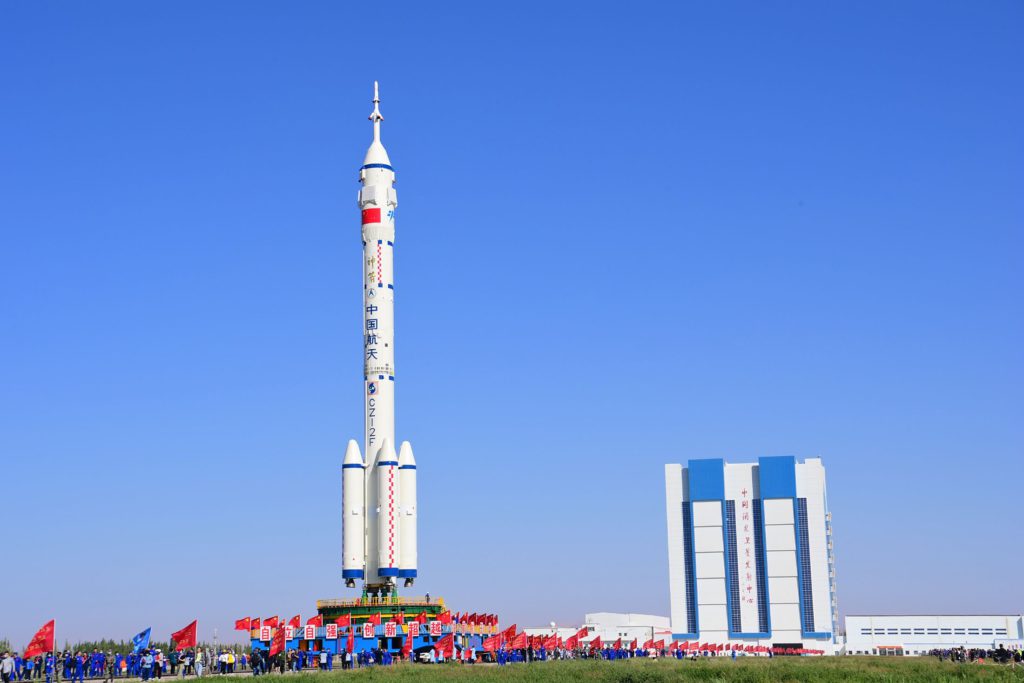
A Long March-2F rocket carrying the Shenzhou-14 spacecraft will blast off at 10:44 a.m. local time Sunday from the Jiuquan Satellite Launch Center in the northwest Gobi Desert. 

Astronauts will live at the Tiangong space station for six months to complete assembly tasks for what will be a national space laboratory, Lin Xiqiang, deputy head of the China Manned Space Agency, told reporters Saturday. 

Astronauts Chen Dong, Liu Yang and Cai Xuzhe will be the third crew to travel to work on Tiangong after China last year launched its first manned mission in an effort to catch up to the U.S. as a space power. 

Tiangong, comprising a core module, Tianhe, and two lab modules — Wentian and Mengtian — is expected to operate for up to 15 years. 

Wentian, or Quest of the Heavens, is scheduled for launch in July. While Mengtian, or Dreaming of the Heavens, will be sent to dock with the Tiangong station in October, according to state newspaper the China Daily.  

More stories like this are available on bloomberg.com

©2022 Bloomberg L.P.
Trump’s Summer Plans Include 7-Hour Interrogation in Fraud Suit

(Bloomberg) — Former President Donald Trump has agreed to be questioned under oath for up to seven hours in a class-action lawsuit over his yearslong promotion of a troubled multi-level marketing company that sold desktop video phones. 

Trump’s sons, Donald Trump Jr. and Eric Trump as well as his daughter, Ivanka Trump, will also be deposed for as long as seven hours each, lawyers for all those involved said in a letter to a judge. Hope Hicks, former counselor to Trump, and Rhona Graff, Trump’s longtime personal executive assistant, will also be interviewed. Most of the depositions will happen in June and July, according to the filing.

The agreements were reached between lawyers in a lawsuit filed by investors claiming Trump duped them into paying thousands of dollars to become independent sellers with ACN Opportunity LLC, the maker of a video phone touted by Trump on “ The Apprentice” and in promotional videos.

The case is: McKoy v. Trump Corp., 1:18-cv-9936, US District Court, Southern District of New York (Manhattan).

More stories like this are available on bloomberg.com

©2022 Bloomberg L.P.
Buy ‘Dull’ Cash-Flowing Stocks, Causeway’s Ketterer Says

(Bloomberg) — Investors should buy “dull” companies that generate steady cash flows as stock markets face growing headwinds from inflation and a potential economic slowdown, according to the chief executive officer of Causeway Capital Management.

Energy companies, utilities, metals and consumer-staples firms are likely to continue generating growing earnings even if the economy slows, Sarah Ketterer said Friday in a Bloomberg Television interview. While former darlings like tech companies have plunged in value, there are potential winners with solid upsides in the sector, she told “Wall Street Week” host David Westin.

“In that rubble of IT, the information-technology sector, there’s some fantastically defensive companies,” she said. “We call them value tech.”

One such recommendation: Fiserv Inc., a payment-processing firm critical for banks to run transactions. “The business is really sticky and the multiples on the stock are quite low,” Ketterer said.

Stocks inched lower this week, falling the most Friday after US employers reported they added more jobs than expected in May. The report fueled expectations the Federal Reserve will keep boosting interest rates to cool the economy and inflation. 

Now’s a bad time to buy bonds, because prices fall when interest rates climb, Chris Ailman, chief investment officer of the California State Teachers’ Retirement System, told Westin. 

“I would be underweight fixed income,” said Ailman, who managed $312 billion as of April 30 at the second-largest US pension fund. “This is a time when you need to find good long-term, but safe and boring investments.” 

Among the best opportunities are illiquid assets such as toll roads, pipelines and other infrastructure, Ailman said. 

More stories like this are available on bloomberg.com

©2022 Bloomberg L.P.

Activision Retaliated Against Staff, Union Complaint Claims

(Bloomberg) — Activision Blizzard Inc. was accused of illegally retaliating against employees for their unionization efforts, according to a labor board complaint filed by the union set to represent workers there.

The Communications Workers of America alleged in the filing, submitted Friday to the US National Labor Relations Board, that the video game publisher violated federal law by terminating a dozen Wisconsin employees and reorganizing operations at its Raven Software subsidiary in response to their organizing efforts.

An Activision spokesperson disputed the union’s allegations. “We respect and believe in the right of all employees to decide whether or not to support or vote for a union, and retaliation of any kind is not tolerated,” the spokesperson said in a statement.

CWA won a unionization election among the Raven staff last month by a vote of 19 to 3. Microsoft Corp, which is set to acquire Activision in a $69 billion deal, said Thursday that it will work with unions representing employees.

Friday’s complaint is the first by CWA regarding its Raven union campaign. The union previously filed other labor board claims against Activision, and the federal agency said last month that its prosecutors had determined the company broke the law in one of those cases, including by illegally threatening employees. Activision has denied wrongdoing.

“Other Activision workers who want to join our union should not face this kind of harassment,” union organizing committee members said in an emailed statement.

Complaints filed with the labor board are investigated by regional offices and, if found to have merit and not settled, can be prosecuted by the agency’s general counsel and heard by administrative law judges. The rulings can be appealed to NLRB members in Washington, D.C., and from there to federal court. The agency can require remedies such as posting of notices and reversals of policies or punishments, but has no authority to impose punitive damages.

(Updates with comments from company in the third paragraph.)

More stories like this are available on bloomberg.com

©2022 Bloomberg L.P.
Retelit Owner Asterion Makes Binding Offer for Italy Telecom Irideos

(Bloomberg) — The Spanish owner of Italian telecommunications company Retelit SpA is among the bidders for network and service provider Irideos SpA, according to people familiar with the matter.

Madrid-based Asterion Industrial Partners, Retelit’s private equity owner, submitted a binding offer last week for Irideos that could value it at as much as 400 million euros ($429 million), the people said, asking not to be identified because the discussions are private. Irideos, based in Milan, also has received binding offers from two other investment firms, the people said.

Irideos is controlled by the Italian infrastructure fund F2i Sgr SpA.

Representatives for Retelit, Irideos and F2i declined to comment. A spokesperson for Asterion wasn’t available outside regular business hours.

Fiber-network operator Retelit is fully owned by Asterion, which last year took it over and delisted it. The company had traded on the Milan Stock Exchange since 2000.

Retelit operates about 16,000 kilometers (10,000 miles) of fiber-optic cables, 12 metropolitan networks in Italy and 19 data centers, according to the its website. Retelit also provides telecommunications services in Italy for the US military at bases in Naples, Vicenza and Aviano. 

More stories like this are available on bloomberg.com

©2022 Bloomberg L.P.

Close Bitnami banner
Bitnami