Bloomberg

Whistleblower Says Facebook Can’t Recover Until Zuckerberg Steps Down

(Bloomberg) — Emma Barnett meets data scientist and Facebook whistleblower Frances Haugen to discuss what compelled her to go public, how she believes Facebook algorithms promote hate speech in fragile countries and push teens to harmful content on Instagram.

She also addresses why she thinks Mark Zuckerberg should step down if the embattled company is to recover. 

More stories like this are available on bloomberg.com

©2022 Bloomberg L.P.

Audio App Clubhouse Lays Off Staff as Strategy Shifts

(Bloomberg) — Clubhouse, the social audio app that became a big hit during the early days of the pandemic, laid off multiple employees this week, according to people familiar with the reductions. The layoffs are part of a broader restructuring and rethinking of the audio app’s strategy.Some employees chose to leave on their own as the company cuts back some of the programming areas it had focused on before, such as sports, news and international, according to the people, who asked not to be identified because the discussions were private.  

“A handful of roles were eliminated as part of streamlining our team, and a few individuals decided to pursue new opportunities,” a spokesperson for Clubhouse said in an emailed statement. “We are continuing to recruit for many roles across engineering, product and design.”

Three women tweeted their departures from the company on June 1st, including Nina Gregory, a National Public Radio alum who led news partnerships, Anu Atluru, head of community, and Aarthi Ramamurthy, head of international. Sean Brown, head of sports partnerships, announced he was leaving last month. Stephanie Simon, who was in charge of brand evangelism and development, left in late April.

“Clubhouse wouldn’t be where it is today without these talented people,” the spokesperson said. “We’re immensely grateful for everything they’ve done and know they’ll do great things in the future.”

The app skyrocketed to a $4 billion valuation after its 2020 launch as people on lockdown around the world turned to the service to listen and chat with others online.  The company has continued to launch new features, like dark mode, which makes the app easier on the eyes. It’s also tested in-app games. Chief Executive Officer Paul Davison last shared usage stats in November 2021. He told CNBC the number of rooms created each day had increased from 300,00 last summer to around 700,000 in the fall.

The app inspired competing products at other tech companies, however, and prominent content creators have left the platform. The Lullaby Club, which various publications highlighted as early success, now does its show on Amazon’s new live audio app Amp.

More stories like this are available on bloomberg.com

©2022 Bloomberg L.P.

Musk Turns to His Earlier Playbook as Tesla Girds for Job Cuts

(Bloomberg) — Two weeks ago Elon Musk signaled Tesla Inc. was staying in the fast lane. Now he’s tapping the brakes. 

The chief executive officer warned in an email to employees that Tesla plans to cut its “overstaffed” salaried workforce by 10%, according to people who received the memo and asked not to be identified discussing the details.

That surprised some analysts and industry watchers who have marveled at Tesla’s record-breaking deliveries even as it deals with shortages of critical parts. Shares of the company sank 9.2% on Friday — the steepest drop in five weeks — as investors digested Musk’s bearish take. 

Just last month, the CEO crowed about a second “AI Day” to showcase the electric carmaker’s prowess in artificial intelligence, software and chips — a move designed in part to lure more engineering talent. A few days later, he tweeted that Tesla was building a “hardcore litigation department.” The auto manufacturer is also hiring to staff new factories in Austin and Berlin, where it expects to steadily ramp up production this year.

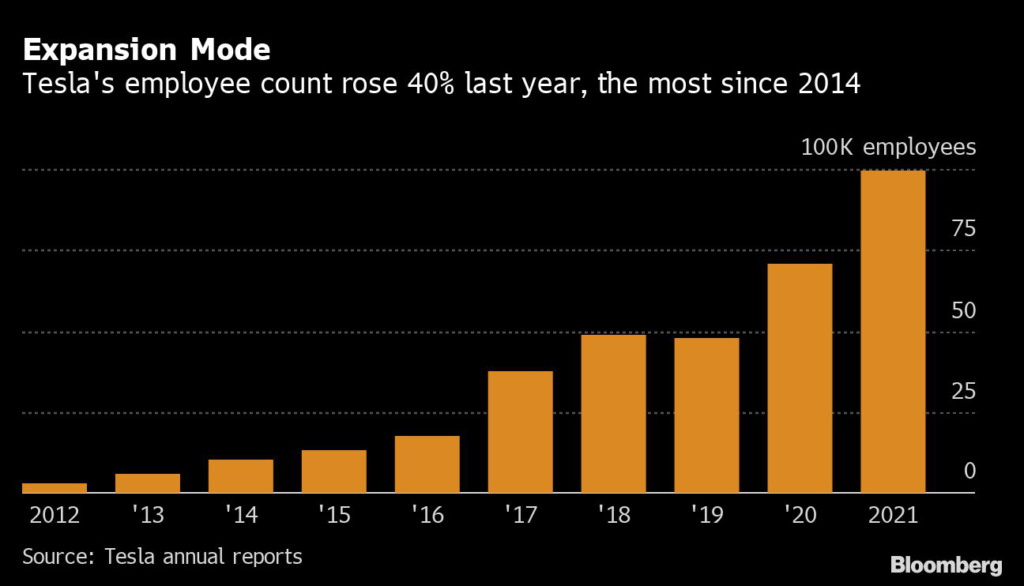
Tesla has ballooned to about 100,000 employees globally, and the number of hourly workers installing battery packs and solar roofs is expected to continue to grow. But Musk appears to be reaching back into his startup mode playbook to rekindle a sense of urgency. Now that Tesla has joined the ranks of the blue-chip S&P 500 index and has plenty of cash on hand, he is sending memos to stave off complacency instead of joking about staving off bankruptcy. 

Tesla, which went public in June 2010, has been through cycles of rapid growth and reductions before. Tesla laid off about 700 workers in 2017 amid what Musk termed a “production hell” for the debut of its Model 3 sedan. A year later, the company let go 9% of its employees as it struggled to ramp up output.

Read story: Musk’s Model 3 Miscalculation Culminates in Major Tesla Job Cuts

In some ways, Musk’s missive shows how normal the company has become. Corporate downsizing is routine at American companies with large payrolls. Former General Electric Co. CEO Jack Welch was legendary for his ruthless system of firing the lowest-ranked 10% of employees every year. 

More than 40% of the Austin, Texas-based company’s staff is now global as it expands rapidly outside the US and nearly 40% work on production lines. 

The planned cuts were prompted by worries about a possible recession, according to a Reuters report earlier Friday, which cited Musk saying he had a “super bad feeling” about the economy. That comment drew scorn from President Biden, who dismissed the warning after being asked about it by reporters. 

Read more: Good Luck on Moon Trip, Biden Tells Musk After Economy Warning

Famous Workaholic

Musk and CFO Zachary Kirkhorn did not respond to an email asking for context as to where within the company the salaried reductions would be focused. The top-selling EV brand’s CEO is known as a workaholic who puts his job ahead of everything else — and who has little tolerance for what he sees as sloth. 

In recent weeks, Musk has praised Tesla employees in China, many of whom have been sleeping on the factory floor as part of a so-called “closed-loop” system meant to combat Covid-19. He lauded Chinese workers for “burning the 3 a.m. oil” while criticizing Americans who he described as “trying to avoid going to work at all.” That was followed by another memo laying down the hammer about the need for Tesla employees to resume in-person office work. 

“Everyone at Tesla is required to spend a minimum of 40 hours in the office per week,” Musk wrote in an email entitled “To be super clear.” “Moreover, the office must be where your actual colleagues are located, not some remote pseudo office. If you don’t show up, we will assume you have resigned.”

(Updates with closing shares in third paragraph.)

More stories like this are available on bloomberg.com

©2022 Bloomberg L.P.

Microsoft’s Dollar Alarm Raises New Worry for Software Stocks

(Bloomberg) — Software makers that have been battered amid this year’s stock slump were dealt another blow this week when Microsoft Corp. warned of even more headwinds coming down the pike. 

The world’s largest software maker cut its profit forecast for the current quarter on Thursday and blamed the surging US dollar for an upcoming drag on its earnings to the tune of $460 million. The company’s rare mid-season revision took markets by surprise and briefly sent futures on the S&P 500 Index tumbling.

Microsoft and other large US software makers such as Oracle Corp. and Adobe Inc., have complex global operations and higher exposure to foreign currencies. The US Dollar Index has risen more than 7% off a January low, and last month hit its highest in two decades. The more expensive dollar is bound to add to pressures already threatening the companies’ margins such as higher costs.

“A strong dollar will be a recurring theme across many large software companies, as most generate over one-third of their sales outside the US,” said Anurag Rana, senior analyst with Bloomberg Intelligence.

Soaring U.S. Treasury yields and expectations of tighter monetary policy from the Federal Reserve have caused investors to flee software stocks with pricey valuations and whose profits are expected to be delivered far in the future. 

Read more: Corporate America Turns Up Volume on Warnings About Economy 


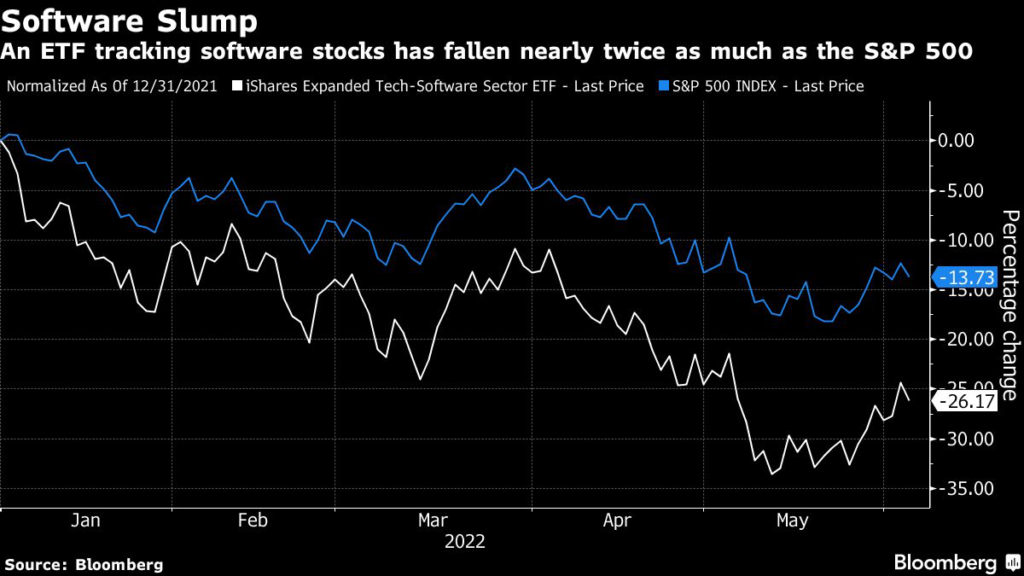
The iShares Expanded Tech-Software Sector ETF is down 26% in 2022, including a drop of 2.3% in Friday’s session. A Goldman Sachs basket of the priciest software names is down more than 45%, while the broad S&P 500 Index is down 14%. Microsoft fell 1.7% on Friday and ended the week with a 1.2% decline.

Dollar Hedge 

Wall Street has been encouraged by strong financial results from software makers this earnings season. Salesforce Inc. this week gave a bullish full-year forecast but said results were hurt by the dollar’s strength, and warned that it expects the issue to extend into the second quarter. 

Companies with larger exposure to currencies like Salesforce will have to look into hedging strategies to protect against the dollar strength, said Brendan McKenna, a strategist at Wells Fargo. He sees the dollar bulking up against most developed countries’ currencies, as well as those from emerging markets, with few exceptions.

For now, analysts have remained sanguine about profits lost to foreign-exchange rates, focusing instead on strong fundamentals that point to the group’s resilience in the face of slowing economic growth.  

But for some investors, there are still too many risks to justify piling back into software stocks despite more attractive prices. 

“They’re more attractive than they were, but we won’t chase the quality names lower thinking they’re bargains yet,” Stephen Hoedt, managing director of equity research at Key Private Bank. “Cheap can quickly become cheaper in a rising-rate environment.”

(Updates to market close.)

More stories like this are available on bloomberg.com

©2022 Bloomberg L.P.

Elon Musk Tells Tesla Staff Only Salaried Jobs to Be Cut: Report

(Bloomberg) — Elon Musk told Tesla Inc. employees that 10% of salaried workers would lose their jobs, according to people familiar with the matter, as the automaker grapples with the consequences of a swelling workforce.

The chief executive officer said in an internal email Friday that headcount would be reduced because Tesla has become overstaffed in some areas, according to the people, who received the memo and asked not to be identified discussing the details.

Musk said in the same note that the cuts won’t apply to those who build cars or battery packs, the people said. The hourly employee workforce will be expanded, according to the email, which was reported earlier by auto news website Electrek.

The comments appeared to clarify Musk’s stance after Reuters reported several hours earlier that the CEO told company executives he would reduce Tesla staff broadly because he had a “super bad feeling” about the economy. The news sent Tesla’s shares down 9.2% Friday in New York, the biggest decline since late April.

Read more: Musk Turns to Earlier Playbook as Tesla Girds for Job Cuts

Tesla said in its annual report that about 39% of roughly 100,000 workers were “production line employees.”

While it’s not clear if overall headcount will be reduced, Musk’s downbeat commentary marks a shift in tone for the electric-vehicle maker. Tesla recently opened two vehicle assembly plants and notched record global sales volume in its most recent quarter, while Musk predicted “substantially higher” growth later this year.

The latest moves drew scorn from President Joe Biden, who dismissed the billionaire’s warnings about the economy and wished him luck with his firm’s adventures in space. They also caught some on Wall Street off guard, with Credit Suisse analyst Dan Levy calling the comments “a surprise to us given significant growth path” ahead for Tesla.

Read more: Good Luck on Moon Trip, Biden Tells Musk After Economy Warning

But coronavirus-related restrictions in China have crimped output at the company’s Shanghai plant, leading some analysts to question whether Tesla can meet its goal of 50% annual growth in deliveries. Cowen on Friday cut its estimate for the carmaker’s global deliveries to 1.28 million, down from a previous estimate of 1.35 million.

The news adds to a tumultuous stretch for Tesla and Musk, with the carmaker’s stock slumping since the executive struck a deal to acquire Twitter Inc. Anxiety about the global economy and the impact of China’s Covid-19 lockdown in Shanghai, where Tesla has a factory, have also weighed on the company, which has weathered worldwide supply shortages for components like chips better than most.

Musk also joined the heated debate around return to office this week, urging staff at Tesla to get back to their desks, or find work elsewhere.

“The more senior you are, the more visible must be your presence,” Musk wrote, adding that employees were “required to spend a minimum of 40 hours in the office per week.” 

(Updates with stock decline in fourth paragraph)

More stories like this are available on bloomberg.com

©2022 Bloomberg L.P.

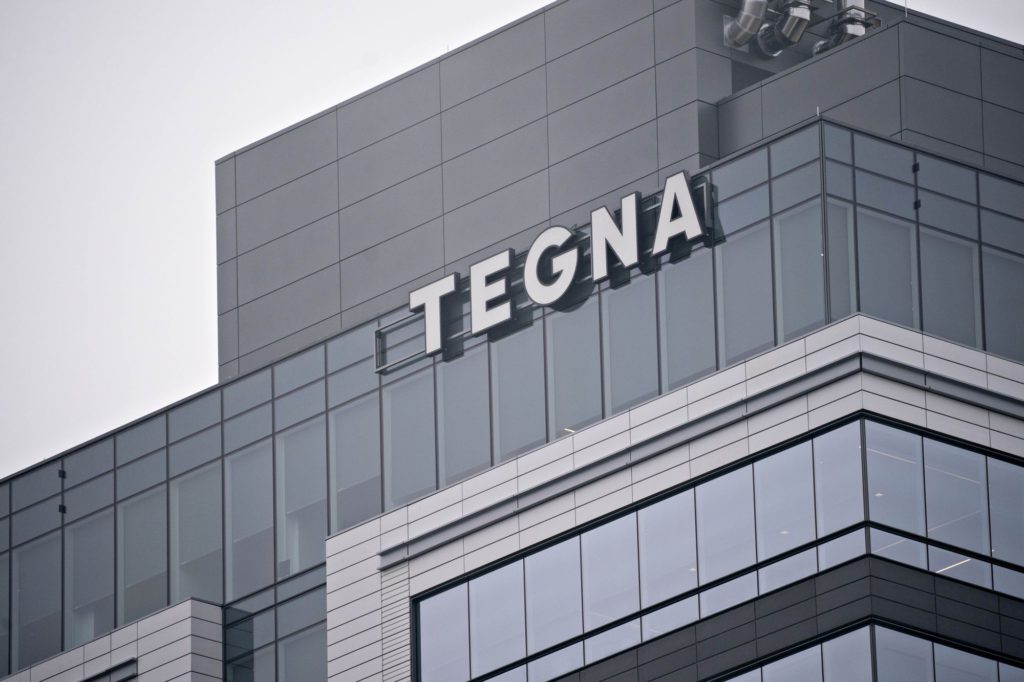
Standard General’s Kim ‘Bewildered’ by FCC’s Tegna Sale Scrutiny

(Bloomberg) — Standard General LP founding partner Soo Kim said he is “bewildered” by the growing federal scrutiny of his company’s $5.4 billion deal to buy TV broadcaster Tegna Inc.

In a letter Friday, the Federal Communications Commission posed a series of questions, including how the deal for 64 TV stations would improve local broadcasting. Critics earlier said the transaction would lead to higher cable TV prices for consumers.

The administration of President Joe Biden is moving to crack down on mergers, reflecting concern about widespread consolidation across industries. The FCC, an independent agency, is led by a Biden appointee.

“I’m bewildered because this deal does not create more concentration in the industry,” the South Korea-born Kim said in an interview. “It feels like we’re going through more scrutiny than other mergers that actually increased concentration and didn’t increase diversity.”

In its letter, the FCC asked whether the companies plan to coordinate with private equity firm Apollo Global Management Inc., which is helping to finance the deal. The New York-based investment firm is acquiring preferred equity in the transaction that doesn’t have governance rights.

FCC Questions

The agency also asked about possible strategies for negotiating agreements with cable providers for rights to carry TV station signals and inquired about “anticipated staffing reductions.” It set a June 13 deadline for responses.

“We intend to respond to the FCC promptly and in a forthright manner,” Kim said, adding that Apollo “is one of many financing sources to this deal, none of whom will have any control over the operations or strategic direction of the company.”

Tegna didn’t respond to requests for comment. Apollo declined to comment.

Standard General, a private equity firm, agreed to acquire Tegna in February for $24 a share. If the deal goes through, the company will be led by Deborah McDermott, chief executive officer of Standard Media Group.

Given the need for more diversity and women-run businesses in the sector, Kim said he would have thought the deal would be embraced by regulators.

On May 20, the FCC allowed critics of the proposed acquisition more time to make their case, after a union and consumer advocates said the deal would let private equity firms increase the prices Tegna charges pay-TV providers to carry its stations, raising costs for consumers.

Shares of McLean, Virginia-based Tegna fell as much as 1.9% after the FCC’s letter was published but closed little changed at $21.82 in New York.

More stories like this are available on bloomberg.com

©2022 Bloomberg L.P.

Softbank-Backed 2TM Cuts About 90 Jobs as Crypto Winter Lingers

(Bloomberg) — 2TM Participacoes SA, the holding company that owns Brazil’s Mercado Bitcoin SA, has dismissed about 90 employees, more than 10% of its workforce, according to people familiar with the matter, who asked not to be named because the number isn’t public.

In a statement, which did not include the exact number of people affected, 2TM said the measure was necessary because of the macroeconomic climate. The statement cited rising interest rates, inflation, and current global financial conditions. O Estado de S. Paulo, a Brazilian newspaper, first reported 2TM’s layoffs.

2TM raised $50 million in November from investors including Tribe Capital and 10T Holdings. Earlier this year, the company had been linked to a potential deal with Coinbase Global Inc. that could have resulted in a controlling acquisition or a minority stake sale. The talks ended in early May. 

Coinbase, which has faced its own financial challenges, said on Thursday that it would extend a hiring freeze and rescind certain job offers. That announcement followed a similar move from Gemini, which said it would slash 10% of its workforce, and cuts at Bahrain-based Rain Financial. 

Read more: Coinbase-Backed Rain Cuts Jobs Amid Cryptocurrency Selloff 

2TM is at least the second Softbank-backed crypto firm that has cut its workforce in Latin America to reduce costs in recent weeks, as the ongoing “crypto winter” has seen tokens like Bitcoin and Ether fall significantly from their record highs. 

At the end of May, Mexico-based crypto exchange Bitso told CoinDesk it had cut 80 employees out of a workforce of more than 700 people. 

Read More: June Cryptos Outlook – Fast Boats and Ebbing Tides: BI Crypto Weekly

More stories like this are available on bloomberg.com

©2022 Bloomberg L.P.
Stocks Resume Weekly Losses as Jobs Fuel Rate Bets: Markets Wrap

(Bloomberg) — US stocks resumed their trend of weekly losses after strong hiring data cleared the way for the Federal Reserve to remain aggressive in its fight against inflation. Treasuries fell and the dollar strengthened against peers.

The S&P 500 slumped 1.6% afternoon trading, tipping the benchmark index into negative territory for the eighth week in the past nine periods. Tesla Inc. also dragged tech shares lower Friday after reports the company plans to reduce its salaried workforce. Meanwhile, energy shares advanced as crude reached $120 a barrel in New York.

Stocks turned sharply lower on Friday after May hiring data topped expectations, suggesting the labor market remains robust enough for the Fed to raise rates quickly as it battles runaway price gains. The US central bank is expected to raise rates by 50 basis points at its next two meetings. Market-derived odds for a third hike of that magnitude in September held steady near 85% after the jobs report. Gold slipped.

“The second half of 2022 is going to be a roller coaster ride for investors unless the Fed is able to bring inflation under control without a hard landing,” said Peter Essele, head of portfolio management at Commonwealth Financial Network. “Most investors seem to be wagering on a crash-and-burn scenario at this point as recessionary fears abound, and equity markets fail to develop any sort of positive momentum.”

Investors remain beholden to economic data and how it will impact the pace of US monetary tightening, as worries mount that a restrictive Fed could throw the world’s largest economy into a recession. The strong jobs report quelled some concern that growth was slowing too sharply, while at the same time cleared the path for the Fed to stay aggressive.

US May nonfarm payrolls rose 390,000 compared to estimates of 318,000, according to a Bloomberg survey of economists. Meanwhile, the unemployment rate remained unchanged at 3.6% in the month, versus expectations of 3.5%. 

Here’s what else Wall Street is saying about US payrolls:

  • “The labor market is tight and job growth is stable. The Federal Reserve can continue to tighten financial conditions and remove the historic level of accommodation in the markets.” – Jeffrey Roach, chief economist for LPL Financial
  • “Another month of solid job growth in May is further evidence that the U.S. economy was not in a recession in the spring … Americans continue to return to the labor force as the rising cost of living pressures household finances.” – Bill Adams, chief economist for Comerica Bank
  • “People were hoping for a number that would maybe dissuade the Fed from their stated plan for continual 50 basis point hikes and quantitative tightening, and they didn’t get it today,” Steve Sosnick, chief strategist at Interactive Brokers
  • “What this number tells the Fed is: ‘go ahead and keep hiking rates like crazy, because you’re not creating unemployment, you can put pain into risk markets to hopefully cool demand.’ And that’s not what we want to see and I think it’s being reflected in the stock market today.” — Jim Bianco, founder of Bianco Research, on Bloomberg TV
  • “We’re going to have this face off trying to figure out about the soft landing and the Fed that’s probably going to continue well into the fall … There’s just a lot of things that suggest volatility is likely to remain elevated.” – Scott Brown, technical market strategist at LPL Financial
  • “Equity futures are initially reacting negatively to the report. We look for volatility to continue as investors struggle to find an appropriate multiple on record earnings. However, full employment in the U.S. is a solid buffer against the risk of slowing global growth.” – John Lynch, chief investment Officer for Comerica Wealth Management
  • “Best part about the employment report is the uptick in participation … The bad part is that we still need millions more working to reduce the pervasive shortages driving inflation. It’s frustrating that the Fed is trying to damp down demand and restrict hiring when we need to see a string of strong jobs reports.” – Bryce Doty, senior vice president at Sit Investment Associates
  • “The Fed decision is a done deal at this point, so this report is more about what it tells us about underlying demand and the economy’s ability to handle everything. It’s a good report that shows the general population is coming back into the labor force.” – Shawn Cruz, head trading strategist at TD Ameritrade

Oil rose, securing its sixth straight week of gains. The yen held near the psychologically important 130 level against the greenback. And Bitcoin fell back below $30,000.

How will markets be affected by the Fed’s quantitative tightening? QT officially starts Wednesday and is the theme of this week’s MLIV Pulse survey. Click here to participate anonymously.

Some of the main moves in markets:

Stocks

  • The S&P 500 fell 1.6% as of 4:02 p.m. New York time
  • The Nasdaq 100 fell 2.7%
  • The Dow Jones Industrial Average fell 1.1%
  • The MSCI World index fell 1.1%

Currencies

  • The Bloomberg Dollar Spot Index rose 0.4%
  • The euro fell 0.2% to $1.0722
  • The British pound fell 0.6% to $1.2498
  • The Japanese yen fell 0.8% to 130.86 per dollar

Bonds

  • The yield on 10-year Treasuries advanced three basis points to 2.94%
  • Germany’s 10-year yield advanced four basis points to 1.27%

Commodities

  • West Texas Intermediate crude rose 2.9% to $120.28 a barrel
  • Gold futures fell 1% to $1,853.60 an ounce

(A previous verison corrected the headline to reflect bets on rate hikes not cuts)

More stories like this are available on bloomberg.com

©2022 Bloomberg L.P.
Stocks Head for Weekly Loss as Jobs Fuel Rate Bets: Markets Wrap

(Bloomberg) — US stocks headed for a weekly loss after strong hiring data cleared the way for the Federal Reserve to remain aggressive in its fight against inflation. Treasuries fell and the dollar rose.

The S&P 500 slumped more than 1% in afternoon trading, paring losses that reached almost 2% earlier in the session. The index in on track for the eighth weekly loss in the past nine periods. Tesla Inc. dragged tech shares lower after reports the company plans to reduce its salaried  workforce. Energy shares advanced as crude approached $120 a barrel in New York.

Stocks turned sharply lower after May hiring data topped expectations, suggesting the labor market remains robust enough for the Fed to raise rates quickly as it battles runaway price gains. The Fed is expected to raise rates by 50 basis points at its next two meetings. Market-derived odds for a third hike of that magnitude in September held steady near 85% after the jobs report. The dollar rose and gold slipped.

“The second half of 2022 is going to be a roller coaster ride for investors unless the Fed is able to bring inflation under control without a hard landing,” said Peter Essele, head of portfolio management at Commonwealth Financial Network. “Most investors seem to be wagering on a crash-and-burn scenario at this point as recessionary fears abound, and equity markets fail to develop any sort of positive momentum.”

Investors remain beholden to economic data and how it will impact the pace of US monetary tightening, as worries mount that a restrictive Fed could throw the world’s largest economy into a recession. The strong jobs report quelled some concern that growth was slowing too sharply, while at the same time cleared the path for the Fed to stay aggressive.

US May nonfarm payrolls rose 390,000 compared to estimates of 318,000, according to a Bloomberg survey of economists. Meanwhile, the unemployment rate remained unchanged at 3.6% in the month, versus expectations of 3.5%. 

Here’s what else Wall Street is saying about US payrolls:

  • “The labor market is tight and job growth is stable. The Federal Reserve can continue to tighten financial conditions and remove the historic level of accommodation in the markets.” – Jeffrey Roach, chief economist for LPL Financial
  • “Another month of solid job growth in May is further evidence that the U.S. economy was not in a recession in the spring … Americans continue to return to the labor force as the rising cost of living pressures household finances.” – Bill Adams, chief economist for Comerica Bank
  • “People were hoping for a number that would maybe dissuade the Fed from their stated plan for continual 50 basis point hikes and quantitative tightening, and they didn’t get it today,” Steve Sosnick, chief strategist at Interactive Brokers
  • “What this number tells the Fed is: ‘go ahead and keep hiking rates like crazy, because you’re not creating unemployment, you can put pain into risk markets to hopefully cool demand.’ And that’s not what we want to see and I think it’s being reflected in the stock market today.” — Jim Bianco, founder of Bianco Research, on Bloomberg TV
  • “We’re going to have this face off trying to figure out about the soft landing and the Fed that’s probably going to continue well into the fall … There’s just a lot of things that suggest volatility is likely to remain elevated.” – Scott Brown, technical market strategist at LPL Financial
  • “Equity futures are initially reacting negatively to the report. We look for volatility to continue as investors struggle to find an appropriate multiple on record earnings. However, full employment in the U.S. is a solid buffer against the risk of slowing global growth.” – John Lynch, chief investment Officer for Comerica Wealth Management
  • “Best part about the employment report is the uptick in participation … The bad part is that we still need millions more working to reduce the pervasive shortages driving inflation. It’s frustrating that the Fed is trying to damp down demand and restrict hiring when we need to see a string of strong jobs reports.” – Bryce Doty, senior vice president at Sit Investment Associates
  • “The Fed decision is a done deal at this point, so this report is more about what it tells us about underlying demand and the economy’s ability to handle everything. It’s a good report that shows the general population is coming back into the labor force.” – Shawn Cruz, head trading strategist at TD Ameritrade

Oil rose, heading for its sixth straight week of gains. The yen held near the psychologically important 130 level against the greenback. And Bitcoin fell back below $30,000.

How will markets be affected by the Fed’s quantitative tightening? QT officially starts Wednesday and is the theme of this week’s MLIV Pulse survey. Click here to participate anonymously.

Some of the main moves in markets:

Stocks

  • The S&P 500 fell 1.4% as of 2:56 p.m. New York time
  • The Nasdaq 100 fell 2.4%
  • The Dow Jones Industrial Average fell 0.8%
  • The MSCI World index fell 1%

Currencies

  • The Bloomberg Dollar Spot Index rose 0.4%
  • The euro fell 0.2% to $1.0721
  • The British pound fell 0.6% to $1.2499
  • The Japanese yen fell 0.8% to 130.83 per dollar

Bonds

  • The yield on 10-year Treasuries advanced five basis points to 2.96%
  • Germany’s 10-year yield advanced four basis points to 1.27%

Commodities

  • West Texas Intermediate crude rose 2.4% to $119.66 a barrel
  • Gold futures fell 1% to $1,852.80 an ounce

(A previous verison corrected the headline to reflect bets on rate hikes not cuts)

More stories like this are available on bloomberg.com

©2022 Bloomberg L.P.
DeSantis Defends Vetoing Funds for Tampa Bay Rays After Team’s Gun Safety Tweets

(Bloomberg) — Florida Governor Ron DeSantis defended his veto of $35 million in funding for a potential spring training site for the Tampa Bay Rays after the Major League Baseball team last week said it was committed to “actionable change” in the wake of the school mass shooting in Texas.

“I don’t support giving taxpayer dollars to professional sports stadiums,” DeSantis said Friday at a press briefing when asked about the veto of the youth sports complex. “Companies are free to engage or not engage with whatever discourse they want, but clearly, it’s inappropriate to be doing tax dollars for professional sports stadiums. It’s also inappropriate to subsidize political activism of a private corporation.”

The Tampa Bay Rays said on May 26 that it would donate $50,000 to the Everytown for Gun Safety’s Support Fund and use its channels to offer facts about gun violence in the wake of “devastating events that took place in Uvalde, Buffalo and countless other communities across our nation.” 

Everytown for Gun Safety, which advocates gun-safety measures, is backed by Michael Bloomberg, founder and majority owner of Bloomberg LP. 

Last week, an 18-year-old man killed 19 children and two teachers at an elementary school in Texas, and a racist attack 10 days earlier at a grocery store in Buffalo, New York, left 10 victims dead.

The Tampa Bay Times reported the veto on Thursday as part of DeSantis’s approval of the state’s budget for next year. 

DeSantis, widely considered a possible contender for the Republican nomination for the 2024 presidential race, has targeted a series of culture-war, wedge issues popular with his base and has moved to confront companies that oppose them. In April, he signed legislation to strip Walt Disney Co. of its self-governing privileges in the state after the company criticized a law he supported that limits school instruction about gender identity and sexual orientation.

Read More: DeSantis Signs $109.9 Billion Budget with Tax Cuts, State Guard

More stories like this are available on bloomberg.com

©2022 Bloomberg L.P.

Close Bitnami banner
Bitnami