

Bloomberg

Amazon Consumer Chief Exits as Jassy Hints at More Change

(Bloomberg) — Amazon.com Inc. consumer chief Dave Clark is resigning, a possible casualty of a slowdown at the crucial e-commerce business he ran.

The sudden departure signals that Chief Executive Officer Andy Jassy is looking for changes in the company’s consumer division, which overbuilt during the pandemic and left Amazon saddled with excess warehouse space that the company has since begun looking to sublet.

“The past few years have been among the most challenging and unpredictable we’ve faced in the history of Amazon’s Consumer business, and I’m particularly appreciative of Dave’s leadership during that time,” Jassy said in a statement. “As we shared last week during our annual shareholder meeting, we still have more work in front of us to get to where we ultimately want to be in our Consumer business. 

“To that end, we’re trying to be thoughtful in our plans for Dave’s succession and any changes we make. I expect to be ready with an update for you over the next few weeks.”

Clark, 49, made significant contributions to Amazon during his 23 years at the company. He started out of business school in 1999, working to manage some of its earliest warehouses, then climbed up the ranks of the logistics division until taking it over in 2012. As head of global fulfillment, he introduced robots into Amazon‘s warehouse and took the lead in building a transportation arm, when partners like United Parcel Service Inc. and the U.S. Postal Service proved unable to handle Amazon’s surging demand. 

At founder Jeff Bezos’ behest, Clark was also putting in place the pieces for same-day and one-day delivery, which was expensive and probably contributed to the warehouse overbuilding of recent years. 

Clark earned a reputation for being remorseless with underperforming employees — one nickname was “The Sniper” — but also for being the one person with intimate knowledge of Amazon‘s complex supply chain. His departure leaves a big hole. “I think it’s scary for Amazon,” said a former vice president. “Clark is the architect of that network.”

During Bezos’ tenure as CEO, Clark ran his show with little day-to-day oversight. But when Bezos stepped aside last year, Clark found himself working for Jassy, who was seeking granular details about Amazon’s businesses, according to three people familiar with the internal dynamics.

Jassy, who had a reputation for micromanaging during his time running Amazon’s cloud division, spent his first year in charge of the entire company diving into all elements of the business. That included hot topics in Clark’s world, including worker safety, said the people, who requested anonymity to discuss an internal matter. Clark wasn’t receptive to the extra attention, they said.

Amazon and Clark didn’t immediately comment on the relationship between the two men. 

Clark’s move to Dallas from the tony Seattle suburb of Medina also raised eyebrows internally, the people said. The executive had been instrumental in the decisions to set up hubs for Amazon’s logistics division in Bellevue, near Seattle, as well as Nashville. At the end of his tenure at Amazon he was a plane ride away from both.

Read a profile of Dave Clark, Amazon’s ‘Sniper’ of Logistics and Consumer Businesses 

Clark was among senior executives whose compensation package was singled out by investment advisory firms who argued his pay should be better tied to company performance. Clark was paid $56 million in 2021.

“To all I’ve had the honor of working with: thank you for making it so much fun to come to work every day for 23 years to invent cool, amazing things for customers,” Clark tweeted on Friday.

(Updates with details on Clark’s tenure.)

More stories like this are available on bloomberg.com

©2022 Bloomberg L.P.
Broadcaster Tegna Is Queried by FCC Over $5.4 Billion Sale

(Bloomberg) — TV station owner Tegna Inc.’s $5.4 billion sale to private equity buyer Standard General LP is coming under more scrutiny from US regulators after critics said the deal would boost prices for consumers.

In a letter Friday, the Federal Communications Commission posed a series of questions, including how the deal for 64 TV stations would improve local broadcasting.

The administration of President Joe Biden is moving to crack down on mergers, reflecting concerns about widespread consolidation across industries. The FCC, an independent agency, is led by a Biden appointee.

In its letter, the FCC asked whether the companies plan to coordinate with private equity firm Apollo Global Management Inc., which is helping to finance the deal. The New York-based investment firm is acquiring preferred equity in the transaction that doesn’t have governance rights.

The agency also asked about possible strategies for negotiating agreements with cable providers for rights to carry TV station signals and inquired about “anticipated staffing reductions.” It set a June 13 deadline for responses.

Tegna and Standard General didn’t respond to requests for comment. Apollo declined to comment.

Standard General, a private equity firm led by its chairman, Soo Kim, agreed to acquire Tegna in February for $24 a share, consummating a years-long takeover saga for the television broadcaster.

On May 20, the FCC allowed critics of the proposed acquisition more time to make their case, after a union and consumer advocates said the deal would let private equity firms increase the prices Tegna charges pay-TV providers to carry its stations, raising costs for consumers.

Shares of McLean, Virginia-based Tegna fell as much as 1.9% after the FCC’s letter was published but were little changed at $21.96 at 1:28 p.m. in New York.

(Updates with responses from parties in sixth paragraph.)

More stories like this are available on bloomberg.com

©2022 Bloomberg L.P.
Amazon Consumer Chief Dave Clark Announces His Resignation

(Bloomberg) — Amazon.com Inc. veteran executive Dave Clark, who oversaw the consumer business that includes the online retail operation, is stepping down.

“To all I’ve had the honor of working with: thank you for making it so much fun to come to work every day for 23 years to invent cool, amazing things for customers,” Clark tweeted on Friday.

Clark’s departure signals that Chief Executive Officer Andy Jassy is looking for changes in the company’s consumer division, which overbuilt during the pandemic and left Amazon saddled with excess warehouse space.

The company spooked investors in April after reporting a weak profit outlook, and Amazon has since begun looking to sublet millions of square feet of warehouse space, Bloomberg has reported. 

“The past few years have been among the most challenging and unpredictable we’ve faced in the history of Amazon’s Consumer business, and I’m particularly appreciative of Dave’s leadership during that time,” Jassy said in a statement. “As we shared last week during our annual shareholder meeting, we still have more work in front of us to get to where we ultimately want to be in our Consumer business. 

“To that end, we’re trying to be thoughtful in our plans for Dave’s succession and any changes we make. I expect to be ready with an update for you over the next few weeks.”

Clark grew up with Amazon, rising through the ranks to become CEO: Worldwide Consumer, which put him in charge of the e-commerce business that is the company’s primary revenue source but has often struggled to be profitable.

Read a profile of Andy Jassy, Amazon’s ‘Sniper’ of Logistics and Consumer Businesses 

Clark was among senior executives whose compensation package was singled out by investment advisory firms who argued his pay should be better tied to company performance. Clark, who last year took charge of Amazon’s retail and logistics business, was paid $56 million in 2021.

Clark became consumer chief amid a series of departures after Jeff Bezos ceded the CEO role to Jassy in 2021. Clark’s predecessor, Jeff Wilke, left Amazon last year.

More stories like this are available on bloomberg.com

©2022 Bloomberg L.P.
Stocks, Bonds Drop After Jobs Fuel Rate-Hike Bets: Markets Wrap

(Bloomberg) — US stocks dropped and Treasury yields turned higher after a stronger-than-forecast hiring report sparked speculation the Federal Reserve has room to remain aggressive as it battles inflation.

The S&P 500 slumped 1.5% while the 10-year Treasury rate pushed closer toward 3% after data showed employers added more jobs than expected last month. The Fed is expected to raise rates by 50 basis points at its next two meetings. Market-derived odds for a third hike of that magnitude in September held steady near 85% after the jobs report. The dollar rose and gold slipped.

Tech stocks led a broad decline, with Tesla Inc. off more than 8% after Chief Executive Officer Elon Musk said the carmaker needs to cut 10% of its staff. His dour assessment of the economy was the latest in a string of warnings from Corporate America that tougher times lie ahead.

Investors remain beholden to economic data and how it will impact the pace of US monetary tightening, as worries mount that a restrictive Fed could throw the world’s largest economy into a recession. The strong jobs report quelled some concern that growth was slowing too sharply, while at the same time cleared the path for the Fed to stay aggressive.

US May nonfarm payrolls rose 390,000 compared to estimates of 318,000, according to a Bloomberg survey of economists. Meanwhile, the unemployment rate remained unchanged at 3.6% in the month, versus expectations of 3.5%. 

“The labor market is tight and job growth is stable,” Jeffrey Roach, chief economist for LPL Financial, said after the jobs report. “The Federal Reserve can continue to tighten financial conditions and remove the historic level of accommodation in the markets.”

Here’s what else Wall Street is saying about US payrolls:

  • “Another month of solid job growth in May is further evidence that the U.S. economy was not in a recession in the spring … Americans continue to return to the labor force as the rising cost of living pressures household finances.” – Bill Adams, chief economist for Comerica Bank.
  • “Equity futures are initially reacting negatively to the report. We look for volatility to continue as investors struggle to find an appropriate multiple on record earnings. However, full employment in the U.S. is a solid buffer against the risk of slowing global growth.” – John Lynch, chief investment Officer for Comerica Wealth Management
  • “Recession fears are now getting dismissed by markets participants and the job report agrees with that.” – Florian Ielpo, head of macro at Lombard Odier Asset Management
  • “Best part about the employment report is the uptick in participation … The bad part is that we still need millions more working to reduce the pervasive shortages driving inflation. It’s frustrating that the Fed is trying to damp down demand and restrict hiring when we need to see a string of strong jobs reports.” – Bryce Doty, senior vice president at Sit Investment Associates
  • “The Fed decision is a done deal at this point, so this report is more about what it tells us about underlying demand and the economy’s ability to handle everything. It’s a good report that shows the general population is coming back into the labor force.” – Shawn Cruz, head trading strategist at TD Ameritrade

Oil rose, heading for its sixth straight week of gains. The yen held near the psychologically important 130 level against the greenback. And Bitcoin fell back below $30,000.

How will markets be affected by the Fed’s quantitative tightening? QT officially starts Wednesday and is the theme of this week’s MLIV Pulse survey. Click here to participate anonymously.

Here are some key events to watch this week:

  • The UN’s Food and Agriculture Organization releases its monthly food price index at a time of maximum concern about global supplies on Friday

Some of the main moves in markets:

Stocks

  • The S&P 500 fell 1.5% as of 12:35 p.m. New York time
  • The Nasdaq 100 fell 2.6%
  • The Dow Jones Industrial Average fell 0.9%
  • The MSCI World index fell 1.1%

Currencies

  • The Bloomberg Dollar Spot Index rose 0.3%
  • The euro fell 0.2% to $1.0727
  • The British pound fell 0.5% to $1.2511
  • The Japanese yen fell 0.8% to 130.83 per dollar

Bonds

  • The yield on 10-year Treasuries advanced five basis points to 2.96%
  • Germany’s 10-year yield advanced four basis points to 1.27%

Commodities

  • West Texas Intermediate crude rose 1.9% to $119.08 a barrel
  • Gold futures fell 1% to $1,853.10 an ounce

(A previous verison corrected the headline to reflect bets on rate hikes not cuts)

More stories like this are available on bloomberg.com

©2022 Bloomberg L.P.
New York Crypto Mining Moratorium Bill Goes to Hochul

(Bloomberg) — New York state lawmakers passed a bill that would trigger a two-year moratorium on new permits for certain power plants involved in Bitcoin mining. 

The measure, which was approved by by a vote of 36 to 27 in the state Senate early Friday morning, now moves on to Governor Kathy Hochul for consideration. The state Assembly approved the bill last month. Hochul has 10 days to sign or veto the legislation.

If the bill becomes law, it would be among the most significant restrictions in the US against the energy-intensive process. It’s also in stark contrast to policies in states such as Texas and Georgia, which are using tax benefits and less restrictive regulations to court companies to relocate operations. New York has long been seen as an attractive place for crypto mining firms to set up due to cheap hydroelectric energy sources. In recent years, firms have also repurposed old coal and gas powered facilities. 

Crypto industry groups as well as environmental conservationists have been closely monitoring the decision as lawmakers weigh the pros and cons of digital assets mining that use energy intensive proof-of-work authentication methods for cryptocurrencies like Bitcoin. 

Democratic Senator Elizabeth Warren of Massachusetts has weighed in on the New York proposal, raising concerns over the energy usage and environmental impact of Bitcoin miners. Senators Kirsten Gillibrand, a New York Democrat, and Wyoming Republican Cynthia Lummis, who has been a strong advocate for the crypto industry, are working on a sweeping bill to regulate the volatile asset class, including an analysis on the environmental impact of energy consumption from crypto mining. 

The New York bill calls for a two-year halt on new permits for miners that use carbon-based fuel and also, requires an environmental impact study with an eye on meeting climate goals established under a 2019 statute. Existing mining firms or ones currently undergoing the permit renewal process would be allowed to continue operations.

Local legislators and environmental groups and climate advocates have been vocal opponents of the Bitcoin mining companies in the state. New York delayed its decision on whether to allow operations by public miner Greenidge Generation Holdings Inc. to continue. 

Crypto mining became a hot button issue after China and others banned the practice last year, driving much of that activity to North America.  

Read more: Texas Bitcoin Miners Seek Cheap Power, Land and a Place to Stay

The rise of so-called miners, which use high-powered computers to process transactions and collect rewards in crypto, has drawn ire from climate advocates worldwide. Meanwhile, industry groups including Blockchain Association have criticized the moratorium, saying it could hamper business growth.   

Read more: China Warns State Firms on Crypto Mining, Mulls Punitive Steps 

(Adds perspective on the outlooking in mining across the US, starting in the third paragraph.)

More stories like this are available on bloomberg.com

©2022 Bloomberg L.P.
Tesla Faces Increase in Complaints Over ‘Phantom Braking’

(Bloomberg) — Tesla Inc. is facing stepped-up scrutiny from US regulators who have received 758 complaints of cars made by the company that suddenly brake at high speeds, more than double the number of reported incidents earlier this year.

Complaints alleging unexpected brake activation in 2021-2022 Tesla vehicles rose from 354 in February, prompting the National Highway Traffic Safety Administration to ask Tesla for a response by June 20, according to a regulatory filing on Friday. The data was cited in a May 4 letter NHTSA sent to Tesla Field Quality Director Eddie Gates.

In February, the agency opened a probe into the so-called “phantom braking” phenomenon, which covers an estimated 416,000 Tesla Model 3 and Model Y vehicles. No crashes or injuries stemming from the braking issue have been reported.

Read more: Tesla ‘Phantom Braking’ Complaints Spurs Formal NHTSA Probe

Tesla didn’t reply to a request for comment. Its shares fell 6.2% to $727.06 as of 10:00 a.m. in New York.

“That is a huge number of complaints in a short time, and indicates that NHTSA’s probe should be stepping up,” said Michael Brooks, acting executive director and chief counsel of the Center for Auto Safety. “We have hundreds of owners per month reporting false activation of their emergency braking systems, and untold numbers of others not reporting the issue to NHTSA.” 

The probe of unexpected braking was launched in February, two weeks after NHTSA announced it was reviewing complaints about Tesla’s forward-collision avoidance system.

NHTSA also has other investigations into the automaker’s technology and vehicles. It opened a probe into a possible defect of its partially automated driver-assistance feature in August 2021, when it began looking into how the system handles crash scenes following a dozen collisions with first responders and other vehicles. 

In December, NHTSA launched an evaluation of Tesla allowing car occupants to play video games on front-center touch screens. The carmaker told the agency it would work on a software update to lock the feature when vehicles are in motion.

Tesla has marketed driver-assistance features using the names Autopilot and Full Self-Driving that still require drivers to keep their hands on the wheel. The company has drawn criticism from the likes of the National Transportation Safety Board, former NHTSA leaders and members of Congress over issues including how it’s branded the systems and whether it does enough to safeguard against inattentiveness and misuse.

(Updates with shares in fourth paragraph; Adds safety advocate comment in fifth paragraph.)

More stories like this are available on bloomberg.com

©2022 Bloomberg L.P.
Stocks, Bonds Drop After Jobs Fuel Rate-Cut Bets: Markets Wrap

(Bloomberg) — US stocks dropped and Treasury yields turned higher after a stronger-than-forecast hiring report sparked speculation the Federal Reserve has room to remain aggressive as it battles inflation.

The S&P 500 slumped more than 1%, while the 10-year Treasury rate pushed toward 3% after data showed employers added more jobs than expected last month. The Fed is expected to raise rates by 50 basis points at its next two meetings. Market-derived odds for a third hike of that magnitude in September held steady near 85% after the jobs report. The dollar was little changed and gold slipped.

Tech stocks led a broad decline, with Tesla Inc. off more than 7% after Chief Executive Officer Elon Musk said the carmaker needs to cut 10% of its staff. His dour assessment of the economy was the latest in a string of warnings from Corporate America that tougher times lie ahead.

Investors remain beholden to economic data and how it will impact the pace of US monetary tightening, as worries mount that a restrictive Fed could throw the world’s largest economy into a recession. The strong jobs report quelled some concern that growth was slowing too sharply, while at the same time cleared the path for the Fed to stay aggressive.

US May nonfarm payrolls rose 390,000 compared to estimates of 318,000, according to a Bloomberg survey of economists. Meanwhile, the unemployment rate remained unchanged at 3.6% in the month, versus expectations of 3.5%. 

“The labor market is tight and job growth is stable,” Jeffrey Roach, chief economist for LPL Financial, said after the jobs report. “The Federal Reserve can continue to tighten financial conditions and remove the historic level of accommodation in the markets.”

Here’s what else Wall Street is saying about US payrolls:

  • “Another month of solid job growth in May is further evidence that the U.S. economy was not in a recession in the spring … Americans continue to return to the labor force as the rising cost of living pressures household finances.” – Bill Adams, chief economist for Comerica Bank.
  • “Equity futures are initially reacting negatively to the report. We look for volatility to continue as investors struggle to find an appropriate multiple on record earnings. However, full employment in the U.S. is a solid buffer against the risk of slowing global growth.” – John Lynch, chief investment Officer for Comerica Wealth Management
  • “Recession fears are now getting dismissed by markets participants and the job report agrees with that.” – Florian Ielpo, head of macro at Lombard Odier Asset Management
  • “Best part about the employment report is the uptick in participation … The bad part is that we still need millions more working to reduce the pervasive shortages driving inflation. It’s frustrating that the Fed is trying to damp down demand and restrict hiring when we need to see a string of strong jobs reports.” – Bryce Doty, senior vice president at Sit Investment Associates
  • “The Fed decision is a done deal at this point, so this report is more about what it tells us about underlying demand and the economy’s ability to handle everything. It’s a good report that shows the general population is coming back into the labor force.” – Shawn Cruz, head trading strategist at TD Ameritrade

Oil was steady, heading for its sixth straight week of gains. The yen held near the psychologically important 130 level against the greenback. And Bitcoin fell back below $30,000.

How will markets be affected by the Fed’s quantitative tightening? QT officially starts Wednesday and is the theme of this week’s MLIV Pulse survey. Click here to participate anonymously.

Here are some key events to watch this week:

  • US May employment report Friday
  • The UN’s Food and Agriculture Organization releases its monthly food price index at a time of maximum concern about global supplies on Friday

Some of the main moves in markets:

Stocks

  • The S&P 500 fell 1.2% as of 9:54 a.m. New York time
  • The Nasdaq 100 fell 1.8%
  • The Dow Jones Industrial Average fell 0.7%
  • The Stoxx Europe 600 fell 0.1%
  • The MSCI World index fell 0.8%

Currencies

  • The Bloomberg Dollar Spot Index was little changed
  • The euro was unchanged at $1.0747
  • The British pound fell 0.1% to $1.2563
  • The Japanese yen fell 0.5% to 130.48 per dollar

Bonds

  • The yield on 10-year Treasuries advanced four basis points to 2.94%
  • Germany’s 10-year yield advanced three basis points to 1.27%

Commodities

  • West Texas Intermediate crude rose 0.8% to $117.81 a barrel
  • Gold futures fell 0.2% to $1,867 an ounce

More stories like this are available on bloomberg.com

©2022 Bloomberg L.P.

Strong Dollar Is Latest Headache for Pricey Software Stocks

(Bloomberg) — Even better-than-expected earnings haven’t been enough to stem this year’s rout in software stocks, and now the sector is getting hit with another headwind: the stronger dollar.

Salesforce Inc., one of the last big tech companies to report first-quarter earnings, surprised investors with a bullish forecast this week. Overall, 85% of software companies in the S&P 500 reported profits that beat expectations, versus just 79% for all tech companies, according to data compiled by Bloomberg.

Yet the group has experienced some of the sharpest selling among sectors because investors are looking ahead to even tighter monetary policy from the Federal Reserve. Besides weighing on highly valued stocks, rising rates are driving the dollar up while also adding to concern about a possible recession. Microsoft Corp. on Thursday lowered its forecast for this quarter because of the currency’s strength.

“They’re more attractive than they were, but we won’t chase the quality names lower thinking they’re bargains yet,” Stephen Hoedt, managing director of equity research at Key Private Bank, said of software stocks. “Cheap can quickly become cheaper in a rising-rate environment.”

The iShares Expanded Tech-Software Sector ETF is down 26% in 2022, including a drop of 1.6% in Friday’s session. A Goldman Sachs Group Inc. basket of the priciest software names is down more than 45%. The overall S&P 500 information technology sector index has fallen about 20%.

The tech bear market in part reflects the yield on the 10-year Treasury note, which has risen to 2.9% from below 1.35% in December. Higher rates discount the present value of expected profits, and for highly valued software companies most of the earnings are far off in the future.

Microsoft trades near 26 times estimated earnings, down from a recent peak above 35 but still over its 10-year average of 21. The S&P 500 software and services index is at 25 times, also above its long-term average.

Even though Salesforce’s outlook spurred a rally in the stock Wednesday, the company doubled the hit it expects to take to its revenue this year because of the dollar’s strength. The US Dollar Index has risen more than 7% off a January low, and last month hit its highest since 2002.

According to KeyBanc Capital Markets, software stocks ended May with downside potential of as much as 27% to their pre-Covid averages, when measured on the basis of enterprise value to free cash flow. It sees particular risk for companies with low or negative free-cash-flow margins.

For now, analysts aren’t pricing in a deteriorating environment. Brokerages have raised their estimates for 2022 revenue growth for software and services companies: They expect growth of 14.1%, up from 13.9% in late January. Revenue for the overall tech sector is predicted to rise 12.3% this year.

“Even though rates and the potential for a recession have soured the backdrop, we are really enthusiastic about the multiyear backdrop for software,” said Denny Fish, who manages the $4.8 billion Janus Henderson Global Technology and Innovation Fund. “You might need to bide your time for prices to recover, but Microsoft and Salesforce show the demand environment continues to be strong.”

Tech Chart of the Day

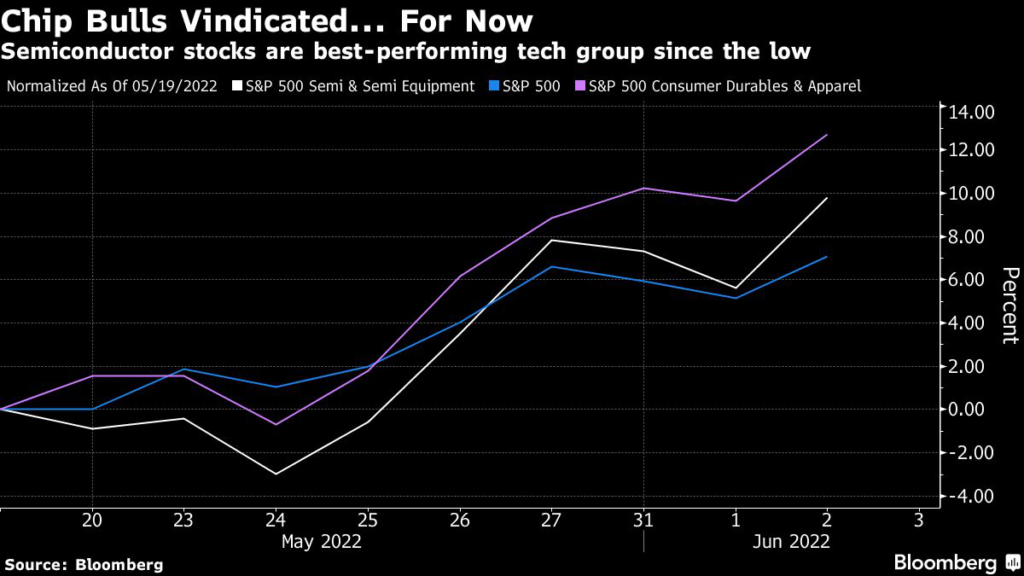
This may be a bear market rally, but for investors in semiconductor companies it’s coming as quite a relief. Chip stocks fell the most among technology sectors in this year’s market plunge, to the point that some bulls started to pound the table in the middle of May. The timing proved fortuitous: Since the S&P 500 bottomed on May 19, semiconductors have been the best-performing tech group, easily beating the benchmark. Consumer and retail stocks are faring the best though.  

Top Tech Stories

  • Taiwan’s MediaTek Inc. expects surging sales of smartphone and smart-television chips to continue to fuel growth in the key market of India, the fabless chipmaker’s country head said
  • Walmart Inc. will build four new US e-commerce warehouses in a push to speed deliveries, using an automated system to pick out items while also creating more than 4,000 jobs
  • Micron Technology Inc. fell after Piper Sandler downgraded the stock to underweight from neutral, citing the company’s “oversized exposure to mobile, PCs, and other consumer end-markets”
  • Tesla Inc. Chief Executive Officer Elon Musk said the electric carmaker needs to cut staff by around 10%, noting he had a “super bad feeling” about the economy, according to an internal email seen by Reuters
  • Traveloka, Southeast Asia’s biggest online travel startup, is close to raising more than $200 million from investors after ending talks to go public via a merger with a blank-check company last year, according to people familiar with the matter
  • Coinbase Global Inc. said it will extend a hiring freeze for both new and existing positions for the “foreseeable future” and rescind a number of accepted offers
  • Apple Inc. supplier BYD plans to begin commercial production of iPads this month in northern Vietnam after a trial run started in May, according to a provincial government official

(Updates to market open.)

More stories like this are available on bloomberg.com

©2022 Bloomberg L.P.

Twitter Clears US Antitrust Review on $44 Billion Musk Deal

(Bloomberg) — Twitter Inc. has passed the US antitrust review, clearing a hurdle for its acquisition by Elon Musk in a proposed $44 billion deal.

Approval was largely expected but the transaction is still subject to acceptance by Twitter shareholders and other regulatory reviews.

Under US merger law, Musk was required to notify the Federal Trade Commission and the US Department of Justice antitrust division to allow an investigation into potential antitrust concerns. The 30-day review period expired Thursday night. It may still be months before Twitter fully comes under Musk’s control as the billionaire continues to seek additional financing commitments.

Separately, Musk is facing regulatory scrutiny over how he has handled filings for the deal. The US Securities and Exchange Commission sent a query to Musk in April requesting information about the timing of his disclosure of his stake in Twitter and the type of filing he made. 

Twitter shares were up 1.8% Friday morning in New York.


More stories like this are available on bloomberg.com

©2022 Bloomberg L.P.

Tesla Faces Big Increase in Complaints Over ‘Phantom Braking’

(Bloomberg) — Tesla Inc. is facing stepped-up scrutiny from US regulators who have received 758 complaints of cars made by the company that suddenly brake at high speeds, more than double the number of reported incidents earlier this year.

Complaints alleging unexpected brake activation in 2021-2022 Tesla vehicles rose from 354 in February, prompting the National Highway Traffic Safety Administration to ask Tesla for a response by June 20, according to a regulatory filing on Friday. The data was cited in a May 4 letter NHTSA sent to Tesla Field Quality Director Eddie Gates.

In February, the agency opened a probe into the so-called “phantom braking” phenomenon, which covers an estimated 416,000 Tesla Model 3 and Model Y vehicles. No crashes or injuries stemming from the braking issue have been reported.

Read more: Tesla ‘Phantom Braking’ Complaints Spurs Formal NHTSA Probe

Tesla didn’t immediately reply to a request for comment.

More stories like this are available on bloomberg.com

©2022 Bloomberg L.P.

Close Bitnami banner
Bitnami