Bloomberg

Musk Suspends Ye From Twitter After Offensive Image Post

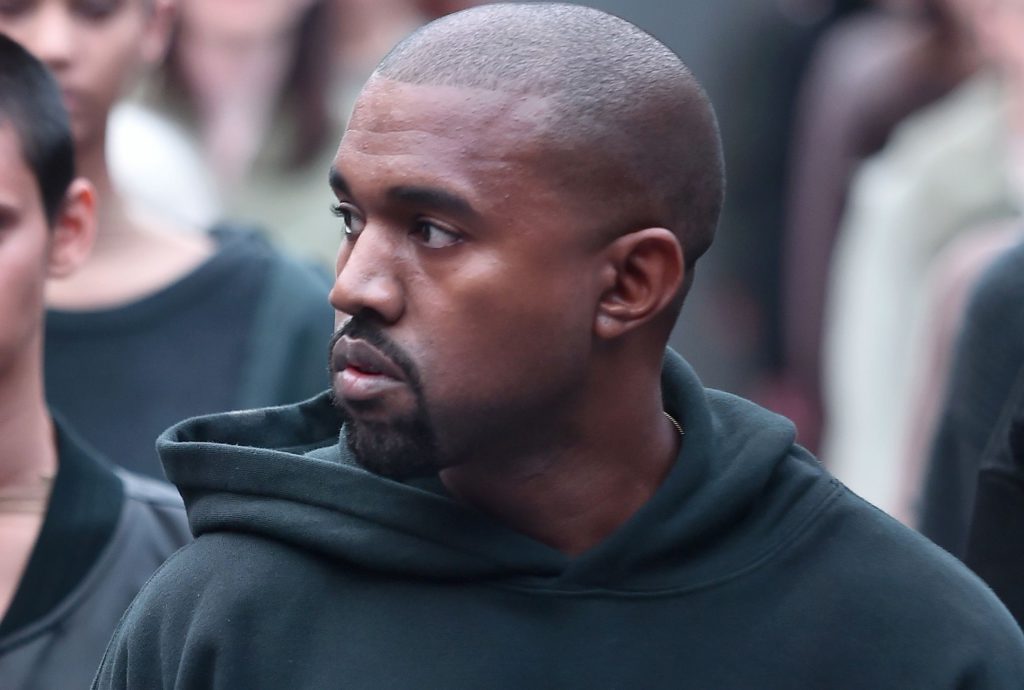
(Bloomberg) — Even on Elon Musk’s Twitter, there are red lines for permissible content, and Kanye West, who now calls himself Ye, crossed one of them with a late Thursday night post that prompted the network to suspend his account.

The artist tweeted an image combining the Star of David with a swastika, which got removed by the social media service. In its place was a message saying the post violated Twitter Inc.’s rules and a link to its policy page explaining enforcement actions. Since then, the entire account has been suspended, with all of its tweets now obscured. Ye had 32.2 million followers before the suspension.

Musk addressed the issue after the post’s initial removal, saying Ye had — not for the first time — breached Twitter’s rule against incitement to violence and his account would be suspended. It’s the most high-profile test yet of Musk’s avowed policy of making Twitter a home for free speech, even where it offends, so long as it’s not in breach of the law.

Two weeks earlier, the social network’s new owner welcomed Ye back from his Twitter exodus, at the same time as he restored former US president Donald Trump’s access. Ye had left Twitter after the service took action on his posts that it deemed antisemitic.

The cordial relations between the two men did not seem to last long, however, as Ye’s most recent tweet, which he labeled his last, featured an unflattering image of a shirtless Musk on vacation. Musk responded to that post with the words “That is fine.” He also replied to the tweet containing the removed image with “This is not.”

(Updates with account suspension)

More stories like this are available on bloomberg.com

©2022 Bloomberg L.P.

Indonesian Startup GoTo is World’s Worst Large Size Tech IPO This Year

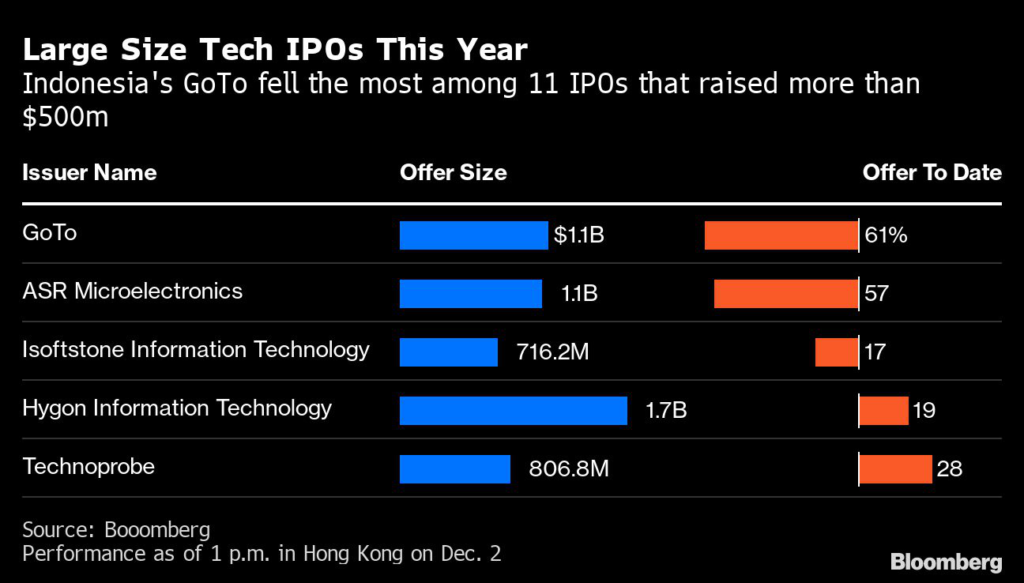
(Bloomberg) — GoTo Group’s post-IPO stock selloff makes it the worst performer among 11 tech and internet companies that raised more than $500 million in inaugural share sales this year.

Shares of the Indonesian startup provider of food delivery services to fintech solutions are falling for a 10th straight session, taking losses since listing to 61%. The recent slide was triggered by fears that backers such as Alibaba Group Holding Ltd. and SoftBank Group Corp. would sell stakes when a lock-up period ended this week. The stock has tumbled by the most allowed by the exchange every day this week.

Several tech companies that listed over the past 18 months, such as Zomato Ltd. in India and SenseTime Group Inc. in Hong Kong, saw their shares plunge once early investors were allowed to sell stakes following their initial public offerings.

Other recent big tech listings from Southeast Asia have also tumbled amid a slump in peers shares globally. Competitor Grab Holdings Ltd.’s stock has lost 65% since its listing in New York following the merger with a special purpose acquisition company one year ago. Online marketplace PT Bukalapak.com is down 67% since its Jakarta debut in Aug. 2021.   

GoTo officers planned to facilitate a controlled stake sale by pre-IPO backers, attempting to avoid a plunge in price, but the proposal didn’t come to fruition. GoTo shareholders that had considered selling decided not to proceed at this time, GoTo said on Nov. 30.

Indonesia’s largest tech company has lost about $22 billion in market capitalization from a peak reached in June. The company’s IPO raised $1.1 billion and the shares soared 13% in their first day of trade in April, following what was at the time one of the world’s largest IPOs for the year.

More stories like this are available on bloomberg.com

©2022 Bloomberg L.P.

Uber CEO Says Won’t Cut Jobs Despite Mounting Tech Layoffs

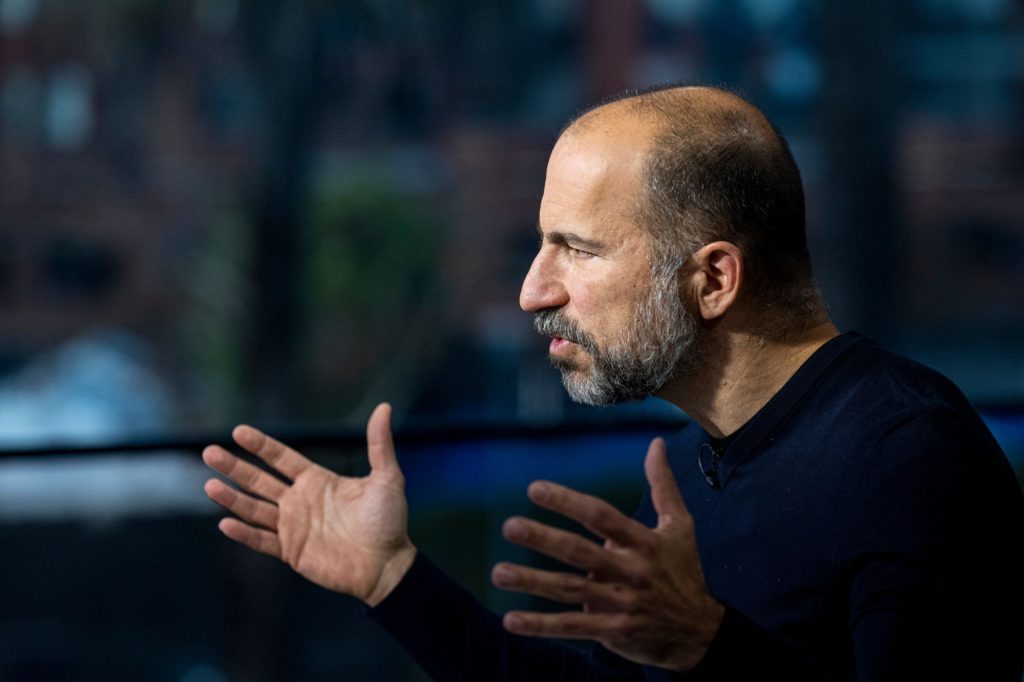
(Bloomberg) — Uber Technologies Inc. isn’t considering cutting jobs even as competitors from DoorDash Inc. to Lyft Inc. slash staff to deal with an uncertain economic outlook, Chief Executive Officer Dara Khosrowshahi said Thursday.

“No, we’re in a good place,” Khosrowshahi told Bloomberg News after speaking at the Economic Club of Chicago, responding to a question about whether the ride-hailing giant will reduce headcount.

His comments stood out among tech peers that have cut staff by the thousands. Uber’s rival Lyft said last month it would reduce headcount by 13% and hive off its first-party vehicle business. Food-delivery giant DoorDash announced it would cut 1,250 jobs to rein in expenses. 

Uber has avoided widespread layoffs, though Khosrowshahi has said the company is taking a more conservative stance on hiring and other investments. That’s after a major scale-back in 2020 when Uber dismissed more than 6,000 employees, or about a quarter of the workforce at the time, at the height of the pandemic.

In November, Uber reported third-quarter revenue jumped 72% to $8.34 billion, which assuaged investors’ concern that rising inflation would deter customers from hailing a ride or ordering takeout.

“We’re seeing zero signs of weakness,” Khosrowshahi said at the event. He added that Uber has been the beneficiary of a shift in consumer spending from retail to services. 

Khosrowshahi was optimistic about the supply of drivers on the platform, despite a protracted shortage that has raised fares and wait times, and said that periods of economic uncertainty typically spur people to seek out side hustles in ride-hailing or food-delivery. “Our driver base has increased substantially,” he said.

More stories like this are available on bloomberg.com

©2022 Bloomberg L.P.

Bitcoin Set for More Losses in Wake of FTX’s Collapse if History Is a Guide

(Bloomberg) — A seasonal cryptocurrency pattern points to more losses for Bitcoin in December in the wake of the seismic collapse of the FTX exchange.

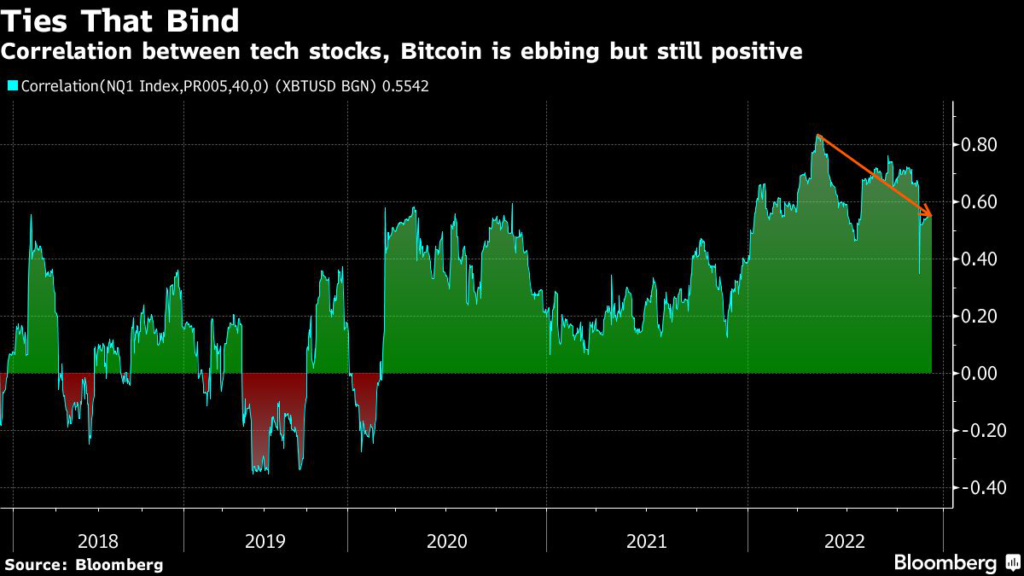
The largest token sank 16% in November and over the past decade it always went on to have a weak December following declines in the prior month, according to data compiled by Bloomberg.

The pattern was evident in 2018, 2019 and 2021, leaving an average December slide of almost 11%. If history repeats, crypto may lag stocks given heightened expectations for this quarter’s equity rebound to continue in the run-up to Christmas as the Federal Reserves swivels to smaller interest-rate hikes.

“The digital asset class is working through a period of contagion, where assessing counterparty credit risk and solvency remains imperative,” said John Toro, head of trading at digital-asset exchange Independent Reserve. “It seems most likely that during this period of heightened credit risk, Bitcoin will underperform other high-beta risk assets.”

Crypto markets swooned in the period around the Nov. 11 bankruptcy of Sam Bankman-Fried’s FTX trading platform and sister investment house Alameda Research. They steadied as the month wore on, propped up in part by signs that the Fed will switch to less aggressive monetary tightening.

“We would be more biased to a steadier, positive December as some of the excess fear and extreme extrapolations of contagion recede,” said Richard Galvin, co-founder of fund manager Digital Asset Capital Management. “Added to that, the macro environment remains more positive — for the time being.”

The worlds of traditional and digital finance alike remain transfixed by the wreckage of FTX, which at one point boasted a $32 billion valuation but whose founder Bankman-Fried now professes to have only $100,000 in the bank.

Former Federal Deposit Insurance Corp. Chair Sheila Bair said US regulators “need to crack down” on the most problematic aspects of crypto in the wake of the collapse of FTX and related entities.

Galaxy Digital Chief Executive Officer Mike Novogratz dropped his forecast for Bitcoin to climb to $500,000 in five years, citing tightening monetary policy, while adding that the token will get there eventually.

Bitcoin was little changed and trading just below $17,000 as of 12:25 p.m. in Singapore, while second-ranked Ether was steady at $1,272. A gauge of the top 100 tokens has shed more than 60% this year amid a prolonged crypto rout that toppled a number of digital-asset businesses.

For crypto market prices: CRYP; for top crypto news: TOP CRYPTO.

–With assistance from Sunil Jagtiani.

More stories like this are available on bloomberg.com

©2022 Bloomberg L.P.

Here Are the VIP Guests Invited to Biden’s Dinner for Macron

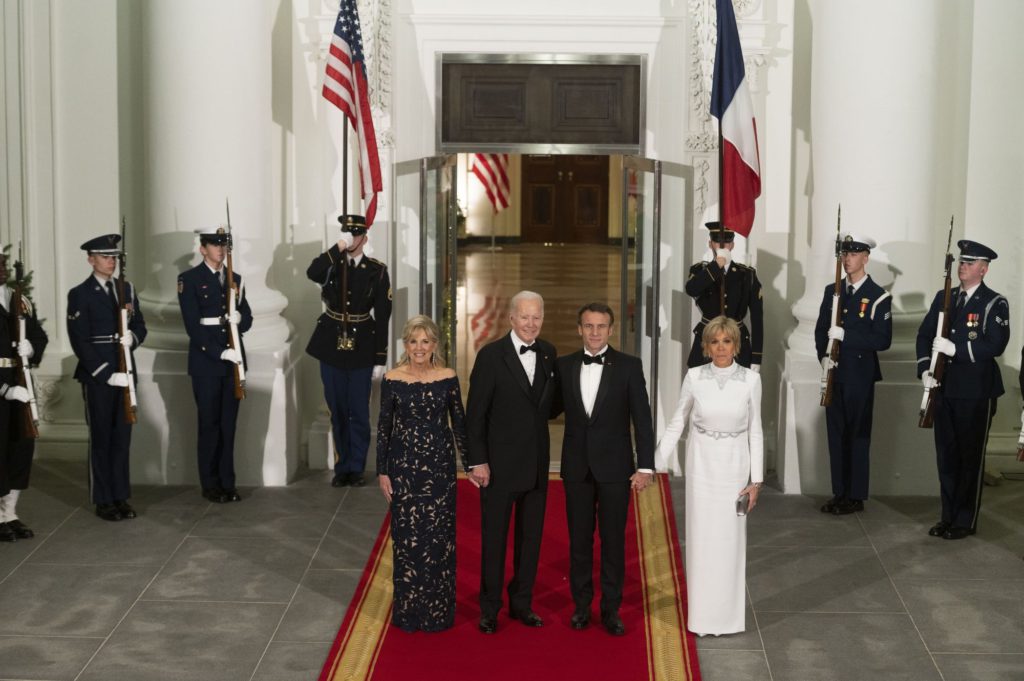
(Bloomberg) — Apple Chief Executive Officer Tim Cook, Bank of America CEO Brian Moynihan, KKR and Co. co-founder Henry Kravis and film producer Jeffrey Katzenberg were among the guests Thursday at President Joe Biden’s first state dinner honoring French President Emmanuel Macron. 

LVMH founder Bernard Arnault, joined by Hélène Marie Mercier Arnault, Delphine Arnault, executive vice president of Louis Vuitton, and Evercore Inc. Senior Chairman Roger Altman were some of the corporate executives who received coveted invitations to the state dinner, the first at the White House in more than three years.

Also at the dinner were Avram Glazer, whose family owns the NFL’s Tampa Bay Buccaneers and a majority stake in Manchester United; Ted Sarandos, the Netflix Inc. co-CEO, with his wife Nicole Avant, former US ambassador to the Bahamas; and Laurene Powell Jobs, the president and founder of Emerson Collective.

The dinner, considered one of the most lavish White House traditions and a show of respect to visiting heads of state, caps a busy two days of meetings and events for Macron, his wife Brigitte, President Biden and First Lady Jill Biden.

The guest list is one of the larger ones for a state dinner in recent history, according to Colleen Shogan, a historian at the White House Historical Association. Some guests appeared on the red carpet, while others chose to arrive through a separate White House entrance to avoid the press.

As she walked down the red carpet, Conde Nast’s Anna Wintour was asked how Vogue magazine snagged an exclusive interview with the president’s granddaughter, Naomi Biden, before her wedding at the White House last month. “Well, what gal doesn’t want to be in Vogue for her wedding,” Wintour responded.

Other notables from media and Hollywood include Atlantic Media chair David Bradley and Katherine Bradley; MSNBC’s “Morning Joe” co-hosts Mika Brzezinski and husband Joe Scarborough; and Julia Louis-Dreyfus of “Veep” fame. 

‘Democratic Values’

Biden at the dinner offered a toast to France, the first US ally.

“We stick up for one another and our democratic values to which Washington and Lafayette dedicated their lives, and we still strive to build a world that’s worthy of our highest hopes and of our future,” said Biden, adding the two countries can “always count on one another as allies and friends.”

Macron called Biden a “dear friend” and said the two nations should stand together to defend democratic principles.

“In a lot of places today, these principles are at risk or challenged. Even in our won societies, our own democracies, a lot of people just want to jeopardize or revert on these principles,” Macron said. “It’s time to get shoulder to shoulder precisely to be entitled to say at the same time, ‘We the people,’ and ‘liberte, egalite, fraternite.’”

Guests were to enjoy a performance by Grammy Award-winning musician Jon Batiste, who performed along with his father, Michael Batiste.

Batiste arrived through the East Garden Room entrance with his wife, family members and young nephew, who waved at reporters.

“It’s going to be fire,” Batiste said of his performance.

Actress Ariana DeBose, an Oscar winner for her role in “West Side Story,” arrived alongside Henry Muñoz III, former Democratic National Committee finance chair. “I couldn’t be more excited,” said DeBose about attending the dinner.

Actress Jennifer Garner is attending the dinner with her daughter, Violet Affleck. Also walking down the red carpet at the White House were John Legend and Chrissy Teigen.

Tim Cook was accompanied by Lisa Jackson, Apple’s vice president of environment, policy and social initiatives. He told reporters that his meeting Wednesday with Twitter Inc. owner Elon Musk was “very good.”

Tony West, senior vice president and chief legal officer at Uber Technologies Inc., was accompanied by his wife Maya Harris, the sister of Vice President Kamala Harris. The vice president also attended with the second gentleman, Doug Emhoff.

“Late Show” host Stephen Colbert arrived with his wife, Evelyn McGee-Colbert. 

Bipartisan Dinner

Democratic lawmakers at the dinner include House Speaker Nancy Pelosi, who was joined by her daughter, journalist and documentary filmmaker Alexandra Pelosi, as well as Senate Majority Leader Charles Schumer of New York, House Majority Leader Steny Hoyer, and House Democratic Whip James Clyburn.

But the dinner is a bipartisan affair with House Republican Leader Kevin McCarthy, House Minority Whip Stephen Scalise, Republican Maine Senator Susan Collins and Representative Michael McCaul of Texas attending. 

McCarthy said on the red carpet that he thought Republicans, who will control the House next year, would be able to work with Biden on the economy, energy independence, border security and stopping fentanyl smuggling. Asked how he felt about dining with Biden’s son Hunter Biden, whom Republicans plan to investigate, McCarthy said: “Well, I’m at dinner with my mom so we’re going to have a great time.”

The president’s home state of Delaware was represented by Representative Lisa Blunt Rochester, Governor John Carney, and Senators Tom Carper and Chris Coons. The president’s daughter Ashley Biden also attended.

Secretary of Defense Lloyd Austin, Health and Human Services Secretary Xavier Becerra and Secretary of State Antony Blinken are among the guests from the president’s Cabinet.

Read more: Biden and Macron to Feast on Lobster and World’s Best Cheese

The guests dined in a large heated tent on the South Lawn of the White House, where they will be served Maine lobster, American caviar, ravioli, steak and potatoes, according to the first lady’s office. The menu included a cheese course highlighted by Oregon’s Rogue River Blue, the first US cheese to ever win the World Cheese Awards.

The inclusion of Maine lobster sparked criticism from Oceana, a conservation advocacy group. Monterey Bay Aquarium’s Seafood Watch and the Marine Stewardship Council have encouraged consumers to avoid Maine lobster because of the threat its fishing practices pose to endangered North Atlantic right whales.

The state dinner was the second hosted for Macron, who was previously honored in April 2018 by then-President Donald Trump. Trump also hosted a state dinner for then-Australian Prime Minister Scott Morrison in September 2019, in what would be the last such event at the White House before the pandemic.

The Macrons will travel to New Orleans on Friday where they will meet with Louisiana Democratic Governor John Bel Edwards, who is also at Thursday’s dinner.

McCarthy, Cook, Kravis, Arnault and Edwards attended Trump’s Macron dinner as well.

–With assistance from Justin Sink.

(Updates with new quotes, details in paragraphs 8-15. Earlier version corrected reference to Naomi Biden.)

More stories like this are available on bloomberg.com

©2022 Bloomberg L.P.

UBS Cuts IPhone Forecast by 16 Million on Covid, Demand Issues

(Bloomberg) — Apple Inc.’s iPhone 14 generation may fall 16 million units shy of expectations this year, as China’s Covid Zero policy roils its key Zhengzhou plant and entry-level models face weak demand, according to UBS.

UBS analysts slashed their forecast of total iPhone 14 production to 76 million from 92 million units for the second half of 2022, a 20% fall from 2021. They attributed the lower expectations to both the manufacturing disruption faced by Foxconn, also known as Hon Hai Precision Industry Co., and softening demand for lower-end iPhone 14 models. It’s one of the most bearish estimates about the current quarter and comes at a time of uncertainty about China’s potential relaxation of virus lockdown measures.

“It is important to monitor whether lengthening wait times for the iPhone 14 Pro/Pro Max affect demand,” UBS analysts led by Grace Chen wrote in a Dec. 1 note. “The speed with which Apple and Hon Hai can resolve the challenges at Zhengzhou is key to 2022’s fourth quarter and 2023’s first quarter volume.”

Foxconn is maintaining closed-loop operation at its Zhengzhou campus, complicating efforts to make up for lost assembly time. The closed-loop approach restricts workers to their dorms or the factory floor, minimizing the number of other people they come into contact with in hopes of containing the spread of the virus.

Local authorities lifted the lockdown that had affected the area, and the central government has also indicated a softening stance. The pace of China’s reopening is a closely watched measure and likely to impact the speed with which Foxconn can recruit staff to replenish its workforce and fulfill orders.

Challenges to iPhone Pro production could further pressure Apple’s business, as the premium phones have picked up the slack for slumping demand for the regular iPhone 14 models this year. The Foxconn facility at Zhengzhou produces the vast majority of iPhone 14 Pro and Pro Max devices.

Turmoil at the Zhengzhou plant will likely lead to a production shortfall of 6 million iPhone Pro units, Bloomberg reported earlier this week. Apple has lowered its production target of the new handsets this year to about 87 million units from an earlier projection of 90 million units.

It’s likely Apple could also ask assemblers like Pegatron Corp. and Luxshare Precision Industry Co., which typically focus on lower-end iPhone models, to produce more of the premium models to meet holiday season demand, UBS said. If such a shift happens, Foxconn’s iPhone assembly share could fall from 70%-to-75% this year to 65%-to-70% in 2023, the analysts added.

Read more: Apple Faces Deficit of 6 Million IPhone Pros on China Tumult

–With assistance from Cindy Wang.

More stories like this are available on bloomberg.com

©2022 Bloomberg L.P.
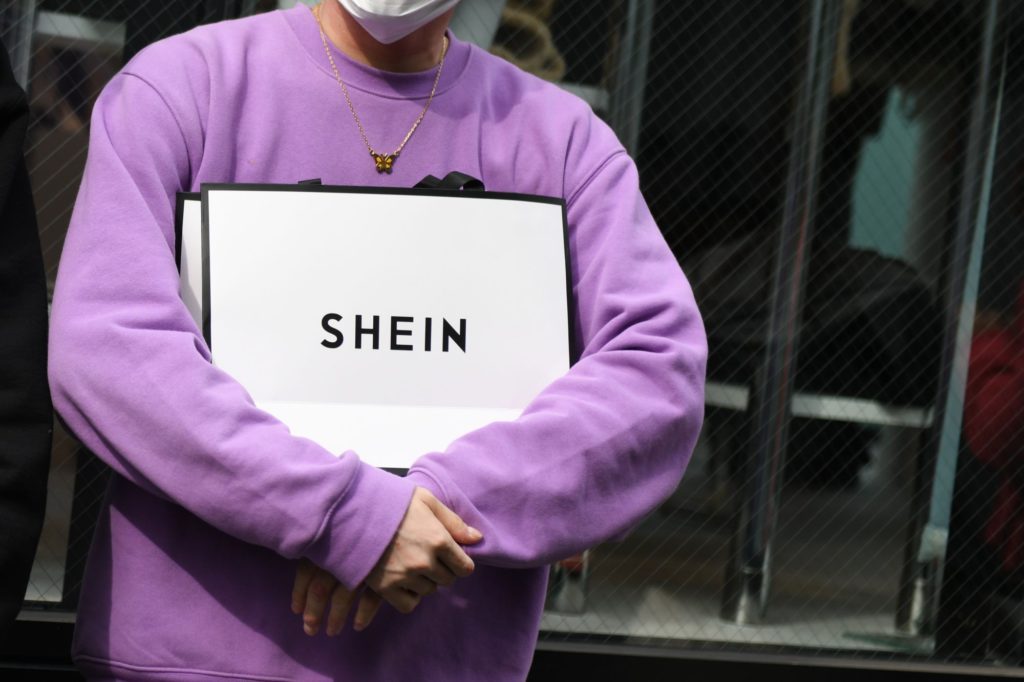
TPG Leads $465 Million Fund to Piggyback on the Next Shein

(Bloomberg) — Hidden Hill Capital, a private equity firm backed by GLP Pte., has raised $465 million for a fund targeting the infrastructure for a generation of Chinese companies like Shein that are turning outward for growth.

The Hidden Hill Foundation Fund has started out with shares in six companies including J&T Express Co. and JD.com Inc. unit JD Logistics Inc., which its operator previously invested in. NewQuest Capital Partners, owned by the alternative asset manager TPG Inc., is the fund’s lead investor alongside backers from North America, Asia and Europe, Hidden Hill said in a statement Friday.

Hidden Hill joins investors betting that Chinese firms will increasingly look abroad for growth. It aims to invest in the ecosystem that will support those future global giants, from technology services to the raw logistical support they will need to move goods around the world. 

China’s giant tech sector is accelerating its international push after grappling with a double-whammy of regulatory crackdowns and economic malaise at home. Emerging from the transition are a new crop of upstarts like Shein, which leverages China’s fast and cheap labor to sell clothing to US customers.

Hidden Hill, whose portfolio firms provide technology and platforms for such China-based but international businesses, wants a slice of that action at a time the world is fretting over the fracture of global supply chains.

“We see the opportunity where, with China at its center, Asia will develop a unified supply chain to service the global market,” Higashi Michihiro, GLP’s China chief strategy officer and Hidden Hill’s founding partner, said in an interview. “Asia will have its own UPS in the future.”

Established in 2018 with offices in Shanghai and Hong Kong, Hidden Hill manages over $3.6 billion of assets across five yuan-denominated funds and two US dollar funds, it said, focusing on supply chain digitization and renewable energy. It has made bets on the logistics arms of China Eastern Airlines Corp. and China Southern Airlines Co., as well as startups like freight software developer G7 and sorting robots maker Libiao Robotics. Its main backer GLP has about $115 billion of assets under management, it said in a statement.

One of its latest investments is in Jet Commerce, which offers consulting, marketing and logistics services for brands and ecommerce platforms like TikTok and Sea Ltd.’s Shopee. In August, the Hangzhou startup said it raised $60 million from investors including Hidden Hill and ByteDance Ltd.-backed Jinqiu Capital, without disclosing its valuation. Another Hidden Hill investee, ZongTeng Group, is a key logistics partner to ByteDance and Shein.

Read more: China’s Venture Funding Tumbles Precipitously After Crackdown

Venture capital investments in China are falling sharply this year, as investors sour on money-losing tech startups and publicly traded stocks tumble. Growing tensions between the US and China have driven investors to look at regional clusters like Southeast Asia. China-focused private capital fundraising has plunged 81% to $21.5 billion so far this year, down from $115.9 billion in 2021, according to data tracker Preqin.

“We always have an exit plan in mind for our investors,” said Richard Dong, another founding partner at Hidden Hill. “The point of bringing Chinese firms overseas is not only about giving them a new revenue stream, it’s also about offering our LPs another window to exit under the current macro environment.”

(Updates with fundraising data from the ninth paragraph. A previous version of the story corrected an exec’s title.)

More stories like this are available on bloomberg.com

©2022 Bloomberg L.P.
FTX Japan Says Work Underway to Allow Withdrawal of Client Funds

(Bloomberg) — The Japanese subsidiary of failed crypto empire FTX said it is working to allow users in the country to withdraw their funds, paving the way for a rare case of investors getting money back from the collapsed exchange. 

The plan for the resumption of withdrawal services, which were first suspended on Nov. 8, has been approved by the new FTX Trading management team, according to an update on its website on Thursday. As part of the plan, the firm is incorporating controls, security audit, reconciliations, and reviews. 

Sam Bankman-Fried’s sprawling tangle of FTX group companies slid into a chaotic bankruptcy on Nov. 11, potentially bilking more than a million creditors around the world and fomenting turmoil in the crypto sector. In Japan, the financial regulator has been seeking a road map and timeline for the return of customer assets as soon as possible, Bloomberg News reported this week. 

FTX Japan customer balances would be transferred to Liquid, a platform it bought this year to boost its local presence, after a verification process so that users can withdraw their money, people familiar with the matter had said. FTX Japan K.K. currently holds about $94.5 million in crypto assets and $46 million in fiat currency in designated client accounts.

FTX Japan said it has confirmed with the law firm representing the FTX group in the Chapter 11 bankruptcy proceedings that Japanese customer cash and crypto currency should not be part of FTX Japan’s estate. The local unit plans to resume withdrawal service in the ordinary course on this basis, according to the statement. 

The management of FTX Japan is in regular dialogue with the country’s regulators, and has shared the first draft of the plan with more consultations happening on a regular basis as key milestones are met, the statement said. The private keys of the asset segregated wallets are kept offline at all times and are solely under the control of the Japan operations team, it added. 


More stories like this are available on bloomberg.com

©2022 Bloomberg L.P.
Asia Stocks Set for Mixed Open With Jobs in Focus: Markets Wrap

(Bloomberg) — Stocks fell in Asia after US equities struggled for direction, with traders awaiting a jobs report later Friday for clues on the Federal Reserve’s next policy steps. 

A gauge of Asian equities dropped, led by Japan, where the yen’s five-day rally increased downward pressure on stocks. A Bank of Japan board member suggesting the need for a policy assessment added to negative sentiment.

Futures contracts for the S&P 500 slid after the index edged lower during the US session. It rallied earlier this week on Fed Chair Jerome Powell’s signals of a downshift in the pace of hikes. 

Bets on where the central bank rate will peak have now dropped below 4.9%, according to swap markets. The current benchmark sits in a range between 3.75% and 4%.

Fed Bank of New York President John Williams said further hikes are needed to curb inflation. Concern that such tightening raises the odds of a recession became more pronounced after data showing American manufacturing contracted in November for the first time since May 2020. 

The Bloomberg Dollar Spot Index steadied after sinking to its lowest since June. 

Australian and New Zealand government bond yields slid, following the lead from Treasuries on Thursday, when their rally gathered steam amid a pullback in expectations for Fed tightening. The 10-year US benchmark yield rose slightly to 3.54% during Asian trading.

The remarkably resilient US jobs market is beginning to cool, but Friday’s employment report may fall short of the turning point Fed officials are seeking in their battle to beat back inflation. 

Still, Sarah Ponczek, financial adviser at UBS Private Wealth Management, said the jobs figures and other data may start to show a slowing trend in the economy.

“There have been slight hints that the interest-rate hike cycle that we have seen is starting to filter through the economy,” she said on Bloomberg Radio.

In South Africa, the political turmoil risks sending the financial market into deeper rout, with the rand coming off its worst one-day loss since May and yields on the 10-year sovereign bond rising most since 2015.

Elsewhere, oil was set for a weekly gain with China further easing Covid restrictions and the US considering a pause in sales from its strategic reserves. Gold slid.

Key events this week:

  • US unemployment, nonfarm payrolls, Friday
  • ECB’s Christine Lagarde speaks, Friday

Stocks

  • S&P 500 futures fell 0.3% as of 12:04 p.m. Tokyo time. The S&P fell 0.1%
  • Nasdaq 100 futures fell 0.4%. The Nasdaq 100 rose 0.1%
  • Japan’s Topix index fell 2%
  • South Korea’s Kospi index fell 1.1%
  • Hong Kong’s Hang Seng Index fell 0.6%
  • China’s Shanghai Composite Index fell 0.1%
  • Australia’s S&P/ASX 200 Index fell 0.8%

Currencies

  • The Bloomberg Dollar Spot Index was little changed
  • The euro was little changed at $1.0514
  • The Japanese yen rose 0.1% to 135.19 per dollar
  • The offshore yuan fell 0.1% to 7.0490 per dollar

Cryptocurrencies

  • Bitcoin was little changed at $16,924.47
  • Ether fell 0.3% to $1,272.2

Bonds

  • The yield on 10-year Treasuries advanced four basis points to 3.54%
  • Japan’s 10-year yield was little changed at 0.25%
  • Australia’s 10-year yield declined eight basis points to 3.40%

Commodities

  • West Texas Intermediate crude rose 0.4% to $81.54 a barrel
  • Spot gold fell 0.3% to $1,798.05 an ounce

This story was produced with the assistance of Bloomberg Automation.

–With assistance from Rita Nazareth and Rob Verdonck.

More stories like this are available on bloomberg.com

©2022 Bloomberg L.P.
Tesla Expands Vehicle Lineup With Delivery of ‘Badass’ Big Rig

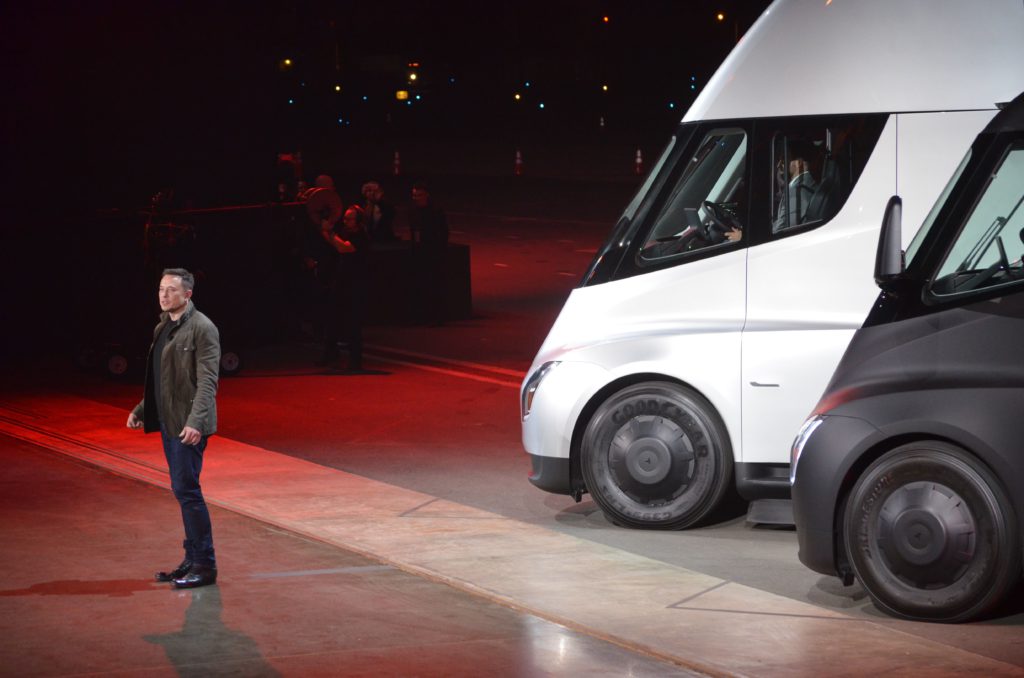
(Bloomberg) — Tesla Inc. handed over the first of its electric Semi trucks Thursday, a milestone for the automaker more than five years after it unveiled the vehicle.

“If you want the most badass rig on the road, this is it,” Chief Executive Officer Elon Musk said at a low-key “delivery event” at Tesla’s battery factory in Sparks, Nevada. 

While electric passenger cars get most of the buzz, the move to electrify trucking could be transformative for an industry known for high emissions and hefty fuel costs. Adding driver assistance features can also help operators save on labor expenses.

Tesla has designed the Semi truck around the driver, with a central seating position, plenty of room to stand up and ample storage space. On stage, Musk said Tesla had pulled off a 500-mile (805-kilometer) demonstration run on a single charge and full load in California, between Tesla’s Fremont plant and San Diego. A time-lapse video was shown of the route.

Large fleet operators like PepsiCo Inc., Walmart Inc., Meijer Inc. and J.B. Hunt Transport Services Inc. were among the companies that placed non-binding reservations for the Semi five years ago. The first deliveries will go to PepsiCo’s Frito-Lay plant in Modesto, California. 

See also: Tesla Has California to Thank for Its First Semi Truck Delivery

During Tesla’s last earnings call, Musk said the company is tentatively planning to produce 50,000 Semis for North America in 2024. He appears to have taken the product off the back burner after the passing of the Inflation Reduction Act, which makes tax credits of as much as $40,000 available to commercial vehicles. Musk didn’t say anything about volume production or pricing Thursday evening. 

The Semi has an estimated range of 500 miles per charge and its own “Tesla Semi” chargers. The introduction will add a fifth vehicle to Tesla’s lineup — which currently features the passenger models S, X, 3 and Y — and fulfills Musk’s longstanding pledge to move into heavy-duty trucks.

The Semi will be put to work for Tesla, carrying freight between the company’s factories in Nevada and Fremont and back again so that engineers can continually refine the product, Dan Priestley, the truck’s program manager, said on stage Thursday. 

In his “Master Plan, Part Deux” opus from 2016, Musk said “the Tesla Semi will deliver a substantial reduction in the cost of cargo transport, while increasing safety and making it really fun to operate.”

–With assistance from Ed Ludlow.

(Updates with comments and details from event in Nevada.)

More stories like this are available on bloomberg.com

©2022 Bloomberg L.P.
Close Bitnami banner
Bitnami