Bloomberg

Bitcoin Retreats to Consolidate Below $30,000; Solana Tumbles

(Bloomberg) — The $30,000 mark is proving to be an obstacle for Bitcoin yet again.

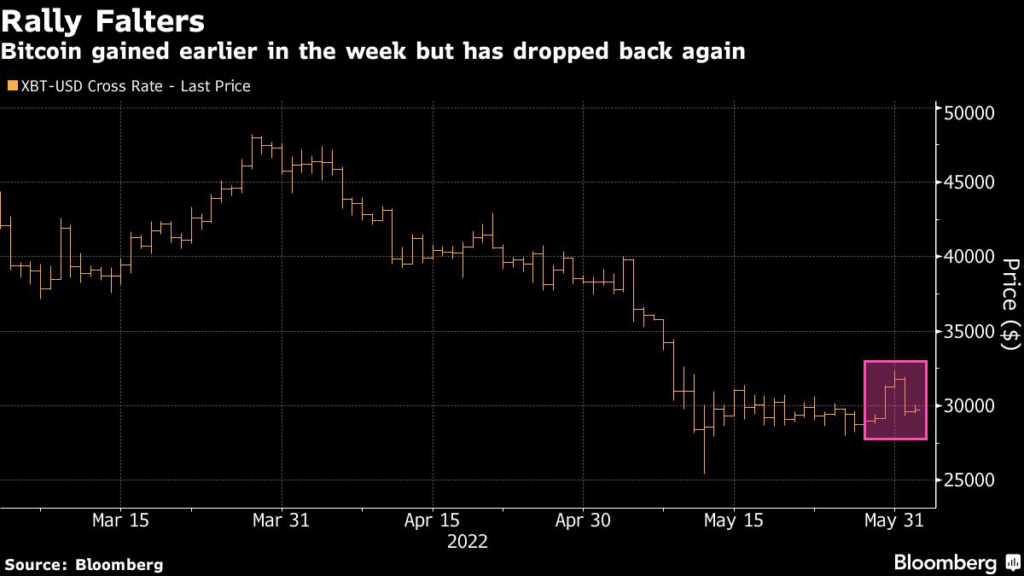
The largest cryptocurrency steadied out below that round-number level after tumbling Wednesday and closing down 6.8%, near session lows. It was up 0.4% to $29,704 as of 12:01 p.m. in Singapore Thursday. 

“The technical outlook is neutral at best and Bitcoin really needs to trade back above $40k before any kind of bullish outlook can be confirmed,” Nicholas Cawley, a strategist at DailyFX, wrote in a note Wednesday.

Bitcoin had staged a mini-rally to start the week, rising to a three-week high of $32,359 on Tuesday and giving some in the markets hope that it might gain upward momentum. Cryptocurrencies have struggled as the Federal Reserve and other central banks hike rates amid stubbornly high inflation.

Solana underperformed amid a network outage, dropping 4.5% after having fallen 11% the prior day. Avalanche was off 4.3%. 

More stories like this are available on bloomberg.com

©2022 Bloomberg L.P.

Solana Blockchain Restarts After Bug Causes 4 1/2-Hour Outage

(Bloomberg) — The Solana blockchain is back up and running after a software glitch caused an outage of more than four hours, the latest in a series of shutdowns of the network in less than a year. 

While Solana’s rise to the upper echelon of crypto’s top alternatives to Bitcoin and Ethereum has been rapid, it has been hampered by outages in recent months. The digital asset’s network suffered a wave of blackouts and service issues lasting as long as 18 hours in January, prompting ire from frustrated traders who watched their portfolio values decline while unable to offload tokens.

The network remains secure, as do all funds, Solana said earlier in an Twitter post. 

The price of Solana’s SOL token slumped for a third day on Thursday, falling as much as 4.8% to $38.67 and underperforming most other major tokens. It had traded as high as $260 in November.

More stories like this are available on bloomberg.com

©2022 Bloomberg L.P.

Asia Stocks Drop as Rate Fears Escalate; Oil Sinks: Markets Wrap

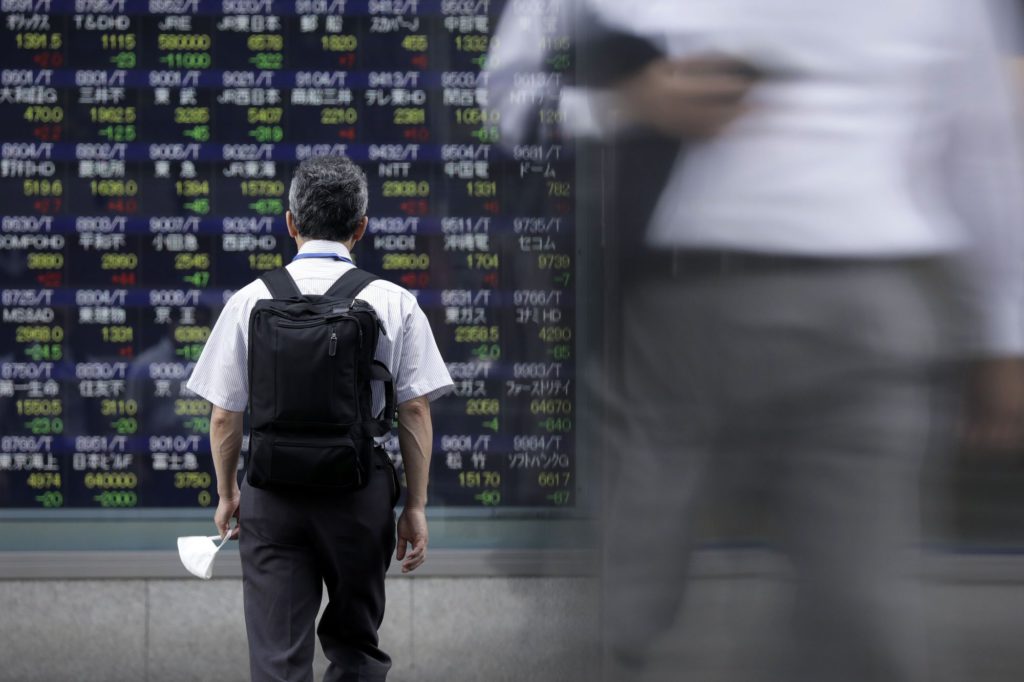
(Bloomberg) — Stocks in Asia fell Thursday as central bankers amplified hawkish messages in their quest to rein in inflation, weighing on risk assets. Oil sank.

An MSCI Inc. gauge of Asia-Pacific shares retreated for a second day, with equities in Hong Kong leading declines amid tough virus curbs. US contracts fluctuated after stocks dropped on Wall Street. US manufacturing activity and job openings data fueled concern the Federal Reserve will need to get more restrictive to slow runaway price gains.

Treasuries held losses, with 10-year yields edging up above 2.90%. Traders raised bets on the path for rate hikes and the Fed started its balance-sheet reduction process. The dollar was steady while the yen held near 130 per dollar after its recent decline on the prospect of widening interest rate differentials with the US.

Crude oil slid on a report that Saudi Arabia is ready to pump more oil if Russian output declines. OPEC+ is scheduled to meet to discuss supply policy. 

JPMorgan Chase & Co.’s Jamie Dimon sounded alarm bells on the economy. Dimon warned investors to prepare for an economic “hurricane.” In contrast, JPMorgan’s bullish strategist Marko Kolanovic expects stocks to rebound by the end of the year, underscoring the increasing debate as markets are buffeted by challenges from tightening monetary policy to the war in Ukraine.

Investors are on edge over whether the Fed’s tighter policies will induce a recession. A chorus of Fed officials has fallen behind calls to keep hiking to counter price pressures. Mary Daly of the San Francisco Fed and her more hawkish colleague James Bullard of St. Louis both backed a plan to raise rates by 50 basis points this month, while Richmond’s Thomas Barkin said it made “perfect sense” to tighten policy.

“We do see the rise in probability of a recession in the second half of this year, potentially persisting into 2023 as the Fed continues to battle inflation,” Tracie McMillion, Wells Fargo Investment Institute head of global asset allocation strategy, said on Bloomberg Television.

McMillion also cautioned that markets haven’t fully priced in the impact of the Fed’s balance-sheet reduction. “The impact of quantitative tightening starting to roll off the Fed’s balance sheet this month is really untested and unprecedented. Our guess is that it’s probably not fully priced into markets,” she said.

Elsewhere, the Bank of Canada raised its overnight rate by a half percentage point, as expected, and warned that it may act “more forcefully” if needed to tackle inflation. 

Chinese stocks fluctuated. Beijing ordered state-owned policy banks to set up an 800 billion yuan ($120 billion) line of credit for infrastructure projects as it leans on construction to stimulate an economy battered by coronavirus lockdowns.

How will markets be affected by the Fed’s quantitative tightening? QT officially starts Wednesday and is the theme of this week’s MLIV Pulse survey. Click here to participate anonymously.

Here are some key events to watch this week:

  • Cleveland Fed President Loretta Mester discusses the economic outlook Thursday
  • US May employment report Friday
  • The UN’s Food and Agriculture Organization releases its monthly food price index at a time of maximum concern about global supplies on Friday

Some of the main moves in markets:

Stocks

  • S&P 500 futures were steady as of 1:10 p.m. in Tokyo. The S&P 500 fell 0.7%
  • Nasdaq 100 futures were little changed. The Nasdaq 100 fell 0.7%
  • Topix index fell 0.6%
  • Australia’s S&P/ASX 200 Index fell 1%
  • Kospi index lost 1%
  • Hang Seng Index fell 1.6%
  • Shanghai Composite Index was little changed
  • Euro Stoxx 50 futures rose 0.2%

Currencies

  • The Bloomberg Dollar Spot Index was little changed
  • The Japanese yen was at 130.03 per dollar
  • The offshore yuan was at 6.7062
  • The euro was at $1.0655

Bonds

  • The yield on 10-year Treasuries were at 2.91%
  • Australia’s 10-year bond yield climbed eight basis points to 3.50%

Commodities

  • West Texas Intermediate crude slid 2% to $112.98 a barrel
  • Gold was at $1,845.39 an ounce

More stories like this are available on bloomberg.com

©2022 Bloomberg L.P.

Delhivery CEO Navigates Market Meltdown in ‘Nerve-Wracking’ IPO

(Bloomberg) — Sahil Barua, chief executive officer of logistics startup Delhivery Ltd., minces no words about the process of going public in what’s shaping up to be an historic meltdown in the technology industry.

“It was nerve-wracking,” said the 37-year-old, who is also a co-founder.

The IPO last week came only after months of discussions with potential investors and investment bankers, Barua said in a video chat this week. Executives paid multiple visits to would-be backers to explain the business models and numbers at the company, which is based in Gurgaon in the suburbs of New Delhi. 

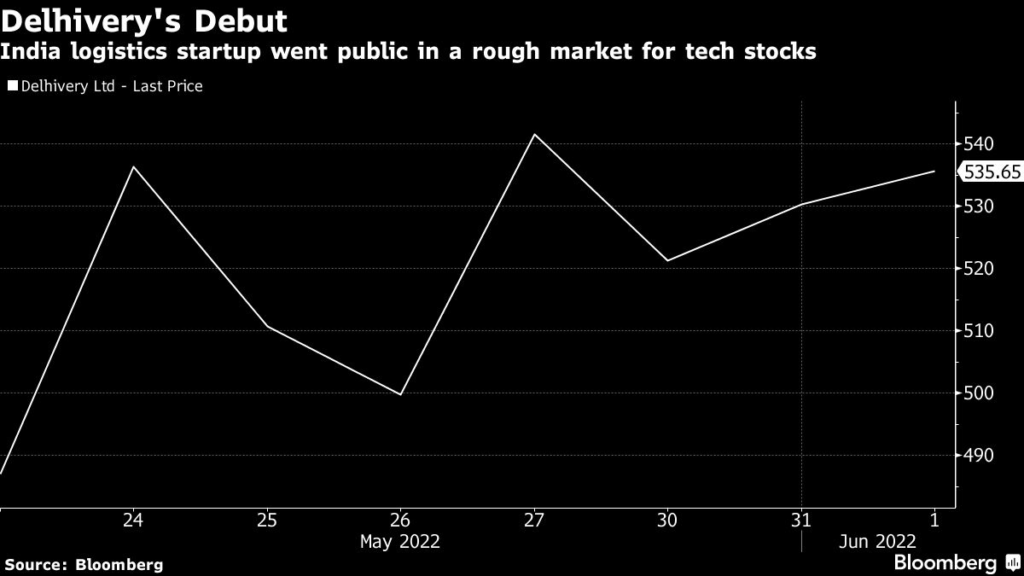
Barua and his team slashed the size of the offering by about 30% at the beginning of May and then decided to price shares conservatively, essentially sacrificing some cash in the short-term to try to avoid a tumble for investors. Shares are now up 10% from Delhivery’s debut, which he thinks signals solid appetite for risk in India’s public markets despite a drop in financing from venture capital firms.

“Technology stocks had corrected more than 20% in the period between filing our initial draft documents to our IPO so we modified our pricing,” Barua said. “We decided we’d rather have modestly-priced shares which rise rather than tumble on listing.”

Shares, which debuted at 487 rupees each, closed Wednesday at 536 rupees.

That the founders weren’t selling any shares in the company sent the right signal to the market, he said. Although retail investors bid for only about half the shares that were on sale, institutional investors flocked to the stock, resulting in an oversubscription. 

“Retail investors have a hard time understanding why new-age technology companies make losses,” he said. 

A rout in technology stocks is resetting expectations for the venture capital ecosystem, which has grown dependent on a flood of cash from privately held funds to finance money-losing operations. Delhivery — which provides last-mile delivery, warehousing and cross-border logistics support to a variety of companies — has been grabbing market share by spending its cash on buying smaller rivals. It’ll continue to chase acquisitions with the proceeds of the IPO, Barua said.

Delhivery’s decision to stick to its IPO plans despite the market turmoil may stem in part from the need to replenish its reserves. Its cash hoard had shrunk to just over 3.6 billion rupees ($46 million) at the end of 2021 from more than 16 billion rupees at end-March 2019, while total expenses almost doubled in the nine months to December 2021 from a year earlier. Losses almost tripled over the same period. 

Delhivery’s backers include SoftBank Group Corp., Tiger Global LP, the Carlyle Group Inc. and FedEx Corp. Following a historic loss on its Vision Fund, SoftBank has said it plans to cut startup investment by 50% or more this year. The average monthly value of deals led by Tiger Global has also slowed to less than half what it was a year ago, according to PitchBook.

Founded in 2011 as a food delivery service, Delhivery provides warehousing for Xiaomi Corp. and Lenovo Group Ltd., shipment tracking for Inditex SA’s Zara and Hennes & Mauritz AB, deliveries for Amazon.com Inc. and Walmart Inc.-owned Flipkart and logistics for India’s largest automakers, appliance manufacturers, and consumer goods makers. The company plans to expand overseas by partnering with minority shareholder FedEx Corp. to sell its technology services.

Delhivery posted a fourth quarter loss of 1.2 billion rupees on revenue of 20.7 billion rupees earlier this week. 

Founders Barua, Kapil Bharati and Suraj Saharan spent years building their own maps, designing ways for freelance delivery staff to handle large amounts of cash, and expanding its reach beyond big cities in India’s fragmented logistics market spanning thousands of mom & pop logistics operators. 

While rising fuel prices and shortage of skilled labor are headwinds, companies like Delhivery are betting that scale will help them succeed.  

“Logistics is not a discretionary expenditure so there’s no softening of demand despite the Ukraine war and macro-economic shocks,” said Barua. “The intersection of logistics and infrastructure is at the heart of the India story.”

More stories like this are available on bloomberg.com

©2022 Bloomberg L.P.

Ex-NFT Marketplace Employee Charged with Insider Trading

(Bloomberg) — A former employee of OpenSea, the world’s largest NFT marketplace, was charged with insider trading in the first-ever such case involving digital assets, US prosecutors said.

Nathaniel Chastain, 31, a former product manager at OpenSea was arrested Wednesday by the FBI on wire-fraud and money-laundering charges, according to Damian Williams, the U.S. Attorney for the Southern District of New York.

NFTs, or non-fungible tokens, are unique digital assets that are often highly sought by collectors. Investors and speculators are buying everything from pictures of digital apes to cute penguins and trading cards. Prices of NFTs can fluctuate wildly in a matter of hours, and sometimes minutes. 

Chastain was responsible for selecting NFTs that were to be featured on OpenSea’s homepage between June 2021 and September 2021, according to the government. While the company kept the information confidential, Chastain secretly bought dozens of NFTs shortly before they were featured, selling them later for two to five times more than he paid, prosecutors said. He allegedly used digital wallets and anonymous accounts on OpenSea to hide the purchases.

“NFTs might be new, but this type of criminal scheme is not,” Williams said. “Nathaniel Chastain betrayed OpenSea by using its confidential business information to make money for himself.”

Chastain pleaded not guilty at his arraignment Wednesday before US Magistrate Judge Barbara Moses, who agreed to release him on $100,000 personal recognizance bond. He faces as long as 20 years in prison if convicted, Williams said. 

“Mr. Chastain is not guilty of the charges,” his lawyer, David Miller, said after court. “When all the facts are known, we are confident he will be exonerated.”

Chastain was ordered to return to court on June 15 for an initial court appearance before U.S. District Judge Jesse Furman.

(Updates with Chastain’s not guilty plea in sixth paragraph.)

More stories like this are available on bloomberg.com

©2022 Bloomberg L.P.

Amazon Workers Close In on Trial to Recoup Work-at-Home Expenses

(Bloomberg) — Amazon.com Inc. workers seeking to recoup expenses they incurred while working from home during the pandemic moved a step closer to trial when a California judge threw out the e-commerce giant’s request to dismiss the lawsuit.

California-based engineer, David Williams, claimed in the proposed class-action lawsuit that the company violated state laws by failing to come up with a policy to compensate workers for remote work-related expenses.

The suit reflects the mounting legal headache facing companies, including Amazon and Wells Fargo, that are seeing a flurry of complaints being filed by workers looking to recoup expenses for expenses they paid for while working from home during the pandemic. 

The ruling is a blow to Amazon which had argued it isn’t liable because expenses incurred by employees including home internet and equipment costs stemmed from government orders to shelter-in-place and not from the company. 

Even if the company’s argument were true, “that does not absolve Amazon of liability,” U.S. District Judge Vince Chhabria said in his order. “What matters is whether Williams incurred those expenses ‘in direct consequence of the discharge of his or her duties, or of his or her obedience to the directions of the employer.’”

A spokesperson for Amazon didn’t immediately respond to a request for comment.

Williams said in his complaint that the proposed class-action could cover several thousand workers employed by Amazon in California who ended up footing monthly bills of $50 to $100 to pay for expenses that facilitated remote work.

The ruling allows Williams’s claims on California labor code violations to move forward. Chabbria granted Amazon’s request to dismiss claims that its conduct violated California’s unfair competition law but gave Williams an opportunity to revise the complaint.  

The case is Williams v. Amazon.com Services LLC et al, 3:22-cv-01892, in the Northern District of California (San Francisco),

More stories like this are available on bloomberg.com

©2022 Bloomberg L.P.

Top Tech Dealmaker Warns China’s VC Winter Is Far From Over

(Bloomberg) — Chinese startups will struggle to attract investment throughout 2022 and possibly beyond, one of the country’s most successful dealmakers said, adding to a chorus of warnings about a reckoning for global tech firms after years of easy money.

Investors in private equity and venture capital funds, known as limited partners, are becoming a lot more selective before committing capital, Bao Fan, founder of China Renaissance Holdings, told Bloomberg News in Hong Kong. The industry may be witnessing the start of a longer-term shift in the geography and type of investor, as American and risk-averse backers begin to cool on China, he said in an interview.

“It’s very difficult for new funds — especially the first-timers — to raise capital under current circumstances,” the 52-year old financier said. “No one knows when this will end.”

The former Morgan Stanley and Credit Suisse banker should know. He’s had his finger on the pulse of China’s tech and VC ecosystem over the past two decades, having been an early investor in big names like Didi Global Inc. and Meituan as well as a bookrunner on JD.com Inc.’s $2 billion US initial public offering in 2014. Last year, his company was a top underwriter for Kuaishou Technology’s Hong Kong listing, the biggest internet IPO since Uber Technologies Inc.’s debut in 2019.

His near-term outlook adds to a frosty mood around investments into China, which was recently dubbed “uninvestable” by JPMorgan Chase & Co. analysts following a withering year of government regulations, Covid-19 disruptions and geopolitical tensions battering the country’s economy. JPMorgan analysts later revised that assessment.

Is China ‘Uninvestable’ and What Does That Even Mean?

“At the end of the day, investment is to make money,” Bao said. “If the market is not good, it will definitely affect everybody’s enthusiasm for investment.” The Nasdaq Golden Dragon China Index — a benchmark tracking Chinese stocks listed in the US — slid roughly 20% this year. Meanwhile, Hong Kong’s closely-watched Hang Seng Index has fallen 9%.

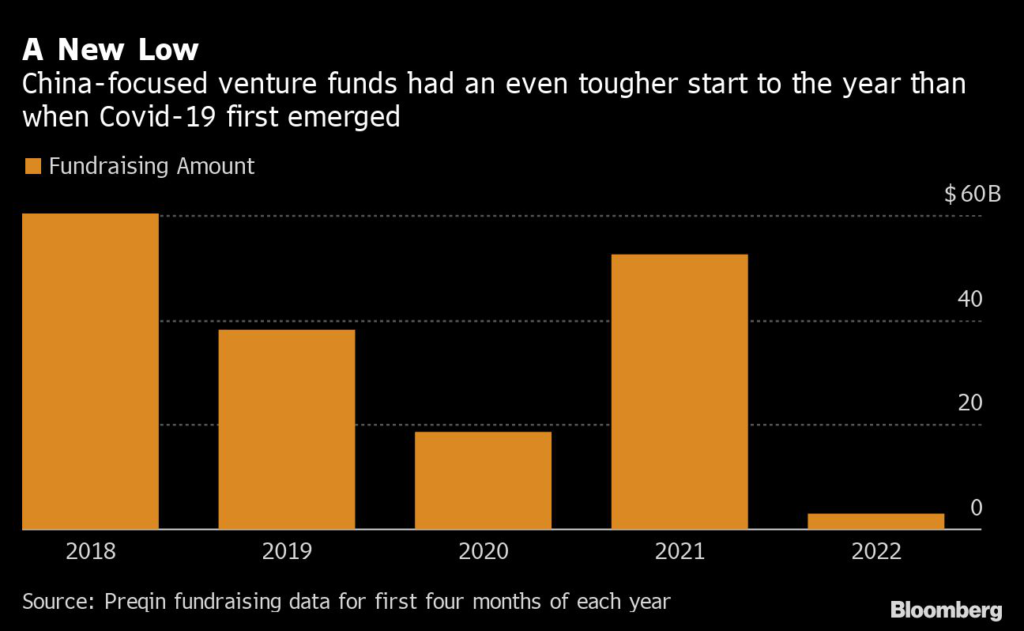
Fundraising for new ventures in the country has fallen off a cliff, mirroring the performance of its best-known tech stocks like Alibaba Group Holding Ltd. and Tencent Holdings Ltd., which have been in the crosshairs of a wide-ranging Beijing crackdown on internet firms. Venture capital and private equity funds raised $3 billion in the first four months of 2022, marking a decline of more than 90% compared to a year ago, according to estimates from industry data provider Preqin.

Markets all over the world are going through a painful rethink about the lofty valuations they’ve put on tech stocks, and China is leading the way with a decline in VC deals this year that’s nearly four times the pace of the global slide, Preqin’s figures showed.

As a frontline fundraiser, Bao has witnessed a pullback from many US and European investors. But at the same time, he sees emerging markets increasingly stepping in to fill the void for China-focused private equity investors.

“Western LPs are investing in China primarily for financial returns but LPs from emerging markets, sovereign funds in particular, have a different mandate,” Bao said, pointing to the desire to strengthen a country’s domestic economy through outward investment.

“We could act as a bridge and help export China’s knowhow, expertise and talents to emerging markets and help LPs there to develop their digital economy,” said Bao, who is visiting Dubai this week.

China Renaissance managed 48.9 billion yuan ($7.3 billion) across its ten private equity funds as of December 2021, according to its most recent filing. Some of his portfolio companies, such as Shenzhen-based MGI Tech, which provides advanced gene-sequencing solutions to health care companies, could use the Middle East as its launchpad for going global, Bao said.

He has also backed companies that provide smart industrial technology used in supply chains, contracts and transactions — advanced manufacturing is another area of interest for many in Southeast Asia, for instance.

China Is Leading the Global Contraction in Venture Capital Deals

Bao’s ability to connect rising Chinese companies with investors in emerging markets may hold the key for his team to fend off competition from the likes of KKR & Co. and Tiger Global Management, which in recent years are also increasingly turning to deep-pocketed Middle East investors for funding.

Bao’s sales pitch appears to be resonating with regional funders. From a total of $800 million raised as of early 2022 for his Huaxing Growth Capital Fund IV, 60% of that came from Asian investors including those from the Middle East, while American investors chipped in only 2%, according to China Renaissance.

At home, Bao sees good opportunity in sectors that align with Beijing’s long-term tech ambition, such as manufacturing automation and so-called deep tech, businesses that will help resolve the supply chain bottlenecks that gripped the world for much of the past two years. It’s a tricky market to navigate, with Beijing reining in internet companies and Washington threatening to expel more than 200 US-listed Chinese firms.

But if you believe China’s economy will eventually regain momentum and strength, now is a good time to invest in its companies, according to Bao.

“The uglier the market, the more attractive the opportunities it yields for investors, unless you truly believe China is uninvestable,” he said.

More stories like this are available on bloomberg.com

©2022 Bloomberg L.P.

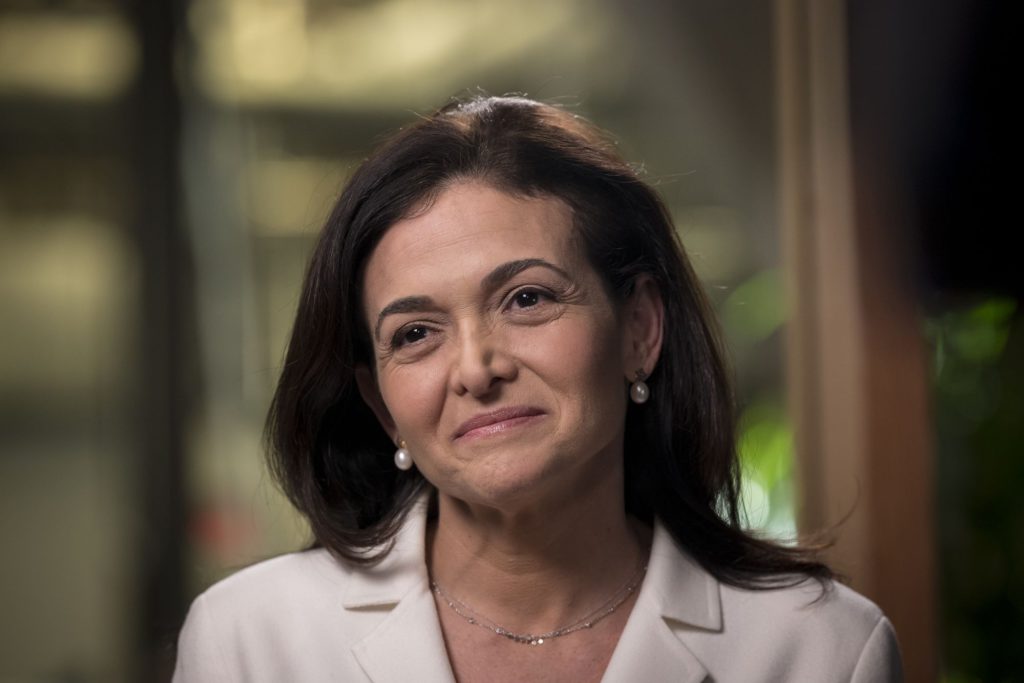
Sheryl Sandberg Stepping Down as Meta’s COO After 14 Years

(Bloomberg) — Meta Platforms Inc.’s Sheryl Sandberg, who became one of the most recognized figures in global business after helping Facebook transform from a startup into a multibillion-dollar advertising powerhouse, is stepping down as chief operating officer.

Sandberg, 52, will remain on the board of Meta, the parent company of Facebook, Instagram and WhatsApp, according to a post on the social network Wednesday. Javier Olivan, who has led the company’s growth efforts for years, will take Sandberg’s place as COO when she formally leaves in the fall.

Sandberg joined Facebook in 2008 and was key to turning it into a social media giant that generated almost $120 billion in revenue last year. Along the way, she became an influential author — publishing “Lean In” in 2013 — and served as the highest-profile face of the company next to Chief Executive Officer Mark Zuckerberg. Alongside him, she championed Facebook’s business culture of growing quickly and fixing problems later, leading to multiple public scandals over lapses in privacy and content moderation. Sandberg spent years trying to improve Facebook’s relationship with the public and regulators.

In an interview with Bloomberg, Sandberg called her time at Meta the “honor and privilege of a lifetime,” but joked that it’s also “not the most manageable job anyone has ever had.”

“It’s a decision I didn’t come to lightly, but it’s been 14 years,” she said on Wednesday. “I want to make more room to do more philanthropically, to do more with my foundation.”

Shares of Meta slipped 2.6% to $188.64 at the close in New York. The stock has declined 44% this year, steeper than the 23% drop in the Nasdaq Composite Index.

Formerly at Google, Sandberg joined the then-fledgling Facebook to oversee all its business functions — ads, partnerships, business development and operations — so that Zuckerberg could focus on products. Meta, as the company became known in a rebranding last year, now has four products with more than 1 billion users, and its advertising business generated $27 billion in sales in the first quarter.

What Bloomberg Intelligence Says:

“Sandberg’s abrupt exit, along with the cyclical downturn in ads and almost $10 billion in annual operating losses around the Reality Labs segment, will likely stoke more uncertainty over the company’s business model and free cash flow.”

— Mandeep Singh, BI senior technology industry analyst

Click here to read the research.

Sandberg said she’s planning to get married this summer and hopes to spend more time with her kids and soon-to-be stepchildren. She also plans to work on advocacy for women’s issues — a focus of her Lean In foundation — and other philanthropy.

She said that taking another job in business or in politics was “pretty unlikely,” but added, “I learned a long time ago: Never make any predictions about the future.”

Meta’s policy and advertising organizations have been at the center of many of its scandals over the years, including the company’s role in the 2016 U.S. election and the handling of data policies related to Cambridge Analytica.

Over the years, Sandberg has made fewer public appearances on behalf of the company, primarily speaking about Meta’s efforts for small businesses, and focusing on the Lean In organization. Parts of her role have already been passed on. Former UK Deputy Prime Minister Nick Clegg, for example, received a big promotion earlier this year, formally taking over some of the company’s policy duties that Sandberg used to oversee.

A Meta spokeswoman said that Sandberg’s decision has nothing to do with a recent investigation into whether she used Meta resources to try and quash a news story about her former boyfriend. The spokeswoman added that the investigation is over and has been resolved.

Sandberg is departing as Meta shifts its focus to products that enable the virtual reality-driven metaverse, which require a significant evolution of its business model. “The metaverse will be a place where businesses and consumers connect,” she said. “The exact form that takes is something that will be figured out over the next number of years, much longer-term.”

She said that she made the decision to leave the company last weekend and told Zuckerberg of her plans then. The two executives have become close friends over the years.

“She has taught me so much and she has been there for many of the important moments in my life, both personally and professionally,” Zuckerberg, 38, wrote in his own Facebook post, adding that Sandberg “supported me and Priscilla as we navigated challenges having children.”

“Our partnership has always been deeper than just business,” he said.

(Updates with comment from interview, closing share price in sixth paragraph.)

More stories like this are available on bloomberg.com

©2022 Bloomberg L.P.

HPE Cuts Full-Year Profit Forecast on Currency, Supply Chain and Russia

(Bloomberg) — Hewlett Packard Enterprise Co. declined about 6% in extended trading after lowering its full-year profit forecast, citing unfavorable currency movements, supply chain disruptions and the impact of exiting the Russian market.

Profit, excluding some items, will be as much as $2.10 a share in the fiscal year, which is seven cents a share less than the previous guidance issued in March. Earnings in the current period, which ends in July, will be 44 cents to 54 cents a share, the Spring, Texas-based company said Wednesday in a statement.

While earnings were affected by supply chain challenges and the costs of pulling out of Russia in the aftermath of the invasion of Ukraine, customer demand remains strong, Chief Executive Office Antonio Neri said in an interview. “We have an amazing high-quality backlog that is firm,” Neri said.

HPE is trying to reduce its reliance on sales of hardware such as data-center servers by encouraging customers to pay for additional services with subscriptions. The company said its annualized revenue run-rate, which reflects future payments under the subscription software-as-a-service model, jumped 25% to $829 million. Revenue from HPE’s Intelligent Edge service grew 8% to $867 million, about half the growth rate during the same quarter last year and less than analysts anticipated. 

Fiscal second-quarter revenue was $6.71 billion, little changed from the period a year ago, and shy of analysts’ average estimate of $6.8 billion. Profit, excluding some items, was 44 cents a share, compared with the average projection of 45 cents.

Revenue from HPE’s Intelligent Edge service grew 8% to $867 million, less than analysts’ anticipated and about half the growth rate during the quarter a year earlier. The unit, which is a key part of HPE’s transformation, covers products that let companies gather and process data where it is generated instead of sending it to an external storage center.

In February, HPE said it stopped all shipments and sales to Russia and Belarus, which cost $126 million in the second quarter. The company said it now has decided to end all operations in the countries, which will result in non-material charges in the current period.

Supply chains continued to restrict the company’s ability to meet demand, particularly with lockdowns in the Chinese cities of Shenzen and Shanghai, Neri said. He estimates that China’s lockdowns combined with the impact from Russia cost the firm $250 million during the quarter.

Neri added that a strong U.S. dollar weighed on earnings, since a majority of HPE’s business is generated by international sales. Earlier this month, the Bloomberg dollar index hit its highest point since the early days of the pandemic, and remains elevated. 

The stock fell as low as $14.50 in extended trading after closing at $15.78 in New York. The shares gained just less than 1% this year. 

More stories like this are available on bloomberg.com

©2022 Bloomberg L.P.

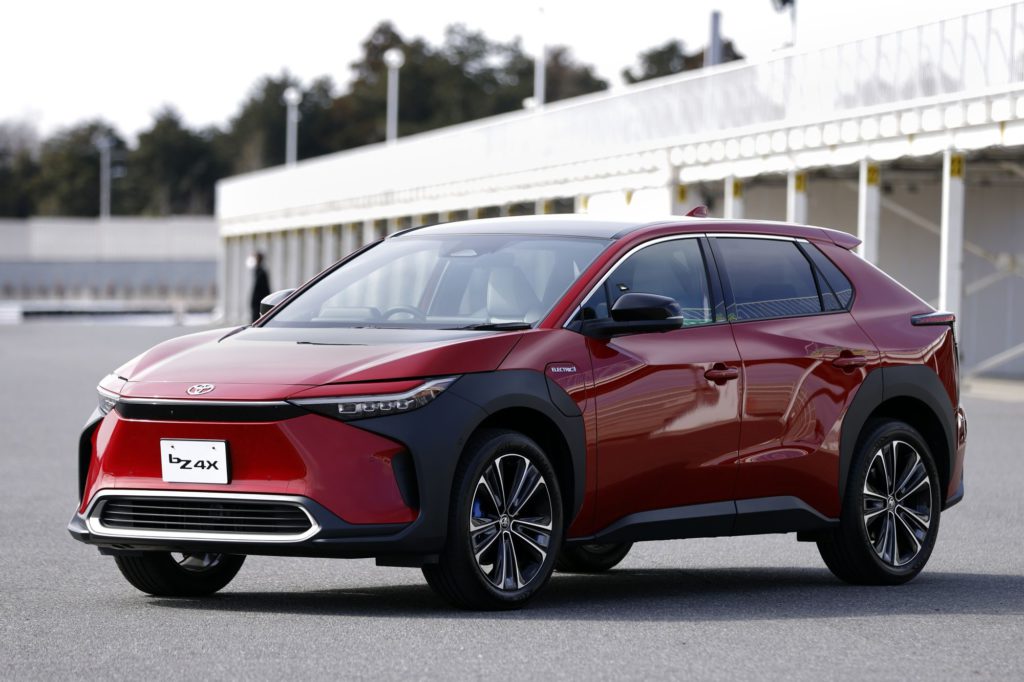
Supply Snags Threaten EV Revolution, Top Toyota Scientist Says

(Bloomberg) — Surging battery prices and shortages of metals and materials are likely to last for some time, Toyota Motor Corp.’s chief scientist warned, trends that could weigh on the world’s embrace of electric vehicles.

The shift to EVs over the past decade has been driven by steadily falling battery prices, a dynamic that’s enabled plug-in vehicles to travel longer at costs approaching those of gasoline-powered cars. Now, manufacturers are running low on supplies of lithium, nickel and other key battery inputs, with trade frictions and the war in Ukraine exacerbating issues and forcing prices higher.

It’s not just these gyrations, Gill Pratt said in a recent interview at the Toyota Research Institute in Los Altos, California. The question is whether the industry has “invested the right amounts in different parts of the supply chain to make this change so fast,” said Pratt, TRI’s founding chief executive officer.

Over the past few months, automakers pushing forward with aggressive plans for EV roll-outs have been sounding alarm bells about impending shortages and an unprecedented rise in the cost of materials used to manufacture batteries. Higher inputs have pushed carmakers from Tesla Inc. to BYD Co. to hike vehicle prices.

In some respects, “the world has thought about this in too simple of a way,” Pratt said of the industry’s rapid shift to EVs. Taking into account various automaker and energy sector timelines, “you do come up against hard limits,” he said. 

“There’s going to be this crunch, not enough materials,” Pratt warned, adding that conditions are likely to remain “hard” in the near- and mid-term.

Pratt, a former Massachusetts Institute of Technology professor and well-known roboticist, was picked by Toyota President Akio Toyoda in 2016 to lead the Toyota Research Institute, a US-based group working on automated driving, robotics and artificial intelligence. Pratt has also taken on the role of ambassador, communicating Toyota’s thinking and strategies to global audiences and relaying information back to headquarters in Japan.

On top of rising battery costs, new uncertainties are emerging over how quickly and widely EVs will spread. With the economies of the world’s two biggest automobile markets — the US and China — under strain, there are signals that EVs, expensive already, may be drifting further out of reach for average consumers. 

With gas prices surging globally, “we haven’t yet seen any broad slowdown in EV sales,” said Kota Yuzawa, head of Asia auto research at Goldman Sachs Group Inc. But “there is fear that this month EV prices might go up again,” he said. 

For now, the base case for EV sales remains unchanged, but green inflation — a term for the sharp rise in energy transition-related prices — could put “negative downward pressure on EV penetration,” Yuzawa said.

According to data from Cox Automotive, the average transaction price for a new EV in the US climbed to more than $65,000 in April, up 16% from a year earlier. That outpaced gains in total new vehicle prices over the same period and placed EVs squarely in the same price bracket as luxury cars. 

Raw-material costs may yet drive prices higher. The International Energy Agency forecasts that, after more than a decade of declines, battery packs could become 15% more expensive this year. While a flood of new models are underpinning EV sales at the moment, “ensuring future growth will demand greater efforts to diversify battery manufacturing and critical mineral supplies to reduce the risks of bottlenecks and price rises,” according to a recent IEA report.

“That’s what I’m worried about the most,” Pratt said. “If prices go up, and the amount of money people have may not keep up.” 

Read more: Volkswagen, Toyota Pledge Billions in Bid to Dethrone Elon Musk

Even so, BloombergNEF’s 2022 EV outlook released Wednesday estimates that plug-in passenger vehicle sales will more than triple to 20.6 million in 2025, much higher than the 14 million it was forecasting just a year ago.

At the same time, BNEF warns that raw-material supply constraints are set to push back the point in time at which EVs reach price parity with combustion vehicles. There’s also a widening gap between wealthy and emerging economies’ EV adoption rates, suggesting the transition may “not be an equitable one,” according to the outlook.

While the industry builds out stable battery supply chains, a logical interim step is hybrid technology, according to Pratt. Hybrids are more efficient than traditional cars, though they still run on gasoline. They’re cheaper than all-electric models and are fitted with smaller batteries that require fewer raw materials.

Along with EVs, Toyota is continuing to invest heavily in hybrids, seeking to spread its bets and bide time as battery supply chains mature. The Japanese automaker’s relatively small number of pure-EV sales has fueled criticism that it’s been dragging its feet amid the EV revolution. 

Stung by those critiques, Toyota unveiled a 4 trillion yen ($31.4 billion) investment in EVs in December to make clear that it’s serious about the shift, even if it has a different timeline and path in mind.

For now, Toyota’s strategy to move cautiously into EVs while wagering on hybrids appears to be paying off. Toyota overtook General Motors Co. in the last three months of 2021 as the No. 1 automobile seller in the US and retained its crown in early 2022 as soaring gas prices pushed consumers to flock to hybrids as an affordable, more fuel-efficient option.

Toyota’s idea is to not “have perfect be the enemy of good,” Pratt said. That, he said, means giving consumers vehicles that produce less carbon emissions “but that they can afford.” 

More stories like this are available on bloomberg.com

©2022 Bloomberg L.P.

Close Bitnami banner
Bitnami