
Bloomberg

China Green Finance Pioneer Sees Loan Slowdown as Economy Stalls

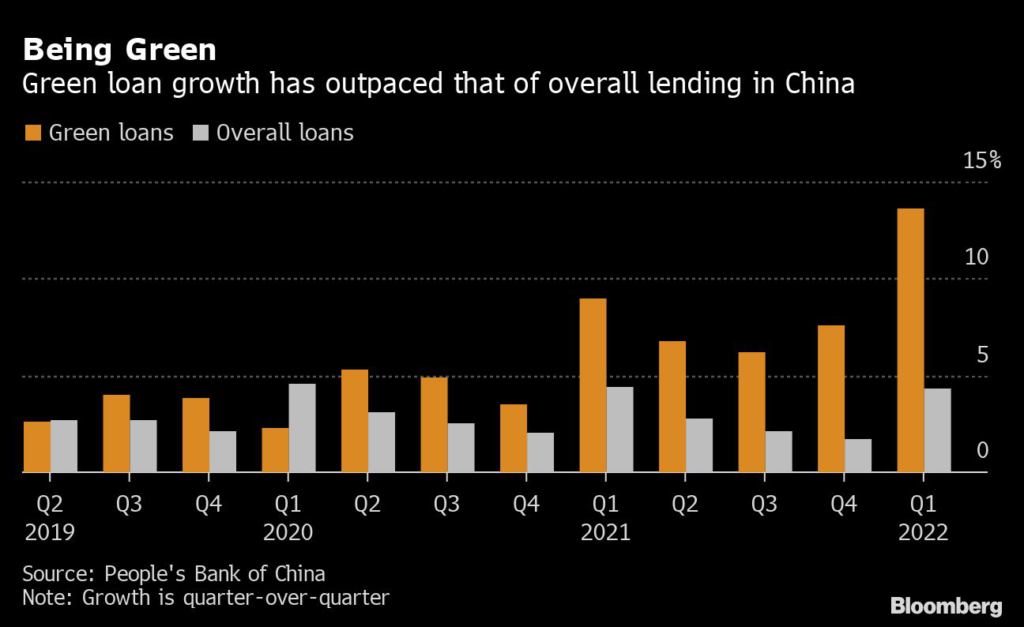
(Bloomberg) — Demand for green loans in China is poised to slow alongside the rest of the economy after growing three times faster than the overall market in the first quarter, according to the lender that helped pioneer green finance.

Industrial Bank Co., one of the first firms in China to start a green lending business in 2006, sees demand weakening as economic growth and confidence stall. That could put a dent in green loan issuance, which has outpaced overall lending in recent years and was especially strong at the start of 2022. 

“The situation domestically and internationally has become more uncertain, and economic development is facing multiple pressures,” said Li Li, the deputy general manager of the Fuzhou-based bank’s green finance department, in a written response. “The weak credit demand has impacted the promotion of our green finance business.”

China, the world’s largest polluter, has made an ambitious pledge to peak carbon emissions by 2030 and to be carbon neutral by 2060. Reaching those goals will mean leaning heavily on its banking system to back green projects and businesses that will contribute to the transition from carbon-intensive practices.

Green and ESG-related lending has benefited Chinese banks. In the first quarter, the amount of green loans grew 14% from the previous quarter, much faster than the 4.3% growth in overall loans, according to central bank data. Growth surged 39% year-on-year in the first three months.

As part of the green push, Chinese companies are issuing sustainable debt at a record pace — topping all other countries, and up 81% through May 25 compared with the same period last year, according to Bloomberg data. Chinese banks also top the Asia-Pacific leader board for green bond underwriting this year. 

Still, in the near term, it’s likely “the economic downturn has weakened corporate investment plans and reduced demand for green project financing,” said Effie Xin, a managing partner at EY Greater China Financial Services.

China has been promoting green lending for years, and often touts itself as the biggest green credit market in the world with 18.1 trillion yuan ($2.7 trillion) in green loans outstanding at the end of March. Some researchers have challenged that designation as comparable data on green loans isn’t always available in other countries. 

Green loans currently make up about a 10th of the loan portfolios at Industrial Bank and some of China’s largest state-owned banks. That may not be enough to make a meaningful impact to fight climate change considering the large role that bank financing plays in driving policy, according to Mathias Lund Larsen, a PhD fellow at Copenhagen Business School who focuses on governance of China’s green finance system. Ideally, green loans as a proportion of the total should be double that amount, he said.

Another challenge amid the slowdown is the tendency to increase lending to infrastructure projects like roads and bridges — which can boost the economy but aren’t environmentally friendly, Larsen said. Already this year, Chinese banks’ have helped finance coal companies at a faster pace than last year.

“Unfortunately, the research on the greenness of Chinese stimulus packages in the past has been that they have a very low green focus,” Larsen said. 

Industrial Bank meanwhile still aims to expand its green portfolio this year by 150 billion yuan, or about 33%, Li said. China’s eighth-biggest bank by assets signed off on about 65 billion yuan in new green loans in the first quarter, about 43% of its annual target, according to an earnings report. 

To hit the goal amid the sluggish outlook, Li said the bank will focus on adding new customers with the help of existing green clients and on lending to segments like solar, wind and hydropower. The bank will also target rural areas, as the government looks to bring more renewable energy to the countryside.


More stories like this are available on bloomberg.com

©2022 Bloomberg L.P.
GameStop Sales Beat Estimates With Shift to Crypto and NFTs

(Bloomberg) — GameStop Corp. reported mixed results in the first quarter as the gaming retailer shifts to cryptocurrencies and nonfungible tokens.

Net sales rose 8% to $1.38 billion in the three months ended April 30, the company reported in a statement on Wednesday, better than the $1.33 billion analysts estimated. But the company also reported its net loss more than doubled to $157.9 million. The adjusted loss of $2.08 per share, missed analysts’ average estimate for a loss of $1.16, according to data compiled by Bloomberg. Shares initially rose as much as 9% in extended trading before giving up those gains.

Ryan Cohen, who joined the board and became chairman last year, has been trying to revive growth at beleaguered GameStop, which has slowed as gamers shifted from buying game discs to digital downloads. The company became the poster child for so-called meme stocks, seeing volatile swings in the stock price over the last year that have little to do with its business fundamentals. 

Cohen hasn’t said much publicly about his plans to push GameStop into the volatile world of cryptocurrencies, but earlier this month the company launched a digital asset wallet that will allow gamers to store, send and receive cryptocurrencies and NFTs without leaving their web browser. The wallet will be used in GameStop’s new NFT marketplace, expected to launch in the current quarter.   

Analysts aren’t fully convinced that the company, which has struggled to transition from a brick-and-mortar game retail store, will become a leader in the NFT market. The recent selloff in cryptocurrencies hasn’t helped the picture for GameStop’s new initiatives.

“Our skepticism is rooted in its lack of presence in mobile, control by larger peers over their respective mobile and console walled gardens, and the fact that GameStop has only begun to attempt to penetrate the PC market, where the NFT competitive landscape is more open,” Michael Pachter, an analyst at Wedbush Securities, wrote in a note to clients before the results were released.

The shares are down about 52% in the past year, compared with about a 2% decline in the S&P 500 Index. 

GameStop has suffered from a combination of supply chain issues and an opaque business strategy. Over the last several years, it has churned through a variety of business concepts with mixed reactions from investors and customers. Under Cohen, the company has been expanding its offerings, improving logistics and making a series of new hires with e-commerce and technology experience. That includes Chief Executive Officer Matt Furlong, who came from Amazon.com Inc. where he managed the Australia business, and Nir Patel, who was named chief operating officer. 

GameStop said inventory was $917 million at the close of the quarter, compared with $570.9 million a year earlier, reflecting an improvement in levels of merchandise in stock “to meet increased customer demand and offset supply chain” challenges.


More stories like this are available on bloomberg.com

©2022 Bloomberg L.P.
Oracle Wins Regulatory Approvals for $28 Billion Cerner Takeover

(Bloomberg) — Oracle Corp. said it has received all regulatory clearances needed to complete its $28.3 billion purchase of digital medical-records provider Cerner Corp., paving a further expansion into health care for the software giant.

“Cerner and Oracle have the capability to transform health care delivery by providing medical professionals with a new generation of health care information systems,“ Larry Ellison, Oracle chairman and chief technology officer, said Wednesday in a statement. 

Oracle expects to close the deal on June 6 after the completion of its $95-a-share tender offer to Cerner investors. Ellison is scheduled June 9 to discuss the acquisition and Oracle’s cloud-based health services, the company said in the statement.

The acquisition, announced last December, will be “substantially accretive” to Oracle’s earnings in fiscal year 2023, and a “growth engine for years to come,” said Oracle Chief Executive Officer Safra Catz.

Oracle, the second-biggest software maker by revenue, is best known for legacy database products. The company has struggled in recent years to gain ground in cloud computing, in which companies rent data storage and analytic power from large server centers, trailing far behind market leaders Amazon.com Inc. and Microsoft Corp. The acquisition of Cerner gives Oracle a huge foothold in technology for the health care industry.

More stories like this are available on bloomberg.com

©2022 Bloomberg L.P.

Stocks Decline as Data Show a Still-Hot Economy: Markets Wrap

(Bloomberg) — US equities started the month lower after a strong set of data suggested the Federal Reserve has not yet slowed growth enough to tamp down inflation, while JPMorgan Chase & Co.’s Jamie Dimon warned restrictive policies threaten to tip the economy into recession.

The S&P 500 fell 0.8% as data showed an unexpected advance in US manufacturing activity as well as exceptionally high job openings, fueling concern the Fed will need to get more restrictive to slow runaway price gains. Financial firms in the index slid 1.7% after Dimon said private borrowers may be stranded as conditions tighten. 

The yield on 10-year Treasuries spiked higher as traders raised bets on the path for rate hikes. Oil rose ahead of an OPEC+ meeting to discuss supply policy. And tech shares outperformed, led by a 10% surge in Salesforce Inc. The business-software giant jumped the most in nearly two years after raising its forecast in a sign demand remains robust.

The strong data landed in a market where investors are on edge over whether the Fed’s tighter policies will induce a recession, a sentiment underscored by Dimon’s comments. The central bank has twice raised rates since March and signaled it will enact two additional 50 basis-point increases at its next meetings. 

While some economic data have started to slow, according to the Fed’s Biege Book, others remain robust enough that investors now see the chances growing for a third 50-point increase. St. Louis Fed President James Bullard urged policy makers on Wednesday to raise interest rates aggressively followed by cuts later.

“We now find ourselves in a little bit more no man’s land,” Greg Boutle, US head of equity and derivative strategy at BNP Paribas, said on Bloomberg TV. “We are in this kind of a bear market environment yet we haven’t seen recession manifest in a macro data yet. So we still think there is a path for the US economy to have a soft rather than a hard landing.”

Citigroup Inc. strategists said that after a difficult first five months of 2022, the pain may not be over yet for global equity markets. The prospect of downward revisions to earnings estimates is the latest headwind to face stock investors, already rattled by runaway inflation and the potential impact of central-bank tightening aimed at controlling it, the strategists led by Jamie Fahy wrote in a note.

Among individual stock moves, ChargePoint Holdings Inc. slipped as analysts noted that the EV charging network firm’s margins came under pressure due to rising costs and supply-chain disruption. Delta Air Lines Inc. also fell after raising its revenue outlook but warned it likely won’t grow capacity through the year’s end.

Europe’s Stoxx 600 Index extended declines in the wake of euro-zone figures Tuesday that showed a record jump in consumer prices, strengthening the case for the European Central Bank to lift interest rates. Meanwhile, in the US, Treasury Secretary Janet Yellen gave her most direct admission yet that she made an incorrect call last year in predicting that elevated inflation wouldn’t pose a continuing problem.

“Big picture, the market has priced in an economic slowdown but not a recession,” Ned Davis Research strategists Ed Clissold and Thanh Nguyen said in a note. “The timing and magnitude of any Fed pivot is the biggest factor in determining whether the rally can continue deep into the second half of the year. Another hurdle for the market is that earnings estimates appear vulnerable to further downward revisions.”


How will markets be affected by the Fed’s quantitative tightening? QT officially starts Wednesday and is the theme of this week’s MLIV Pulse survey. Click here to participate anonymously.

Here are some key events to watch this week:

  • Cleveland Fed President Loretta Mester discusses the economic outlook Thursday
  • US May employment report Friday
  • The UN’s Food and Agriculture Organization releases its monthly food price index at a time of maximum concern about global supplies on Friday

Some of the main moves in markets:

Stocks

  • The S&P 500 fell 0.7% as of 4:01 p.m. New York time
  • The Nasdaq 100 fell 0.7%
  • The Dow Jones Industrial Average fell 0.5%
  • The MSCI World index fell 0.8%

Currencies

  • The Bloomberg Dollar Spot Index rose 0.6%
  • The euro fell 0.7% to $1.0654
  • The British pound fell 0.9% to $1.2485
  • The Japanese yen fell 1.2% to 130.18 per dollar

Bonds

  • The yield on 10-year Treasuries advanced eight basis points to 2.93%
  • Germany’s 10-year yield advanced six basis points to 1.19%
  • Britain’s 10-year yield advanced five basis points to 2.16%

Commodities

  • West Texas Intermediate crude rose 0.2% to $114.95 a barrel
  • Gold futures rose 0.1% to $1,850.60 an ounce

More stories like this are available on bloomberg.com

©2022 Bloomberg L.P.

Scholz Touts Latest Ukraine Arms Delivery After Criticism

(Bloomberg) — Chancellor Olaf Scholz announced that Germany will supply Ukraine with IRIS-T guided missiles as he pushed back against persistent criticism that the government in Berlin is dragging its feet on sending heavy weaponry.

“In the coming weeks we will continue to deliver weapons,” Scholz said Wednesday in an address to the lower house of parliament. Germany will also send four systems of the multi-rocket launcher MARS II from its own military stocks to Ukraine, in coordination with a US plan to send a similar system, according to a German official who asked not to be named because the plans aren’t public. 

The IRIS-T guided missiles, manufactured by Ueberlingen, Germany-based Diehl Defence, are “the most modern air-defense system that Germany has,” Scholz said, adding that it’s capable of protecting major cities from attack. He did not specify the number of missiles, while Foreign Minister Annalena Baerbock said in a separate address later Wednesday it would take “months” for the missiles to be delivered due to the advanced nature of the technology.

“It was actually supposed to go to another country but we stepped in and arranged for them to do without it and for it to go to Ukraine,” Baerbock said. “It needs these medium and long-term signals that show we haven’t given up on Ukraine in three months but will defend it according to our means without getting directly involved ourselves.”

The announcement won praise from Andrij Melnyk, the country’s ambassador to Germany, an outspoken critic of Germany’s response to the war and prior relationship with Russia. “This is a real breakthrough for us,” Melnyk said in an interview with WirtschaftsWoche.

Ukraine expects the first IRIS-T delivery in October and could obtain a further 11 systems at short notice, the German magazine cited Melnyk as saying. Each system costs 140 million euros ($149.2 million), he told the magazine.

Following Russia’s invasion of Ukraine, Germany reversed a long-standing policy of not sending arms to conflict zones. Scholz’s ruling coalition agreed to supply the government in Kyiv with weapons including anti-tank rocket launchers, Stinger anti-aircraft missiles, Strela surface-to-air missiles, anti-tank mines, machine guns, hand grenades and ammunition.

Amid intense pressure to do more, and match shipments of heavier weapons organized by some allies, the government also agreed to send seven self-propelled, armored howitzers and 50 Gepard anti-aircraft armored vehicles. However, apparent delivery delays prompted Ukrainian Foreign Minister Dmytro Kuleba to direct more sharp criticism at Germany as recently as Monday.

“There are countries we are waiting for to deliver and countries we are tired of waiting for,” Kuleba said in an interview with Italy’s la Repubblica newspaper. “Germany belongs to the second group.”

Defense Minister Christine Lambrecht justified the delay by saying that Ukrainian soldiers need 40 days of training to use the howitzers, while the vehicles aren’t yet in condition to be sent.

Germany is working with several eastern European countries, including the Czech Republic, on swap deals under which those states send Soviet-era equipment to Ukraine. Germany then pays for the delivery of modern replacement tanks.

Scholz told lawmakers Wednesday that the government in Prague will send 20 T-72 tanks to Ukraine to be replaced by Germany and talks on further deliveries are continuing. Germany will also provide Ukraine with a radar system capable of detecting artillery, he said.

He referred to an agreement with Greece announced this week under which the government in Athens will send Ukraine BMP-1 infantry fighting vehicles that the country took delivery of in 1994. Greece will get Marder fighting vehicles from Germany in return, the Greek defense ministry said.

According to Scholz, additional weapons Germany will provide include:

  • 12 self-propelled armored artillery systems in conjunction with the Netherlands
  • 54 armored personnel carriers together with Denmark

(Updates with rocket launchers in the second, Ukrainian ambassador comment in fifth paragraph)

More stories like this are available on bloomberg.com

©2022 Bloomberg L.P.

Stocks Pare Loss as Data Show a Still-Hot Economy: Markets Wrap

(Bloomberg) — US equities started the month modestly lower after a strong set of data suggested the Federal Reserve has not yet slowed growth enough to tamp down inflation, while JPMorgan Chase & Co.’s Jamie Dimon warned restrictive policies threaten to tip the economy into recession.

The S&P 500 fell 0.2% after declining as much as 1.4% as data showed an unexpected advance in US manufacturing activity as well as exceptionally high job openings, fueling concern the Fed will need to get more restrictive to slow runaway price gains. Financial firms in the index plunged as much as 2.5% after Dimon said private borrowers may be stranded as conditions tighten. 

The yield on 10-year Treasuries spiked higher as traders raised bets on the path for rate hikes. Oil rose ahead of an OPEC+ meeting to discuss supply policy. And tech shares outperformed, led by a 11% surge in Salesforce Inc. The business-software giant jumped the most in nearly two years after raising its forecast in a sign demand remains robust.

The strong data landed in a market where investors are on edge over whether the Fed’s tighter policies will induce a recession, a sentiment underscored by Dimon’s comments. The central bank has twice raised rates since March and signaled it will enact two additional 50 basis-point increases at its next meetings. While some economic data have started to slow, others remain robust enough that investors now see the chances growing for a third 50-point increase. St. Louis Fed President James Bullard urged policy makers on Wednesday to raise interest rates aggressively followed by cuts later.

“We now find ourselves in a little bit more no man’s land,” Greg Boutle, US head of equity and derivative strategy at BNP Paribas, said on Bloomberg TV. “We are in this kind of a bear market environment yet we haven’t seen recession manifest in a macro data yet. So we still think there is a path for the US economy to have a soft rather than a hard landing.”

Citigroup Inc. strategists said that after a difficult first five months of 2022, the pain may not be over yet for global equity markets. The prospect of downward revisions to earnings estimates is the latest headwind to face stock investors, already rattled by runaway inflation and the potential impact of central-bank tightening aimed at controlling it, the strategists led by Jamie Fahy wrote in a note.

Among individual stock moves, ChargePoint Holdings Inc. slipped as analysts noted that the EV charging network firm’s margins came under pressure due to rising costs and supply-chain disruption. Delta Air Lines Inc. also fell after raising its revenue outlook but warned it likely won’t grow capacity through the year’s end.

Europe’s Stoxx 600 Index extended declines in the wake of euro-zone figures Tuesday that showed a record jump in consumer prices, strengthening the case for the European Central Bank to lift interest rates. Meanwhile, in the US, Treasury Secretary Janet Yellen gave her most direct admission yet that she made an incorrect call last year in predicting that elevated inflation wouldn’t pose a continuing problem.

“Big picture, the market has priced in an economic slowdown but not a recession,” Ned Davis Research strategists Ed Clissold and Thanh Nguyen said in a note. “The timing and magnitude of any Fed pivot is the biggest factor in determining whether the rally can continue deep into the second half of the year. Another hurdle for the market is that earnings estimates appear vulnerable to further downward revisions.”


How will markets be affected by the Fed’s quantitative tightening? QT officially starts Wednesday and is the theme of this week’s MLIV Pulse survey. Click here to participate anonymously.

Here are some key events to watch this week:

  • Cleveland Fed President Loretta Mester discusses the economic outlook Thursday
  • US May employment report Friday
  • The UN’s Food and Agriculture Organization releases its monthly food price index at a time of maximum concern about global supplies on Friday

Some of the main moves in markets:

Stocks

  • The S&P 500 fell 0.2% as of 3:27 p.m. New York time
  • The Nasdaq 100 was little changed
  • The Dow Jones Industrial Average fell 0.2%
  • The MSCI World index fell 0.4%

Currencies

  • The Bloomberg Dollar Spot Index rose 0.5%
  • The euro fell 0.7% to $1.0659
  • The British pound fell 0.9% to $1.2494
  • The Japanese yen fell 1.2% to 130.17 per dollar

Bonds

  • The yield on 10-year Treasuries advanced nine basis points to 2.94%
  • Germany’s 10-year yield advanced six basis points to 1.19%
  • Britain’s 10-year yield advanced five basis points to 2.16%

Commodities

  • West Texas Intermediate crude rose 0.5% to $115.25 a barrel
  • Gold futures rose 0.2% to $1,851.90 an ounce

More stories like this are available on bloomberg.com

©2022 Bloomberg L.P.
Elon Musk’s Demand Staffers Stop ‘Phoning It in’ May Cost Him Talent

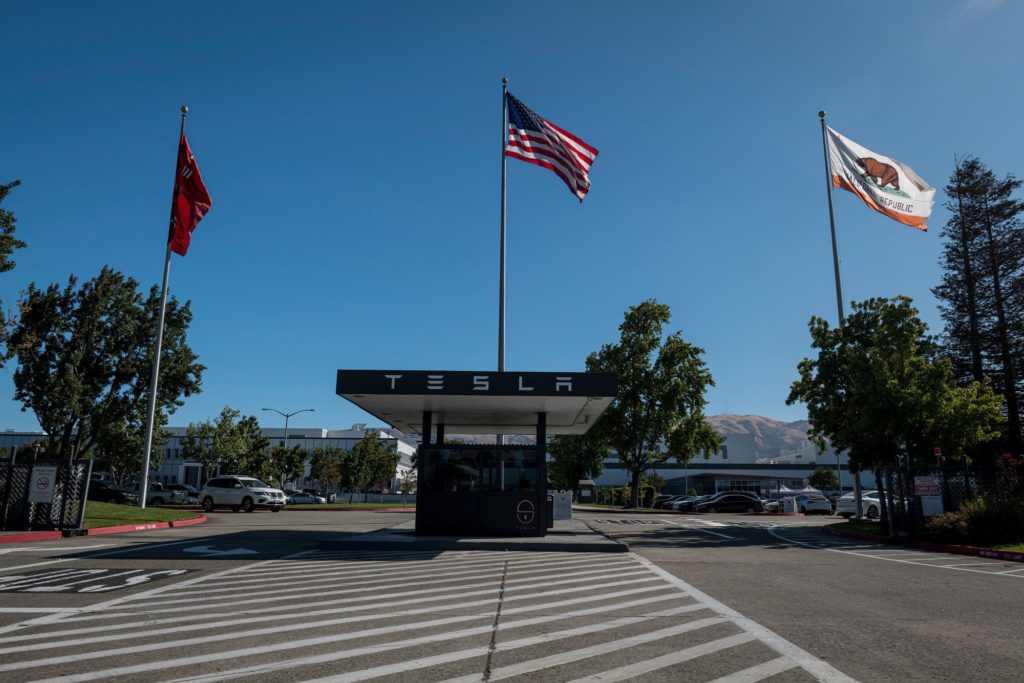
(Bloomberg) — Elon Musk’s demand that Tesla Inc. staff stop “phoning it in” and get back to the office has thrust the world’s richest person into the noisy debate over the future of work, and shows again that some CEOs remain tone-deaf to employees’ growing demands for flexibility.

“Everyone at Tesla is required to spend a minimum of 40 hours in the office per week,” Musk wrote in a message addressed to employees at the electric-car maker. That “must be where your actual colleagues are located, not some remote pseudo office. If you don’t show up, we will assume you have resigned. The more senior you are, the more visible must be your presence.” 

But that mandate might not be acceptable to some at Tesla, and will certainly spook staffers at Twitter Inc., which Musk is seeking to acquire, who have enjoyed a work-from-anywhere policy throughout the pandemic. In today’s tight labor market, with salaries soaring and workers quitting at a record clip, Musk’s policy could also cost him some talent.

“Companies that demand that their employees come back to the office are likely to face a set of problems,” said Brian Kropp, head of human-resources research at Gartner Inc., a technology-consulting company. “They will either have access to a smaller talent pool or will have to pay a compensation premium to force employees to come back.”

More than two out of three so-called knowledge workers — data scientists, engineers, graphic designers — prefer hybrid work, according to an ongoing survey of more than 10,000 white-collar workers from Future Forum. The research consortium is backed by Slack Technologies, a unit of Salesforce Inc. that offers a popular workplace communications service.

Empty Offices

Just 19% of executives are working from the office five days a week, compared with 35% of nonexecs, Future Forum found. Those who are in the office full time report higher levels of stress and anxiety, and more than half would prefer to work flexibly at least part of the time.

Tesla’s chief executive officer isn’t having that. In his return-to-office memo, Musk said Tesla would have “long ago gone bankrupt” if he hadn’t “lived in the factory so much — so that those on the line could see me working alongside them.”

He also ridiculed companies with more flexible workplace policies, saying “when was the last time they shipped a great product? It’s been a while.” 

Carmakers, along with retailers and other firms with a mix of white-collar and frontline workers, walk a fine line when they extend flexibility to some employees and not to others.

The pandemic laid bare how dependent society is on the physical presence of blue-collar workers in hospitals, meatpacking plants and grocery stores. The idea of white-collar employees logging in safely at home, while lower-paid employees risked their health to show up in person, has been an added source of resentment in an already stratified U.S. economy.

Going It Alone

Musk’s office mandate contrasts with some auto-industry rivals. Ford Motor Co. in April adopted a “flexible hybrid” model where some salaried staffers mainly come in for collaborative work and otherwise work from home. General Motors Co. has a “work appropriately” strategy that lets white-collar workers log in remotely, rather than coming in every day. Mitsubishi Motors North America Inc. offers its corporate employees the option to work from home all the time.

Musk’s dismissal of remote work, which he dismissed as “pretend,” illustrates a commonly held perception among bosses that remote workers aren’t as productive, innovative or collaborative as those in the office.

Goldman Sachs Group Inc. CEO David Solomon last year called remote work an “aberration,” while Morgan Stanley CEO James Gorman expressed frustration that New Yorkers were visiting the city’s restaurants but avoiding their offices.

Research from Nicholas Bloom at Stanford University and other academics has shown that remote workers are just as productive, and typically more satisfied, than office workers.

Twitter’s Take

Musk’s ultimatum also runs counter to current policy at Twitter, which is one of the most prominent tech companies to let most employees work from home permanently. 

“If our employees are in a role and situation that enables them to work from home and they want to continue to do so forever, we will make that happen,” Twitter said last year. Half of the world’s workers do so remotely or in a hybrid setup, up from 9% prior to the Covid-19 pandemic, according to a global study of employers by Willis Towers Watson, a risk-management and human-resources firm.

“The widespread adoption of these work arrangements during the pandemic has challenged some of myths that have accompanied remote work over the years, namely that people cannot be productive working remotely, which has fed into greater openness and acceptance,” said Brad Bell, director of the Center for Advanced Human Resource Studies at Cornell University. At Tesla, though, “clearly that is not true.”

More stories like this are available on bloomberg.com

©2022 Bloomberg L.P.

Bitcoin’s Stock-Market Decoupling Proves Fleeting

(Bloomberg) — Bitcoin’s decoupling with US equities is proving to be brief with risk aversion again weighing on global asset markets. 

The largest cryptocurrency fell for the first time in five trading sessions, dropping as much as 6% to $29,878. The Nasdaq 100 Index dropped for a second straight day. Most other cryptocurrencies also declined with Ether down more than 5%, Cardano dropping about 6% and Solana slipping more than 7%. Tron was the lone bright spot among the largest digital tokens, rising more than 5%.

Traders had begun to speculate last week that cryptocurrencies such as Bitcoin would begin to decouple from risk assets as investors focused more on industry-specific catalysts.      

“The ‘decoupling’ a few days ago attributed to some large accounts liquidating Ethereum and Bitcoin,” said Teong Hng, chief executive of crypto investment firm Satori Research. “Now that those flows have subsided, the correlation kicks back again.”


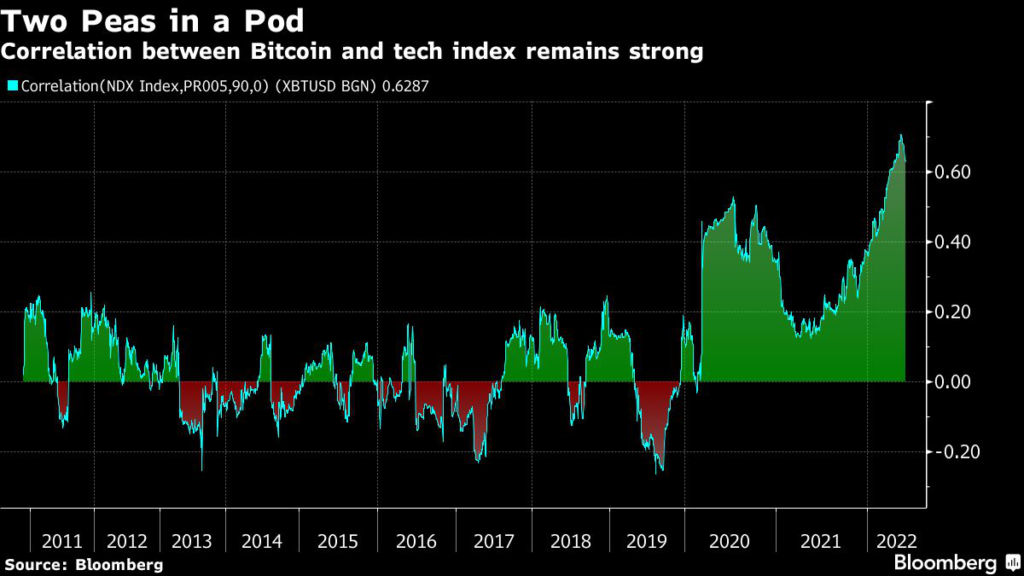
Analysts have been noting all year that cryptocurrencies and stocks have been joined at the hip when it comes to their moves. When one goes up on any given day, the other tends to follow, and vice versa. Correlations between stocks and Bitcoin have been strong, and the relationship is even more pronounced between the coin and tech stocks, which can sometimes be thought of as more speculative plays in the market. 

The 90-day correlation coefficient of Bitcoin and the tech gauge now stands above 0.68, among the highest such readings in Bloomberg data going back to 2010. A coefficient of 1 means the assets are moving in lockstep, while minus-1 would show they’re moving in opposite directions. 

Tron was the exception to Wednesday’s crypto slide. The token has rallied since controversial crypto entrepreneur Justin Sun launched his own stablecoin on his Tron network just before the collapse of the TerraUSD (UST) stablecoin last month. 


More stories like this are available on bloomberg.com

©2022 Bloomberg L.P.
Kim Kardashian to Start New Skin-Care Line With Coty

(Bloomberg) — Kim Kardashian, the celebrity and influencer, is starting a new skin-care line with Coty Inc.

SKKN by Kim will launch on a new online store, operated in tandem with Coty, on June 21, according to a statement. Initial products include a cleanser, toner, exfoliator, and several serums and creams, with prices ranging from $43 to $95.

“What began as a psoriasis diagnosis became the catalyst for my journey of skincare discoveries, inspiring me to learn more about my skin and how to care for it,” Kardashian said in the statement. 

Coty shares fell 1.9% to $6.96 at 12:39 p.m. in New York trading. 

Coty has increasingly tied its fortunes to the Kardashians as it seeks to harness their star power to give sales a boost. The company acquired a 20% stake in Kardashian’s beauty business in 2020. The $200 million deal valued her business at $1 billion. 

Coty has also done business with Kardashian’s sister, Kylie Jenner. It acquired 51% of Kylie Jenner’s beauty brands in 2020 and was involved in the relaunch of Kylie Cosmetics in July 2021.

Kardashian previously said she would rebrand her KKW Beauty and KKW Fragrance lines, which she launched in 2017 and shut down in 2021. Kardashian also co-founded the lingerie label Skims, most recently valued at $3.2 billion in January.

(Updates to add context and share trading.)

More stories like this are available on bloomberg.com

©2022 Bloomberg L.P.

Elon Musk’s Ultimatum to Tesla Execs: Return to the Office or Get Out

(Bloomberg) — The world’s richest man has had it with this whole working-from-home business.

Tesla Inc. Chief Executive Officer Elon Musk sent an email late Tuesday to “Everybody” at his electric-car company, elaborating on an earlier missive to executive staff about the need to be in the office. Employees at numerous companies, used to working from home or hybrid policies, have revolted against “RTO” policies and long commutes. 

Read More: Elon Musk’s Demand Staffers Stop ‘Phoning It in’ May Cost Him Talent

“Everyone at Tesla is required to spend a minimum of 40 hours in the office per week,” Musk wrote in an email titled “To be super clear.” “Moreover, the office must be where your actual colleagues are located, not some remote pseudo office. If you don’t show up, we will assume you have resigned.”

Bloomberg News confirmed that current Tesla employees received the email Wednesday morning. 

“The more senior you are, the more visible must be your presence,” Musk wrote. “That is why I lived in the factory so much — so that those on the line could see me working alongside them. If I had not done that, Tesla would long ago have gone bankrupt.”

Earlier, Musk sent an email to executive staff requiring that they be in “a main Tesla office, not a remote branch office unrelated to the job duties, for example being responsible for Fremont factory human relations, but having your office be in another state.”

In recent weeks, Musk has praised Tesla China employees for “burning the 3 am oil” while saying that Americans are “trying to avoid going to work at all.” 

Thousands of Tesla staff in Shanghai have been effectively locked in for months, working 12-hour shifts, six days a week. Until recently, many were sleeping on the factory floor as part of a closed-loop system meant to keep Covid out and cars rolling off the production line.

Workers brought in to bring the factory back up to speed are being shuttled between the facility and sleeping quarters — either unused factories or an old military camp — with day- and night-shift workers sharing beds in makeshift dorms.

Read more: Tesla, VW Keep Shanghai Workers Isolated Even as Lockdown Eases

When a fan on Twitter asked Musk to address people who think going into work is an antiquated concept, he replied “They should pretend to work somewhere else.” 

It’s not the first time Musk’s tough-love treatment of employees has come up.

Roughly two weeks before Musk reached a $44 billion deal to acquire Twitter Inc., Keith Rabois, a Silicon Valley venture capitalist and entrepreneur, tweeted an anecdote that speaks to his friend’s management style. At Space Exploration Technologies Corp., Musk once noticed a group of interns milling around while waiting in a line for coffee.

Musk threatened to fire them all if it happened again, and had security cameras installed to monitor compliance, according to Rabois, who knows Tesla’s founder from their days at PayPal Holdings Inc.

Employees at Twitter — one of the most prominent companies to allow permanent remote work — are “in for a rude awakening,” Rabois wrote in April. 

(Updates with Musk’s second email starting in second paragraph.)

More stories like this are available on bloomberg.com

©2022 Bloomberg L.P.

Close Bitnami banner
Bitnami