Bloomberg

Fidelity Slashes Reddit, Stripe Valuations After Tech Rout

(Bloomberg) — Fidelity Investments cut valuations for several closely held technology companies, including social media platform Reddit and payment software provider Stripe. 

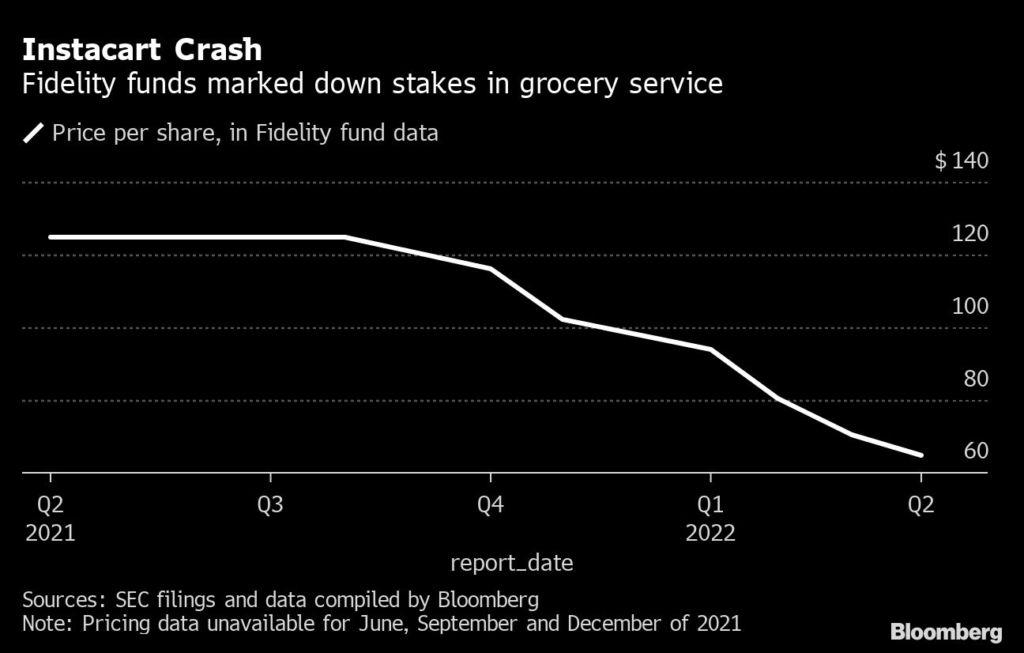
In April, Fidelity funds marked down stakes in Reddit by more than a third from the preceding month and Stripe by 13%, according to filings and data compiled by Bloomberg. Fidelity also cut valuations for TikTok owner ByteDance and for Instacart.

The changes track a broad decline in public equity markets that punished technology stocks in particular, with the Nasdaq 100 tumbling 21% through the first four months of the year. Venture-backed growth companies that debuted since the start of the pandemic lost almost half of their value, according to PitchBook data. 

The fallout could bode ill for other firms that hold stakes in the companies. Andreessen Horowitz and Sequoia Capital both backed Stripe and Reddit, PitchBook data show. Chase Coleman’s Tiger Global Management also has been among Stripe’s investors. Dan Sundheim’s D1 Capital Partners wrote down its investment in Instacart earlier this year.

Hedge Fund Hell: How the Tech Crash Is Clobbering the Tiger Cubs

Fidelity funds cut Reddit to $39.65 a share from $61.79, where they had been valued for the previous nine months. Stripe shares were reduced to $32.05 apiece, the lowest since last March. The payments firm raised $600 million that month at a valuation of $95 billion, making it the most valuable US startup. Reddit was valued at more than $10 billion as of August.

Read more: Stripe Is Said to Discuss Public Listing With Banks for 2022

Shares of Instacart were pegged at $64.85 at the end of April, down by almost half from their peak a year earlier, while Beijing-based ByteDance was reduced to $128.07, a 13% decline from the preceding month.

Mutual funds can hold a portion of their assets in private equity investments, with a cap imposed by the US Securities and Exchange Commission. Money managers have dipped into private markets as a way to pump up returns in their funds.

The holdings data of Fidelity funds as of the end of April were provided to Bloomberg. The calculated valuations of the four tech companies’ securities were then compared to the values that the fund manager ascribed to its holdings in SEC filings.

A spokeswoman for Boston-based Fidelity declined to comment.

More stories like this are available on bloomberg.com

©2022 Bloomberg L.P.

Gen Z’s Workplace Demands Force Corporate Korea to Loosen Up

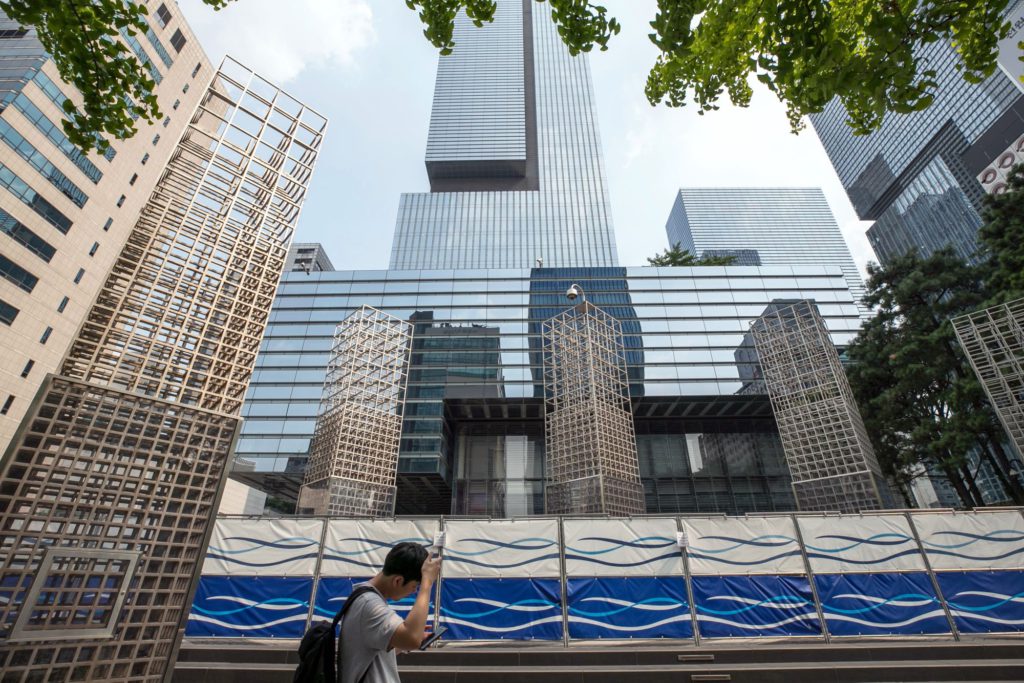
(Bloomberg) — When Jeong Da-eun started looking for work ahead of graduation, she had little interest in Samsung or Hyundai, traditionally the most popular employers in South Korea, put off by stories about their regimented work culture and emphasis on family connections. 

“I’d much prefer working for an internet company like Kakao,” said the 25 year old. 

She’s not alone. Messaging app Kakao has been the top pick of university students for two years in a row in a “dream employer” survey by career portal Job Korea, unseating Samsung and other family-run business empires that dominated such rankings for years. 

Executives of those companies have taken notice, making changes in the past year aimed at dismantling their top-down, hierarchical corporate culture. At Samsung Electronics Co., leading smartphone maker and the chaebol’s flagship business, employees are being encouraged to address each other by name rather than job titles. Hyundai and Lotte Group, both major conglomerates with interests ranging from department stores to food, recently stopped asking job applicants details about their family background. 

“The young leaders at these family-controlled conglomerates are facing trends that require them to be more flexible and open-minded,” said Park Ju-gun, head of corporate research at Leaders Index, a chaebol-focused research firm.

While many students are still attracted to the status and stability promised by a major chaebol, more young professionals are now turned off by their culture, including centralized decision-making processes and traditional offices, with rows of desks arranged by order of seniority and new hires positioned near the hallway.

“Just call me JH” 

Samsung Electronics’ Han Jong-hee, promoted to co-CEO in December, held his first town hall meeting in April in which he asked that employees call each other by their names rather than titles such as “director.”

“Just call me JH,” the 60-year-old executive said to a crowd of employees attending the meet-and-greet.

One employee, feeling emboldened by Han’s call to abandon traditional notions of authority, asked whether he was aware that “for us 2030s, Samsung is no longer the top choice,” referring to a Korean term for people in their 20s and 30s. Han said he “100%” recognized this as a problem. 

Samsung is expected to announce more changes in the coming year as its 53-year-old leader Jay Y. Lee — released last year after serving time in jail for bribery and corruption — returns to a more public role, directing the conglomerate’s strategy and reforming its corporate culture, chaebol watchers say. Samsung declined to comment.

The companies’ emphasis on loyalty and order is believed to have helped drive growth of these businesses as the country recovered from the Korean War. The conglomerates’ expansion in turn played a key role in turning a poor, agrarian country in the 1950s into the world’s 10th largest economy. 

The chaebol’s culture of absolute deference toward seniors, particularly those related to the founders, is now seen as problematic, hindering innovation and good decision-making. Senior executives and scions of founding families are now eager to present themselves as friendly and accessible rather than remote or, worse, prone to abuse of privilege. Many still remember the public backlash following the 2014 “nut rage” incident, an in-flight tantrum by a Korean Air executive and heiress of the airline’s parent Hanjin Group. 

At Hyundai Motor Group, Executive Chairman Euisun Chung, who is also the grandson of the founder, now regularly meets low-level employees, which Leaders Index’s Park says “would have been unimaginable in Hyundai’s previously extreme, conservative culture.”

Bonuses and promotions 

As elsewhere, a prolonged pandemic has prompted South Korea’s young professionals to reassess their career choices. A Job Korea survey of office workers at major companies in April found that 90% were interested in changing jobs, up from 69% a year earlier. Among the top reasons was dissatisfaction with the corporate culture.

In order to retain talent, companies including Samsung and SK Hynix recently paid record annual bonuses, with some employees receiving 100% of their annual salary. Companies, however, are aware that such one-off incentives aren’t enough.

Samsung late last year promoted a record number of executives in their 30s and 40s to senior positions, in response to what it described as a “rapidly changing, competitive landscape.”

At Hyundai and Lotte, executives are reconsider their focus on family background. The practice of employing and placing people based on family connections was originally aimed at nurturing loyalty and cohesion, but chaebol critics have said it often led to competent workers being overlooked. 

Lotte is also starting to promote more women and recruiting more senior officials from outside the company, according to Lee Kang Hun, vice president of Lotte Corp, the holding company for the group. Like many Korean companies, Lotte had previously adhered to what is called a “pure blood culture,” promoting employees based on their perceived loyalty, with mid-career hires rarely rising to top positions. 

“We want to recruit talented people, no matter where they were born or which university they attended,” Lee said. 

But Jeong, who did not apply to any of the conglomerates and ended up working in government, is not convinced. Most chaebol have implemented changes over the years, such as hiring an increasing number of executives and board members from outside, but family members are known to operate from backstage. Some companies are also still known for favoring recruits from certain regions or universities tied to their leaders. 

“The work culture might be improving, but they still prioritize school and family backgrounds,” Jeong said. 

More stories like this are available on bloomberg.com

©2022 Bloomberg L.P.

Tesla Makes Pitch to Turn Texas Homes Into ‘Virtual Power Plants’

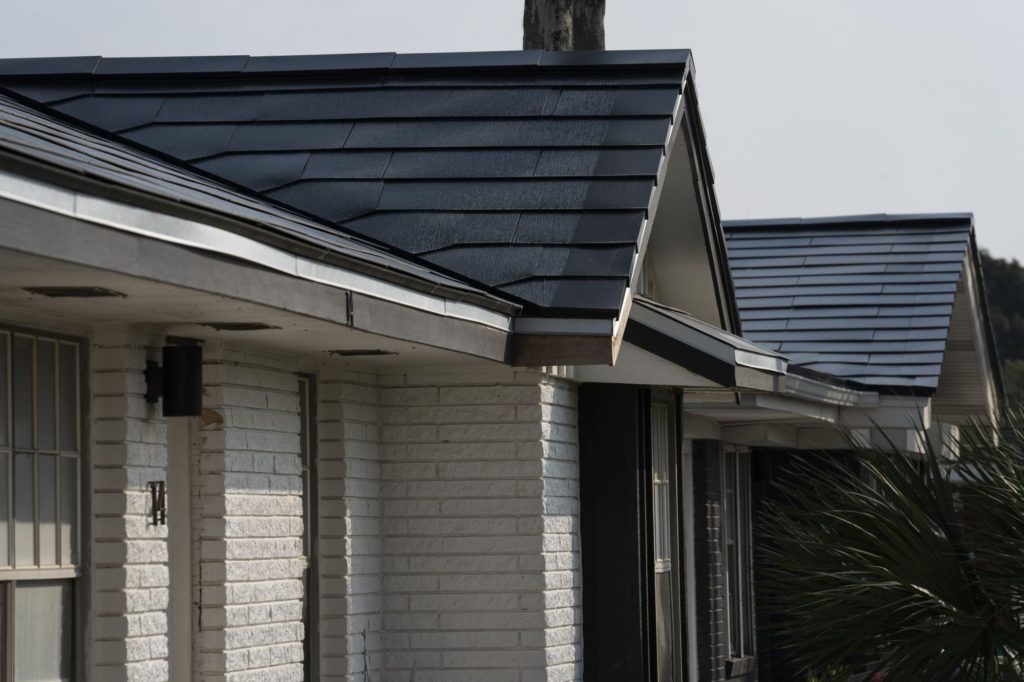
(Bloomberg) — Tesla Inc. is hoping to turn some Texas homes into “virtual power plants” after tests showed its home batteries can be quickly tapped to reduce stress on the state grid.

Tesla is making the push after trying a project that pooled together 64 northern Texas homes outfitted with rooftop solar and Powerwall batteries. The pilot project showed that the setup can tap spare battery capacity and provide grid services within seconds, executives said Tuesday at a grid workshop hosted by Elon Musk’s company.

Tesla is advocating for rule changes with the main Texas grid operator to set terms on how owners of such residential batteries can participate in the power market and be compensated. Households received gift cards for their role in the pilot project. A residential program could be rolled out within a year if the Electric Reliability Council of Texas approves, Arushi Sharma Frank, Tesla’s US energy markets policy lead, said during Ercot’s virtual workshop.

More stories like this are available on bloomberg.com

©2022 Bloomberg L.P.
HP’s Quarterly Revenue Gains 3.9% on Thriving Business Demand

(Bloomberg) — HP Inc. reported sales and profit that topped analysts’ estimates on steady demand by companies upgrading computer systems.

Still, the results pointed to some potential issues ahead for the hardware company as consumer spending fell for personal computers and printers.

Fiscal second-quarter revenue increased 3.9% to $16.5 billion, Palo Alto, California-based HP said Tuesday in a statement. Analysts, on average, projected $16.1 billion. Most of the gains came from business demand for desktop computers. Fiscal second-quarter profit, excluding some items, was $1.08 a share, topping estimates. 

HP said Personal Systems division revenue increased 9.2% to $11.5 billion, led by commercial sales. But consumer sales declined 6% and notebook units declined 23% in the period, which ended April 30. Printing revenue declined 7% to $5 billion, with total hardware units down 23%.

The consumer slowdown was particularly acute on low-end products and in Europe and China, while premium machines and gaming saw “strong demand,” HP Chief Executive Officer Enrique Lores said in an interview. 

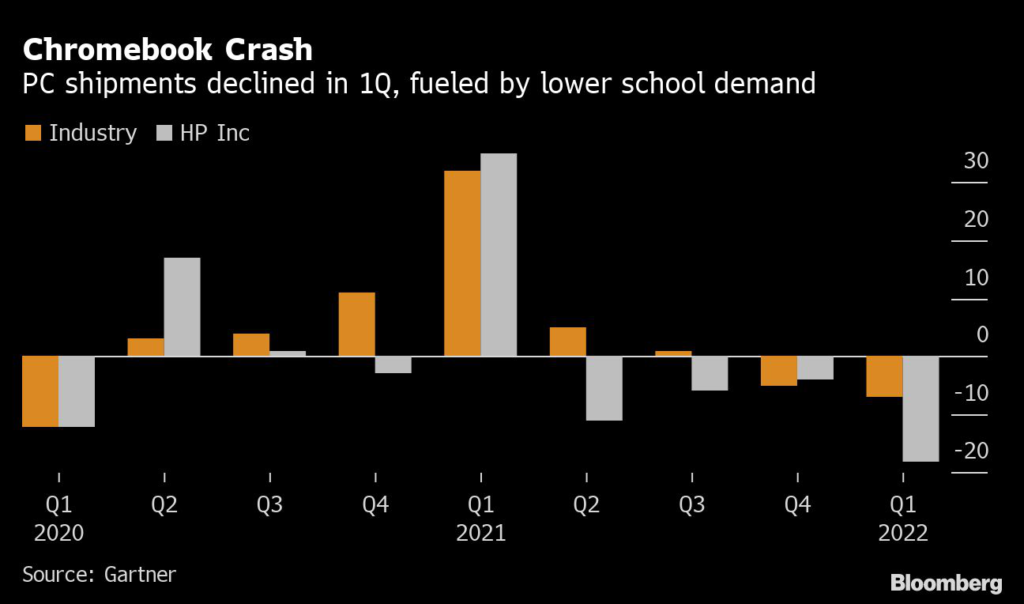
PC shipments industrywide declined 6.8% in the first three months of the year, spurred by reduced demand particularly for Chromebooks used by schools.

Rival PC-maker Dell Technologies Inc. reported earnings that beat analyst estimates last week. “The difference is Chromebook exposure. Dell didn’t have as much Chromebook exposure – HP does,” said Bloomberg Intelligence’s Woo Jin Ho. HP is also more exposed to the consumer market, which may be more affected by macroeconomic concerns like inflation, Ho said.

“Despite the softer consumer, we’re certainly seeing strength on commercial,” said HP Chief Financial Officer Marie Myers in an interview. “The commercial side is approximately 65% of our portfolio now and I think that’s a trend that’s going to continue.”

The shares rose about 2% in extended trading after closing at $38.84 in New York. The stock has gained 3% this year, running counter to a general decline in technology shares. 

In March, HP acquired Poly, formerly known as Plantronics Inc., which sells phone headsets and other audio and video accessories, in a $3.3 billion deal to add equipment for remote work. The company expects to complete the takeover by the end of 2022, pending shareholder and regulatory approval. It’s projecting annual growth for Poly of about 15% in the first three years after the deal closes. 

While components are easier to procure than last year, supply chains continue to be a barrier to meeting demand, Lores said. 

More stories like this are available on bloomberg.com

©2022 Bloomberg L.P.
Stocks End a Volatile Month Right Where They Began: Markets Wrap

(Bloomberg) — A tumultuous May for markets ended almost exactly where it started in equities, with a late-session drop Tuesday depositing the S&P 500 less than a point higher than its level a month ago. It was a final twist in a month that saw volatility surge and debates rage around inflation, the Federal Reserve’s plan to subdue it and the impact on the economy.

The S&P 500 fell 0.6% on Tuesday, bringing its monthly return to virtually zero. During the month of May, the benchmark index surged more than 8% after falling within points of a 20% drop from a record, signifying a bear market. 

Ten-year Treasury yields climbed 12 basis points to 2.85%, just below where they started the month. West Texas Intermediate oil was little changed, leaving it 10% higher in the month. And Bitcoin held above $31,000, down 17% in May.

Equities began the day lower on worries inflation was proving more persistent, intensifying the debate over how quickly central banks will raise interest rates. Euro-zone consumer prices jumped 8.1% to a record from a year earlier in May. Meanwhile, WTI crude oil pared gains from a partial ban on Russian oil by the European Union. The dollar advanced.

Fears central-bank rate hikes may tip the economy into a recession are keeping investors watchful as rising food and energy costs squeeze consumers. May saw nearly unprecedented volatility in stocks as the S&P 500 plunged more than 3% three different times and capped its longest streak of weekly losses since 2001 only to surge at the month’s end.

The moves come amid skepticism about whether the market is near a trough and as volatility stays elevated. Swaps show traders have almost fully priced in two half-point rate increases in June and July, with even odds of a third such hike in September.

“When you throw-in the likelihood that earnings estimates are going to have go be cut in a significant way as we move through the summer, it emboldens our view that the stock market will have to see lower-lows before the ultimate bottom for this decline is reached,” Matt Maley, chief market strategist at Miller Tabak + Co., said. 

Federal Reserve Chair Jerome Powell is meeting President Joe Biden in a rare Oval office meeting on Tuesday to discuss inflation ahead of US payroll numbers later this week. The meeting follows comments by Fed Governor Christopher Waller on Monday, suggesting the Fed should keep raising rates in half-percentage point steps until inflation is easing back toward the central bank’s goal. 

“It’s times like these when investors need a crystal ball,” wrote LPL Financial strategists Jeff Buchbinder and Ryan Detrick. “We fully acknowledge how tough it is to see the bull case for stocks right now, and a retest of recent lows is certainly possible, but this week we lay out the bull case for the second half of the year. It starts with inflation.”

Among individual stock moves, Deutsche Bank AG slipped after the lender and its asset management unit had their Frankfurt offices raided by police. Unilever Plc jumped as activist investor Nelson Peltz joined its board. And US-listed Chinese stocks — including Alibaba Group Holding Ltd. — climbed, wiping out the group’s monthly losses as easing in lockdown measures in major cities and better-than-expected economic data reassured investors. 

How will markets be affected by the Fed’s quantitative tightening? QT officially starts Wednesday and is the theme of this week’s MLIV Pulse survey. Click here to participate anonymously.

Here are some key events to watch this week:

  • The Federal Reserve is set to start shrinking its $8.9 trillion balance sheet Wednesday
  • The Fed releases its Beige Book report on regional economic conditions Wednesday
  • New York Fed President John Williams, St. Louis Fed President James Bullard speak at separate events Wednesday
  • OPEC+ virtual meeting Wednesday
  • Cleveland Fed President Loretta Mester discusses the economic outlook Thursday
  • US May employment report Friday
  • The UN’s Food and Agriculture Organization releases its monthly food price index at a time of maximum concern about global supplies on Friday

Some of the main moves in markets:

Stocks

  • The S&P 500 fell 0.6% as of 4:05 p.m. New York time
  • The Nasdaq 100 fell 0.3%
  • The Dow Jones Industrial Average fell 0.7%
  • The MSCI World index fell 0.6%

Currencies

  • The Bloomberg Dollar Spot Index rose 0.4%
  • The euro fell 0.4% to $1.0735
  • The British pound fell 0.4% to $1.2604
  • The Japanese yen fell 0.9% to 128.69 per dollar

Bonds

  • The yield on 10-year Treasuries advanced 12 basis points to 2.85%
  • Germany’s 10-year yield advanced seven basis points to 1.12%
  • Britain’s 10-year yield advanced 11 basis points to 2.10%

Commodities

  • West Texas Intermediate crude fell 0.1% to $114.94 a barrel
  • Gold futures fell 1% to $1,839.10 an ounce

More stories like this are available on bloomberg.com

©2022 Bloomberg L.P.
Tesla’s Loyal Retail Fan Club Set to Rev Up Stock’s Recovery

(Bloomberg) — Tesla Inc.’s grip on its retail trading fans is hard to shake.

Retail buyers have remained steadfast even as the company’s troubles have mounted since April, sparking a dizzying drop in the electric-vehicle maker’s share price. And after last week’s 14% surge, that loyal following could supercharge a recovery with investors again starting to turn to growth stocks. 

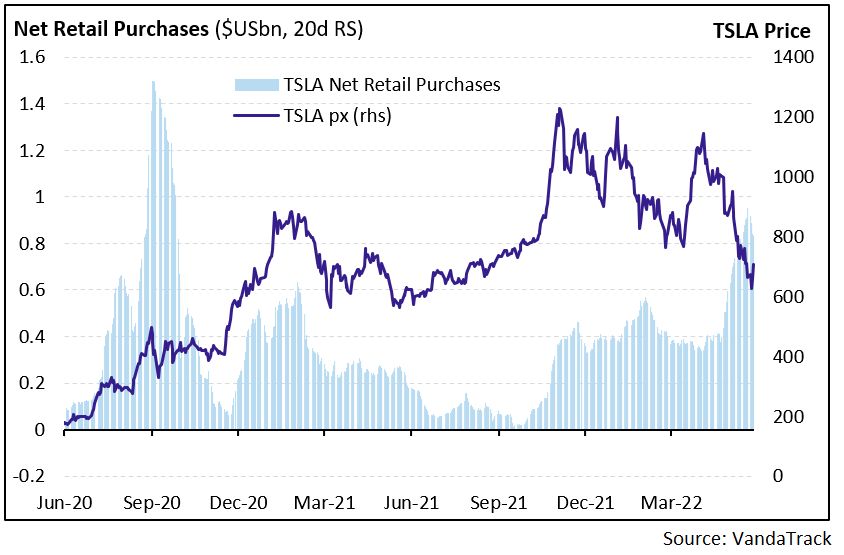
“In May, we’ve seen the strongest monthly buying of Tesla shares by retail investors since August 2020, when the company announced its first stock split,” Vanda Research analyst Fabian Birli said. Whatever the reason — anticipation of another stock split, the army of Musk-fans doubling-down after the Twitter deal or just plain dip-buying — there has been a “clear uptick in retail sentiment for Tesla since the start of the month,” Birli added.

Net buying of Tesla shares by retail investors in May was $708 million as of Friday, the second most among mega-cap technology stocks, trailing only Apple Inc. Tesla was the top gainer on the NYSE FANG+ Index last week and the third biggest contributor to the S&P 500 Index as it posted its biggest weekly gain since November 2020. 

Tesla shares are down 34% since a recent peak on April 4 due to the company’s manufacturing troubles in China and investors’ fears about growth slowing worldwide. The noise from the CEO Elon Musk’s bid for Twitter Inc. also hasn’t helped. But the stock is still hardly cheap compared to Tesla’s peers, as the company’s $786 billion market capitalization is head and shoulders above any other global auto company. 

Musk’s retail fans have a lot to do with that strength.

“A good way to look at the situation is to compare the cult following that Elon Musk has versus the cult following that Bitcoin and other crytpos had until recently,” said Matthew Maley, chief market strategist for Miller Tabak + Co. “Musk has produced game changing products in several areas, so confidence level is much higher… and that’s why the stock has been able to bounce nicely now that the broad market has stabilized, while Bitcoin is still languishing,” the strategist said.

Tesla did not respond to a request for comment. The company’s shares closed down 0.2% on Tuesday.

As retail traders’ ability to influence the stock market has increased in recent years, companies have recognized the value in attracting these investors with maneuvers like stock splits, which reduce the price of a share and makes them more appealing to individual investors. 

Tech behemoths Alphabet Inc. and Amazon.com Inc. also recently split their shares in an effort to bring in retail buyers. In fact, Tesla’s own stratospheric rise in its stock price in 2020 was in part fueled by a stock split, and the company on March 28 announced its plan for another via a tweet.

“The loyal retail following for Tesla holds an advantage for long-term shareholders in the company as these investors are willing to look through near-term negatives which softens the drops in the stock and can accelerate any upward trends,” said Gene Munster, former technology analyst who’s now a managing partner at venture-capital firm Loup Ventures.

(Updates stock move in fifth and eigth paragraphs.)

More stories like this are available on bloomberg.com

©2022 Bloomberg L.P.
Meta Platforms to Ditch FB Ticker in Favor of META on June 9

(Bloomberg) — Facebook parent company Meta Platforms Inc. will change its stock ticker to META ahead of the market opening on June 9, completing a rebranding that began with a new name last year. 

The ticker arrives at a difficult time for the stock, which is down more than 40% this year — hurt by a broader tech rout as well as concerns about slowing growth at the social media giant. Meta has traded under the ticker FB since the company’s initial public offering in 2012.

The company changed its name from Facebook to Meta last October to signal its commitment to the so-called metaverse, a more immersive version of the internet that Chief Executive Officer Mark Zuckerberg hopes to build. 

Roundhill Investments had used the META ticker for its Roundhill Ball Metaverse ETF, but relinquished the symbol on Jan. 31. That set the stage for the change.

More stories like this are available on bloomberg.com

©2022 Bloomberg L.P.
FTC’s Antitrust Probe of Amazon Picks Up Speed Under New Boss

(Bloomberg) — The US Federal Trade Commission has revamped its antitrust probe of Amazon.com Inc., shaking up the investigative team, re-interviewing potential witnesses and asking questions about the company’s recent acquisition of MGM Studios, three people familiar with the probe said.

The agency has been looking at Amazon since 2019 over antitrust concerns with its retail business and cloud computing services. Lina Khan, who became chair of the agency last year, had made a name for herself with a groundbreaking legal paper into Amazon’s potential antitrust violations and has taken a personal interest in the probe. 

She’s assigned the case to John Newman, an antitrust professor and former Justice Department prosecutor, who joined the FTC as a deputy director of competition in December and has reorganized the team probing Amazon since taking it over, according to the people, who asked not to be identified discussing non-public information about the situation. 

The agency declined to comment on the re-organization. Amazon didn’t immediately respond to a request for comment.

Trump Focus

During the administration of President Donald Trump, the FTC opted to prioritize an antitrust investigation into Facebook and assigned only two lawyers to the Amazon one, two of the people said. 

Before joining the FTC from Columbia Law School, Khan worked as a staffer for the House Judiciary antitrust subcommittee that had spent 16 months investigating Alphabet Inc.’s Google, Amazon, Apple Inc. and Meta Platforms Inc. Khan focused on the Google section of what eventually became the panel’s 449-page report, while an FTC staffer detailed to the committee led the Amazon portion.

The panel’s report became public in October 2020, but by last summer the FTC investigation hadn’t broken any new ground from what had been outlined in the congressional report, two of the people said.

After taking over the agency, Khan helped draft some lines of questioning for investigators, one of the people said. Since then, FTC lawyers have homed in on aspects of the probe involving Amazon Web Services, the company’s lucrative cloud computing business, and more recently the $8.45 billion MGM acquisition.

Amazon said in March it closed its acquisition of the movie studio when the FTC’s review of the deal expired without a challenge.

The FTC declined to comment directly on the deal at the time but issued a statement that it “does not approve transactions and may challenge a deal at any time if it determines that it violates the law.”

FTC lawyers have been asking questions about the MGM deal’s impact on the company’s video streaming service, Amazon Prime, two of the people said.

Khan Opposition

Amazon has sought to sideline Khan, arguing that her past work should preclude her from involvement in any FTC cases against the company. A similar recusal push by Facebook was rejected by the agency and a federal judge overseeing the FTC’s suit against the company.

The FTC isn’t the only regulator focused on Amazon. In response to an antitrust price-fixing investigation by the Washington state attorney general, the company agreed to pay a $2.25 million fine in January and shutter a program in which it agreed on pricing with third-party sellers, rather than compete with them.

Karl Racine, the attorney general for the District of Columbia, sued Amazon last year, alleging the online retailer encourages higher-than-necessary consumer prices through policies that guarantee the tech giant a minimum profit on each item sold, while discouraging merchants on the site from offering their products at lower prices elsewhere.

A Superior Court judge dismissed the suit in March, but DC is appealing with support from the Biden administration. European regulators are also probing how the e-commerce giant treats sellers on its platform.

More stories like this are available on bloomberg.com

©2022 Bloomberg L.P.
Stocks Head for Monthly Gain After May Volatility: Markets Wrap

(Bloomberg) — A tumultuous May for markets was poised to end with modest losses, preserving a small monthly gain in the S&P 500 that came despite raging debates around inflation, the Federal Reserve’s plan to subdue it and the impact on the economy.

The S&P 500 was little changed Tuesday, bringing its monthly return to 0.5%. During the month of May, the benchmark index surged nearly 9% after falling within points of a 20% drop from a record, signifying a bear market. 

Ten-year Treasury yields climbed 12 basis points to 2.85%, just below where they started the month. West Texas Intermediate oil was little changed, leaving it 10% higher in the month. And Bitcoin held just above $31,000, down 17% in May.

Equities began the day lower on worries inflation was proving more persistent, intensifying the debate over how quickly central banks will raise interest rates. Euro-zone consumer prices jumped 8.1% to a record from a year earlier in May. Meanwhile, WTI crude oil pared back gains from a partial ban on Russian oil by the European Union. The dollar advanced.

Fears central-bank rate hikes may tip the economy into a recession are keeping investors watchful as rising food and energy costs squeeze consumers. May saw nearly unprecedented volatility in stocks as the S&P 500 plunged more than 3% three different times and capped its longest streak of weekly losses since 2001 only to surge at the month’s end.

The moves come amid skepticism about whether the market is near a trough and as volatility stays elevated. Swaps show traders have almost fully priced in two half-point rate increases in June and July, with even odds of a third such hike in September.

“When you throw-in the likelihood that earnings estimates are going to have go be cut in a significant way as we move through the summer, it emboldens our view that the stock market will have to see lower-lows before the ultimate bottom for this decline is reached,” Matt Maley, chief market strategist at Miller Tabak + Co., said. 

Federal Reserve Chair Jerome Powell is meeting President Joe Biden in a rare Oval office meeting on Tuesday to discuss inflation ahead of US payroll numbers later this week. The meeting follows comments by Fed Governor Christopher Waller on Monday, suggesting the Fed should keep raising rates in half-percentage point steps until inflation is easing back toward the central bank’s goal. 

“It’s times like these when investors need a crystal ball,” wrote LPL Financial strategists Jeff Buchbinder and Ryan Detrick. “We fully acknowledge how tough it is to see the bull case for stocks right now, and a retest of recent lows is certainly possible, but this week we lay out the bull case for the second half of the year. It starts with inflation.”

Among individual stock moves, Deutsche Bank AG slipped after the lender and its asset management unit had their Frankfurt offices raided by police. Unilever Plc jumped as activist investor Nelson Peltz joined its board. US energy stocks rose following the advance in crude oil prices. And US-listed Chinese stocks also climbed, on track to wipe out their monthly losses as easing in lockdown measures in major cities and better-than-expected economic data reassured investors. 

How will markets be affected by the Fed’s quantitative tightening? QT officially starts Wednesday and is the theme of this week’s MLIV Pulse survey. Click here to participate anonymously.

Here are some key events to watch this week:

  • The Federal Reserve is set to start shrinking its $8.9 trillion balance sheet Wednesday
  • The Fed releases its Beige Book report on regional economic conditions Wednesday
  • New York Fed President John Williams, St. Louis Fed President James Bullard speak at separate events Wednesday
  • OPEC+ virtual meeting Wednesday
  • Cleveland Fed President Loretta Mester discusses the economic outlook Thursday
  • US May employment report Friday
  • The UN’s Food and Agriculture Organization releases its monthly food price index at a time of maximum concern about global supplies on Friday

Some of the main moves in markets:

Stocks

  • The S&P 500 was little changed as of 3:34 p.m. New York time
  • The Nasdaq 100 rose 0.4%
  • The Dow Jones Industrial Average fell 0.2%
  • The MSCI World index fell 0.3%

Currencies

  • The Bloomberg Dollar Spot Index rose 0.4%
  • The euro fell 0.4% to $1.0735
  • The British pound fell 0.4% to $1.2607
  • The Japanese yen fell 0.9% to 128.70 per dollar

Bonds

  • The yield on 10-year Treasuries advanced 12 basis points to 2.85%
  • Germany’s 10-year yield advanced seven basis points to 1.12%
  • Britain’s 10-year yield advanced 11 basis points to 2.10%

Commodities

  • West Texas Intermediate crude rose 0.3% to $115.46 a barrel
  • Gold futures fell 0.8% to $1,842 an ounce

More stories like this are available on bloomberg.com

©2022 Bloomberg L.P.
DeLorean Shows Off Electric Car, Says It Will Arrive in 2024

(Bloomberg) — A new electric DeLorean will arrive in 2024, says the latest iteration of the DeLorean Motor Co.

This is the brand John DeLorean founded in 1975, which went bankrupt by 1982. The collapse was due to mismanagement, complaints about poor fabrication and lackluster performance—and the fact that its founder was charged with conspiring to smuggle 55 pounds ($24 million worth) of cocaine into the US. He was acquitted.

Now rebranded as DeLorean Motors Reimagined LLC after years of wallowing as a niche steel-car automaker in Texas, DeLorean says it’s making a modern electric coupe, the Alpha5.

The effort is led by Joost de Vries, who joined the company in 2021. He was previously vice president of sales at Karma Automotive, the beleaguered Chinese-owned entity that purchased assets of the also-defunct Fisker Automotive in a bankruptcy auction in 2014. During his tenure, Karma faced major sales challenges and financial troubles due to its inability to manufacturer quality cars. De Vries also worked as vice president of global service at Tesla.

But the DeLorean Alpha5 won’t have hypercar speed. It won’t even be street legal, de Vries said.

The renderings for the latest version of the almost 40-year-old marque show a modern gullwing coupe that looks less wedge-like than the original that gained international fame when it was featured in the 1985 film, Back to the Future. Softly rounded in an arch from front to back, it has thin white headlights and a long red band of light that makes up the taillights. Images on the company’s website indicate it has an active rear spoiler and seating for four.

It will be able to hit 60 mph in 2.9 seconds and have a top speed of 155 mph, according to the company, numbers that approximate the Lucid Air family sedan but lack the blinding speed of a Rimac Nevera, which can do 0-60mph in 1.8 seconds. The Tesla Model S Plaid edition can do the 0-60 mph sprint in 1.9 seconds.

Then again, the DeLorean cars DMC was making after a British-born mechanic named Stephen Wynne purchased the logo and existing inventory from John DeLorean in 1995 were far from quick. Identical to those in the movie, underpowered and lacking even rudimentary modern comforts, Wynne’s DeLoreans, made in Texas, lacked power steering and automatic transmission; the placement of the shifter, clutch, and other pedals were so tight they crammed all but the daintiest feet.

John DeLorean’s original version of the DeLorean was even more archaic. When it launched in 1981, the car had a 130-horsepower 2.8-liter V6 Peugeot-Renault-Volvo engine in the rear of a Lotus frame. Available with manual or automatic transmission, it went to 60 mph in 10.5 seconds and got just 18 miles per gallon. Fewer than 9,000 of them were made at DeLorean’s facility in Northern Ireland. Prices started at $25,000.

DeLorean is registering interest in the Alpha5 on its website, which it first hinted at in a Super Bowl commercial in February. It is unclear if the company is also taking deposits. In light of many startups that announce a concept without delivering it in production form, savvy consumers will wait until the car becomes reality before committing any money to it.

Requests to the company for comment were not immediately returned.

More stories like this are available on bloomberg.com

©2022 Bloomberg L.P.
Close Bitnami banner
Bitnami