Bloomberg

Bitcoin Seen at Risk of Resuming Slide If $29,000 Support Fails

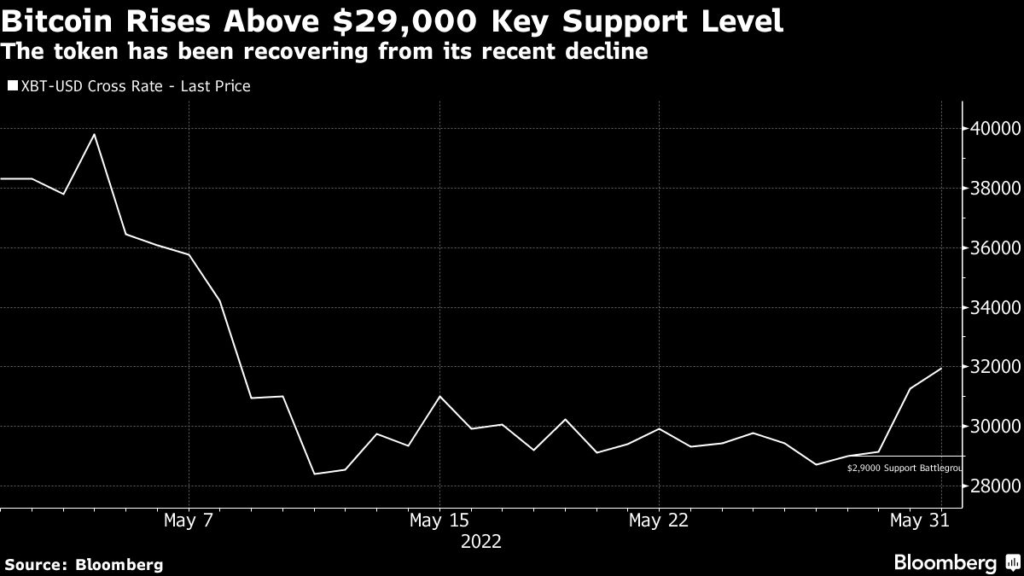
(Bloomberg) — While Bitcoin is higher for a fourth day, some closely-watched technical measures suggest that prices could drop to the lowest since December 2020 if the largest cryptocurrency fails to maintain support at $29,000. 

Bitcoin is trading above $30,000 on Tuesday as it recovers from a sharp decline in the past three weeks. However, it’s still down 16% in May. Smaller tokens have bounced back as well, with Ether nearing $2,000 and Cardano’s ADA spiking by as much as 25%, partly due to its network upgrade. 

But Bitcoin’s recent recovery may be a blip before another steep drop, instead of a sustained reversal of its recent decline. Based on the token’s price movement patterns in the past, it could sink as low as $22,130 if it fails to defend its key support level. 

“If it can hold the psychologically important $30,000 level, it could range-trade to resistance at $40,000,” Jamie Douglas Coutts, senior market structure analyst at Bloomberg Intelligence, wrote in a report. “Technically, a break below $29,000 would confirm an ominous double-top pattern with next support at the May low of $25,424, then the 200-week moving average at $22,130.”

In the second half of 2022, seasoned investors will likely turn their attention to Bitcoin halving, which is a pre-programmed update that cuts Bitcoin rewards for miners in half every four years, Coutts wrote. Halving boosts the price of Bitcoin since it results in a smaller supply of the token. The next such event is expected to take place in mid-May 2024. 

“Bitcoin usually performs most strongly in the 12 months after each halving as daily issuance shrinks,” Coutts wrote. 

More stories like this are available on bloomberg.com

©2022 Bloomberg L.P.

‘Top Gun: Maverick’ Sets Memorial Day Weekend Box-Office Record

(Bloomberg) — “Top Gun: Maverick” had the biggest-ever theatrical debut for a Memorial Day weekend, lifting the spirits of cinema operators clawing their way back from the pandemic.

From its opening through Monday, the film brought in ticket sales of $160.5 million in the US and Canada, producer Paramount Pictures said, beating the old record held by the 2007 film “Pirates of the Caribbean: At World’s End.” Imax Corp., the pioneer in large theater screens, had its best Memorial Day Weekend ever, with $32.5 million in ticket sales.

The figure raises the prospects for the first real summer moviegoing season since 2019, before the Covid-19 pandemic. It also suggests the industry could recover to 85% or 90% of its previous high annual tickets sales of more than $11 billion, Bloomberg Intelligence said Tuesday.

The movie, a sequel to the 1986 film that cemented Tom Cruise’s star status, was also the biggest-ever opening weekend for the actor. In its first three days, it made $126.7 million in domestic theaters, double the performance of his second-best opening in 2005 with “War of the Worlds,” according to data from Comscore Inc.

Paramount said older men drove ticket sales to the movie, about fighter pilot Pete “Maverick” Mitchell. Almost 60% of the audience was male and 55% of fans were over age 35, likely meaning they recalled the first “Top Gun.” 

Having a film about the US Navy’s flight school open over Memorial Day weekend probably helped draw moviegoers into theaters, according to Paul Dergarabedian, senior media analyst with Comscore. Box office estimates grew over the weekend, suggesting word-of-mouth recommendations for the picture were strong.

More stories like this are available on bloomberg.com

©2022 Bloomberg L.P.

Stocks Pare Loss as Price Fears Mount; Bonds Fall: Markets Wrap

(Bloomberg) — US stocks pared losses Tuesday as record inflation accelerated in Europe, intensifying the debate over how quickly central banks will raise interest rates in response.

The S&P 500 was little changed, led by gains in energy, while the Nasdaq 100 added 0.5% and Europe’s Stoxx 600 Index ended lower.

Euro-zone consumer prices jumped 8.1% from a year earlier in May, exceeding the 7.8% median estimate in a Bloomberg survey. Meanwhile, WTI crude oil rose to $117 barrel after the European Union agreed to pursue a partial ban on Russian oil. Treasury yields climbed across the curve, joining the selloff in German bunds and European bonds. The dollar advanced. 

Fears central-bank rate hikes may tip the economy into a recession are keeping investors watchful as rising food and energy costs squeeze consumers. US stocks are on track to end the month with modest gains amid skepticism about whether the market is near a trough and as volatility stays elevated.  

The S&P 500 posted gains of 1% or more four out of the five trading days last week, but many see the rally as short lived with expectations of aggressive Fed rate hikes on the horizon. Swaps show traders have almost fully priced in two half-point rate increases in June and July, with even odds of a third such hike in September.

“When you throw-in the likelihood that earnings estimates are going to have go be cut in a significant way as we move through the summer, it emboldens our view that the stock market will have to see lower-lows before the ultimate bottom for this decline is reached,” Matt Maley, chief market strategist at Miller Tabak + Co., said. 

Federal Reserve Chair Jerome Powell is expected to meet President Joe Biden in a rare Oval office meeting on Tuesday to discuss inflation ahead of US payroll numbers later this week. The meeting comes after Fed Governor Christopher Waller said Monday he wants to keep raising rates in half-percentage point steps until inflation is easing back toward the central bank’s goal. 

“What remains critical is that even though the Federal Reserve is likely to remain hawkish until the peak in interest rates and the Fed balance sheet reduction — both of which are expected in September — inflation expectations are plummeting and nominal rates are cooling down,” Lisa Shalett, chief investment officer at Morgan Stanley Wealth Management, said in a note. “We sense not only are we passing ‘peak Fed’ but that more positive catalysts will arrive by the fourth quarter as inflation decelerates, China stimulus accelerates and the US midterm election campaigns heat up.”

Among individual stock moves, Deutsche Bank AG slipped after the lender and its asset management unit had their Frankfurt offices raided by police. Unilever Plc jumped as activist investor Nelson Peltz joined its board. US energy stocks rose following the advance in crude oil prices. And US-listed Chinese stocks also climbed, on track to wipe out their monthly losses as easing in lockdown measures in major cities and better-than-expected economic data reassured investors. 

“Despite a potential strong finish to a historically weak month, the SPX is still coming into June with a loss of more than 10%,” Craig W. Johnson, chief market technician at Piper Sandler, said in a note. “The good news is that for similar performance years, the index has historically rebounded into year-end. For years with losses of more than 10% from January to May, the SPX has posted average and median June to December returns of 6.3% and 5.8%, respectively.”

Elsewhere, Bitcoin was back above $32,000 as investors and strategists said the digital currency is showing signs of bottoming out.

How will markets be affected by the Fed’s quantitative tightening? QT officially starts Wednesday and is the theme of this week’s MLIV Pulse survey. Click here to participate anonymously.

Here are some key events to watch this week:

  • The Federal Reserve is set to start shrinking its $8.9 trillion balance sheet Wednesday
  • The Fed releases its Beige Book report on regional economic conditions Wednesday
  • New York Fed President John Williams, St. Louis Fed President James Bullard speak at separate events Wednesday
  • OPEC+ virtual meeting Wednesday
  • Cleveland Fed President Loretta Mester discusses the economic outlook Thursday
  • US May employment report Friday
  • The UN’s Food and Agriculture Organization releases its monthly food price index at a time of maximum concern about global supplies on Friday

Some of the main moves in markets:

Stocks

  • The S&P 500 was little changed as of 12:43 p.m. New York time
  • The Nasdaq 100 rose 0.5%
  • The Dow Jones Industrial Average fell 0.1%
  • The MSCI World index fell 0.2%

Currencies

  • The Bloomberg Dollar Spot Index rose 0.4%
  • The euro fell 0.4% to $1.0732
  • The British pound fell 0.3% to $1.2613
  • The Japanese yen fell 0.8% to 128.58 per dollar

Bonds

  • The yield on 10-year Treasuries advanced 10 basis points to 2.84%
  • Germany’s 10-year yield advanced seven basis points to 1.12%
  • Britain’s 10-year yield advanced 11 basis points to 2.10%

Commodities

  • West Texas Intermediate crude rose 2.3% to $117.67 a barrel
  • Gold futures fell 0.5% to $1,847.30 an ounce

More stories like this are available on bloomberg.com

©2022 Bloomberg L.P.

‘Pure Gambling’ Prompts Wild Swings in New Luna Cryptocurrency

(Bloomberg) — Terra’s new Luna token is taking holders on a wild ride just days after being distributed to investors who saw the value of their cryptocurrencies tied to the failed blockchain destroyed.

Various trading platforms showed differing prices after the tokens were awarded on Saturday in what’s referred to in the crypto industry as an airdrop. Kraken data show that the price opened at around $17, and swung between $30 and $4.80. OKX listed an opening price of $1, with extremes of $20 and $5. Luna 2.0, as the new token is known, was up about 30% to around $9 on Tuesday, according to pricing data from from TradingView and Kraken.   

Veteran observers pointed out that while volatility is a fixture in crypto, the extreme moves stand out. Speculators are likely seeking to book quick gains on the moves higher, while previous holders of the failed TerraUSD (UST) stablecoin and Luna tokens are trying to recoup losses of around $40 billion. 

“This is pure gambling like crypto has never seen,” said Fadi Aboualfa, head of research at crypto prime brokerage Copper.    


Even though thousands of, if not millions of, investors saw the value of their crypto holdings associated with the original Terra blockchain wiped out earlier this month, many crypto exchanges started supporting trading Luna 2.0 tokens. Binance, the largest crypto trading platform, listed it Tuesday.

“For users who hold Luna 1.0 on the platform, the airdrop of Luna 2.0 can ideally assist in making up for the losses during previous incidents,” a representative of crypto exchange Huobi wrote in an email response on Huobi’s support of listing Luna 2.0.

Analysts in general remain bearish on the new Terra blockchain created by Terraform Labs, who is also responsible for the original Terra blockchain. 

“This initial volatility just shows to me that Luna 2.0 is now a speculative asset, and will likely trade on narrative until they can regain the trust of builders to bring fundamental value to the new ecosystem,” said Thomas Dunleavy, senior crypto research analyst at digital-asset data firm Messari. “I really, really doubt they can do that with so many other great, and well-funded alternatives out there.”

Under a measure approved last week by the Terra community, the original Terra blockchain was split off and is known now as Terra Classic, while Luna, which plunged close to zero this month, was renamed Luna Classic with the ticker LUNC. The new Terra blockchain does not include stablecoins. The collapse of Terra’s algorithmic UST stablecoin triggered a broader meltdown in crypto earlier this month, which saw billions of dollars vanished in just a few days.

“One of the most important things about crypto is the brand or marketing and community,” Aboualfa said. “Terra has burned its community, and brand is tarnished. Whatever they do here is going to be pointless.”

Terra’s official Twitter account said earlier that there’s an issue with the token airdrop, with some investors receiving less Luna 2.0 than expected, adding that the team is “actively working on a solution.”

John Kramer, director of trading at crypto market maker GSR, pointed out that the new Luna token is still relatively “illiquid,” and some investors are still holding their new Luna 2.0 tokens. 

“The remaining holders likely view the tokens as a call option on the potential success of the rebooted network, refusing to sell for pennies on the dollar compared to their prior value,” Kramer said. 

More stories like this are available on bloomberg.com

©2022 Bloomberg L.P.

IBM Must Pay $1.6 Billion in BMC Case, Federal Judge Orders

(Bloomberg) — International Business Machines Corp. must pay $1.6 billion to BMC Software Inc. for swapping in its own software while servicing their mutual client, a Houston federal judge ruled.

US District Judge Gray Miller, after a seven-day non-jury trial, rejected IBM’s claim that their mutual client AT&T Corp. opted to switch software products on its own and ruled that IBM’s role in the decision to dump BMC “smacked of intentional wrongdoing.”

For more than a decade, IBM serviced AT&T’s mainframe computers, which ran on rival BMC’s software products. IBM and BMC have long operated under a carefully negotiated agreement that forbids IBM from encouraging mutual clients, like AT&T, to switch to IBM’s competing software product line.

BMC sued IBM in 2017 claiming its rival intended to breach their agreement and poach AT&T’s software business when the two companies renewed their power-sharing deal in 2015. IBM countered that AT&T dumped BMC’s products and jumped to IBM for its own reasons, which IBM claims is fair game under its BMC agreement.

“This verdict is entirely unsupported by fact and law, and IBM intends to pursue complete reversal on appeal,” IBM said in a statement. “IBM acted in good faith in every respect in this engagement. The decision to remove BMC Software technology from its mainframes rested solely with AT&T, as was recognized by the court and confirmed in testimony from AT&T representatives admitted at trial.”

BMC didn’t immediately respond to a message seeking comment on the order.

More stories like this are available on bloomberg.com

©2022 Bloomberg L.P.

Chinese Firm That Accused NSA of Hacking Has Global Ambitions

(Bloomberg) — For years, the US government and American cybersecurity companies have alleged that China is behind brazen hacks that have pilfered troves of sensitive documents.

Chinese government officials have denied the claims and repeatedly accused the US of its own cyber-espionage, without providing evidence.

That changed in February, when a well connected Chinese cybersecurity firm went public with what it claimed was a US National Security Agency campaign aimed at computers in 45 countries and regions, including China. US officials didn’t respond to requests for comment at the time.

The disclosure suggested a more aggressive public response by China toward foreign hacking attempts. It also highlighted the growing clout of Qi An Xin Technology Group Inc., a Chinese technology firm established in 2014 that has ambitions of becoming a global cybersecurity giant.

The company, whose headquarters are a 10-minute drive from the Forbidden City, has been the beneficiary of a three-year plan, unveiled last year, to expand China’s cybersecurity industry to more than 250 billion yuan ($39.3 billion) by 2023 by increasing investments in the sector and streamlining regulation.

Qi An Xin was entrusted with handling cybersecurity at Tiananmen Square for the 70th anniversary of the Chinese Communist Party’s rule, and it oversaw network security for the Beijing Winter Games. In December, the Beijing city government selected Qi An Xin as one of 20 “invisible champions,” a designation given to companies that develop technology critical to China’s national strategy.

“Their talent is, without a doubt, top 10 globally, as far as companies are concerned,” said Dakota Cary, a consultant on China’s cyber capabilities at Krebs Stamos Group. “When there’s an issue at a provincial level or even at the central level, when the government needs a response team, it seems like Qi An Xin is the go-to.”

A representative for Qi An Xin declined to comment on this story.

China’s cyber industry accounts for less than 7% of the global market, compared to the U.S. at around 40%, according to a study last year from the International Institute of Strategic Studies.

Chinese cybersecurity companies have struggled to grow their business in the private commercial market because of low awareness about the risks of cyberattacks particularly within the small and medium-sized business community, said Cary and two other cybersecurity experts. Public reporting on threats or attacks is rare, so investing in cyber isn’t considered a critical business cost, according to multiple analysts with knowledge of China’s cyber industry.

That lack of demand for cyber protection among businesses and individuals in part explains Qi An Xin’s reliance on state clientele, said Cary. Its contracts with government, public security agencies and military clients comprise 52% of its revenue in 2019, according to the research firm Dongguan Securities. 

Overall, Qi An Xin brought in 5.81 billion yuan ($871 million) in revenue in 2021, lagging behind some of the bigger Western cybersecurity firms. Palo Alto Networks Inc., for example, reported $4.3 billion in revenue during its fiscal year 2021.

But the company has ambitions to compete globally against U.S. cybersecurity firms and others in the West. Founder Qi Xiangdong told reporters he wants Qi An Xin to “walk out into the world” this year.

The company has some business outside the Chinese mainland that includes providing cybersecurity services for the overseas operations of Chinese companies and banks in places such as Southeast Asia, the Middle East and Africa, according to a report by Avic Securities.

It also holds contracts to provide cybersecurity infrastructure for governments including those in Indonesia, Algeria, Angola and Ethiopia, Avic analysts say.

China’s cyber industry is still mainly driven by compliance, so its security products are made to meet domestic regulatory requirements that may be at odds with needs outside of the country, said Vivien Pua, security industry analyst at market research firm Frost & Sullivan.  

In addition, trust is more difficult for Chinese companies such as Qi An Xin to build in Western countries, said Niko Yang, a senior analyst at the Beijing-based investment research firm EqualOcean. Qi An Xin’s connections with the government may complicate any attempts to appear to be independent to potential clients overseas, a concern many Chinese-linked cyber services face. 

“For this kind of critical infrastructure, it is hard for countries to be willing to completely hand things over to others,” he said. “It is the same in China’s domestic cybersecurity – they also won’t have foreign companies carry out the most critical security tasks.”

Those close ties to the government are indisputable.

Its founder, Qi Xiangdong, 57, worked for 17 years at Xinhua, the national media agency, where he ascended to the role of deputy of its communications technology bureau. He also serves as a delegate to a Beijing city government political advisory body.

Company president Wu Yunkun, meanwhile, serves as vice president of a working committee at the China Information Ministry Association, which is supervised by the Ministry of Civil Affairs. Vice President Yang Hongpeng, was also previously in the communications department of Xinhua. Board members Meng Yan, Xu Jianjun and Zhao Bingdi have had state-connected roles in finance and technology.

In February, a security team at Qi An Xin called Pangu Labs — known in China for exploiting vulnerabilities to access Apple Inc. iOS systems — issued a report saying that it had found malware in domestic IT systems that it claimed was created by a hacking group called “Equation.” That group is “generally believed” to be linked to the NSA, according to the researchers.

Malware was allegedly found within an unnamed Chinese agency in 2013 and 2015, which Pangu Labs claims was part of a 10-year campaign that infiltrated key institutions around the world, according to the report, which was covered by the Communist Party-backed Global Times.

The alleged espionage campaign occurred in 2013, and information about the malware had previously surfaced during leaks from former NSA contractor Edward Snowden, meaning other hacking groups could have also accessed the code. However the details of the hack were perhaps less significant than the fact they had been published at all, according to Cary, of Krebs Stamos Group.

“There’s something in the relationship between Qi An Xin and the government that has allowed them to publish something like this,” he said. “That’s part and parcel of why they have so many contracts.”

Pangu Labs previously told Bloomberg News it had waited nearly a decade to disclose details about the hack because it was analyzing the data in question.

Chinese cybersecurity firms have rarely directly shared details about foreign attacks. 

In March 2020, Qihoo 360 Technology Co. Ltd., which was co-founded by Qi, blamed a group suspected to be associated with the CIA for alleged hacks against China. The US government added Qihoo 360 to its Entity List over national security concerns.

The state-owned China Electronics Corporation purchased a 23% stake in Qi An Xin in 2019, replacing Qihoo 360 as the second-largest shareholder behind Qi Xiangdong. 

While outing the NSA could further endear Qi An Xin to the Chinese government, it may complicate its efforts to expand in the West. So could U.S. restrictions on some Chinese tech firms, and China’s own reluctance to integrate with the global talent pool, said Greg Austin, an IISS senior fellow for cyber, space and future conflict.

More stories like this are available on bloomberg.com

©2022 Bloomberg L.P.

Car Inventory Crunch Reveals Dealers’ Bait-and-Switch Online Tactics

(Bloomberg) — Tiffani Deems of Boise, Idaho, wanted a new Kia hybrid and did what any shopper for anything would do these days — she went online. However, the cars listed on dealer websites were gone and her query was met with a come-on to visit a showroom and buy something else.

She ended up shopping like it’s 1999 — meeting at dealerships with salespeople who’d sit her down and go through a list of vehicles scheduled to arrive, sometimes printed out on a big sheaf of paper. 

“I had to go to five dealerships and call every day,” she said. “That’s not how I want to do it.”

It’s hardly news that the pandemic has messed with the supply chain on a range of goods, especially cars, leading to price gouging. But the shortage has also exposed a dirty secret of the US car industry: online shopping, where consumers are freed of pressure tactics from aggressive salespeople, is unreliable partly because many dealers want to work face-to-face.

Dealer websites with out-of-date inventory typically managed by third party vendors are mostly there to generate sales leads and lure buyers into showrooms. When a car is sold, it remains on the site until the financing clears. When a buyer puts down a deposit, the car is still listed as available. Even after the car is sold, the vendors and dealers don’t update inventory quickly, said Paolo da Silva, vice president of e-commerce at Cox Automotive.

“There is no connectivity between those systems and what the manufacturer is doing in terms of production,” da Silva said. “A human being has to update those cars.” 

State franchise laws don’t help. Most states require dealers to handle the final sale transaction and manufacturer websites are designed with that in mind. Even if customers uses the configurator on a site to spec out a car, they have to go to a dealer to order it.

Tesla is the exception, allowing customers to order vehicles directly. Since it has no franchised dealers, cars can be ordered directly. 

Before the semiconductor shortage, all of this mattered less because dealers usually had so many cars that if a particular vehicle was sold, a dozen similar ones might be on the lot. 

“Under normal real-world circumstances, that car would be here within 12 days,” said Buffalo-area Chevrolet dealer Duane Paddock. “But we had so many others in stock that it didn’t matter. No one cared.”

Carmakers and dealers typically stocked 60 to 90 days worth of vehicles. Currently, they have fewer than 20. When the pandemic crunch eases, they’re shooting for 45 since they’ve seen that they earn more when inventory is tighter. The current average car price of $45,000 is a record high.

But to settle on the right inventory and offer customers the colors and options they want, da Silva said the online experience will have to be updated with automakers linking their websites to production scheduling. That will push dealers to sell more cars to order rather than move inventory, but the pandemic showed that consumers want the change.

Customer survey show that 90% of car shoppers at least start online. In a study Cox released in January, customer satisfaction rose in 2020 when in-person sales fell off because of pandemic-driven health concerns. Many dealers were forced to handle everything online and even delivered the car. A record 72% of buyers were satisfied. That fell to 66% in 2021 as showrooms reopened and choices fell. Consumers who did most of the transaction digitally were more likely to be happy with the experience, the study showed.

“There will be a big push for vendors to connect directly to manufacturers and dealer websites,” da Silva said of what’s ahead. “Dealers are used to the old ways. They want to sell you something else. That’s going to have to change over time.” 

Cox, which owns Dealer.com, has developed a web tool called Essential Commerce. It can select a specific vehicle with a vehicle identity number (VIN), value a customer’s trade-in and sign a contract. It’s in early stages of being deployed to dealers, da Silva said.

Car companies are also making changes to improve transparency, although the dealers still largely control what appears on their sites.

Jeremie Papin, chairman of Nissan Americas, said as it reduces inventory for better pricing, it is rolling out a website called Nissan@Home that lets customers shop for an exact model with a VIN. About 700 of Nissan’s 1,100 dealers are enrolled, although dealers are the ones who make sure the inventory is accurate. 

General Motors Co. has also given dealers tools to track inventory and vehicles that are in transit, but, there too, dealers and a third party control the website, said a company spokesman.

Ford Motor Co. has taken a different approach, offering customers incentives of up to $1,000 to order vehicles directly in exchange for more time to build it. This is the system in Japan and Europe where dealers have far less space to store vehicles and customers order online and wait for their car to be built.  

So where does all of that leave US buyers? Right now, still driving around taking what they can get, not what they want. Deems of Boise bought a Kia Seltos.

“They didn’t even have any new Kias on the lot,” she said. “I’m lucky I found a car.”

More stories like this are available on bloomberg.com

©2022 Bloomberg L.P.
These Investors Say Nasdaq’s Bear Market Has Legs

(Bloomberg) — The drubbing global technology stocks have seen this year may be far from over.

That’s the message from many strategists and fund managers, who expect this year’s rout to deepen in the near term as the Federal Reserve aggressively tightens monetary policy to fight inflation, raising the specter of a recession. 

Even as a potential economic contraction looms, analysts are still predicting that earnings growth for tech companies will accelerate late this year and in 2023. Investors are overweight the sector in their portfolios and expect to profit by buying when prices dip, according to Bank of America Corp.’s quantitative strategists. Until that optimism fades, tech stocks won’t find a bottom, the firm says.

Last week’s swift rebound isn’t convincing the skeptics. The Nasdaq 100 Index gained 7.2%, snapping seven weeks of losses. Still, the tech-heavy benchmark is on pace to close in the red this month.

“While the rebound feels good it is not unusual to have bear market rallies,” said Peter Garnry, head of equity strategy at Saxo Bank. “Investors should not forget that the underlying commodity and supply chain dynamics will continue to underpin pressures on inflation and interest rates.” 

Frothy technology shares have led the selloff in global markets on worries about higher rates curbing earnings growth. The tech-heavy Nasdaq 100 has lost $4.3 trillion in value from its November peak, entering a bear market. Alphabet Inc., Microsoft Corp. and Amazon.com Inc. have slumped 20% or more since the record. 

“People used to buy the dip, but the weakness has gotten to the point where people are wondering whether tech should be avoided altogether,” said Robert Stimpson, co-chief investment officer at Oak Associates, which manages about $2 billion. 

Read more: Goldman Says Hedge Funds’ Rush to Dump Growth Wasn’t Fast Enough

Lower valuations are encouraging some bargain hunters. The Nasdaq 100 is trading at 21 times projected profits over the next 12 months, down by about a third from its 2020 peak and below its five-year average of about 23. Alphabet sits at 17, down 40% from its high.

There’s “exceptional” long-term opportunity in tech stocks given the decline in multiples over the past six months,  said Katie Koch, chief investment officer for public markets equity at Goldman Sachs Asset Management, said in an interview with Bloomberg TV last week. 

Still, the average return potential for stocks on the Nasdaq 100 has dropped to 28% from more than 40% earlier this month, signaling a shift in sentiment as analysts slashed their 12-month price targets on individual companies.

After Meltdown, Tech-Bottom Signals Have Yet to Scream ‘Buy Now’

To assess the current environment, Garnry suggests analyzing the meltdowns in the 1970s and the dotcom bubble. 

“These drawdowns had multiple rebounds, periods of relief, before going lower again, so today’s investors must be extremely careful of not being fooled by a short-term rebound,” said.

Tech Chart of the Day

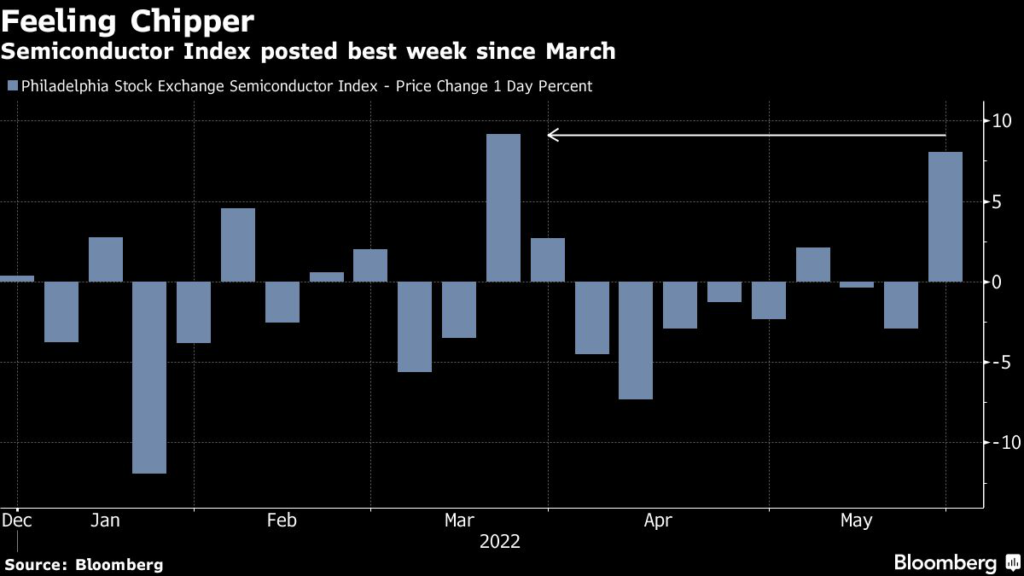
Chip stocks just had a spectacular run. The Philadelphia Stock Exchange Semiconductor Index rose 8.1% last week, snapping two weeks of declines and posting the biggest gain in more than two months. The rebound was fueled by a rally in the broader market and robust results by some companies like Marvell Technology Inc. 

Top Tech Stories

  • US-listed Chinese stocks such as e-commerce giant Alibaba Group Holding Ltd. jumped, putting them on track to wipe out their monthly losses. The easing of lockdown measures in major cities and better-than-expected economic data reassured investors
  • Tesla Inc. and Volkswagen AG plan to keep workers at their Shanghai factories isolated in so-called closed loop management systems until June 10, according to people familiar with the matter, even as authorities allow most residents to move freely around the city amid falling Covid-19 cases
  • Telecom Italia SpA is seeking an enterprise value of about 20 billion euros ($21.5 billion) for the landline network it plans to sell to Italy’s state lender and a group of international funds, according to people with knowledge of the matter
  • A lobby group including Apple Inc. and other technology giants operating in India called out the country’s authorities for misunderstanding how patent fees work, following local officials’ dispute with Xiaomi Corp.
  • Tiger Global Management has further reduced its holding in Just Eat Takeaway.com NV after a slump of more than 70% in the food-delivery service’s share price

(Adds stock move in fourth paragraph.)

More stories like this are available on bloomberg.com

©2022 Bloomberg L.P.

Stocks Slide as Inflation Fears Mount; Bonds Fall: Markets Wrap

(Bloomberg) — US stocks fell Tuesday as inflation pressures accelerated in Europe, intensifying the debate over how quickly central banks will raise interest rates in response. 

The S&P 500 fell 1%, led lower by health care and industrials, while the Nasdaq 100 and Europe’s Stoxx 600 Index also slid. Treasury yields climbed across the curve, joining the selloff in German bunds and European bonds. The dollar advanced. 

Euro-zone consumer prices jumped 8.1% from a year earlier in May, exceeding the 7.8% median estimate in a Bloomberg survey. Meanwhile, WTI crude oil rose above $119 a barrel after the European Union agreed to pursue a partial ban on Russian oil.

Fears central bank rate hikes in response to stubbornly high inflation are keeping investors watchful. Global stocks are on track to end the month with modest gains amid skepticism about whether the market is near a trough and as volatility stays elevated. 


“It’s very hard to have conviction at the moment,” Mike Bell, global market strategist at JPMorgan Asset Management, said in an interview with Bloomberg Television. “We think it makes sense to be neutral on stocks and pretty neutral on bonds actually.” The possibility that Russia could retaliate to the EU move on oil by disrupting gas flows “would make me be careful about being overweight risk assets at the moment,” he said.

President Joe Biden will hold a rare Oval office meeting on Tuesday with Federal Reserve Chair Jerome Powell amid the highest inflation in decades and ahead of US payroll numbers later this week. The meeting comes after Fed Governor Christopher Waller said Monday he wants to keep raising rates in half-percentage point steps until inflation is easing back toward the central bank’s goal. 

“This time, the Fed’s tightening cycle will be longer, and policy rates and bond yields will have to go higher than markets currently expect,” Franklin Templeton Fixed Income Chief Investment Officer Sonal Desai said in a note. “The corresponding risk to asset prices and economic growth is greater than many like to admit.”

Among individual stock moves, Deutsche Bank AG slipped after the lender and its asset management unit had their Frankfurt offices raided by police. Unilever Plc jumped as activist investor Nelson Peltz joined its board. US energy stocks rose following the advance in crude oil prices. And US-listed Chinese stocks also climbed, on track to wipe out their monthly losses as easing in lockdown measures in major cities and better-than-expected economic data reassured investors. 

“Despite a potential strong finish to a historically weak month, the SPX is still coming into June with a loss of more than 10%,” Craig W. Johnson, chief market technician at Piper Sandler, said in a note. “The good news is that for similar performance years, the index has historically rebounded into year-end. For years with losses of more than 10% from January to May, the SPX has posted average and median June to December returns of 6.3% and 5.8%, respectively.”

Elsewhere, Bitcoin was back above $31,000 as investors and strategists said the digital currency is showing signs of bottoming out.

How will markets be affected by the Fed’s quantitative tightening? QT officially starts Wednesday and is the theme of this week’s MLIV Pulse survey. Click here to participate anonymously.

Here are some key events to watch this week:

  • The Federal Reserve is set to start shrinking its $8.9 trillion balance sheet Wednesday
  • The Fed releases its Beige Book report on regional economic conditions Wednesday
  • New York Fed President John Williams, St. Louis Fed President James Bullard speak at separate events Wednesday
  • OPEC+ virtual meeting Wednesday
  • Cleveland Fed President Loretta Mester discusses the economic outlook Thursday
  • US May employment report Friday
  • The UN’s Food and Agriculture Organization releases its monthly food price index at a time of maximum concern about global supplies on Friday

Some of the main moves in markets:

Stocks

  • The S&P 500 fell 1% as of 9:48 a.m. New York time
  • The Nasdaq 100 fell 0.8%
  • The Dow Jones Industrial Average fell 1.2%
  • The Stoxx Europe 600 fell 0.6%
  • The MSCI World index fell 0.8%

Currencies

  • The Bloomberg Dollar Spot Index rose 0.5%
  • The euro fell 0.7% to $1.0702
  • The British pound fell 0.6% to $1.2577
  • The Japanese yen fell 0.9% to 128.78 per dollar

Bonds

  • The yield on 10-year Treasuries advanced 10 basis points to 2.84%
  • Germany’s 10-year yield advanced seven basis points to 1.13%
  • Britain’s 10-year yield advanced eight basis points to 2.07%

Commodities

  • West Texas Intermediate crude rose 3.2% to $118.76 a barrel
  • Gold futures fell 0.1% to $1,854.60 an ounce

More stories like this are available on bloomberg.com

©2022 Bloomberg L.P.

China’s Home Sales Slump Persisted in May During Lockdowns

(Bloomberg) — China’s home sales slump persisted in May as Covid outbreaks in key cities overshadowed efforts to revive buyer confidence.

The 100 biggest real estate developers saw new-home sales plummet 59% in May from a year earlier, according to preliminary data from China Real Estate Information Corp. The drop matched April’s decline as the biggest this year. 

The figures are another blow for the embattled property sector, which has been hit by strict coronavirus lockdowns and a liquidity crisis among developers. Under pressure to halt an economic slowdown, Chinese authorities stepped up efforts in May to salvage the residential market by urging banks to lend more, lower mortgage costs and ease rules on owning multiple properties. 

The property industry’s debt woes have been spreading to stronger firms as weaker sales hurt cash inflow. State-backed Greenland Holdings Corp. last week shocked investors by seeking to delay repayment on a dollar bond, spurring a broader selloff among higher-rated companies like Country Garden Holdings Co. 

“Property sales will remain weak, although the magnitude of the decline in sales will gradually narrow over the second half of 2022,” Moody’s Investors Service analysts including Yulia Wan wrote in a May 31 note. “Tight liquidity and weak sales will result in more property developers running into financial difficulties.”

More stories like this are available on bloomberg.com

©2022 Bloomberg L.P.

Close Bitnami banner
Bitnami