Bloomberg

Israel, UAE Ink Free Trade Pact in Boost to Economic Ties

(Bloomberg) —

Israel and the United Arab Emirates signed a broad economic pact that will eliminate most customs fees and help expand bilateral trade to more than $10 billion within five years, officials said. 

The formal signing of the agreement comes less than two years after Israel and the Gulf Arab state forged full diplomatic ties. It was negotiated earlier this year. 

The pact is the fastest free trade agreement to be signed in Israeli history, Prime Minister Naftali Bennett said in a tweet, describing it as the first of its scope to be signed between his country and an Arab nation.

The UAE is working to close more trade deals as it seeks to deepen its ties with fast-growing economies and draw billions of dollars in foreign investment, a UAE official told Bloomberg earlier this year. The Israel deal is expected to boost bilateral trade to more than $10 billion within five years, and add $1.9 billion to the UAE’s gross domestic product within the same period, UAE state-run WAM news agency reported. 

The Gulf nation signed a similar agreement with India in February and has started talks with former regional foe Turkey on the topic.  

The Israel deal, which covers items ranging from fertilizers to pharmaceuticals, will eliminate customs fees on 96% of the items traded between the two countries, Israel’s Economy Ministry said. 

“On the export side, the agreement is expected to give Israeli companies a competitive advantage and facilitate the activity of businesspeople in the Emirati market” the ministry said. “The agreement will help reduce the cost of living by lowering import costs to Israel.”

The accord also aims to promote trade in e-commerce and computing. It includes agreements on the protection of intellectual property, patents and copyrights.

The pact grants mutual access to the government procurement market, and in some tenders, suppliers from both countries will be able to participate on equal terms to those awarded to local suppliers, the Israeli Economy Ministry said.  

The agreement “will create a new paradigm for the region. It will accelerate growth and underscores a shared belief that the only way to build resilient and sustainable economies in a complex world is by doing so together,” UAE Minister of Economy Abdulla Bin Touq said. 


(Updates with trade forecast in lede and 4th paragraph, comment in last)

More stories like this are available on bloomberg.com

©2022 Bloomberg L.P.

UK Seeks to Rein In Big Four With Revamped Audit Rules

(Bloomberg) — The UK will bring in sweeping audit reforms aimed at reining in the dominance of the Big Four accountancy firms and cleaning up the industry following a string of high-profile scandals. 

The government said Tuesday that it will replace the Financial Reporting Council with a new watchdog that will be given tougher enforcement powers and be funded by an industry levy.

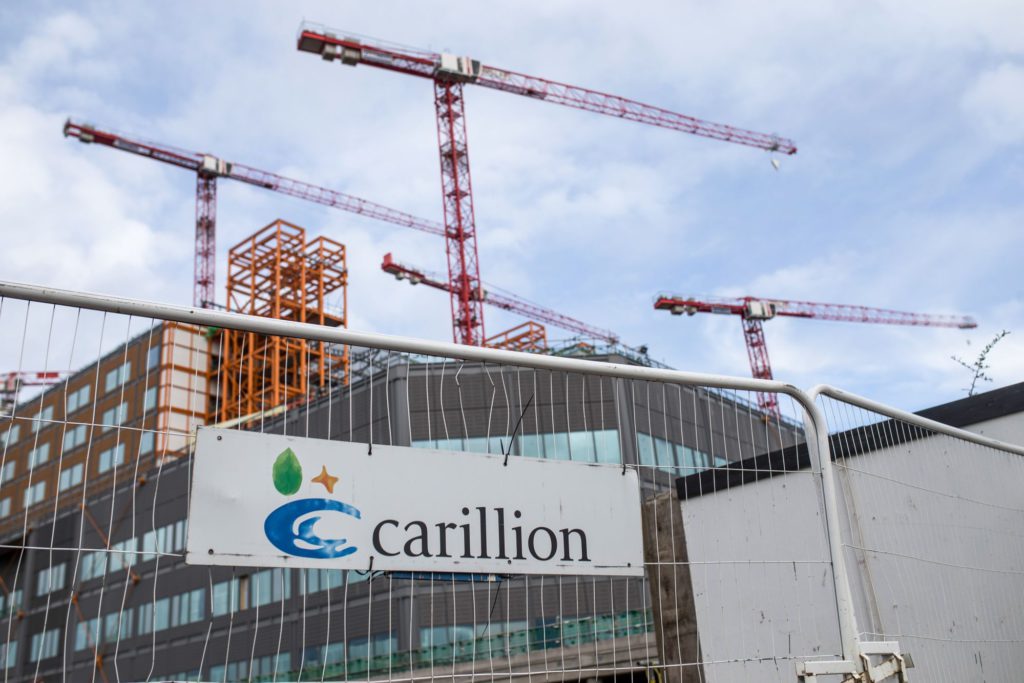
The widely awaited overhaul comes after lawmakers and practitioners promised to improve audit quality following a series of high-profile missteps such the collapse of Carillion Plc in 2018 and the BHS Ltd. failure in 2016. All of the major auditors accepted the need to change auditing since then and restructured their audit practices. 

The Audit, Reporting and Governance Authority will also have the ability to designate large private companies as “public interest entities” to ensure they are more transparent to investors. FTSE 350 firms will also need to conduct some of their audits with a challenger firm to PricewaterhouseCoopers, KPMG, Deloitte and Ernst & Young — to help nurture more competition. 

Missed Opportunity

Despite being generally well-received, the revamp faced some criticism. 

The FRC’s chief executive officer, Jon Thompson, said the government’s decision to not introduce a US-style federal law reporting regime is a “missed opportunity.” 

Jon Holt, chief executive at KPMG UK, agreed with Thompson about the lack of US-style reforms and said it offers businesses no defined framework for internal control and “risks a pick ’n’ mix approach to reporting and measurement.”

“While we await more details on the measures and clarity around timings, it is an opportunity to further strengthen the UK’s corporate reporting system and drive trust in business,” said Stephen Griggs, a managing partner at Deloitte. 

“The detailed response marks a step forward and its significance should not be underestimated,” Hemione Hudson, head of audit at PWC UK, said. EY didn’t immediately respond to a request for comment.

KPMG was fined over £14 million ($17.7 million) over misconduct on major work it carried out for Carillion and data services company Regenersis. The firm has faced ongoing criticism for the quality of its work. It has previously been fined millions of pounds over shoddy audits of companies including Conviviality Plc, Silentnight Group and Ted Baker Plc.

Administrators for NMC Health sued Ernst & Young in the U.K. over claims of negligent auditing spanning six years. Elsewhere Deloitte was penalized £15 million for its audit of Autonomy Corp., and PWC is being probed by the regulator for Greensill Capital and Sanjeev Gupta’s Wyelands Bank.

“This is about trying to reduce the risk as much as we can — these big unexpected collapses like Carillion and BHS,” Martin Callanan, minister for corporate responsibility, said in an interview. “We also want to reinforce the UK’s reputation with investors who rely on information about the health of these companies and it’s also about trying to restore public trust in big business through transparency and accountability for the people who run and the people who audit these businesses.”


(Updates with KPMG comments in seventh paragraph)

More stories like this are available on bloomberg.com

©2022 Bloomberg L.P.

Bonds Fall, Stocks Slide as Inflation Fears Mount: Markets Wrap

(Bloomberg) — Stocks and US equity futures dropped, while bonds fell Tuesday as euro-zone inflation accelerated to a fresh all-time high, intensifying the debate at the European Central Bank about how rapidly to raise interest rates.

S&P 500 and Nasdaq 100 contracts slipped at least 0.3%. Europe’s Stoxx 600 Index was set to snap four days of gains, retreating from a one-month high. Treasury yields climbed across the curve, joining Monday’s selloff in German bunds and European bonds. The dollar advanced. 

Brent crude oil rose above $120 a barrel after the European Union agreed to pursue a partial ban on Russian oil. Higher energy and food costs are keeping upward pressure on prices globally and squeezing consumers. Euro-zone consumer prices jumped 8.1% from a year earlier in May, exceeding the 7.8% median estimate in a Bloomberg survey. The acceleration was driven by food and energy after Russia’s invasion of Ukraine.

Global stocks are on track to end the month with modest gains amid skepticism about whether the market is near a trough and as volatility stays elevated. Fears that central bank rate hikes will induce a recession, stubbornly high inflation and uncertainty around how China will boost its flailing economy are keeping investors watchful. 

“It’s very hard to have conviction at the moment,” Mike Bell, global market strategist at JPMorgan Asset Management, said in an interview with Bloomberg Television. “We think it makes sense to be neutral on stocks and pretty neutral on bonds actually.” The possibility that Russia could retaliate to the EU move on oil by disrupting gas flows “would make me be careful about being overweight risk assets at the moment,” he said.

Among individual stock moves in Europe Tuesday, Deutsche Bank AG slipped after the lender and its asset management unit had their Frankfurt offices raided by police. Credit Suisse Group AG dropped after a report that the bank is weighing options to strengthen its capital. Unilever Plc jumped as activist investor Nelson Peltz joined its board. Royal DSM NV soared after agreeing to form a fragrances giant by combining with Firmenich.

US-listed Chinese stocks gained in New York premarket trading, on track to wipe out their monthly losses as easing in lockdown measures in major cities and better-than-expected economic data reassured investors. Alibaba Group Holding Ltd., JD.com Inc. and Baidu Inc. were higher. Electric carmakers also rose after China announced a 50% cut in the purchase tax for low-emission passenger vehicles.

With rate hikes in full swing in the US and the UK, the ECB is preparing to lift borrowing costs for the first time in more than a decade to combat the 19-member currency bloc’s unprecedented price spike.

In the US, Federal Reserve Governor Christopher Waller said he wants to keep raising interest rates in half-percentage point steps until inflation is easing back toward the central bank’s goal. 

Meanwhile, President Joe Biden will hold a rare Oval office meeting on Tuesday with Fed Chair Jerome Powell amid the highest inflation in decades and ahead of US payroll numbers later this week.

“This time, the Fed’s tightening cycle will be longer, and policy rates and bond yields will have to go higher than markets currently expect,” Franklin Templeton Fixed Income Chief Investment Officer Sonal Desai said in a note. “The corresponding risk to asset prices and economic growth is greater than many like to admit.”

Elsewhere, Bitcoin was back above $31,000 as investors and strategists said the digital currency is showing signs of bottoming out.

How will markets be affected by the Fed’s quantitative tightening? QT officially starts Wednesday and is the theme of this week’s MLIV Pulse survey. Click here to participate anonymously.

Here are some key events to watch this week:

  • Euro zone CPI Tuesday
  • The Federal Reserve is set to start shrinking its $8.9 trillion balance sheet Wednesday
  • The Fed releases its Beige Book report on regional economic conditions Wednesday
  • New York Fed President John Williams, St. Louis Fed President James Bullard speak at separate events Wednesday
  • OPEC+ virtual meeting Wednesday
  • Cleveland Fed President Loretta Mester discusses the economic outlook Thursday
  • US May employment report Friday
  • The UN’s Food and Agriculture Organization releases its monthly food price index at a time of maximum concern about global supplies on Friday

Some of the main moves in markets:

Stocks

  • Futures on the S&P 500 fell 0.6% as of 6:13 a.m. New York time
  • Futures on the Nasdaq 100 fell 0.3%
  • Futures on the Dow Jones Industrial Average fell 0.6%
  • The Stoxx Europe 600 fell 0.5%
  • The MSCI World index was little changed

Currencies

  • The Bloomberg Dollar Spot Index rose 0.3%
  • The euro fell 0.5% to $1.0728
  • The British pound fell 0.4% to $1.2603
  • The Japanese yen fell 0.3% to 127.91 per dollar

Bonds

  • The yield on 10-year Treasuries advanced eight basis points to 2.82%
  • Germany’s 10-year yield advanced two basis points to 1.08%
  • Britain’s 10-year yield advanced two basis points to 2.01%

Commodities

  • West Texas Intermediate crude rose 3.2% to $118.80 a barrel
  • Gold futures fell 0.2% to $1,852.80 an ounce

More stories like this are available on bloomberg.com

©2022 Bloomberg L.P.

UK Moves to Boost Stablecoin Protections After Terra Collapse

(Bloomberg) —

The UK government proposed additional safeguards to protect against the potential collapse of stablecoins, weeks after the implosion of one such instrument rocked cryptoasset markets. 

The government published a consultation paper on Tuesday that recommended amending existing legislation to address such risks, including giving the Bank of England additional powers to oversee the administration of failed stablecoin issuers of “systemic importance.” 

The proposal would broaden the UK’s existing plans to regulate stablecoins to take into account this month’s collapse of Terra, the stablecoin ecosystem whose failure wiped more than $40 billion off the value of its two main tokens. That event sparked renewed efforts by regulators around the world to ensure that stablecoins, whose values are pegged to an asset like the US dollar, don’t endanger financial stability. 

“Since the initial commitment to regulate certain types of stablecoins, events in cryptoasset markets have further highlighted the need for appropriate regulation to help mitigate consumer, market integrity and financial stability risks,” the Treasury said in its proposal, which will be considered by Parliament when time allows.

The UK’s Financial Conduct Authority plans to discuss Terra’s failure with the Treasury in coming months, Bloomberg reported earlier. The government’s initial proposal for stablecoin regulation was announced in April, just before Terra’s collapse. 

Read more: Terra Hasn’t Killed Crypto, But It Was a Narrow Escape

Under the proposal, the UK would amend its Financial Market Infrastructure Special Administration Regime, or FMI SAR, to include risks posed by possible failures of stablecoin firms that are not banks. The Treasury plans to require that FMI SAR becomes the general default framework for dealing with failed stablecoin projects, and to tweak it so that it can adequately address any risks to financial stability.

This means stablecoin projects could access bespoke insolvency arrangements if their collapse is judged to impact financial stability. The BOE would direct administrators to ensure that the continuity of a failed stablecoin issuer takes priority over the interests of creditors. 

The BOE would have to consult with the FCA before it seeks special administration for stablecoin firms. Treasury proposals in April had already recommended that stablecoin issuers that pose systemic risks would be required to operate under the BOE’s supervision, while smaller projects would sit under the FCA’s purview.

“Further work will be required to consider whether it would be appropriate to put in place a bespoke legal framework for the failure of such firms and, if so, its design,” the Treasury added, though its focus remains on making sure existing laws can be applied, too.

The Treasury will accept feedback on the consultation until Aug. 2.

More stories like this are available on bloomberg.com

©2022 Bloomberg L.P.

Japan’s Kishida Seeks Fresh Growth Via ‘New Capitalism’ Plan

(Bloomberg) — Japanese Prime Minister Fumio Kishida said the country needed to focus on new areas of growth as a panel laid out proposals for his “new form of capitalism” aimed at reducing social disparities and driving the economy. 

“We’ve put together a grand design for a new capitalism,” Kishida said at a meeting of the panel on Tuesday. “We’ll seek new growth, using the problems we face as a source of energy.”

The proposals are likely to get a cabinet rubber-stamp in early June. Kishida and several other cabinet ministers are on the panel, along with outside experts. 

The plan calls for more investment in human capital, greater support of innovation and startups as well as efforts to decarbonize and digitalize the economy.

Kishida’s push to make Japan’s capitalist model more equitable and more sustainable has attracted criticism from some investors, who are wary of earlier calls to increase the capital gains tax, curb share buybacks and remove the legal requirement for quarterly earnings reports.

The prime minister has walked back earlier comments that seemed to suggest efforts to spread the benefits of economic growth more widely might hurt shareholder profits. 

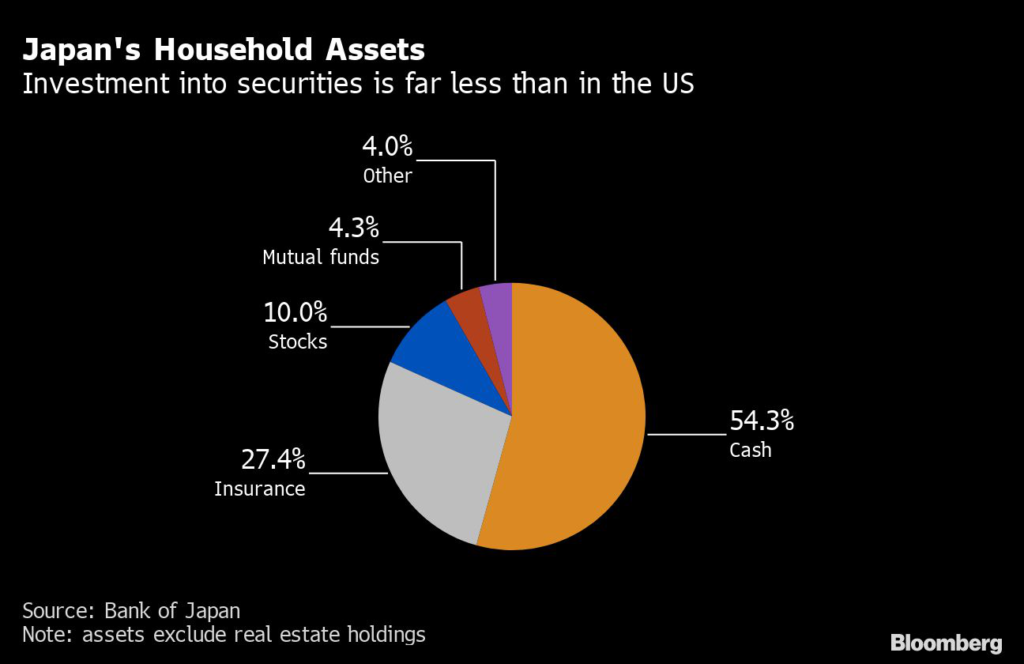
The plan includes calls for investment in training, proposals for enabling the establishment of blank-check investment companies, a goal to double household income from financial assets as well as a requirement for firms to reveal gender pay gaps among their employees. 

Read More: Japan Set to Make Companies Disclose Gender Pay Gap This Year

That suggests the panel may be leaving aside more controversial proposals for now. With recent polls showing the highest approval ratings for Kishida since he took office, he may be encouraged to take bolder steps once a key July election is over and his position is more secure.

The proposals recommend supporting around one million people to develop skills and re-join the labor force. Other recommendations include supporting next-generation semiconductor technology and issuing a new class of bonds to support clean energy industries. Concrete numbers for investment were generally lacking in the proposals. 

The plan is also aimed at doubling the asset-based incomes of citizens by encouraging people to move their savings into stocks and mutual funds. That move would mean a revamp of existing tax-free investment plans that were promoted during former Prime Minister Shinzo Abe’s administration, according to the proposal. 

One of the current programs allows up to 1.2 million yen ($9,370) of tax-exempt investment per year for five years. The plan echoes Japan’s postwar hyper-growth period in the 1960s, when Prime Minister Hayato Ikeda aimed to double household income, and succeeded. 

Earlier this month, the premier called on an audience in the City of London to “invest in Kishida.” Still, financial markets are likely to remain wary over his earlier comments about raising capital gains tax and limiting stock buybacks, moves that detractors say are against market interests. 

(Updates with comments from Prime Minister Fumio Kishida in second paragraph.)

More stories like this are available on bloomberg.com

©2022 Bloomberg L.P.

UK Cleans Up Accounting Sector With Revamped Audit Rules

(Bloomberg) — The UK will bring in sweeping reforms aimed at the faltering audit regime to rein in the dominance of the Big Four accountancy firms, in an attempt to clean up the sector following a string of high-profile scandals. 

The UK government said Tuesday that it will replace the sector’s regulator, the Financial Reporting Council, with a new watchdog that will be given tougher enforcement powers and be funded by an industry levy.

The widely awaited reforms come after the government and industry promised to improve audit quality following a series of past scandals such as the collapse of Carillion in 2018 and the BHS failure in 2016. All of the major auditors accepted the need to change auditing since then and restructured their audit practices. 

The Audit, Reporting and Governance Authority will also have the ability to designate large private companies as “public interest entities” to ensure they are more transparent with investors. FTSE 350 firms will also need to conduct some of their audits with a challenger firm to PricewaterhouseCoopers, KPMG, Deloitte and Ernst & Young — to help nurture more competition. 

Misssed Oppurtunity

Despite generally well received the new reforms didn’t go far enough for some. 

The FRC’s chief executive officer, Jon Thompson, said the regulator welcomes the government’s “much needed” reform, in a statement. However, the government’s decision to not introduce a US-style federal law reporting regime is a “missed opportunity.” 

KPMG and EY did not immediately respond to a request for comment.

“While we await more details on the measures and clarity around timings, it is an opportunity to further strengthen the UK’s corporate reporting system and drive trust in business,” Stephen Griggs, a managing partner at Deloitte, said. 

“The detailed response marks a step forward and its significance should not be underestimated,” Hemione Hudson, head of audie at PWC UK, said.

KPMG was fined over £14 million ($17.7 million) over misconduct on major work it carried out for Carillion and data services company Regenersis. The firm has faced ongoing criticism for the quality of its work. It has previously been fined millions of pounds over shoddy audits of companies including Conviviality Plc, Silentnight Group and Ted Baker Plc.

Administrators for NMC Health sued Ernst & Young in the U.K. over claims of negligent auditing spanning six years. Elsewhere Deloitte was penalized £15 million for its audit of Autonomy Corp., and PWC is being probed by the regulator for Greensill Capital and Sanjeev Gupta’s Wyelands Bank.

“This is about trying to reduce the risk as much as we can — these big unexpected collapses like Carillion and BHS,” Martin Callanan, minister for corporate responsibility, said in an interview. “We also want to reinforce the UK’s reputation with investors who rely on information about the health of these companies and it’s also about trying to restore public trust in big business through transparency and accountability for the people who run and the people who audit these businesses.”


(Updates with FRC CEO comments in fifth paragraph)

More stories like this are available on bloomberg.com

©2022 Bloomberg L.P.

China Factory Activity Gradually Improves as Lockdowns Ease

(Bloomberg) — China’s factories still struggled in May, but the slower pace of contraction suggests that the worst of the current economic fallout may be coming to an end as the country starts to ease up on its tough lockdowns.

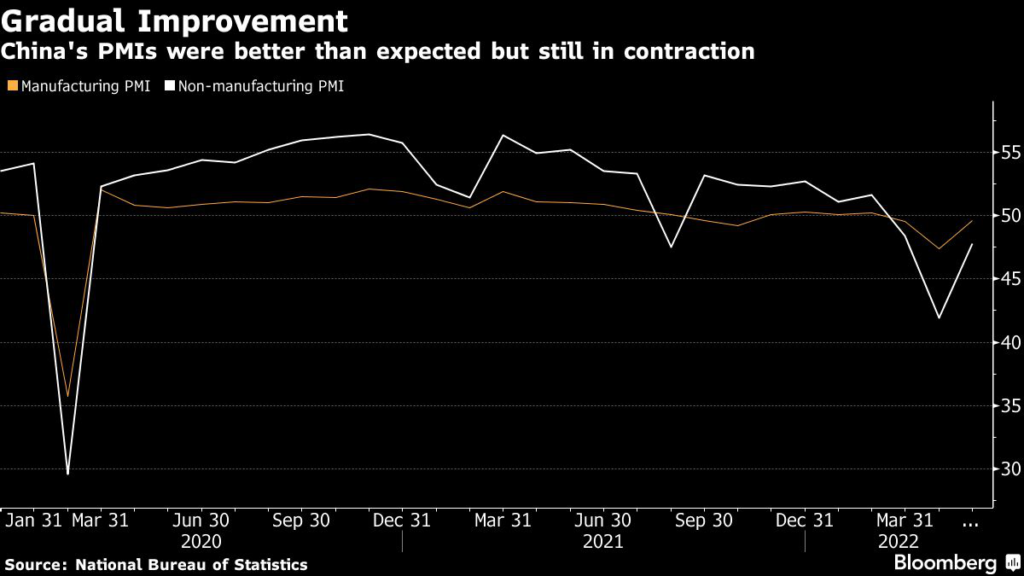
The official manufacturing purchasing managers index rose to 49.6 from 47.4 in April, according to data released by the National Bureau of Statistics on Tuesday. A reading below 50 still indicates a contraction, but the gauge was better than the median estimate of 49 in a Bloomberg survey of economists. 

The non-manufacturing gauge, which measures activity in the construction and services sectors, increased to 47.8 from April’s 41.9, above the consensus forecast of 45.5.

While the economy still hasn’t completely turned a corner, the better-than-expected data does suggest that efforts to ease some restrictions are helping companies resume production and putting a floor under the decline in activity. Even so, the pace of recovery will be slow this time around, and economists still predict growth will weaken to 4.5% this year — well below the government’s target of around 5.5%. 

Tuesday’s data indicates that “in-contact services sectors are still the epicenter of slowdown while the initial manufacturing sector recovery has been slower,” compared to the 2020 lockdown, said Liu Peiqian, chief China economist at NatWest Group Plc. “We think the pace and scale of recovery might be more gradual.”

What Bloomberg Economics Says …

The surprisingly big gains in China’s May PMIs suggest the worst of the economy’s slump may be over. The data show activity still broadly shrinking — but much less so than in April. Both production and demand saw much narrower contractions in the manufacturing sector.

— Chang Shu and David Qu, economists

Read the full report here

Zhao Qinghe, senior statistician at the NBS, noted the recovery in manufacturing production and demand, though said in a statement that the momentum “still needs to be strengthened.”

China’s benchmark CSI 300 Index closed 1.6% higher, one of the best performers in Asia, with information technology and telecommunications shares the main gainers. The yield on China’s 10-year government bonds climbed 2 basis points to 2.79% as of 5:02 p.m. local time.

Lingering Impact

The outlook for China’s economy has darkened this year amid widespread Covid outbreaks and stringent controls to curb infections. 

Lockdowns have begun to ease, allowing for some recovery in activity. And Beijing has tried to support growth through a variety of measures, and recently rolled out a broad support package that covered everything from consumption and investment to tax cuts and loan support. Premier Li Keqiang has also repeatedly called for local governments to do more to stabilize growth, warning of dire consequences if they don’t move decisively. 

But the effects of the restrictions on production and supply chains will still likely be felt for months as businesses struggle to restart.

Pressures from supply shocks and a fall in demand “are still severe and the impact of the pandemic on economic growth cannot be underestimated,” said Zhang Liqun, a researcher with the State Council’s Development Research Center, in a statement released by the China Federation of Logistics and Purchasing after Tuesday’s PMI data.

More than 50% of the surveyed companies said raw material prices and logistics costs are high, he said, while over 40% said demand is insufficient. The federation compiles the PMI data alongside the NBS.

Chinese authorities are vigilant about inflationary risks as global commodity prices remain high and the war in Ukraine continues, and are focusing on how to keep food and energy costs in check. 

China has enough coal inventory at major power plants for 32 days, said Zhao Chenxin, a vice head of the National Development and Reform Commission, the country’s top economic-planning agency. Oil product and natural gas inventories at key Chinese oil and gas firms are also at high levels, and there is enough to meet demand, he said at a briefing Tuesday.

Even if China manages to right its supply chains and address other risks quickly, any sustained recovery is still challenged by a lack of demand. The threat of a cycle of Covid lockdowns should there be more outbreaks has weighed on business confidence, making them more cautious about expanding. Consumers are also likely save up, rather than spend, if they’re uncertain about the future.

The recovery ultimately comes down to whether China locks down cities in the future, said Iris Pang, chief economist for Greater China at ING Bank NV. If those restrictions continue, “damages on the economy could be deep.”

(Adds details from market close and official comments on energy supply.)

More stories like this are available on bloomberg.com

©2022 Bloomberg L.P.

How Ford’s Electric Pickup Can Power Your House for 10 Days

(Bloomberg) — Spend an afternoon driving the Ford F-150 Lightning around the vineyards and redwood-shaded back roads of California wine country and the pickup’s considerable power is apparent. What makes the electric version of America’s best-selling vehicle a potential game-changer, though, is not its acceleration (zero to 60 miles per hour in 4.3 seconds) or its range (up to 320 miles on a charge). Rather it’s the technology that taps the Lightning’s battery pack to power your home or the electric grid itself during increasingly frequent climate-driven blackouts.

The extended-range Lightning’s 131 kilowatt-hour lithium-ion pack boasts almost 10 times the capacity of a Tesla Powerwall, an $11,000 home backup battery that can’t be driven to the supermarket. The Lightning is “a mini powerplant for your home,” says Jason Glickman, executive vice president for engineering, planning and strategy at California utility PG&E Corp. “It can support the grid on a hot summer day, when we have demand spiking.”

“At scale, when these vehicles are enabled to send energy back to the grid, flex alerts and notices of grid emergencies will be a thing completely of the past,” adds Glickman, whose utility is testing how to integrate the truck into its management of the grid.

He’s speaking from the tailgate of a Lightning, one of three parked on a hill overlooking vineyards at Dutton Ranch in Sebastopol, along with a top Ford executive and the president of Sonoma County Winegrowers, an association of 1,800 farmers that promotes sustainable agriculture. Ford staged the event earlier this month to showcase a pilot program that’s supplying Dutton Ranch and two other local farms with electric pickups and vans as part of a service called Ford Pro that helps businesses manage their vehicle fleets.

The Lightning is the first EV sold in the US with bi-directional charging capability enabled to supply electricity back to homes and the grid. On this day, Ford had not yet handed over electric trucks to the grape growers — it has a backlog of some 200,000 orders. (A week later, the company delivered the first Lightning to a customer in Michigan.) But the family-owned farms’ embrace of this 21st century rural electrification initiative indicates the prospects for transforming battery-powered pickups into vehicles to decarbonize the economy and build resilience against climate change.

Sonoma County Winegrowers president Karissa Kruse, speaking over a sound system plugged into a Lightning, says that at first, “growers were skeptical and there wasn’t a lot of enthusiasm for going electric, especially in their trucks. Now they’re like, ‘Can I get in on the pilot program? I heard you could get us a truck.’”

Some time with the Lightning shows why. While electric vehicles are often referred to as batteries on wheels, the Lightning might be better described as a mobile power strip. The extended-range Lightning I test drove featured a 240-volt outlet in the truck bed that can power heavy-duty machinery from 9.6 kilowatts of carbon-free electricity generated onboard. There are also two 120-volt outlets in the cab, four in the bed and another four in the cavernous front trunk that Ford calls a “Mega Power Frunk.”

“The real value right off the bat is the gas savings, as California gas prices are out-of-sight,” says Steve Dutton, a fifth-generation farmer and co-owner of Dutton Ranch, which is powered in part by a solar array. “As we get the trucks and put them into service, we’re going see more and more opportunities where we can use that electric power for equipment out in the field.”

The pickup’s ability to keep Dutton’s employees’ lights on is particularly attractive in a place like California, where wildfires and heat waves have triggered seasonal blackouts in recent years. “If there’s a power outage and the truck is parked at one of my boys’ houses, and he can run the house off the battery, that’s awesome,” says Dutton, who is married to Kruse.

Transforming a Lightning into a home generator requires Ford’s 80-amp charging station and a $3,895 home integration system from Sunrun Inc. Installation cost for the Sunrun system varies according to the home and location. The charging station comes with the extended-range version of the Lightning; it’s a $1,310 option for buyers of the standard 230 mile-range version of the pickup.

If the Lightning is plugged in when a blackout hits, the home automatically begins drawing electricity from the battery. When power is restored, the system disconnects and then resumes charging the vehicle. Ford says the Lightning can fully power an average home for roughly three days.

“That’s a house like my house with AC, Xbox, kids going crazy leaving lights on everywhere,” Linda Zhang, chief engineer of the F-150 Lightning, tells Bloomberg Green. With more frugal use, the Lightning could keep a home running for up to 10 days, she says.

Zhang, who has the backup system installed at her home, says half of retail reservations for the Lightning are from people who have never owned a truck. “That new customer to trucks is really being brought in, in my mind, by the Mega Power Frunk and by the Pro Power Onboard,” she says. “And some people are just truly, really interested in this product as a backup generator.”

She declined to say whether future Ford electric vehicles will feature bi-directional capability. 

Whether the technology helps speed electrification depends on how it will perform in day-to-day life, according to Debapriya Chakraborty, a researcher at the University of California at Davis Institute of Transportation Studies.

“If you need to travel during a power outage, there are some limitations,” says Chakraborty, who studies consumer attitudes toward EVs. “If you’re charging on solar, then you can use the battery power to probably run any machine in the evening, when electricity rates are higher.”

The version of the pickup aimed at commercial fleets, called the Lightning Pro, has a starting price of $39,974 before state and federal rebates and tax credits. With those incentives, the price is comparable with the base F-150 gasoline model. From there, the Lightning can veer into “cowboy Cadillac” territory, with increasingly luxe models that top out with the $90,874 Platinum edition.

Ford brought more than a dozen trucks to Sonoma for media test drives, and I spent an hour piloting a $77,000 “iced blue silver” Lightning Lariat around the Russian River Valley’s narrow winding roads, cocooned in a whisper-quiet cabin. The 6,600-pound pickup handled like a much smaller vehicle, and I can confirm Joe Biden wasn’t exaggerating when he said “this sucker’s quick” after a lap last year.

Not being a truck person, I needed a reality check. So I texted my impressions of the Lightning to my friend John, a craftsman who drives a 1990 F-150 and is the type of traditional customer Ford needs to electrify. “I want one!” he wrote back. “$40K — but I just filled the old truck to the tune of $140. I should get my name on the list.”

More stories like this are available on bloomberg.com

©2022 Bloomberg L.P.

Tesla, VW Keep Shanghai Workers Isolated Even as Lockdown Eases

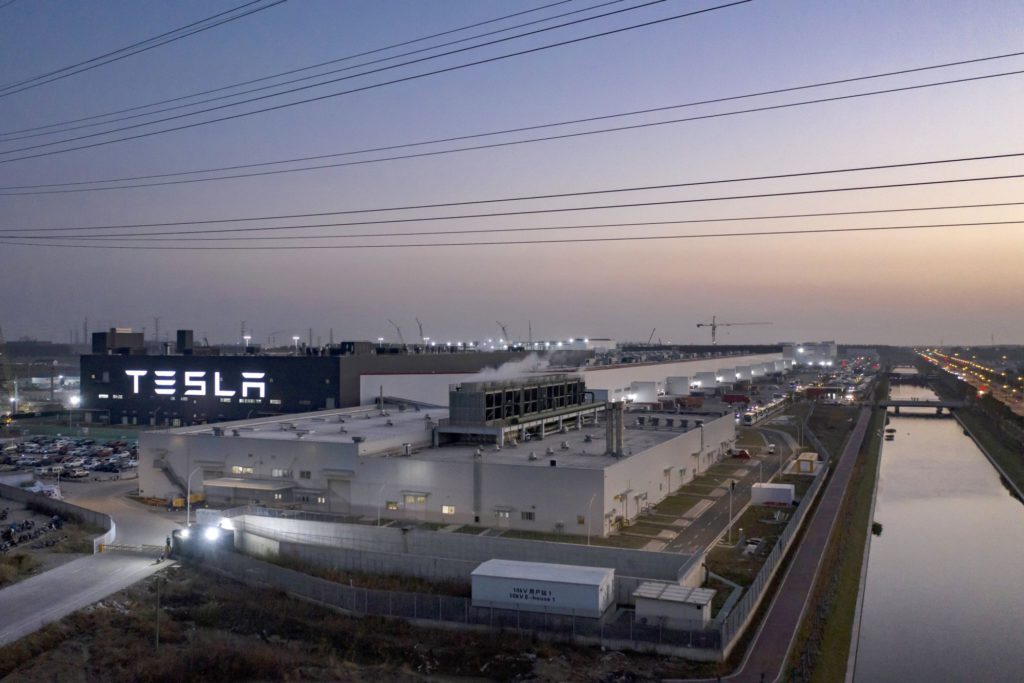
(Bloomberg) — Tesla Inc. and Volkswagen AG plan to keep workers at their Shanghai factories isolated in so-called closed loop management systems until June 10, according to people familiar with the matter, even as authorities allow most residents to move freely around the city amid falling Covid-19 cases.  

Elon Musk’s electric-car maker told the more than 10,000 workers living in Tesla’s “factory bubble” to be prepared to stay in the system until June 10, according to the people, who asked not to be named because the plans are private. While movement restrictions are being lifted for residents in low-risk parts of Shanghai, the company wants to have a 10-day buffer to ensure production stability, they said. 

Tesla has gone to great lengths to resume production at the Shanghai plant, which was shut for about three weeks from late March because of the city’s Covid lockdown, costing it around 40,000 units of lost output. Workers brought in to bring the factory back up to speed have been housed in disused factories and an old military camp, with day-shift and night-shift workers sharing beds in makeshift dorms. 

Read more: Tesla Quarantining Thousands of Workers to Restore China Output

VW’s Shanghai factory, operated with local partner SAIC Motor Corp., also told employees that it would keep its closed-loop system in place until June 10, according to an internal notice seen by Bloomberg News. All workers living on site have been asked to stay, while others should remain at home, the memo said. The company will gradually step up to full production between June 13 to June 30, it said. 

A representative for Tesla in China didn’t immediately respond to requests for comment. A spokesperson for VW said: “SAIC-VW is still under a closed-loop production system, and will further adjust production plans based on relevant policies,” without giving out a specific timeframe.

With Covid-19 cases easing, Shanghai is relaxing some of the strictest virus controls of the pandemic and moving to stimulate the country’s faltering economy. Residents in low-risks areas will be free to move around the city from June 1, and companies will no longer need to be on a “whitelist” to resume production. 

Tested Regularly

First used during the Beijing Winter Olympics as a way of keeping athletes and support staff separate from the wider population, closed loops, or factory bubbles, typically require workers to only go from on-site accommodation to the factory and back, and be tested regularly for Covid. The systems have been promoted by officials as a way to restart industry while limiting virus transmission. The toll on workers, however is significant, with staff constantly tested and separated from outside society.

Read more: Apple Supplier Faces Worker Revolt in Locked Down China Factory

China’s dogged adherence to stamping out the coronavirus at all costs has slowed everything from consumer spending to manufacturing in the world’s second-largest economy. 

Not a single car was sold in Shanghai last month and overall passenger vehicle sales in China tumbled 36% from a year ago to 1.06 million units, the biggest decline since March 2020, China Passenger Car Association data released earlier this month showed. 

The country cut the purchase tax on passenger cars by half as part of a raft of measures aimed at stimulating the economy. 

More stories like this are available on bloomberg.com

©2022 Bloomberg L.P.

Telecom Italia Seeks $21.5 Billion for Landline Network, Sources Say

(Bloomberg) — Telecom Italia SpA is seeking an enterprise value of around 20 billion euros ($21.5 billion) for the landline network it plans to sell to Italy’s state lender and a group of international funds, according to people with knowledge of the matter. 

The company’s shares rose as much as 5.9% and traded up 4.5% at 10:33 a.m. in Milan following Bloomberg’s initial report of the plan. That marked the best performance on Italy’s benchmark FTSE MIB index, giving the carrier a market value of about 6.4 billion euros.

The proceeds would allow the former phone monopoly, which has an enterprise value of about 36 billion euros and debt of around 30 billion euros according to Bloomberg data, to cut its debt pile, accelerating Chief Executive Officer Pietro Labriola’s turnaround plan, said the people, asking not to be named because the internal calculation isn’t public. The valuation is preliminary and could change, they said.

A spokesman for Telecom Italia declined to comment.

Telecom Italia said Sunday it’s preparing to sell off the entirety of its network in a plan that would shift control of the asset to the Italian state.

The phone carrier said it reached a preliminary, non-binding accord with state lender Cassa Depositi e Prestiti SpA, which serves as the government’s financial arm, to combine its grid with the network owned by smaller rival Open Fiber SpA, which is controlled by CDP.

Read more: Telecom Italia Kicks Off Plan to Sell Network to State, Funds

The accord also includes Open Fiber and Teemco, a Luxembourg company controlled by US private equity firm KKR & Co., which owns a stake in Telecom Italia’s FiberCop SpA fiber unit. Macquarie Group Ltd., a minority investor in Open Fiber, also signed the deal.

The news marks the end of an era for the carrier, which was privatized in 1997 and has struggled with financing for decades. The ex-monopoly is now hoping to use proceeds from the network sale to cut its debt pile and kick-start a fiber rollout for a country that lags far behind its European peers.

Telecom Italia earlier this year rejected a 10.8 billion-euro takeover proposal from KKR, preferring to push ahead with an in-house plan aligned with the Italian government’s goal of building a single national fiber network while avoiding duplicate investments. 

Labriola also wants to spin the company’s commercial services off into a separate unit. That process will need approval from Italian and European authorities, which could take several months, people familiar with the matter said. 

(Updates with shares in second paragraph.)

More stories like this are available on bloomberg.com

©2022 Bloomberg L.P.
Close Bitnami banner
Bitnami