Bloomberg

Japan Panel to Release Proposal for Kishida’s ‘New Capitalism’

(Bloomberg) — Japanese Prime Minister Fumio Kishida’s plans for what he calls a “new form of capitalism” aimed at reducing social disparities without hampering growth are likely to become clearer as early as Tuesday with the release of a key panel’s main proposals.

The premier is due to speak toward the end of the panel’s meeting later in the day. Local media including the Yomiuri newspaper have reported an outline of the plan will be published ahead of a likely cabinet rubber-stamp in early June. Kishida and several other cabinet ministers are on the panel, along with outside experts. 

Based on the discussions so far and media reports, the proposals are likely to call for more investment in human capital, greater support of innovation and startups as well as efforts to decarbonize and digitalize the economy.

Kishida’s drive to make Japan’s capitalist model more equitable and more sustainable has attracted criticism from some investors, who are wary of earlier calls to increase the capital gains tax, curb share buybacks and remove the legal requirement for quarterly earnings reports.

The prime minister has walked back earlier comments that seemed to suggest efforts to spread the benefits of economic growth more widely might hurt shareholder profits. 

Local media reports have so far focused on investment in training, proposals for enabling the establishment of blank-check investment companies, a goal to double household income from financial assets as well as a duty for firms to reveal gender pay gaps among their employees. 

That suggests the panel may be leaving aside more controversial proposals for now. With recent polls showing the highest approval ratings for Kishida since he took office, he may be encouraged to take bolder steps once a key July election is over and his position is more secure.

The proposal recommends supporting around one million people to develop skills and re-join the labor force, according to the Yomiuri. Other recommendations include supporting next-generation semiconductor technology and issuing a new class of bonds to support clean energy industries — although few concrete numbers for investment have been reported so far. 

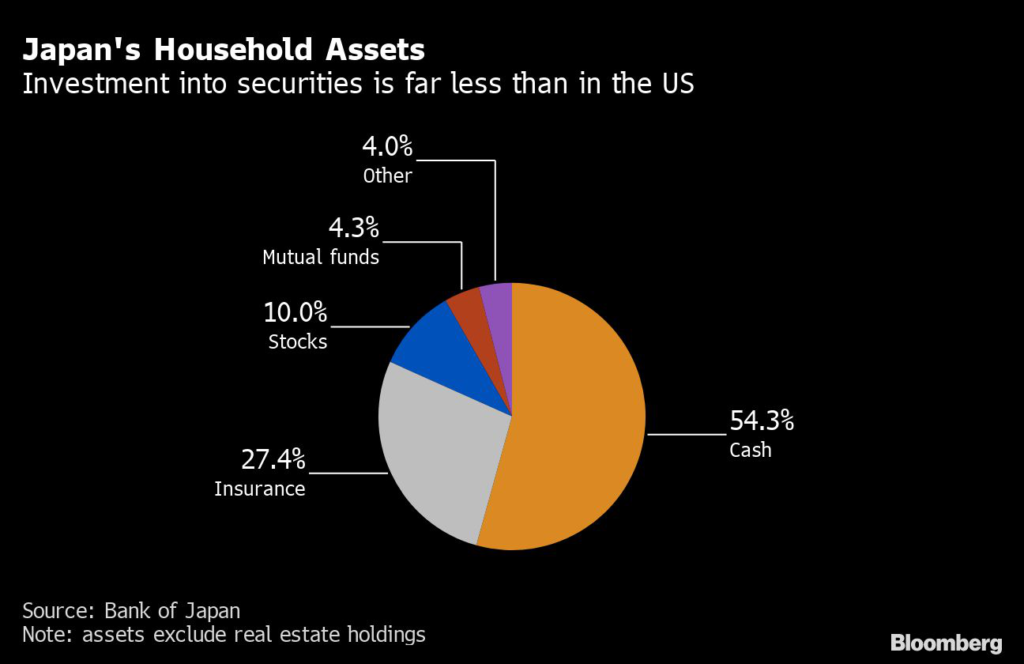
The plan is also aimed at doubling the asset-based incomes of citizens by encouraging people to move their savings into stocks and mutual funds, according to the Tokyo Shimbun. That move would mean an expansion of existing tax-free investment plans that were promoted during former Prime Minister Shinzo Abe’s administration, the newspaper said. 

The current program allows up to 1.2 million yen ($9,370) of tax-exempt investment per year for five years. The plan echoes Japan’s postwar hyper-growth period in the 1960s, when Prime Minister Hayato Ikeda aimed to double household income, and succeeded. 

Earlier this month, the premier called on an audience in the City of London to “invest in Kishida.” Still, financial markets are likely to remain wary over his earlier comments about raising capital gains tax and limiting stock buybacks, moves that detractors say are against market interests. 

More stories like this are available on bloomberg.com

©2022 Bloomberg L.P.

Singapore Starts Digital-Asset Initiative Amid Crypto Departures

(Bloomberg) — Singapore has begun a project to investigate potential uses of asset tokenization as the city state looks to establish itself as a hub for decentralized finance after several key crypto players left.

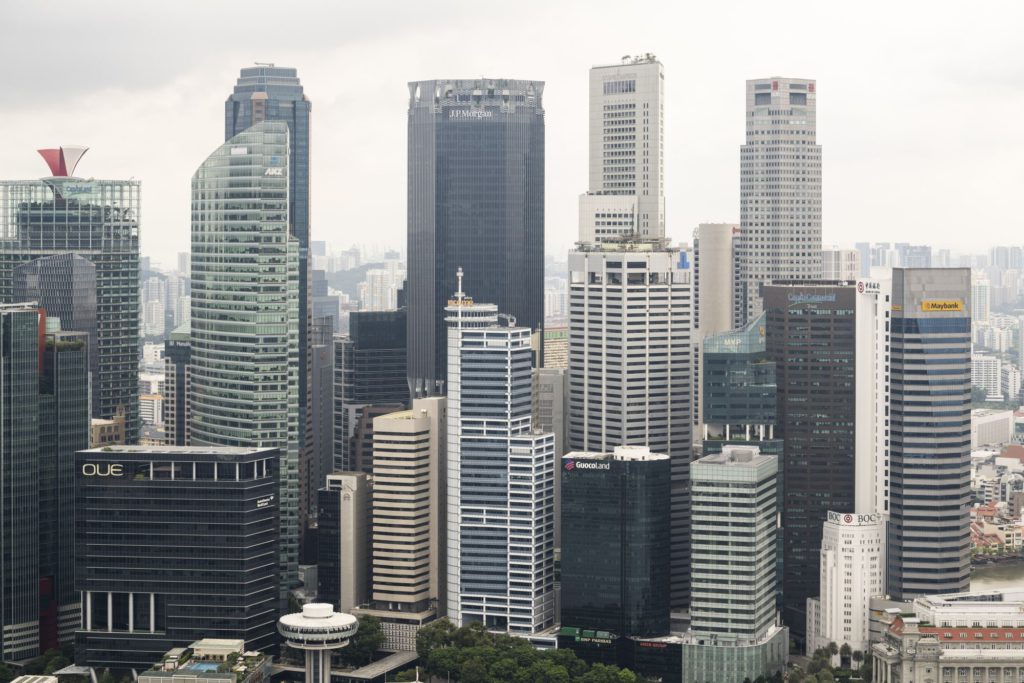
“Project Guardian,” a collaboration between the Monetary Authority of Singapore and the finance industry, will test the feasibility of applications in asset tokenization and decentralized finance (DeFi) while working to manage risks to financial stability and integrity, according to a statement from Deputy Prime Minister Heng Swee Keat on Tuesday.

The project aims to develop and pilot use cases in areas including open, interoperable networks; trust anchors; and institutional-grade DeFi protocols. The first pilot in the project will explore potential DeFi applications in wholesale funding markets. The pilot, led by DBS Bank Ltd., JPMorgan Chase & Co. and Marketnode Pte, involves the creation of a permissioned liquidity pool comprising tokenized bonds and deposits.

The MAS was relatively early among regulators to look at uses of blockchain technology, and Singapore set up a licensing regime a few years ago. However, applicants have been frustrated by the slowness of approvals, and a crypto advertising ban caught the industry off guard. 

Crypto players have been enticed particularly to Dubai, where the government is actively wooing companies in the space, with Bybit Fintech Ltd. moving its headquarters there from Singapore. Three Arrows also switched to that location and crypto exchange Binance Holdings Ltd. shifted many of its operations from Singapore.

“Through practical experimentation with the financial industry and the broader ecosystem, we seek to sharpen our understanding in this rapidly transforming digital assets ecosystem,” said Sopnendu Mohanty, chief fintech officer at the MAS. “The learnings from Project Guardian will serve to inform policy markets on the regulatory guardrails that are needed to harness the benefits of DeFi, while mitigating its risks.”

More stories like this are available on bloomberg.com

©2022 Bloomberg L.P.

GoTo Slides After Posting Wider Loss in First Report Since IPO

(Bloomberg) — GoTo Group shares declined after its quarterly losses widened, underscoring investor skepticism about the earnings potential of the Indonesian tech company that had its trading debut last month.

The stock fell as much as 3.8% to 302 rupiah in Jakarta after the ride-hailing and e-commerce operator reported a net loss of 6.47 trillion rupiah ($444 million) for the quarter though March, triple that a year earlier. Bernstein started coverage of the stock with an underperform rating and price target of 224.16 rupiah, implying room to fall 29%.

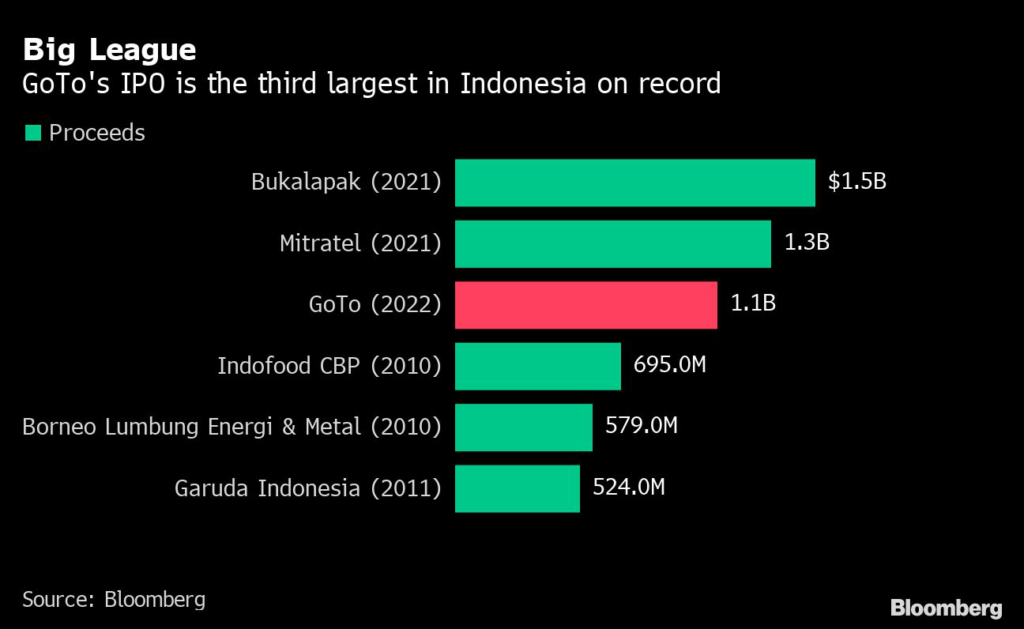
GoTo is trying to convince investors of its profitability prospects even as Russia’s invasion of Ukraine, soaring inflation and rising interest rates weigh on the technology industry globally. The company raised $1.1 billion in one of the world’s largest initial public offerings for 2022, gaining funds to compete against rivals such as Grab Holdings Ltd. as online services gain steam in Southeast Asia.

GoTo is the largest of a crop of companies seeking to ride the rapid pace of mobile penetration and internet use in Southeast Asia, a region of more than 650 million people. Yet Chief Executive Officer Andre Soelistyo still needs to reassure investors of the company’s earnings potential amid heavy spending to fend off competition and lure more users.

What Bloomberg Intelligence Says

“Local knowledge and cross-selling between Gojek and Tokopedia give GoTo an upper hand in the country, but rivals such as Grab and Sea may take a bigger share of the region’s broader internet economy as they expand in other countries while GoTo stays focused on Indonesia. Its roughly 10x forward multiple, based on our sales scenario, is rich vs. the duo and may be unsustainable.”

– Nathan Naidu, analyst

Click here for research

Gross revenue advanced 53% to 5.2 trillion rupiah in the quarter. For the calendar year 2021, the metric rose at about a 44% clip on a pro-forma basis. GoTo’s quarterly adjusted loss before interest, taxes, depreciation and amortization widened to 5.4 trillion rupiah.

The company is the result of last year’s merger between Indonesia’s two most valuable internet startups — ride-hailing provider Gojek and e-commerce firm Tokopedia — to get more firepower against rivals in an increasingly cutthroat market. Over the years, the two amassed a long list of investors, including Google, Tencent Holdings Ltd. and Sequoia Capital India.

GoTo is among Southeast Asian consumer-internet companies that are adding users at a rapid clip but have yet to generate sustainable profit. The company is enjoying a leadership position in Indonesia, a country of more than 270 million people whose mobile-savvy consumers are shopping on Tokopedia’s platform and ordering rides and food via Gojek’s app.

That has helped its shares outperform those of Grab, which became a publicly traded company through a merger with a U.S. special purpose acquisition vehicle late last year. GoTo shares have now lost about 10% since its IPO, valuing the company at about $24.7 billion. Grab, down about 70% since its SPAC merger, has a market capitalization of less than $10 billion.

Get More:

  • Gross revenue from on-demand services, which include ride-hailing, grew 58% to 3.1 trillion rupiah in the first quarter.
  • E-commerce gross revenue grew 53% to 1.9 trillion rupiah.
  • Its financial technology services business grew about 41% thanks to record GoPay users and GTV volumes.
  • The overall first-quarter take rate increased to 3.7% from 3.5%, credited to more monetization initiatives.
  • Total net revenue, which strips out incentives such as discounts for users, advanced 5.6% on a pro-forma basis to 1.5 trillion rupiah. That’s up 65% from a year earlier, the company said in an updated filing based on non-pro-forma numbers.
  • GoTo’s gross transaction value, the sum of transactions flowing through its platform, grew 46% to 140 trillion rupiah. Fintech services was the biggest contributor at about 55%.
  • In the second quarter, gross transaction value is set to increase to as much as 150 trillion rupiah, CEO Soelistyo said on a conference call.

More stories like this are available on bloomberg.com

©2022 Bloomberg L.P.

Chinese Film Starlet Fined a Million Dollars for Fat-Loss Ads

(Bloomberg) — Chinese actress Jing Tian was slapped with a million-dollar fine for breaching the nation’s advertising law by touting candies as a weight-loss drug.

Jing, who has been in Hollywood blockbusters such as “The Great Wall” with Matt Damon and “Kong: Skull Island,” has been a brand ambassador for Infinite Free, a Guangzhou-based company that claimed its fruit and vegetable candy could prevent the body from absorbing sugars, oils and fats. 

In the ads, which have since been pulled from e-commerce sites such as Alibaba’s Taobao and JD.com, the 33-year-old actress said that people could keep in shape by taking two “candies” after eating a meal. The local regulator in Guangzhou imposed a 7.22 million yuan ($1.1 million) fine on May 28, saying ordinary food can’t be claimed to have therapeutic effects under the advertising law. The state regulator said it supported the decision in a follow-up statement, adding that market regulators nationwide should step up supervision of celebrities’ advertising activities.

Jing is the latest celebrity to be caught up in a year-long crackdown on the entertainment industry. Regulators have targeted what state media outlets have characterized as “improper” idol worship, excessive wealth held by some and dubious tax practices. The Chinese cyberspace regulator last year told social media platforms to remove all rankings of celebrities. One of China’s most popular film stars, Zhao Wei, was blacklisted from the nation’s internet, and actress Zheng Shuang was ordered to pay 299 million yuan in overdue taxes, late fees and fines.

Jing, who raked in 2.6 million yuan in “illegal income” from the endorsement, apologized on the Twitter-like Weibo platform, saying she didn’t do enough due diligence when she signed her contract. 

“I hereby offer my solemn apology, for failing to fulfil my obligations to examine the contract during the process of signing and for the negative impact on consumers that trust the related product,” she wrote. “I’ll never advertise for any product in this category in future to prevent this from happening again.”

More stories like this are available on bloomberg.com

©2022 Bloomberg L.P.

Giant Deep Ocean Turbine Trial Offers Hope of Endless Green Power

(Bloomberg) — Power-hungry, fossil-fuel dependent Japan has successfully tested a system that could provide a constant, steady form of renewable energy, regardless of the wind or the sun. 

For more than a decade, Japanese heavy machinery maker IHI Corp. has been developing a subsea turbine that harnesses the energy in deep ocean currents and converts it into a steady and reliable source of electricity. The giant machine resembles an airplane, with two counter-rotating turbine fans in place of jets, and a central ‘fuselage’ housing a buoyancy adjustment system. Called Kairyu, the 330-ton prototype is designed to be anchored to the sea floor at a depth of 30-50 meters (100-160 feet).

In commercial production, the plan is to site the turbines in the Kuroshio Current, one of the world’s strongest, which runs along Japan’s eastern coast, and transmit the power via seabed cables.

“Ocean currents have an advantage in terms of their accessibility in Japan,” said Ken Takagi, a professor of ocean technology policy at the University of Tokyo Graduate School of Frontier Sciences. “Wind power is more geographically suited to Europe, which is exposed to predominant westerly winds and is located at higher latitudes.” Japan’s New Energy and Industrial Technology Development Organization (NEDO) estimates the Kuroshio Current could potentially generate as much as 200 gigawatts — about 60% of Japan’s present generating capacity. 

Like other nations, the lion’s share of investment in renewables has gone into wind and solar, especially after the Fukushima nuclear disaster curbed that nation’s appetite for atomic energy. Japan is already the world’s third largest generator of solar power and is investing heavily in offshore wind, but harnessing ocean currents could provide the reliable baseline power needed to reduce the need for energy storage or fossil fuels.

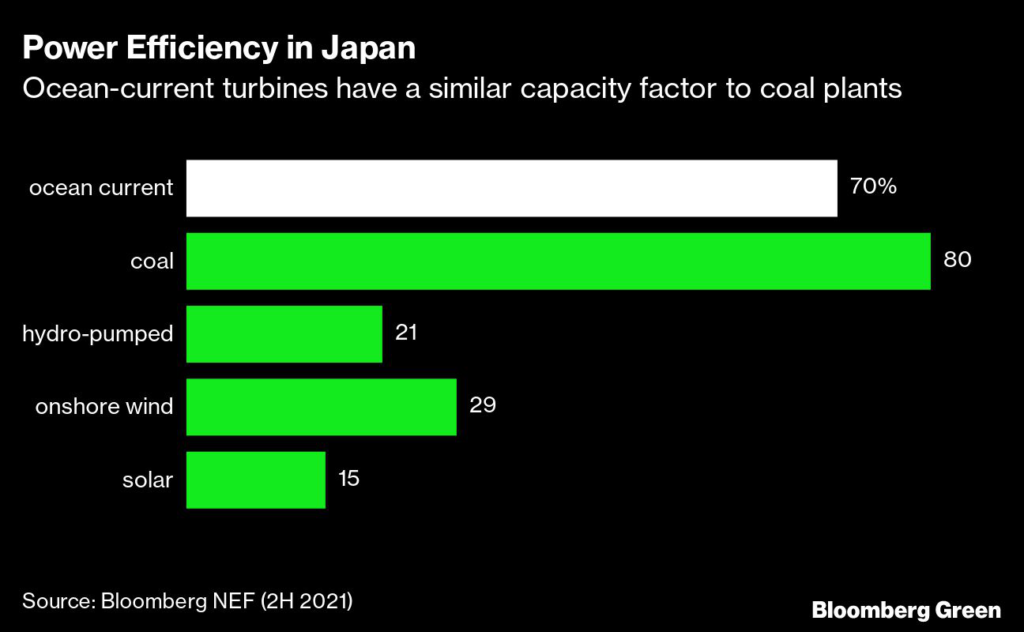
The advantage of ocean currents is their stability. They flow with little fluctuation in speed and direction, giving them a capacity factor — a measure of how often the system is generating — of 50-70%, compared with around 29% for onshore wind and 15% for solar. 

In February, IHI completed a 3 ½ year-long demonstration study of the technology with NEDO. Its team tested the system in the waters around the Tokara Islands in southwestern Japan by hanging Kairyu from a vessel and sending power back to the ship. It first drove the ship to artificially generate a current, and then suspended the turbines in the Kuroshio. 

The tests proved the prototype could generate the expected 100 kilowatts of stable power and the company now plans to scale up to a full 2 megawatt system that could be in commercial operation in the 2030s or later. 

Like other advanced maritime nations, Japan is exploring various ways of harnessing energy from the sea, including tidal and wave power and ocean thermal energy conversion (OTEC), which exploits the difference in temperature between the surface and the deep ocean. Mitsui OSK Lines Ltd. has invested in UK-based Bombora Wave Power to explore the potential for the technology in Japan and Europe. The company is also promoting OTEC and began operating a 100 kW demonstration facility in Okinawa in April, according to Yasuo Suzuki, general manager of the corporate marketing division. Kyushu Electric’s renewable unit Kyuden Mirai Energy begins a 650 million yen ($5.1 million) feasibility test this year to produce 1 MW of tidal power around the Goto Islands in the East China Sea.  The government this month also proposed changes to offshore wind auctions that could speed up development.

Among marine-energy technologies, the one advancing fastest towards cost-effectiveness is tidal stream, where “the technology has advanced quite a long way and it definitely works,” said Angus McCrone, a former BloombergNEF chief editor and marine energy analyst. Scotland-based Orbital Marine Power is one of several companies constructing tidal systems around Orkney, location of the European Marine Energy Centre. Others include SIMEC Atlantis Energy’s MeyGen array and California-based Aquantis, founded by US wind pioneer James Dehlsen, which reportedly plans to start testing a tidal system there next year.

While tidal flows don’t run 24 hours, they tend to be stronger than deep ocean currents. The Kuroshio current flows at 1 to 1.5 meters per second, compared with 3 meters per second for some tidal systems. “The biggest issue for ocean current turbines is whether they could produce a device that would generate power economically out of currents that are not particularly strong,” said McCrone.

Ocean Energy Systems, an intergovernmental collaboration established by the International Energy Agency, sees the potential to deploy more than 300 gigawatts of ocean energy globally by 2050.

But the potential for ocean energy is location dependent, taking into account the strength of currents, access to grids or markets, maintenance costs, shipping, marine life and other factors. In Japan, wave energy is moderate and unstable through the year, while areas with strong tidal currents tend to have heavy shipping traffic, Takagi said. And OTEC is better suited to tropical regions where the temperature gradient is bigger. One of the advantages of the deep ocean current is it doesn’t restrict navigation of ships, IHI said.

Still, the Japanese company has a long way to go. Compared with onshore facilities, it’s much more complicated to install a system underwater. “Unlike Europe, which has a long history of the North Sea Oil exploration, Japan has had little experience with offshore construction,” said Takagi. There are major engineering challenges to build a system robust enough to withstand the hostile conditions of a deep ocean current and to reduce maintenance costs. 

“Japan isn’t blessed with a lot of alternative energy sources,” he said. “People may say that this is just a dream, but we need to try everything to achieve zero carbon.”

With the cost of wind and solar power and battery storage declining, IHI will also need to demonstrate that overall project costs for ocean current power are competitive. IHI aims to generate power at 20 yen per kilowatt-hour from large-scale deployment. That compares with about 17 yen for solar in the country and about 12-16 yen for offshore wind. IHI also said it conducted an environmental assessment before it launched the project and will use the test results to examine any impact on the marine environment and fishing industry.

If successful at scale, deep ocean currents could add a vital part in providing green baseline power in the global effort to phase out fossil fuels. IHI’s work could help Japan’s engineering take a leading role with government support, said McCrone.

IHI has to make a convincing argument that “Japan could benefit from being a technology leader in this area,” he said.


More stories like this are available on bloomberg.com

©2022 Bloomberg L.P.

Smart Ring That Acts as Wallet and Key Gets Backing From Big Japanese Firms

(Bloomberg) — Itochu Corp., Mitsubishi UFJ Financial Group Inc. and other companies are investing in Evering, a chip-embedded smart ring that can act as a wallet and a key, people with knowledge of the matter said. 

Evering is backed by MTG Co., a listed Japanese health and beauty company. MTG struck a contract with Visa Inc. last year and began selling rings in Japan, which cost about 20,000 yen ($158) apiece, including tax. 

As retailers around the world seek ways to make it easier for consumers to shop seamlessly without touching anything, Evering and MTG are betting that their smart ring will resonate with early adopters. Made out of zirconia, the finger-worn gadget lets people do things such as lock and unlock doors, as well as pay for drinks in stores.

Read more: Smart Rings Seen as New Frontier for Cashless Payments

MTG disclosed that they are raising about 1 billion yen from investors in a securities filing on Tuesday. More than a dozen investors are participating in the financing for Evering, which may eventually seek a public listing, said the people, who asked not to be identified because the negotiations aren’t public. Potential backers include Daiwa House Industry Co. and Toppan Inc. 

A representative for MTG declined to comment on investors. Itochu confirmed that it is participating in the funding, as did Daiwa House, which plans to integrate Evering’s technology into homebuilding. Spokespeople for Mitsubishi UFJ and Toppan declined to comment.   

The Covid-19 pandemic has made touchless payments a much more popular method of purchasing. Evering users can pay for goods by holding it over a payment terminal. The ring, which is waterproof and doesn’t require charging, is linked to a credit card and payment histories can be accessed via smartphones.

MTG, which went public in 2018, also offers the Sixpad exercise system and facial products. Shares of the company rose as much as 9.2% in early trading on Tuesday.

Yoshihito Ohta, MTG’s chairman, said in an interview last year that his goal is for Evering to reach a market capitalization of at least 100 billion yen.

(Updates with comment, company statement, share reaction.)

More stories like this are available on bloomberg.com

©2022 Bloomberg L.P.

These China Developer Bonds Are Flashing Big Warning Signals

(Bloomberg) — A debt crisis in China’s property industry has sparked a record wave of defaults and dragged more developer bonds down to distressed levels.

Risks are now spreading to even higher-rated borrowers. A property firm long considered among the nation’s most resilient, Greenland Holdings Corp., shocked investors last week with a proposed dollar-bond payment delay. Earlier this month, China’s fourth-largest developer, Sunac China Holdings Ltd., became one of the biggest to default. 

That suggested most private Chinese developers face the risk of a missed payment if they can’t access fresh financing, according to some analysts.

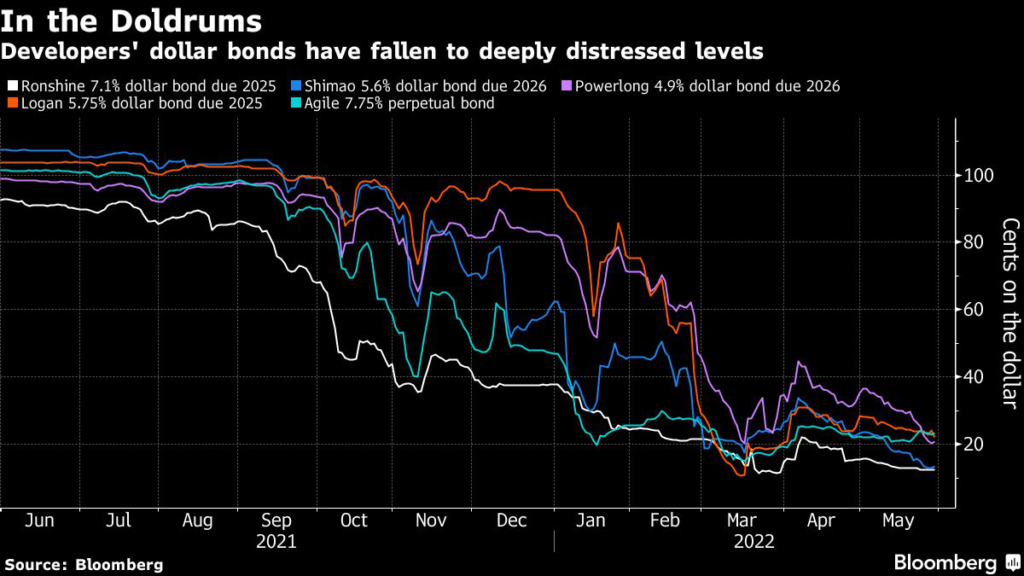
Refinancing in global debt markets is out of the question for many firms after average yields on their junk dollar notes jumped above 20%. Covid lockdowns in Shanghai and elsewhere have added to pressure on home sales, amid a sector cash crunch sparked by a crackdown on excessive leverage. Goldman Sachs Group Inc. analysts recently raised their projected 2022 default rate for high-yield Chinese developers to 31.6% from a previous forecast of 19%. 

The following is a list of the five developers in a Bloomberg index of Chinese high-yield dollar bonds that have at least one such security indicated below 25 cents on the dollar, and that each have at least $600 million of onshore and offshore note payments due the rest of this year. The firms didn’t immediately have a comment when contacted by Bloomberg. Debt figures mentioned below are based on data compiled by Bloomberg. The developer rankings cited are by sales and are from China Real Estate Information Corp. 

Shimao Group Holdings Ltd. 

The luxury builder was previously considered among China’s healthier property firms. But its status as one the sector’s biggest bond issuers left investors concerned about its liquidity as the broader industry crisis deepened, and the company lost its investment-grade ratings. This month, Shimao’s key onshore unit for the first time sought to delay repayment on a public onshore note.

The country’s 20th-largest developer this year by contracted sales has $2.1 billion of bond payments to make the rest of 2022, including a $1 billion dollar note maturing July 3. Meanwhile, trading of its shares in Hong Kong has been suspended since the start of April because it hasn’t released 2021 results.

Agile Group Holdings Ltd.

Investor views are split between the immediate and the longer term risks when it comes to Agile, which develops villa apartments and high-rise homes set amid landscaped gardens. Its bonds due in August jumped above 80 cents on the dollar after some recent loan payments. But the firm’s other offshore notes range from 23 cents to 39 cents, highlighting longer-term concerns.

Agile, China’s 28th-biggest builder, has $1.16 billion of bond obligations due through year-end, including $600 million of principal on the August notes and a 1.5 billion yuan ($225 million) security due in July. Its shares earlier this month hit a 13-year low.

Ronshine China Holdings Ltd.

China’s 23rd biggest builder garnered attention in February, when its dollar securities fell amid a slump at Zhenro Properties Group Ltd. That firm’s founder is a brother of Ronshine Chairman Ou Zonghong. But unlike Zhenro it’s avoided having to seek debt exchanges and hasn’t missed any note payments.

Ronshine has $937 million of bond payments yet to make this year, with the lion’s share being a $688 million note due in October. Ronshine was among developers whose auditor resigned during the recent earnings season, and its 2021 report is slated to be released by Tuesday. 

Logan Group Co.

Worries about the possible scale of builders’ undisclosed leverage has kept Logan in the spotlight. Two major credit rating firms withdrew their grades on the builder in the past two months, part of a wave of such actions in the sector this year. The company earlier this month asked its auditor to resign, saying a timetable to complete the 2021 audit couldn’t be reached.

Logan has a scheduled $1 billion of note payments the rest of this year that include a $279 million bond in August. The company, China’s 22nd-largest builder, has had its shares halted since May 12 amid the lack of audited results.

Powerlong Real Estate Holdings Ltd.

The Shanghai-based developer’s notes have been among May’s worst performers after the city’s Covid lockdowns. Powerlong, which also builds commercial projects and is a shopping-mall owner, ranks 43rd this year by contracted home sales. It has $694 million of onshore and offshore bond payments due the rest of this year, including a $200 million note maturing July 25.

The firm conducted repurchases and redemptions earlier this year. But market prices have signaled continued concern recently, with July’s offshore note back at 50 cents on the dollar and most others below 30 cents. A Powerlong unit said Friday it won’t redeem a 500 million yuan perpetual note, which would increase the bond’s coupon by three percentage points.

More stories like this are available on bloomberg.com

©2022 Bloomberg L.P.

China Is Leading the Global Decline in Venture Capital Deals

(Bloomberg) — China, once the primary rival to Silicon Valley’s technology success, is now leading the global decline in venture capital investments.

The value of venture deals in the country tumbled 44% to $24.7 billion in the first four months of the year, compared with a year earlier, according to data from the research firm Preqin. That’s almost twice the rate of decline in the US and nearly four times the pace of the global slide.

A rout is sweeping the entire tech industry this year, which some have argued is well-earned and overdue. After more than a decade of surging valuations, the sector has taken a beating, with prominent stocks like Amazon.com Inc. and Tesla Inc. tumbling and venture investors pulling back from high-risk deals.

Silicon Valley venture firm Sequoia Capital warned founders and chief executives last week that the good times are over and they need to prepare for a new era with severely constrained access to capital. “Rates are rising, money is no longer free, and that has massive implications for valuations and fundraising,” it said in a presentation for its portfolio companies.

China’s situation has been aggravated by the Communist Party’s crackdown on tech giants and rigid policies for stamping out Covid-19. Lockdowns in cities like Shanghai have hampered all manner of business, from advertising and investments to the production of Tesla automobiles and Apple Inc. iPhones.

“Last year, because of domestic policy, the financing progress was slowed down, while this year many fundraising deals were completely suspended due to the impact of the plunge of the global capital market and the outbreak of the pandemic,” Duane Kuang Ziping, founding managing partner of Qiming Venture Partners, wrote in an article published this month. 

Many startups that were seeking financing have been in a difficult situation for more than a year, wrote Kuang. Qiming has made roughly the same amount of investments from January to April this year as the same period a year ago, though many were follow-on deals with its existing projects. 

China hit a record of more than $130 billion in venture deals in 2021 despite the government crackdown, according to Preqin. That was more than 50% higher than the year before. 

Beijing went after companies that dominated certain spheres in online commerce and content like Alibaba Group Holding Ltd. and food delivery leader Meituan, and investors bet that smaller players could thrive or escape the worst of the regulatory crackdown. VCs continued to back select players they thought could thrive over the long run as the world’s No. 2 economy moved up the tech ladder.

Indeed, despite the decline in money this year, both deal values and volumes in China from January to April this year have surpassed those during the same period in 2020. 

Yi Zheng, partner at Zoo Capital said he is “cautious but still optimistic” about China. There are still lots of opportunities in the country because of its large domestic market and countries around the world are seeking alternatives for localizing supply chains, he said. 

“Investors and LPs may not be as desperate as the data showed,” Zheng said. “They are still investing in China but at a different pace and in different ways in the current economic cycle.”

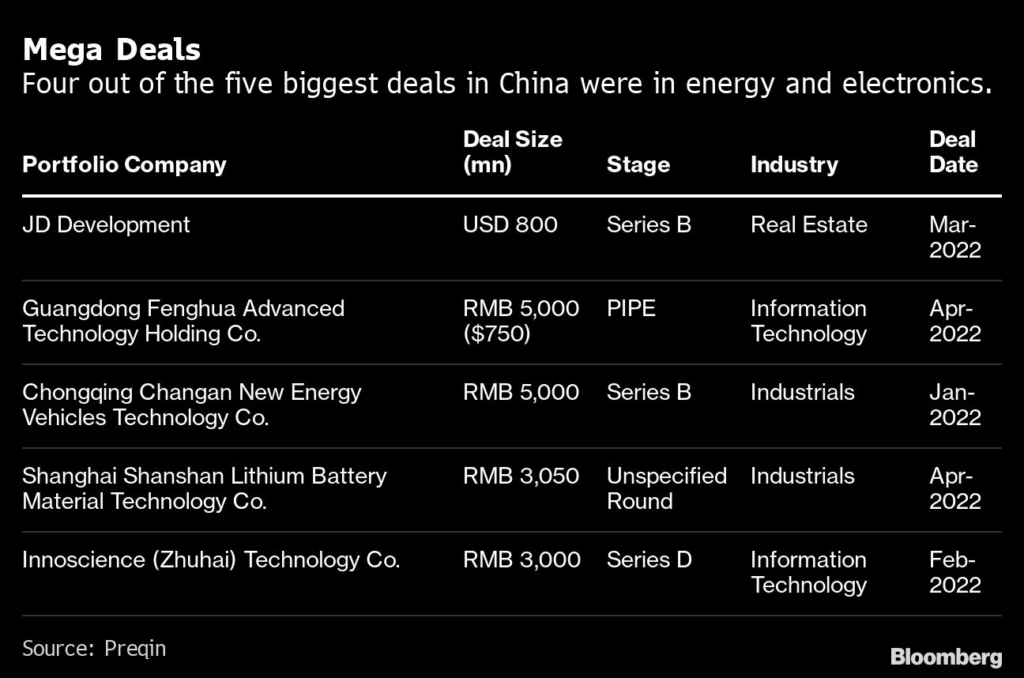
More investments are going into sectors favored by the Communist government, including renewable energy and electric vehicles. Under President Xi Jinping, the Beijing authorities have made a priority of increasing the competitiveness of key industries, including semiconductors and artificial intelligence. The biggest deals so far this year included an $800 million Series B round for a supply chain technology unit of JD.com Inc. driven by Hillhouse Capital and Warburg Pincus, and a 5 billion yuan ($750 million) bet on chipmaker Guangdong Fenghua Advanced Technology Holding Co. from investors including UBS and China Merchants Capital, according to Preqin.

“We see a transition of popular sectors among the investors,” said Helen Lee, an associate of company intelligence at Preqin. 

In contrast, China’s consumer tech industry was among those hardest hit by the regulatory shake-ups. The combined value of VC deals in information technology, healthcare and consumer discretionary industries dropped 55% in the first four months of 2022, after a jump of 190% in the previous year. Meanwhile, investment in industrials, energy and utilities as well as raw materials and natural resources are on the rise. 

This trend echoes the Chinese government’s repeated call for self-reliance in core technologies. In the first four months of 2022, four out of the five biggest venture capital deals in China were in the new energy, semiconductors and electronic components, all sectors the Chinese government is supporting.

Investors’ attitudes are “mixed” towards China, according to an April report published by Preqin analysts. “Some have hit pause, while others believe that paying attention to China’s long-term strategies and investing in key growth sectors, such as robotics and new energy vehicles, can remain a winning strategy,” the analysts said.  

More stories like this are available on bloomberg.com

©2022 Bloomberg L.P.

Stocks Trim Gains as Inflation Concerns Increase: Markets Wrap

(Bloomberg) — Stocks and US futures trimmed their advance and European bonds tumbled after hotter-than-expected German inflation numbers added to pressure for action from central bank policymakers to tame rising prices.

European equities pared a fourth day of gains, still on course for the longest winning streak since March. Luxury stocks outperformed Monday as China’s reopening plans boosted sentiment. Shares in theater chain operator Cineworld Group Plc soared after the movie “Top Gun: Maverick” topped the Memorial Day weekend box office.  Bitcoin posted its biggest gain in two weeks, rising above $31,000 for the first time since May 16. 

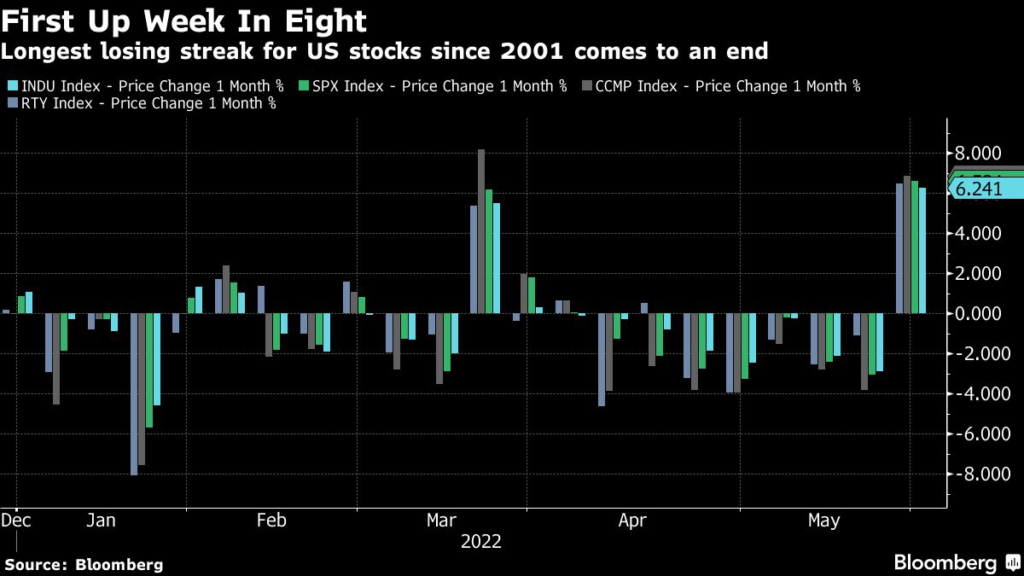
Nasdaq 100 contracts and S&P 500 futures rose in a sign the bounce in US stocks may have further to run after Wall Street’s best week since November 2020. The S&P 500 wiped out its May losses and snapped a string of seven weekly declines as institutional investors rebalanced portfolios into the end of the month.

The dollar slipped for a third day versus major peers as havens lost their appeal amid the slightly improved mood. Cash Treasuries aren’t trading because of the Memorial Day holiday. 

Traders are pondering whether the bottom of the selloff is near as investors have been buying the dip after one of the worst starts to the year for equities. However, a wall of worries remains from hawkish central banks underscoring fears of a recession, escalating food inflation from the war in Ukraine and China’s lockdowns stunting economic activity.  

“We are in the middle of a bear-market rally,” Mahjabeen Zaman, Citigroup Australia head of investment specialists, said on Bloomberg Television. “I think the market is going to be trading range-bound trying to figure out how soon is that recession coming or how quickly is inflation going down.” She added that Treasury yields are set to peak this year.

Meanwhile, German inflation hit another all-time high, adding urgency to the European Central Bank’s exit from crisis-era stimulus after numbers from Spain also topped economists’ estimates. The reports came 10 days before a crucial ECB meeting where officials are set to announce the conclusion of large-scale asset purchases and confirm plans to raise interest rates in July for the first time in more than a decade.

Money markets wagered on 113 basis points of rate increases by year-end, up three basis points since Friday. German bonds held declines, with benchmark 10-year yields eight basis points higher at 1.05%.

Traders will be looking to the US payroll numbers later this week to gauge the Federal Reserve’s tightening path as it strives to rein in inflation. Meanwhile, the Fed is set to start shrinking its $8.9 trillion balance sheet starting Wednesday. 

Federal Reserve Governor Christopher Waller said he wants to keep raising interest rates in half-percentage point steps until inflation is easing back toward the US central bank’s goal. “I support tightening policy by another 50 basis points for several meetings,” he said in remarks prepared for delivery on Monday in Frankfurt. “In particular, I am not taking 50 basis-point hikes off the table until I see inflation coming down closer to our 2% target.” 


Read: Wild Five Months Leaves Wall Street Split on When Selloff Ends

Oil climbed to a two-month high in response to the easing of Chinese lockdowns and as the European Union worked on a plan to ban imports of Russian crude.

In Asia, Japanese and Hong Kong equities led gains. China’s yuan outperformed after the nation reported fewer Covid-19 cases in Beijing and Shanghai. China’s reopening moves prompted a gauge of emerging-market stocks to rise to the highest since May 5. 


China in Danger of Exporting Fresh Inflation Turmoil: MLIV Pulse

Here are some key events to watch this week:

  • US markets closed for Memorial Day Monday
  • EU leaders start a two-day special meeting in Brussels Monday with the war in Ukraine, defense, inflation, energy and food security on the agenda
  • China PMI Tuesday
  • Euro zone CPI Tuesday
  • The Federal Reserve is set to start shrinking its $8.9 trillion balance sheet Wednesday
  • The Fed releases its Beige Book report on regional economic conditions Wednesday
  • New York Fed President John Williams, St. Louis Fed President James Bullard speak at separate events Wednesday
  • OPEC+ virtual meeting Wednesday
  • Cleveland Fed President Loretta Mester discusses the economic outlook Thursday
  • US May employment report Friday
  • The UN’s Food and Agriculture Organization releases its monthly food price index at a time of maximum concern about global supplies on Friday

Some of the main moves in markets:

Stocks

  • Futures on the S&P 500 rose 0.5% as of 4:28 p.m. New York time
  • Futures on the Dow Jones Industrial Average rose 0.4%
  • The Stoxx Europe 600 rose 0.6%
  • The MSCI World index rose 0.6%
  • Futures on the Nasdaq 100 rose 1%
  • The MSCI Asia Pacific Index rose 1.9%
  • The MSCI Emerging Markets Index rose 2.1%

Currencies

  • The Bloomberg Dollar Spot Index fell 0.3%
  • The euro rose 0.4% to $1.0778
  • The British pound rose 0.2% to $1.2655
  • The Japanese yen fell 0.3% to 127.55 per dollar
  • The offshore yuan rose 0.7% to 6.6727 per dollar
  • The Mexican peso rose 0.1% to 19.5531 per dollar
  • The Brazilian real fell 0.4% to 4.7503 per dollar

Bonds

  • Germany’s 10-year yield advanced nine basis points to 1.06%
  • Britain’s 10-year yield advanced seven basis points to 1.99%

Commodities

  • West Texas Intermediate crude rose 1.8% to $117.17 a barrel
  • Gold futures were little changed

More stories like this are available on bloomberg.com

©2022 Bloomberg L.P.

Ukraine Latest: Biden Says No to Rockets That Could Hit Russia

(Bloomberg) — President Joe Biden said the US would not send Ukraine “rocket systems that can strike into Russia,” seemingly quashing reports the administration would consider long-range weapons in a new assistance package. Ukraine has repeatedly called for more offensive weapons as it battles Russian troops in the east. 

It comes as European Union members continue to wrangle over the terms of a potential ban on Russian oil purchases. Leaders are being pushed to at least give political backing to an agreement, an official said, with formal approval of sanctions at a later date. 

Hungary remains the key holdout, with Prime Minister Viktor Orban saying there is no consensus but signaling he’s ready to agree if the bloc guarantees his country still receives the fuel via a pipeline and other measures in case that avenue is disrupted.


(See RSAN on the Bloomberg Terminal for the Russian Sanctions Dashboard.)

Key Developments

  • Todd Boehly Completes Takeover of UK’s Chelsea Football Club
  • Russia Comes Up With a New Bond-Payment Plan to Avoid Default
  • Pimco Fund Added to Russia Swap Exposure in Weeks Before War
  • Rosneft Plans to Pay Record-High Annual Dividend on Oil’s Rally
  • Europe Faces an Old Methane Hotspot in Rush to Exit Russian Gas

All times CET:

Sweden and Finland’s NATO Bid ‘Uncompromising,’ Erdogan Says (9:40 p.m.)

Recep Tayyip Erdogan, the president of Turkey, said Sweden and Finland’s “uncompromising insistence” to join NATO has added an “unnecessary item” to the alliance’s agenda, according to an op-ed published in the Economist. 

Turkey is threatening to block the Nordic nations from joining NATO because it would increase security risks for the country and NATO’s future, Erdogan said in the article. Ankara has insisted that any new candidates for NATO membership recognize its concerns about Kurdish militias, a stance that has been a major source of tension. 

“Where Sweden and Finland stand on the national security concerns and considerations of other countries, with which they would like to be allies, will determine to what extent Turkey would like to be allies with those states,” Erdogan wrote. “Where Sweden and Finland stand on the national security concerns and considerations of other countries, with which they would like to be allies, will determine to what extent Turkey would like to be allies with those states.”

Zelenskiy Says Russia Bets on Instability in Europe (8:00 p.m.) 

Russia “bets on chaos” by making energy prices skyrocket and nudging Europeans to protest their governments, Volodymyr Zelenskiy said in a video address to the European Council where he urged officials to adopt the sixth sanctions package which would include restrictions on Russian oil.

Russia uses citizens of Africa and Asia as hostages, pushing them toward famine by blocking food supplies from Ukraine as a means of triggering a new wave of mass migration to Europe, Zelenskiy said.

“Food safety can’t be secured without halting Russia’s war against Ukraine,” he said. 

Chelsea Football Club Sold to Dodgers Owner, Ending Abramovich Era (6:50 p.m.)

US investor Todd Boehly has completed his $4.25 billion ($5.4 billion) takeover of Chelsea Football Club from the sanctioned Russian oligarch Roman Abramovich, who was forced to put the team up for sale before being sanctioned in the UK’s response to Russia’s invasion of Ukraine. 

The deal ends almost 20 years of ownership under billionaire Abramovich, during which the club rose to become one of the dominant forces in the English Premier League. It also represents another instance of wealthy Russians being forced from high-profile positions in western countries as a result of President Vladimir Putin’s war.

Chelsea won 21 trophies under Abramovich. Boehly owns the Los Angeles Dodgers baseball team.

Biden Says No to Long-Range Rocket Systems for Ukraine (5:31 p.m.)

Ukraine has been calling for weeks for longer range multiple launch rocket, or MLRS, systems it says are needed to halt Russian advances in the east. The US president told reporters that America would not send “rocket systems that can strike into Russia.” 

The comment seemed to contradict previous reports the US would consider offering Ukraine the systems — some of which have a range of 300 kilometers — as part of a new military aid package expected to be announced within days.

Dutch Energy Firm Says Russia to Cut Gas Flows (5:10 p.m.)

After cutting gas supplies to Poland, Bulgaria and Finland, Russia has now warned it will halt pipeline shipments to a Dutch energy firm. GasTerra will stop receiving supplies from Gazprom on Tuesday after refusing to accept new payment terms imposed by Russia including opening a rubles account with Gazprombank.

The move will remove about 2 billion cubic meters of gas from the market from now until Oct. 1, when GasTerra’s contract with the Russian gas giant was set to expire.

Russia’s Seaborne Crude Flows Rise as EU Tussles Over Ban (5:05 p.m.)

Europe’s avoidance of the country’s supplies is forcing barrels on longer routes to willing buyers in Asia, with India the biggest market for crude from western Russia. 

Overall crude shipments edged higher in the seven days to May 27, largely shrugging off mid-month EU restrictions that trading houses see as prohibiting them from dealing with Russian state energy companies.

Estonian Premier Says Future of Government at Risk (4:46 p.m.)

Prime Minister Kaja Kallas — a fierce critic of Russian President Vladimir Putin — cited a legislative standoff with a junior coalition partner.

Kallas, who has seen her popularity soar at home and abroad as she urges EU nations to do more to confront Putin, signaled she’d seek to end her coalition if the Centre Party under former Premier Juri Ratas wins a parliamentary vote on a family benefits package with help from the opposition.

“Politics is so that one day you’re in power and the next day, you’re not — so I can’t be sure of that,” Kallas told Bloomberg Television. A government collapse would leave the Baltic nation potentially rudderless at a time of heightened security risks and record inflation.

Orban Sets Out Two Conditions for EU Oil Embargo (4:05 p.m.)

“There is no compromise at this moment at all,” the Hungarian prime minister said on arrival at the EU summit in Brussels. “There is no agreement at all.” 

While he said a European Commission proposal to impose an embargo on Russian crude purchases was no longer an “atom bomb” hurled at the Hungarian economy, he echoed the sentiments of other EU leaders that a deal wouldn’t be clinched at the meeting.

“In the next round we can discuss investments and timeline for us to do without Russian oil via pipelines but we don’t needs to discuss that today,” he said. “If I get my guarantees today then we’re safe.”

Russia Suffers Heavy Ground Force Losses Since War Started (4:01 p.m)

Russia has likely lost around one third of the ground combat forces it committed on Feb. 24, according to a senior NATO official. Still, its troops are slowly and incrementally gaining territory in the east and the limited terrain captured is militarily important to press a sustained offensive, the official told reporters.

Russian commanders are trying to redistribute forces swiftly, often without adequate preparation, deploying more green soldiers and combat-fatigued soldiers from other battles to form reconstituted units, the official said.

Moscow also appears to be mobilizing Soviet-era T-62 battle tanks from storage, which are likely to be vulnerable to anti-tank weapons. That shows its shortage of modern combat equipment, the official said. 

Russian LNG Plant Halts Loading Ex-Gazprom Tankers (3:55 p.m.)

The operator of Russia’s Sakhalin-2 liquefied natural gas plant stopped supplying the fuel to a former Gazprom PJSC trading unit seized by Germany, according to people with knowledge of the matter.

Sakhalin Energy isn’t loading LNG vessels for Gazprom Marketing & Trading Ltd. due to sanctions imposed by Moscow, said the people, who asked not to be identified discussing sensitive matters.

The Sakhalin-2 plant on the Pacific coast mainly supplies customers in Japan, South Korea and China. 


Macron ‘Very Cautious’ on Chances of Deal on Russian Oil Ban (3:27 p.m.)

“I remain very cautious because there are new demands from Hungary,” French President Emmanuel Macron told Bloomberg on his way into the EU summit. “We will try to move forward.”  

European Commission President Ursula von der Leyen told reporters her “expectations are low that it will be solved in the next 48 hours,” but added she was confident “that thereafter there will be a possibility.”

German Heavy Weapons for Kyiv Still Pending (3 p.m.)

The ruling coalition and the main opposition conservatives sealed a deal on enshrining a 100 billion-euro ($107 billion) fund to boost military spending in the constitution amid continued criticism over delays in supplying Ukraine with promised heavy weapons.

Germany announced plans to supply heavy weaponry a month ago. But so far, none of the seven armored howitzers and an initial 15 Gepard armored vehicles have been delivered. Defense Minister Christine Lambrecht said that Ukrainian soldiers need to undergo a 40-day training program to use the howitzers, while the vehicles aren’t yet in condition to be sent.

Pimco Fund Added to Russia Swap Exposure Before War (2:56 p.m.)

Pacific Investment Management Co.’s largest fund increased its exposure to Russian default swaps by selling more than $100 million of protection to banks including Barclays Plc and JPMorgan & Chase Co.

Pimco’s Income Fund already had almost $1 billion of bets on Russia via credit-default swaps coming into the year, and added a net $106 million in the first quarter, according to documents filed this month with the Securities and Exchange Commission. The bulk of the new swaps were sold in January, with some added in February before the war began, according to a person with direct knowledge of the matter.

Brussels Seeks Political Deal on Russian Oil Ban (2:22 p.m.)

The embargo would cover seaborne oil, which makes up two thirds of the bloc’s oil imports from Russia, according to an official who spoke on condition of anonymity to discuss the negotiations.

Some temporary exceptions would be granted to several members that will take more time to resolve. It’s unclear whether Hungary — which has resisted supporting the ban citing its dependence on supplies from Moscow — is on board. All 27 members must agree on sanctions.

The package will include the exclusion of Russia’s largest bank, Sberbank, from the SWIFT international payment messaging network, plus a ban on three more Russian state-owned broadcasters, the official said.

Ukraine Starts First Rape Trial for Russian Soldier (2:04 p.m.)

The Prosecutor General of Ukraine says it has sent for a court trial the first case of an alleged wartime rape. The trial will be held in-absentia, as the accused Russian soldier is not in Ukraine’s custody. 

Denmark’s Orsted Warns Russia May Cut Gas (1 p.m.)

Denmark could be the next country cut off from Russian natural gas as its biggest utility is refusing to cave in and make payments in rubles. Orsted A/S is preparing for Gazprom PJSC to cut off one of Denmark’s biggest sources of the fuel, the firm said in a statement, adding it expects it will be able to secure alternate sources of supply in the European wholesale market. The payment deadline is Tuesday and the company said it will continue to pay in euros.

Daily power prices in Finland surged after Russia suspended energy exports to its western neighbor earlier this month. European nations are split over how to handle Moscow’s demand that all payments for the fuel should be made in the local currency, and utilities have responded to the challenge differently.

Rosneft Plans Record Dividend (11:45 a.m.)

Russian oil giant Rosneft PJSC promised record dividends on the back of soaring prices, but some foreign investors may struggle to access the payout.

The board recommended 23.63 rubles a share for the second half of 2021, bringing full-year dividends to an all-time high of 41.66 rubles. That follows an announcement last week by Gazprom, which proposed its highest ever payout after benefiting from a supply crunch in Europe. The decisions of both companies will see the Russian state gaining the most, as it’s the biggest shareholder. Many foreign investors could have difficulties obtaining the payout following restrictions imposed by President Vladimir Putin.

Crypto Exchange Buys Eurovision Mic to Fund Drones (11:15 a.m.)

A crypto-currency exchange bought this year’s Eurovision crystal mic trophy from Kalush Orchestra, the Ukrainian rap-folk band that won the competition, to help it raise funds for their country’s military.

Estonian crypto exchange WhiteBit bought the trophy for $900,000 in an auction held on Instagram over the weekend. Oleh Psiuk, Kalush Orchestra’s lead singer, also sold his signature pink hat for 11 million hryvnia ($374,000). The money will be spent on drone systems, according to the band.

Kherson Farmers ‘Start Grain Sales to Russia’ (11 a.m.)

Part of last year’s grain harvest is being shipped from the southern Kherson region to Russia, Tass reported, citing Kirill Stremousov, a representative of the occupation administration there. Ukrainian farmers and officials have accused Russia of confiscating and stealing grain from areas it has seized. Russia almost completely occupies Kherson and Stremousov is deputy head of the administration.

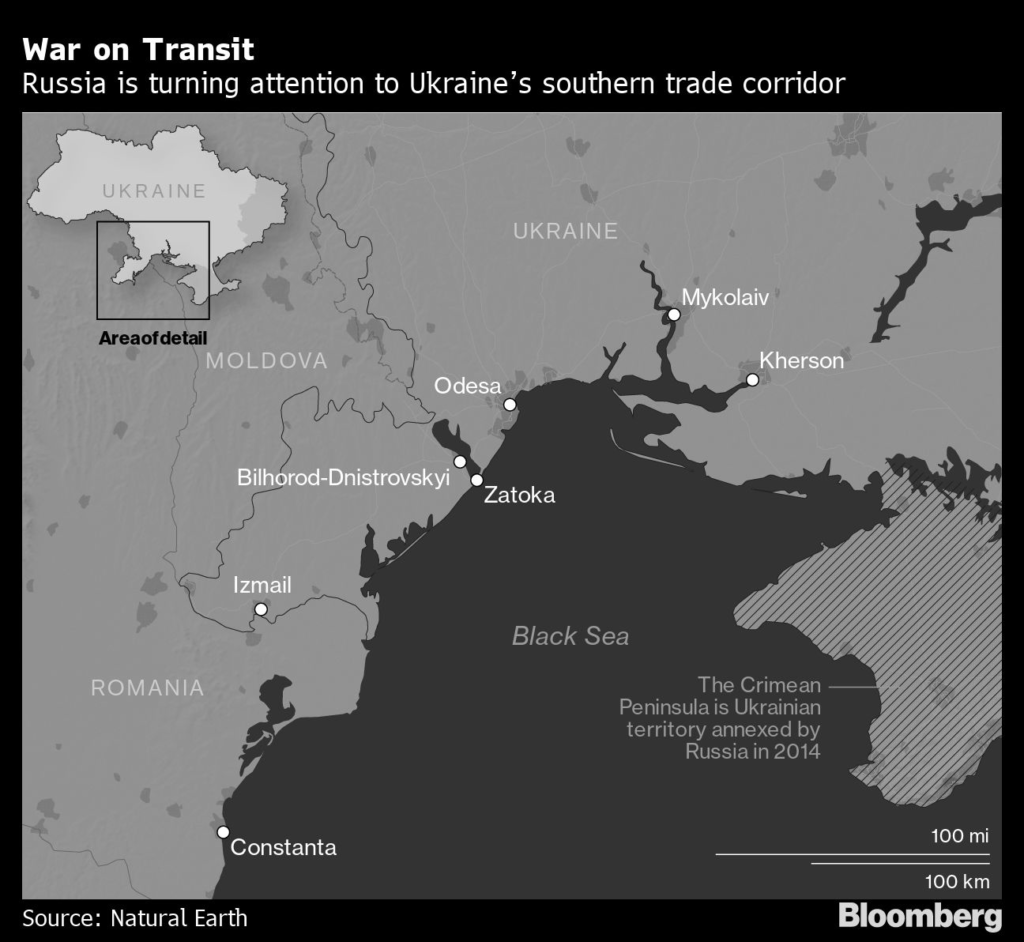
Separately, Taras Kachka, a deputy Ukrainian economy minister, called for warships to patrol the Black Sea to protect vessels carrying food exports from Russian attacks. His comments on Facebook followed reports of multiple Russian air strikes on a bridge in Zatoka between the Black Sea and the Bilhorod-Dnistrovskyi estuary, which is key for Ukrainian export shipments.

Ukraine’s exports have been limited to rail and road routes via neighboring EU nations since the war started, helping to keep grain prices near a record high.

Russian Advance in Sievierodonetsk Continues (9:30 a.m.)

Russian troops continue to advance toward the city center in Sievierodonetsk in the eastern Luhansk region, according to Serhiy Haiday, the local governor. “Battles are continuing, the situation is very difficult,” he said on his Telegram channel.

The city’s infrastructure has been ravaged, with 60% of residential buildings so severely damaged that they can no longer be repaired, Haiday said, adding that about 1 million of people in the occupied areas of Luhansk remain without a functioning water supply.

More stories like this are available on bloomberg.com

©2022 Bloomberg L.P.

Close Bitnami banner
Bitnami