Bloomberg

Bitcoin Rallies Above $30,000 as China Eases Covid Curbs

(Bloomberg) — Bitcoin rose the most in two weeks, trading above $30,000 as investors and strategists said the digital currency is showing signs of bottoming out.

The largest cryptocurrency was up 5.2% to $30,687 at 2:21 p.m. in New York, its biggest increase since May 15. Ether and smaller tokens like Avalanche, which got pummeled last week even as Bitcoin held relatively steady, were also up. Stocks rose in Asia and Europe after China said it will ease Covid curbs, while US markets were closed for the Memorial Day holiday.

China’s Covid Outbreak Wanes as Curbs Eased to Boost Economy 

“Markets are long overdue for a relief rally,” said Hayden Hughes, chief executive of social media trading platform Alpha Impact. “Bitcoin just went through eight consecutive weeks in red territory and got technically oversold to levels we traditionally only see at the bottom of bear markets.” 

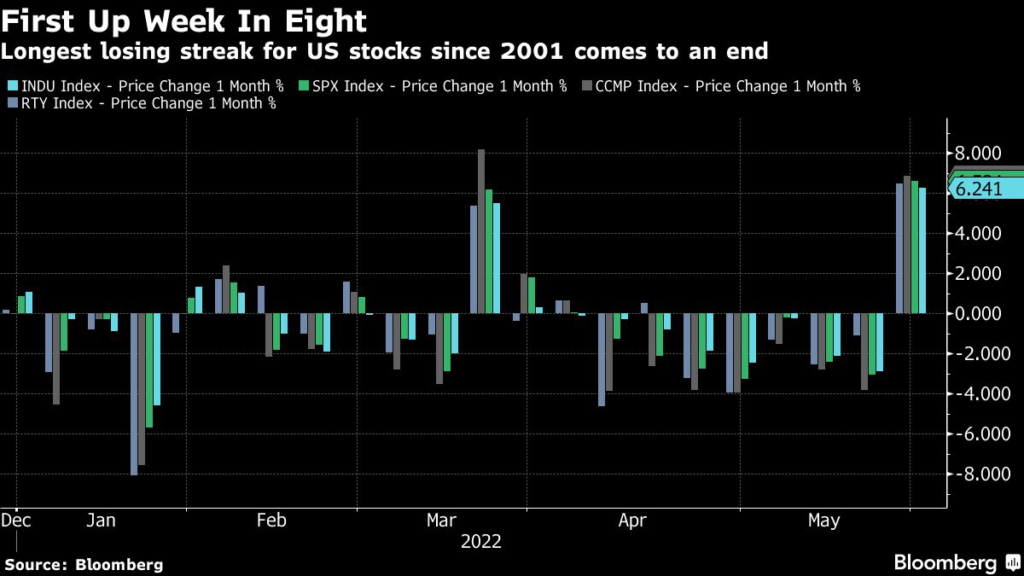
The correlation between Bitcoin and stocks started to break down last week as the S&P 500 Index posted its biggest weekly gain since November 2020, while Bitcoin fell for the eighth week in a row. 

“I expect this gap to close a bit in the short term with crypto catching up,” Shiliang Tang, chief investment officer at crypto fund LedgerPrime, said in an email.

Ether jumped as much as 7.7% on Monday while Avalanche and Solana rose as much as 12% and 7%, respectively, before giving up some of those gains. 

“On Alpha Impact, we’re seeing heavy buying of Ether and several altcoins, and these patterns mirror what we saw in the July 2021 bear market bottom and the January 2022 local bottom,” Hughes said.

Trading volume was muted due to the US holiday.

The price rally is “happening in very thin trading conditions over a weekend and into a US holiday,” said Joel Kruger, a strategist at crypto exchange LMAX Digital. “So price action needs to be taken with a grain of salt.”

Inflation reports from Spain and Germany on Monday underscored that the macroeconomic forces that have weighed on crypto in recent weeks aren’t about to ease. Consumer prices in both countries jumped faster than expected in May, adding pressure on the European Central Bank to remove crisis-era stimulus. Rising interest rates around the world have triggered a selloff in risk assets this year, sending Bitcoin down 34% since Dec. 31.

(Updates prices, adds comments in pararaphs 5 and 9)

More stories like this are available on bloomberg.com

©2022 Bloomberg L.P.

Bitcoin Rallies as China’s Covid Easing Adds to Risk-On Mood

(Bloomberg) — Bitcoin posted its biggest gain in two weeks as China’s easing of Covid curbs stoked investor enthusiasm for riskier assets. 

The largest cryptocurrency advanced as much as 6% to $30,894 on Monday and traded at $30,390 at 2:47 p.m. in London. Ether and smaller tokens like Avalanche, which got pummeled last week even as Bitcoin held relatively steady, were also up. Stocks rose in Asia and Europe after the S&P 500 rallied on Friday. 

China’s Covid Outbreak Wanes as Curbs Eased to Boost Economy 

“Markets are long overdue for a relief rally,” said Hayden Hughes, chief executive of social media trading platform Alpha Impact. “Bitcoin just went through eight consecutive weeks in red territory and got technically oversold to levels we traditionally only see at the bottom of bear markets.” 

Cryptocurrencies re-established their tendency to trade in tandem with equities after falling on Friday even as the S&P 500 capped a weekly advance of 6.6%. Friday’s divergence sparked concerns that investors would continue dumping digital tokens even amid a revival in demand for other risk assets. 

Inflation reports from Spain on Germany on Monday underscored that the macroeconomic forces that have weighed on crypto in the past months aren’t about to ease. Consumer prices in both countries jumped faster than expected in May, adding pressure on the European Central Bank to remove crisis-era stimulus. Rising interest rates around the world have triggered a selloff in risk assets this year, sending Bitcoin down 34% since Dec. 31. 

German Inflation Hits Fresh Record, Piling Pressure on ECB 

Ether jumped as much as 6.6% on Monday while Avalanche and Solana rose 9% and 6%, respectively, before giving up some of those gains. Luna, the new token distributed to investors who saw the value of their cryptocurrencies tied to the Terra blockchain wiped out earlier this month, advanced 13%, according to CoinGecko. 

“On Alpha Impact, we’re seeing heavy buying of Ether and several altcoins, and these patterns mirror what we saw in the July 2021 bear market bottom and the January 2022 local bottom,” Hughes said.

(Updates prices, adds Spain, Germany inflation in fifth paragraph.)

More stories like this are available on bloomberg.com

©2022 Bloomberg L.P.

Electric Boat Maker Unveils Urban Water Taxi Aimed at Venice

(Bloomberg) — Sweden’s Candela Speed Boat AB, which makes electric boats that fly above water, has unveiled a new craft it hopes will replace gas-guzzling vessels used by commercial operators in the tourism industry.

The 28-foot (8.5-meter) P-8 Voyager unveiled Monday in Venice, Italy, is designed for six passengers and meant to be used as a water taxi or a tender boat for cruise ships.

Candela, one of a slew of startups that aim to replace combustion engine-powered watercraft with battery-powered boats, is taking a different route than competitors like Vision Marine, Arc Boat Co. and fellow Swedish rival X Shore, as the company’s boats run on underwater wings, known as hydrofoils, that makes them fly above the surface.

Hydrofoiling eliminates almost all wake, a particular advantage in places such as Venice. Motorboats in the city’s world-famous canals create a constant barrage of waves that wash up against walls and can erode structures over time. In other marine environments, sound pollution from fossil-fuel engines can cause major problems for wildlife. By contrast, the P-8 is designed to glide virtually silently above water, taking off from the surface when it hits 16 knots (30 kilometers per hour).

The boat is set to expand a lineup that includes Candela’s first model, the C-7 sports boat, and the C-8, an 8.5-meter day cruiser going into production this year. Having completed a 24 million-euro ($25.8 million) funding round led by EQT Ventures last year, Candela also plans to put a ferry for 30 passengers into commercial operation on the waterways of its native Stockholm in 2023.

More stories like this are available on bloomberg.com

©2022 Bloomberg L.P.

Ukraine Latest: Macron Douses Talk of Fast Russia Oil Ban Deal

(Bloomberg) — French President Emmanuel Macron dampened expectations of a quick deal on banning Russian oil as he headed into a summit of European Union leaders. 

Asked about signs that a deal on oil was within reach, Macron told Bloomberg: “I remain very cautious because there are new demands from Hungary. We will try to move forward.” 

Leaders are being pushed to at least give political backing to an agreement on oil, an official said, with formal approval of sanctions to come at a later date. Hungary has refused to back a compromise despite proposals aimed at securing its Russian oil supplies, according to people familiar with the talks.

(See RSAN on the Bloomberg Terminal for the Russian Sanctions Dashboard.)

Key Developments

  • Russia Comes Up With a New Bond-Payment Plan to Avoid Default
  • Pimco Fund Added to Russia Swap Exposure in Weeks Before War
  • Rosneft Plans to Pay Record-High Annual Dividend on Oil’s Rally
  • Europe Faces an Old Methane Hotspot in Rush to Exit Russian Gas
  • Ukraine Faces a Dangerous New Adversary — Time: Balance of Power

All times CET:

Macron ‘Very Cautious’ on Chances of Deal on Russian Oil Ban (3:27 p.m.)

The French president noted “new demands” from Hungary. European Commission President Ursula von der Leyen told reporters going into the meeting her “expectations are low that it will be solved in the next 48 hours,” but added she was confident “that thereafter there will be a possibility.”

German Heavy Weapons for Kyiv Still Pending (3 p.m.)

The ruling coalition and the main opposition conservatives sealed a deal on enshrining a 100 billion-euro ($107 billion) fund to boost military spending in the constitution amid continued criticism over delays in supplying Ukraine with promised heavy weapons.

Germany announced plans to supply heavy weaponry a month ago. But so far, none of the seven armored howitzers and an initial 15 Gepard armored vehicles have been delivered. Defense Minister Christine Lambrecht said Monday that Ukrainian soldiers need to undergo a 40-day training program to use the howitzers, while the vehicles aren’t yet in condition to be sent.

Pimco Fund Added to Russia Swap Exposure Before War (2:56 p.m.)

Pacific Investment Management Co.’s largest fund increased its exposure to Russian default swaps by selling more than $100 million of protection to banks including Barclays Plc and JPMorgan & Chase Co.

Pimco’s Income Fund already had almost $1 billion of bets on Russia via credit-default swaps coming into the year, and added a net $106 million in the first quarter, according to documents filed this month with the Securities and Exchange Commission. The bulk of the new swaps were sold in January, with some added in February before the war began, according to a person with direct knowledge of the matter.

Brussels Seeks Political Deal on Russian Oil Ban (2:22 p.m.)

The embargo would cover seaborne oil, which makes up two thirds of the bloc’s oil imports from Russia, according to an official who spoke on condition of anonymity to discuss the negotiations.

Some temporary exceptions would be granted to several members that will take more time to resolve. It’s unclear whether Hungary — which has resisted supporting the ban citing its dependence on supplies from Moscow — is on board. All 27 members must agree on sanctions.

The package will include the exclusion of Russia’s largest bank, Sberbank, from the SWIFT international payment messaging network, plus a ban on three more Russian state-owned broadcasters, the official said.

Ukraine Starts First Rape Trial for Russian Soldier (2:04 p.m.)

The Prosecutor General of Ukraine says it has sent for a court trial the first case of an alleged wartime rape. The trial will be held in-absentia, as the accused Russian soldier is not in Ukraine’s custody. 

Denmark’s Orsted Warns Russia May Cut Gas (1 p.m.)

Denmark could be the next country cut off from Russian natural gas as its biggest utility is refusing to cave in and make payments in rubles. Orsted A/S is preparing for Gazprom PJSC to cut off one of Denmark’s biggest sources of the fuel, the firm said in a statement, adding that it expects it will be able to secure alternate sources of supply in the European wholesale market. The payment deadline is Tuesday and the company said it will continue to pay in euros.

Daily power prices in Finland surged after Russia suspended energy exports to its western neighbor earlier this month. European nations are split over how to handle Moscow’s demand that all payments for the fuel should be made in the local currency, and utilities have responded to the challenge differently.

Rosneft Plans Record Dividend (11:45 a.m.)

Russian oil giant Rosneft PJSC promised record dividends on the back of soaring prices, but some foreign investors may struggle to access the payout.

The board recommended 23.63 rubles a share for the second half of 2021, bringing full-year dividends to an all-time high of 41.66 rubles. That follows an announcement last week by Gazprom, which proposed its highest ever payout after benefiting from a supply crunch in Europe. The decisions of both companies will see the Russian state gaining the most, as it’s the biggest shareholder. Many foreign investors could have difficulties obtaining the payout following restrictions imposed by President Vladimir Putin.

Crypto Exchange Buys Eurovision Mic to Fund Drones (11:15 a.m.)

A crypto-currency exchange bought this year’s Eurovision crystal mic trophy from Kalush Orchestra, the Ukrainian rap-folk band that won the competition, to help it raise funds for their country’s military.

Estonian crypto exchange WhiteBit bought the trophy for $900,000 in an auction held on Instagram over the weekend. Oleh Psiuk, Kalush Orchestra’s lead singer, also sold his signature pink hat for 11 million hryvnia ($374,000). The money will be spent on drone systems, according to the band.

Kherson Farmers ‘Start Grain Sales to Russia’ (11 a.m.)

Part of last year’s grain harvest is being shipped from the southern Kherson region to Russia, Tass reported, citing Kirill Stremousov, a representative of the occupation administration there. Ukrainian farmers and officials have accused Russia of confiscating and stealing grain from areas it has seized. Russia almost completely occupies Kherson and Stremousov is deputy head of the administration.

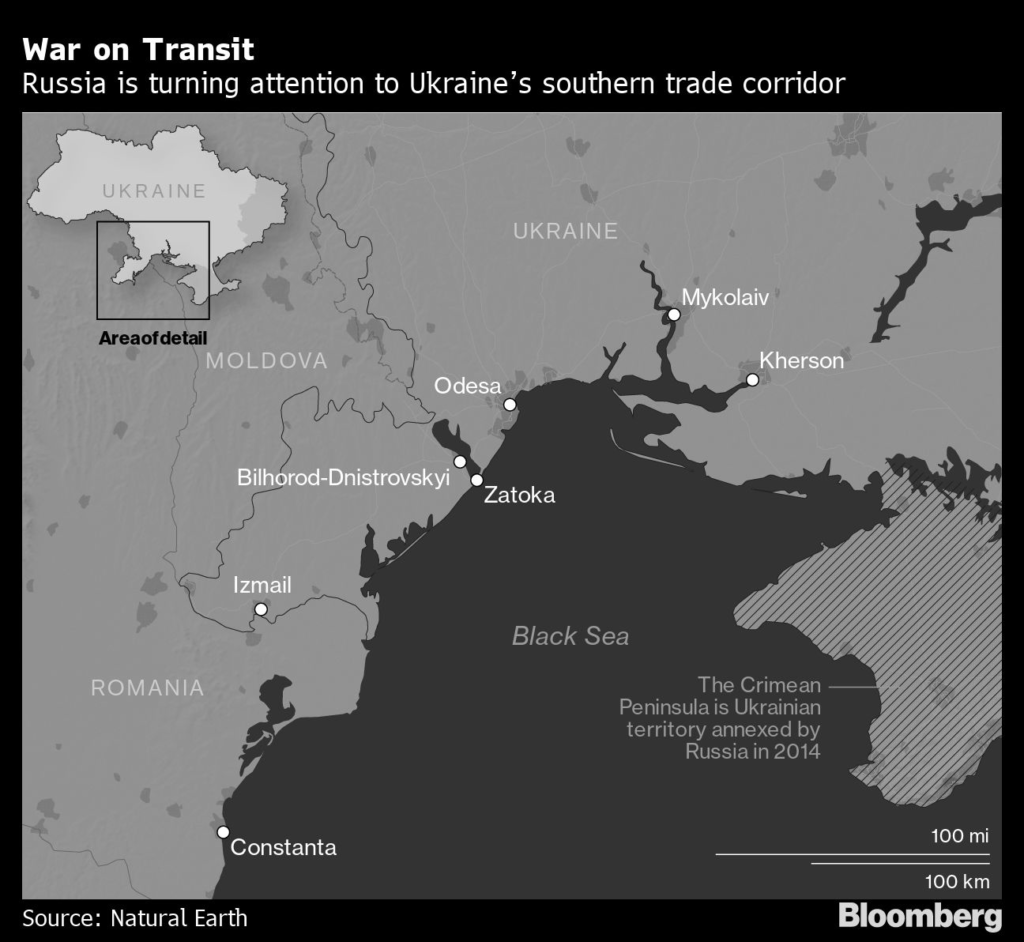
Separately, Taras Kachka, a deputy Ukrainian economy minister, called for warships to patrol the Black Sea to protect vessels carrying food exports from Russian attacks. His comments on Facebook followed reports of multiple Russian air strikes on a bridge in Zatoka between the Black Sea and the Bilhorod-Dnistrovskyi estuary, which is key for Ukrainian export shipments.

Ukraine’s exports have been limited to rail and road routes via neighboring EU nations since the war started, helping to keep grain prices near a record high.

Russian Advance in Sievierodonetsk Continues (9:30 a.m.)

Russian troops continue to advance toward the city center in Sievierodonetsk in the eastern Luhansk region, according to Serhiy Haiday, the local governor. “Battles are continuing, the situation is very difficult,” he said on his Telegram channel.

The city’s infrastructure has been ravaged, with 60% of residential buildings so severely damaged that they can no longer be repaired, Haiday said, adding that about 1 million of people in the occupied areas of Luhansk remain without a functioning water supply.

New French Foreign Minister Visits Kyiv (7:30 a.m.)

France’s new foreign affairs minister, Catherine Colonna, is visiting Kyiv on Monday, where she will meet Ukrainian counterpart Dmytro Kuleba and President Zelenskiy.

Colonna will underline France’s determination to reinforce its support for Ukraine, both humanitarian and financial, and in terms of supplying defense equipment, according to a statement from the foreign ministry. She will discuss the blockade of cereal and oil-seed exports from Ukraine in an effort to find concrete solutions as quickly as possible, the ministry said.

South Korea Conservatives Plan Ukraine Visit (5:44 a.m.)

Members of South Korean President Yoon Suk Yeol’s conservative People Power Party said they plan to visit Ukraine next month, as the government mulls sending more aid to Kyiv.

Yoon’s government may reach a deal with Canada that could include providing the North American country with as many as 100,000 artillery shells, which would then make their way to Ukraine, South Korean broadcaster SBS reported, citing an unidentified military source. Canada has been providing lethal weapons to Ukraine and recently requested South Korea to provide weapons to Ottawa, it said.

More stories like this are available on bloomberg.com

©2022 Bloomberg L.P.

GoTo Growth Tops 50% in First Report Since $1.1 Billion IPO

(Bloomberg) — GoTo Group posted about 53% gross revenue growth in its first quarterly report as a public company, accelerating from the 2021 pace and highlighting the rapid expansion of Indonesia’s tech and online industries.

Gross revenue advanced to 5.2 trillion rupiah ($357 million) in the quarter though March, while net losses more than tripled to 6.47 trillion rupiah, the ride-hailing and e-commerce operator said Monday in a statement. For the calendar year 2021, the metric rose at about a 44% clip on a pro-forma basis. GoTo’s quarterly adjusted loss before interest, taxes, depreciation and amortization widened to 5.4 trillion rupiah.

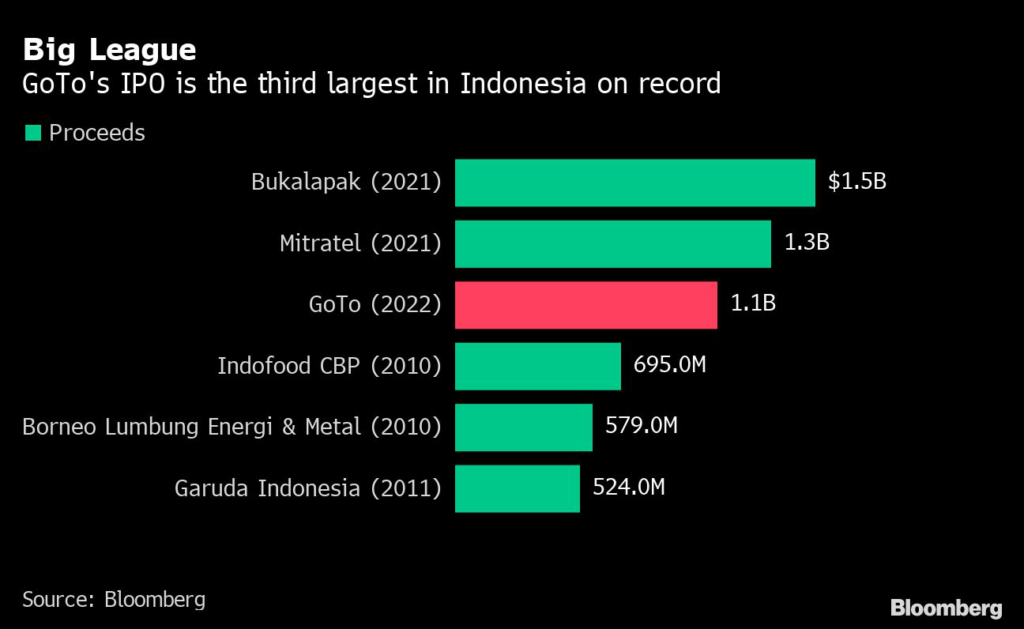
GoTo is trying to convince investors of its growth prospects even as Russia’s invasion of Ukraine, soaring inflation and rising interest rates weigh on the technology industry globally. The company raised $1.1 billion in one of the world’s largest initial public offerings for 2022, gaining funds to compete against rivals such as Grab Holdings Ltd. as online services gain steam in Southeast Asia.

GoTo is the largest of a crop of companies seeking to ride the rapid pace of mobile penetration and internet use in Southeast Asia, a region of more than 650 million people. Yet Chief Executive Officer Andre Soelistyo still needs to reassure investors of the company’s earnings potential amid heavy spending to fend off competition and lure more users.

What Bloomberg Intelligence Says

“Cross-selling opportunities between Indonesia’s top ride-booking (Gojek) and online-shopping (Tokopedia) platforms lessens pressure on new-user acquisition and should support long-term sales growth.”

– Nathan Naidu, analyst

Click here for research

The company is the result of last year’s merger between Indonesia’s two most valuable internet startups — ride-hailing provider Gojek and e-commerce firm Tokopedia — to get more firepower against rivals in an increasingly cutthroat market. Over the years, the two amassed a long list of investors, including Google, Tencent Holdings Ltd. and Sequoia Capital India.

GoTo is among Southeast Asian consumer-internet companies that are adding users at a rapid clip but have yet to generate sustainable profit. The company is enjoying a leadership position in Indonesia, a country of more than 270 million people whose mobile-savvy consumers are shopping on Tokopedia’s platform and ordering rides and food via Gojek’s app.

That has helped its shares outperform those of Grab, which became a publicly traded company through a merger with a U.S. special purpose acquisition vehicle late last year. GoTo shares have lost about 7% since its IPO, valuing the company at more than $25 billion. Grab, down about 70% since its SPAC merger, has a market capitalization of less than $10 billion.

Get More:

  • Gross revenue from on-demand services, which include ride-hailing, grew 58% to 3.1 trillion rupiah in the first quarter.
  • E-commerce gross revenue grew 53% to 1.9 trillion rupiah.
  • Its financial technology services business grew about 41% thanks to record GoPay users and GTV volumes.
  • The overall first-quarter take rate increased to 3.7% from 3.5%, credited to more monetization initiatives.
  • Total net revenue, which strips out incentives such as discounts for users, advanced 5.6% to 1.5 trillion rupiah.
  • GoTo’s gross transaction value, the sum of transactions flowing through its platform, grew 46% to 140 trillion rupiah. Fintech services was the biggest contributor at about 55%.
  • In the second quarter, gross transaction value is set to increase to as much as 150 trillion rupiah, CEO Soelistyo said on a conference call.

(Updates with more earnings metrics starting in eighth paragraph, net losses in second paragraph.)

More stories like this are available on bloomberg.com

©2022 Bloomberg L.P.
Dubai-Based Ride Sharing Firm Swvl to Cut Third of Headcount

(Bloomberg) — Sign up for our Middle East newsletter and follow us @middleeast for news on the region.

Swvl Holdings Corp., a Dubai-based ride sharing firm, plans to reduce headcount by 32% as part of efforts to turn cash flow positive by next year. 

The cuts will affect 400 people, Chief Financial Officer Youssef Salem told Bloomberg on Monday. The company said in a statement that the reductions will focus on roles that have been automated, and it will help some employees transition to new roles. 

Swvl said its so-called Transport as a Service and Software as a Service businesses are “growing rapidly,” helped by recent acquisitions, and the company plans to continue growing these businesses. It also aims to continue investing in developing its proprietary technology stack.

The firm has announced a spree of deals over the past year, including Volt Lines — its fourth acquisition since August. It bought Berlin-based mobility startup Door2door in March, mass transit company ViaPool in November, and Shotl, an on-demand ride service that uses shuttle buses, in August. 

Swvl was co-founded by Mostafa Kandil, a former Rocket Internet SE executive who also worked with Careem, which is now owned by Uber Technologies Inc. 

The ride-sharing firm made its debut on the Nasdaq Stock Market on April 1 after merging with blank-check company Queen’s Gambit Growth Capital. Swvl’s shares have more than halved since that debut, valuing the company at $581 million.

(Updates with number of employees affected in second paragraph)

More stories like this are available on bloomberg.com

©2022 Bloomberg L.P.

South Africa Had Fifth Covid Wave Despite 97% Antibody Protection

(Bloomberg) — South Africa experienced a fifth wave of Covid-19 infections despite 97% of the population having antibodies due to previous infections or vaccination, the results of a blood survey show. Examination of 3,395 samples from blood donors earlier this year, at the tail end of the fourth wave of infections, showed that 87% of …

South Africa Had Fifth Covid Wave Despite 97% Antibody Protection Read More »

Stocks Gain as China Virus Easing Spurs Optimism: Markets Wrap

(Bloomberg) — Stocks and US futures advanced after China eased some virus curbs and Wall Street had its best week since November 2020. Euro-area bonds tumbled after inflation prints surprised to the upside.

A fourth day of gains for European equities extended their longest winning streak since late March and drove the Stoxx 600 index to the highest in more than three weeks. Luxury stocks outperformed Monday as China’s reopening plans boosted sentiment.

Nasdaq 100 contracts and S&P 500 futures both rose in a sign the bounce in US stocks may have further to run. The S&P 500 wiped out its May losses and snapped a string of seven weekly declines as institutional investors rebalanced portfolios into the end of the month.

The dollar slipped for a third day versus major peers as havens lost their appeal amid the improved mood. Cash Treasuries aren’t trading because of the US Memorial Day holiday.

“Risk is back in business it seems,” said AJ Bell investment director Russ Mould. “A reopening of key economic hubs in China and suggestions the US Federal Reserve might slow the pace of interest rate hikes are helping to boost sentiment, at least in the short term.”

German inflation hit another all-time high, adding urgency to the European Central Bank’s exit from crisis-era stimulus after numbers from Spain also topped economists’ estimates. The reports came 10 days before a crucial ECB meeting where officials are set to announce the conclusion of large-scale asset purchases and confirm plans to raise interest rates in July for the first time in more than a decade.

Oil climbed in response to the easing of Chinese lockdowns and as the European Union worked on a plan to ban imports of Russian crude.

In Asia, Japanese and Hong Kong equities led gains. China’s yuan outperformed after the nation reported fewer Covid-19 cases in Beijing and Shanghai. China’s reopening moves prompted a gauge of emerging-market stocks to rise to the highest since May 5. Bitcoin posted its biggest gain in two weeks, rising close to $31,000. 

Read: Wild Five Months Leaves Wall Street Split on When Selloff Ends

Traders are pondering whether the bottom of the selloff is near as investors have been buying the dip after one of the worst starts to the year for equities. However, a wall of worries remains from hawkish central banks underscoring fears of a recession, escalating food inflation from the war in Ukraine and China’s lockdowns stunting economic activity.  

“We are in the middle of a bear-market rally,” said Mahjabeen Zaman, Citigroup Australia head of investment specialists, said on Bloomberg Television. “I think the market is going to be trading range-bound trying to figure out how soon is that recession coming or how quickly is inflation going down.” She added that Treasury yields are set to peak this year.

Traders will be looking to the US payroll numbers later this week to gauge the Federal Reserve’s tightening path as it strives to rein in inflation. Meanwhile, the Fed is set to start shrinking its $8.9 trillion balance sheet starting Wednesday. 


China in Danger of Exporting Fresh Inflation Turmoil: MLIV Pulse

Here are some key events to watch this week:

  • US markets closed for Memorial Day Monday
  • EU leaders start a two-day special meeting in Brussels Monday with the war in Ukraine, defense, inflation, energy and food security on the agenda
  • China PMI Tuesday
  • Euro zone CPI Tuesday
  • The Federal Reserve is set to start shrinking its $8.9 trillion balance sheet Wednesday
  • The Fed releases its Beige Book report on regional economic conditions Wednesday
  • New York Fed President John Williams, St. Louis Fed President James Bullard speak at separate events Wednesday
  • OPEC+ virtual meeting Wednesday
  • Cleveland Fed President Loretta Mester discusses the economic outlook Thursday
  • US May employment report Friday
  • The UN’s Food and Agriculture Organization releases its monthly food price index at a time of maximum concern about global supplies on Friday

Some of the main moves in markets:

Stocks

  • The Stoxx Europe 600 rose 0.5% as of 1:08 p.m. London time
  • Futures on the Nasdaq 100 rose 1.2%
  • Futures on the Dow Jones Industrial Average rose 0.3%
  • The MSCI Asia Pacific Index rose 2%
  • The MSCI Emerging Markets Index rose 2.3%

Currencies

  • The Bloomberg Dollar Spot Index fell 0.3%
  • The euro rose 0.3% to $1.0767
  • The Japanese yen fell 0.3% to 127.45 per dollar
  • The offshore yuan rose 0.7% to 6.6749 per dollar
  • The British pound was little changed at $1.2640

Bonds

  • Germany’s 10-year yield advanced eight basis points to 1.05%
  • Britain’s 10-year yield advanced seven basis points to 1.98%

Commodities

  • Brent crude rose 0.7% to $120.22 a barrel
  • Spot gold was little changed

More stories like this are available on bloomberg.com

©2022 Bloomberg L.P.
Uranium Investors Await Price Rally to Revive Namibia Projects

(Bloomberg) — Namibia’s finance minister said uranium miners are waiting for prices to recover before reviving projects in Africa’s biggest producer of the ore, which is needed for nuclear power in a world shifting away from fossil fuels.  The semi-arid southwest African nation is investing in water facilities and is planning a second desalination plant …

Uranium Investors Await Price Rally to Revive Namibia Projects Read More »

India Probes ZTE, Vivo as More China Firms Under Scrutiny

(Bloomberg) — India is probing the local units of ZTE Corp. and Vivo Mobile Communications Co. for alleged financial improprieties, according to documents seen by Bloomberg, extending an investigation into other China-based firms after fining Xiaomi Corp.

The Ministry of Corporate Affairs will scrutinize auditor reports and has received information from unnamed sources that indicates potential violation including fraud, according to the documents. In the case of Vivo, an inquiry was sought in April to detect if there were “significant irregularities in ownership and financial reporting” while authorities were asked to study the books of ZTE and submit findings “on urgent basis,” according to the documents.

Representatives for ZTE and Vivo didn’t reply to emails seeking comment. An email to the spokesperson for the ministry of corporate affairs wasn’t answered.

India has tightened scrutiny of China-based firms since 2020, when the two nations saw the deadliest fighting in decades at their disputed Himalayan border. Prime Minister Narendra Modi’s government has banned more than 200 mobile applications from Chinese providers, including shopping services from Alibaba Group Holding Ltd., the TikTok short video hit from ByteDance Ltd. and apps used on Xiaomi’s phones. This month the country’s anti-money-laundering agency took control of the bank accounts of Xiaomi Technology India for allegedly breaching foreign-exchange laws, a decision that was put on hold following a court order. 

The Ministry of Corporate Affairs has started the process of inspecting books of accounts of more than 500 Chinese companies, according to a person with knowledge of the matter. Apart from ZTE and Vivo, this includes Xiaomi, Oppo, Huawei Technologies, several Indian units of Alibaba Group such as Alibaba.com India E-commerce Pvt. Ltd., and Alibaba Cloud (India) LLP, the person said, asking not to be identified as the details are private.

Representatives for Xiaomi, Oppo, Huawei and Alibaba didn’t reply to emails seeking comment.

The ministry, in some cases, has sent letters to the firms seeking details on directors, shareholders of the companies, ultimate beneficiaries and owners, while it is in the process of seeking similar details from the rest of the companies, the person said. A report is expected in July, the person added.

Once the inspection reports are ready, the ministry would decide on whether further investigation by the serious fraud office is needed, the person said.  

More stories like this are available on bloomberg.com

©2022 Bloomberg L.P.
Close Bitnami banner
Bitnami