
Bloomberg

Asia Stocks, US Futures Rise as China Curbs Eased: Markets Wrap

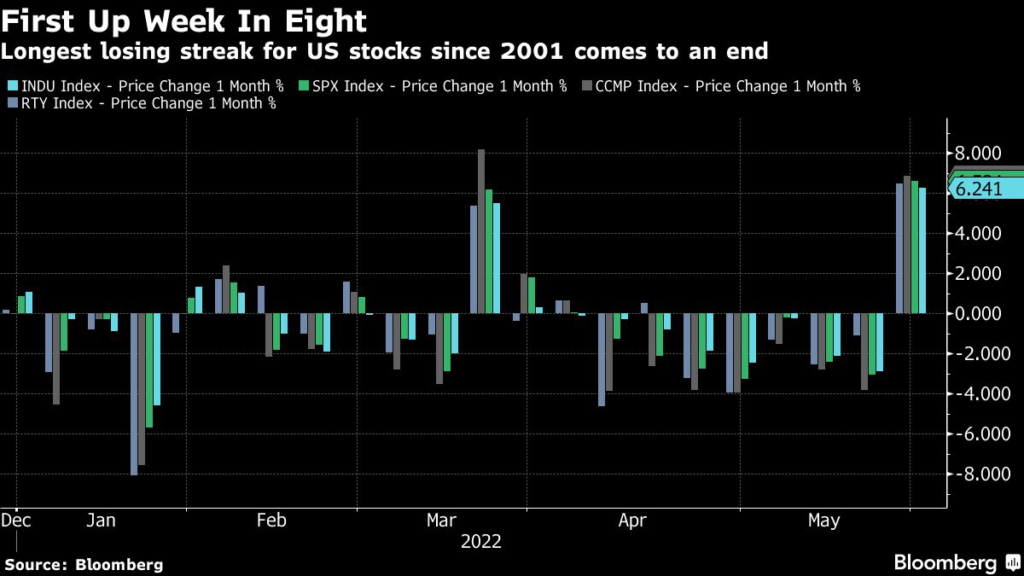
(Bloomberg) — Stocks in Asia and US futures advanced Monday after China eased some virus curbs and Wall Street had its best week since November 2020. 

Japanese and Hong Kong equities led gains, while S&P 500 and Nasdaq 100 contracts climbed in a sign the bounce may have further to run. The S&P 500 wiped out its May losses and snapped a string of seven weekly declines as institutional investors rebalanced portfolios into the end of the month. 

China’s yuan outperformed after the nation reported fewer Covid-19 cases in Beijing and Shanghai. That spurred the government to ease some of the strict virus controls to stimulate sagging growth. Chinese stocks had more modest gains as reopening plans sparked gains in selective sectors like consumer and travel.

The dollar slipped for a third day versus major peers as havens lost their appeal amid the improved mood. Oil traded near $116 a barrel as the European Union failed to agree on a revised package of Russian sanctions. Cash Treasuries won’t trade in Asia because of the US Memorial Day holiday.


Read: Wild Five Months Leaves Wall Street Split on When Selloff Ends

Traders are pondering whether the bottom of the selloff is near as investors have been buying the dip after one of the worst starts to the year for equities. However, a wall of worries remains from hawkish central banks underscoring fears of a recession, escalating food inflation from the war in Ukraine and China’s lockdowns stunting economic activity.  

“We are in the middle of a bear market rally,” said Mahjabeen Zaman, Citigroup Australia head of investment specialists, said on Bloomberg Television. “I think the market is going to be trading range bound trying to figure out how soon is that recession coming or how quickly is inflation going down.” She added that Treasury yields are set to peak this year.

Traders will be looking to the US payroll numbers later this week to gauge the Federal Reserve’s tightening path as it strives to rein in inflation. Meanwhile, the Fed is set to start shrinking its $8.9 trillion balance sheet starting Wednesday. 

Elsewhere, Asia’s coal benchmark rallied to the highest level on record as India moved to secure shipments, tightening supplies in the region.

Here are some key events to watch this week:

  • US markets closed for Memorial Day Monday
  • EU leaders start a two-day special meeting in Brussels Monday with the war in Ukraine, defense, inflation, energy and food security on the agenda
  • China PMI Tuesday
  • Euro zone CPI Tuesday
  • The Federal Reserve is set to start shrinking its $8.9 trillion balance sheet Wednesday
  • The Fed releases its Beige Book report on regional economic conditions Wednesday
  • New York Fed President John Williams, St. Louis Fed President James Bullard speak at separate events Wednesday
  • OPEC+ virtual meeting Wednesday
  • Cleveland Fed President Loretta Mester discusses the economic outlook Thursday
  • US May employment report Friday
  • The UN’s Food and Agriculture Organization releases its monthly food price index at a time of maximum concern about global supplies on Friday

Some of the main moves in markets:

Stocks

  • S&P 500 futures rose 0.5% as of 1:39 p.m. in Tokyo. The S&P 500 rose 2.5%
  • Nasdaq 100 futures increased 1.1%. The Nasdaq 100 rose 3.3%
  • Topix index climbed 2%
  • Australia’s S&P/ASX 200 Index advanced 1.2%
  • Hang Seng Index gained 1.9%
  • Shanghai Composite Index rose 0.3%
  • Euro Stoxx 50 futures climbed 0.6%

Currencies

  • The Bloomberg Dollar Spot Index fell 0.2%
  • The Japanese yen rose 0.1% to 126.97 per dollar
  • The offshore yuan was at 6.6581 per dollar, up 0.9%
  • The euro rose 0.2% to $1.0755

Bonds

  • The yield on 10-year Treasuries declined one basis point to 2.74% Friday
  • Australia’s 10-year bond yield was at 3.25%

Commodities

  • West Texas Intermediate crude rose 0.9% to $116.08 a barrel
  • Gold was at $1,861.24 an ounce, up 0.4%

More stories like this are available on bloomberg.com

©2022 Bloomberg L.P.
Meta’s German Oculus Blockade Has Startups Facing Harsh Reality

(Bloomberg) — Meta Platforms Inc.’s ongoing battle with German regulators has created a stumbling block for the country’s nascent virtual reality industry.

Local startups have been struggling to get their hands on Meta’s headsets after they were pulled from the shelves. Now they are having to choose whether to develop applications using less popular rival headsets, or give up on the fast-growing $4.4 billion market.

“The sales stop of Oculus Meta already has an immense impact on us, since the complete B2C sector cannot be served with it,” said Christian Gnerlich, founder of Brainjo, a Regensburg-based VR company that specializes in brain-training software. “Almost no one has a pair of VR glasses.”

Meta removed its Oculus headsets from the German market in 2020, fewer than three months after the country’s top court confirmed an allegation that Facebook was abusing its dominant position. Later that year, the Federal Cartel Office opened a probe into the requirement that its Quest 2 headset users register a Facebook account in order to operate the device. 

A spokesperson for the company declined to comment on why it doesn’t sell the headsets in Germany. 

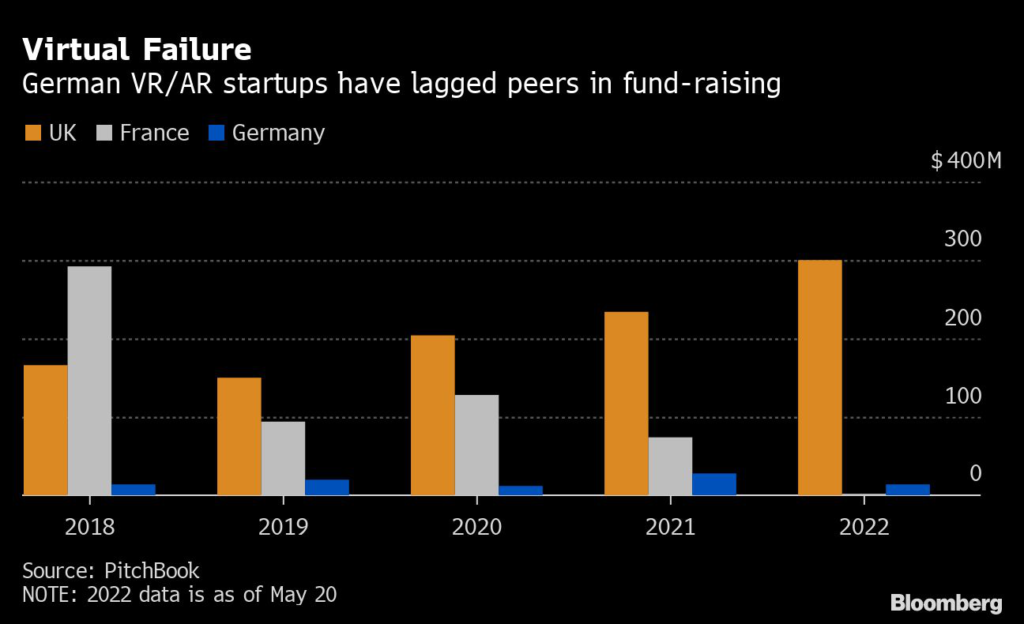
In the meantime, German virtual reality firms have lagged far behind peers in the UK, France, Israel and Switzerland in fund-raising, according to data compiled by PitchBook. 

Meta is the world’s top VR headset maker, with 80% market share according to research firm IDC. Customers have spent over $1 billion on Meta’s Quest store content, in part driven by Facebook founder Mark Zuckerberg’s obsession with the so-called metaverse, a virtual world that blends gaming, VR and social media. JPMorgan estimates spending in the metaverse could eventually reach $1 trillion.

While it is possible to get Quest 2 headsets delivered to Germany via Amazon stores hosted by other EU nations, the workaround is an added cost to developers and depresses demand among potential clients. 

Regulatory Battles

The dispute between Meta and the Federal Cartel Office is one of several cases where the company’s data policies and practices have triggered concerns in Germany. Regulators have banned the company from collecting data of German users of its WhatsApp messaging service, while this year the nation’s top civil court ruled Facebook can’t deny locals the right to use invented names.

“Facebook isn’t looked on fondly,” said Daniel Pots, the co-founder of VR Bits, a Leipzig-based developer for corporate safety training and marketing solutions. “As many of our clients come from industry – important industrial sectors like electricity providers – they’re very concerned with data protection.”

While Meta is the dominant player in the industry, there are signs that competition is heating up. Some developers have hailed the ByteDance Ltd.’s Pico Neo as comparable quality to the Quest 2, while Apple Inc. executives recently previewed an mixed-reality headset to the company’s board, according to people familiar with the matter. 

The market for VR devices may grow by 27% annually through 2026, according to Mandeep Singh, a senior tech analyst at Bloomberg Intelligence.

VR Bits has been working to convert some of their products for alternative headsets, including the Chinese-made Pico Neo, according to Pots. 

‘Insane Market Dominance’

“More and more people are saying that Pico headsets are a lot easier to maintain,” said Soenke Kirchhof, the head of VR production studio INVR. “Facebook has an insane market dominance and that needs to be broken. There’s no market when there’s only one developer.”

Other companies also face questions over information security. Last year, Ireland’s Data Protection Commission began two probes of ByteDance’s TikTok video sharing app, including one after Irish privacy chief Helen Dixon expressed concerns it was sending some EU user information to China. 

VR fitness app developer Icaros, founded in 2015, shifted away from the Oculus system when Meta halted sales, according to Chief Executive Officer and founder Michael Schmidt.

While the results of the Oculus probe are pending, the head of the Federal Cartel Office said this month that Facebook will be to be covered by Germany’s tougher new digital antitrust rules, suggesting regulators and Meta remain at an impasse. 

“If Oculus wouldn’t have been so strong in the market, virtual reality would have advanced as a technology much more,” Schmidt said. “We would love to enter their world but we’d also love to see the restrictions fall.”  

More stories like this are available on bloomberg.com

©2022 Bloomberg L.P.
Singapore’s Golden Gate Targets Vietnam Startups in Growth Push

(Bloomberg) — Singapore’s Golden Gate Ventures is opening two offices in Vietnam to invest in the country’s emerging tech sector that it predicts will spur Southeast Asia’s next phase of growth.

The Singapore-based venture capital firm is planning to set up posts in Ho Chi Minh City and Hanoi, it said in a statement Monday. Founding partner Vinnie Lauria has moved to Ho Chi Minh City to head operations.

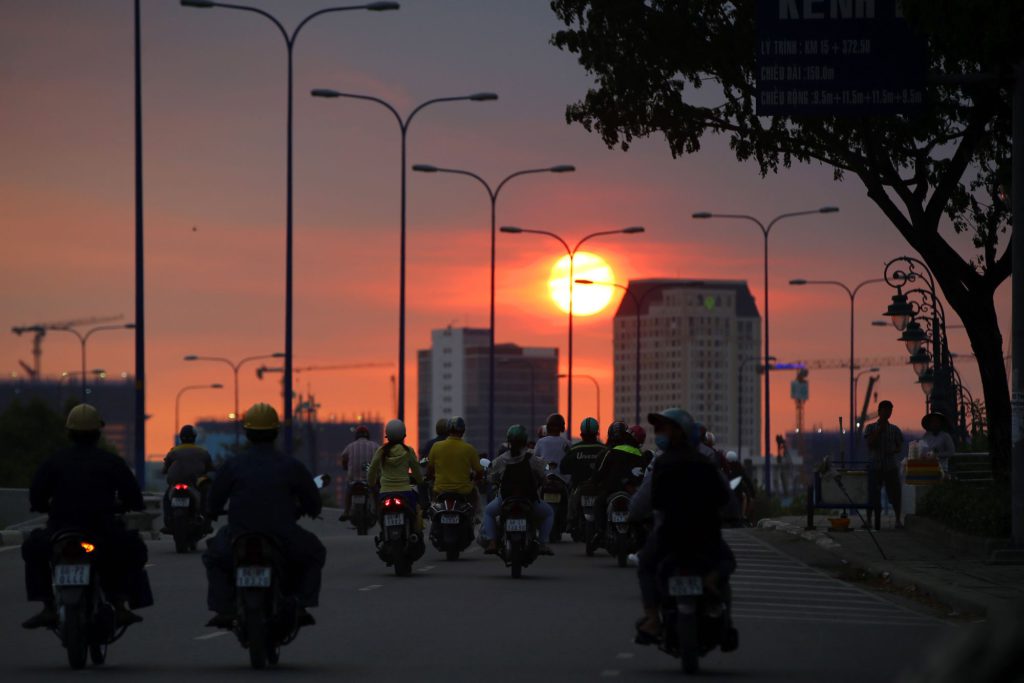
Vietnam, with a population of about 100 million, is attracting venture capitalists as the country’s economy expands and consumers adopt online and mobile services. Vietnam’s startups drew a record $1.4 billion of investment last year and the number of newly established enterprises rose 32% in the first four months of 2022 compared with two years earlier, said Vu Quoc Huy, director of National Innovation Centre, a unit of Vietnam’s Ministry of Planning and Investment.

“We are expecting investments to double in the next three years,” Vu said in Golden Gate’s release.

Founded by Lauria and former Silicon Valley entrepreneurs Jeffrey Paine and Paul Bragiel in 2011, Golden Gate was one of the earliest VC firms to target Southeast Asia’s nascent technology sector. It has since launched four funds and invested in more than 60 companies across the region, according to its website. They include online classified app Carousell, logistics platform Ninja Van and Appota Corp., a Vietnamese mobile gaming platform with more than 55 million users.

The move underscores an influx of capital into the booming Southeast Asian region as investors seek opportunities beyond the U.S. and China. VC firms are targeting the region of about 650 million people where the internet economy is set to double to $363 billion by 2025, according to a report by Google, Temasek Holdings and Bain & Co.

More stories like this are available on bloomberg.com

©2022 Bloomberg L.P.
This Is the Space Station China is Building to Challenge the US

(Bloomberg) — China released new details about the final stages of work on its Tiangong space station, an under-construction orbiter started after the US barred Beijing from participating in the International Space Station.

The Shenzhou XIV spacecraft, which will carry three astronauts in June for a six-month mission to Tiangong, was moved to the launchpad at the Jiuquan Satellite Launch Center in Inner Mongolia on Sunday, state media reported, with a launch scheduled “in the coming days.”

Following that mission, China will launch one of the station’s lab components in July and the second in October, the official China Daily reported on Sunday. 

READ: China, US Race to Make Billions From Mining the Moon’s Minerals

“After the space labs, the Tianzhou 5 cargo craft and the Shenzhou XV crew are scheduled to arrive at the massive orbiting outpost around the end of the year,” according to the China Daily report.

Last week, China released a new, high-definition image of Tiangong, which is in orbit around 400 kilometers (250 miles) above the Earth. 

Once Tiangong is complete, China will be the only country to operate a space station of its own, adding to other accomplishments such as landing on Mars last year and on the far side of the moon in 2019.

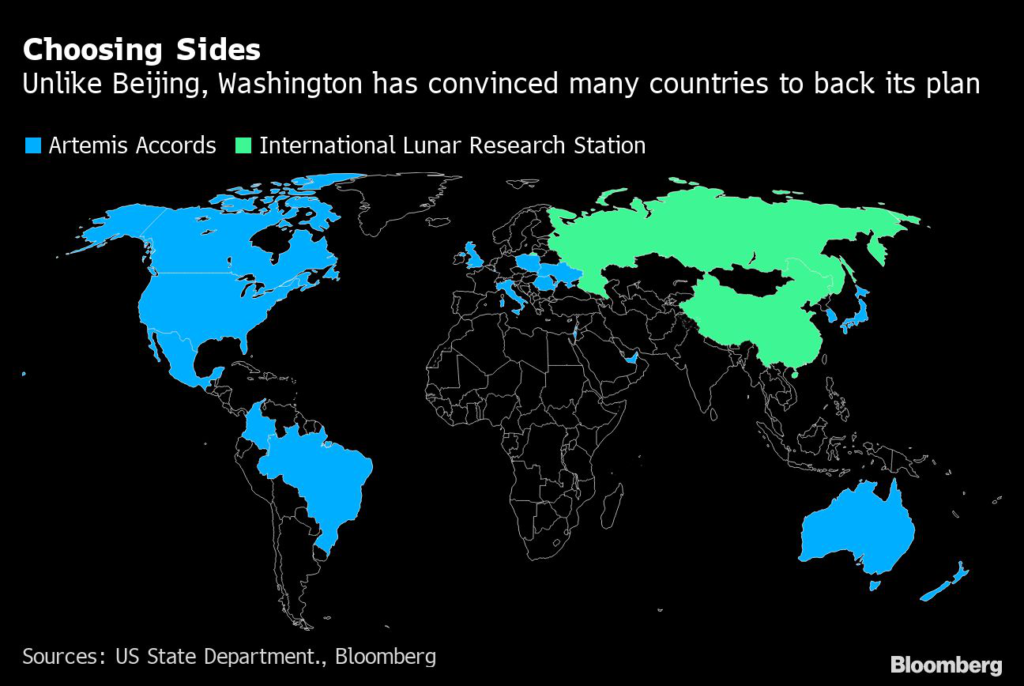
Under President Xi Jinping, China has increased efforts to match the US as the dominant power in space, teaming up with Russia on a proposed lunar research station and opposing the Washington-backed Artemis Accords, which are intended to help govern future space activity such as mining on the moon. 

Chinese state media has criticized the accords as an effort to create a space-based NATO.

So far, though, the US is winning more countries over to its vision for space. Colombia became the 19th country to endorse its vision for space governance, signing the accords on May 10. 

While China has released images of the station in the past, the new picture offers online viewers a better chance to hone in on specific parts. It provides a closer look at details such as the green stripes wrapping around several cylinders, the orange and black solar panels and the Chinese flags on the exterior.

The cabin will have capacity for six people, who’ll be able to occupy more than 110 cubic meters of activity space, according to the People’s Daily. There will also be two exit hatches for astronauts, and one for cargo.

Zhurong, the rover that China landed on Mars last year, has temporarily gone into dormancy because of a dust storm, according to state media, citing the China National Space Administration, which predicted the rover would resume operations around December.

More stories like this are available on bloomberg.com

©2022 Bloomberg L.P.
Bitcoin May Still Be Primed for a Further Drop From Range

(Bloomberg) — Bitcoin — stuck in a range around $30,000 lately — has some market watchers wondering if it’s vulnerable to further drops.

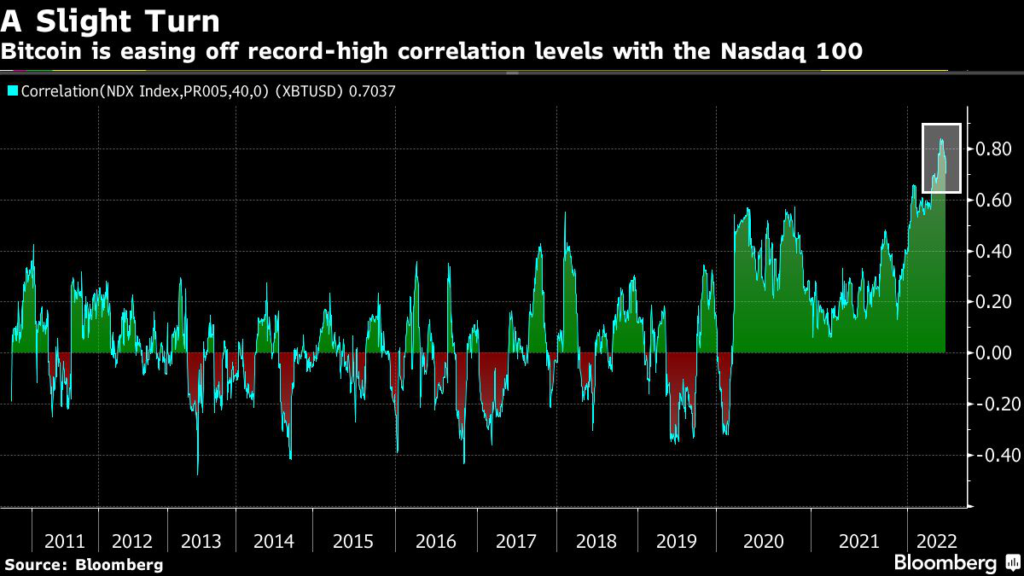
The largest cryptocurrency climbed for a third day, jumping as much as 3.7%, but it’s been stuck around $30,000 for several weeks now. What’s more, its record-high correlation with the Nasdaq 100 — illustrating its behavior like a risk asset — has tailed off as tech stocks rallied in the past week.

“This is the type of de-correlation nobody wanted,” said Antoni Trenchev, co-founder and managing partner of crypto lender Nexo. “Bitcoin has yet to test its sub-$26,000 May 12 lows. One senses it’s only a matter of time, given Bitcoin’s failure to mirror the Nasdaq’s gains in the past week.”  

Bitcoin has been stymied in recent months as the Federal Reserve and other central banks have pivoted toward rate-hiking cycles amid stubbornly high inflation. The collapse of the Terra ecosystem has also hurt sentiment in digital assets. 

Bitcoin is holding up relatively well compared with some of its peers, including second-ranked Ether, but some technical analysis is still flagging concerns.

Bitcoin’s sideways churn over the last two weeks inside of a so-called “pennant” ended with prices breaking lower late last week. Bears will continue to have the upper hand unless the token reclaims $30,200, according to the pattern — and any break below $28,000 could see $25,000 coming back in focus. A descending-triangle pattern indicates that anything below about $25,400 could put the 2017 peak — just below $20,000 — into play.

“One final pullback to test May 12 lows near $25,401 still looks more likely before any meaningful low is in place,” Mark Newton, head of technical strategy at Fundstrat, wrote in a note Thursday. 

More stories like this are available on bloomberg.com

©2022 Bloomberg L.P.
SoftBank Execs’ Pay Slashed After Historic Vision Fund Loss

(Bloomberg) — SoftBank Group Corp.’s top executives saw steep cuts in their paychecks as the Japanese conglomerate marked a historic loss for its Vision Fund unit.

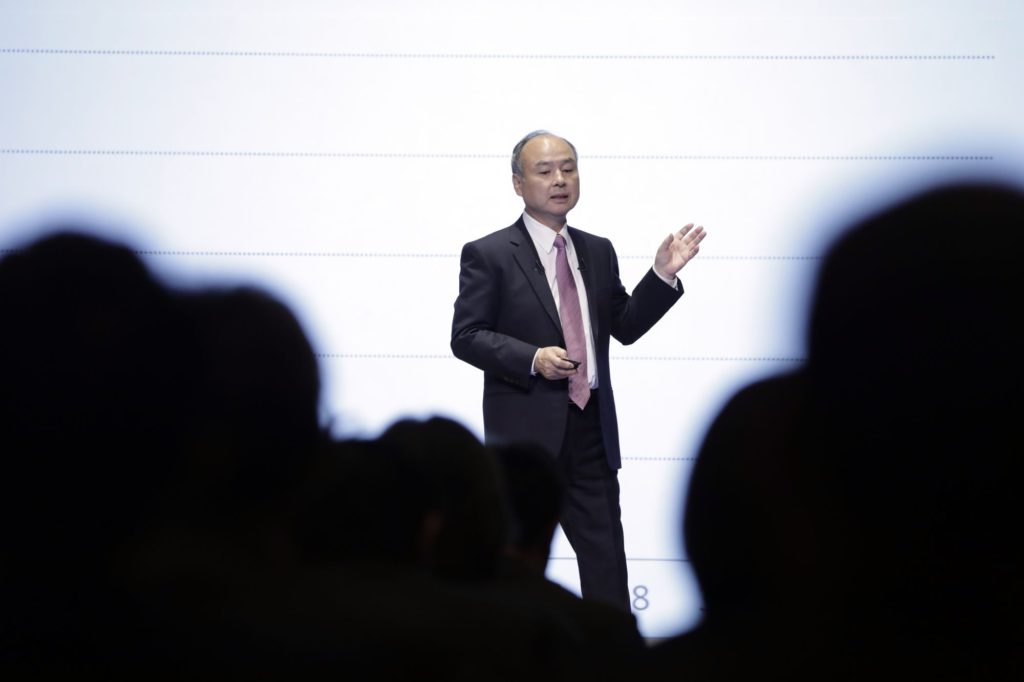
The company’s founder and Chief Executive Officer Masayoshi Son kept his pay unchanged at 100 million yen (roughly $785,000), however some of his top executives whose compensation was made public through a company filing on Monday saw big drops following a record $20.5 billion loss.

Chief Financial Officer Yoshimitsu Goto made 293 million yen, down almost 40% from the previous year. Ken Miyauchi, chief of SoftBank’s domestic telecom operation, made 539 million yen, down 15%. Both long-serving lieutenants have helped lead SoftBank’s multiple reinventions, from broadband provider to telecom operator to the world’s biggest tech investor.

Simon Segars, who stepped down as the head of the company’s chip unit Arm Ltd. in February, earned 1.15 billion yen during the almost-three months that he was a board director, SoftBank said, without providing further details. Segars received 1.88 billion yen in the previous year, ended March 2021.

Ronald Fisher, Son’s long-time lieutenant who also stepped down from his role leading the Vision Fund’s US arm in April, earned 126 million yen during his time as a board director last year from April to June 23. He got 917 million yen in the prior year and remains an adviser to Son.

SoftBank CEO Pays Price for Tech Bets With $20 Billion Loss

SoftBank did not disclose what compensation former Chief Operating Officer Marcelo Claure, previously one of Son’s most trusted allies and highest-paid executives, received before his departure earlier this year. He earned 1.8 billion yen in the prior year. Compensation was also not disclosed for Rajeev Misra, who heads the Vision Fund. Both departed SoftBank’s board in November 2020.

In 2021, SoftBank’s Top Executives Made $64 Million After Record Profits

The world’s largest tech fund reported its biggest loss ever for the year ended Mar. 31 as a selloff in tech shares deflated the value of its portfolio companies, including public holdings like Coupang Inc. and Didi Global Inc.

The Japanese tech investor earlier this week named venture capitalist David Chao to join its board as it tries to regain its footing from money-losing investments. Chao’s appointment will be subject to approval at the upcoming annual general meeting of shareholders on Jun. 24.

To compare SoftBank pay with executive compensation filed to the US Securities and Exchange Commission, see the Bloomberg Pay Index.

(Updates with compensation details)

More stories like this are available on bloomberg.com

©2022 Bloomberg L.P.
SoftBank Executives’ Pay Slashed After Historic Vision Fund Loss

(Bloomberg) — SoftBank Group Corp.’s top executives saw steep cuts in their paychecks as the Japanese conglomerate marked a historic loss for its Vision Fund unit.

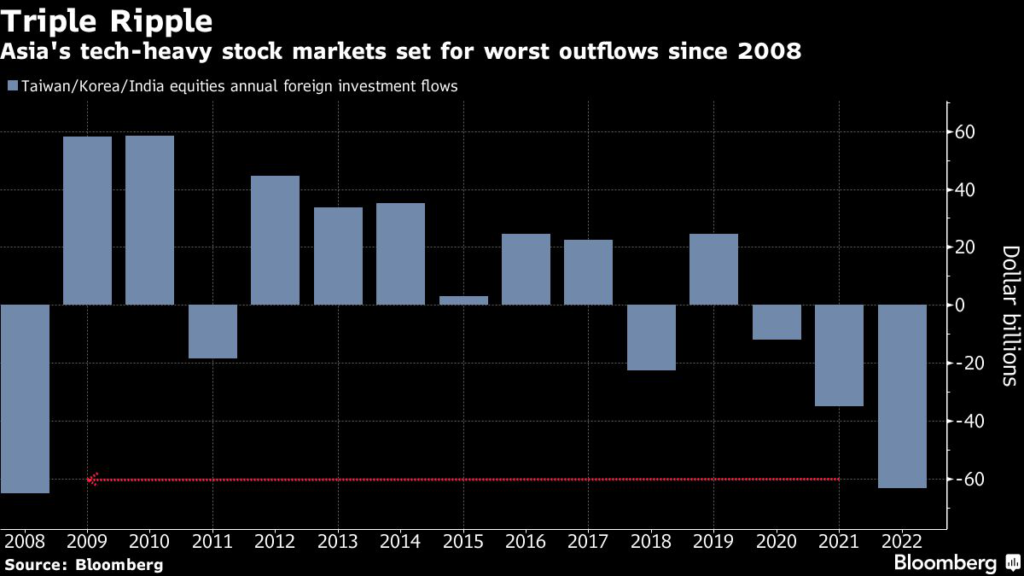
The company’s founder and Chief Executive Officer Masayoshi Son kept his pay unchanged at 100 million yen (roughly $785,000), however some of his top executives whose compensation was made public through a company filing on Monday saw big drops following a record $20.5 billion loss.

Chief Financial Officer Yoshimitsu Goto made 293 million yen, down almost 40% from the previous year. Ken Miyauchi, chief of SoftBank’s domestic telecom operation, made 539 million yen, down 15%. Both long-serving lieutenants have helped lead SoftBank’s multiple reinventions, from broadband provider to telecom operator to the world’s biggest tech investor.

Simon Segars, who stepped down as the head of the company’s chip unit Arm Ltd. in February, earned 1.15 billion yen during the almost-three months that he was a board director, SoftBank said, without providing further details. Segars received 1.88 billion yen in the previous year, ended March 2021.

Ronald Fisher, Son’s long-time lieutenant who also stepped down from his role leading the Vision Fund’s US arm in April, earned 126 million yen during his time as a board director last year from April to June 23. He got 917 million yen in the prior year and remains an adviser to Son.

SoftBank CEO Pays Price for Tech Bets With $20 Billion Loss

SoftBank did not disclose what compensation former Chief Operating Officer Marcelo Claure, previously one of Son’s most trusted allies and highest-paid executives, received before his departure earlier this year. He earned 1.8 billion yen in the prior year. Compensation was also not disclosed for Rajeev Misra, who heads the Vision Fund. Both departed SoftBank’s board in November 2020.

In 2021, SoftBank’s Top Executives Made $64 Million After Record Profits

The world’s largest tech fund reported its biggest loss ever for the year ended Mar. 31 as a selloff in tech shares deflated the value of its portfolio companies, including public holdings like Coupang Inc. and Didi Global Inc.

The Japanese tech investor earlier this week named venture capitalist David Chao to join its board as it tries to regain its footing from money-losing investments. Chao’s appointment will be subject to approval at the upcoming annual general meeting of shareholders on Jun. 24.

To compare SoftBank pay with executive compensation filed to the US Securities and Exchange Commission, see the Bloomberg Pay Index.

(Updates with compensation details)

More stories like this are available on bloomberg.com

©2022 Bloomberg L.P.
Tech-Heavy Stock Markets See $63 Billion of Outflows in Asia

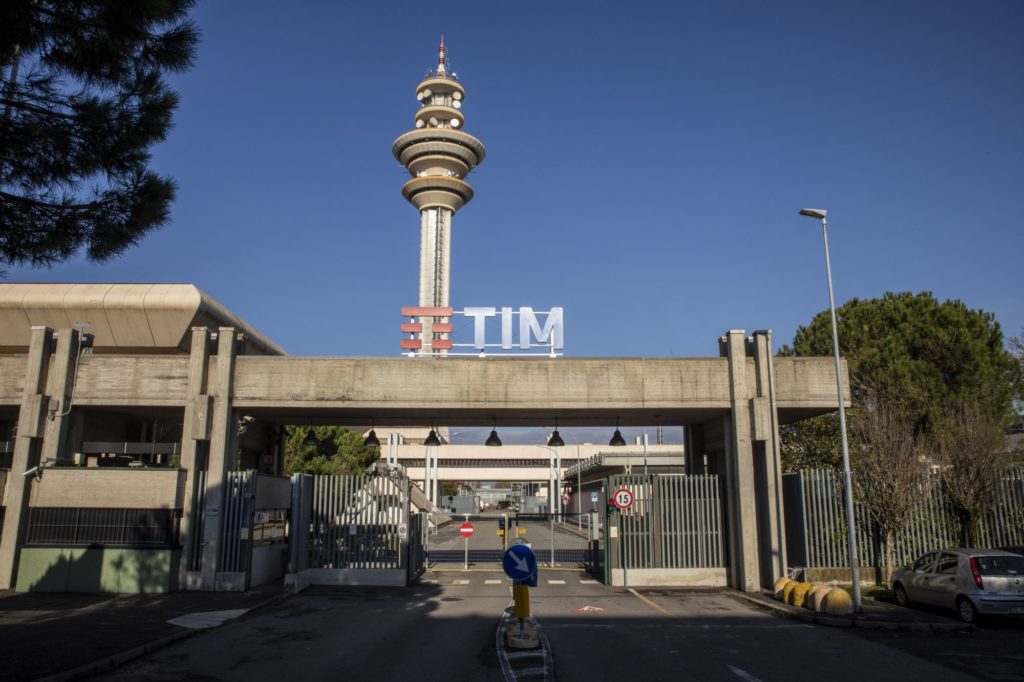
(Bloomberg) — Tech-heavy stock markets in Asia are bearing the brunt of foreign selling as global growth concerns spurred by rising borrowing costs and the war in Ukraine sap appetite for risk assets.

Overseas funds have sold about a net $63 billion worth of shares in Taiwan, South Korea and India so far this year, according to the latest available data compiled by Bloomberg. The tech sector’s weighting in the Taiex, Kospi and Sensex gauges is higher than that in the broader MSCI Asia Pacific Index.

The exodus is the worst in Taiwan, with foreign investors having dumped a net $28.1 billion year-to-date. That’s even as global funds last week bought the most shares in two months.

More stories like this are available on bloomberg.com

©2022 Bloomberg L.P.
Telecom Italia, Italy’s CDP Sign Preliminary Single Grid Pact

(Bloomberg) — Telecom Italia SpA reached a preliminary accord with state-backed lender Cassa Depositi e Prestiti SpA for a national single-network project, marking a key step to merge their landline grids.

The carrier signed a memorandum of understanding with Cassa Depositi, its second-largest investor, to combine Telecom Italia’s grid with a similar network owned by smaller rival Open Fiber SpA, which is controlled by Cassa Depositi, the firms said in a joint statement.

The accord was also signed by Open Fiber, and Teemco, a Luxembourg company controlled by US private equity firm KKR & Co., which owns a stake in Telecom Italia’s FiberCop SpA fiber unit, and Macquarie Group Ltd., a minority investor in Open Fiber.

Under the accord, Telecom Italia’s fixed network infrastructure activities will be split from its commercial activities to be merged with the network controlled by Open Fiber. The involved parties plan to sign a binding agreements by the end of October.

Telecom Italia Chief Executive Officer Pietro Labriola, an industry veteran, is working on a turnaround project for Telecom Italia. Under his plan, the firm’s landline assets would be separated and merged with Open Fiber’s, aligning Telecom Italia with a government goal of building a single national fiber network while avoiding duplicate investments. The plan also foresees all commercial services being spun off into a separate unit.

Earlier this year, Telecom Italia rejected a 10.8 billion-euro takeover proposal from KKR. 

More stories like this are available on bloomberg.com

©2022 Bloomberg L.P.

‘Top Gun’ Nostalgia Banks $124 Million in Holiday Debut

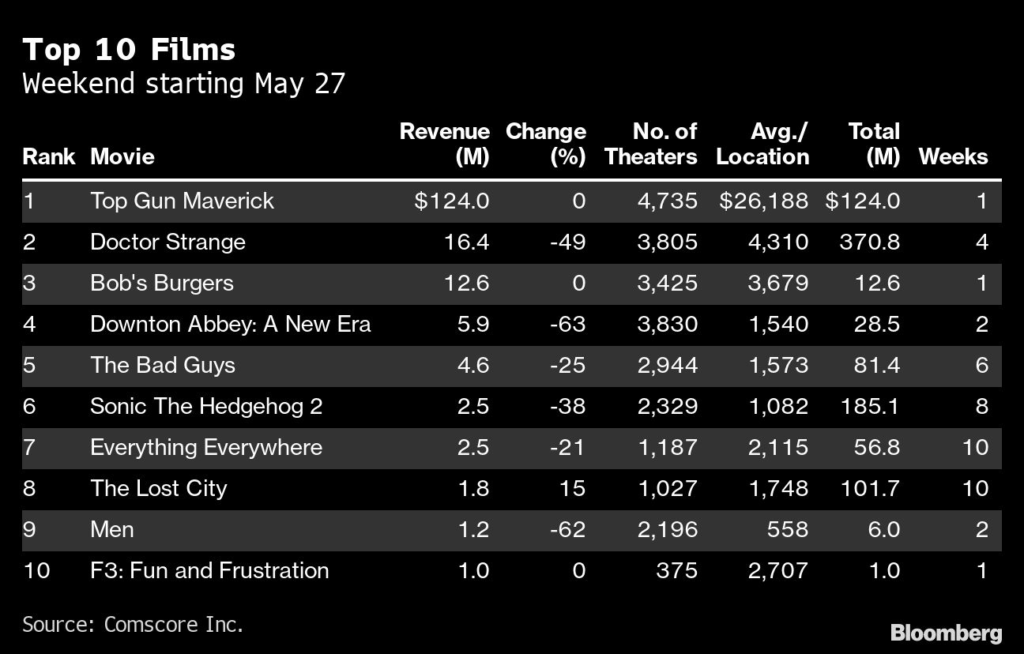
(Bloomberg) — “Top Gun: Maverick” topped the Memorial Day weekend box office, appealing to a broad swath of viewers, including many who have been slow to return to theaters.

  • The sequel film, starring Tom Cruise as the titular Pete “Maverick” Mitchell, raked in an estimated $124 million in Friday-through-Sunday ticket sales in the U.S. and Canada, Paramount Pictures said in an email. That was short of the $130 million estimate from BoxofficePro.com. Bloomberg Intelligence projected up to $107 million.
  • “Top Gun,” produced by Paramount Global and Skydance Media, gave theaters one of their biggest box office debuts since the start of the pandemic. It’s a rare nonsuperhero movie among the top performers, trailing Sony Group’s “Spider-Man: No Way Home” at $260 million Walt Disney Co.’s “Doctor Strange in the Multiverse of Madness” at $187 million, and Warner Bros.’s “The Batman” at $134 million.

Key Insights

  • Cruise’s reprisal of his 1986 performance resonated well with audiences and critics. More than 97% of each recommended the flick, according to review aggregator site RottenTomatoes.com. The Washington Post wrote that the movie, which follows Cruise’s character as he trains a group of young pilots, was “familiar and new in just the right proportions” and also commended Cruise’s performance as “commanding and generous.”
  • The opening weekend was the biggest ever for Cruise, and Paramount said 55% of the audience was over age 35.
  • The movie likely won’t get a release in China, diminishing its global revenue. Chinese technology company Tencent Holdings Ltd. had signed on to co-finance the film in 2019 but pulled out over concerns that the movie glorifies the US military, according to the Wall Street Journal.
  • The film pairs old stars like Cruise and Val Kilmer — who played Tom “Iceman” Kazansky in the original — with fresh faces such as Miles Teller, who plays the son of Maverick’s late friend Nick “Goose” Bradshaw.
  • “Top Gun” represents a return to normalcy as viewers once again seek refuge from the heat in air-conditioned theaters. Like pre-pandemic summers, studios will more regularly roll out big-budget films such as Universal Picture’s “Jurassic World Dominion” and Disney’s “Lightyear,” both slated for June.


(Updates with charts and bullet item on age of audience)

More stories like this are available on bloomberg.com

©2022 Bloomberg L.P.

Close Bitnami banner
Bitnami