World

Colombian charged in Haiti president's killing pleads not guilty in US court

A former Colombian soldier charged in the United States with participating in the assassination of Haitian President Jovenel Moise pleaded not guilty Friday, his lawyer in Miami said. 

Accused by the US courts of having participated in the “conspiracy to kidnap or assassinate” Moise, Mario Palacios “will plead not guilty,” said lawyer Alfredo Izaguirre as he left the Miami courthouse where the case is being tried. 

Moise was shot dead on the night of July 6 to 7, 2021 in his private residence in Port-au-Prince. A hit squad of Colombian mercenaries is suspected of having carried out the slaying. 

Mario Palacios is accused of being one of five armed men who entered the room where the late president was killed. 

Arrested in October in Jamaica, he could not be extradited to Haiti due a lack of evidence provided by the authorities in Port-au-Prince. 

He was then arrested again on January 3 in Panama, during a stopover on a flight from Jamaica, and extradited to the United States. 

US law is being applied in this case because the plan to kill the Haitian president was allegedly partly organized on US soil in Florida, by American-Haitian nationals. 

Palacios faces life imprisonment. Another suspect was charged by the US Justice Department on January 20 — Haitian-Chilean national Rodolphe Jaar, 49, is also accused of complicity in the murder. 

He admitted in a December interview with US police to having provided the hit squad with weapons and ammunition.

Sending mercenaries to Libya main income source for Darfur armed groups: UN

Providing mercenaries in Libya’s internal conflict has become the main source of revenue for armed groups from Sudan’s own war-torn Darfur region, the United Nations said in a report Friday.

The report, drawn up by UN experts in charge of monitoring the arms embargo imposed on Sudan, said the guns-for-hire deals had been facilitated by the United Arab Emirates.

It said the activity meant that the arms embargo had been broken “with the transfer of arms and other military materiel into Darfur.”

“Mercenary activities in Libya had been the major source of financing for most Darfurian movements” in 2021, the report said.

It noted that thousands of Sudanese mercenaries are in Libya in the service of the self-proclaimed Libyan National Army controlled by Marshal Khalifa Haftar. 

These mercenaries come from signatory and non-signatory movements of the Juba Peace Agreement, concluded in October 2020, the experts said, adding that they are not able to quantify the total number.

“Most Darfurian armed groups continued to work for the Libyan National Army in Libya during the reporting period, securing areas and manning checkpoints. In return for these tasks, the five main movements (SLA/MM, GSLF, SLA/TC, SLA/AW and SRAC) were receiving payments and logistical support,” the UN experts said.

The report noted that “several sources in the movements said that the money and support were discussed and agreed upon in meetings between their military commanders and United Arab Emirates representatives in Libya.”

“The payments were provided by the United Arab Emirates and channelled to the movements by the Libyan National Army, which took a cut,” the report added.

The UN experts said that when confronted last November with allegations about providing “financial and military support to Darfurian forces (both in the Sudan and in Libya), the United Arab Emirates referred to its country’s moderate position and struggle against extremism and hate speech.”

The report also said the Sudanese government had participated in the activities of the so-called “5+5” Joint Military Commission, which brings together representatives from eastern and western Libya to guarantee the ceasefire and the withdrawal of foreign fighters and troops from that country. 

The UN experts said several “small groups” of Sudanese mercenaries operating in Libya had shown willingness to engage in peace talks and return to Sudan.

Darfur is a vast region in western Sudan regularly shaken by clashes linked, among other things, to territorial disputes or difficulties in accessing water.

The region has experienced a long war that has, since 2003, left at least 300,000 dead and 2.5 million people displaced, according to the UN.

US probe finds single attacker in Kabul evacuation bombing

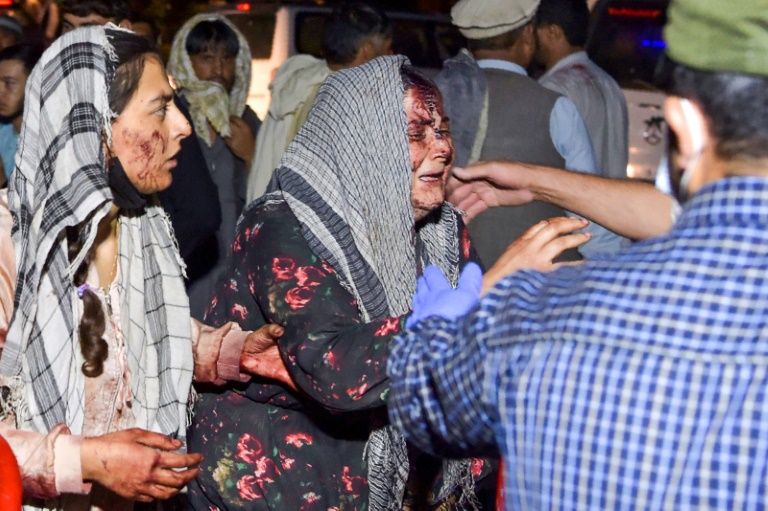
An attack that killed at least 173 people including 13 US service members during the chaotic Kabul airport evacuation last year was undertaken by a single suicide bomber, a Pentagon investigation concluded Friday.

The investigation ruled out more than one perpetrator or anyone using firearms in the August 26 attack, which was claimed by the Islamic State group.

At least 160 Afghan civilians and the 13 US troops were killed by the bombing, which came during the final days of the US military’s withdrawal after  two decades of war, according to the investigation.

The bomb exploded in a dense crowd just outside the airport’s Abbey Gate as thousands of people pushed to try to get inside and leave the country in the US-managed airlift.

Although some gunfire erupted after the bombing, US officers said they were warning shots and none of those who died in the event were killed by them. 

“There were no gunshot wounds” among the victims, said Brigadier General Lance Curtis, who presented the investigation findings Friday.

He said that the deaths were from shrapnel including ball bearings from the bomb, the wounds of which can look like gunshot wounds.

Curtis admitted that on the day, the US military thought the attack was “complex,” involving an Islamic State gunman as well as the bomber.

“We now know that the explosive fired ball bearings causing wounds that looked like gunshots. When combined with a small number of warning shots, that led many to assume that a complex attack had occurred,” Curtis told reporters.

Also adding to the confusion was the fact that the shrapnel from the blast punctured tear gas canisters carried by the US troops for crowd control.

That created “instant chaos and sensory overload,” said one of the officials who briefed reporters on the investigation.

The bomb also left 45 US service members injured, some with brain injuries from the concussive force of the blast.

The black-garbed perpetrator, shown in the investigator’s sole video of the bombing, was later identified by Islamic State as Abdul Rahman Al-Logari, who was released from a government prison by the Taliban after they took control of Kabul on August 15.

Macron the mediator wades into Russia-Ukraine crisis

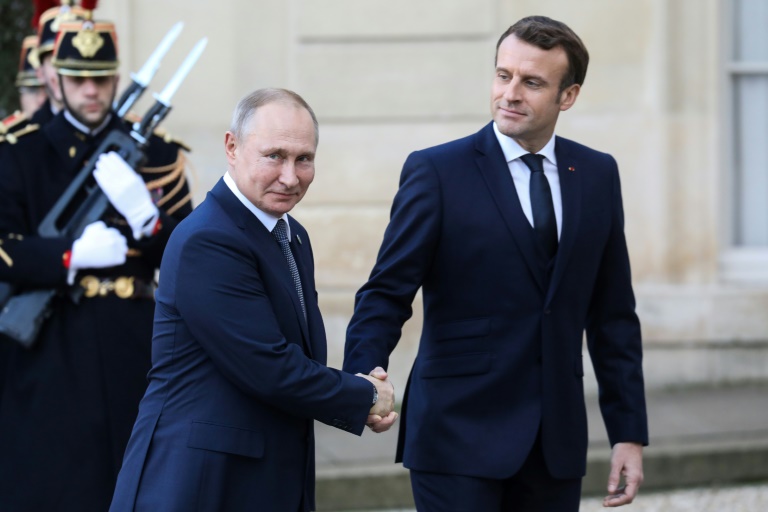
French President Emmanuel Macron will fly to Russia and Ukraine next week in an attempt to avert conflict between the neighbours, reprising his role as a crisis mediator that has produced limited results in the past.

The 44-year-old leader, who is facing elections in April, has repeatedly thrown himself into the search for solutions to some of the world’s most acute diplomatic problems from Iran’s nuclear programme to Libya’s civil war. 

His latest attempts to lower tensions between Russian President Vladimir Putin and Ukrainian counterpart Volodymyr Zelensky are consistent with the two main features of his thrusting foreign policy since coming to power in 2017.

He has always argued that Europe and the European Union should take greater charge of its own defence and security, and has sought to push France forward on the international stage with what he describes as “diplomacy of audacity.”

He laid out this philosophy in front of French ambassadors in 2019, telling them that Europe risked disappearing unless it stood up for itself and arguing that the only choice is “to take part in the game and use our weight”. 

“I believe in one thing: it’s a strategy of audacity and taking risks,” he said. 

– Setbacks – 

This approach has led to some highly public setbacks, particularly early in his term, which some critics think revealed his naivety and France’s limitations as a middle-ranking world power.

“France has a long tradition of mediating, but Emmanuel Macron in particular has wanted to be a sort of balancing power,” said Bruno Tertrais from the Foundation for Strategic Research think-tank in Paris. 

“It’s striking, however, how his efforts have rarely led to success.”

Among Macron’s failures was an initiative to try to broker a solution to the Libyan civil war in 2017 which caused friction with EU partner Italy and led to criticism that France was secretly supporting a local warlord.

On the Iran nuclear crisis, Macron repeatedly tried to broker direct talks between former US president Donald Trump and Tehran, even flying the Iranian foreign minister unannounced to a G7 meeting in France in 2019 — in vain.

Following a huge port explosion in Beirut that brought down the government in Lebanon in 2020, Macron visited the disaster scene, sleeves rolled up, and promised to help bring about a “new political order”. 

There has been no radical reform since and Lebanon remains mired in crisis.

The summer before, in 2019, the French leader invited Putin to his summer holiday residence in a surprise attempt to try to reset relations, which went down badly in eastern Europe where EU countries feel most threatened by the Kremlin.  

“You can’t criticise Emmanuel Macron for trying to launch mediation efforts, but you can criticise him in some situations for doing it on his own,” Tertrais said. 

The French president on Friday exchanged views with German Chancellor Olaf Scholz, who is still taking his first steps on the world stage after succeeding Angela Merkel in December.

Tertrais said one success was Macron’s “quite spectacular” intervention in 2017 to free Lebanon’s then prime minister Saad Hariri after he was effectively detained in Saudi Arabia.

– Multi-track diplomacy –

Analysts are unsure what the French leader can achieve during his visits to Moscow and Kyiv on Monday and Tuesday to de-escalate a crisis sparked by the massing of around 100,000 Russian troops on Ukraine’s border. 

Tatiana Kastoueva-Jean at the French Institute of International Relations (IFRI) said that Putin sees Macron as the de-facto leader of Europe after veteran German chancellor Merkel stepped down after 16 years in power.

“In Germany, the new coalition government is still getting up to speed,” she said. “So Macron is the voice of Europe in talks with Putin.”

France also currently holds the rotating presidency of the 27-member European bloc.

Michel Duclos, a former ambassador at the Montaigne Institute, a Paris-based think-tank, said the French president has been wise not to build up expectations and appears to be coordinating better with EU allies.

“You get the impression he has learned from his previous failures,” he told AFP. 

The French presidency on Friday was not promising miracles from Macron’s trip.

He will “make contact, engage in negotiation in the clearest possible terms,” the presidency said.

“It is not a question of settling everything” but of moving towards a “de-escalation”, it said.

At home, political observers are unsure how the flurry of diplomacy will influence Macron’s re-election chances.

With the first round of the election looming on April 10, Macron will also have to decide in coming weeks whether to pull out a French force deployed in Mali in west Africa where relations with the ruling military junta have broken down. 

Macron’s attempted peace-making “reinforces his international stature” but brings with it the risk of failure which opponents would use, a French lawmaker close to Macron told AFP this week, asking not to be named. 

“He has to show that he can obtain concrete results.”

In Chernobyl ghost town, Ukraine forces train for combat

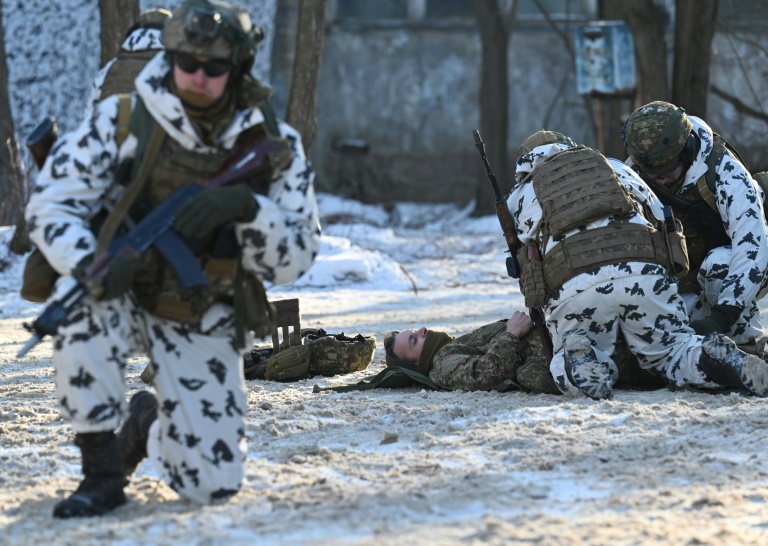
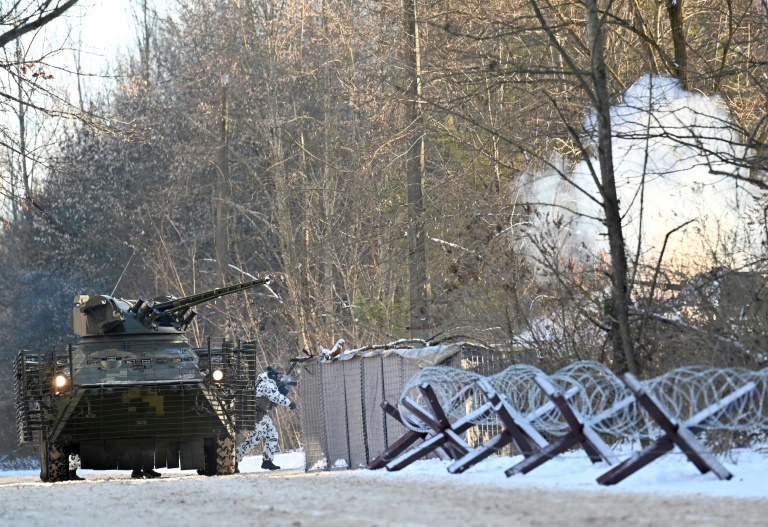
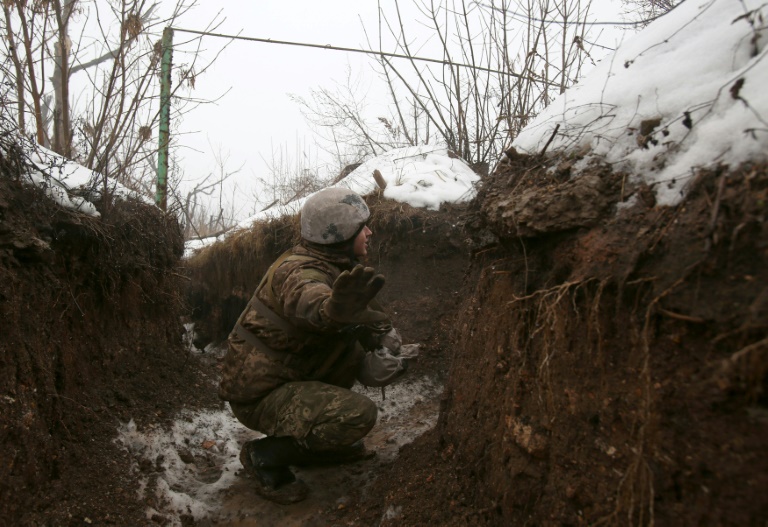
Machine gun fire echoed through the abandoned buildings of Pripyat in the Chernobyl Exclusion Zone, as Ukrainian National Guard troops on Friday staged urban combat exercises.

The live-fire training — carried out in one of the most radioactive places on earth — came as warnings swirl over a potential Russian invasion. 

Moscow has massed over 100,000 troops along Ukraine’s border — including deploying personnel to Belarus, which lies just 10 kilometres (six miles) to the north for joint drills.

For Ukraine’s forces, the deserted streets and apartment blocks of Pripyat — empty since residents were evacuated following the nuclear reactor disaster in 1986 — made an ideal training ground.  

Troops in winter camouflage practised clearing armed attackers from buildings, targeted mortar fire and took on snipers in urban conditions.   

Emergency service workers staged evacuations — a speaker on a drone telling residents to clear out — and fought fires caused by fighting.  

“As there are no civilians around here we can conduct exercises with real ammunition in a situation as close to actual urban warfare as possible,” said one National Guard serviceman, giving only his call sign Litva.  

But conducting exercises inside the exclusion zone has its own risks.  

Ahead of the training — the first of its kind staged in Pripyat — workers with Geiger counters had to scan the route to check there were no radioactive hotspots. 

“It has all been checked and it doesn’t present a danger,” Litva said confidently, as he clutched his automatic rifle to his chest. 

– Radioactive hotspots –

Some Western leaders insist the threat from Russia’s massed forces is real and urgent — but authorities in Kyiv have cautioned against stirring “panic”.

Ukraine’s defence minister Oleksiy Reznikov played down the likelihood of an incursion by Russian forces sent to Belarus for joint drills.  

While the US has said that their number could reach 30,000 — Reznikov insisted that the “several thousand” Russians currently across the Belarusian frontier were not enough to attack. 

He also pointed to difficult terrain as a major obstacle — and the threat from radiation if they tried to push through the exclusion zone towards the capital Kyiv.  

“This area is very hard to get through — forests, swamp, rivers — it’s complicated enough to move by foot let alone with a tank,” Reznikov told journalists, who had been ferried into the exclusion zone on a press tour to see the exercises. 

“And don’t forget that still since the disaster there remain some highly radioactive areas on the route from Belarus.”

– Heightened security –

Ukraine’s interior minister Denys Monastyrskiy said that due to the spike in tensions security had been stepped up around all nuclear reactors — including the  Chernobyl site, now covered by a mammoth protective sarcophagus. 

“We’re absolutely sure that the nuclear plant in Chernobyl is not under threat,” Monastyrskiy said. 

But the National Guard troops in Pripyat were not training to counter a full-scale Russian invasion.  

They were instead preparing for the threat from ununiformed infiltrators who might seize buildings and stir unrest across the country. 

That was what happened when Russia seized the Crimean peninsula in 2014 and began fuelling a separatist conflict in the east of Ukraine.

Ukraine’s authorities insist that type of internal destabilisation remains their biggest worry.

“We have to show our readiness to react to all events,” said Monastyrskiy

Quito flooding toll raised to 27

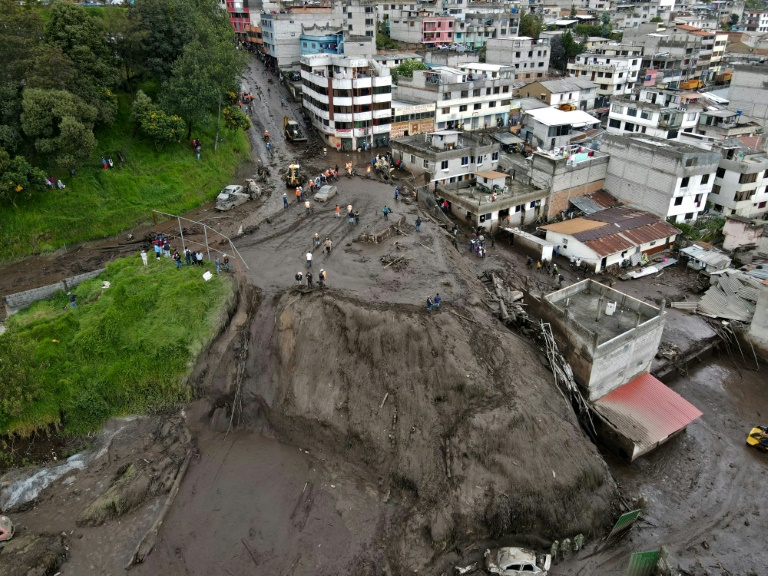
The heaviest flooding to hit Ecuador in two decades claimed 27 lives this week and left 53 people injured, municipal officials said Friday.

The floods inundated homes, carried off cars, and swept away volleyball players and spectators on a sports field.

Two people remain missing, Quito security official Guido Nunez told reporters.

A massive clean up operation was under way, and rescuers were continuing the search for victims in the vicinity of the sports field that was first in the path of the sudden deluge.

Rain that drenched Quito for 17 straight hours caused flooding and surges of mud that damaged roads, agricultural areas, clinics, schools, a police station and an electric power substation.

Quito mayor Santiago Guarderas said Monday’s rains overwhelmed a hillside water catchment structure that had a capacity of 4,500 cubic meters but was inundated with more than four times that volume.

Guarderas said Monday’s downpour brought down 75 liters per square meter (1.8 gallons per square foot) following 3.5 liters on Saturday.

This is “a record figure, which we have not had since 2003,” he added.

Three days of mourning were observed in Quito, a city of some 2.7 million people.

Heavy rains have hit 22 of Ecuador’s 24 provinces since October, claiming at least 44 lives.

China ups stakes for Biden by backing Moscow against West

China’s support for Russia in the standoff over Ukraine upends the strategic calculus for US President Joe Biden, who must now contend with a second front in a geopolitical fight whose ramifications could be felt worldwide.

By jointly lashing out Friday at Washington’s alleged destabilising policies in both Eastern Europe and the Asia-Pacific region, Beijing and Moscow indicated that sanctions alone would not deter their bids to play larger roles on the global stage.

Appearing publicly as the Beijing Olympics opened, Russian President Vladimir Putin and his Chinese counterpart Xi Jinping showed an “enhanced commitment to make the world safe for authoritarianism, in particular in former socialist countries,” said Steve Tsang, a political scientist at the SOAS University of London.

And for Xi, taking a public stand on Ukraine demonstrates “his shared interest with Putin to challenge the US-dominated world order”, Tsang told AFP.

Official Chinese media outlets have been playing up the frequent encounters between Xi and Putin since Russia’s 2014 annexation of Crimea, which saw the Russian leader largely blacklisted by the West.

China’s Global Times noted recently that “besides the official meetings, the two also shared some close moments like enjoying vodka, caviar and Russian ice cream and celebrating each other’s birthdays”.

“We know that both Russia and China value sovereignty above anything else, so alliance is still too strong of a word,” said Anton Barbashin, an analyst at the Riddle think-tank in Glasgow, Scotland.

“But we are definitely going to see more coordinated action in international relations, maybe simultaneous campaigns in Europe and Asia, as well as deepening economic ties between Moscow and Beijing,” he told AFP.

– ‘Opportunity costs’ –

And the Ukraine crisis gives Xi a chance to riposte indirectly to Biden’s avowed focus of containing China’s ambitions in the Asia-Pacific, as evidenced by the recent US-Australia defence pact and nuclear submarines deal.

“It increases Russia’s relative importance for China — Xi couldn’t have provoked Biden nor Europe this openly,” said Pascal Ausseur, a former French navy admiral and director of the Mediterranean Foundation of Strategic Studies. 

“And Putin showed Xi that he knows how to take geopolitical and military risks, which Beijing must have appreciated,” he said.

Putin is using the threat to invade Ukraine to demand a halt to NATO expansion and what it calls “Cold War” ideologies, and now has Beijing’s explicit support in the showdown.

“Don’t forget that Barack Obama told Putin that Russia was only a regional power — he wants to show that Russia plays a central role, and he’s succeeding,” Ausseur said.

The payoff for China, meanwhile, could be in its own backyard: More US troops focussing on Ukraine and other Eastern European nations means less military weight to compete with Beijing in the Pacific.

The US response to Moscow on any Ukraine invasion, for example, could weigh heavily on any Chinese move to take control of Taiwan, whose independence Washington has signalled it would defend.

“US strategies designed to deter or overextend Russia should not inadvertently overextend the United States by imposing high opportunity costs,” the RAND Corp analyst Stephanie Pezard wrote in a recent analysis.

Both Russia and China would also seize on any apparent US backdown over Ukraine to portray Washington as an unreliable partner, a potent argument as both countries look to spread their global influence, in particular in Africa.

“If the United States chooses retrenchment rather than its traditional global leadership role, both Russia and China could try to fill the void,” Pezard said.

Experts also agreed that time is on Putin’s side, as he left Moscow to meet with Xi in Beijing ahead of the opening of the of the Winter Olympic Games — which Biden and other Western leaders pointedly snubbed.

“Putin should be able to get Xi to commit to support Russia should the Ukraine situation end up with Russia being sanctioned — but probably on the understanding that Putin will not spoil Xi’s Winter Games” by invading Ukraine during the competitions, Tsang said. 

Ottawa police chief vows crackdown on 'unlawful' protest

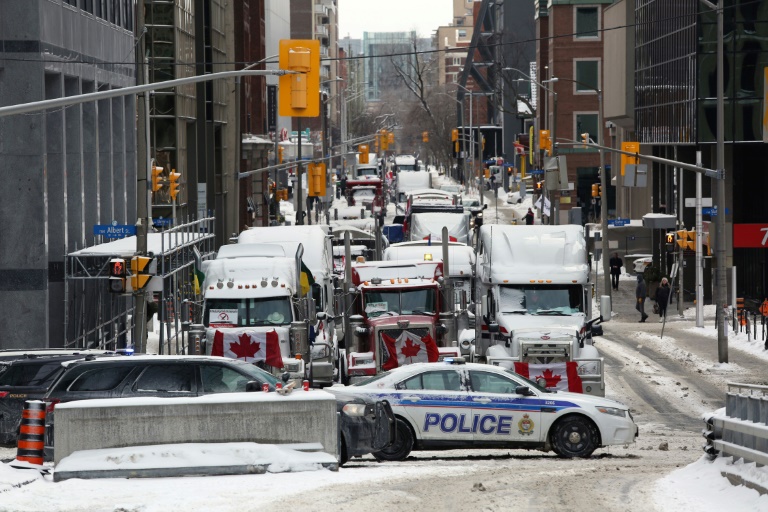
Ottawa’s police chief vowed Friday to crack down on an “unlawful” occupation of the Canadian capital by protesters opposed to vaccine mandates, as the trucker convoy’s clogging of the city enters a second week.

The tough talk from Ottawa’s top law enforcement official comes as the number of protesters — emboldened by support from former US president Donald Trump — is set to surge again this weekend, as well as be joined by counter-protesters.

“This remains… an increasingly volatile and increasingly dangerous demonstration,” Chief Peter Sloly told a news conference.

Following thousands of complaints from local residents of threats and harassment by protesters who’ve made even sleep difficult with incessant honking, Sloly said police were now “committed to bringing this unlawful demonstration to an end.”

But he did not offer a timeline.

An additional 150 police officers were deployed in downtown Ottawa Friday ahead of the expected arrival of 2,000-3,000 more protesters and counter-protesters this weekend.

The demonstration had peaked at several thousand last Saturday, according to officials, before dwindling to a few hundred by midweek.

“The lawlessness must end,” Sloly said, adding that acts of mischief, hate, harassment, intimidation and “other threatening behaviors” will not be tolerated.

Bridges and roadways into the city this weekend will be blocked, with protesters asked to park in lots on the outskirts and walk or use city transit to downtown.

Meanwhile, authorities have stepped up tracking protest supporters who are “funding and enabling unlawful and harmful activity,” Sloly said.

– Truckers staying for long haul –

The so-called “Freedom Convoy” started on Canada’s Pacific coast in late January and picked up supporters along its 4,400-kilometer (2,700 miles) trek to the capital, as well as more than Can$10 million (US$8 million) in online donations.

Its leaders told a news conference Thursday they planned to stay in Ottawa until vaccine mandates and other public health measures to slow the spread of Covid-19 are lifted.

On the streets of Ottawa, protestors hunkered down, building a large wooden shed in a city park to stockpile fuel containers and propane tanks — a show of resolve rebuked by Mayor Jim Watson.

They’ve also called for Prime Minister Justin Trudeau’s Liberal government to resign.

In a statement Friday, Trump expressed support for the protesters, saying the “harsh policies of far left lunatic Justin Trudeau… has destroyed Canada with insane Covid mandates.” He also egged on a proposal to hold a similar rally in Washington.

Trudeau, who’s isolating after contracting Covid, has refused to meet with them, as others stepped up criticisms of the protesters, accusing them of racism and even terrorism — labels organizers reject.

An estimated 400 more trucks are headed to Ottawa to try to join about 100 big rigs currently parked in front of parliament and surrounding streets, according to police. 

Other cities including Toronto, Quebec City and Winnipeg are also bracing for protests this weekend, while a blockade of a border crossing in Alberta continues.

Russia wins Chinese backing in showdown over Ukraine

Russia won China’s backing in its showdown with the West over Ukraine on Friday, as Beijing agreed with Moscow that the US-led NATO military alliance should not admit new members.

The demand for NATO to stop expanding came after a meeting between Russian President Vladimir Putin and Chinese counterpart Xi Jinping in Beijing that saw Putin hail the two countries’ “dignified relationship”.

In a long strategy document, Moscow and Beijing hit out at what they said was Washington’s destabilising role in global security.

“The parties oppose the further expansion of NATO and call on the North Atlantic Alliance to abandon the ideological approaches of the Cold War era,” the document read, urging respect for the “sovereignty, security and interests of other countries.” 

The call echoes demands from Russia that have been at the centre of weeks of intensive negotiations between Moscow and the West, under the shadow of a potential conflict.

NATO Secretary General Jens Stoltenberg hit back at the Russo-Chinese claims. 

“This is fundamentally not about NATO expansion. This is about respecting the right of every sovereign nation to choose their own path,” he told MSNBC’s Morning Joe. 

Western capitals have accused Russia of amassing some 100,000 troops on the borders of pro-Western Ukraine in preparation for an invasion and have vowed to impose devastating sanctions on Moscow if it attacks.

The document released by Beijing and Moscow Friday also set out criticisms of Washington’s “negative impact on peace and stability” in the Asia-Pacific region.

Russia and China also said they were “seriously concerned” by the AUKUS defence alliance including Australia, the UK and the United States.

German Chancellor Olaf Scholz was the latest European leader to announce a visit to the region on Friday, saying he would go to Ukraine on February 14 and Russia the next day.

– ‘Delusional’ false flag claims –

French President Emmanuel Macron will visit Moscow on Monday and Kyiv on Tuesday for talks with his Russian and Ukrainian counterparts.

Putin’s meeting with Xi — hours ahead of the opening ceremony of the Winter Olympic Games — came after the United States said it had evidence of a plan by Moscow to film a fake Ukrainian attack on Russians to justify an attack on its neighbour.

Pentagon spokesperson John Kirby said the US had “information that the Russians are likely to want to fabricate a pretext for an invasion”, but did not provide evidence.

Russia, which has repeatedly denied any invasion plans, said the US claims were absurd.

“The delusional nature of such fabrications — and there are more and more of them every day — is obvious,” Foreign Minister Sergei Lavrov said.  

Washington’s claim came on the back of visits from European leaders to shore up their backing for Kyiv, including from British Prime Minister Boris Johnson and Turkish President Recep Tayyip Erdogan. 

Ukraine’s Foreign Minister Dmytro Kuleba on Friday welcomed the displays of support, saying they had prevented Russia from “further aggravating the security situation”.

– ‘Intimidation strategy’ –

“Our partners believe in Ukraine and that means Moscow’s intimidation strategy is not working. Russia has lost this round,” Kuleba said.

During Erdogan’s visit Thursday he and Ukrainian President Volodymyr Zelensky signed an agreement expanding the production of parts in Ukraine for a Turkish combat drone whose sale to Kyiv has angered Moscow.

Erdogan has tried to position Turkey, which is a member of NATO, as a neutral mediator close to both Moscow and Kyiv.

Following his trip, Erdogan accused the West of making the crisis “worse”.

“Unfortunately, the West until now has not made any contribution to resolving this issue,” he said in comments published by local media Friday.

“They are only making things worse,” Erdogan said, adding that Joe Biden “has not yet been able to demonstrate a positive approach”.

Russia’s relationship with the West was severely damaged in 2014 when it annexed the Crimean peninsula from Ukraine and threw its political weight behind armed separatists in the east the country.

Nearly eight years of fighting between Kyiv and the pro-Moscow fighters has cost more than 13,000 lives and seen the West and Russia exchange waves of tit-for-tat sanctions.

In the most recent diplomatic flare-up, Putin has demanded guarantees that Ukraine will not join NATO and has implicitly threatened the former Soviet state with the massive military build-up.

Russia also wants NATO and the United States to foreswear the deployment of missile systems near Russia’s borders and to pull back NATO forces in eastern Europe.

These tensions have been aggravated by plans for joint military exercises between Russia and neighbouring Belarus, where Washington claims Moscow is preparing to send 30,000 troops.

Venezuela marks 30 years since Chavez's failed but career-launching coup

The Venezuelan president’s daughter was on the telephone when the first shells hit the official residence in Caracas 30 years ago in a coup attempt led by a then-unknown paratrooper, Hugo Chavez.

The attempt to unseat her father Carlos Andres Perez failed, but catapulted leftist Chavez into an unstoppable political career.

“They attacked us in a cruel and terrible way for more than four hours,” Carolina, Perez’s youngest daughter, told AFP.  

Then 28, she cowered in the main bedroom of the residence, La Casona, with her mother Blanca, two nephews aged four and five, and an octogenarian aunt.

The offensive on La Casona came just minutes after the president had left the government palace, Miraflores, amid the first rumors of an uprising. 

He was at a television station, addressing the country, while Miraflores also came under heavy fire.

But despite the involvement of 10 military battalions from five cities, the coup on February 3 and 4, failed to topple Perez.   

The soldiers were meant to be reinforced by troops under the command of Chavez, then 37, but these never arrived.

As the coup plotters were rounded up, Chavez surrendered on television, wearing camouflage and the red beret that later became his signature.

“Unfortunately, for now, the objectives that we had set for ourselves have not been achieved,” he said at the time, adding: “new possibilities will arise again.”  

– ‘For now’ –

Chavez was a prisoner for two years until receiving a pardon. 

Four years later, in 1998, the anti-United States firebrand was elected president. He governed, mostly uninterrupted, until his death in 2013. 

Chavez’s famous “for now,” according to his successor Nicolas Maduro, “was converted into hope, into ‘for ever’.” 

“Chavez rebelled against the dominant system, the oligarchy and imperialism,” said Maduro, who like Chavez is branded a dictator by rights groups and opponents.

Maduro’s comments on public television came in the week that Venezuela celebrates the so-called “Bolivarian Revolution” with February 4 (dubbed 4F) marked as a “day of dignity” with tributes to the coup leaders, many still in government today.  

In spite of Venezuela’s many problems, Chavez is still hailed as a revolutionary hero by many.

The barracks-turned military museum where he plotted the coup holds Chavez’s remains and is place of cult worship.

– ‘The savagery’ –

The assault on Perez’s government came amid rising anger over a neoliberal shift by the government and protests against fuel price hikes that were brutally repressed.

More than 200 soldiers fired on the presidential residence, and Carolina Perez remembers the walls pocked by shrapnel, her car riddled with more than 500 bullets and two mortars that fell on the chapel and the house without exploding.

“It has been 30 years and I still don’t understand the savagery,” she told AFP.

Perez recalled that her mother, who died in 2020, ordered a guard to keep an eye on her family while she treated the wounded on both sides.

Injured soldiers were brought into the house to be treated.

“My mom gave them a kind of paracetamol and brandy to ease the pain,” Perez recalled.

Her father, meanwhile, talked to the nation on television, and returned home in the early morning hours, with the coup neutralized.

The walls of the hallway and the main bedroom were stained with blood.

In 1993, months after the coup, Perez was forced to leave office under a cloud of corruption. He fled to the United States in 2001 to avoid trial, and stayed there until his death in 2010.

– From ‘fool’ to hero –

Carlos Hermoso, now 69, supported the uprising with his Red Flag party, which had infiltrated the military to promote a communist takeover.

“The goal was a popular uprising… that was always our idea, whether it was a coup or not,” he told AFP.

With a force of 550 civilians Hermoso was ready to join the offensive, but says the weapons the military had promised him never arrived.

“Hugo Chavez never trusted civilians,” said Hermoso.

“And in the end a fool (Chavez) ended up playing the role of hero” without ever firing a shot during the failed coup. 

Carolina Perez, who slept with a weapon for many years after her ordeal, recalled when the soldier in charge at La Casona surrendered.

“‘You won… for now,’ he told me,” — a precursor to Chavez’s own words later.

Close Bitnami banner
Bitnami