Bloomberg

Big-Tech Stocks Lose $400 Billion — And They’re Still Expensive

(Bloomberg) — This week’s $370 billion big tech selloff amid a broader rally in the market did nothing to change the view that the stocks are still too expensive.

No big-name Wall Street types are out there declaring them cheap, and investors have actually come to see them as more dangerous rather than more attractive after the rout, irrespective of Friday’s rebound.

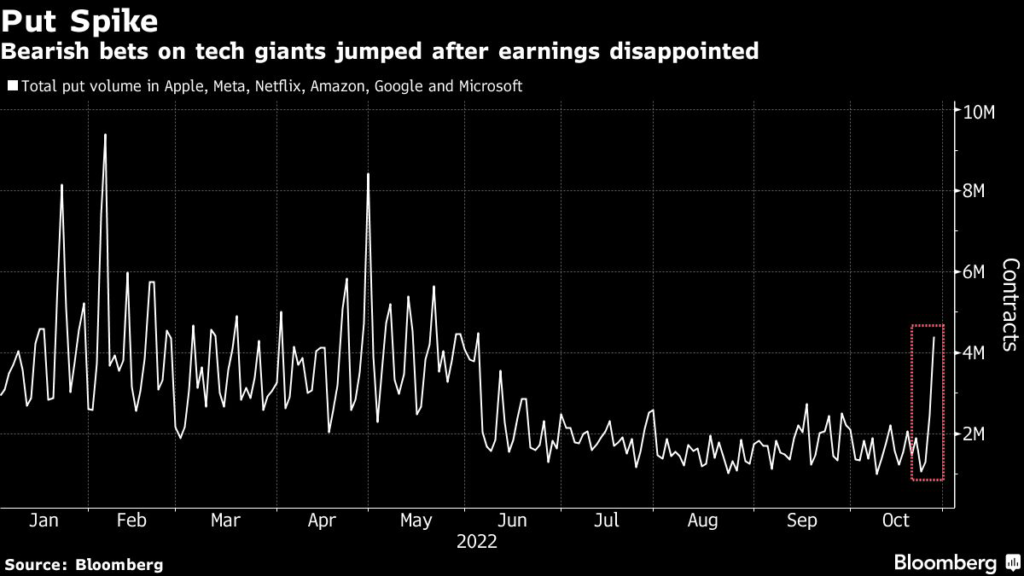
As the week went on and the ugly earnings reports piled up, investors frantically scooped up put options that protect themselves from further losses.

Yes, the likes of Alphabet Inc., Amazon.com Inc. and Microsoft Corp. are less expensive after the selloff, but they are far from obvious bargains. Part of the problem, says Mark Haefele, the chief investment officer at UBS Global Wealth Management, is that analysts now need to mark down their earnings estimates for these companies to reflect the weakening economic fundamentals highlighted in the third-quarter reports. And as those estimates come down, the stocks’ valuations based on projected profits will bounce right back up.

“Earnings estimates for tech look too high given elevated US inflation, declining corporate confidence and a tightening of financial conditions,” Haefele said.

The Week That Was

One after another, tech giants delivered a roughly similar message this week: Sales are slowing from personal computers to digital advertising and e-commerce amid soaring interest rates and rampant inflation. Even growth in cloud computing, regarded as something close to recession-proof because the services can help businesses save money, is decelerating.

The response from traders was to head for exits in droves, inflicting more pain on a critical group of stocks that over the course of the year have gone from perennial market leaders to pariahs and laying down another roadblock to a sustainable market rebound. 

Options trading in big tech stocks suggest that investors are back on the cautious side or even speculating that there’s more room to fall. The aggregated put volume for Apple Inc., Meta Platforms Inc., Netflix Inc., Amazon, Alphabet and Microsoft has spiked from a low and is now back at levels last seen in May, according to data compiled by Bloomberg.

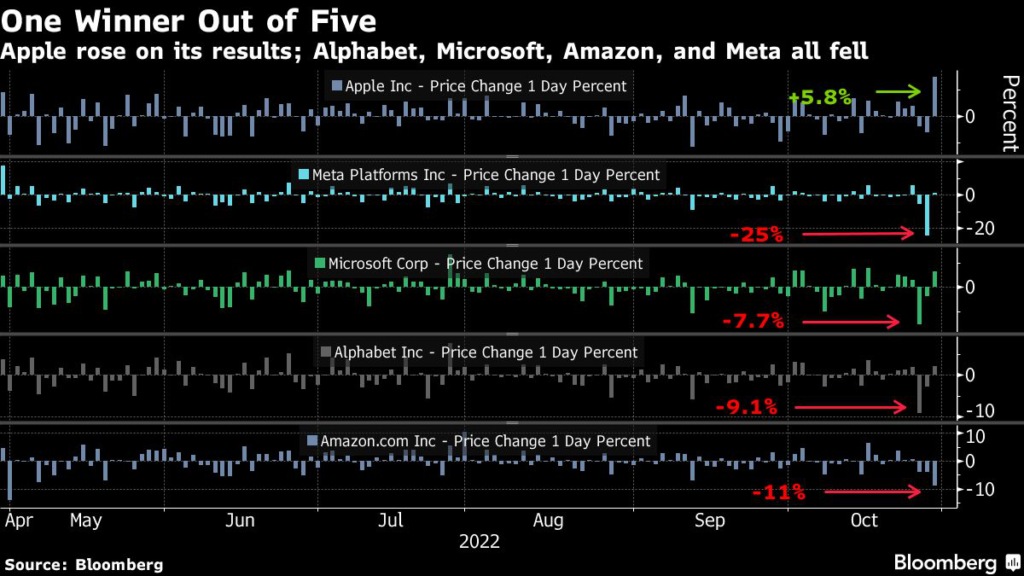
Microsoft and Alphabet lost about $280 billion in combined market value on Wednesday, the day after delivering results. Meta Platforms shed a quarter of its value after plans to boost spending jolted investors amid its second-consecutive quarter of shrinking revenue. Meanwhile, Amazon’s worst forecast for holiday-quarter growth in its history sent the stock down as much as 12% on Friday, briefly pushing its market capitalizaton below $1 trillion.

Apple’s Resilience

It wasn’t until Apple, the last of the five biggest technology companies by sales to report, that investors were treated to some good news. The iPhone maker’s quarterly revenue exceeded Wall Street estimates thanks to brisk sales of Mac computers and wearables like watches. However, Apple warned that growth wouldn’t be as good in the current quarter. 

Apple’s relative strength in the wake of the other ugly earnings reports generated relief and sent the stock to a 7.6% gain on Friday, helping to lift the Nasdaq 100 Index and the S&P 500 while adding about $150 billion to its market value.

Market Influence

Microsoft, Amazon and Alphabet have all seen their shares fall more than 30% this year, compared with a roughly 18% decline for the S&P 500. Apple, the only of the megacaps whose shares are living up to the notion that big tech’s massive scale and dominant market positions would insulate them from a market downturn, has fallen 12%.

Big tech’s fall from grace has eroded its influence over the market-capitalization weighted S&P 500 Index this year to the lowest since April 2020. Still, at 19% of the benchmark, Apple, Microsoft, Alphabet, Amazon and Meta Platforms hold bigger sway than the utilities, energy and consumer sectors combined.

So far this week the carnage has done little to dampen enthusiasm on Wall Street this week amid optimism that the Federal Reserve is nearing a pause in its rate-hiking campaign with the economy weakening. The S&P 500 rallied for a second-consecutive week with a 4% advance.

Still, a gauge of the four original FANG stocks — Meta Platforms, Amazon, Netflix and Alphabet — is on track for its worst week ever relative to the S&P 500 Index. 

Megacap tech stocks, the go-to place for investors to hide out during the pandemic, have been among the market’s biggest losers this year as the Federal Reserve embarked on its fastest tightening program in decades.

“Not even tech giants are immune to that,” said Michael O’Rourke, chief market strategist at Jonestrading. “These earnings reports clearly show how inflation is catching up to consumer spending and how rate hikes are whipsawing the economy.”

(Updates share moves and market values throughout.)

More stories like this are available on bloomberg.com

©2022 Bloomberg L.P.

Apple Is the Only Big Tech Consolation in Wild $477 Billion Rout

(Bloomberg) — In a week that has seen hundreds of billions in market value wiped out at the biggest technology firms, Apple Inc. is bucking the trend with another set of resilient results. 

Apple jumped 7.6% on Friday and added more than $150 billion in market value after the iPhone maker’s revenue and profit both topped analysts’ estimates. In contrast, fellow megacaps Microsoft Corp., Alphabet Inc., Amazon.com Inc. and Meta Platforms Inc. saw their shares tumble after reporting results this week, shedding $477 billion in combined market value in the trading session immediately after the results.

Apple’s slight beat on revenue in the fourth quarter at a time when most large technology companies are struggling “shows a resilient business model,” said Bloomberg Intelligence analyst Anurag Rana.

Earlier on Friday, Amazon fell as much as 12% to briefly dip below $1 trillion in market value, as the e-commerce and cloud computing company joined Microsoft in providing weak updates to its cloud business — fast-growing divisions for both tech giants. 

Overall, Apple turned out to be this week’s bright spot among many disappointing earnings releases from technology companies, said Peter Garnry, head of equity strategy at Saxo Bank.

“Apple’s performance the past year with a cost-of-living crisis, supply chain constraints and soaring input costs has been phenomenal and last night’s result confirms that Apple is a fortress that can withstand the volatile environment,” he said.  

–With assistance from Ryan Vlastelica and Matt Turner.

(Adds closing share price, added market value, in first bullet)

More stories like this are available on bloomberg.com

©2022 Bloomberg L.P.

Elon Musk Starts Cutting Jobs at Twitter

(Bloomberg) — A handful of people posing as Twitter employees departed from the company’s San Francisco headquarters carrying boxes of belongings. Inside the company, Slack channels lit up with suspicion that the people were enacting a hoax, and were not in fact laid off, people familiar with the matter said.

Bloomberg was unable to verify the identities of the people leaving the building.

Elon Musk started cutting jobs right after the deal closed Thursday, firing executives, including the chief executive officer and chief financial officer, people familiar with the matter have said.

The company has scheduled an employee meeting for next Wednesday, but some staff did not receive invitations, according to one of the people familiar with the matter.

Twitter didn’t respond to a request for comment.

(Corrects first paragraph and headline of story to show that people leaving the building posed as Twitter employees)

More stories like this are available on bloomberg.com

©2022 Bloomberg L.P.

Crypto Broker Genesis Says Lending Plunged 80% in Third Quarter

(Bloomberg) — Crypto brokerage Genesis, reeling from a sharp decline in the digital-asset market that sent the industry into a tailspin, said it originated $8.4 billion in new loans in the third quarter, an 80% plunge from the prior three-month period. Most of the rest of its businesses also experienced substantial declines.  

Total active loans slumped to $2.8 billion from $4.9 billion in the second quarter, Genesis said in its quarterly earnings report. Trading volumes also declined, with spot volume sliding 44% to $9.6 billion. Its derivatives desk traded $18.7 billion in notional value, down 30% from the prior quarter. In one bright spot, the company’s custody services saw an 8% increase in client signups.

The brokerage, a unit of billionaire Barry Silbert’s Digital Currency Group, said its lending desk was “staying active through the market sell off” but the industry’s appetite for leverage “continues to wane” in the face of deteriorating macro conditions, characterized by persistent interest-rate increases. 

“Heading into the fourth quarter, the cryptocurrency market is lacking directional momentum as participants are taking stock after a beleaguering summer of endless negative headlines,” Genesis said in its report, adding that the company is “prepared for a sustained crypto winter.”

Genesis was the biggest creditor ensnared in the collapse of Three Arrows after the once highflying hedge fund failed to meet margin calls. Over the summer, the company cut staff by 20% and overhauled its leadership team. A series of senior executives have departed, including its co-head of sales and trading Matt Ballensweig and head of derivatives Joshua Lim. Most recently, its new chief risk officer Michael Patchen also left after three months. 

More stories like this are available on bloomberg.com

©2022 Bloomberg L.P.

Apple Dodges Tech Rout, Even While Warning of Holiday Slowdown

(Bloomberg) — Apple Inc. soared 7.6% in New York trading after delivering enough good news in its quarterly report to avoid the fate of most tech giants this earning season, when peers have seen valuations plunge by hundreds of billions of dollars. 

Though sales of iPhones and services were softer than expected last quarter, Apple’s revenue and profit both topped analysts’ estimates. Even with growth expected to decelerate during the current period, investors found enough optimism to send the shares on their biggest one-day rally since July 2020.

The company far outshined Alphabet Inc., Amazon.com Inc., Meta Platforms Inc., Microsoft Corp. and others, which all delivered gloomy earnings reports in recent days, sending their shares tumbling. 

But even Apple’s generally positive results raised questions for investors, who are looking for signs that the long-resilient company might finally fall victim to a slowing economy. Apple’s iPhone and services sales came in just shy of projections — sparking concerns about two areas that were expected to be strong performers. And Apple’s Mac computer business will decline substantially in the holiday quarter following a sales surge driven by new models, Chief Financial Officer Luca Maestri warned on a conference call.

With loyal customers still eager to snap up its pricey products, Apple has been seen as an outlier during a punishing tech slowdown. The company also released its latest iPhone earlier in the year than usual, giving the fiscal fourth quarter a greater portion of sales from Apple’s flagship device. But roaring inflation and a broader slowdown in consumer spending, particularly for personal devices, may still be weighing on the company.

The iPhone, Apple’s flagship device, generated about $42.6 billion in the fourth quarter, which ended Sept. 24, the company said. Analysts had estimated nearly $42.7 billion. Services, such as music and video streaming, brought in $19.2 billion. That was well short of the almost $20 billion projection. 

The shares had declined 18% this year heading into the earnings, though that was a better performance than that of most major indexes. The S&P 500 has lost 20% in 2022, and the tech-heavy Nasdaq Composite Index is down 31%.

The Cupertino, California-based company didn’t provide a specific revenue forecast for the current quarter, continuing an approach it adopted at the start of the Covid-19 pandemic. But analysts estimate sales of about $128 billion, which would be an all-time record.

Apple’s overall revenue grew 8.1% to about $90.1 billion in the fiscal fourth quarter. That beat the $88.6 billion estimate, because of better-than-expected growth in its Mac and wearables businesses. Earnings of $1.29 a share topped the average projection of $1.26.

Apple’s iPhone remains its biggest source of sales, and the company was expected to get a boost from an earlier release this quarter. The period included about nine days of sales of the iPhone 14, iPhone 14 Pro and iPhone 14 Pro Max. But the iPhone 14 Plus — a new format that has seen a tepid response from consumers — didn’t launch until the current quarter.

While the iPhone 14 Pro looks similar to the past two models, new features like a 48-megapixel back camera and the Dynamic Island interface have helped entice shoppers. 

The company’s services business includes its Music and TV+ streaming platforms, as well as the Apple Card, iCloud storage and other digital offerings. It’s seen as one of Apple’s key sales drivers, especially as the company expands into new types of services.

Earlier this week, the company boosted prices for some services. Apple Music climbed to $10.99 a month from $9.99, and TV+ increased to $6.99 monthly from $4.99. Apple also modestly bumped pricing for its Apple One services bundles. The increases could further fuel revenue, though they also risk having customers defect to rival services.

Sales of the iPad, meanwhile, decreased 13% to $7.17 billion last quarter, also missing expectations. The tablet saw a sales resurgence in 2020 and 2021, helped by workers and students equipping their home offices during the pandemic. Demand has slowed since then, and the device suffered from supply-chain snags over the past year.

Apple launched a new iPad Air earlier this year, but it didn’t come out with a new iPad Pro or entry-level model until the current quarter. 

Apple generated $11.5 billion from the Mac, handily beating estimates of $9.25 billion. That product line also enjoyed a pandemic bump, fueled by the spread of hybrid work environments. But it suffered a slowdown as well, with Mac sales badly missing estimates in the June quarter.

What Bloomberg Intelligence Says:

Apple’s slight beat on revenue in fiscal 4Q, at a time when most large tech companies are struggling, shows a resilient business model. 

–Anurag Rana, BI senior industry analyst

Click here to read the research.

The Mac bounced back in the fourth quarter, with sales marking a record for that period. The category was buoyed by a redesigned MacBook Air and new low-end 13-inch MacBook Pro — Apple’s two most popular computers.

On the call, Maestri said that the Mac had a stronger-than-usual quarter in last year’s holiday quarter due to the redesigned 14-inch and 16-inch MacBook Pros. Those were Apple’s first high-end laptops built with its own processors, replacing chips from Intel Corp. That kind of shift won’t be replicated this holiday period.

The company’s wearables, home and accessories segment, which includes the Apple Watch, AirPods, the TV set-top box, HomePod, Beats headphones and other accessories, also saw momentum last quarter. Apple made $9.65 billion from those products, beating expectations.

In September, the company launched the Apple Watch Ultra and second-generation AirPods Pro earbuds. A new Apple TV with a faster chip is going on sale in early November.

Apple signaled in its previous quarterly report that it would be more cautious with spending, part of a broader deceleration for Silicon Valley companies. Unlike some peers, Apple has avoided mass layoffs. But it plans to cut back on expenditures in 2023 and slow hiring, Bloomberg News has reported. “Obviously we’re being deliberate in our decisions of where to invest,” Chief Executive Officer Tim Cook said in July.

–With assistance from Nate Lanxon.

(Adds closing share price in the first paragraph)

More stories like this are available on bloomberg.com

©2022 Bloomberg L.P.

Seeds of a Stock-Market Recovery Sown in Tech’s Catastrophe Week

(Bloomberg) — They’ve been safety stocks, a pie-in-the-sky growth trade, and a play on fortress profit margins that has been vacuuming up cash for a decade. Now megacap technology names have morphed into something else: market dogs.

All things considered, that’s not the worst news for bulls.

While stocks like Meta Platforms and Amazon.com have been blowing up all year, something in the selloff shifted this week. Not only did they plunge as bond yields were steadily falling, but the rout occurred alongside an otherwise buoyant market, a twist that could signal investors were finding better uses for their dollars.

The view was written large in data on fast-money speculators, which showed managers such as hedge funds beating a rapid retreat from the beaten-up growth sector. Where is the money going? Considering a democratized version of the S&P 500 just posted one of its best back-to-back weekly gains since 2009, the answer seems to be: everywhere else. 

The rotation helped extend another rally during the 2022 bear market, the seventh since January. While all previous recovery attempts ended in vain, this episode, occurring in the face of the fallout of the sturdiest firms, is encouraging to Lori Calvasina, head of US equity strategy at RBC Capital Markets.

“The market is starting to move from areas where there is still risk to be priced in and into the areas where a lot of risks have already been baked in,” Calvasina said on Bloomberg TV. “That’s what’s supposed to happen when you make a bottom.”

With the exception of Apple Inc., the Faamg bloc — also including Amazon.com, Microsoft Corp., Google parent Alphabet Inc. and Meta formerly known as Facebook — saw their shares all tumbling on the first day post earnings. Citing everything from a strong dollar to weaker demand, the once-stronghold companies are showing cracks. 

The Big Five wiped out more than $250 billion in share values this week, putting a lid on the Nasdaq 100 even when over 80% of the index’s members advanced. 

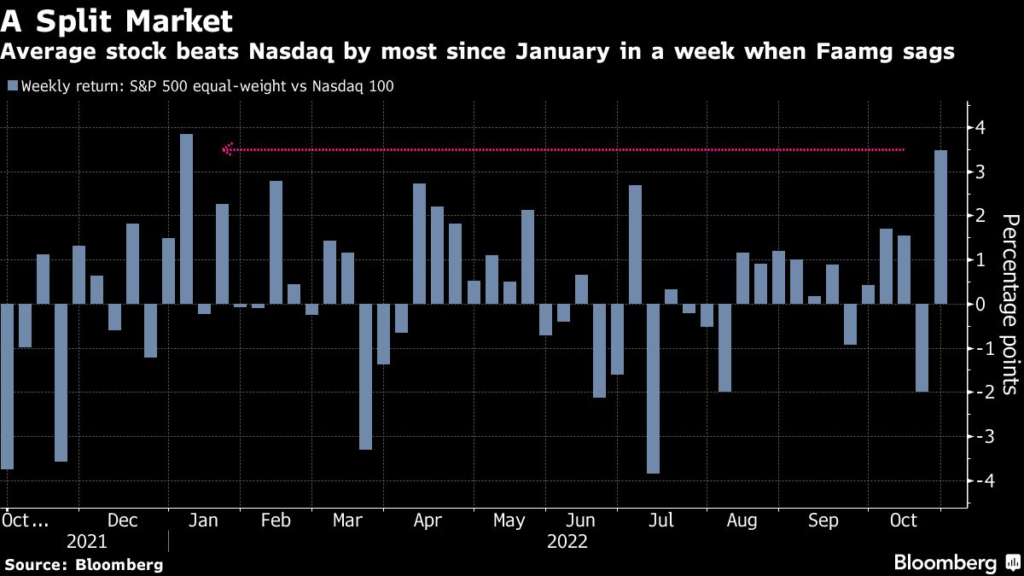
By contrast, the S&P 500 Equal Weight Index, a version that strips out the bias of market cap and treats Apple the same as Alaska Air Group Inc., climbed more than 3.5% for a second week in a row. Such a streak of big up weeks has only happened two other times since 2009, all during the post-pandemic rebound in 2020. 

In fact, the equal-weight S&P 500 beat the cap-weighted, tech-heavy Nasdaq 100 by 3.4 percentage points, the most since January. 

“We like the price action in the last couple weeks notwithstanding some negative earnings reports,” said Mike Wilson, chief US equity strategist at Morgan Stanley said on Bloomberg TV Wednesday. “We think the market will hold up and that will be another positive catalyst because if the market doesn’t go down on bad news on fundamentals, then what do you have?” 

In the view of Wilson, who was ranked the best portfolio strategist in the latest Institutional Investor survey, prevailing pessimism among money managers and the potential for peak central bank hawkishness set the stage for a rally that can last until the holiday season. 

Amid tech earnings chaos and ahead of the Federal Reserve’s policy meeting next week, professional speculators are quickly pulling back from the market. Hedge funds, which cut equity exposure to multi-year lows during the 2022 selloff, trimmed positions in both the long and short side of their books from Monday to Wednesday, unwinding risky bets at the fastest pace since March, data compiled by Goldman Sachs Group Inc.’s prime broker show. 

A continuing rotation out of tech giants is set to close a valuation gap with the rest of the S&P 500, putting the market on a more stable footing. Despite the retreat, Faamg shares were traded at 25 times earnings, above a median multiple of 19 for the other 495 stocks.

The fact that Faamg’s misery has not spilled over is likely a function of how much investors have lightened up their positions, making them less vulnerable to the selloff.  

Take hedge funds, which have accelerated their exit this year. At the start of this week, Faamg shares made up roughly 11% of their overall net exposure in single stocks, client data compiled by Goldman’s team including Vincent Lin show. That’s the lowest proportion since at least the start of 2019 and down from a peak of 18% seen in 2020.

With all its reflexivity, cross-currents, and feedback loops, the 2022 stock market has defied easy narratives. Besides evidence of a mass migration of money into value stocks, explanations for this week’s buoyancy encompass the idea that softening earnings play into the Fed’s goals for bringing down inflation, and that enough wealth destruction has occurred in equities to start curbing price excesses in the economy.

Treasury yields fell over the week amid weakening data from manufacturing to housing, with another set of yield curve inverted in a classic recession warning. 

The specter of a looming economic downdraft, however, is no trouble to equity investors willing to bid on cheap-looking stocks whose valuation can be framed as having priced in the worst outcome. 

The Russell 2000 of small-caps, for instance, rose for six straight days, notching the longest winning streak since March 2021. At its low in June, the index was trading at 16 times profits, on par with the trough multiple seen during the 2020 pandemic crash. 

To JPMorgan Chase & Co.’s sales trading team, one big fear among clients is missing out on the next big rally. To them, a dovish Fed and a lower-than-expected inflation print would more than offset any earnings weakness.  

“Most of my clients are still playing the ‘don’t blow up’ song into year-end,” Matt Reiner, an equity sales trader with JPMorgan, wrote in a note earlier this week. “That tone will change into ‘let’s take a shot’ if we grind a bit higher and the pain remains prevalent.”

–With assistance from Melissa Karsh, Lisa Abramowicz and Jonathan Ferro.

More stories like this are available on bloomberg.com

©2022 Bloomberg L.P.

Amazon Slips Below $1 Trillion in Value After Bleak Outlook

(Bloomberg) — Amazon.com Inc.’s market value briefly fell below $1 trillion after its disappointing earnings report and outlook sent investors running for the exit.

The stock fell as much as 12% on Friday after the e-commerce giant projected the slowest holiday-quarter growth in the company’s history, while sales at its important web services business missed estimates. That sent Amazon’s market value down to about $995 billion before the stock rebounded and closed with a decline of 6.8%.

The stock had fallen as much as 21% in after-hours trading Thursday. Amazon is joining a long list of US companies to see their market values crumble in this year’s bear market.

Read more: Amazon Plunges After Projecting Lackluster Holiday Sales 

“It (stock selloff) looks like an overreaction to us after a difficult earnings week for the group,” Piper Sandler analyst Thomas Champion wrote in a note. While the macro environment remains challenging, especially in Europe, the company’s forecast “looks conservative.”

The ranks of companies with valuations in excess of $1 trillion have thinned this year with soaring U.S. Treasury rates and the highest inflation in decades weighing particularly heavily on the stocks of technology companies. The Nasdaq 100 Index has fallen 29% from last year’s peak amid rising risks to economic growth from supply chain snarls and Covid-19 lockdowns in China to the war in Ukraine.  

Electric-car maker Tesla Inc., once worth more than $1.2 trillion, has seen its market value tumble to about $720 billion. Facebook parent Meta Platforms Inc. market value plunged by more than 75% from its $1.08 trillion peak last year, forcing it out from the ranks of the world’s 20 largest companies. Even Apple Inc., whose massive cash flows and fortress balance sheet have made it a favorite destination for risk averse investors, briefly lost its title as the most valuable company in the world to oil giant Saudi Aramco.

Bezos on Brink of $23 Billion Wealth Drop, Among Worst On Record

The Covid-19 pandemic had helped supercharge Amazon’s businesses and propelled its value to a $1.88 trillion peak about a year ago. With growth now slowing and an uncertain macroeconomic backdrop, its shares have fallen about 38% this year. Jeff Bezos, once the richest person in the world, was ranked No. 3 as of Thursday.

“Amazon could trade range-bound until there is evidence of the macro storm clearing and a sustainable improvement in profitability,” said Brent Thill, an analyst at Jefferies who has a buy rating on the stock and a price target of $135.

–With assistance from Matt Turner and Philip Sanders.

(Updates shares and valuations throughout.)

More stories like this are available on bloomberg.com

©2022 Bloomberg L.P.

Ukraine Latest: Russia Ends Rate Cuts; Mobilization Complete

(Bloomberg) — Russia’s central bank cited the inflationary impact of the Kremlin’s recent call-up of reservists to fight against Ukraine in pausing its run of six consecutive interest rate cuts. 

Ukraine downed 23 out of more than 30 Iranian Shahed attack drones launched by Russia in the past two days, according to President Volodymyr Zelenskiy who called them “metal monsters.” Ukrainian forces also shot down a Kh-59 cruise missile, two Ka-52 attack helicopters and another Su-25 fighter jet during the same period. Russia’s representative to the UN has denied that Moscow is using Iranian drones. 

Russia’s defense minister said the call-up of 300,000 reservists to fight in Ukraine had been completed on schedule. The partial mobilization prompted some 350,000 Russians, mostly draft-age men, to flee the country. Some 41,000 newly-mobilized troops are already part of active combat units. 

(See RSAN on the Bloomberg Terminal for the Russian Sanctions Dashboard.)

Key Developments

  • Russian Air Travel is Back, But Aircraft Lack Service, Parts
  • Russia Pauses Rate Cuts as War Call-Up Stirs Economic Angst
  • Biden Questions Putin Claim Russia Won’t Use Nuclear Weapons
  • Putin Plays Down Nuclear Threat in Ukraine as He Lambasts US
  • Tiremaker Nokian Renkaat to Exit Russia as Buyer Found for Plant

On the Ground

Russian forces struck Mykolaiv and several settlements in the Kharkiv region near the Ukrainian-Russian border overnight, local authorities said on Telegram. The Ukrainian army continued its counteroffensive in several areas, according to the General Staff. Citing Russian sources, the Institute for the Study of War reported that counteroffensive operations were conducted in the northeastern Kharkiv Region and along the Kreminna-Lysychansk line. It also noted limited ground assaults by Ukrainian forces in the Kherson region, where Russian forces are continuing to make defensive preparations along the east bank of the Dnipro River. Russian forces continued offensive operations toward Bakhmut and Avdiivka in the Donetsk Region, according to the General Staff of the Ukrainian Army.

(All times CET)

Zelenskiy Scoffs at Russia Saying Its Call-Up Is Complete (8:41 p.m.)

Zelenskiy dismissed Russia’s announcement that it has completed its call-up of 300,000 reservists to fight in Ukraine.

“We feel completely different on the battlefield,” the Ukrainian president said in his nightly address. “Russia is trying to increase pressure on our positions, using mobilized people, but their training and equipment are so poor that it allows us to assume that soon Russia will need a new wave of sending people to the front.”

Commenting on rolling blackouts, Zelenskiy said about 4 million Ukrainians now have a limited supply of electricity, underscoring his frequent calls for allies to “strengthen our air defenses.”

Ukraine Freezes Electricity Prices Through Winter (7:04 p.m.)

Ukraine’s government approved a decree to keep electricity prices for households unchanged for the winter heating season through March.

“Today, despite the war and massive shelling of energy infrastructure, a decision was made to keep tariffs for households unchanged to avoid additional financial burden on our citizens,” Energy Minister Herman Halushchenko said in an emailed statement.

Russia has intensified shelling of Ukrainian energy infrastructure since Oct. 10, damaging at least 30% of electricity production facilities. Ukraine was forced to introduce power supply limits across its regions and the capital Kyiv may face an electricity shortage of as much as 50%, Mayor Vitali Klitschko said.

Pentagon to Tap Inventories 24th Time for $275 Million in Weapons (6:29 p.m.)

The US Defense Department said it will provide Ukraine with an additional $275 million in weapons, the 24th such drawdown from existing inventories.

This batch will include an additional 500 precision-guided 155mm artillery rounds as well as 2,000 more 155mm rounds of Remote Anti-Armor Mine Systems that dispense tank-busting munitions. It also provides for transferring 250 M1117 Armored Security Vehicles and more than 2.75 million rounds of small arms ammunition.

One new item is four satellite communications antennas. Pentagon spokeswoman Sabrina Singh said the “off-the-shelf” antennas are separate from equipment for Elon Musk’s Starlink satellite system.

Crowd Seeking End to War in Ukraine Interrupts Blinken in Montreal (5:50 p.m.)

Protesters demanding an end to hostilities in Ukraine briefly interrupted an event with Secretary of State Antony Blinken and Canadian Foreign Minister Melanie Joly in Montreal. 

The pair were meeting members of Les Filles Fattoush, an organization that assists Syrian refugee women, when demonstrators began shouting “we don’t want you here” and “Yankee go home.” The two were forced to relocate remarks to the press but were never in danger.  

Canada to Issue ‘Ukraine Sovereignty Bonds’ (5:30 p.m.)

The five-year bonds are among the measures Ottawa is putting in place to help Ukraine’s government.

The securities will help Ukraine with essential services including paying pensions and purchasing fuel before winter, Prime Minister Justin Trudeau said in an statement. Equivalent proceeds will be sent to Ukraine through the IMF’s administered account.

The bonds will be offered via financial institutions. Investors will be, in effect, purchasing a regular top-rated Government of Canada five-year bond. Zelenskiy later tweeted his appreication.

Shoigu Tells Putin ‘Partial Mobilization’ Complete (4:29 p.m.)

Russia’s “partial mobilization” — calling up 300,000 reservists to fight in Ukraine — is complete and won’t be extended, Defense Minister Sergei Shoigu said in a televised meeting with President Vladimir Putin.

The call-up, Russia’s first since World War II, shocked many citizens and led more than 350,000 to flee the country amid widespread reports of ineligible candidates being drafted and new troops getting inadequate equipment and poor treatment.

Putin on Friday ordered Shoigu to “modernize” Russia’s draft system to ensure such problems aren’t repeated. Shoigu said 218,000 of the mobilized forces are still in training, while the remainder have already been deployed to Ukraine.

Russia’s Country Risk at Record High (4 p.m.)

Russia’s country risk rose to its highest on record, according to Geoquant indices which quantify risks to investors based on governance, social and security indicators. The index rose to 63.4 on a scale from 0 to 100 where the higher the number, the greater the risk. 

Serbia Needs to Align with EU Foreign Policy: Von Der Leyen (4:09 p.m.)

Like other countries seeking membership of the European Union, Serbia must ensure “a strong alignment with our common foreign and security policy,” said Ursula von der Leyen, head of the European Commission. 

Speaking at a joint news conference with President Aleksandar Vucic during a visit to Serbia, von der Leyen said that “joining the EU means sharing the same values.” She added that Serbia has “done a lot already” in terms of reform. 

Serbia has condemned Russia’s invasion of Ukraine, including in votes at the United Nations, but has failed to impose economic sanctions against Moscow. Vucic insists that respect for Ukraine’s territorial integrity must also apply to Serbia, whose southern province Kosovo seceded with Western support. 

Russia Holds Rates Steady on Impact of Partial Mobilization (13:40 p.m.)

Russia’s central bank held interest rates for the first time since the immediate aftermath of the attack on Ukraine, as risks of higher inflation intensify following the Kremlin’s call-up of reservists to fight in the war.

“While the partial mobilization may mainly create disinflationary pressure in the coming months due to subdued consumer demand, its subsequent effects will be pro-inflationary as it adds to supply-side restrictions in the broader economy,” policy makers said.

Read more: Russia Pauses Rate Cuts as War Call-Up Stirs Economic Angst 

McDonald’s Reopenings Move Ahead Despite Recent Shelling (1:30 p.m.)

McDonald’s is reopening more branches in Ukraine, even as Russian forces shell many of cities and regions far from the front lines, aiming increasingly at the energy grid.  

The US fast-food giant resumed operations in Zhytomyr in west-central Ukraine, following restarts in Kyiv and in far-western Lviv, Interfax reported, citing the company’s press office. 

McDonald’s halted its operations in Ukraine following Russia’s invasion, but has been gradually reopening since September and seeing strong demand. The company in a tweet referenced rolling power outages after Russian attacks, saying its menu is “more romantic…by candlelight.” 

No Recent Exodus From Ukraine, Border Service Says (1:20 p.m.) 

This month’s widespread Russian strikes on Ukraine’s energy grid and the blackouts that have followed in many areas haven’t caused a new exodus from the country, said Andriy Demchenko, spokesman for Ukraine’s state border service. 

From Russia’s invasion on Feb. 24 through the end of September, 20.5 million people crossed Ukraine’s western borders — 9.3 million for entry and more than 11 million who departed. More than 50% of those people crossed the border with Poland, Demchenko said.

Russia Focuses Missiles Against Energy Targets, Air Force Says (12:50 p.m.)

Russia has effectively stopped using cruise and ballistic missiles to target military goals in Ukraine, instead hitting energy objectives amid a growing shortage of such weapons, Ukrainian Air Force spokesman Yuriy Ignat said during a video briefing.

Ukraine estimates Russia may have depleted its missile stockpiles to 13-15% of pre-war levels, according to Ignat. In order to attack Ukrainian troops near front lines, Russia now mostly uses S-300 air defense missiles, adjusted to extend their range to 150 kilometers (93 miles) even though this makes them less precise. Russia has thousands of such missiles in stockpiles, Ignat said.

Russia Says Ukraine Grain Ship Backlog Was ‘Artificially Created’ (11:15 a.m.)

Russia’s foreign ministry said a backlog of ships waiting to sail under Ukraine’s grain deal had been “artificially created in the port of Istanbul in order to put pressure on our experts, weaken controls and speed up the cargo inspection procedure.” Ukrainian President Zelenskiy last week accused Russia of deliberately slowing the pace of grain exports.

The foreign ministry said that vessels had been detained during the Black Sea safe-corridor deal, and some suspended due to non-compliance and smuggling attempts. A spokesperson for the grain initiative said no ships had been detained, but that the average waiting time between departure and clearance of outbound ships increased to 15 days in October.

Russian Air Travel is Back, But Aircraft Lack Service, Parts (10:20 a.m.)

Airbus SE said Russian airlines are flying more domestically than before the pandemic, raising concern that they’re doing so without the necessary maintenance requirements because import sanctions prevent the aircraft from receiving spare parts or software upgrades.

“We are worried about the conditions for maintenance as actually the planes are flying a lot,” Airbus Chief Executive Officer Guillaume Faury said on Friday as the manufacturer reported earnings. “Because of the sanctions, we cannot really monitor and support as we do with our customers in normal times.”

Russia Export Windfall Finds Sanctions Haven in Yuan, Quasi-Bank (10:15 a.m.)

A little-known unit of Russia’s main stock exchange has become a vital link to the global financial system as tens of billions of dollars and euros flood in from sales of oil and other commodities. The National Clearing Centre has seen its foreign-exchange holdings surge this year, according to people familiar with its operations. 

A key link in the gas trade, it has so far avoided the US and European sanctions that have hit the central bank and Russia’s major lenders. Much of the money at NCC, which is held on behalf of Russian banks and their clients, is in yuan, shifted out of dollars and euros and other “unfriendly” currencies at the behest of the central bank, the people said.

Ukraine Continues to Limit Power in Kyiv, Ukrenergo Says (9:35 a.m.)

The Ukrainian national electricity grid operator Ukrenergo continued power cuts in Kyiv and the surrounding region, the company said on Facebook. Power supply is also limited in regions in the country’s center and north-east, including Chernihiv, Cherkasy, Zhytomyr, Kharkiv, Poltava and Sumy which suffered the most infrastructure damage from Russian attacks this week.

Ukraine’s Economy Seen Growing Up To 1.9% Next Year (9:15 a.m.)

Ukraine won’t see a full-fledged economic recovery until the second half of 2024 at the earliest, in a worst-case scenario based on high war-related risks persisting through mid-2024, according to the country’s central bank. The economy would grow by as much as 1.9% in 2023.

In that scenario, inflation will ease faster than expected next year due to reduced consumer demand and frozen utility tariffs, the central bank said in a report published on Thursday. In a more optimistic base-case scenario that envisages a reduction of military risks next year, the National Bank of Ukraine expects the economy to expand by 4% in 2023.

Chechen Leader Acknowledges Losses in Kherson Region (8:30 a.m.)

Ukrainian shelling killed 23 Chechen troops in the Kherson area and wounded 58, according to Ramzan Kadyrov, the Kremlin-backed leader of the Russian region.

The Telegram comment was an unusual Russian public admission of losses, which Kadyrov called “great” in the latest attack. The Chechen leader has provided thousands of troops to support the invasion of Ukraine.

Ukraine Shot Down Most Single-Use Attack Drones in Past Two Days, Zelenskiy Says (8:05 a.m.)

Ukraine downed 23 out of more than 30 Iranian Shahed drones launched by Russia in past two days, according to President Zelenskiy. 

“I thank the guardians of our sky. I am grateful to everyone who participated in the fund raising for the ‘catchers’ of such Shaheds,” Zelenskiy said. “Together, we will certainly clip the wings of all metal monsters, no matter how many of them and from where they fly in the direction of Ukraine.”

Russia has launched 4,500 missile strikes and carried out more than 8,000 air-raids on Ukraine since the beginning of its invasion in late February, Zelenskiy said in his regular nightly address to the nation.

Biden Questions Putin Claim on Nuclear Weapons (6:31 a.m.) 

US President Joe Biden questioned whether Putin was sincere in saying he had no intention of using nuclear or chemical weapons in Ukraine. “If he has no intention, why’s he keep talking about it?” Biden said after he was asked if he believes Putin’s denials in an interview with NewsNation, a cable outlet, broadcast on Thursday.

“Why does he talk about the ability to use a tactical nuclear weapon?” Biden added. “He’s been very dangerous in how he’s approached this. He can end this all. Get out of Ukraine.”

More stories like this are available on bloomberg.com

©2022 Bloomberg L.P.

US Stocks Roar on Big Tech Bounce; Yields Rise: Markets Wrap

(Bloomberg) — A monthlong bounce from bear market lows gathered strength in US stocks Friday as Apple Inc.’s earnings report helped technology shares salvage their week and a smattering of economic data suggested a modicum of progress is being made in the Federal Reserve’s war against inflation.

The S&P 500 and the tech-heavy Nasdaq 100 rose more than 2%. While Apple drove Friday’s relief rally, shares of Microsoft Corp. and Google parent Alphabet Inc. also climbed, snapping a two-day decline. 

Friday’s bounce is a departure from the somber sentiment that roiled markets this week. Investors were on the edge as lackluster earnings from big-tech firms including Amazon, Alphabet and Meta Platforms Inc. rolled in, underscoring the impact of the Fed’s tightening regime. Despite a mostly upbeat report, Apple too warned of a holiday slowdown, hinting at more pain to come. 

Data has also been mixed all week. A core gauge of US inflation accelerated in September, while consumer spending stayed resilient, bolstering the Fed’s case for another jumbo rate hike next week. But a contraction in manufacturing and services, and lower-than-expected US home sales, indicated that Fed tightening is already hitting the economy. 

Economists are still expecting the Fed to raise rates by three-quarters of a percentage point for the fourth time in a row next week. Treasuries remained weaker as hopes of a pivot fizzled.

“It is too early to expect the Fed to signal a more dovish stance,” said Mark Haefele, chief investment officer at UBS Global Wealth Management. “We maintain our view for economic growth to bottom out in the middle of 2023 and for the Fed to stop hiking in 1Q23.” 

Read More: US Core PCE Inflation Picks Up While Consumers Show Resilience

Beyond the US

The ECB delivered a second straight 75 basis-point hike on Thursday but dropped a prior reference to rate increases continuing for “several meetings,” an outcome that was considered dovish. The central bank has a small margin for error after German inflation unexpectedly accelerated this month to 11.6% from a year earlier — far exceeding all estimates in a Bloomberg survey whose median forecast was 10.9%.

The Bank of Japan held its negative rate, 10-year yield cap and asset purchases at the end of a two-day policy meeting, in line with the view of 49 economists surveyed by Bloomberg.

Chinese assets remain in focus, with foreign investors dumping a record amount of mainland China stocks this week and sending Hong Kong equities to a 13-year low. President Xi Jinping’s tightening grip on power hasn’t had the same impact domestically, with mainland investors hunting for bargains in Hong Kong. 

Some of the main moves in markets:

Stocks

  • The S&P 500 rose 2% as of 2:08 p.m. New York time
  • The Nasdaq 100 rose 2.6%
  • The Dow Jones Industrial Average rose 2.3%
  • The MSCI World index fell 0.3%

Currencies

  • The Bloomberg Dollar Spot Index rose 0.3%
  • The euro fell 0.2% to $0.9942
  • The British pound rose 0.2% to $1.1592
  • The Japanese yen fell 0.9% to 147.64 per dollar

Cryptocurrencies

  • Bitcoin rose 1.1% to $20,616.69
  • Ether rose 1.7% to $1,553.09

Bonds

  • The yield on 10-year Treasuries advanced nine basis points to 4.01%
  • Germany’s 10-year yield advanced 14 basis points to 2.10%
  • Britain’s 10-year yield advanced eight basis points to 3.48%

Commodities

  • West Texas Intermediate crude fell 1.8% to $87.49 a barrel
  • Gold futures fell 1.3% to $1,644.30 an ounce

–With assistance from Michael Msika, Kurt Schussler, Allegra Catelli, Cecile Gutscher, Brett Miller and Reade Pickert.

More stories like this are available on bloomberg.com

©2022 Bloomberg L.P.
Ye’s Twitter Access Freeze Was Previously Lifted

(Bloomberg) — Rapper Ye, formerly known as Kanye West, had his access to Twitter limited only for a “period of time” after his anti-Semitic tweet earlier this month and hasn’t posted on the social media platform since that post was removed.

  • On Oct. 9, a Twitter spokesperson had said “the account owner was required to delete the Tweet and their access to Twitter was limited for a period of time”
  • Twitter has yet to respond to Bloomberg’s request for comment
  • NOTE: Musk Takes Twitter Helm, Enacts Sweeping Change as Deal Closes

(Corrects to say Ye’s Twitter access curbs lifted previously not after Musk deal close)

More stories like this are available on bloomberg.com

©2022 Bloomberg L.P.
Close Bitnami banner
Bitnami