
Bloomberg

Bitcoin Attempts to Break Range While Testing Highs of the Week

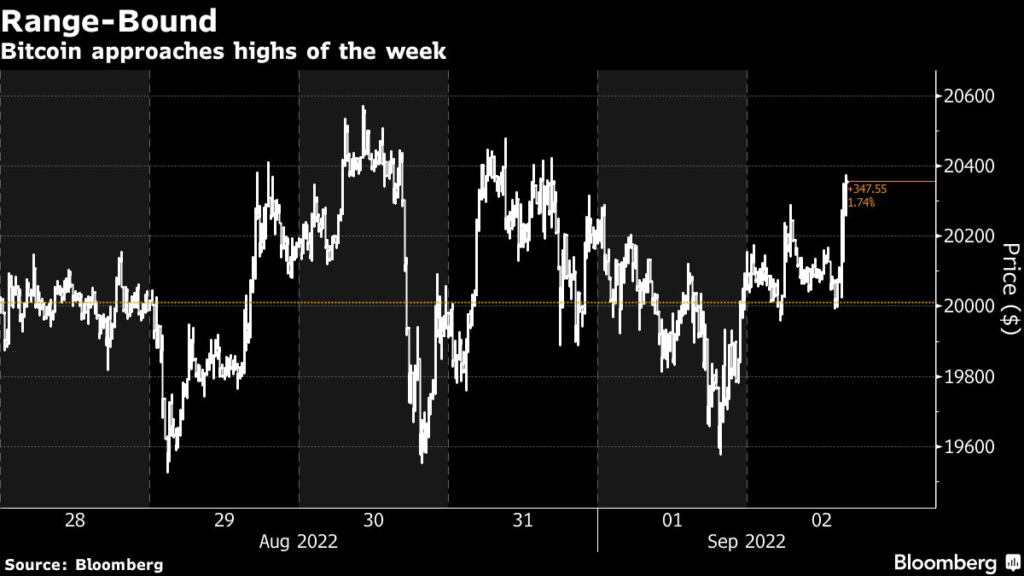
(Bloomberg) — Bitcoin briefly approached the highest levels of the week before pulling back as investors continue to debate the implications of rising borrowing rates for riskier assets.

The largest token by market value was little changed after earlier rising as much as 1.8% to $20,438. Ether and Polkadot both pulled back after each rose more than 3%. Other cryptocurrencies were mixed, with an index of 100 of the largest digital tokens added about 1%. 

Bitcoin’s been glued to a tight trading range of around $19,500 to $20,700 over the past week, with the coin unable to break out above $20,000 in any meaningful way. 

“The coin is stuck in a range and momentum is weak,” said Wilfred Daye, chief executive officer of Securitize Capital, a digital asset management firm. Summer seasonality doesn’t help, he added, meaning that there’s low liquidity in the marketplace. 

Investors are still grappling with how aggressive the Federal Reserve will continue to be as data shows the US economy continues to be on strong footing while inflation remains high. The US labor market stayed robust in August as employers added jobs and more people entered the workforce, data out Friday showed.

“Into the long US weekend, the market could see some profit taking of short positions today. Hence, a squeeze higher across the crypto space.” said Teong Hng, chief executive at crypto investment firm Satori Research. “Today’s NFP number does not change the current macro picture.”

Bitcoin has largely been trading in tandem with US stocks, which also rose on Friday. Despite the slight bump higher, the largest cryptocurrency remains down more than 50% this year.

“Bitcoin’s response is more or less fully in tune with how risk assets elsewhere reacted to today’s NFP numbers.” said Vetle Lunde, analyst at Arcane Crypto. “It’s promising that BTC holds for now, but investors should pay close attention to the potential implications of the $19k area breaking. Nevertheless, by now, a vast majority of traders seems to focusing on protection and hedging.”

More stories like this are available on bloomberg.com

©2022 Bloomberg L.P.

Fintech R2 Reaches $100 Million Valuation After Google-Led Round

(Bloomberg) — Latin American fintech firm R2 reached a $100 million valuation following a $15 million Series A round led by Google’s Gradient Ventures. 

Other participants on this round are Femsa Ventures and PayU, as well as prior investors General Catalyst, Adam Neumann’s 166 2nd, and Magma Partners, said co-founder Roger Larach in an interview. It comes amid a tougher environment for startups as US rates rise and tech valuations drop. Startup funding for the region fell in the first quarter. 

Read More: Latin America’s Unicorns Face a Reckoning as VCs Flee Risk

R2, named after a statistics concept, provides lending infrastructure and capital to allow companies to offer financial services under their own brands. Clients currently include last-mile service Rappi in Ecuador and Mexico’s Clip. 

“We’re solving the credit deficit by allowing other platforms to lend to small and medium enterprises,” said Larach in an interview. “For larger companies, it allows a chance to solve a pain point for clients, which is lack of access to credit.”

The loans they offer range from $500 to $25,000. 

The company plans to use the funds to improve its technology, including data analysis. It has 34 employees with 12 nationalities and recently launched operations in Chile. R2 plans to expand to other markets over the next 12 months. 


More stories like this are available on bloomberg.com

©2022 Bloomberg L.P.
Biden Lauds ‘More Good News’ on Jobs as GOP Attacks Continue

(Bloomberg) — President Joe Biden hailed “more good news” after the latest government data showed US employers added a healthy number of jobs in August, even as a stream of people entering the job market pushed the unemployment rate higher. 

“The great American jobs machine continues its comeback,” Biden said Friday at the White House. 

“The bottom line is jobs are up, wages are up, people are back to work. And we’re seeing some signs that inflation may be — may be, I’m not over promising — may be beginning to ease,” he added.

Nonfarm payrolls increased 315,000 last month following a revised 526,000 advance in July, a Labor Department report showed Friday. The unemployment rate unexpectedly rose to a six-month high of 3.7%, the first increase since January, as the participation rate climbed.

The latest data indicated that working-age women were now employed at rates not seen since before the onset of the Covid-19 pandemic, Biden said. 

The state of the economy will be a key factor heading into the November midterms that will determine whether Democrats retain their slim House and Senate majorities. Polls indicate that the economy is voters’ primary concern. 

Read more: US Employers Add 315,000 Jobs as More Workers Join Labor Force

Cecilia Rouse, chair of the White House Council of Economic Advisers, described the report as “solid.”

“That did bring along a slight increase in the unemployment rate, but overall a solid report that suggests that we’re making the transition that we know we need to make in our labor market to stable, sustainable economic growth,” Rouse said in an interview Friday with Bloomberg Television. 

The still-low unemployment rate means the Fed will keep considering raising interest rates, as it seeks to bring down inflation. The trick for the Fed is to not act so quickly that the economy cools off and the US dips into a recession.

“This is really what the Fed is hoping for,” former Fed governor and University of Chicago professor Randall Kroszner said Friday on Bloomberg TV about the latest jobs numbers. “More people are coming back into the labor market. That helps to reduce the tightness of that market.”

The White House is “focused on not trying to work against the Fed,” Rouse said. 

“We are aware the president wants to give the Federal Reserve the independence and the room it needs to bring down inflation,” she said. “While nonetheless, putting into place good, solid policies that help to build economic capacity, so that our economy is growing in a steady, sustainable way that benefits all Americans.”

Republicans have centered their criticism of Biden’s presidency around soaring inflation, whereas the Biden administration has touted passage of a $437 billion health, climate and tax law, dubbed the Inflation Reduction Act, as well as new subsidies for domestic semiconductor manufacturing.

“Hardworking Americans are living paycheck-to-paycheck thanks to Joe Biden and Democrats’ higher prices, higher taxes, and lower wages,” Republican National Committee Chairwoman Ronna McDaniel said in a statement Friday. 

“As long as Democrats continue to rubber-stamp Biden’s agenda and waste taxpayer dollars on their radical policies, families will continue to struggle to afford everything from gas to school supplies to groceries,” she said. 

Economists had projected an almost 300,000 gain in payrolls and a 3.5% jobless rate, based on the median estimates in a Bloomberg survey.

More stories like this are available on bloomberg.com

©2022 Bloomberg L.P.

Stocks Rise as Jobs Report Eases Pressure on Fed: Markets Wrap

(Bloomberg) — US stocks advanced, while two-year Treasury yields declined, after jobs data that showed some signs of easing in a still-tight American labor market. The dollar fell.

The S&P 500 rose as much as 1.3% and the two-year yield pushed below 3.5% after employers added 315,000 jobs last month, slightly above what economists expected. Wage growth slowed as more Americans entered the labor force, potentially signaling some softening in labor demand.  

The jobs report prompted some traders in the rates market to slightly alter their views on the Federal Reserve’s next policy move. While markets are still pricing in the likelihood of a three-quarters of a percentage point interest-rate hike this month, they trimmed their bets after the report. 

The labor-market data add to a bevy of reports this week that validate the Fed’s assertion that the economy is robust enough to withstand more tightening. Risk assets have been under pressure since Chair Jerome Powell made clear the central bank will raise rates further and keep them elevated until price gains slow.

”Today’s jobs report was a step in the right direction, in that the pace of job and wage growth stabilized,” wrote Matt Peron, director of research at Janus Henderson Investors. “This should allay some of the worst fears that have taken hold in equity markets of late. However, we reiterate our caution that we are not out of the woods just yet, as stubbornly high wage gains could keep the Fed on an aggressive path. Stay invested but defensive.”

Read More: Everything Working ‘Way It Should’: Wall Street Reacts on Jobs

Concern that rising rates will hurt growth has already weighed on markets, pushing global bonds into their first bear market in a generation. The Bloomberg Global Aggregate Total Return Index of government and investment-grade corporate bonds down more than 20% from a 2021 peak. 

Oil trimmed gains after news that the Group of Seven most industrialized countries agreed to introduce a price cap for global purchases of Russian oil, while Russia looks set to resume gas supplies through its key pipeline.

Meanwhile, zinc headed for its biggest weekly loss in over a decade on concern Chinese demand will be hamstrung by new virus restrictions. Gold and Bitcoin rose.

Some of the main moves in markets:

Stocks

  • The S&P 500 rose 1.1% as of 11:32 a.m. New York time
  • The Nasdaq 100 rose 1%
  • The Dow Jones Industrial Average rose 1.1%
  • The Stoxx Europe 600 rose 2%
  • The MSCI World index fell 0.8%

Currencies

  • The Bloomberg Dollar Spot Index fell 0.5%
  • The euro rose 0.8% to $1.0029
  • The British pound rose 0.3% to $1.1576
  • The Japanese yen was little changed at 140.09 per dollar

Bonds

  • The yield on 10-year Treasuries declined three basis points to 3.22%
  • Germany’s 10-year yield declined four basis points to 1.53%
  • Britain’s 10-year yield advanced four basis points to 2.92%

Commodities

  • West Texas Intermediate crude rose 2% to $88.30 a barrel
  • Gold futures rose 1% to $1,726.40 an ounce

More stories like this are available on bloomberg.com

©2022 Bloomberg L.P.
Amid SPAC Rout, Brazil’s Semantix Ready to Put Money to Work

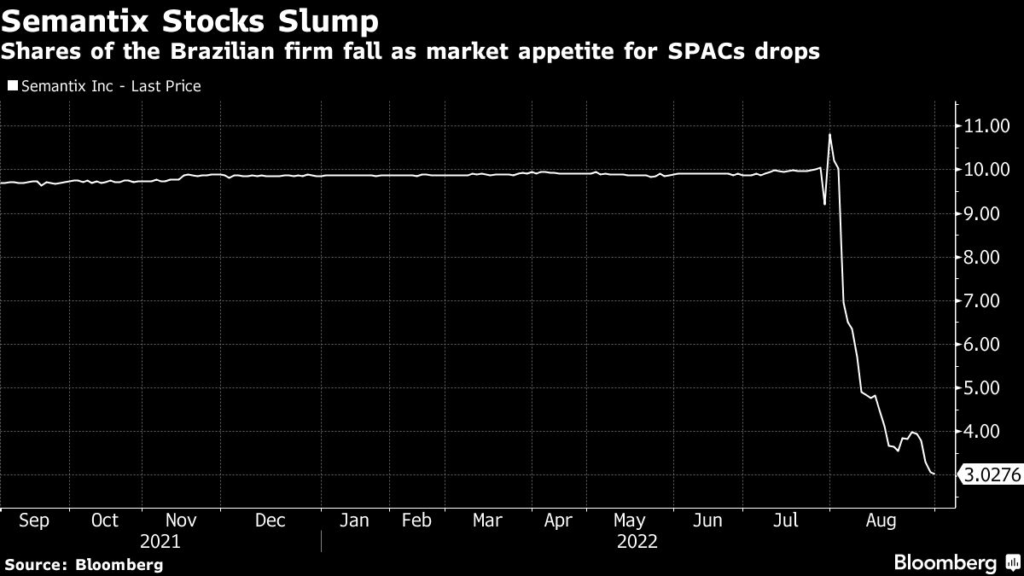
(Bloomberg) — Brazilian data software provider Semantix Inc. has seen its shares sink 60% since going public in early August after completing a merger with Alpha Capital, a special purpose acquisition company, amid a slump in the tech industry.

But with the $127 million that it raised in the process, it’s eyeing more acquisitions, looking to grow headcount and open a new office in the US in anticipation of a rebound for the beaten down sector, chief executive officer Leonardo Santos and board member Rafael Steinhauser said in an interview.

“SPAC redemptions now are extremely high, they collapsed,” said Steinhauser, a co-founder of Alpha, adding that the company faced the challenge of rising interest rates, a tech rout and changes in SPAC regulation. “I don’t have a crystal ball, but I think all three things are going to come back to a more reasonable state. Technology is going to come back.”

The Sao-Paulo based company has a team working on potential purchases that could offer “complementary technologies” such as machine learning, Santos said. The company announced the purchase of Brazilian data provider Zetta Health Analytics for just over 52 million reais ($10 million) on Wednesday, and others have been shortlisted for consideration.

Semantix is a “deep tech” company, which provides data software and analytics used by clients for tasks such as giving e-commerce recommendations or packaging potential financial products. Its clients include Mercedes Benz, Bradesco, Hospital Care, among others. 

The firm is hiring in Brazil, Mexico, Colombia and Chile, and plans to increase its work force to as much as 1,000 employees by year-end from 700 currently. It’s also expanding operations in the US, opening a new office in San Francisco before the end of the year that adds to an existing one in Miami. With almost no spending on marketing so far, the company will begin to spend in growing its brand awareness. 

“We’re growing very fast with practically zero investment in marketing,” Santos said. “We want to spend more.” 

The company’s proprietary software as a service (SaaS) revenue grew 25% in the first half of the year and 62% in June compared to the same month the previous year, according to the executives. It plans to sell two times more in the second half of the year than in the first half, pushing the year’s total revenue to as much as 290 million reais ($55 million).

The company posted a loss of 86 million reais ($16.4 million) in the first half of the year. Semantix started trading publicly on Aug. 3 after completing a merger with Alpha. 

Alpha had initially announced the purchase of Semantix in late November, but the listing in Nasdaq was delayed by regulatory changes from the US Securities Exchange Commission that led the banks that were originally part of the deal to exit the transaction, said Steinhauser. The merger process was then led by the Semantix and Alpha management, involving weeks of back and forth with the regulators.

Semantix was founded by Santos in 2010, who remains at the helm after the merger. Original shareholders include a fund backed by Banco Bradesco SA and the private-equity firm Crescera. 

SPAC Woes

SPACS, which are blank-check companies that connect private businesses to public capital markets without having to go through a traditional initial public offering soared in popularity in 2020 and early 2021 but have since lost steam. The IPOX SPAC Index, which tracks the performance of a group of blank-check firms, is down more than 43% from its peak in February of 2021. 

The redemption rate for the SPAC that took Semantix public was 85%, Steinhauser says, but that it’s lower than the average which is above 90%.

“Of course we wanted to have 0%. But times are very different,” he said.

Even with the difficulties, Steinhauser said the Alpha team is interested in pursuing other SPAC vehicles further down the line.

“Nothing has changed from our original thesis, that SPACs are good for companies that have grown enough and have an ambition to go to the world and play in the first league,” Steinhauser said. “Today the context is quite difficult, but we have demonstrated it’s possible.”

More stories like this are available on bloomberg.com

©2022 Bloomberg L.P.

OneWeb Takes $230 Million Hit After Russia Seized Its Satellites

(Bloomberg) — British satellite startup OneWeb Ltd. took a $229 million writedown after Russia scuppered its launch plans and took 36 of its spacecraft hostage indefinitely earlier this year. 

The impairment came after OneWeb canceled a launch in March at a Kremlin-controlled launchpad in Kazakhstan, after refusing Russia’s demand for Britain to sell its stake in the company. That postponed a series of planned launches, incurred an insurance cost, and left the satellites in Russia’s hands, OneWeb said in accounts published late Thursday.

The London-based company is part owned by the British government alongside other investors including Indian telecom group Bharti, Softbank Group Corp and French satellite operator Eutelsat SA, which agreed to merge with OneWeb in July.

The $3.4 billion combination between the two firms will create a European satellite operator that can compete with projects from the likes of Elon Musk and Jeff Bezos to blanket the earth in a new kind of low-earth orbit or “LEO” broadband.

OneWeb’s net loss for the year ending March 31 was $390 million, with revenue of just $9.6 million. The company said it has total committed orders of “more than $300 million.”

More stories like this are available on bloomberg.com

©2022 Bloomberg L.P.
Broadcom Rallies After Forecast Suggests It’s Evading Chip Slump

(Bloomberg) — Broadcom Inc. shares rose the most in three months after the chipmaker gave a strong sales forecast for the current quarter, allaying fears that spending on internet infrastructure is slowing. 

Revenue in the fiscal fourth quarter will be about $8.9 billion, Broadcom said in a statement Thursday, compared with an average analyst estimate of $8.72 billion. The shares advanced as much as 5.7% to $519.81 in New York following the report, the biggest intraday gain since May 27.

The outlook suggests Broadcom is sidestepping a broader decline in chip demand, at least for now. Other suppliers, including Nvidia Corp., Intel Corp. and Micron Technology Inc., have predicted a steep sales slowdown — hurt by sluggish orders of personal computers and smartphones. Given that pessimism, Broadcom Chief Executive Officer Hock Tan acknowledged that his company’s report was “somewhat surreal.”

“From our vantage point, infrastructure spending is still very much holding,” Tan said on a conference call with analysts. “It’s true end demand.”

Broadcom’s backlog of orders, which can’t be canceled, is expanding and now sits at $31 billion, Tan said. The company is rigorous in ensuring that those orders reflect demand for real products — and aren’t just going to be sitting in a warehouse. Broadcom’s average lead time, the gap between getting an order and filling it, remains at 50 weeks, Tan said. 

Broadcom is faring better than companies that focus on chips for PCs, which aren’t selling well because consumers are coping with inflation and putting off big-ticket purchases. Nvidia revealed an additional headache this week when it said that new restrictions on exporting to China could hurt sales. The warning triggered a decline in chip stocks Thursday, with Nvidia falling as much as 12%.

Broadcom, which gets about 30% of its chip revenue from China, hasn’t received a notice from the US government and doesn’t expect to, according to Tan. 

Broadcom sells a wide range of chips, making the San Jose, California-based company a bellwether for the tech industry.

Its semiconductors provide short-range connectivity for many Apple Inc. devices, including the iPhone. Other products are key to the networking machinery inside giant data centers owned by Amazon.com Inc.’s AWS and Alphabet Inc.’s Google. Cisco Systems Inc. uses those same chips in its products for corporate data centers, and a different range of Broadcom silicon runs many of the world’s set-top boxes.

Broadcom said demand from its large North American customer, its code for Apple, was solid and that it expects an increase in the current period when that company debuts a new range of models. The chip supplier said it expects unit volumes to be about the same as they were when the previous model was introduced. 

Broadcom also has branched out into enterprise software by acquiring security and mainframe capabilities. And it’s trying to extend that diversification with a $61 billion purchase of VMWare Inc. in a transaction announced May 26.

The company, like many of its peers, outsources much of its production. The biggest struggle in the past two years has been getting enough supply from those manufacturers. Now those shortages are at risk of turning into an inventory buildup.

In the third quarter, which ended July 31, Broadcom’s profit rose to $9.73 a share, excluding some items. Revenue climbed to $8.46 billion. Analysts had predicted a profit of $9.57 a share on sales of $8.41 billion.

Tan has predicted that the chip business will decelerate to historical growth rates of about 5% or less. That would be a major comedown from last year, when sales surged 26%. 

Investors have already decided that the latest chip boom has run its course. Broadcom has fallen 26% in 2022 through Thursday’s close, in line with the Philadelphia Stock Exchange Semiconductor Index.

More stories like this are available on bloomberg.com

©2022 Bloomberg L.P.
Suspected Russian Ransomware Group Hacks Italian Energy Agency

(Bloomberg) — A hacker group with links to Russia has claimed responsibility for a recent ransomware attack targeting Italy’s energy industry, amid an escalation the Rome-based government says could be related to the Russian invasion of Ukraine.

In a post published on the so-called dark web, the BlackCat group said it stole 700 gigabytes of data from networks controlled by Italy’s GSE energy agency, and threatened to publish the information online if its demands were ignored. The post was accompanied by several images of what appeared to be internal documents. The size of BlackCat’s extortion demand wasn’t immediately clear. 

GSE said earlier this week that it suffered a breach, resulting in the company shutting down some IT systems. In addition to other functions, GSE is one of the government agencies responsible for running Italy’s electricity market.

On Wednesday, Italian giant Eni SpA said that its computer networks had been hacked, adding that the consequences appeared to be minor. No one has claimed responsibility for that attack to date. Prime Minister Mario Draghi later convened a meeting with top Italian officials to discuss the incidents. 

Foreign Minister Luigi Di Maio said on Friday that cyberattacks on western European companies have risen following the Russian invasion of Ukraine. The minister added that the attacks are part of a destabilization strategy seen since the invasion in February, without specifying their source.

Researchers at Unit 42, a cybersecurity team at Palo Alto Networks Inc., have linked BlackCat’s members to Russia, pointing out that the group communicates with its members or affiliates in the Russian language and is known to operate on Russian cybercrime forums.

The BlackCat group, also known as ALPHV, breaks into its victims’ computers and uses malicious software to encrypt files stored on them so that the files cannot be accessed. The gang then demands payment to unlock the files.

BlackCat has targeted a wide range of companies in recent months, including law firms, building contractors, a video game maker and technology suppliers. The group is also known for attacks on the energy sector.

It’s unknown whether the BlackCat gang operates under the direction of the Russian state. The group may have some members, or affiliates, who are based outside the country, according to cybersecurity researchers. Connections between the Russian cybercrime world and the country’s intelligence agencies are notoriously muddy. 

In July, BlackCat breached Luxembourg-based gas and energy provider Creos Luxembourg and its parent company Encevo SA. In February, hackers affiliated with BlackCat infected computers at Mabanaft GmbH and Oiltanking GmbH.

The BlackCat gang has links to another ransomware group named DarkSide, which last year breached Colonial Pipeline Co., according to Brett Callow, a threat analyst at cybersecurity firm Emsisoft. Callow said BlackCat’s targeting of energy companies stands out as particularly dangerous, as it’s possible for such attacks to disrupt supplies of electricity or gas.

After the DarkSide hack, for instance, Colonial Pipeline shut down the largest fuel pipeline in in the US for several days, resulting in fuel shortages across the East Coast. The hackers, Callow said, aren’t always in a position to know the impact their attacks will have, and may not even care.

In April last year, the US Treasury issued sanctions against Russia and alleged that the country’s FSB intelligence agency “cultivates and co-opts criminal hackers” and enables them “to engage in disruptive ransomware attacks and phishing campaigns.”

More stories like this are available on bloomberg.com

©2022 Bloomberg L.P.
Apple’s Car Is Beloved Before It Even Exists

(Bloomberg) —

If semiconductor shortages, recession risks and the once-a-century shift in propulsion weren’t enough to keep auto executives up at night, here’s one more sleep disruptor: Consumers are keen to buy an Apple car before one even exists.

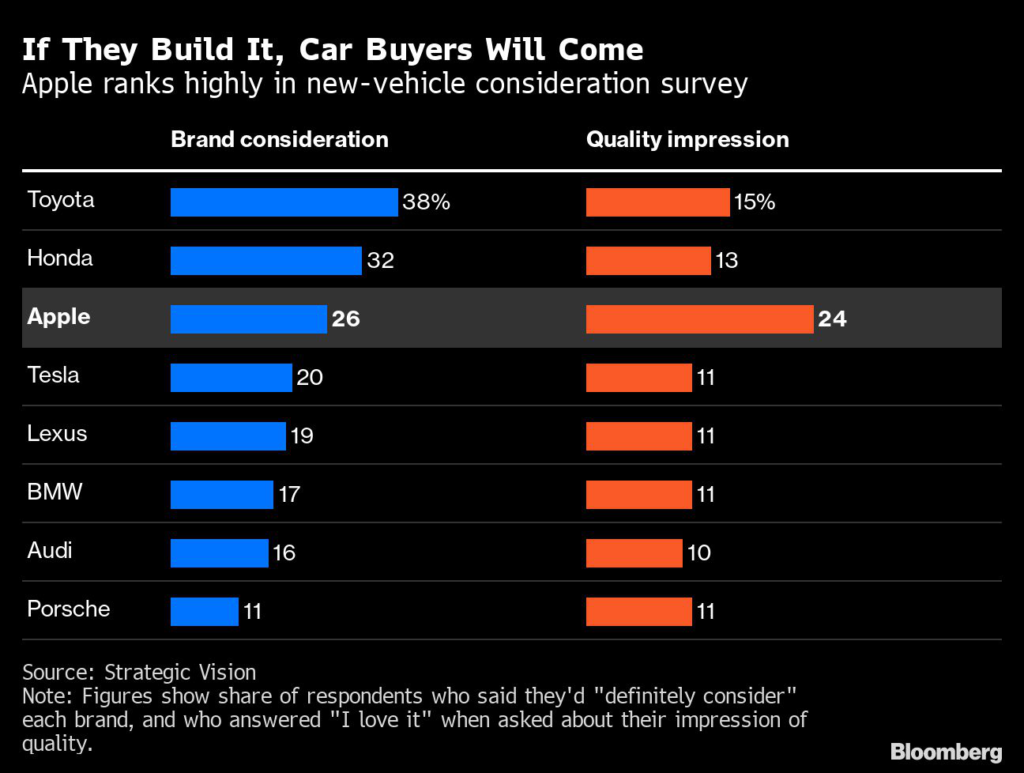
Strategic Vision just released the results of an annual study that this year reached 200,000 new-vehicle owners. For the first time, the consulting firm included Apple among the more than 45 brands it surveyed consumers about. The findings: 26% said they would “definitely consider” buying a set of wheels from the iPhone maker, behind only Toyota and Honda. And 24% ticked the top box (“I love it”) when asked their impression of the quality of the brand, beating all others by a wide margin.

That’s serious brand power and suggests there would be significant appetite for autos alongside all those phones, computers, watches and television boxes.

Whether Tim Cook will actually green-light a product for all these prospective buyers is still unclear. “We’ll see what Apple does,” the chief executive officer told the New York Times last year. “We investigate so many things internally. Many of them never see the light of day.”

Bloomberg’s Mark Gurman has reported Apple is shooting for a fully autonomous electric car and aims to have one ready around 2025. Many companies working on self-driving technology have been unable to deploy robotaxis on the timelines they targeted, and only a handful are offering ride services in select cities. The National Highway Traffic Safety Administration keeps having to remind Americans that no vehicle available for purchase today is capable of driving itself (hear that, Tesla owners?)

Autonomous or not, an Apple car could be a formidable force, especially given the amount of tech consumers want in their new vehicles and the challenges incumbents have had meeting those expectations (see Bloomberg’s feature story yesterday on Volkswagen’s software woes.) Cook employs legions of coders capable of developing the brains a modern electric vehicle needs to manage battery power and navigate traffic. The company also owns all sorts of content that could be piped into dashboard screens, assuming passengers will be able to safely avert their eyes from the road.

For the time being, at least, Apple lacks an industrial partner. But one of the companies it knows best — iPhone assembler Foxconn — recently acquired a former General Motors assembly plant in Ohio from struggling startup Lordstown Motors. That factory is big enough to easily make 400,000 vehicles a year.

While there are already plans to make Endurance pickups for Lordstown and an EV called the Pear for Fisker, both those companies are unproven startups. There may be plenty of space for Apple in that factory’s future.

Strategic Vision’s study indicates automakers already having issues responding to the competitive threat posed by Tesla could be in for another menace. But Elon Musk also ought to take notice: More than 50% of Tesla owners said they’d definitely consider a future Apple vehicle. “Everyone should be prepared,” Strategic Vision President Alexander Edwards says.

(Updated to add hyphen to terminal headline.)

More stories like this are available on bloomberg.com

©2022 Bloomberg L.P.
US Futures Rise, Treasuries Mixed After Jobs Data: Markets Wrap

(Bloomberg) — US stock futures advanced, while two-year Treasury yields were little changed as investors jobs data that showed some signs of easing in a still-tight American labor market. The dollar fell.

Contracts on the S&P 500 pushed to session highs and the two-year yield held below 3.5% after employers added 315,000 jobs last month, slightly above what economists expected. Wage growth slowed as more Americans entered the labor force, potentially signaling some softening in labor demand.  

The jobs report likely did little to alter trader views on the Federal Reserve’s next policy move — a rate increase of up to three-quarters of a percentage point as it continues to battle inflation. The data add to a bevy of reports this week that validate the Fed’s assertion that the economy is robust enough to withstand more tightening. Risk assets have been under pressure since Chair Jerome Powell made clear the central bank will raise rates further and keep them elevated until price gains slow.

“Unemployment remains relatively low, but the cause may be minimal labour force participation rather than a booming economy,” said Richard Flynn, managing director at Charles Schwab UK. “Investors will be mindful that jobs reports are a lagging indicator that are often strong heading into a recession. Indeed, broader economic indicators have been weakening recently.


Concern that rising rates will hurt growth has already weighed on markets, pushing global bonds into their first bear market in a generation. The Bloomberg Global Aggregate Total Return Index of government and investment-grade corporate bonds down more than 20% from a 2021 peak. 

Oil trimmed gains after news that the Group of Seven most industrialized countries is poised to agree to introduce a price cap for global purchases of Russian oil, while Russia looks set to resume gas supplies through its key pipeline.

Meanwhile, zinc headed for its biggest weekly loss in over a decade on concern Chinese demand will be hamstrung by new virus restrictions. Gold and Bitcoin rose.

Here are some key events to watch this week:

  • UK leadership ballot closes Friday. Winner announced Sept. 5

Some of the main moves in markets:

Stocks

  • Futures on the S&P 500 rose 0.7% as of 8:33 a.m. New York time
  • Futures on the Nasdaq 100 rose 0.8%
  • Futures on the Dow Jones Industrial Average rose 0.1%
  • The Stoxx Europe 600 rose 0.5%
  • The MSCI World index fell 0.8%

Currencies

  • The Bloomberg Dollar Spot Index fell 0.3%
  • The euro rose 0.8% to $1.0028
  • The British pound rose 0.3% to $1.1576
  • The Japanese yen was little changed at 140.24 per dollar

Bonds

  • The yield on 10-year Treasuries declined one basis point to 3.24%
  • Germany’s 10-year yield advanced one basis point to 1.57%
  • Britain’s 10-year yield advanced two basis points to 2.90%

Commodities

  • West Texas Intermediate crude rose 1.7% to $88.08 a barrel
  • Gold futures rose 0.4% to $1,716 an ounce

More stories like this are available on bloomberg.com

©2022 Bloomberg L.P.

Close Bitnami banner
Bitnami
