
Bloomberg

Shenzhen Gets Antsy as Officials Quell Rumors of Second Lockdown

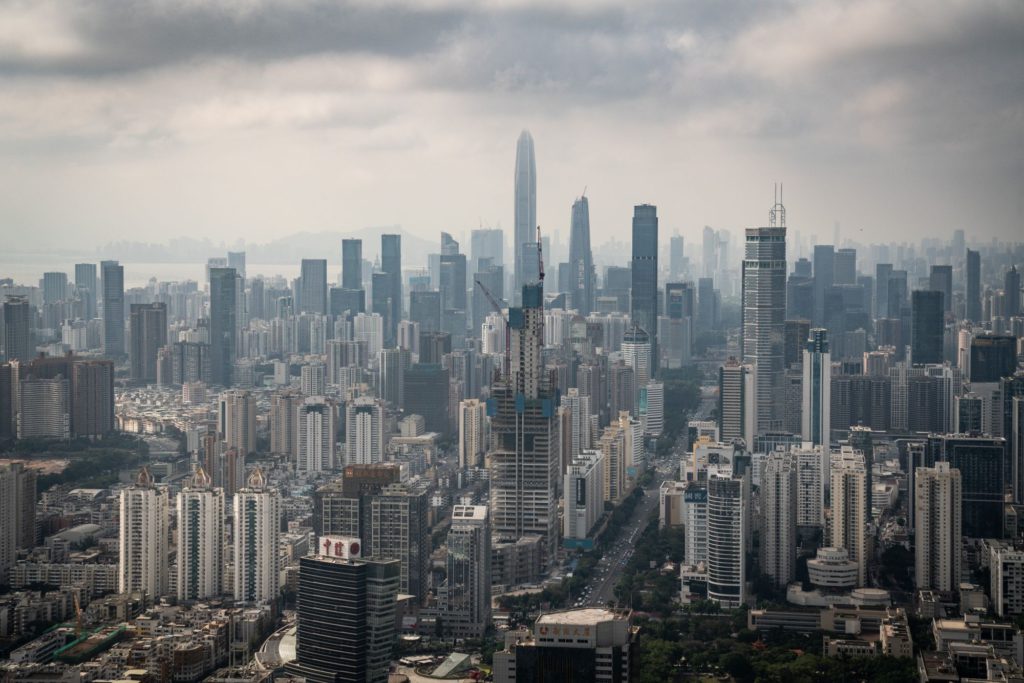
(Bloomberg) — With rising Covid cases, residents in China’s technology hub of Shenzhen are fearing a second city-wide lockdown, even as local authorities sought to quash such rumors fueled by restrictions imposed just hours earlier in another megacity to the west.

The anti-epidemic task force of the metropolis in the southern province of Guangdong said some online posts misconstrued district-level measures such as work-from-home as a lockdown, and asked the city’s almost 18 million people to remain calm and go about their daily lives. The agency said residents must continue to monitor official announcements on the latest Covid guidelines, according to a notice from the city administration. 

The anxiety in Shenzhen, which already experienced a seven-day complete lockdown in mid-March, underscores how China’s enduring Covid Zero policy is keeping the nation on edge even almost three years after the first coronavirus case emerged in Wuhan. Though new cases in the country are fewer than elsewhere in the world, Beijing has pressed ahead with its strict control measures that brought widespread misery to Shanghai during a grueling lockdown in April and May. On Thursday, about 21 million residents of Chengdu in Sichuan province went into a lockdown.   

Chengdu Fears Shanghai Repeat as Cities Fall to Xi’s Covid Zero

At least seven of 10 districts in Shenzhen have introduced control measures such as closing entertainment venues and restaurants. Wide swaths of Futian and Luohu districts, where cases have been found, have been locked down, with residents ordered to stay at home. Those in other districts have been told to avoid gatherings and stay home as much as possible.          

Situated on the mainland just across the border from Hong Kong, Shenzhen is home to some of China’s biggest companies including Huawei Technologies Co. and BYD Co., which are now accustomed to “closed loop” systems. The restrictions mean employees only move between work and home, physically cut off from people outside their factories or offices. Such a method has been used by businesses to avoid major disruptions. A Foxconn representative said in a statement Thursday that operations at the firm’s Shenzhen plant were normal.   

Panic in Ikea as China Locks Down Store on Remote Covid Risk

The risk of a second city-wide lockdown in Shenzhen is high because the city last introduced strict curbs after discovering 29 cases. The latest data show 87 new cases for Thursday, up from 62 the previous day, with most discovered in quarantine. Nationwide, there were 1,855 cases for Thursday, down from 1,903 the day before. China’s Covid infections have dropped from a peak of 3,400 in mid-August, but has spread to 25 out of 31 provinces and regions.  

Efforts similar to those in Shenzhen — seeking to allay concerns over an impending lockdown — also happened in Shanghai and Chengdu, only to be followed by a lockdown. A Chengdu man surnamed Yu published a post Aug. 29 saying that the city would go into lockdown, triggering panic-buying by residents. Officials said the post was false, and detained Yu for 15 days and fined him 1,000 yuan ($145). Two days later the speculation became reality. 

More stories like this are available on bloomberg.com

©2022 Bloomberg L.P.
Stocks Dip as Dollar Gauge Hovers Near Record High: Markets Wrap

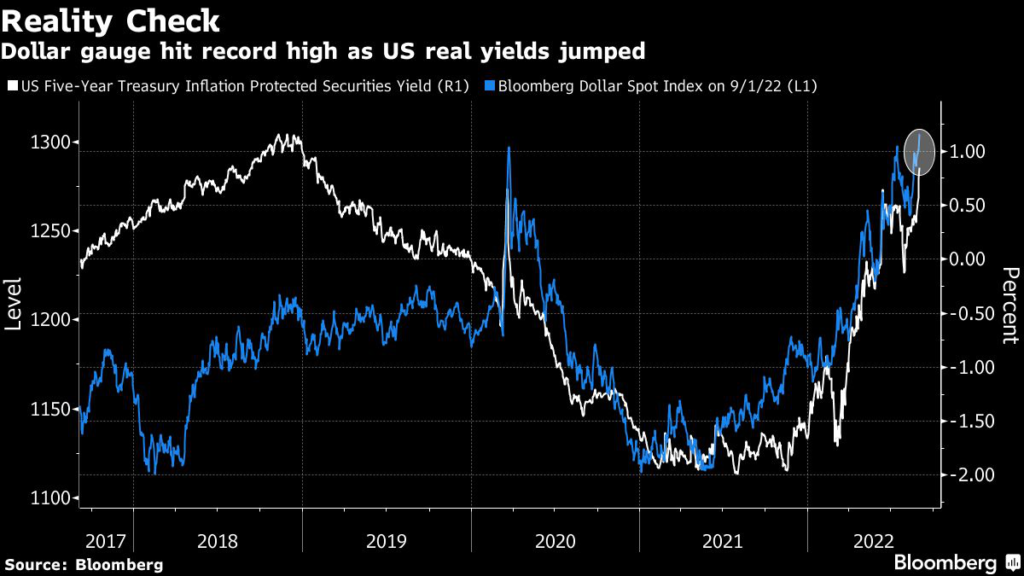
(Bloomberg) — An Asian stock index fell Friday and a dollar gauge hovered near a record high ahead of key US jobs data that could stir expectations for another sharp Federal Reserve interest-rate hike.

Drops in Japan and Hong Kong weighed on the region-wide equity index, while China’s bourses were mixed. US futures wavered after Wall Street snapped a four-day losing streak to eke out modest gains.

The jobs update Friday is expected to show healthy payrolls growth and follows a stronger-than-expected US manufacturing report. Traders increasingly anticipate another large 75 basis points Fed rate rise to cool inflation.

The two-year Treasury yield was close to the highest since 2007 against that backdrop, while the Bloomberg Dollar Spot Index inched back but remained in sight of the unprecedented level hit Thursday. The euro strengthened.

Global bonds as a whole slumped into their first bear market in a generation: the Bloomberg Global Aggregate Total Return Index of government and investment-grade corporate bonds is down more than 20% from a 2021 peak.

A gauge of world shares is set for its worst week since June, roiled by ebbing bets on tempered Fed tightening after US central bank officials made it clear that they see the need for restrictive monetary settings for some time. 

“We don’t have a lot of reasons to be bullish in this type of environment for the next couple of weeks and months,” Meera Pandit, global market strategist at JPMorgan Asset Management, said on Bloomberg Television. “Yet when we think about the longer term perspective and the longer term investor, these are the types of level that can be fruitful in the long run.”

US data showed manufacturing growth steadied in August and that a measure of materials costs fell for a fifth month in a sign of easing inflation pressures.

The payrolls report later Friday is projected to show a 298,000 gain and solid wage growth. Federal Reserve Bank of Atlanta President Raphael Bostic said there’s still some work to do to contain price pressures.

Elsewhere, oil bounced above $88 a barrel, undoing much of the losses sparked by China’s move to lock down the metropolis of Chengdu to curb Covid. The latter step had amplified worries about the commodity demand outlook.

Gold struggled to break above $1,700 an ounce, while Bitcoin held the $20,000 mark — the crypto version of the line in the sand.

Here are some key events to watch this week:

  • ECB Governing Council members due to speak at event Tuesday through Sept. 2
  • US nonfarm payrolls, Friday
  • UK leadership ballot closes Friday. Winner announced Sept. 5

Will Chinese sovereign bonds outperform Treasuries? China is the theme of this week’s MLIV Pulse survey. Click here to participate anonymously.

Some of the main moves in markets:

Stocks

  • S&P 500 futures fell 0.1% as of 12:32 p.m. in Tokyo. The S&P 500 rose 0.3%
  • Nasdaq 100 futures lost 0.1%. The Nasdaq 100 was little changed
  • Japan’s Topix index dropped 0.4%
  • Australia’s S&P/ASX 200 index was steady
  • South Korea’s Kospi index was little changed
  • China’s Shanghai Composite index rose 0.3%
  • Hong Kong’s Hang Seng index lost 0.6%
  • Euro Stoxx 50 futures rose 1%

Currencies

  • The Bloomberg Dollar Spot Index fell 0.1%
  • The euro was at $0.9959, up 0.1%
  • The Japanese yen was at 140.14 per dollar, up 0.1%
  • The offshore yuan was at 6.9082 per dollar, up 0.1%

Bonds

  • The yield on 10-year Treasuries was at 3.25%
  • Australia’s 10-year bond yield was at 3.67%

Commodities

  • West Texas Intermediate crude rose 2% to $88.31 a barrel
  • Gold was at $1,699.37 an ounce, up 0.1%

More stories like this are available on bloomberg.com

©2022 Bloomberg L.P.
Sea Cuts Jobs in Gaming Arm in Second Downsizing Wave

(Bloomberg) — Sea Ltd. is trimming staff in its money-making gaming arm to rein in costs. It’s the e-commerce giant’s second round of job cuts this year, following a string of setbacks that is forcing the company to shift its focus away from unbridled growth to profitability.

Southeast Asia’s largest tech firm is planning to reduce headcount in its most profitable division Garena and in new ventures at its research and development arm, according to people familiar with the matter. About 40 jobs will be cut from its game livestream app Booyah!, including in teams involved in product management and quality assurance, the people said, asking not to be named because the information is private.

The Singapore-based company is also shuttering several of its experimental ventures at its R&D unit Sea Labs, the people said. It will let go about a dozen employees working in areas such as public cloud and blockchain, one person said. The company has also rescinded job offers across tech roles at its e-commerce arm Shopee, the person said. 

“We continue to focus on the long term strength of our ecosystem. In line with this, we have made some changes to improve efficiency in our operations that impact a number of roles,” Sea said in an emailed statement. Reuters first reported the job cuts. Sea had 67,300 employees as of the end of 2021, double its headcount the year before, according to the company’s most recent annual report. 

The tech giant is now scaling back its overseas footprint and periphery businesses as rising competition and investor skepticism force the company to shift focus toward boosting profitability, rather than on expanding abroad. Sea in June made its first major job cuts at Shopee.

The company faces increasing pressure to cut costs, with growth in its main e-commerce business slowing after a pandemic-era high. Consumers are pulling back on spending online, as rising interest rates and prices weigh on the economy.

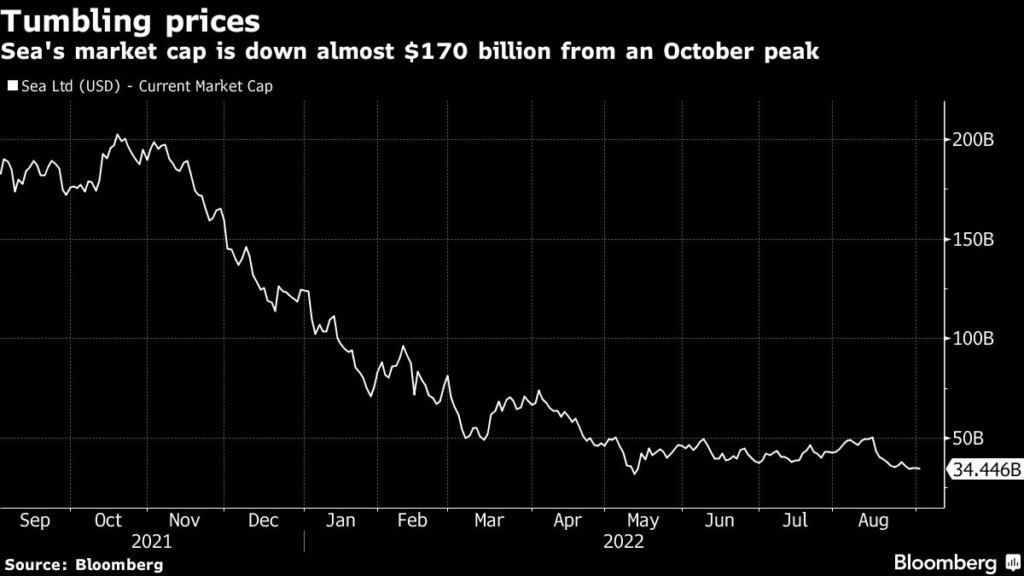
Sea has lost almost $170 billion of its market value since an October high on questions about its money-making prospects. The company said it expected Garena to post its first decline in bookings this year, and last month, it withdrew its 2022 e-commerce forecast.

Sea’s e-commerce rival Lazada Group has been stepping up its investments across Southeast Asia and seeks to build on momentum in the region to expand in Europe. This week, Lazada’s Chinese parent Alibaba Group Holding Ltd. said it invested $913 million in its Southeast Asian arm, taking the year’s capital influx to $1.3 billion. 

Read more: Sea’s Billionaire CEO Opens Up After 75% Stock Crash (1)

More stories like this are available on bloomberg.com

©2022 Bloomberg L.P.

Philippine Firm Converge Said to Weigh $1 Billion Unit Deal

(Bloomberg) — Converge ICT Solutions Inc. is considering selling a stake in its infrastructure platform, according to people familiar with the matter, a move that would help the Philippine fiber provider raise cash to invest across the group. 

Co-founded and led by entrepreneur Dennis Anthony Uy, Converge has been holding talks with prospective advisers as it weighs a deal that would bring a minority investor into its networks platform, the people said, asking not to be identified because the matter is private. A transaction could help raise about $1 billion depending on the final size and structure, and draw interest from other firms in the industry and investment funds, the people said.

Shares in Converge climbed as much as 4.3%, their largest increase in more than two weeks, valuing the company at about $2.3 billion.

The company offers fixed broadband services for residential, enterprise and wholesale customers, counting more than 560,000 kilometers of fiber assets and a network reaching more than 13.5 million homes in the Philippines as of the end of June, according to a recent press release. It also offers integrated data-center and network solutions. Private-equity firm Warburg Pincus held a minority stake in Converge until earlier this year.

Converge’s revenue growth may slow to 25%-30% in 2022 from 69.2% last year as consumers return to schools and offices, and as inflation damps demand, Chief Operations Officer Jesus Romero said in August.

Considerations are at a preliminary stage, no final decisions have been made and Converge could still decide against pursuing a deal, the people said. 

While management regularly reviews opportunities to maximize shareholder value, no decision has been made on any such transaction, Converge’s Investor Relations Director Owen Kieffer Ocampo said in response to a Bloomberg News query. 

Digital infrastructure assets in Southeast Asia are drawing increasing investor interest. Globe Telecom Inc. in the Philippines last month agreed to sell two portfolios of towers to a KKR & Co.-backed company and a Stonepeak joint venture for about $1.3 billion. In Malaysia, DigitalBridge Group Inc. and Equinix Inc. have been shortlisted into a final round of talks for the data center business of Time Dotcom Bhd., Bloomberg News has reported. 

(Updates with shares increase in third paragraph.)

More stories like this are available on bloomberg.com

©2022 Bloomberg L.P.
Lula’s Hope of First-Round Win Dims After Debate, DataFolha Says

(Bloomberg) — A fiery debate and a blitz of campaign advertising further dashed Luiz Inacio Lula da Silva’s hopes of winning Brazil’s presidential election outright on Oct. 2, a DataFolha poll shows.

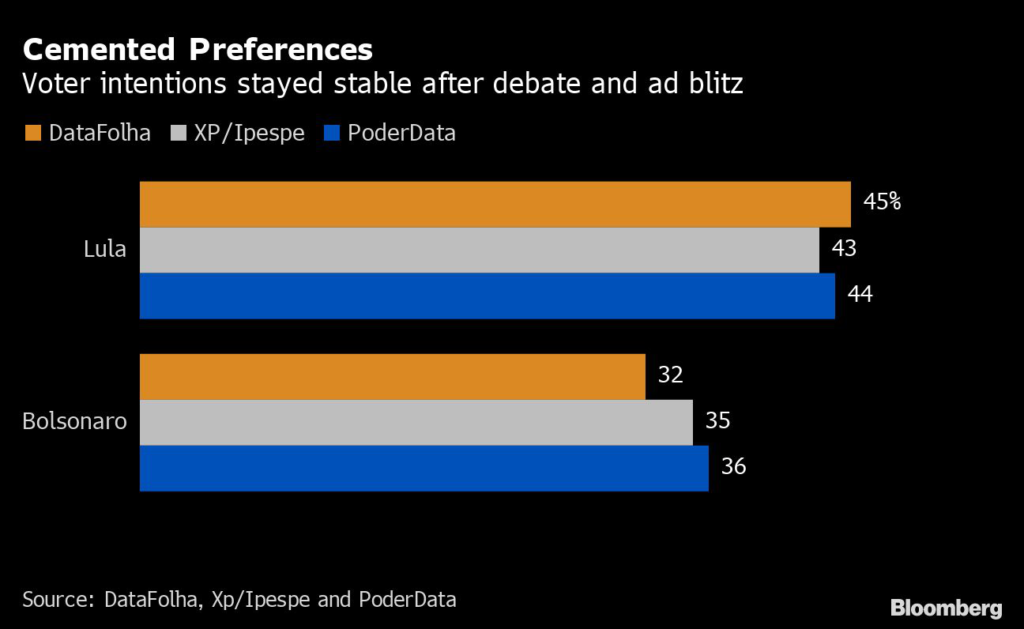
Maintaining a large lead, Lula, a two-term former president, would win 45% of the first-round vote, down from 47% in the last survey two weeks ago but the movement fell within the survey’s margin of error. Incumbent Jair Bolsonaro held steady at 32%.

The results from the highly anticipated poll, with data collected between Aug. 30 and Sept. 1, captures the nation’s reaction to the first televised presidential debate. It also reflects the effects of candidates’ TV and radio campaign spots, which started airing last week.

Moreover, it confirms how voter preferences are firming up before Brazilians head to the polls. Other major opinion surveys released earlier this week also showed no change in voter sentiment, though with Lula leading by a smaller margin.

A candidate needs to win over 50% of the vote, otherwise the two top contenders head to a runoff.

Millions of viewers tuned in to watch as the candidates clashed with one another on Sunday. For nearly three hours, they jousted over the state of the economy, lobbed corruption allegations and personal attacks back and forth. 

Lesser-known challengers seized the opportunity to take aim the front-runners: Bolsonaro, long accused of being a chauvinist, was pilloried for his treatment of women. Lula struggled to regain his footing after accusations that corruption raged at state-oil champion Petroleo Brasileiro SA during his time in office.

The stumbles appear to have increased the desire for an option besides the current and past president: Senator Simone Tebet now has 5% of voter intentions up from 2% previously. Ciro Gomes, a former governor, would take 9%. 

DataFolha interviewed 5,734 people across Brazil, with a margin of error of plus or minus 2 percentage points.

More stories like this are available on bloomberg.com

©2022 Bloomberg L.P.
Samsung Credit Risk Falls as Rating Raised to Government Level

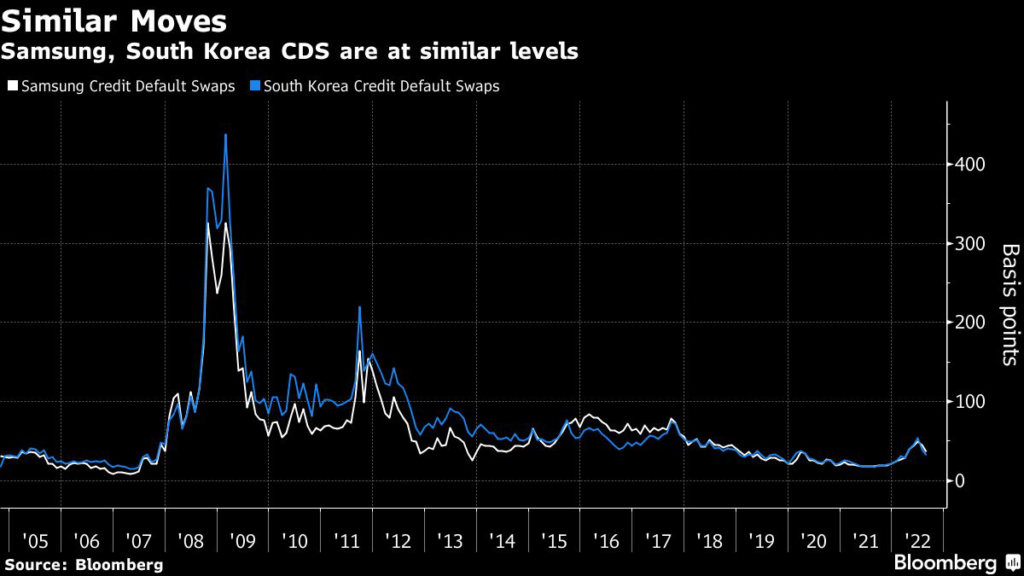
(Bloomberg) — Samsung Electronics Co.’s credit risk fell after Moody’s Investors Service lifted its rating to the same level as the South Korean government, citing the company’s profitability and strong finances.

The senior unsecured debt rating of Korea’s biggest company was raised to Aa2, the third highest level, from Aa3, Moody’s said Thursday. The cost to insure the technology giant’s debt against nonpayment with credit-default swaps fell to 36.1 basis points after the upgrade, near a four-month low, CMA data show.

Moody’s said it expects the Suwon-based company to maintain solid earnings over the foreseeable future and strong business and financial profile through business cycles. The ratings firm also pointed to Samsung’s “exceptionally healthy balance sheet.”


Samsung Electronics has a massive presence in Asia’s fourth-biggest economy, with its revenue equivalent to around 13.5% of Korea’s gross domestic product in 2021, according to Bloomberg calculations. 

It joins a small group of companies worldwide with the same credit score as the home sovereign. That includes Apple Inc. and Microsoft Corp., which have the top Moody’s rating, and Toyota Motor Corp., which has an A1 grade, the same as the Japanese government.  

Read more: How Samsung Patriarch Helped Build Korea’s Tech-Driven Economy

While the global memory chip industry will likely undergo a significant cyclical downturn over the next several quarters, Samsung will remain solidly profitable, according to Moody’s. The company had a net cash position of 108 trillion won ($80 billion) as of June 30, while the total amount of public bonds and loans outstanding was $430 million, according to data compiled by Bloomberg.

More stories like this are available on bloomberg.com

©2022 Bloomberg L.P.
South Korea Sees ‘Betrayal’ in Biden’s Electric Vehicle Push

(Bloomberg) — South Korea views new US rules that favor American-made electric vehicles and batteries as a “betrayal,” a senior official in Seoul said, an issue that threatens to complicate economic and security cooperation between the close allies.

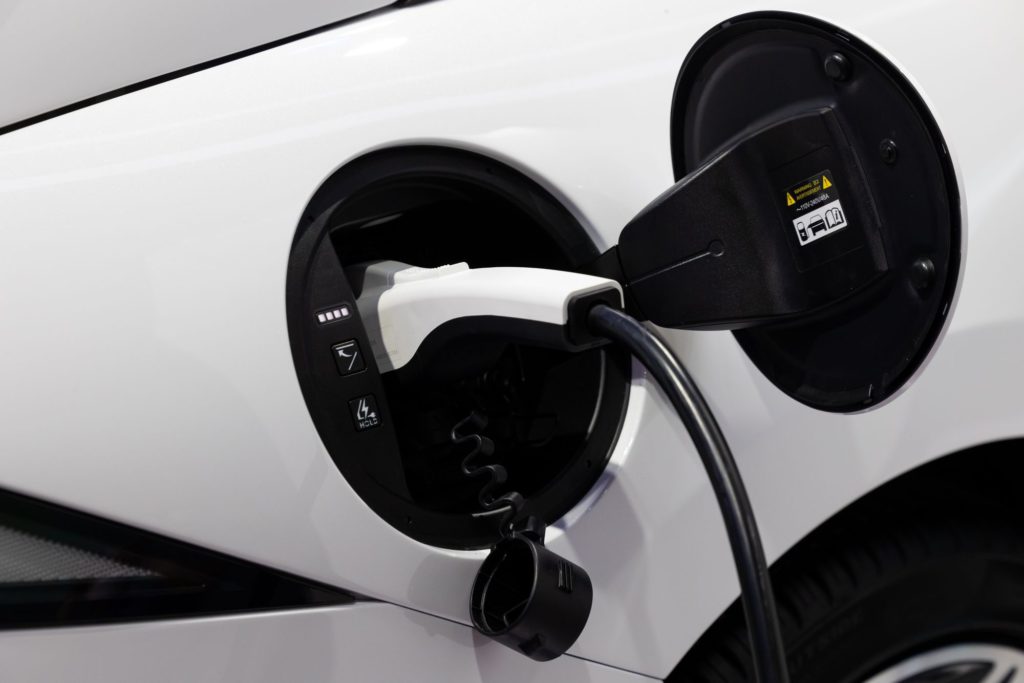
The dispute stems from provisions in the Inflation Reduction Act signed last month by President Joe Biden, which includes tax credits of as much as $7,500 for purchases of electric vehicles made in North America. That could disadvantage major South Korean brands like Hyundai and Kia, which don’t have operational EV plants in the US. 

South Korean President Yoon Suk Yeol’s government views the measure as unfair after a string of big US investment announcements by the country’s companies, said the official, who asked not to be identified discussing internal deliberations. While Seoul hasn’t decided to tie cooperation on the issue to other items on the US’s economic agenda, that couldn’t be ruled out, the official said. 

The friction risks Biden’s efforts to build a tighter network of partners to counter China’s rising influence, as South Korea is key in initiatives such as the Indo-Pacific Economic Framework and the so-called Chip 4 Alliance of major semiconductor manufacturing nations. It has clouded Yoon’s campaign promise to bolster ties with the US on economic issues, as well as security. 

The US legislation also created a rare bit of agreement in South Korea’s bitterly divided parliament this week, when it overwhelmingly passed a resolution expressing concern.

“South Korea may consider the IRA like being stabbed in the back,” said Cheon Seong-whun, a former security strategy secretary under former conservative President Park Geun-hye. “After putting in that much amount of investments, the South Korean administration, as well as its public, expected the same amount of economic benefits back from the US in the form of market accessibility.”

Yoon’s office said it is “working closely with Washington in different levels” for a “swift and smooth settlement.” It didn’t elaborate.

The US has agreed to talks with South Korea on the legislation, South Korea’s trade ministry said Thursday, and Yoon is expected to bring up the matter during a visit to the US later this month. South Korea’s chief trade negotiator, Ahn Duk-geun, will meet Trade Representative Katherine Tai early next week before attending the IPEF meetings scheduled to start Sept. 8 in Los Angeles.

“We take the Republic of Korea’s concerns seriously and stand ready for serious consultations,” Jose W. Fernandez, undersecretary of state for economic growth, energy and the environment, said in a statement. “We will have more details in the coming months as we begin the domestic rule-making process.” 

Yoon made a “deadly mistake” by not holding an in-person meeting with US House Speaker Nancy Pelosi when she visited South Korea last month, a second person familiar with the matter said. Such a meeting could have provided a crucial chance to seek changes ahead of the bill’s passage, the person said.

Yoon’s administration has remained non-committal about joining the Chip 4 Alliance, a new group of major powers that also includes the US, Taiwan and Japan and is aimed at safeguarding the supply of semiconductors. China’s opposition to the move could blow back on South Korea’s chip makers. 

The US law requires carmakers to assemble their EVs in North America to receive subsidies, but Hyundai doesn’t yet have any operational electric car plants there. Meanwhile, all three of South Korea’s main battery makers — LG Energy Solution Ltd., SK On Co. and Samsung SDI Co. — import most of their critical minerals from China.

The disadvantage would slow down Hyundai’s performance in the US, which has placed itself second in EV market share after Tesla in the US this year. South Korea invested a total of to $27.6 billion to the US last year. Hyundai is planning to spend $5.5 billion building EV and battery facilities in Georgia. 

More than 35,000 jobs are expected to be created in the US by 34 South Korean companies, mostly in the battery industry, according to US lobby group Reshoring Initiative.

South Korean Trade Minister Lee Chang-yang will also visit the US this month to lobby against the new measures, saying in August the legislation contains “details that would put a burden on our companies, raising concerns in South Korea, Germany and Japan, which are also exporting electric cars to the US.” 

Lee’s US visit will add pressure after South Korea sent a letter to Tai’s office expressing concerns that the Inflation Reduction Act may breach the US-Korea Free Trade Agreement and World Trade Organization rules.

Still, Representative Brendan Boyle, a Pennsylvania Democrat on the House Ways and Means Committee, expressed doubt that his trade-focused panel would take up the issue ahead of the midterms.  

“I care very deeply about a relationship with the Republic of Korea,” said Boyle, who toured a Hyundai plant last year during a visit to South Korea. “Do I see us wading in right before the election or right after given all the other things we need to do? I would be rather surprised.”

More stories like this are available on bloomberg.com

©2022 Bloomberg L.P.
Steel Price Hikes to Impact Japan’s Manufacturers as Costs Surge

(Bloomberg) — Japan’s biggest steelmaker — grappling with rising raw-material costs, a falling yen and waning demand — has warned the nation’s manufacturing giants face more price hikes this year.

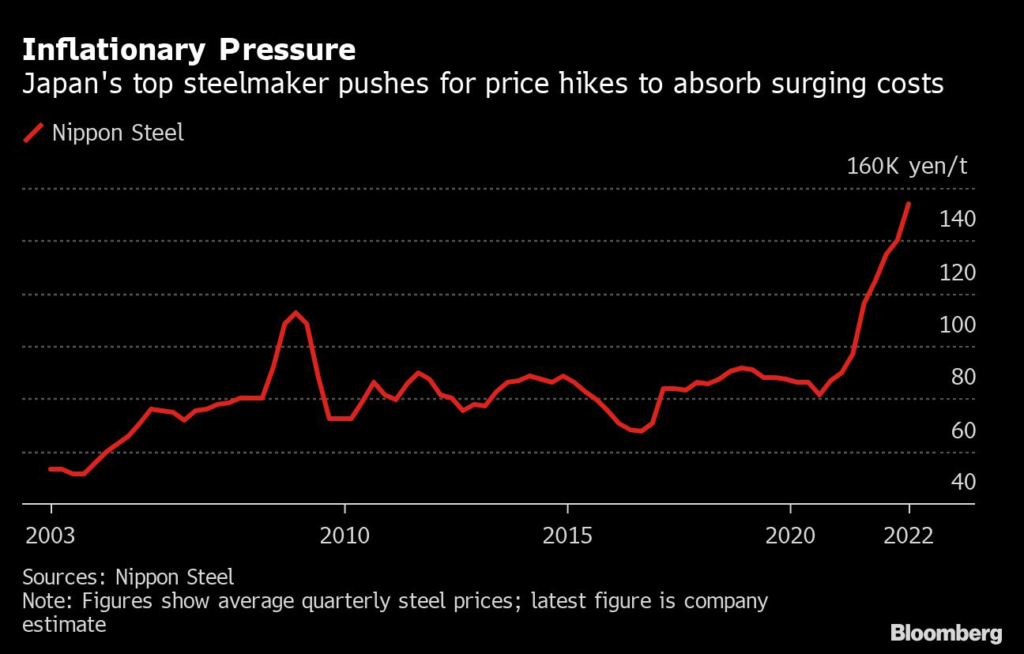
Nippon Steel Corp. is securing increases on contract prices through negotiations with domestic customers in the second half of the fiscal year through March, Executive Vice President Takahiro Mori said in an interview. The company will pass on the surge in costs, including for iron ore and coking coal, which have been exacerbated by a historic decline in the yen. 

The rise in raw material costs has been “quite different” from Nippon Steel’s assumptions made earlier this year, Mori said. The portion of the extra costs, which were shouldered by the company in the first six months of the fiscal year, “will be reflected in product prices from October,” he said. 

The price of iron ore, the major input cost for steel, jumped 32% in the three months through March but has now more than given up those gains amid weakness in China’s steel sector. The yen, meanwhile, has dropped by around 18% against the dollar this year.

Nippon Steel has already secured a big hike from customers that negotiate prices on a shorter-term basis. It won an increase of at least 40,000 yen ($286) a ton for the July-to-September period, according to Mori. 

Nippon Steel’s Customers

Steel is used in everything from cars and ships to skyscrapers, and soaring costs are a blow to Japanese manufacturers, who are also facing energy price hikes.

While Mori didn’t identify particular companies it’s in negotiations with, the industry closely monitors the twice-a-year price talks between Nippon Steel and Toyota Motor Corp. that typically serve as a benchmark. Mitsubishi Heavy Industries Ltd. to Sony Group Corp. and Hitachi Ltd. are among other customers.

Toyota Shares Drop After Sticking to Conservative Profit Outlook

Toyota will raise the price of steel it sells to parts suppliers by 40,000 yen a ton in the second half, an increase of 20% to 30% from the previous six months, Nikkei reported on Thursday without attribution. It buys steel in bulk and sells on to suppliers based on prices negotiated with Nippon Steel. The automaker said last month rising material prices will trim its profit by 1.7 trillion yen for the current fiscal year — more than it previously anticipated. 

A Toyota spokesperson declined to comment.

Japanese steelmakers’ continued push for hikes in their home market has created a gap with overseas prices, posing a risk their customers will switch to cheaper alternatives. Jefferies Japan Ltd. analyst Thanh Ha Pham last month noted in a report that Japanese steel prices were already “the highest on the planet.”

The latest round of price negotiations in Japan comes as the global market takes a hit from the slump in China, which makes more than half of the world’s steel. 

China’s benchmark hot-rolled coil futures have plunged more than a quarter since the end of March. They were trading 1.1% lower at 9:03 a.m. in Shanghai on Friday, while iron ore prices in Dalian were down 0.7%.

The Covid Zero policy has sapped demand and its measures to revive the economy aren’t yet bearing fruit. The listed unit of China Baowu Steel Group said on Tuesday said it’s facing “severe challenges” in the current quarter after its earning missed estimates in the first half of 2022.

Still, China’s downturn hasn’t curbed Nippon Steel’s appetite to secure better terms on deals from domestic users. The management is in the midst of reforms designed to boost earnings even under a “severe” trading environment. 

Mori said there has been no sign of rising steel imports into Japan, partly because of the weak yen. While the currency’s depreciation has amplified the costs of importing raw materials, it’s also made steel from overseas more expensive.

(Updates prices in 12th paragraph)

More stories like this are available on bloomberg.com

©2022 Bloomberg L.P.
China Stocks in US Can Buck Global Selloff if History Right

(Bloomberg) — Technical trends suggest the Nasdaq Golden Dragon China Index could yet deliver more gains after pushing higher last month even as global shares slid the most since June.

The 72-member index of US-listed China shares added 6.1% in August, a period during which the Federal Reserve’s vow of restrictive monetary policy saddled financial markets with some of the worst cross-asset performance since 1981. 

Bets on further stimulus to shore up China’s economy and progress on averting the delisting of Chinese firms from US exchanges over an auditing spat likely aided the jump. Another contributor was an earnings-inspired, 45% rally in e-commerce company Pinduoduo Inc. — which accounts for 10% of the index.

While Covid curbs, a property crisis and power shortages pose major risks to China’s outlook, here are some key historical and technical trends that point to staying power for the Nasdaq Golden Dragon China index’s rally.

History Lesson

Nasdaq Golden Dragon China’s August advance came as the gauge tries to recover from a long slump. A study of the past decade shows five other instances of a minimum 6% monthly jump coming off a bearish backdrop — the proxy used to represent the latter was a sub-50 relative-strength index, a measure of momentum. On average, the China gauge rose 4%, 5.2% and 27.6% over three, six and 12 months respectively after those five instances.

Pinduoduo

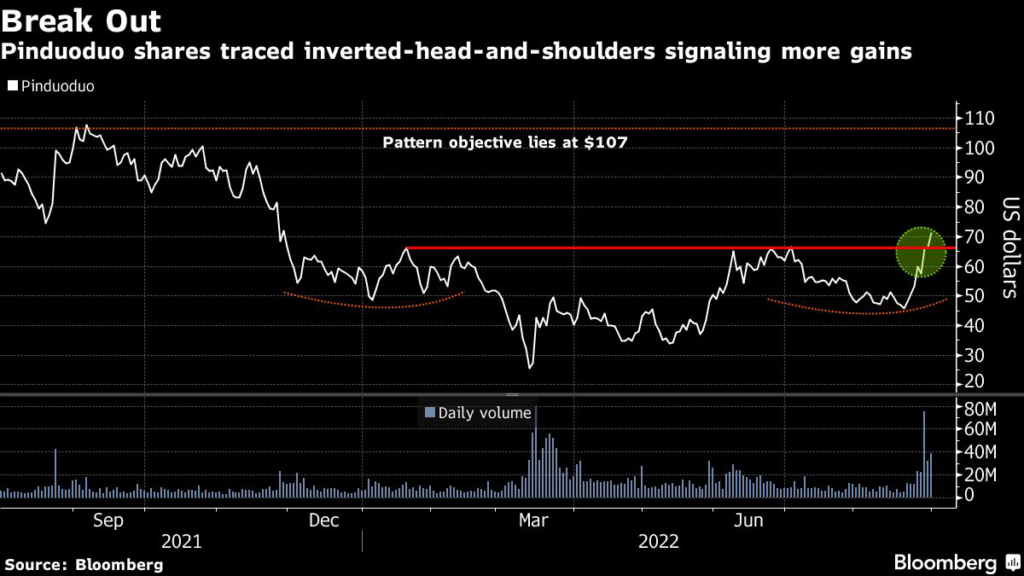
Pinduoduo’s shares have broken out of a so-called inverted-head-and-shoulders formation on high volumes. This technical study suggests a target for the shares of $107. Ellie Jiang, a Hong Kong-based Macquarie Group analyst, has lifted her price target to $104 — implying 46% upside potential. 

If these projections are near the mark, that would support the Nasdaq Golden Dragon China index given Pinduoduo’s weighting. The online retailer rose for a fourth straight day in New York on Thursday, while the wider gauge slipped. 

Support Level

Another technical study shows the index has held above a window around its 21-week moving average. The fact it found support there apes a pattern evident in a bullish period for the gauge that peaked in 2021. Hence, some chart analysts might view the trend as an optimistic sign.

This week’s MLIV Pulse survey focuses on China. It’s brief and anonymous, so please click here to share your views.

(Update with markets in the seventh paragraph.)

More stories like this are available on bloomberg.com

©2022 Bloomberg L.P.
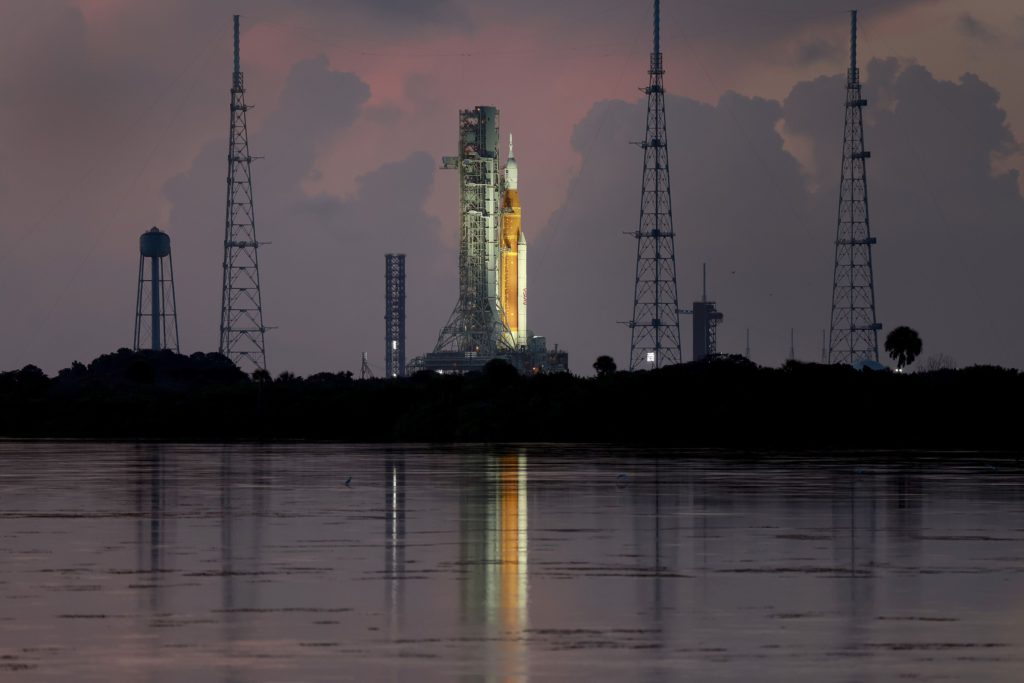
NASA Says It’s a ‘Go’ for Launch of Artemis Moon Rocket on Sept. 3

(Bloomberg) — NASA is proceeding with its schedule to launch the Artemis I moon rocket on Sept. 3 at 2:17 p.m. Florida time.

NASA originally tried to launch its Artemis I mission on Aug. 29, but called off the countdown due to a problem with one of the rocket’s four main engines, as well as other technical issues.

“We are again proceeding into our Saturday launch attempt — we’re comfortable with our risk posture,” Mission Manager Michael Sarafin said at a briefing Thursday in Florida. “That said there’s no guarantee that we’re going to get off on Saturday, but we’re going to try.”

The weather is expected to be favorable, with a 60% chance that conditions will permit the launch, officials said.

Earlier this week, NASA officials said that if the launch attempt this Saturday is called off for reasons unrelated to the rocket’s mechanics — such as weather or air traffic — they expected to be able to try again as soon as 48 hours later.

When NASA tried to chill down the engines in preparation for launch earlier this week, one didn’t appear to be reaching the correct temperature. NASA blamed the problem on a faulty sensor that might have been providing incorrect temperature data. The space agency planned to rework its engine chill process during the next launch attempt.

“The team did absolutely the right thing on the 29th and they knocked off the operation and they knocked off the test,” Sarafin said.

The Artemis I mission will be the first major flight in NASA’s ambitious plan to return to the moon, including sending the first woman and the first person of color to the lunar surface as early as 2025. Artemis I is aimed at testing out the Space Launch System core rocket, made by Boeing Co., and a new deep-space crew capsule called Orion that was developed by Lockheed Martin Corp.

When Artemis I does launch, SLS will be sending an uncrewed Orion on a multiweek mission, along with a host of payloads and sensors to track the journey.

The capsule will insert itself into lunar orbit and enter deep space before returning to Earth and splashing down in the Pacific Ocean off San Diego. NASA plans to stress test the systems ahead of later crewed missions.

(Updates with projected weather conditions in fifth paragraph.)

More stories like this are available on bloomberg.com

©2022 Bloomberg L.P.

Close Bitnami banner
Bitnami
