

Bloomberg

Taiwan Vows Not to Bow to Pressure With China Drills Due to End

(Bloomberg) — Taiwan reiterated it won’t succumb to pressure from China after days of military drills in the air and seas surrounding the island, with hostilities set to continue even as world leaders urge an end to the strife.

The People’s Liberation Army said it conducted exercises around Taiwan on Sunday, with drills focused on testing the capabilities of joint firepower on long-range air and ground strikes. China didn’t say if the military maneuvers — earlier reported to take place till midday Sunday — are over or if they will be extended.

Taiwan said the Chinese drills again simulated attacks on its main island as well as Taiwanese ships. China also deployed drones near Taiwan’s outlying islands, the Defense Ministry said, adding it responded by sending airplanes and ships and monitored the situation through surveillance and reconnaissance.

China has carried out its most provocative military drills in decades in the wake of House Speaker Nancy Pelosi’s trip to Taiwan last week. It has also likely fired missiles over the island of 23 million people, sent warships across the Taiwan Strait’s median line and waves of warplanes across the US-defined boundary. 

“China has brutally used military actions to disrupt regional peace and stability,” Taiwanese Premier Su Tseng-chang told reporters on Sunday. “We will never bow to pressure. We uphold freedom and democracy, and believe Taiwanese disapprove China’s bullying actions with force and saber-rattling at our door.”

Su said the Chinese government shouldn’t flex its military muscles.

“It is not only Taiwan that suffers,” he said. “Even neighboring countries have protested loudly, and freedom-loving and democratic countries such as the United States have strongly condemned it.”

Beijing has denounced the visit by Pelosi as a violation of the US pledge 50 years ago not to formally recognize the government of Taiwan, which China claims as its territory. It announced on Friday a set of measures including cutting off defense talks with the US, further deteriorating relations between the world’s biggest economies.

China is engaging in increasingly destabilizing action, US Secretary of State Antony Blinken told reporters on Saturday, saying he has communicated this to his Chinese counterpart Wang Yi. Blinken said tensions between the US and China need to be de-escalated and he told Wang that lines of communications between the two sides must be kept open.

“The differences between Taiwan and the mainland need to be resolved peacefully,” said Blinken. “Countries throughout the region and around the world are very concerned about that.”

Why Taiwan’s Status Risks Igniting a US-China Clash: QuickTake

Taiwanese President Tsai Ing-wen’s election in 2016 upended Beijing’s efforts to deepen economic and social ties with the island. Tsai, who hails from the pro-independence Democratic Progressive Party, rejects the “One China” framework and has sought greater US ties to reduce reliance on the mainland. 

Pelosi’s visit “demonstrated how the intensity of the conflict has been at that level for a good while now,” Philippine President Ferdinand Marcos Jr. said Saturday after meeting with Blinken. “We sort of got used to the idea.”

China’s military exercises have made ships think twice about heading into one of Taiwan’s most important ports, creating potential delays for shipments of electronic goods. Ship owners, worried about the possibility of missile strikes, are choosing to idle vessels and burn extra fuel until the drills pass.

The Taiwan Strait is a key route for supply chains, with almost half of the global container fleet passing through the waterway this year. While vessels are continuing to travel through the strait during the military exercises, they are navigating around the drill zones. The Taiwanese Maritime & Port Bureau on Thursday told ships to avoid designated areas around the island until Aug. 8 in waters to the east of the island.

“It is an issue that can lead to conflict and war to the detriment of all parties involved, especially the people in Taiwan,” Teo Chee Hean, Singapore’s coordinating minister for national security, said in a Facebook post. “These tensions also have a negative impact on us here in South East Asia. We hope that wisdom will prevail.”

While it’s unclear whether drills around the strait ended as planned, China said Saturday it will practice live weapon firing in the southern part of the Yellow Sea. The drills will last for ten days from Aug. 6-15, it said.

The Maritime Safety Administration also said on Saturday that military exercises will take place in the parts of the Bohai Sea for a month from Aug. 8, and warned ships to avoid entering the area. 

China’s New Flash Point With U.S. Allies Is a Hotspot for Spying

More stories like this are available on bloomberg.com

©2022 Bloomberg L.P.
Tax Bill Latest: Democrats Turn Back GOP Immigration Amendment

(Bloomberg) — The Senate has started voting on a lengthy series of amendments to the Democrats’ $437 billion climate, health and tax package leading up to expected passage of the legislation sometime this weekend.

In one of the quirks of Senate rules being employed by Democrats to pass the bill with a simple majority, Republicans have the chance to offer scores of amendments. Most are designed to force Democratic senators to take politically fraught positions on contentious issues such as immigration and taxes. 

In the 50-50 Senate, Republicans can force a change in the legislation with help from just one member of the Democratic caucus.

Democrats Turn Back Immigration Amendment (2:58 a.m.)

Democrats blocked an effort by Republicans to force a continuation of the Covid-era immigration policy known as Title 42 — which a number of Democrats have said they support — lest they risk the underlying bill. 

Hispanic Democrats have warned they could derail the package in the House if anti-immigration policies are added to it in the vote-a-rama, and Republicans have made clear they hope to add amendments that could bring down the bill.

The amendment by James Lankford of Oklahoma failed on a 50-50 vote.

Democratic Senator Jon Tester then offered a similar amendment, but one that didn’t comply with the budget rules, that needed 60 votes. It failed 56-44 but had the backing of Democrats Kyrsten Sinema and Mark Kelly of Arizona, Catherine Cortez Masto of Nevada, Raphael Warnock of Georgia, Maggie Hassan of New Hampshire and Tester. 

Georgia Senators Support Sanders’ Medicare Amendment (2:25 a.m.)

Those votes came after a series of other failed amendments, including one by Vermont independent Bernie Sanders to expand Medicare benefits for dental, vision and hearing. Sanders’ amendment, which would have been paid for with higher income tax rates on high-earning Americans, including a restoration of the 39.6% tax bracket, was defeated 97-3, with only Warnock and Jon Ossoff of Georgia joining him.

Most Democrats have adopted a strategy of voting against all amendments to protect the bill, though Democrats facing tough re-election fights, like Warnock, have on occasion broken from that strategy on amendments where their votes would not impact the outcome.

Republican Oil, SALT Amendment Blocked (12:50 a.m.)

The Senate blocked an amendment by Senator Lindsey Graham of South Carolina to nix a 16.4 cents per barrel oil import fee and extend a cap on the state and local tax deduction.

Graham said his amendment would prevent a rise in gas prices. Democrats argued it amounted to less than a penny a gallon to pay for toxic cleanup.

But his amendment, defeated on a 50-50 party-line vote, also had a tax increase. It would have extended the $10,000 cap on the state and local tax deduction set in the 2017 GOP tax law by another year to 2027. That cap is unpopular with voters in high-tax states like California, New York and New Jersey. 

Hassan instead proposed an amendment to nix the fees to pay for the Superfund program, but without the SALT tax increase to pay for it.

The Senate voted 55-45 to waive a budget point of order to allow the amendment, short of a 60-vote threshold. Three other Democrats who, like Hassan, face tough reelection fights in November joined her effort: Kelly, Cortez Masto and Warnock, as well as Sinema. 

Democrats Hang Together in Early Sanders Test (12:10 a.m.)

In the first vote of the night, the Senate easily blocked an amendment by Sanders, the Budget chairman, to tie the cost of Medicare prescription drugs to the prices paid by the VA.

Sanders said his amendment would cut drug prices in half and save $900 billion. But Graham, the ranking Republican on the Budget Committee, raised a budget point of order against it.

The Senate voted 99-1 against Sanders’ effort to waive the point of order, killing the amendment. Sixty votes would have been required.

The early vote showed Democrats are united in their strategy of voting down all amendments — even measures they would otherwise agree with — in order to preserve all 50 Democratic votes for the underlying bill.

Minimum Tax Includes Special Treatment for Telecom (10:48 p.m.)

The bill text, released Saturday evening, contains a special carveout in the corporate minimum tax for telecommunications companies that wasn’t included in previous versions of the bill.

The change makes the 15% minimum tax on financial profits less severe for telecom businesses, because they will be able to claim additional deductions when calculating the tax. The legislation also allows companies in all industries to claim tax breaks related to depreciating their equipment and facilities, a previously announced revision that Sinema requested in order to win her support.

Democrats Dare GOP to Strip Out Insulin Cap (10:06 p.m.)

Democrats included a $35 cap on insulin in the bill and are daring the GOP to strip it out.

The top Senate rules official has said the provision, authored by Warnock, is not eligible for the budget bill under Senate rules. But they kept it in the legislation.

Republicans can object to the provision and then Democrats will need 60 votes to waive the objection. Pennsylvania Republican Senator Pat Toomey said the GOP will likely object.

Manchin Ready to Reject GOP Amendments (7:00 p.m.)

During the marathon of amendment votes, it would only take one Democrat siding with all Republicans to change the bill. 

Senator John Thune said the GOP will try to add amendments intended to rile progressive Democrats and make the bill harder to pass the House.

West Virginia Senator Joe Manchin, a moderate Democrat who has sometimes angered his party’s left wing, indicated he wouldn’t go. “I’m protecting the integrity of the bill” he said.

Thune said, “If he sticks to that he is going to make some votes that he regrets.” 

Automakers Lost Fight Over Domestic Content (6:00 p.m.)

US automakers lost their fight to remove domestic content requirements from the vehicle tax proposal. 

Michigan Senators Gary Peters and Debbie Stabenow told reporters that the changes they had sought were not made. Companies will have to comply with tough new battery and critical minerals sourcing requirements that could render the credits useless for years for many manufactures, the senators have warned. 

Manchin insisted on the domestic supply chain requirements.

More stories like this are available on bloomberg.com

©2022 Bloomberg L.P.

China’s Crude Oil Imports Climb From Lowest Level in Four Years

(Bloomberg) — China’s imports of commodities in July offered some tentative signs of a demand recovery after the sharp slump earlier this year due to stringent Covid-19 restrictions and property woes.

Inbound shipments of crude rose from the lowest in four years to 37.33 million tons as travel and transportation activity improved, according to government data released Sunday. Year-to-date volumes are still 4% lower, however. Iron ore imports also crept higher despite headwinds in the steel industry. 

China is seeking to rebound from a stormy second quarter that saw consumer and manufacturing activity hammered by strict Covid curbs and a widening crisis in the property market. Factory activity unexpectedly shrank in July, but the government has pledged measures to shore up growth this year.

Crude inventories shrank in July after an “unusual build-up” ahead of summer because of the virus curbs, according to data analytics firm Kayrros. China is the world’s biggest importer of crude.

Inbound shipments of natural gas declined amid rocketing international prices, while purchases of copper also softened in the low season for demand. Coal imports rose and soybean volumes dropped.

More stories like this are available on bloomberg.com

©2022 Bloomberg L.P.
Robert Brockman, Software Developer Who Fought IRS, Dies

(Bloomberg) — Robert Brockman, who built a multibillion-dollar fortune as a software entrepreneur and investor before he was indicted in a landmark tax-evasion case, has died. He was 81.

Brockman, who was suffering from dementia and undergoing home hospice care, died late Friday, said Kathy Keneally, his attorney. He’d been fighting tax-evasion charges since 2020, but his attorneys said his dementia meant he wasn’t competent to stand trial. 

A judge ruled in May that Brockman was competent. At a hearing a month later, the judge tentatively set his trial date for Feb. 23, 2023. Brockman appeared in bed via video during that hearing. 

“The government wasted time and resources indicting a man who had progressive dementia and was terminally ill,” Keneally said. 

In his younger days, Brockman was known as an inexhaustible worker with a passion for physical fitness, fly fishing in Colorado and dove hunting in Argentina. Forbes estimated his net worth to be $4.7 billion.  

A Florida native of modest origins, Brockman was selling computing services to auto dealers on behalf of International Business Machines Corp. when, in 1970, he founded a company that helped revolutionize how the industry operates in North America and Europe. 

Brockman, a self-taught programmer, developed a software system that helped car dealers run virtually every aspect of their operations. He obtained more than a dozen patents, and grew his software company, Reynolds & Reynolds, into a 5,000-person operation worth some $5 billion.

Read more: The Sting That Snagged the Tax Lawyer to a Pair of Billionaires

As Brockman built his firm into an industry force, he also defended numerous lawsuits accusing him of bare-knuckled business practices. Salespeople accused his company of stiffing them on payments; auto dealers said he tricked them into expensive multiyear contracts. The Federal Trade Commission investigated whether he engaged in anti-competitive practices.

A former Marine reservist who surrounded himself with loyal lieutenants, Brockman had an intense desire for personal privacy that extended to his dealings with the Internal Revenue Service. 

“Brockman had one rule: Don’t do business with the government,” said Robert Tyson, an entrepreneur who won a lawsuit against Brockman for unpaid compensation for services rendered. “He didn’t want the feds looking at anything.”

In October 2020, the US charged Brockman in the largest tax-evasion case ever against an individual, as well as on money-laundering charges. 

Burner Phones

Brockman helped launch the private equity career of Robert F. Smith, America’s wealthiest Black citizen, by providing the initial investment in his firm, Vista Equity Partners. Prosecutors alleged Brockman used a web of offshore entities, code names and burner phones to hide $2 billion in income from the IRS, most of it earned through Vista investments. 

Smith admitted committing tax crimes but avoided prosecution by cooperating with prosecutors against Brockman.

The case against Brockman hinged on whether billions of dollars in an offshore charitable trust were secretly controlled by him, as prosecutors alleged, or were independently managed, as he claimed. Prosecutors said he used untaxed proceeds from offshore entities to buy a Colorado fishing lodge, a private jet and a 200-foot yacht, which his lawyers denied.

“I have not seen this pattern of greed or concealment and cover-up in my 25-plus years as a special agent,” James Lee, an IRS official, said when the charges were filed.

Brockman pleaded not guilty, but his lawyers soon began arguing that dementia left him unable to assist in his defense.

Robert Theron Brockman was born in St. Petersburg, Florida, on May 28, 1941. His father, Alfred Eugene Brockman, owned a gas station. His mother, Pearl, was a physiotherapist. With the family struggling financially, Brockman “decided he didn’t love that and went out to make something of himself,” his younger brother, David, told the Wall Street Journal in 2021.

Seeding Vista

After graduating summa cum laude from the University of Florida in 1963, Brockman worked as a marketing trainee at Ford Motor Co. before moving to IBM, where he became a top salesman in Washington and Houston. In 1970, he set up his own firm, Universal Computer Systems, and began providing auto dealerships with weekly inventory reports, Auto News reported.

As Brockman built his company, he met Smith, then a rising Goldman Sachs technology investment banker. Brockman later seeded Smith’s firm, Vista, with at least $1 billion in funds to buy out enterprise software firms. The arrangement was structured to keep profits offshore, prosecutors say.

In 2006, Brockman brought his software and investing interests together to engineer the acquisition that thrust UCS into the big leagues. Brockman’s closely held firm bought Reynolds & Reynolds, a public company nearly twice its size. Part of the equity financing came from Vista’s original fund, in which Brockman was the sole outside investor.   

The combined firm took the Reynolds & Reynolds name and was controlled by a Bermudian charitable trust set up in the name of Brockman’s father. As Brockman’s wealth grew, so did the trust’s offshore assets. 

In addition to the $5 billion worth of software company holdings, they included $1.3 billion in investments made through an entity based in the British Virgin Islands and $1.4 billion in a Swiss bank, his wife, Dorothy, said in an affidavit filed in a Bermudian court.

Support for Opera

The Bermudian trust and the Brockmans also became active philanthropists. Their gifts included tens of millions of dollars to the Baylor College of Medicine, where Brockman was a trustee, and the Brockman Hall for Opera at Rice University in Houston. They also supported dozens of students with scholarships. 

However, in 2018 US tax authorities raided Brockman’s attorneys in Houston and Bermuda. They uncovered a cache of encrypted documents and messages that prosecutors used in building their criminal case against Brockman. 

Last year, the IRS assessed Brockman for $1.4 billion, related to taxes it said he owed from 2004 to 2018. In January, he sued the US to halt the agency’s immediate assessment of that levy. Days later, he filed a separate lawsuit in Tax Court. While his criminal case will end, the IRS battle against his estate could last years.

“Whether Bob Brockman in fact owed more taxes, which we dispute, can await a decision by the Tax Court,” Keneally said. 

He is survived by his brother David; his wife of 53 years, Dorothy; a son, Robert Brockman II; a daughter-in-law; a grandson; and a granddaughter.   

(Updates with details of IRS litigation)

More stories like this are available on bloomberg.com

©2022 Bloomberg L.P.
Tax Bill Latest: Telecom Gets Special Treatment in Minimum Tax

(Bloomberg) — The Senate is preparing to vote on a lengthy series of amendments to the Democrats’ $437 billion climate, health and tax package leading up to expected passage of the legislation sometime this weekend.

In one of the quirks of Senate rules being employed by Democrats to pass the bill with a simple majority, Republicans have the chance to offer scores of amendments. Most are designed to force Democratic senators to take politically fraught positions on contentious issues such as immigration and taxes. 

In the 50-50 Senate, Republicans can force a change in the legislation with help from just one member of the Democratic caucus.

Minimum Tax Includes Special Treatment for Telecom (10:48 p.m.)

The bill text, released Saturday evening, contains a special carveout in the corporate minimum tax for telecommunications companies that wasn’t included in previous versions of the bill.

The change makes the 15% minimum tax on financial profits less severe for telecom businesses, because they will be able to claim additional deductions when calculating the tax. The legislation also allows companies in all industries to claim tax breaks related to depreciating their equipment and facilities, a previously announced revision that Senator Kyrsten Sinema requested in order to win her support.

Democrats Dare GOP to Strip Out Insulin Cap (10:06 p.m.)

Democrats included a $35 cap on insulin in the bill and are daring the GOP to strip it out.

The top Senate rules official has said the provision, authored by Georgia Senator Raphael Warnock, is not eligible for the budget bill under Senate rules. But they kept it in the legislation.

Republicans can object to the provision and then Democrats will need 60 votes to waive the objection. Pennsylvania Republican Senator Pat Toomey said the GOP will likely object.

Manchin Ready to Reject GOP Amendments (7:00 p.m.)

During the marathon of amendment votes, it would only take one Democrat siding with all Republicans to change the bill. 

Senator John Thune said the GOP will try to add amendments intended to rile progressive Democrats and make the bill harder to pass the House.

West Virginia Senator Joe Manchin, a moderate Democrat who has sometimes angered his party’s left wing, indicated he wouldn’t go. “I’m protecting the integrity of the bill” he said.

Thune said, “If he sticks to that he is going to make some votes that he regrets.” 

Automakers Lost Fight Over Domestic Content (6:00 p.m.)

US automakers lost their fight to remove domestic content requirements from the vehicle tax proposal. 

Michigan Senators Gary Peters and Debbie Stabenow told reporters that the changes they had sought were not made. Companies will have to comply with tough new battery and critical minerals sourcing requirements that could render the credits useless for years for many manufactures, the senators have warned. 

Manchin insisted on the domestic supply chain requirements.

More stories like this are available on bloomberg.com

©2022 Bloomberg L.P.
Telus’s Senko Sees Rogers-Shaw Deal Lessening Competition

(Bloomberg) — The head of Telus Corp.’s mobile phone unit said the sale of Shaw Communications Inc. to Rogers Communications Inc. may curb competition in key markets, including Western Canada.

Speaking in an interview Friday after Canada’s No. 3 telecom company reported its largest ever second-quarter increase in customers, Telus’s Jim Senko said the proposed sale of Shaw’s mobile assets to Quebecor Inc., a smaller regional player based out of Montreal, will probably mean a weaker competitive landscape.

Quebecor’s Videotron mobile unit “doesn’t truly understand the Western markets and would have to wholesale there any kind of wireline services at very thin margins, and will not be able to compete as well as Shaw who owns those assets,” Senko said by telephone.

Rogers has agreed to buy Shaw in a C$20 billion ($15.4 billion) deal that still requires regulatory approval. Including debt, the transaction is worth about C$26 billion.

The merger is also facing a legal challenge from the country’s competition watchdog, which has cited worries about higher prices, poorer service quality and fewer choices.

Read more: Rogers Takeover of Shaw Meets Skepticism; Deal Spread Widens

Quebecor agreed to buy Shaw’s Freedom Mobile wireless service for C$2.85 billion — giving it an opening to expand outside of its core Quebec market. With the sale, Shaw and Rogers are hoping to temper worries related to competition issues.

“I think Shaw was a very strong competitor,” Senko said. “They had the bundling in the West and they executed well in the Greater Toronto Area with Freedom Mobile.”

Quebecor Chief Executive Pierre Karl Peladeau said on an analyst call Thursday he finds the antitrust agency’s concerns “incomprehensible” given the need for more competition in the sector. Citing federal data, Peladeau claims Quebec is one of the most competitive regions in Canada, with wireless service costs less than in other provinces. 

“We must act and we must act now,” he said.

‘Unique Bundles’

Vancouver-based Telus reported operating revenues of C$4.4 billion for the three-month period ended June 30, up 7.1% on a year-over-year basis. The C$0.32 adjusted earnings per share, a 23% boost from 2021, beat Bloomberg’s consensus estimate by C$0.03.

Telus reported that it added 247,000 customers in the second quarter, including 93,000 in net mobile phone additions.

“We have a very diversified product portfolio that we can put together in very unique bundles,” Senko said. The mobile phone, internet and television provider also offers home security solutions. All services can be bundled in a single purchase.

Since the onset of the pandemic, the company has added 800,000 mobile phone net additions, and over 600,000 in wireline.

Telus’ shares were little changed in Toronto trading Friday, closing at C$28.92. The shares have declined 2.9% this year, outperforming rivals Rogers and BCE Inc.

(Updates with relative share price performance in last paragraph. An earlier version corrected the spelling of a company name in the headline.)

More stories like this are available on bloomberg.com

©2022 Bloomberg L.P.
China IPO Market Trounces the World With Record $58 Billion Boom

(Bloomberg) — From London to Hong Kong, large initial share sales have all but dried up across the world’s major financial centers this year. But the market in China is bustling with activity.

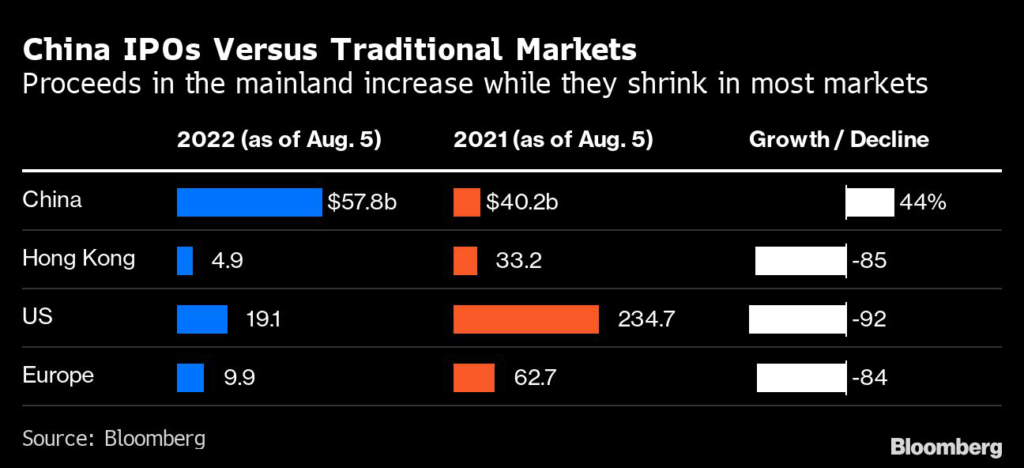
Initial public offerings on mainland exchanges have climbed to $57.8 billion so far in 2022, the largest ever for such a period, according to data compiled by Bloomberg. There have been five IPOs of above $1 billion since January, and one more is on the way. That’s versus just one such sale each in New York and Hong Kong, and none in London. 

China’s IPO market has defied headwinds such as rising interest rates and fears of a US recession, which have brought major equity fundraising elsewhere to a virtual standstill. Offerings in the Asian economy — whose monetary policy is diverging from the Federal Reserve — are largely geared toward local investors.

The surge in listings, according to some market watchers, is also driven by concern that economic conditions could worsen later in the year as flareups in virus cases cause Beijing to stick to the strict Covid Zero strategy. Top leaders have signaled a softening on this year’s official growth target of around 5.5%, denting optimism about a rebound.

“Companies have a stronger willingness for IPO because they see the first half as a better time window to get listed than the time ahead,” said Shen Meng, a director at investment bank Chanson & Co. “They have a weaker outlook for the market and worry that factors including earnings uncertainty could make listing in the future harder than now.”

Secondary Market

With companies rushing to list, China’s share in global IPO proceeds has more than tripled to 44% this year from 13% at end-2021, according to data compiled by Bloomberg.

Better performance of newly traded stocks has also been a draw for listing hopefuls. Shares of mainland IPOs are up by an average 43% this year over their listing price, versus the 13% drop seen in Hong Kong.

Meanwhile, China’s benchmark CSI 300 Index has fallen about 16% since Dec. 31 — one of the worst performers among major global equity gauges — as investors have had to grapple with stringent Covid curbs, a deepening real-estate crisis and a continued crackdown on internet giants.

READ: Taiwan Risk Joins Long List of Reasons to Shun China Stocks

To be sure, new share sales owe part of their strong performance to the fact that valuation during the IPO is capped by local rules. That typically ends up leaving some gains on the table for the newcomers — flops happen, but they’re rare.

Some of the deals that boosted the tally in China have political undertones. Telecom provider China Mobile Ltd. and energy producer CNOOC Ltd., the biggest debuts of 2022, both listed at home after being kicked out of the US following their inclusion on a Donald Trump-era blacklist. In China, they raised $8.6 billion and $5 billion, respectively, and are trading well above their listing prices.

READ: China-US Deal Needed Soon to Avoid Delistings, Gensler Says (3)    

“China is a separate market from the rest of the world. Something that is unique among Chinese investors are those patriotic trades,” said Ke Yan, the head of research at DZT Research in Singapore. “Buying stocks that help China to be more independent from rest of the world and to resist transactions from the US is normal.”

Tech Love

Overall though, the tech sector has been one of the busiest for new share sales in China.

Demand for computer component manufacturer Hygon Information Technology Co.’s 10.8 billion yuan ($1.6 billion) IPO exceeded the amount on offer by 2,000 times. Order-taking began on Aug. 3, just as US House Speaker Nancy Pelosi’s visit to Taiwan rattled global markets.

A semiconductors maker, a manufacturer of digital storage products and a chips producer surged after debuting in the mainland on Friday. Together, their IPOs raised $1.1 billion.  

A lot of the stocks now coming to market in China “are from the tech sector, that investors seem eager to buy given the focus on building up home-grown capabilities,” said Brian Freitas, an analyst for independent research platform Smartkarma in Auckland.

READ: US Sanctions Help China Supercharge Its Chipmaking Industry

More stories like this are available on bloomberg.com

©2022 Bloomberg L.P.

Senate Votes to Open Debate on Democrats’ Tax, Energy, Drug Bill

(Bloomberg) — The Senate voted to open debate on a landmark tax, climate change and drug-price bill during a rare Saturday session that is expected to continue late into the night. 

The $437 billion, 755-page bill, a slimmed down version of President Joe Biden’s multitrillion-dollar domestic agenda, is on track for passage after a year of wrangling with two holdout Democrats, Senators Joe Manchin and Kyrsten Sinema, over the contents of the package. 

“This is one of the most consequential and impactful bills Congress has seen in decades,” Senate Majority Leader Chuck Schumer said as the debate and a marathon slog through scores of proposed amendments got underway. 

The vote was 51-50 with Vice President Kamala Harris breaking the tie. Vermont Democratic Senator Patrick Leahy arrived via wheelchair to cast the vote, after being absent for weeks due to hip surgery.

Senate Democrats Release Final Tax-Climate Bill Text: Document

The legislation would allow Medicare to negotiate drug prices for the first time, starting with 10 high-priced drugs by the middle of this decade and expanding from there. It would cap out of pocket drug costs for seniors enrolled in Part D at $2,000 per year and their spending on insulin at $35 per month. Savings from these lower drug prices is used to pay for three years of subsidized Obamacare premiums. Without an extension, discounted premiums made available during the Covid-19 pandemic are set to expire in January. 

The bill would also provide roughly $374 billion in climate and energy spending, including on expanded tax credits for the purchase of electric vehicles and to fund renewable energy projects. Funding for this comes from the establishment of a 15% corporate minimum tax on large firms, a 1% excise tax on the value of stock buybacks and revenue gained from an $80 billion boost to the Internal Revenue Service budget for tax enforcement. 

Manchin, of West Virginia, agreed to the outline of the deal last month in a surprise deal he negotiated in secret with Senate Majority Leader Chuck Schumer and after he secured funding for coal-related projects, requirements that public lands be opened to fossil fuel projects when opened for renewable projects, and a promise to pass a separate bill easing environmental reviews of energy projects. 

Arizona Senator Sinema endorsed it this week after a proposal to narrow a the carried interest loophole was dropped and an exception to the minimum corporate tax was made for accelerated depreciation tax deductions used by many manufacturers.  She also helped win a $4 billion boost to the Bureau of Reclamation to address a severe drought in the Colorado River basin. 

Democrats are using a fast-track budget process to bypass Republicans, who are united in opposition to the bill and who say its tax increases and spending could worsen inflation and a looming recession. 

“Hundreds of billions of dollars in tax hikes during a recession will kill jobs,” Senate GOP leader Mitch McConnell said Saturday on the Senate floor. “The American people don’t want hundreds of billions of dollars in Green New Deal waste.”

Democrats responded with their own studies which show small inflation decreases over time due to the bill. 

The fast-track process was activated when Democrats last August adopted a fiscal 2022 budget resolution with the goal of quickly enacting a $3.5 trillion measure with major changes to the social safety net and increased taxes on corporations and the wealthy. 

Months of negotiations with Manchin collapsed in December when he walked away from a $2 trillion version of Biden’s agenda which would have provided paid family leave, expanded child tax credits, expanded Medicaid coverage, childcare subsidies and Medicare hearing coverage. 

The budget process comes with certain procedural quirks, including giving Republicans the chance to offer unlimited amendments in what’s known as a vote-a-rama. The GOP has promised to make the process of passing the bill this weekend “hell,” and Democrats expect to stay in session overnight to tire out the opposition and discourage further amendment votes. 

Democrats said they are hoping that Republicans will not use all 10 hours of debate they are entitled to on Saturday and refrain from other procedural delays. GOP tactics will determine whether final vote occurs late Saturday, on Sunday, or later. Sunday is seen as the most likely. 

Passage of the bill would be a major victory for Biden, even though he played a more limited role in the final talks than he did last year when trying to secure passage of a much larger version of the bill. 

It would also be a coup for Schumer after the Biden agenda appeared entirely stalled by party infighting this spring. Schumer cited a series of recent legislative victories, including passage of a new gun law, veterans health benefits and a bill boosting US semiconductor manufacturing. 

More stories like this are available on bloomberg.com

©2022 Bloomberg L.P.
Tom Alberg, Early Amazon Investor and Board Member, Dies at 82

(Bloomberg) — Tom Alberg, co-founder of the venture capital firm Madrona Venture Group and an early investor in Amazon.com Inc., has died. He was 82.

Alberg died Friday, according to a statement released by Madrona.  

In the mid-1990s, Alberg helped Amazon founder Jeff Bezos raise money for the fledgling e-commerce company. Part of Alberg’s role was to explain the promise of the infant internet to potential backers. It took 12 months, but the fund raised $1 million from 22 people, including Alberg and Bezos’s parents, who typically invested $50,000 apiece for a 1% stake.

“It’s very risky,” Alberg said at the time. “But Jeff is for real. He’s obviously a smart guy. He’s very passionate about it.”

Bezos launched his company in July 1994 and opened the amazon.com website in July 1995 to sell books. In the first few weeks, Amazon made $6,000 to $10,000 in sales, and by the end of September was making $20,000 each week, Alberg said in a 1999 Wired magazine interview.

“It was clear there was a trend there,” he concluded.

To say the least. Amazon went on to become the world’s largest online retailer, selling everything from socks to mattresses (and, yes, books), and Bezos became, for a time, the world’s richest man.

When Amazon went public in 1997, Alberg’s name was the only one of those 22 initial investors mentioned in the S-1 filing. He owned 195,000 shares at the time, a stake he reduced over the years.

Alberg served on the Amazon board for more than two decades, before stepping down in 2019 to make way for new blood. At the time, Bezos tweeted: “I’ll miss his sound judgment, deep well of business & life experience, and his quick wit. He’s a smart business person and even better human.”

Bezos on Saturday issued a statement calling Alberg a friend and a “visionary.” Other tech industry titans including Microsoft Corp. Chief Executive Officer Satya Nadella and Amazon CEO Andy Jassy also paid tribute to Alberg.

Amazon was Alberg’s defining investor moment. But through Madrona, which he co-founded in 1995, Alberg helped advise and take public a range of startups. Most were based in and around Seattle, where he grew up.

One was Impinj Inc., whose wireless technology helps companies identify, locate and authenticate billions of everyday items from apparel and golf balls to luggage. Under Alberg, Madrona also profited from an early investment in storage provider Isilon Systems Inc., acquired by EMC Corp. for $2.25 billion in 2010.

In 2009, President Barack Obama tapped Alberg’s industry expertise and named him to the National Advisory Council on Innovation and Entrepreneurship.

Tom Austin Alberg was born on Feb. 12, 1940, in San Francisco to Thomas Alberg and Miriam Twitchell Alberg. He earned a bachelor’s degree in international affairs from Harvard University in 1962 and then a law degree from Columbia University.

After graduating, Alberg joined the New York law firm of Cravath Swaine & Moore as an associate before switching in 1967 to Perkins Coie, a large Seattle firm. He made partner there in 1971 and was principal counsel for Boeing Co., Alaska Airlines and a number of early technology companies.

Before starting Madrona, Alberg helped sell LIN Broadcasting and McCaw to AT&T and was executive vice president of AT&T Wireless from 1990 to 1995.

He wed twice. In 1963, he married Mary Ann Johnke. They had three children: Robert, Katherine and John. Alberg divorced Mary Ann in 1989 and wed Judith Beck. They had two children: Carson and Jessica. Alberg was survived by Judi, his five children and four grandchildren, Madrona said. 

On the side, Alberg taught himself winemaking, working with award-winning vintner Mike Januik to build Novelty Hill Januik Winery in Woodinville, Washington. He was also an avid sailor.

Summing up his career on the Madrona bio page, Alberg said: “The most difficult part of my job? Measuring my enthusiasm for every idea I hear. There are a lot of exciting ideas out there.”

More stories like this are available on bloomberg.com

©2022 Bloomberg L.P.

Cyber Attack Hits NHS 111 Emergency Line in UK: Telegraph

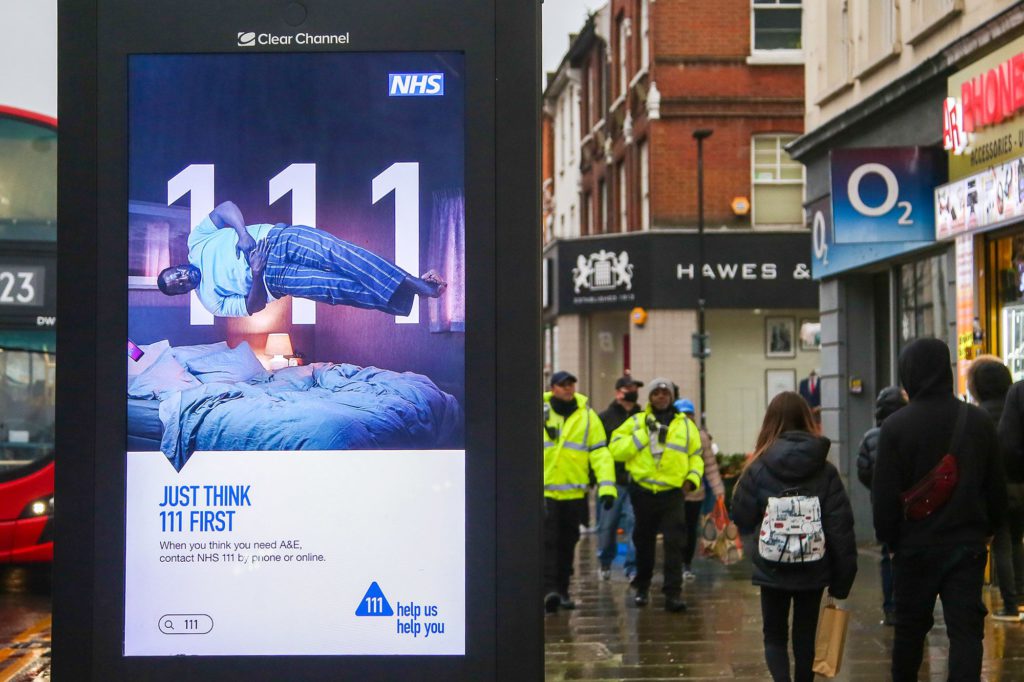
(Bloomberg) — A major cyber attack is delaying response times on the NHS 111 telephone service in the UK that’s used for medical emergencies, the Telegraph reported.

The target of the breach was Advanced, which is owned by private equity companies. It supplies software for about 85% of the hotline’s services, according to the paper. The hackers were part of an organized criminal ground, according to an updated version of the report.

The company’s Adastra system allows call handlers to dispatch ambulances, book urgent appointments or fulfil emergency prescriptions. 

Cases in need of an ambulance are being prioritized, the paper cited a source from the National Health Service as saying. The systems could remain offline until Aug. 9.

Simon Short, chief operating officer of Advanced, said a security issue was identified on Aug. 4 and as a precaution the health and care systems were immediately isolated. The company’s services also extend to care homes and a patient record management system. 

Advanced is owned by Vista Equity Partners and BC Partners.


(Adds in second paragraph that criminal group was probably responsible.)

More stories like this are available on bloomberg.com

©2022 Bloomberg L.P.

Close Bitnami banner
Bitnami